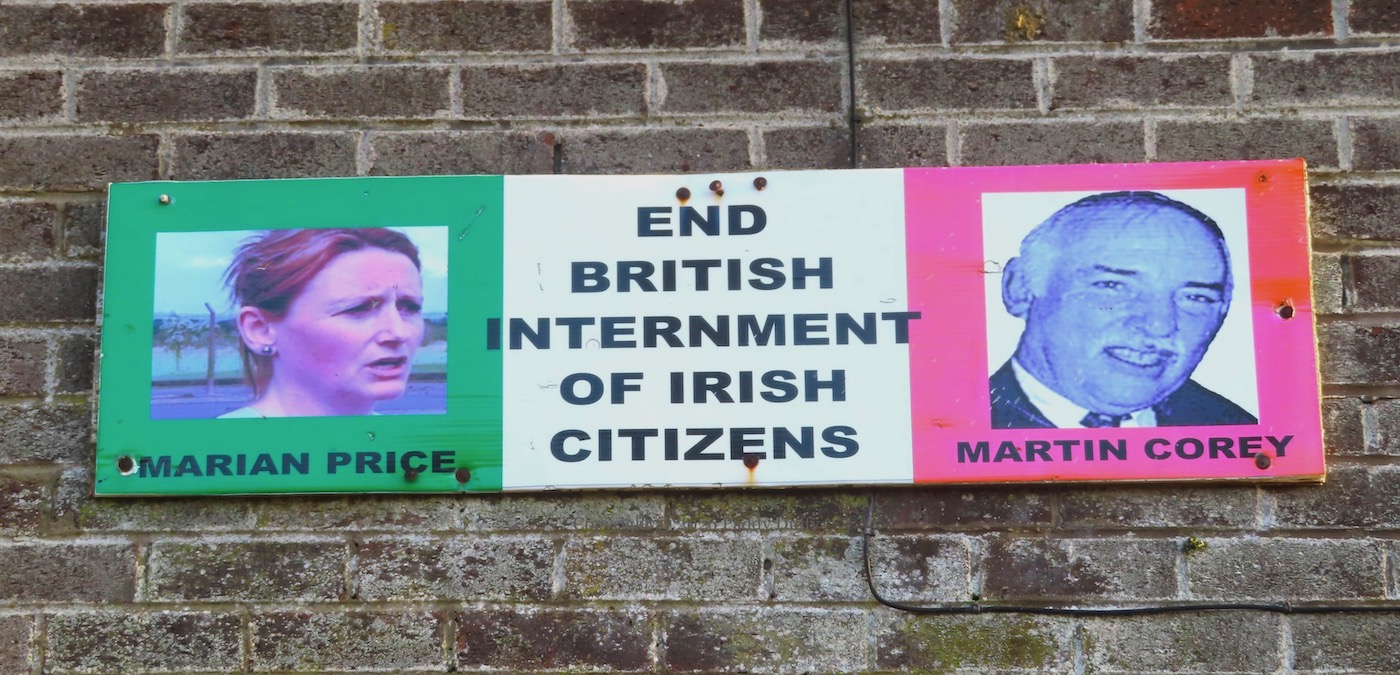
This board with portraits of Marian Price and Martin Corey goes back to 2013 (and perhaps earlier than that). It remains on display in the Obins Street area of Portadown, even though Price was released in 2013 and Corey in January 2014.
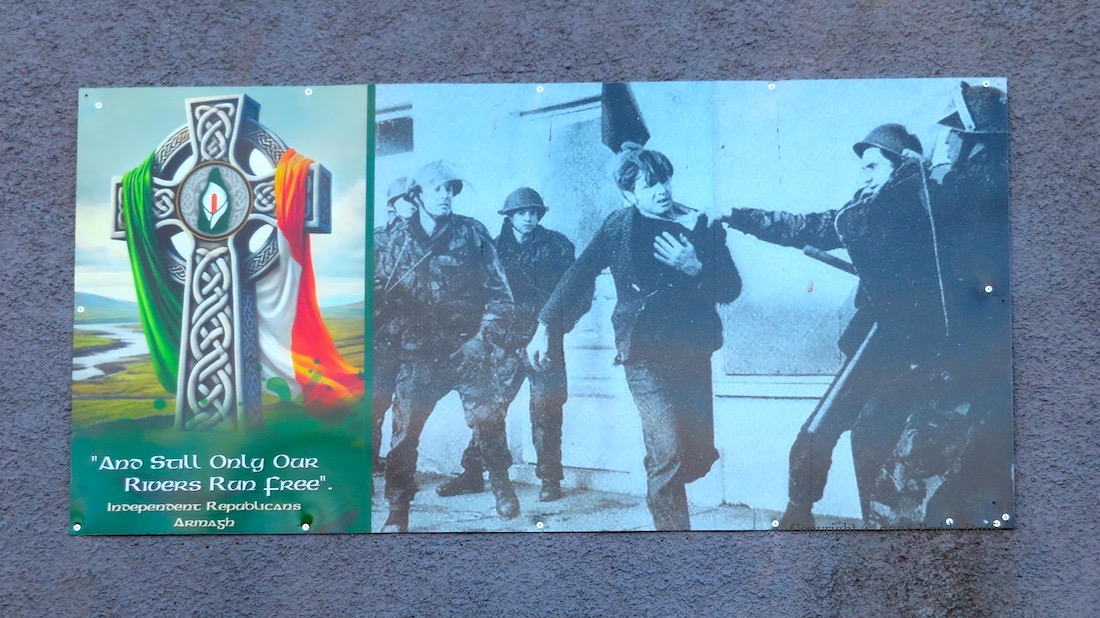
The photograph on the right is real: it shows British troops collaring a civilian in Coalisland in December 1971 – photographer unknown. The image on the left – a Celtic cross draped with a Tricolour – is AI slop. The first (or at least, an early and prominent) use of AI to produce images was Stop The Slaughter In Gaza from November 2023, and it is becoming more frequent in printed boards and wall-painting.
“”And still only our rivers run free” [youtube] – Independent Republicans Armagh [Fb]”
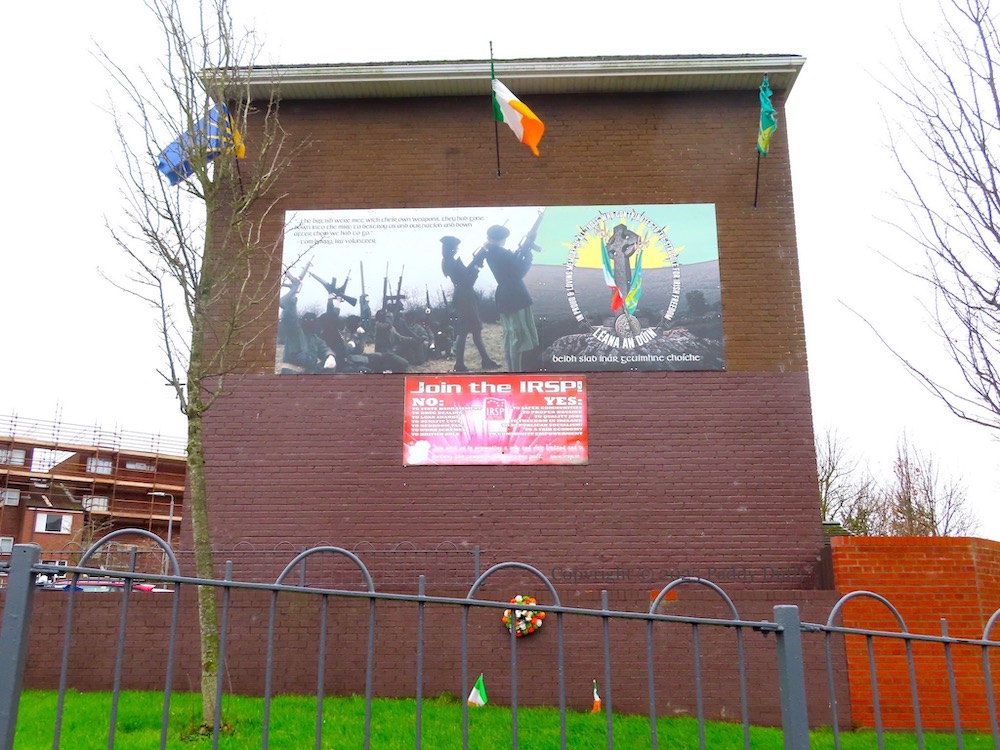
“[They said I was ruthless, daring, savage, blood thirsty, even heartless. The clergy called me and my comrades murderers; but] The British were met with their own weapons. They had gone down into the mire to destroy us and our nation and down after them we had to go. – Tom Barry, IRA volunteer.”
Tom Barry served in the British Army as a teenager and saw action in Mesopotamia and Egypt. The military training served him well when he joined the IRA and soon became commander of the West Cork brigade’s flying column. The quotation above offer a justification for the guerrilla tactics which helped drive the British to the negotiating table. In the Civil War, Barry was on the anti-Treaty side. (WP)
“In proud and loving memory of all those who contributed to the struggle for Irish freedom. Léana An Dúın. Beıdh sıad ınár gcuımhne choíche.”
The red board below is an old (2019) IRSP board, reading, “Join the IRSP. No to state harassment, to drug dealing, to loan sharks, to benefit cuts, to bedroom tax, to work schemes, to British rule. Yes to safer communities, to proper housing, to quality jobs, to freedom in Ireland, to republican socialism!, to a fair economy, to community empowerment. Join with us in promoting a new and fair Ireland and in building the campaign for a border poll. www.irsp.ie“
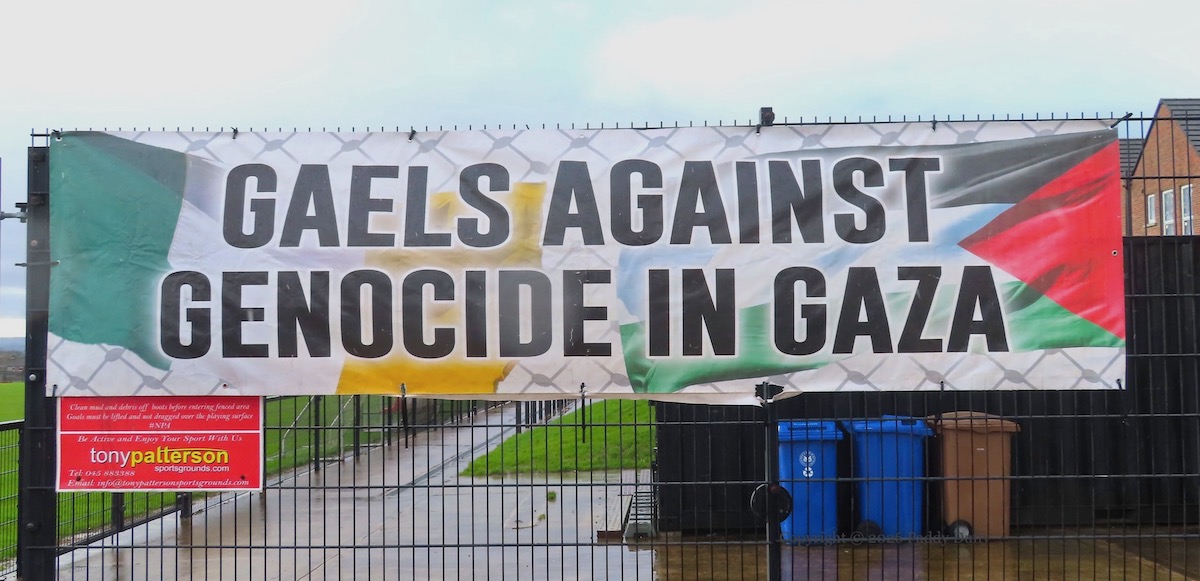
There was a march in Belfast (in early September) which went to the offices or stores of some of these businesses (Independent) because they fund or support the Israeli military – the links above outline the connections. There are also campaigns from various groups (here is IPSC’s) to boycott consumer goods from Israeli producers.
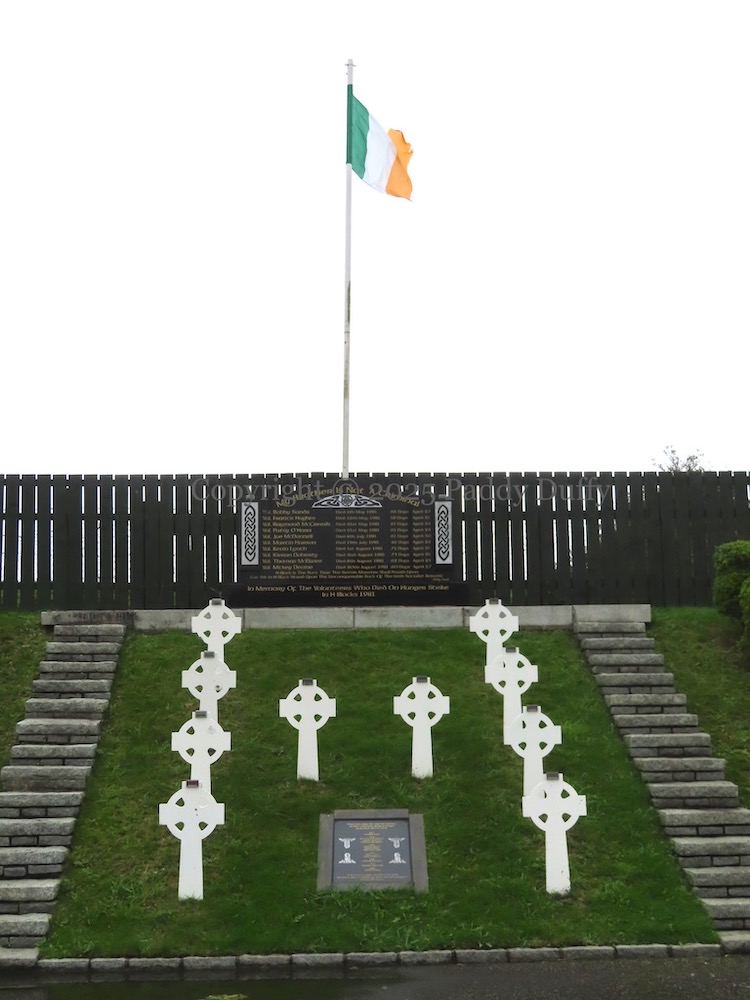
The brothers in question are Raymond and Brian McCreesh, from Camlough, Co Armagh. Raymond is third in the list of the ten deceased 1981 hunger strikers on the large stone at the top of the slope: “In memory of the volunteers who died on hunger strike in H-Blocks 1981.” The quote along the bottom reads, “H-Block is rock that the British monster shall perish upon for we in H-Block stand upon the unconquerable rock of the Irish socialist republic – Bobby Sands”; the source of the quote in unknown.
The lower stone reads “These men made the supreme sacrifice for their country by dying on hunger strike from 1917 to 1976: 1917 Thomas Ashe; 1920 Michael Fitzgerald, Joseph Murphy, Terence McSwiney; 1923 Joseph Whitty, Denis Barry, Andy Sullivan; 1940 Tony Darcy, Sean McNeela; 1946 Sean McCaughey; 1974 Michael Gaughan; 1976 Frank Stagg. “It is not those who can inflict the most but those that can suffer the most who will conquer” – Terence McSwiney.”
The final image is a call from “Independent Republicans Armagh [Fb]” to commemorate Dessie Grew and Martin McCaughey, who were riddled with bullets fired by the SAS as they moved weapons near Moy, Co Tyrone, in 1990 (RN | youtube).
“We must take no steps backward, our steps must [or: will] be onward, for if we don’t, the [ghosts of the] martyrs that died for you, for me, for this country will haunt us forever [or: for eternity].” The words of Máıre Drumm (from an anti-internment rally in Dunville Park on 10th August, 1975 – RN p. 4) appear below a roll of honour for the IRA’s South Armagh Brigade. The list of volunteers is included below; in 1976 Drumm herself was shot dead in her bed by the RHC in the Mater hospital where she was a patient (WP) – she was Vice President of Sınn Féın at the time.
Michael McVerry, Sean Boyle, Francis Jordan, Gerry McKiernan, James Lochrie, Sean Campbell, Peter Cleary, Seamus Harvey, Liam Farrelly, Peadar McElvanna, Kevin Caherty, Raymond McCrees, Brendan Moley, Brendan Burns, Fergal Caraher, Packie Duffy, Eugene Martin, Tim Daly, Malachy Watters, Gary Toner, Keith Rogers, Francie Caraher, Gerald Fearon, Pat Lynch
Twelve more of the martyrs – the Troubles-era hunger-strikes – are on the stone across the street (for a close-up, see the Peter Moloney Collection).
The Linsfort Drive (Creggan) memorial garden (see M02663 and M02775) is featured in the centre of this board of IRA volunteers from the 2nd battalion of the Derry Brigade. There are two similarly designed boards to the 1st battalion in Westland Street and in Lecky Road.
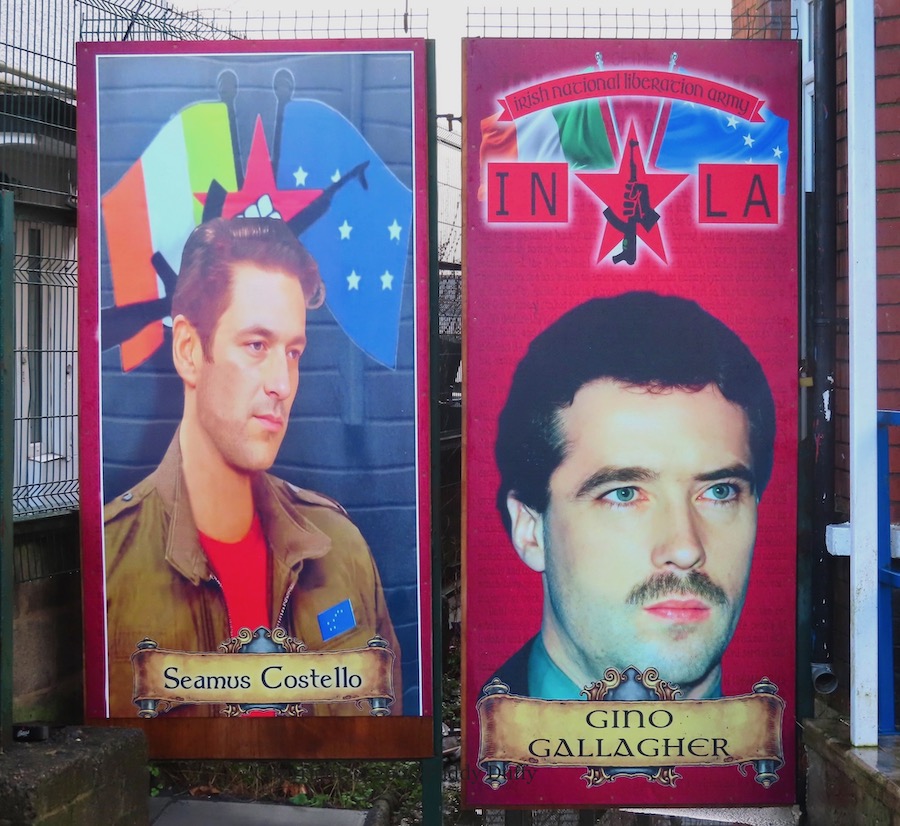
Here are IRSP (web) and RNU (Fb) signs side-by-side in Bishop Street, Derry, both employing the idea of ’empowerment’. Above: “Empower your community – Join the IRSP, the party of Connolly and Costello”; below: “RNU for the community – support, empower & prosper”.
“Óglach Kevin Hannaway, Irish Republican Army, hooded man. Unbowed & unbroken. Ar dheıs Dé go raıbh a anam.”
Kevin Hannaway died in January (2025), aged 77. In 1971 he was interned (Belfast Media) and subjected, along with thirteen others, to the “five techniques” – deprivation of food/drink and of sleep, subjection to noise, prolonged stress positions, and hooding (WP) – as well as being beaten and dropped out of a helicopter (Irish Times). The ‘five techniques’ were found to constitute torture in 2021 (RTÉ) and the PSNI apologised to the victims in 2023 (BBC | Irish Legal News).
Hannaway remained a republican throughout his life and was anti-Agreement in recent years (BBC). The board in Hannaway’s honour was launched on Sunday July 13th (Fb video). The panels of the board were siezed by the PSNI during a drug raid on a home in St James’s on the 11th but returned the next day (BelTel).
“IRPWA [web]. Republican prisoners still exist! Unfinished revolution. Unbowed, unbroken.”
Hugo Street, west Belfast. For a close-up of the Pearse Jordan plaque on the left, see the Peter Moloney Collection.
“On the 9th of July 1972, during the IRA ceasefire, local families began moving into their new homes in Lenadoon but were obstructed by British Occupation Forces who opened fire with rubber bullets and, using a “Sixer” Saracen Armoured Personnel Carrier, rammed a McQuillan’s Quarry lorry carrying furniture and belongings as rioting took place across the district. Seamus Twomey, then the IRA Belfast Brigade OC, ended the ceasefire, ordering local IRA units to engage British Forces. Raging gun battles overwhelmed the British for several days, as the IRA liberated most of Lenadoon.”
The captions to the photographs along the top read (l-r): “British Forces fire projectiles at families moving into their new homes”, “A “Sixer” rams a McQuillan lorry, forcing it off the road”, “Seamus Twomey, IRA Belfast Brigade OC, ordered local units to engage the British”, “An IRA Volunteer takes up position in a nearby street”, “An armed IRA volunteer in Lenadoon in the 1970s, Carrigart flats”, “Local families evacuate Lenadoon as thousands march to Casement Park”, “Local homes bare [bear] the scars of war”.
For background, see this 24 minute Thames TV report (on youtube) about the dispute over houses in Lenadoon; RTÉ also has footage (one | two) of the evacuation.
“In proud & loving memory of all those who contributed to the struggle for Irish freedom – Léana An Dúın – Beıdh sıad ınár gcuımhne choíche”
Lenadoon Avenue, west Belfast, replacing the 1995 Gorta Mór mural. Launched Sunday July 12th.