The image above is of William III landing at Brixham in Devon, England, but the central panel (immediately below) and the fake “blue plaque” celebrate the 1690 landing of William at Carrickfergus. The postcard reproduced in the central panel, as well as an old Londonderry mural which also reproduced it, can be seen in the Peter Moloney collection. For details of the landing, and William’s subsequent travels to Whitehouse, Belfast, Lisburn, and the Boyne, see June 14th, 1690.
On this day 334 years ago (in the Julian calendar, which would be June 24th in the Gregorian), King William III landed at Carrickfergus and began his journey, via Belfast and Lisburn, to the Boyne river (outside Drogheda) where he successfully led his forces against those of James II.
After landing in Carrick, William rode by horse to Whitehouse, half-way to Belfast, where he met his commander-in-chief, the Duke Of Schomberg, who had been in Ireland since the previous August and laid siege to, and taken, the Jacobite garrison in Carrickfergus, making William’s landing there possible (WP).
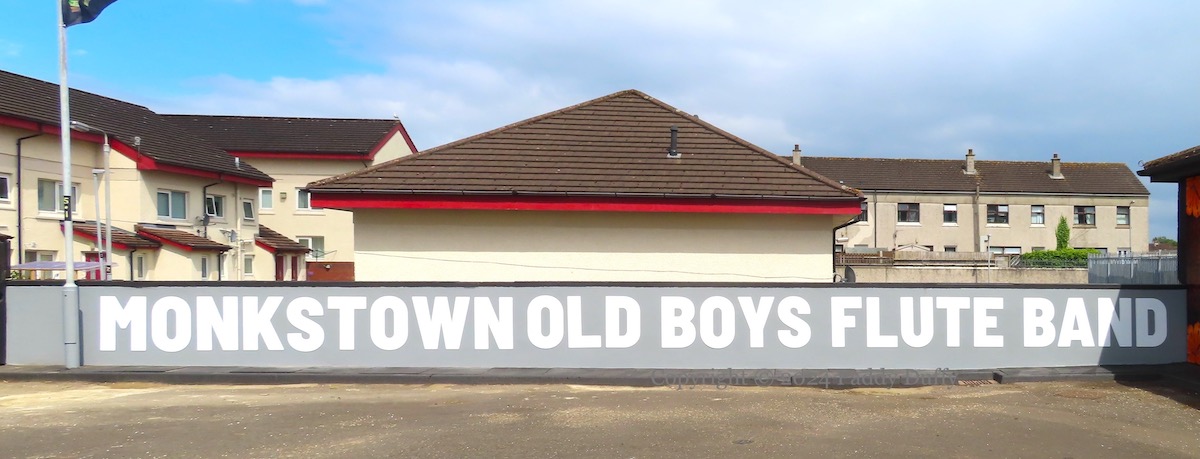
This new large board at Monkstown Old Boys (Fb) celebrates William’s landing and journey to Whitehouse, which is the point closest to Monkstown.
The image reproduced in the centre of the board (see below; a crisper version can be found at Orange Heritage) shows William meeting Schomberg at the eponymous White House, where Glas Na mBradán (the Salmons’ Stream) made a small port. Dalaradia has a 3-D flyover of what the White House and surrounding area might have looked like at the time. The remains of the White House have been restored and now house an interpretive centre (Bangor Historical Society | Causeway Coastal Route).
[The following text appears to be an excerpted and slightly modified version of a page at Orange Heritage.]
“King William was in Ulster from Saturday, June 14th, 1690 until Thursday, June 26th, only 12 days, yet he left behind a legend full of proud memories. For his part he liked what he saw. “This country is worth fighting for,” he said.
“His departure from London had been held up by parliamentary business till the end of May, when he announced that he could wait no longer and adjourned Parliament.
“Early in the morning of June 4 he set out, but on June 11th he embarked on board the yacht “Mary” with a fleet escorted by Sir Cloudesley Shovell’s squadron. On June 14th the hills of Ireland came in sight and in the afternoon the fleet cast anchor off Carrickfergus. He was rowed ashore in the Rear Admiral’s barge and at about 3.30 p.m. landed at the Old Quay under the shadow of the great Norman Castle.
[The 1973 painting of the Quaker greeting William is by Thomas Everard Spence and held by Carrickfergus Council – see Art UK. The Union Flag on the right lacks the St Patrick’s Cross – this would not be added until after the 1801 Act Of Union.]
The Garrison of the Castle had drawn up a Guard of Honour and the townspeople added their applause. The chosen spokesman was a Quaker, whose principles forebade [sic] him to doff his hat, or use such titles as Sir and Majesty. He got over the difficulty by taking off his hat and laying it on a stone and then stepping forward and saying “William, thou art welcome to thy Kingdom” which pleased the King so much that he replied: “you are the best bred gentleman I have met since I came to England.”
“With these words he mounted his horse and set off for Belfast. Half-way along the shore was the little port of Whitehouse, where most of the army disembarked. The Commander-in-Chief, the Duke of Schomberg, and his senior commanders were waiting here to welcome the King. To cover the disembarkation, earthworks has [sic] been thrown up by the engineers at Fort William and garrisoned by troops ready for action.”
“Battle of the Boyne: Although the battle has been commemorated on 12th July for more than 200 years, it actually took place on 1st July according to the old Julian calendar, and on 11th July according to the Gregorian (which replaced the Julian calendar in 1752). It was the last time that two crowned Kings of England, Scotland and Ireland faced each other on the battle field.” [By the time of Britain’s adoption of the Gregorian calendar in 1752 the calendars had moved (in 1700) another day apart, making them eleven days apart at that time. However, eleven days rather than ten were added to all prior dates, even those before 1700 and further back, to yield July 12th as the date of the Battle in 1690.]
“In 1689 Parliament declared that James had abdicated by deserting his kingdom. William (reigned 1689-1702) and Mary (reigned 1689-94) were offered the throne as joint monarchs.
They accepted a Declaration of Rights (later a Bill), drawn up by a Convention of Parliament, which limited the Sovereign’s power, reaffirmed Parliament’s claim to control taxation and legislation, and provided guarantees against the abuses of power which James II and the Stuart Kings had committed.
The exclusion of James II and his heirs was extended to exclude all Roman Catholics from the throne, since ‘it hath been found by experience that it is inconsistent with the safety and welfare of this protestant kingdom to be governed by a papist prince’. The Sovereign was required in his coronation oath to swear to maintain the Protestant religion.”
This is the third version (at least) of the circular King Billy in the centre of Ballymena. The first goes back to 1989 (D00471) and the second to 2000 (X00158 | M00711).
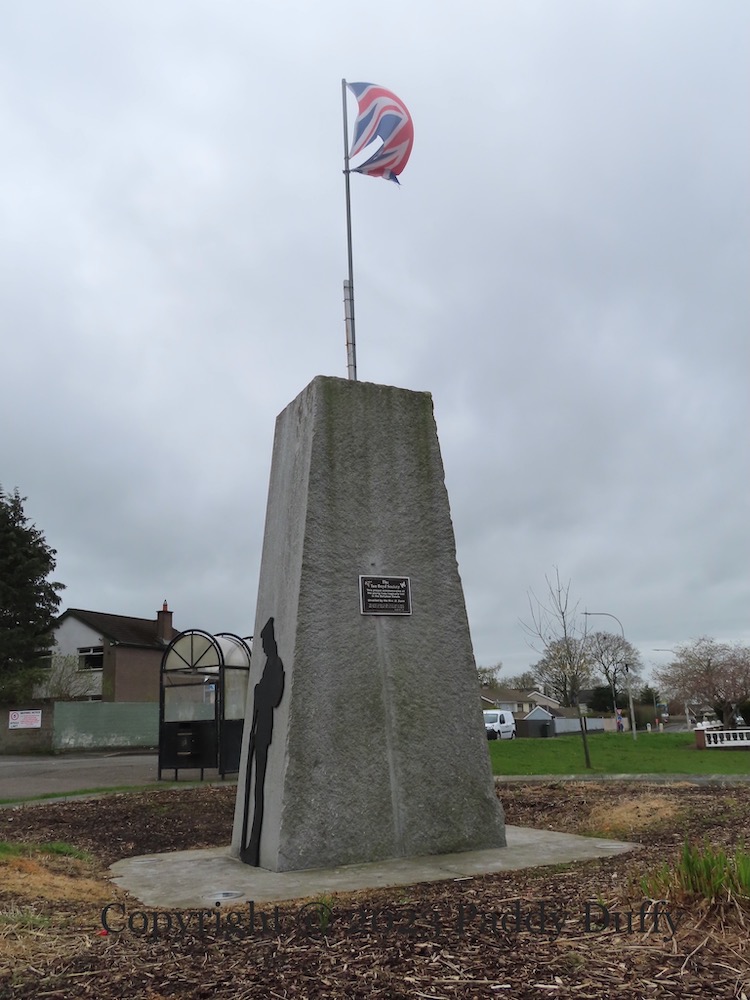
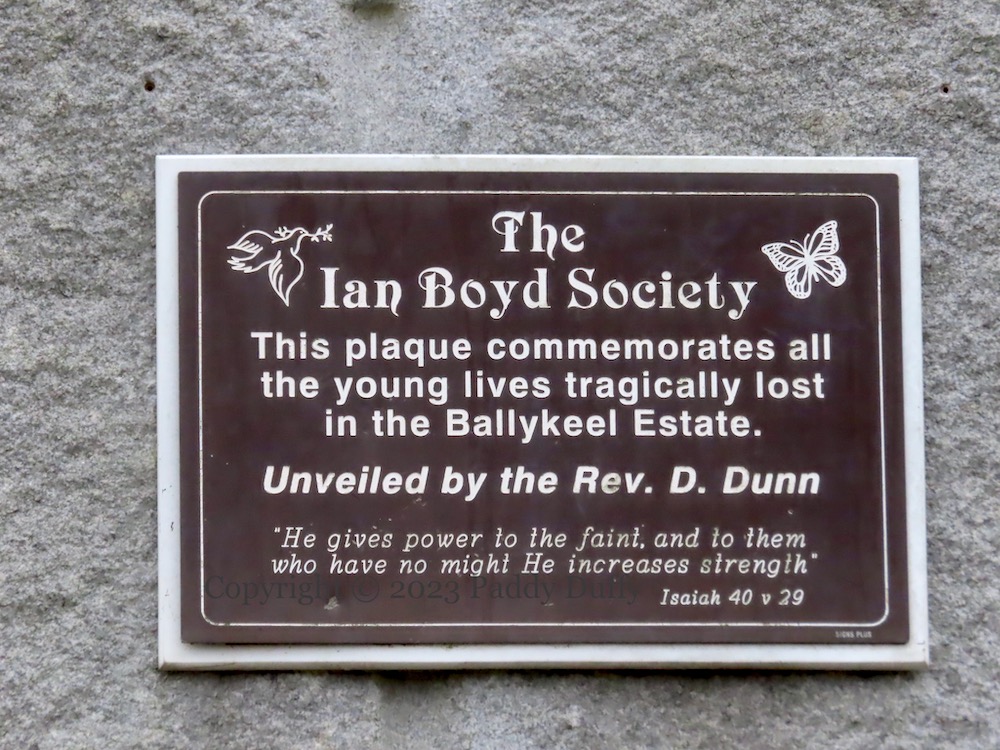
Ballykeel 2 remembers: 1690, VE Day (75th anniversary in 2020 – see also north Belfast | Caw, Londonderry), the Somme 1916, and “all the young lives tragically lost in the Ballykeel estate” (Ian Boyd took his own life in 2006 – anglican.org).
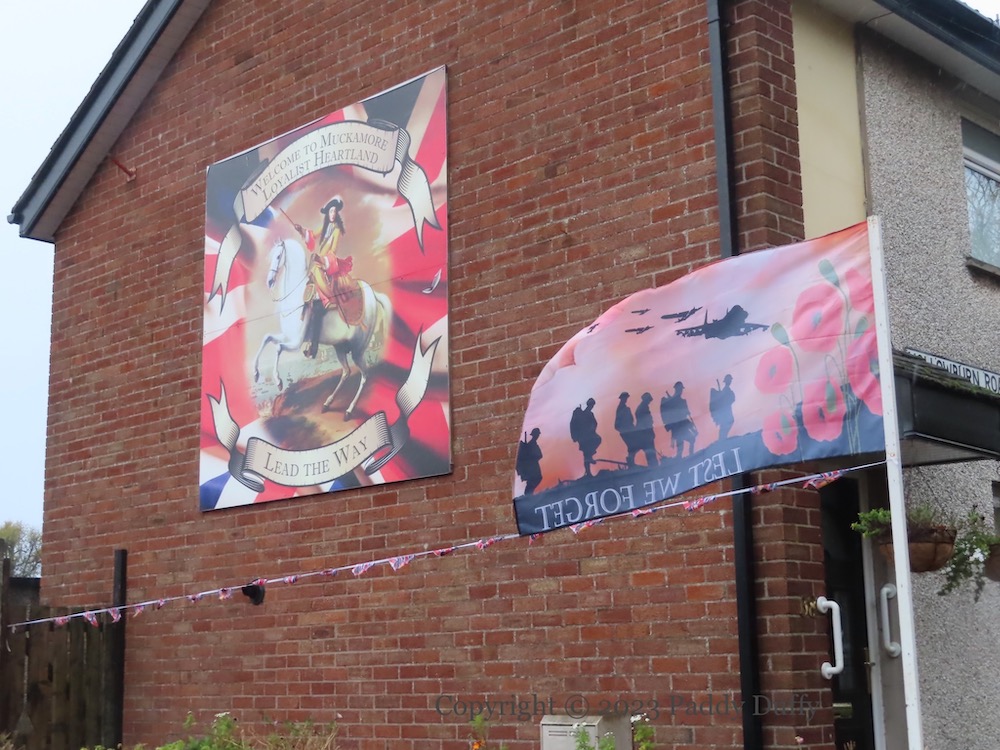
“Welcome to Muckamore, loyalist heartland – lead the way.” “In defence of our heritage and culture.”
In the Muckamore/Ballycraigy areas of Antrim the insignia of the LVF are still in place. “Lead the way” was the slogan of the LVF (see e.g. D01246 for a prominent instance in Ballycraigy). The organisation called a ceasefire and decommissioned some weapons in the years after the Agreement but persists in some form in Antrim (WP).
The Sons Of Ulster also used to use the slogan “Lead the way” (as described in J1947) but it is not present in the board shown in the recent (2022) Old Ulster’s Battle Cry.
The two boards below are on gables above Woodgreen, which is the site of the bonfire (ig) featured in the third image. They used to claim that it was the biggest bonfire (see C06695) but Craigyhill (in Larne) is more recently the tallest – see Commonwealth Handling Equipment.
There is also a memorial garden to Billy Wright in Ballycraigy – see M05203.
William III, statholder of Holland, landed at Torbay, England, in November, 1688 with 250+ ships and 30,000 men in order to overthrow the Catholic convert James II who had become king in 1685. As he came ashore he proclaimed “the liberties of England and the Protestant religion I will maintain.” As king of England, William was automatically made king of Ireland, but he and his forces had to go to Ireland to win the island from James and the forces loyal to him. Schomberg had already successfully besieged Carrickfergus in 1689 when William landed in June 1690.
The mural reproduces the illustration from a postcard.
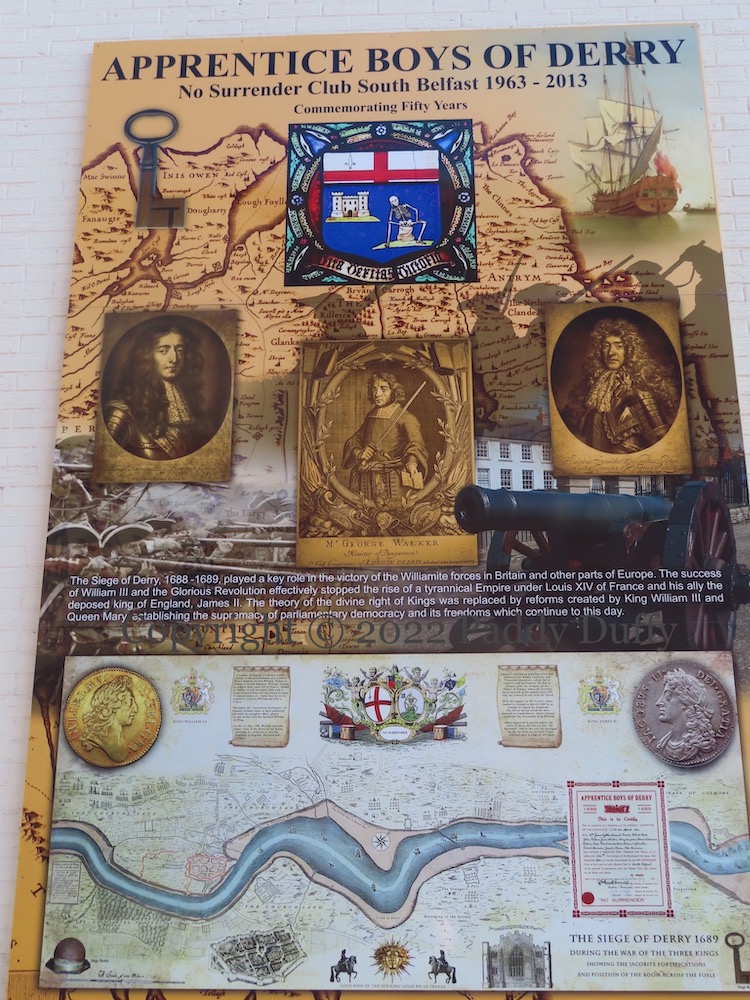
Oak Street is a fitting place for a mural about the Siege of Derry, as the oak leaf, shown to the left and right of the board above (and in the wide shot, below) is a symbol of the town, “doire” meaning an oak grove. The gates to the city were locked by thirteen apprentices, against the wishes of Governor Robert Lundy who wised to surrender the city. When the deposed king James II and his army arrived and demanded the surrender of the city of Derry, the cry from within was “No surrender!” The city was then besieged for 105 days until relief arrived in the form of ships of the navy of the newly crowned William & Mary.
The board shown above celebrates 50 years of the No Surrender Club South Belfast (1963-2013) a club affiliated with the Apprentice Boys Of Derry.
This new Shankill Road installation makes mention of “William and Mary”, Mary being co-monarch with her cousin William from 1689 to 1694, when she died of smallpox. She was raised Anglican, though her parents (including father James II, whom William defeated at the Boyne) had converted to Catholicism in the 1660s. Although the fifteen year-old Mary wept when the marriage was announced, she remained loyal to William and to “Church and State” when James was deposed (WP).
“King William III Prince of Orange 1650-1702. In God is my trust.” “This artwork celebrates the victory of William III over James II at the Battle of the Boyne in 1690 “The battle of the two Kings”. The williamite ranks were filled with Irish protestants and international troops, William encouraged the hearts of his troops on the morning of the battle when he called to them “LET AMBITION FIRE THY MIND” on seeing the opposing army of James II, William exclaimed with delight “Ah I am glad to see you gentlemen; if you escape me now, the fault will be mine” they followed him to victory.”
King Billy crossing the Boyne, with Schomberg dying in the foreground, making this a crude reproduction of Benjamin West’s 1780 painting ‘Battle Of The Boyne’. Second-in-command Schomberg had crossed the Boyne first and met his fate at the hands of Jacobite cavalry. Schomberg’s helper is perhaps George Walker, governor of Derry during the siege, who was shot and killed (reportedly) while attending to Schomberg – see George Walker.









 Paddy Duffy Collection