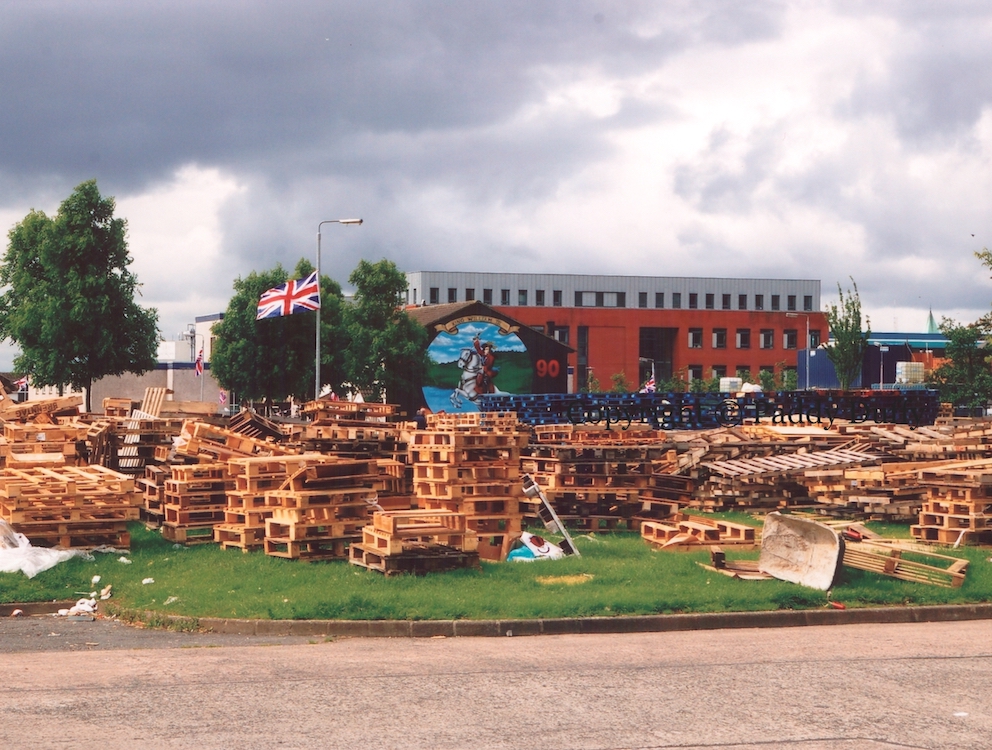
Pallets are being collection in the lower Shankill estate for the Eleventh night bonfire. In the background, King Billy is shown in a mural moving (unusually) from right to left.
A plaque reads, “This mural is dedicated to the past, present & future members of Clifton St Orange Orders from Pride Of The West flute band & Lower Shankill community. REM 1690. Officially opened by Billy Lochrie.”
Shankill Parade, lower Shankill estate, west Belfast
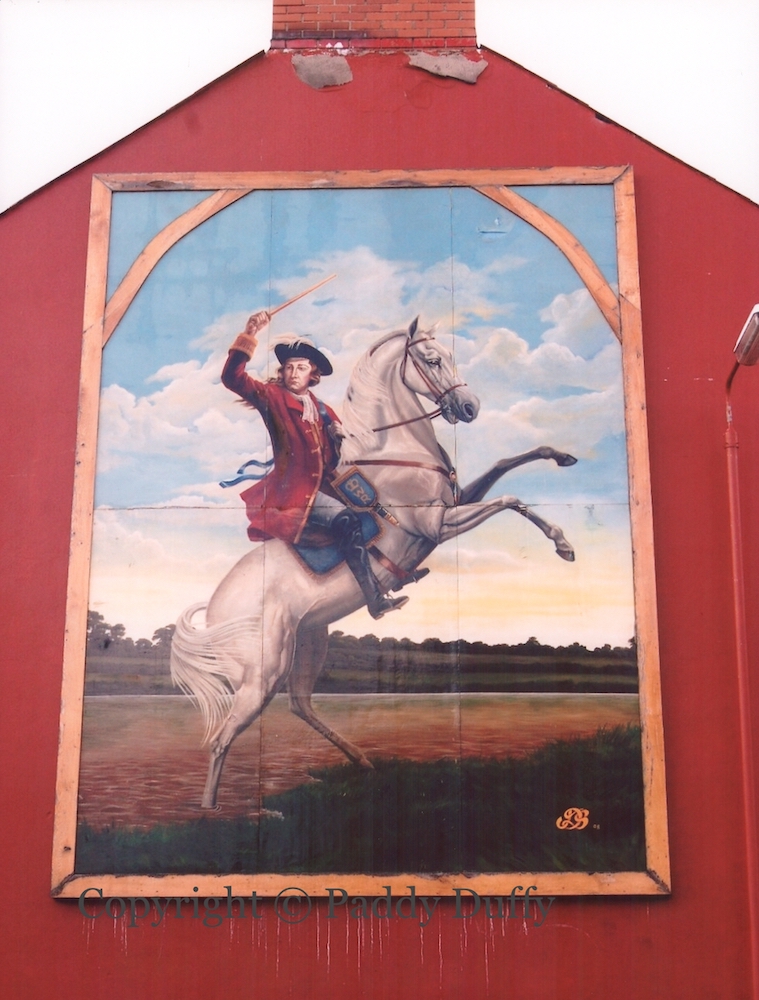
The Village Eddie is re-imaged with a painting of King Billy at the Boyne by John Darren Sutton.
“The first unionist mural was painted in 1908 on the Beersbridge Road in East Belfast by shipyard worker John McLean. It depicted King William at the Battle of the Boyne. This was the start of mural painting becoming a key element in the annual unionist celebration of the Battle of the Boyne, culminating in the Orange Order parades of July 12th. Murals, bunting, arches, painted flagstones, marked out the route of marches as well as adorning countless local areas. Between 1908 and the 1970s the vast bulk of unionist murals depicted King William at the Boyne. Other murals depicted the sinking of the Titanic, the 36th Ulster [sic] Division at the Battle of the Somme, and various royal weddings and anniversaries. Each unionist working class area vied with the neighbouring areas to have the best decorations for the Twelfth. As part of this rivalry, King William murals were painted and repainted year after year, with some surviving through six or more decades. The longest-surviving mural in the South Belfast area was in Rockland Street. It depicted King William on his white horse at the Battle of the Boyne. Painted first in the mid-1920s, it survived until the mid-1990s, when it became a victim first of the heat from an adjacent bonfire, and then of redevelopment. The King William murals began to fade from the walls in the 1970s, to be replaced with murals depicting flags and other inanimate emblems. Overall, the number of murals declined significantly in this decade. In the mid-1980s mural painting in unionist areas came under the control of loyalist paramilitary groups. From that point, the vast majority of murals in unionist areas depicted armed and hooded men. In recent years, the debate on mural painting inside and outside loyalist paramilitary organisations has led to the decline of the military iconography. This debate has led to many positive changes taking place throughout Northern Ireland and in January 2008 Greater Village Regeneration Trust secured funding through the Re-imaging Communities Programme to transform a number of areas within the village. This programme was established to help communities in both rural and urban areas to focus on positive ways of expressing their culture and identity and to encourage the creation of vibrant and attractive shared spaces. Thanks to the overwhelming support and participation of the local community in the Re-imaging process. Local organisations, community leaders, residents and young people have worked closely with artists to tackle the displays of redundant sectarian imagery and replacing these with positive expressions of wider cultural celebration.”
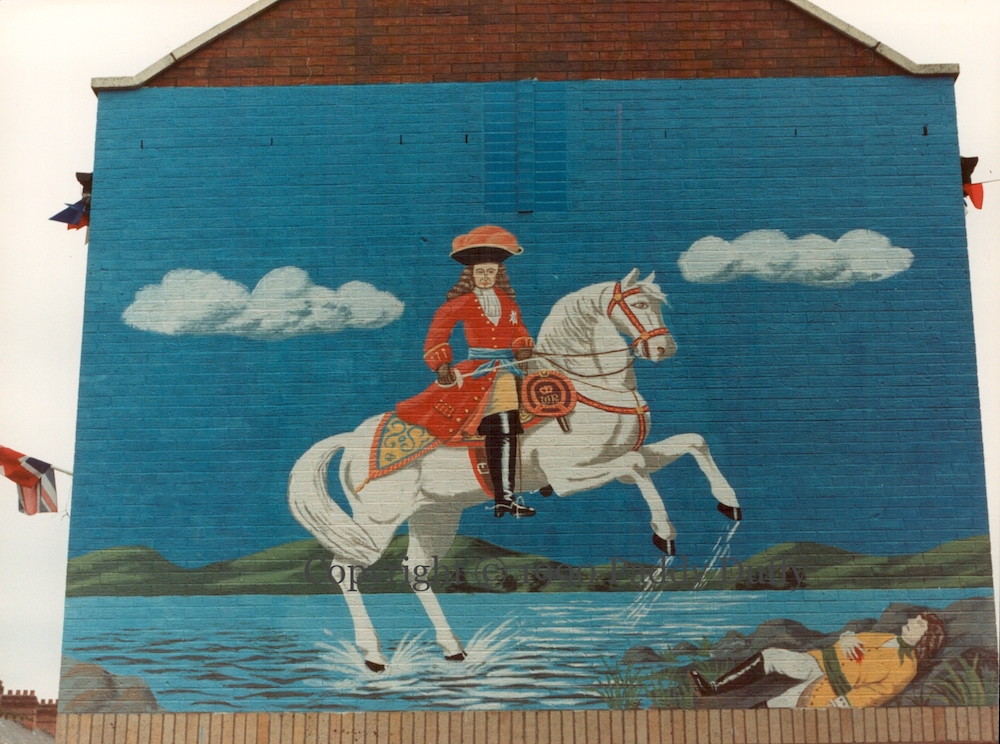
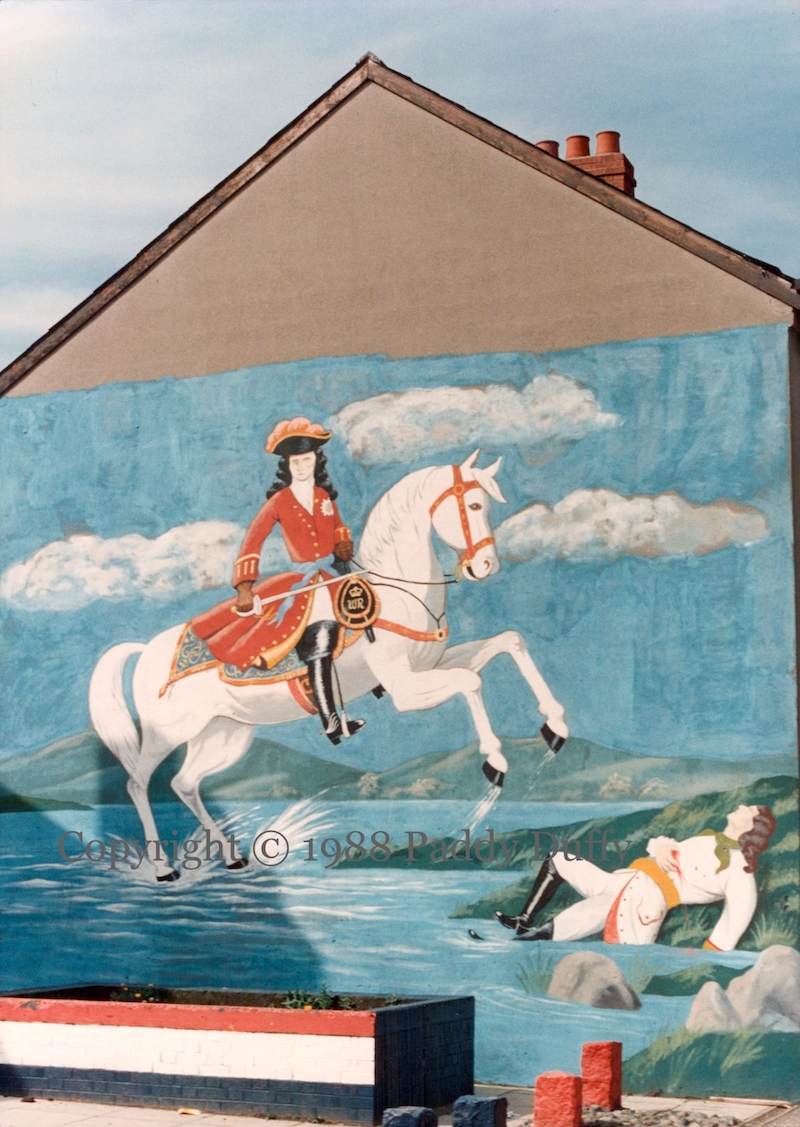
King Billy crossing the Boyne, with Schomberg dying in the foreground, making this a crude reproduction of Benjamin West’s 1780 painting ‘Battle Of The Boyne’. Second-in-command Schomberg had crossed the Boyne first and met his fate at the hands of Jacobite cavalry. Schomberg’s helper is perhaps George Walker, governor of Derry during the siege, who was shot and killed (reportedly) while attending to Schomberg – see George Walker.
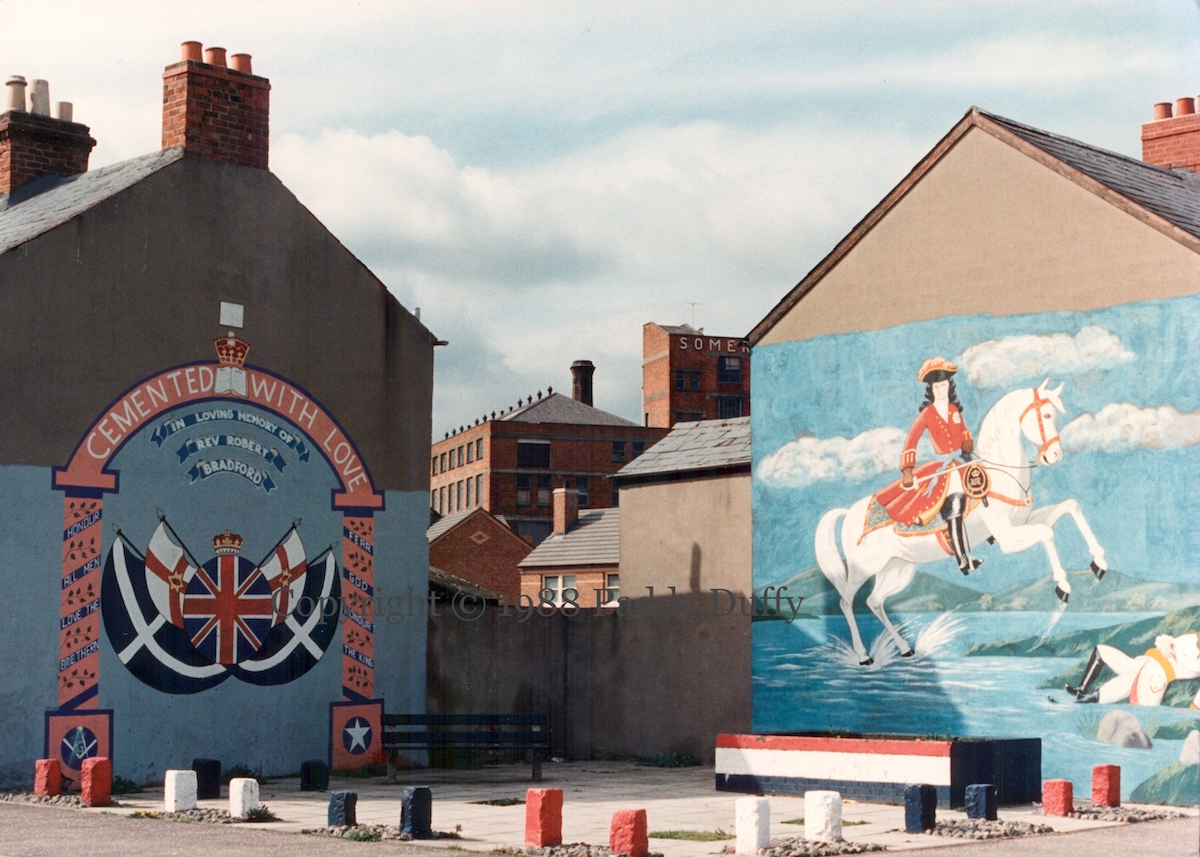
King Billy, in red, white, and blue, crossing the Boyne and trampling on a Jacobite soldier in green, white, and orange. This mural was painted in 1989 by a “H. Gibson” (according to the 2015 repainting). The original version of this mural was on the other side of the Pass, at the junction of Apsley Street and Howard Street South, next to a mural of the Lindsay Street arch dedicated to Robert Bradford. (See Cemented With Love for both of these.) 1989 was the 25th anniversary of the erection of the arch in nearby Lindsay Street, but the arch was not painted into this mural until 2002.
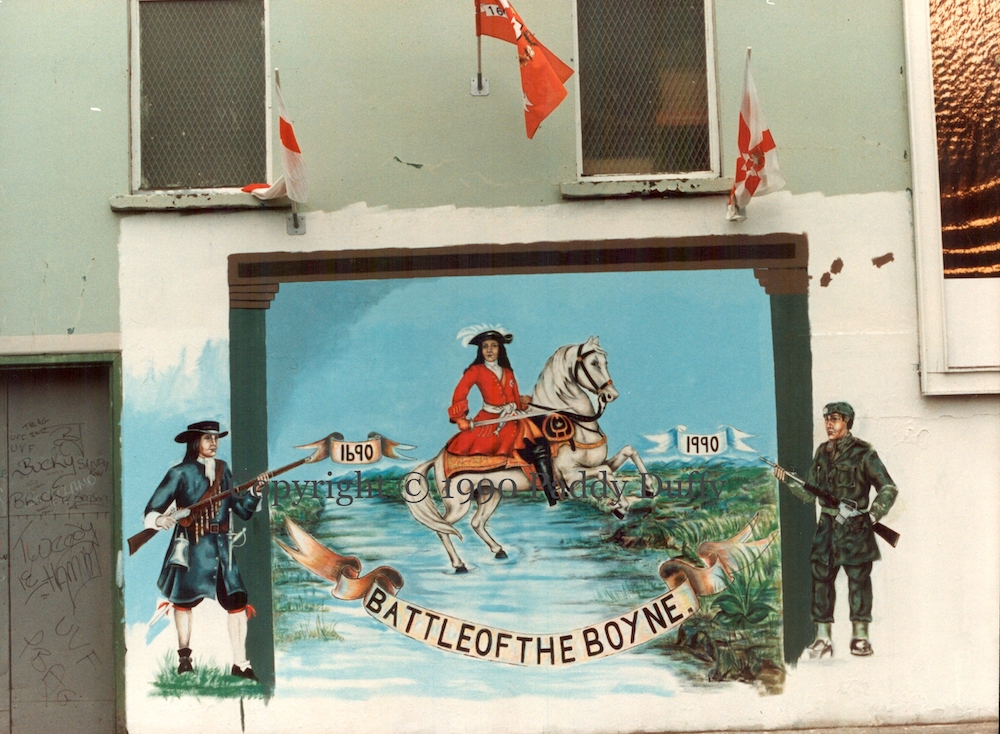
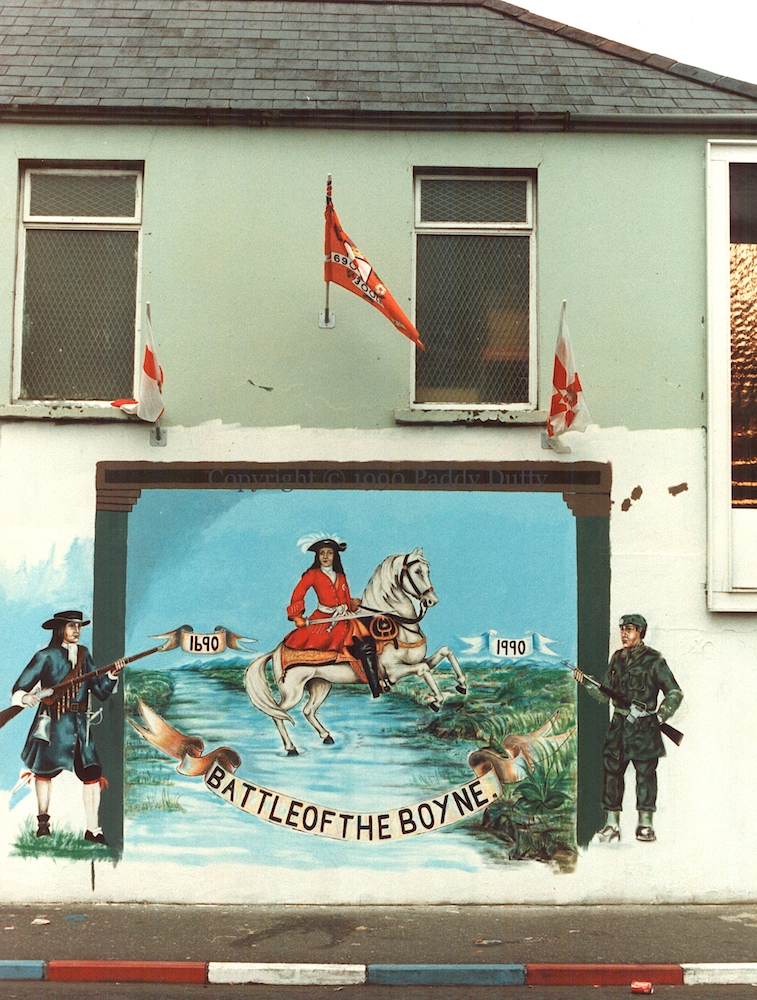
King William III is flanked by foot soldiers from 1690 and 1990. A small painted sign to the right reads, “We the people of Sandy Row remember with pride the 300th anniversary of the Battle of the Boyne. No surrender. Signed, UFF.”
The modern-day gunman on the right would later be replaced by another period soldier – see the Peter Moloney Collection.
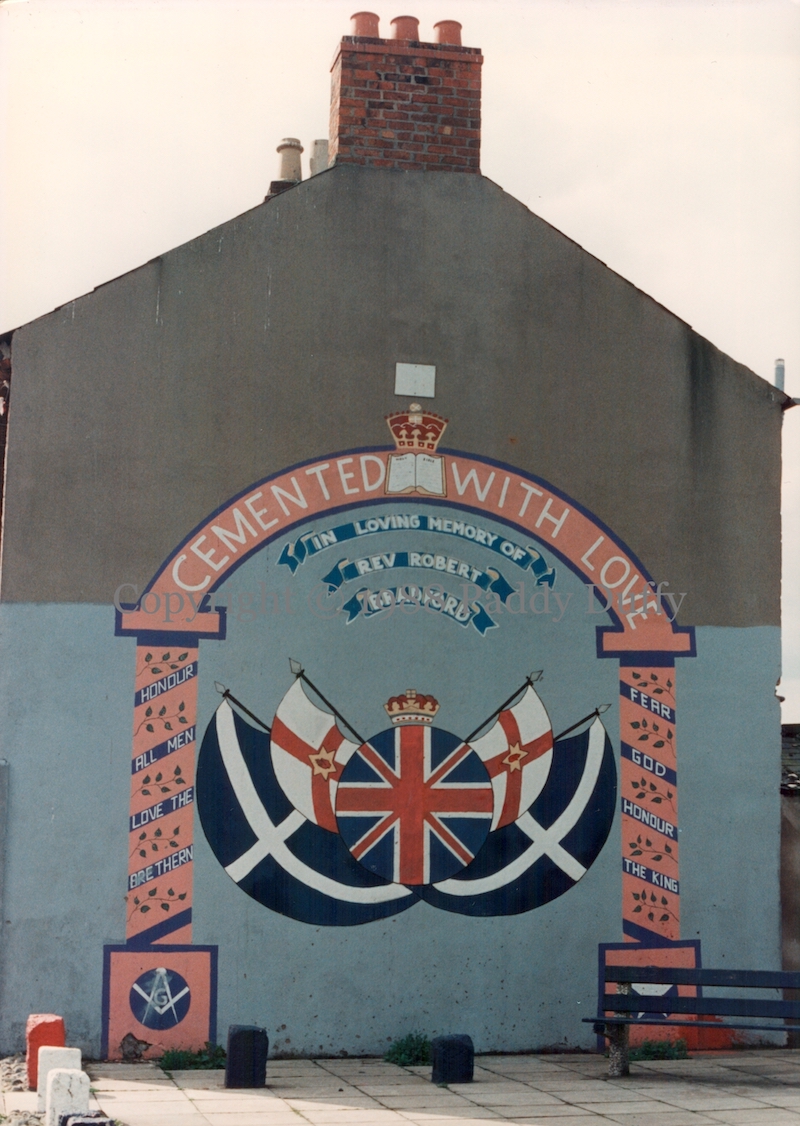
“In loving memory of Rev Robert Bradford.” Bradford was killed in 1981 (see To Bathe The Sharp Sword Of My Word In Heaven) and the mural dates back to (at least) 1983. It perhaps shows the Lindsay Street arch, which was first mounted in 1964. On either side of the arch are written “Honour all men, love the brethren” and “Fear God, honour the King”.
The King Billy mural survived until 1988 and was reproduced on the other side of Donegall Pass in 1989 – see the Peter Moloney Collection. King Billy is subtly coloured red-white-and-blue, while the dying Jacobite is in green-white-and-gold.
At the junction of Apsley Street and Howard Street South, at what is now the entrance to Reverend Robert Bradford Memorial Park.