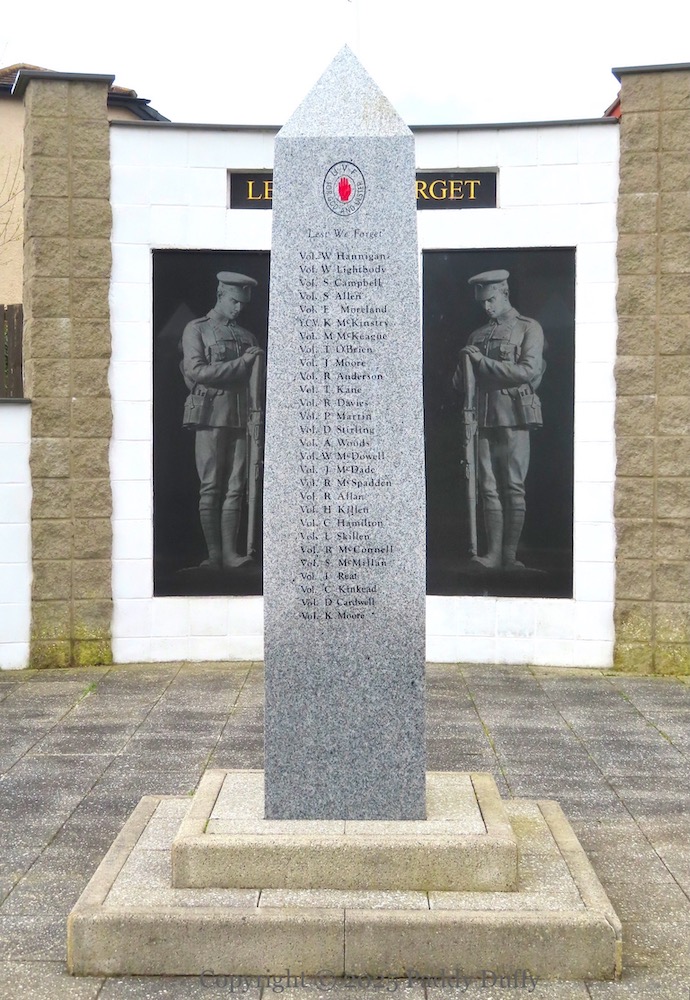
The uniforms of the graveside mourners are from WWI and the image on each side is JP Beadle’s Attack Of The Ulster Division (Royal Irish) at the Battle Of The Somme in 1916, but the names on the pillar (in the image immediately below) are from the modern UVF. Little information about any of those listed is available on-line, but ten of those listed were also on a plaque in Abbot Crescent, which was similarly in front of a 36th Division mural.
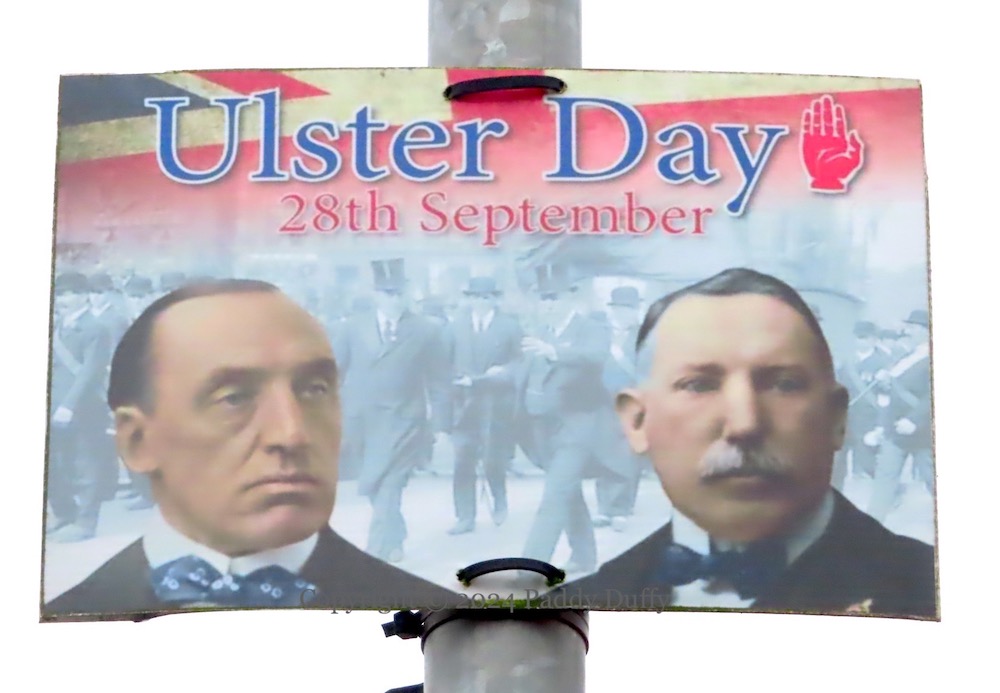
Here is a selection of placards from the Village in south Belfast, many on the theme of the fight against Home Rule in 1912 and the creation of Northern Ireland in 1921.
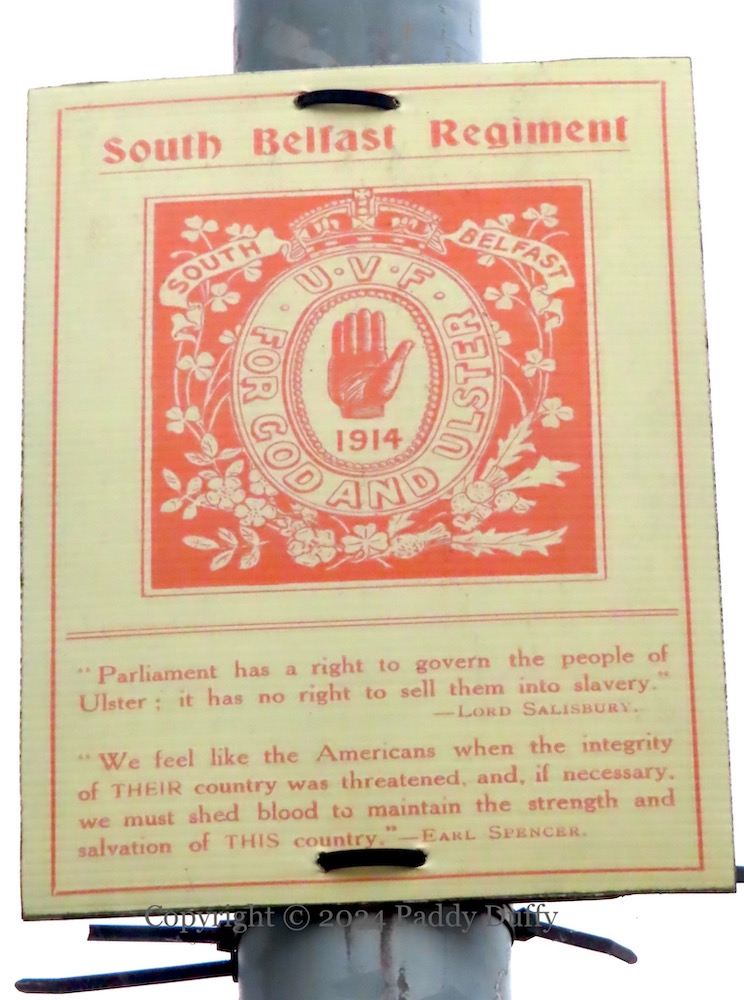
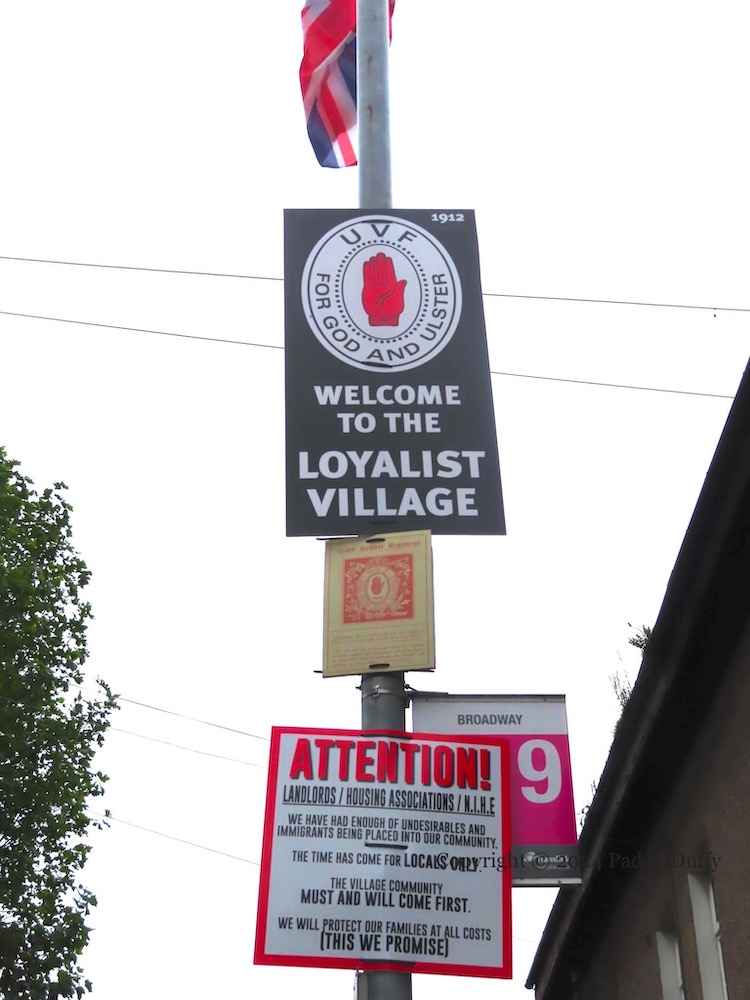
The most interesting is perhaps the small placard sandwiched (in the image below) between the UVF territorial marking (see e.g. Welcome To The Village) and the “warning” to landlords (see Not A Dumping Ground). The quote form Salisbury – “Parliament has a right to govern the people of Ulster; it has no right to sell them into slavery” – comes from a speech made in 1892 (Launceston Examiner) and Spencer was addressing the Lords in 1893 when he said, “We feel like the Americans when the integrity of THEIR country was threatened, and, if necessary, we must shed blood to maintain the strength and salvation of THIS country” (Hansard). Both statements, that is, were made in connection with the second Home Rule bill (of 1893) rather than the third as the “1914” crest of the “South Belfast regiment” of the Ulster Volunteers would suggest.
Below is a reproduction of a stamp featuring Edward Carson, described in the Notre Dame collection. These stamps were sold as a fundraiser; they were not used for postage.
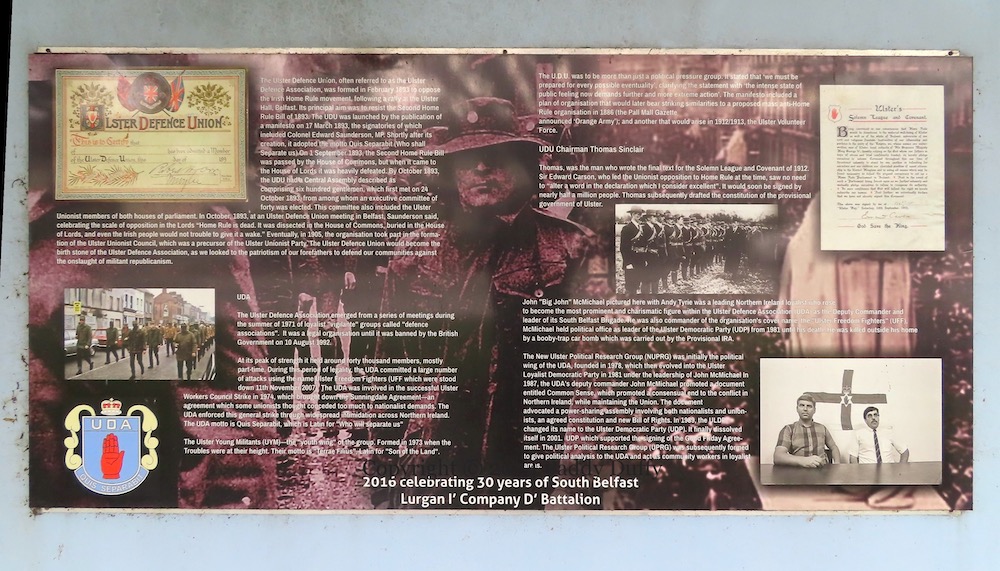
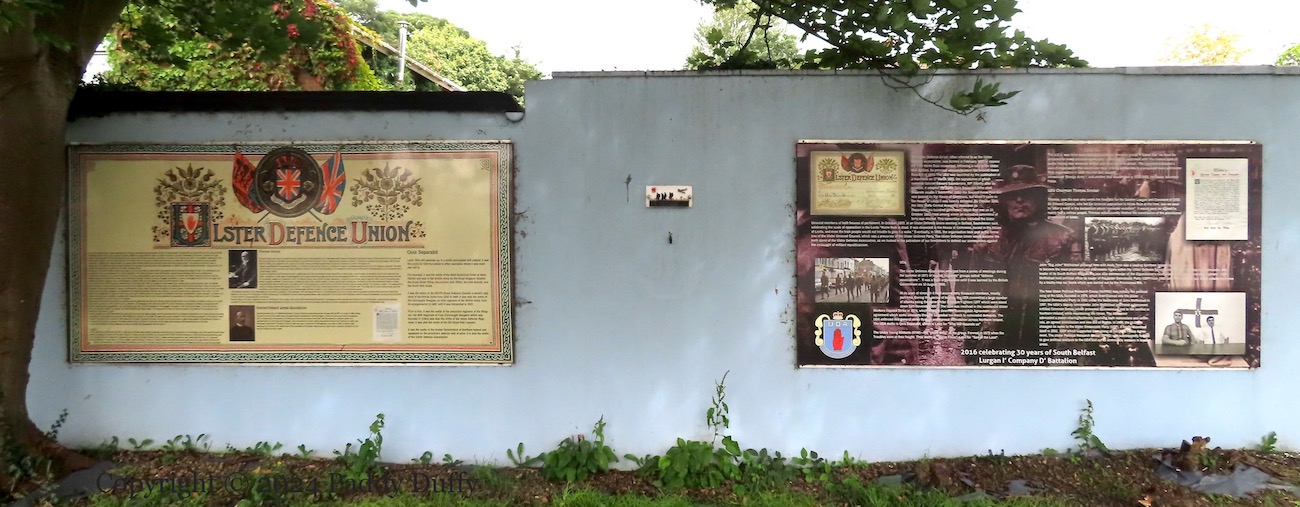
These are the UDA boards on Avenue Road, near Lurgan Park, which proved controversial when they were erected (in 2016), mainly because the second piece (below) “celebrat[es] 30 years of South Belfast/Lurgan 1 company D battalion” UDA and shows Troubles-era shows-of-strength (News Letter) and because it turned out the wall was owned by the Housing Executive (NIWorld).
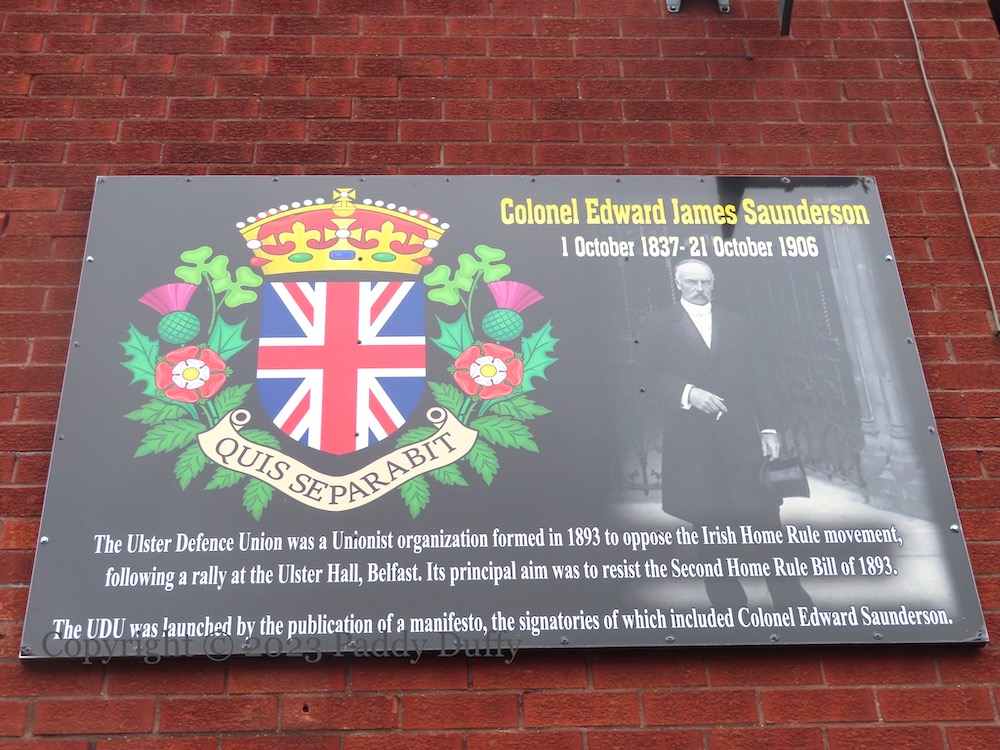
The piece above describes the creation of the UDU in 1893, as a response to the second Home Rule bill, which was passed by the Commons but rejected in the Lords, and which Edward Saunderson celebrated by saying, “Home Rule is dead. It was dissected in the House of Commons, buried in the House of Lords, and even the Irish people would not trouble to give it a wake”. The UDU is as used an origin-story for the UDA, though often in vague terms, such as the verbiage here which reads “[the UDU] would become the birth stone of the Ulster Defence Association, as we looked to the patriotism of our forefathers to defend our communities”. (For more, see UDU-UFF-UDA. For Saunderson, see Union Is Strength.)
This year (2024), UVF lettering a stone’s throw away, on the other side of the entrance to the park, likewise drew criticism (BelTel | ArmaghI), but it has now been removed.
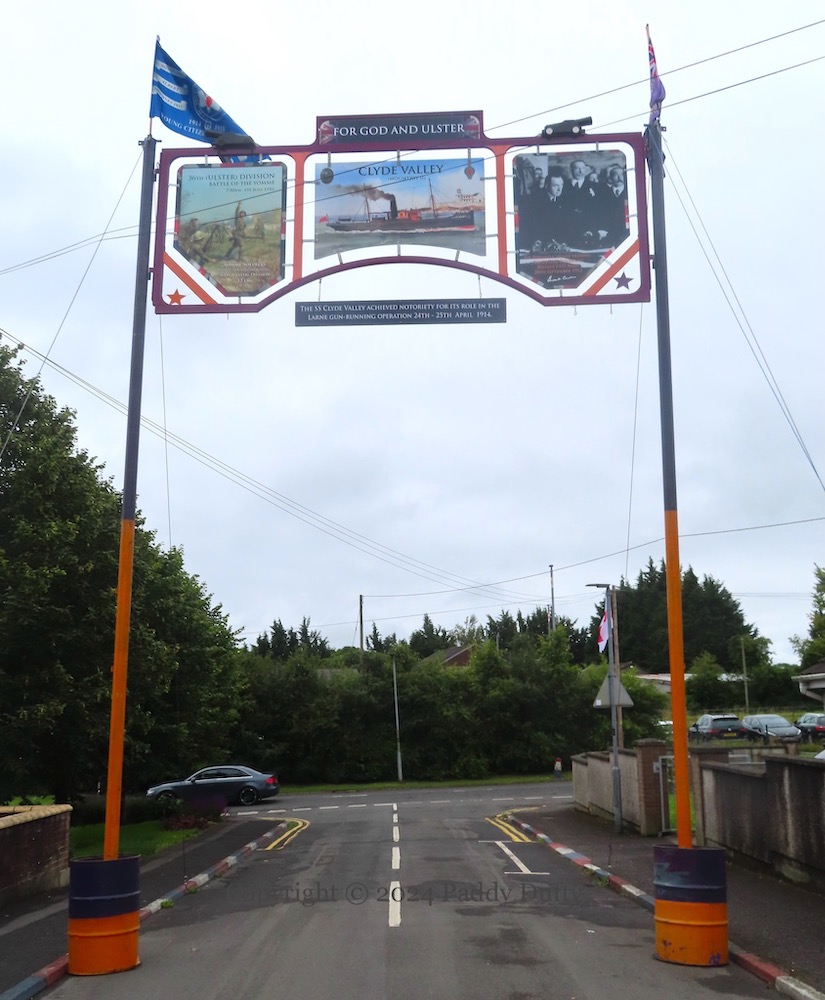
The Millbrook arch has three panels: “36th (Ulster) Division, Battle Of The Somme, 7:30 am 1st July 1916”; the Clyde Valley (Mountjoy II) “The SS Clyde Valley achieved notoriety for its role in the Larne gun-running operation 24th-25th April 1914”; “Sir Edward Carson signing the Ulster Covenant, Belfast City Hall 28th September 1912”.
Above is a mural in Carlingford St, east Belfast showing gravestones of two deceased locals: “6322 Private J. Condon, Royal Irish Regiment, 24th May, 1915, age 14” and “10/16015 Rifleman S. Thompson Royal Irish Rifles, 5th October, 1918”. Their gravestones are the end-point of a journey that began with the Covenant and the Ulster Volunteers (illustrated by images of Carson, the Covenant, gun-running, and Volunteers drilling).
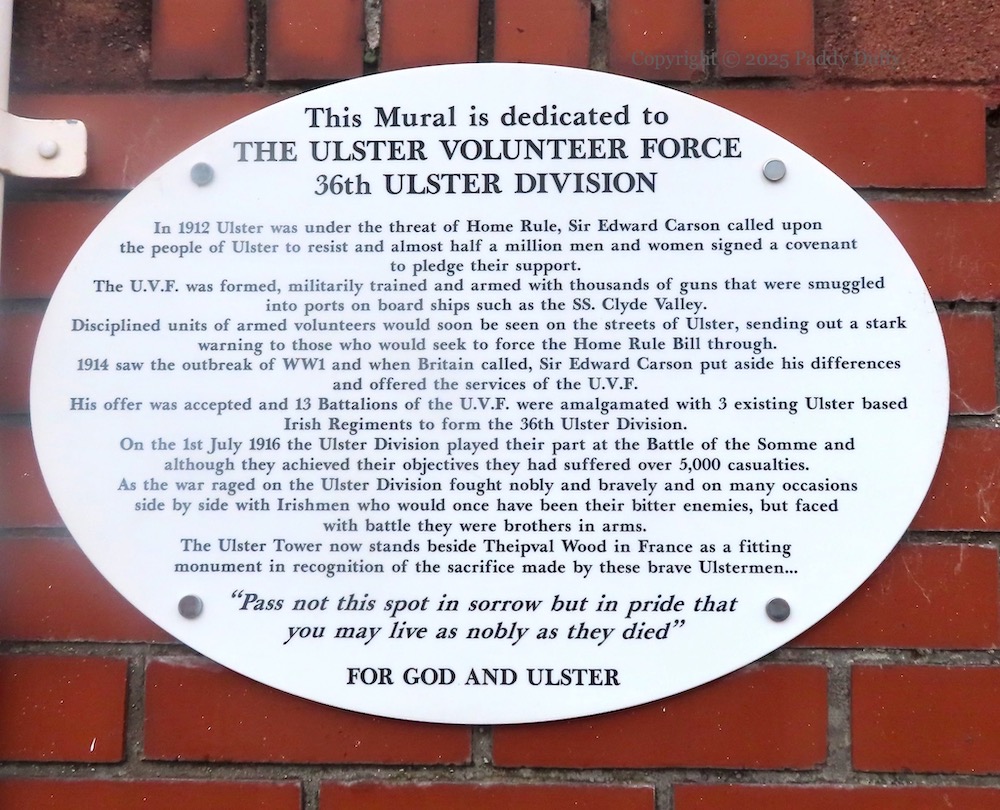
To the left is a plaque describing the journey from the Covenant to the Ulster Volunteers to the Somme: “In 1912 Ulster was under the threat of Home Rule, Sir Edward Carson called upon the people of Ulster to resist and almost half a million men and women signed a covenant to pledge their support. The U.V.F. was formed, militarily trained and armed with thousands of guns that were smuggled into ports on board ships such as the SS. Clyde Valley. Disciplined units of armed volunteers would soon be seen on the streets of Ulster, sending out a stark warning to those who would seek to force the Home Rule bill through. 1914 saw the outbreak of WW1 and when Britain called, Sir Edward Carson put aside his differences and offered the services of the U.V.F. His offer was accepted and 13 battalions of the U.V. F. were amalgamated with 3 existing Ulster based Irish regiments to form the on the 36th (Ulster) Division. On the 1st july the Ulster Division played their part at the Battle of the Somme and although they achieved their objectives they had suffered over 5,000 casualties. As the war raged on the Ulster Division fought nobly and bravely and on many occasions side by side with Irishmen who would once have been their bitter enemies, but faced with battle they were brothers in arms. The Ulster Tower now stands beside Theipval [sic] Wood in France as a fitting monument in recognition of the sacrifice made by these brave Ulstermen … “Pass not this spot in sorrow but in pride that you may live as nobly as they died” For God and Ulster”
There is also a side-wall (out of frame to the right) with the words of Captain Wilfrid Spender, describing the first day of the Battle Of The Somme, 1916, but it is in poor condition.
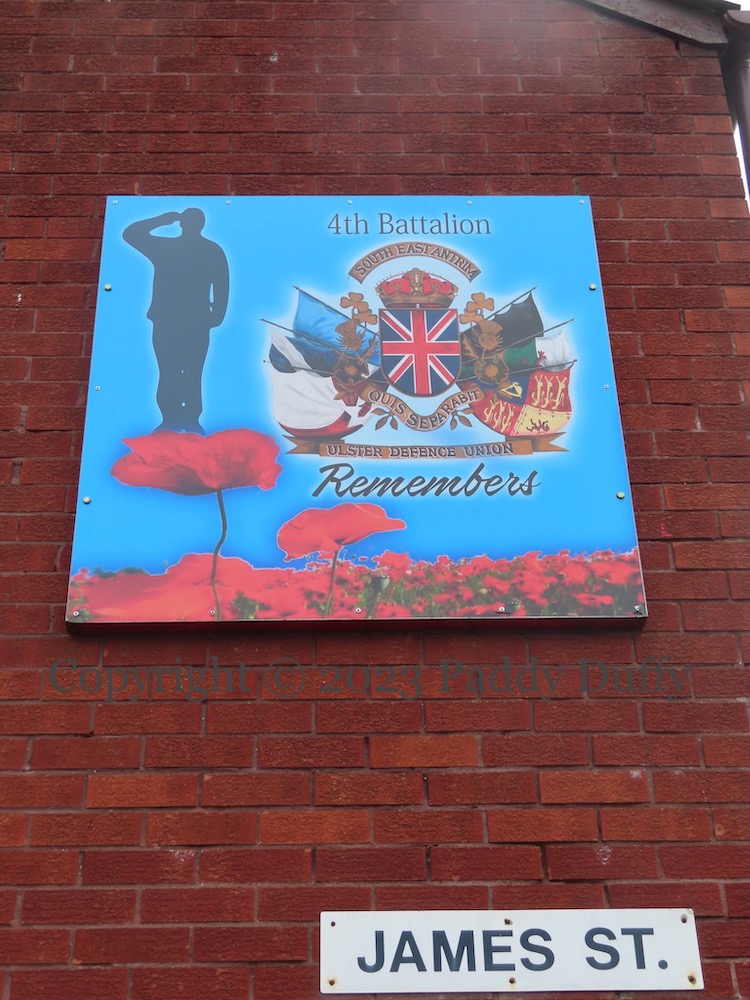
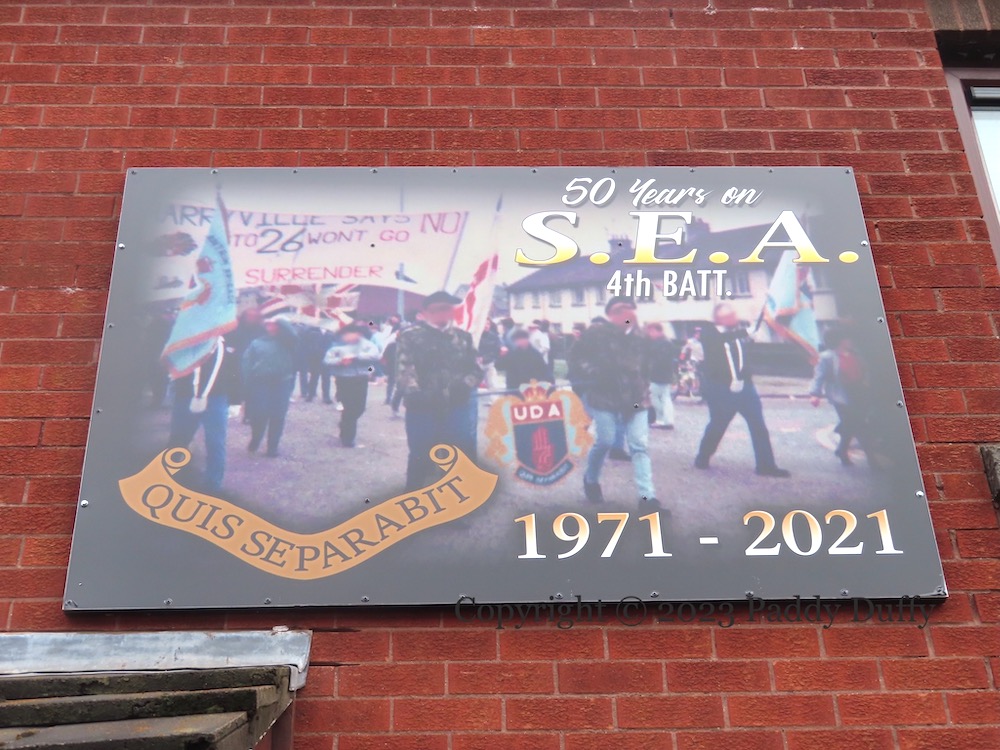
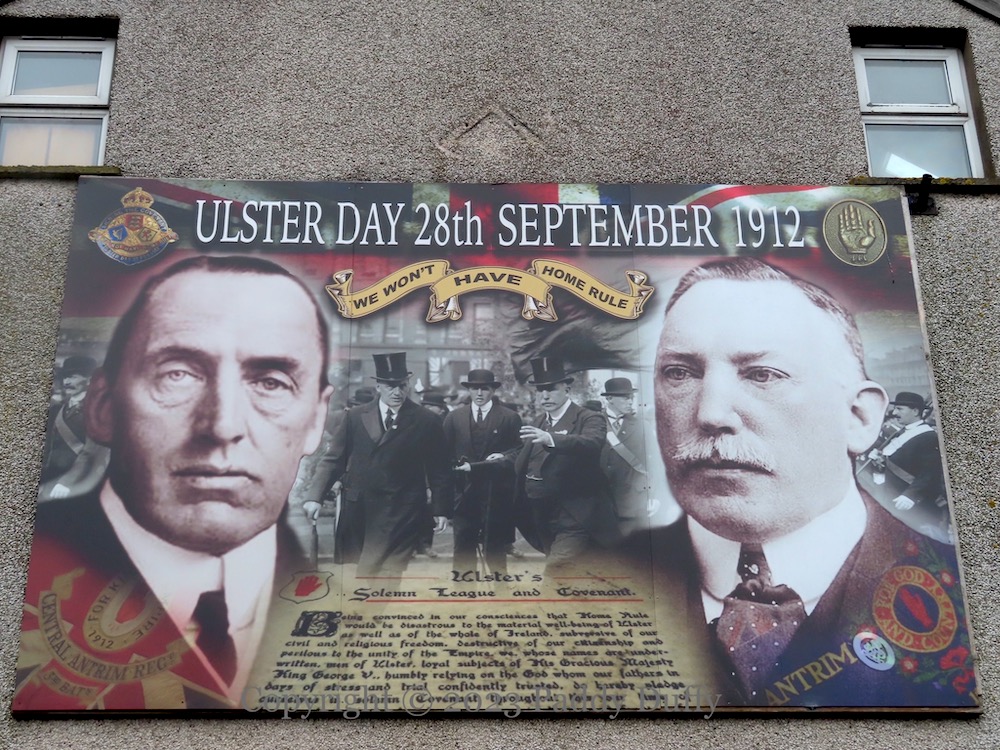
Here is a gallery of six boards from Harryville (four from Larne St/Larne Rd and two from Queen Street). The newest one is shown above; it celebrates Colonel Saunderson, a founder of the Ulster Defence Union, and organisation formed in 1893 to resist the second Home Rule bill. As mentioned on the board, the UDU initially met in Belfast in March and Saunderson was among the signatories of the UDU manifesto (see page 5 of the [Sydney] Freeman’s for 1893-04-29). For more on Saunderson, see Union Is Strength. The second bill was passed by the Commons but defeated in the Lords. The champions of resistence against the third Home Rule bill were Carson and Craig, shown in the penultimate image with the “Ulster Covenant” of September, 2012.
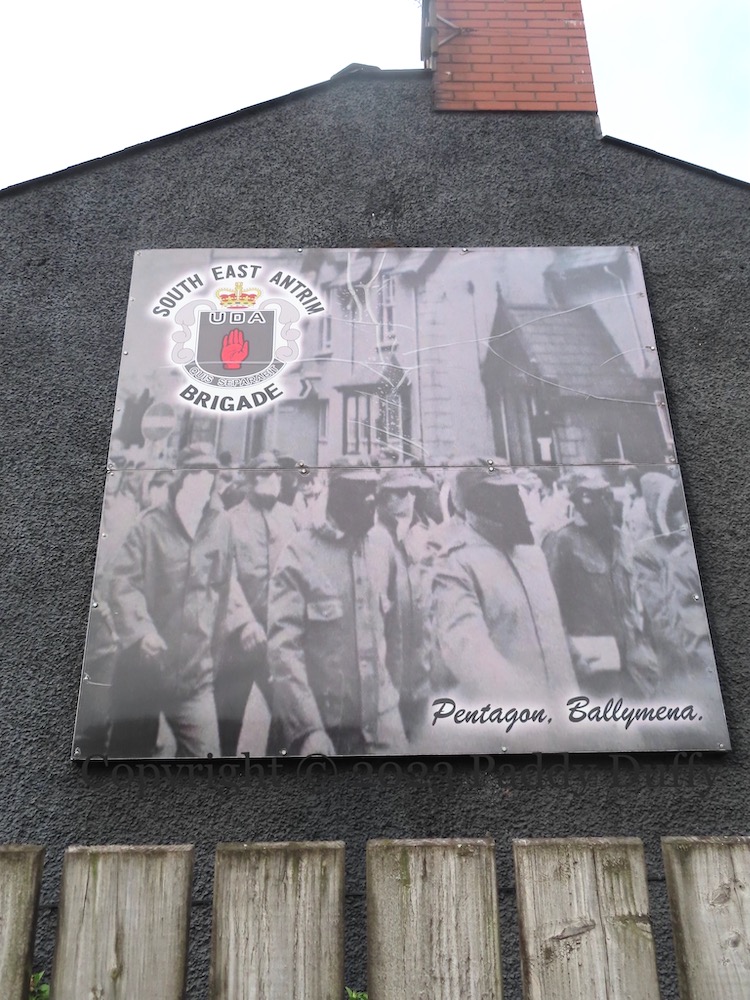
The name “Ulster Defence Union” is being used by some anti-Agreement factions of the UDA as a name for the organisation (starting in 2007 – see WDA on Peter’s site). The second board, just below, is a 4th Battalion South East Antrim UDA/UDU board. The UDA was formed in September 1971 and hence was 50 years old in 2021. The remaining two images show the UDA on parade at Harryville Bridge and in front of Pentagon House.
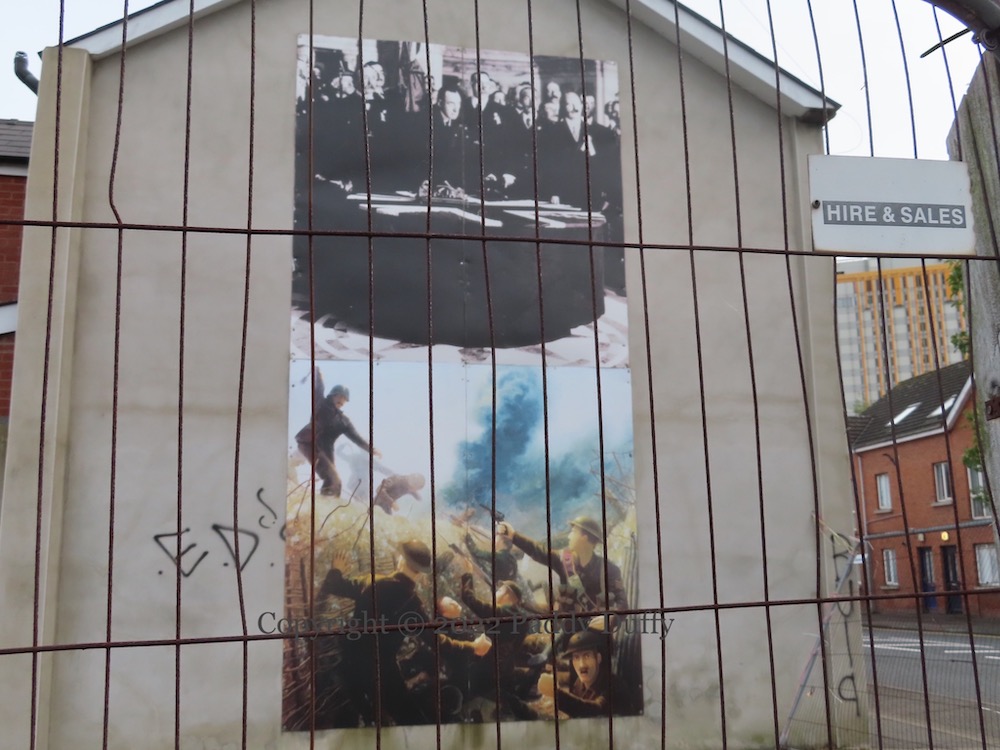
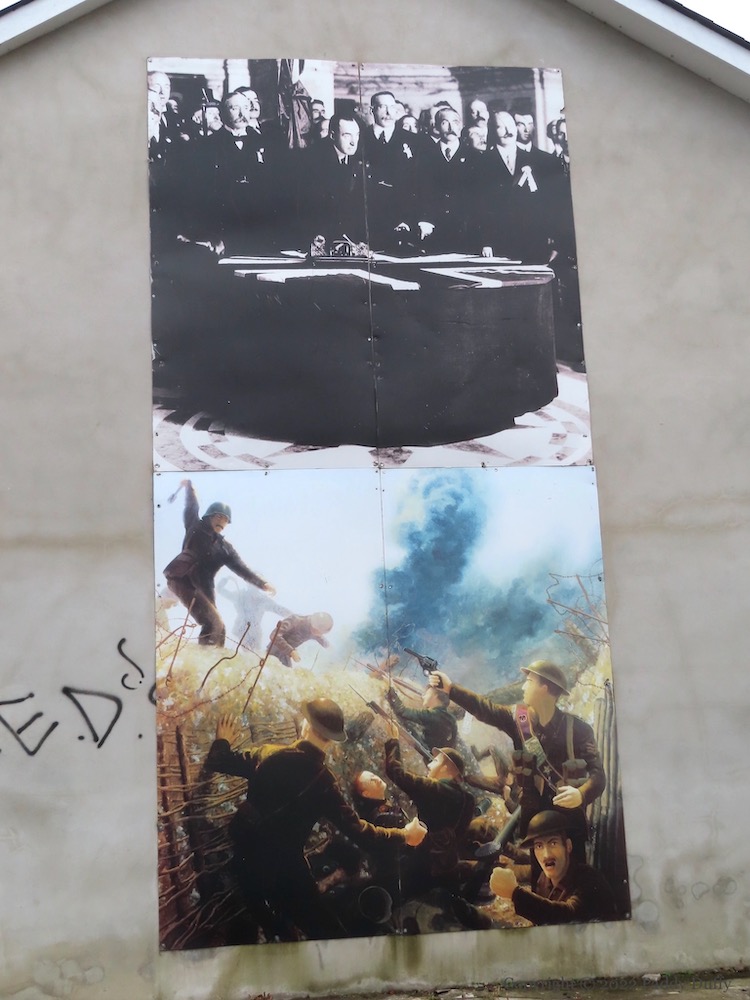
Here are a pair of boards in Barrington Gardens, Belfast: above, the signing of the Ulster Covenant, on September 28th, 1912; below, an attack on British trenches, perhaps intended to represent a scene from the first day of the Battle Of The Somme, July 1st, 1916.
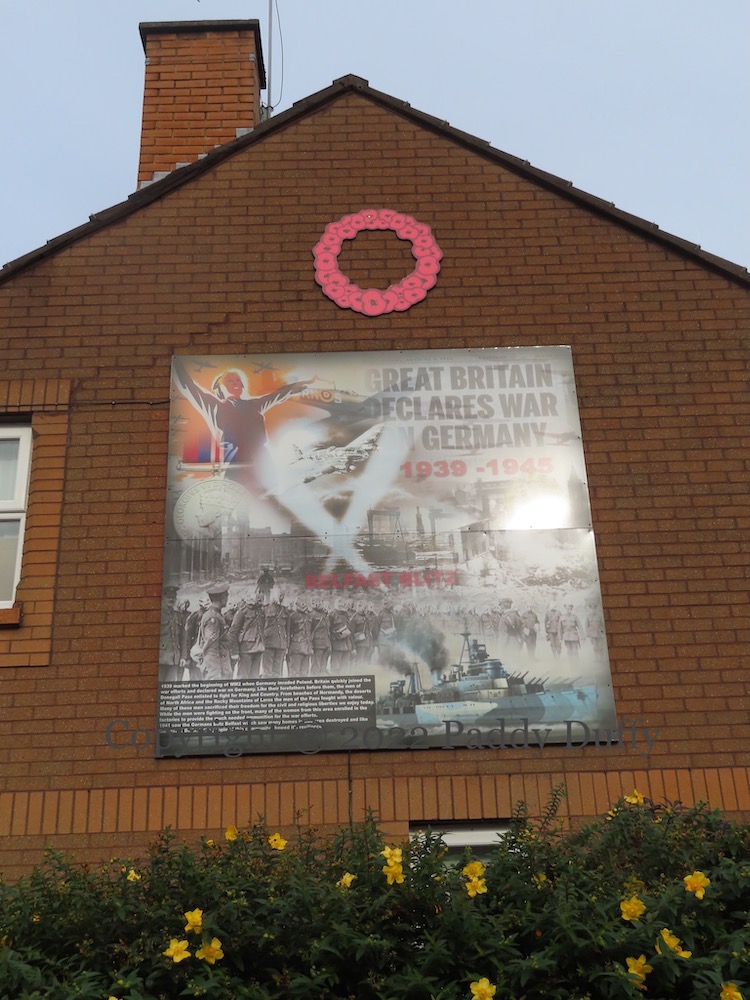
Here are the four boards on Lindsay Street, south Belfast, from east to west.
Above: “Great Britain declares war on Germany 1939-1945. 1939 marked the beginning of WW2 when Germany invaded Poland. Britain quickly joined the war efforts and declared war on Germany. Like their forefathers before them, the men of Donegall Pass enlisted to fight for King and Country. From beaches of Normandy, the deserts of North Africa and the Rocky Mountains of Leros the men of the Pass fought with valour. Many of these men sacrificed their freedom for the civil and religious liberties we enjoy today. While the men were fighting on the front, many of the women from this area enrolled in the factories to provide the much needed ammunition for the war efforts. 1941 saw the Germans Blitz Belfast which saw many homes in this area destroyed and like the rest of Belfast, the people of this community shows it’s [sic] resilience.”
“The war is over. Armistice Day 1918. 11th month, 11th day, 11th, hour.” “But in their eyes shall shine the holy glimmers of goodbyes … Their flower the tenderness of patient minds, and each slow dusk a drawing down of blinds.” Lines from Wilfred Owens’ (1893-1918) ‘Anthem For Doomed Youth‘ on a new board in Lindsay Street.
The text at the bottom reads: “The last three months of WWI became known as the hundred days. Realising they were defeated an armistice was signed by the Germans. Germany finally surrendered and WWI ended on November 11th 1918. The terms of the agreement called for the end of fighting along the entire Western Front to begin a precisely 11 am that morning. Records show that the last British soldier killed in WWI was Private George Edwin Allison of the 5th Royal Irish Lancers. He was killed at Mons at 09:30 am, just 90 minutes before the ceasefire.”
Computer-generated board in Lindsay Street showing a map of the northern end of the Western Front and images of soldiers marching, on horseback, and in the trenches: Donegall Pass remembers 1914-1918 – the great sacrifice. Lest we forget. Here are commemorated the many local men who during the Great War of 1914-1918 gave the most that man can give: life itself for God for King and Country.
“It is needful that we knit together as one man, each strengthening the other, and not holding back of counting the cost” – Ulster [Unionist] Council Resolution 1912.” “Ulster’s solemn league and covenant. Ulster Day 28th September 1912.” The Council met on September 23rd and 471,000 people signed the covenant (figures here) on or around the 28th – Ulster Day – led by Sir Edward Carson.
This pair of boards depict (above) the signing of the Ulster Covenant and (below) the 36th Division – formed largely from the Ulster Volunteers that were formed after the Covenant – in the trenches in WWI. It is reported that some soldiers wore their Orange Order collarettes into battle. The painting is by Carol Graham.
The pair was moved to this wall after the house on the corner was knocked down – see Out Of The Rubble.
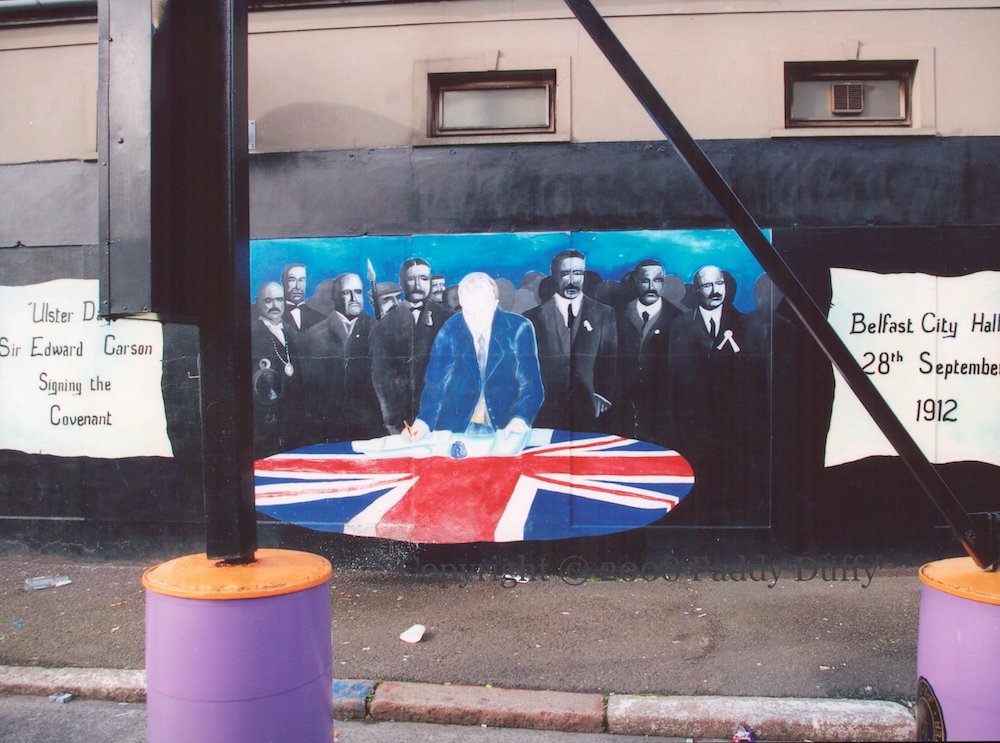
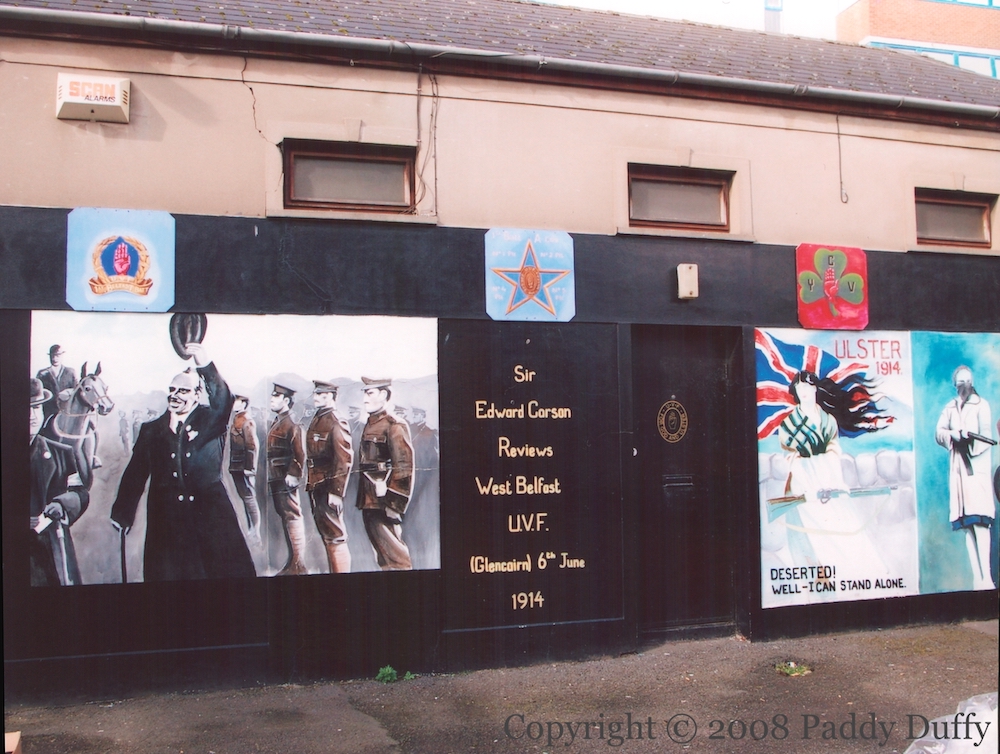
These three panels are in the courtyard of the Rex Bar in what used to be Moscow Street, celebrating resistance to Home Rule – Covenant Day September 28th 1912; the formation of the Ulster Volunteers, being reviewed at Fernhill House in Glencairn Park by Edward Carson; “Deserted! Well I can stand alone“; and (in post-partition Northern Ireland) “a Protestant farmer’s wife guards her husband against sectarian attack from across the border”.












 Paddy Duffy Collection