Here is a gallery of images from the back (Westbourne Street side) of the Vault premises at the old Met building in east Belfast, mostly by emic (web) and FGB (web), with one by Leo Boyd (web)
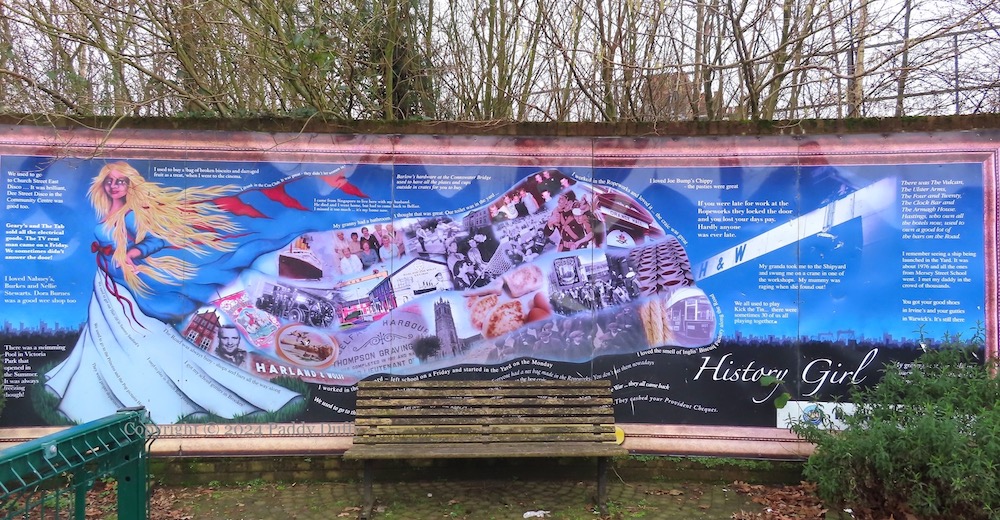
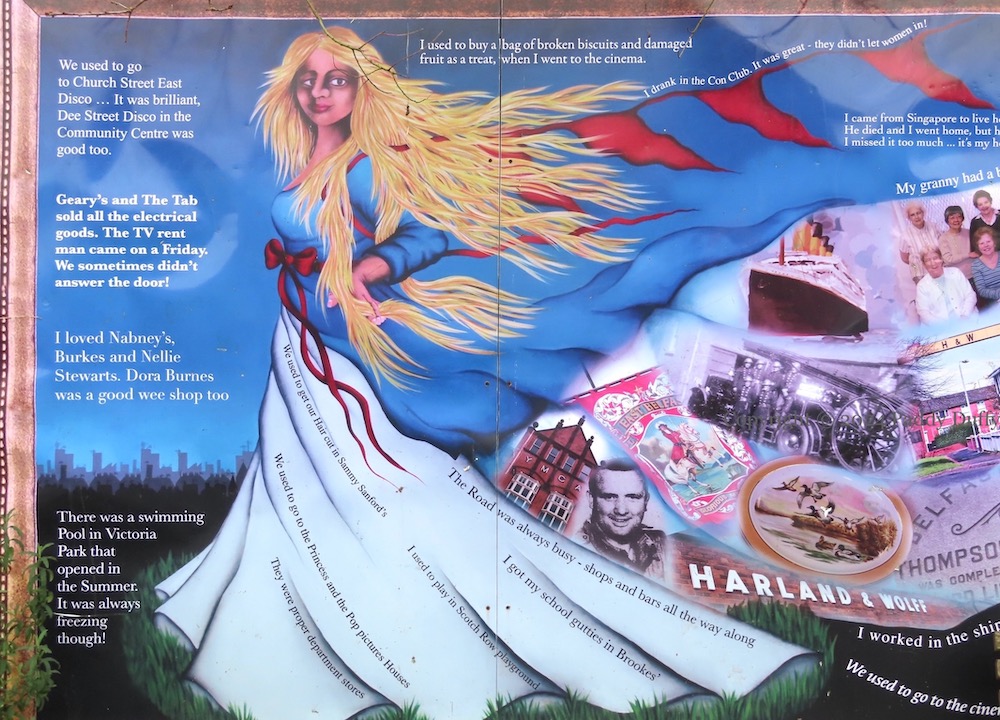
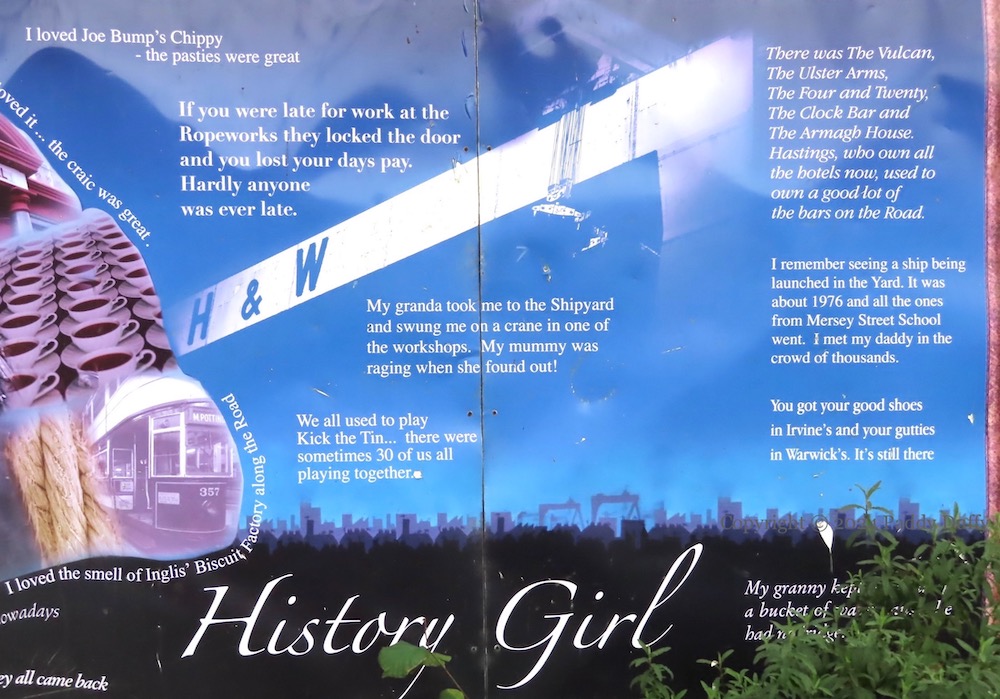
Memories from the History Girl mural in east Belfast’s Thistle Court. (Close-ups below.)
We used to go to Church Street East Disco … It was brilliant. Dee Street Disco in the Community Centre was good too.
Geary’s and The Tab sold all the electrical goods. The TV rent man came on a Friday. We sometimes didn’t answer the door!
I loved Nabney’s, Burkes and Nellie Stewarts. Dora Burnes was a good wee shop too.
There was a swimming pool in Victoria Park that opened in the summer. It was always freezing though!
I used to buy a bag of broken biscuits and and damaged fruit as a treat, when I went to the cinema.
We used to get our hair cut in Sammy Sanford’s.
The Road was always busy – shops and bars all the way along.
Barlow’s hardware at the Conswater Bridge used to have all the plates and cups outside in crates for you to buy.
I drank in the Con Club. It was great – they didn’t let women in!
I came from Singapore to live here with my husband. He died and I went home, but had to come back to Belfast. I missed it too much … it’s my home now.
My granny had a bathroom. I thought that was great. Our toilet was in the yard …
I worked in the Ropeworks and love it … the craic was great.
I loved Joe Bump’s chippy – the pasties were great.
If you were late for work at the Ropeworks they locked the door and you lost your pay. Hardly anyone was ever late.
My grandpa took me to the shipyard and swung me on a crane in one of the workshops. My mummy was raging when she found out!
We used to play Kick the Tin … there were sometimes 30 of us all playing together …
I loved the smell of Inglis’ Biscuit Factory along the Road.
The was The Vulcan, The Ulster Arms, The Four and Twenty, The Clock Bar and The Armagh House. Hastings, who own all the hotels now, used to own a good lot of the bars on the Road.
I remember seeing a ship being launched in the yard. It was about 1976 and all the ones from Mersey Street School went. I met my daddy in the crowd of thousands.
You got your good shoes in Irvine’s and your gutties in Warwick’s. It’s still there.
My granny kept her milk in a bucket of water because she had no fridge.
I worked in the shipyard – left school on a Friday and started in the Yard on Monday.
Everyone had a net bag made in the Ropeworks. You don’t see them nowadays.
We followed the Glens everywhere, but a home match in the Oval was always the best craic.
All my mummy’s brothers were in the Army or Navy during the War … they all came back.
I remember Stanley Brookes. They cashed your Providence Cheques.
We used to go to the cinema on a Saturday morning for the Kids Club. It was always bunged!!
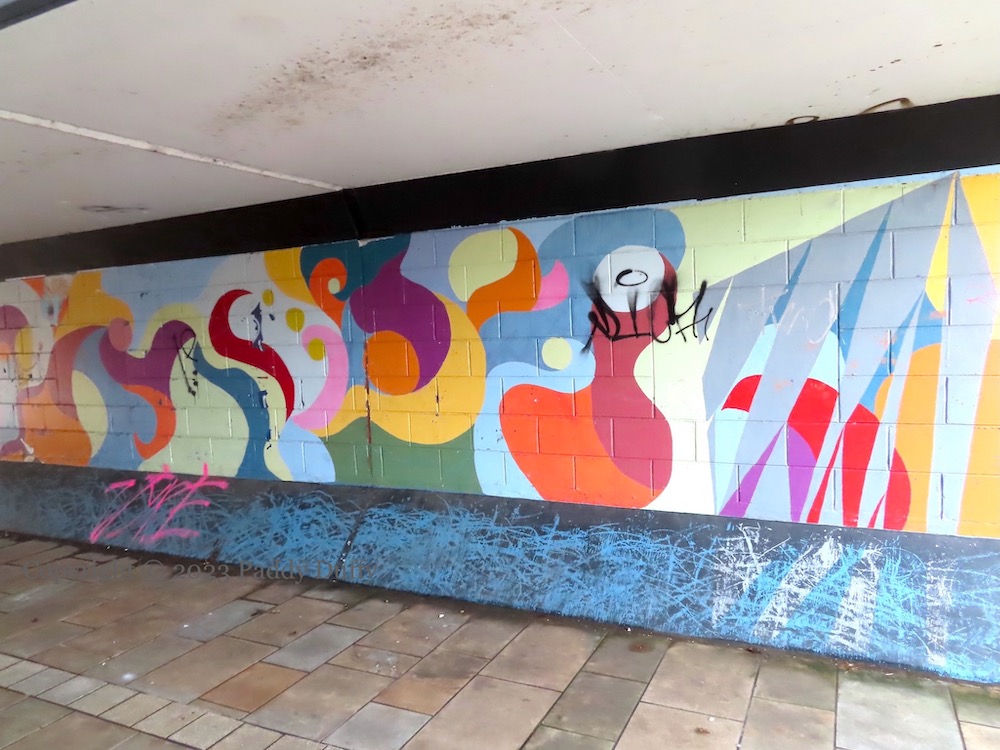
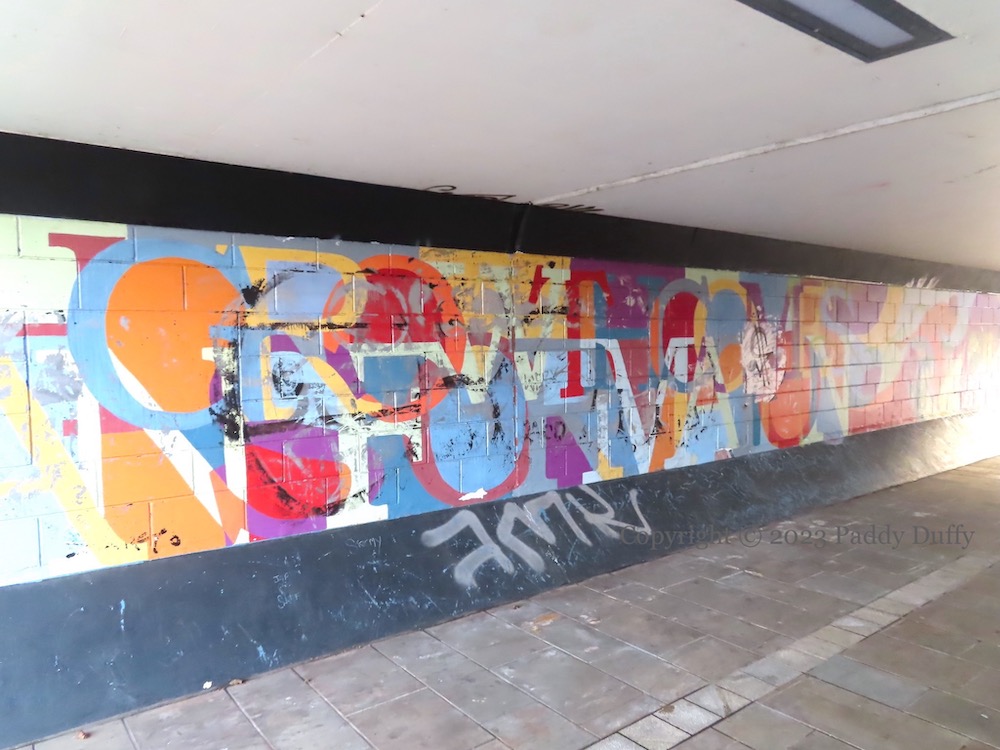
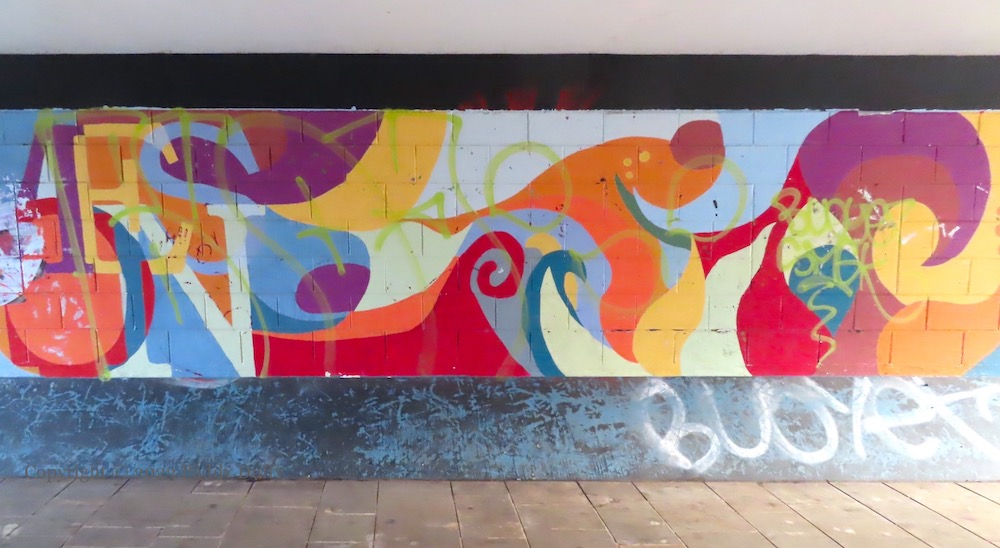
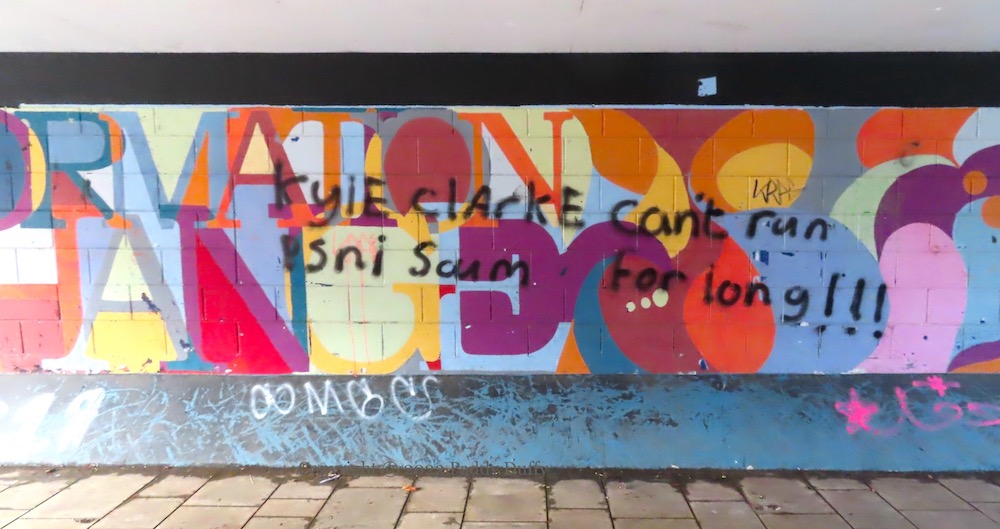
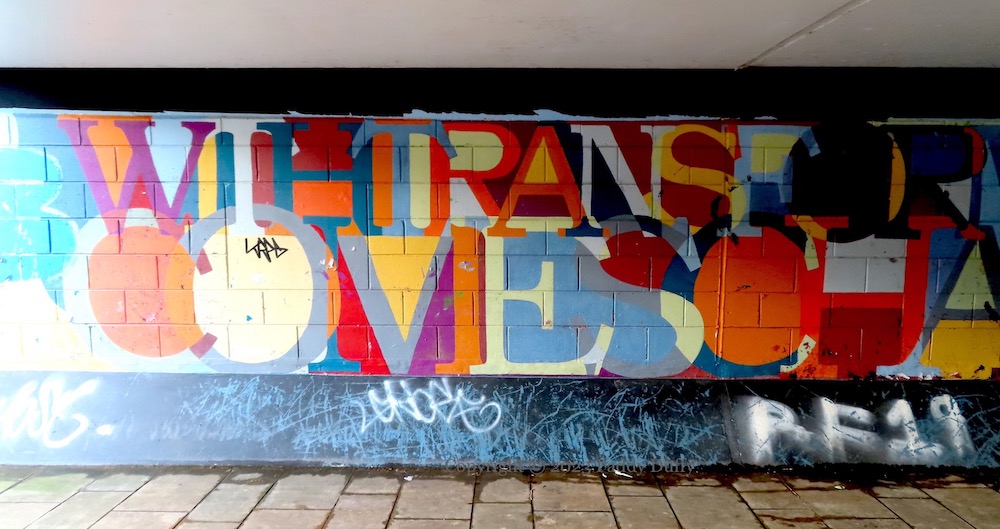
“With growth comes transformation, with transformation comes change.” This is a 2012 piece – now much the worse for wear – by Chuck Hoffman (Genesis Art) and a team of five students from Kansas (including Sam Fine) in the Bridge End tunnel (east Belfast).
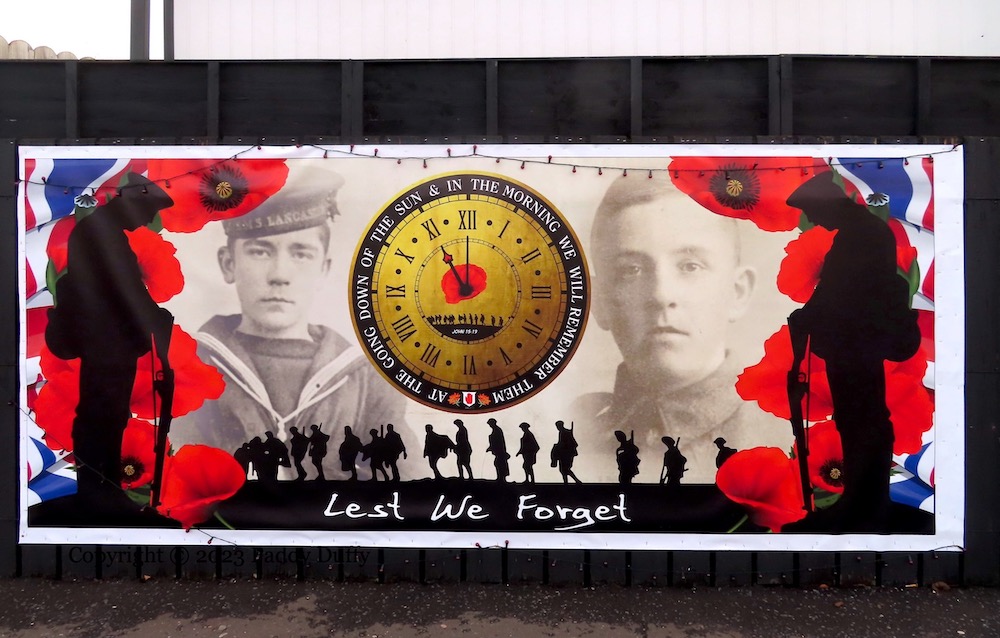
The portrait on the right is probably William McFadzean, familiar from murals such as in the Caw, Londonderry, and in Cregagh, Belfast (though the photo is unknown). The face on the left is John Travers “Jack” Cornwell, “the boy hero of Jutland”, who was awarded the VC for staying at his post as a sight-setter on the HMS Chester (the picture is from an earlier posting, on the HMS Lancaster) when it was hit by German light cruisers on May 31st, 1916. Cornwell died from shrapnel wounds on June 2nd (Mary Evans).
It’s not clear why Cornwell is included here, as he was from, and is buried in, east London, rather than Belfast or Ireland, and does not seem to be associated with the 36th Division. Please get in touch if you can explain his inclusion here. See also: Battle Of Jutland and HMS Caroline.
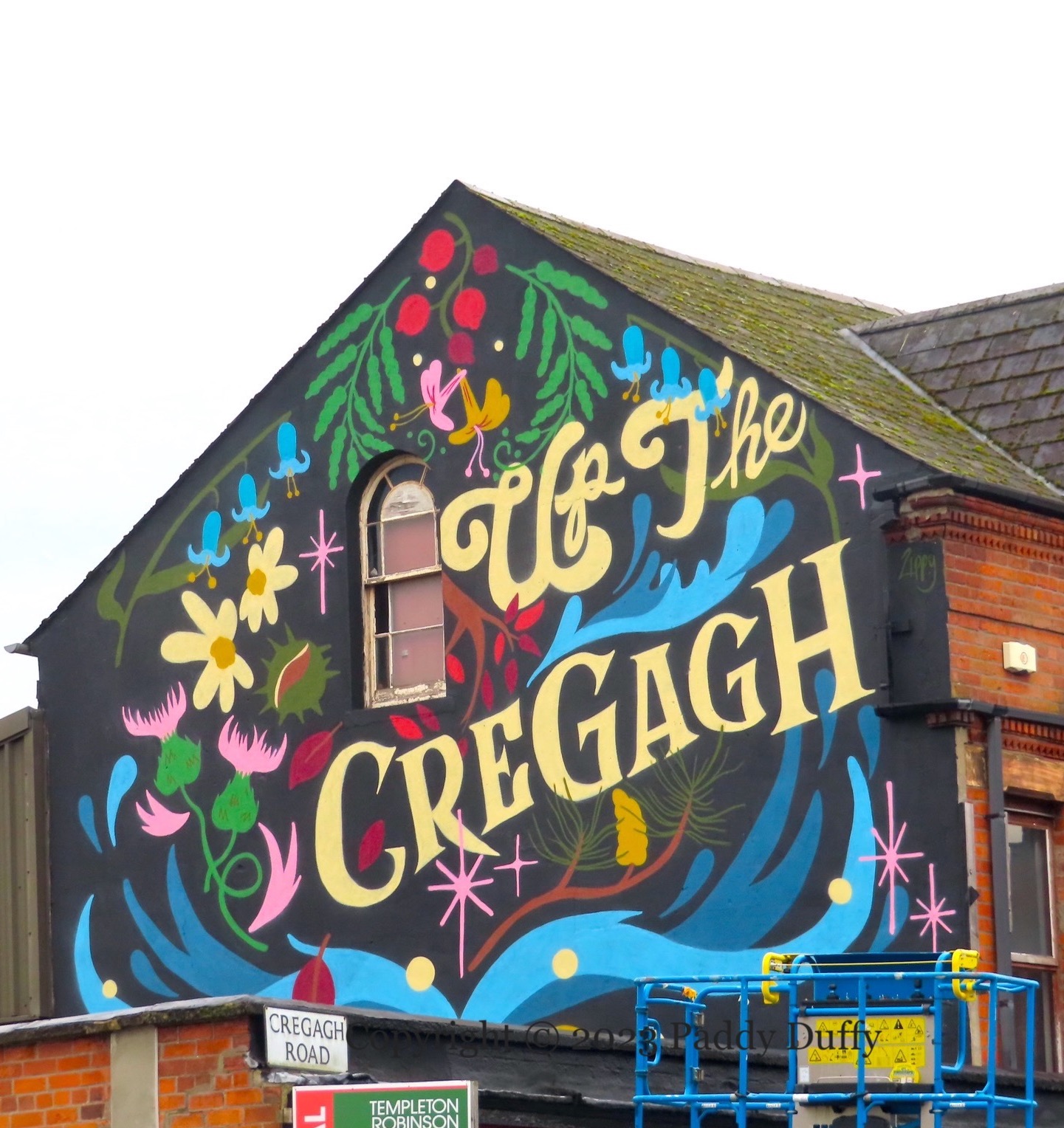
If you’re riding Shank’s mare, the combined length of the Cregagh and Woodstock roads is two miles; where they meet (opposite Ravenhill Avenue) you’ll find this new street-art by Zippy (ig) with support from Decowell Restoration (web), Bethany Fruit (web) and Astrl Fibres (ig), and funding from Belfast City Council).
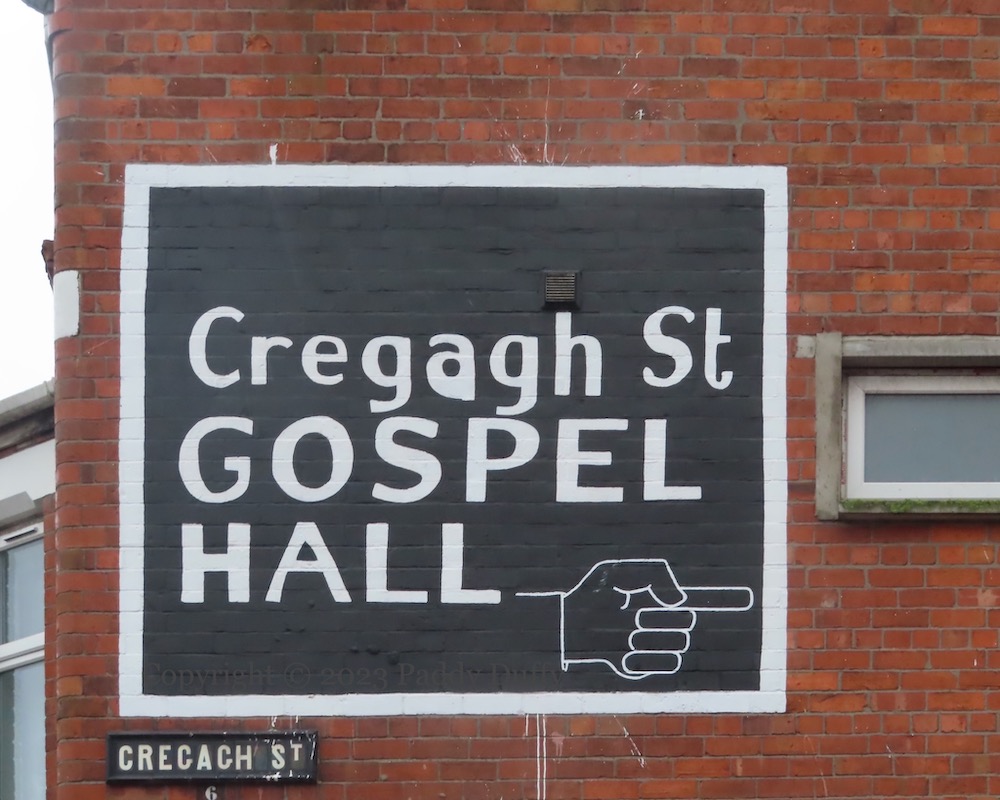
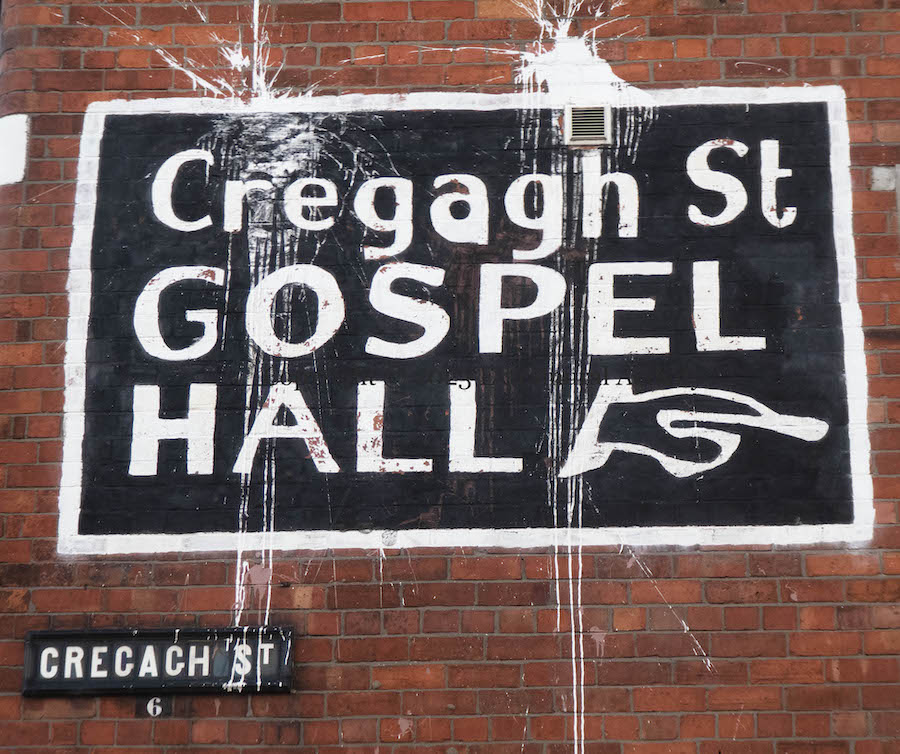
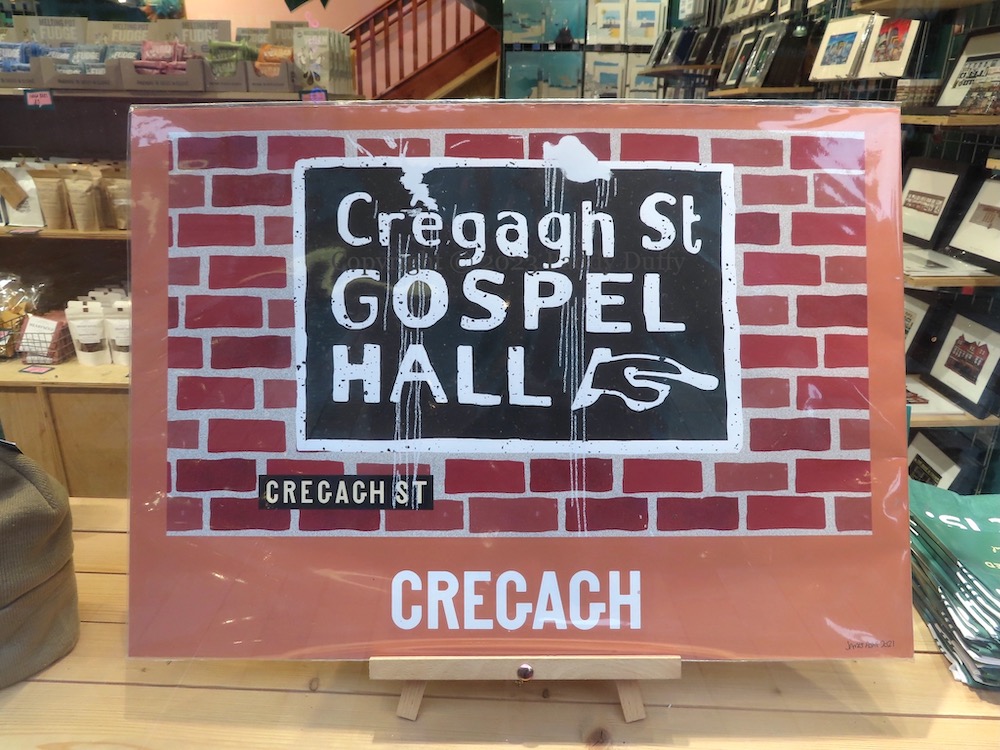
The paint-bombed version of the sign for Cregagh Street Gospel Hall remained in that state for over a decade, so long a time that this is how it is recognised by many and how it is reproduced in a postcard available in Born & Bred (web) in Ann St.
The image above (and of the shop display) are from October 2023; the image of the old sign is from January 2022. It was repainted in the summer of 2022.
The hall itself was constructed in 1938, on the site of a school, and Sunday service is still held (Precious Seed).
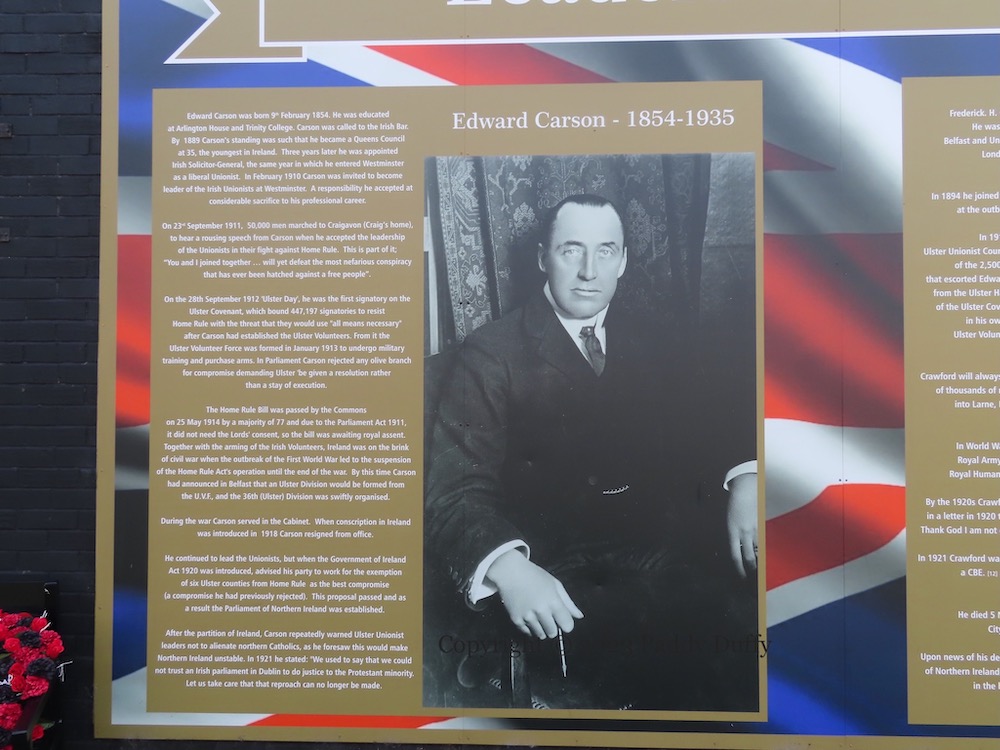
Carson, Crawford, and Craig are lionised as resisters of devolvement of Ireland to Dublin in the early twentieth century. Despite calling Home Rule “the most nefarious conspiracy that has ever been hatched against a free people” and vowing to fight it by “all means necessary”, including the Ulster Volunteers armed by Crawford’s “guns for Ulster”, Edward Carson “warned Ulster Unionist leaders not to alienate norther Catholics, as he foresaw this would make Northern Ireland unstable.”
Above is a mural in Carlingford St, east Belfast showing gravestones of two deceased locals: “6322 Private J. Condon, Royal Irish Regiment, 24th May, 1915, age 14” and “10/16015 Rifleman S. Thompson Royal Irish Rifles, 5th October, 1918”. Their gravestones are the end-point of a journey that began with the Covenant and the Ulster Volunteers (illustrated by images of Carson, the Covenant, gun-running, and Volunteers drilling).
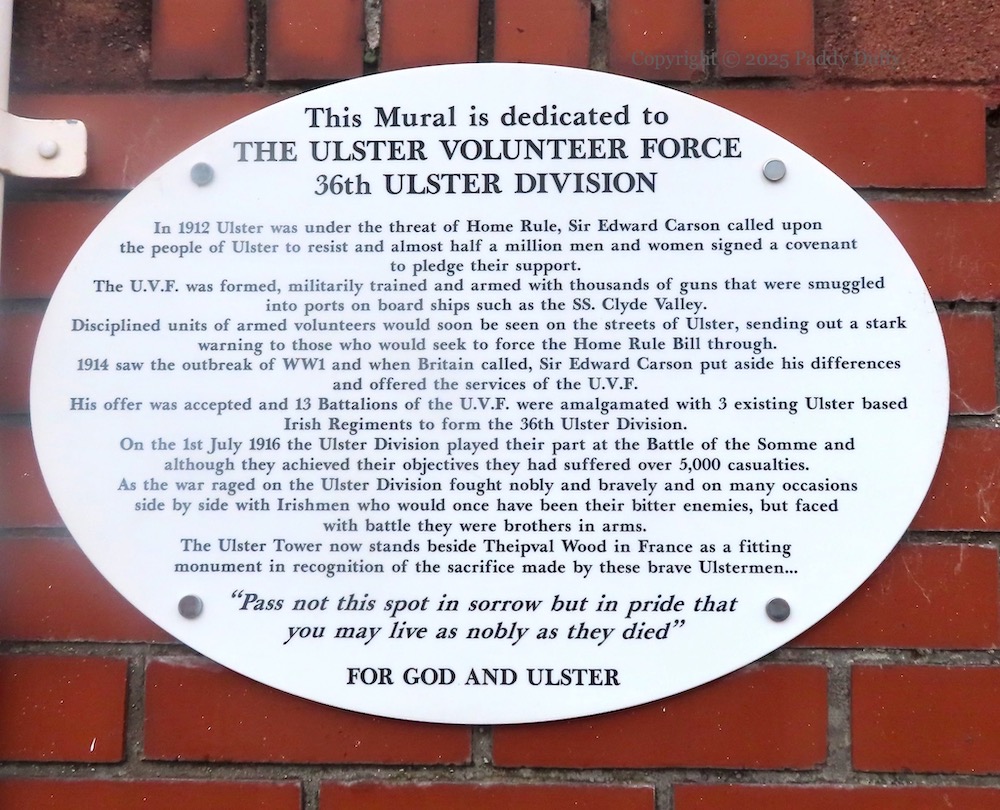
To the left is a plaque describing the journey from the Covenant to the Ulster Volunteers to the Somme: “In 1912 Ulster was under the threat of Home Rule, Sir Edward Carson called upon the people of Ulster to resist and almost half a million men and women signed a covenant to pledge their support. The U.V.F. was formed, militarily trained and armed with thousands of guns that were smuggled into ports on board ships such as the SS. Clyde Valley. Disciplined units of armed volunteers would soon be seen on the streets of Ulster, sending out a stark warning to those who would seek to force the Home Rule bill through. 1914 saw the outbreak of WW1 and when Britain called, Sir Edward Carson put aside his differences and offered the services of the U.V.F. His offer was accepted and 13 battalions of the U.V. F. were amalgamated with 3 existing Ulster based Irish regiments to form the on the 36th (Ulster) Division. On the 1st july the Ulster Division played their part at the Battle of the Somme and although they achieved their objectives they had suffered over 5,000 casualties. As the war raged on the Ulster Division fought nobly and bravely and on many occasions side by side with Irishmen who would once have been their bitter enemies, but faced with battle they were brothers in arms. The Ulster Tower now stands beside Theipval [sic] Wood in France as a fitting monument in recognition of the sacrifice made by these brave Ulstermen … “Pass not this spot in sorrow but in pride that you may live as nobly as they died” For God and Ulster”
There is also a side-wall (out of frame to the right) with the words of Captain Wilfrid Spender, describing the first day of the Battle Of The Somme, 1916, but it is in poor condition.
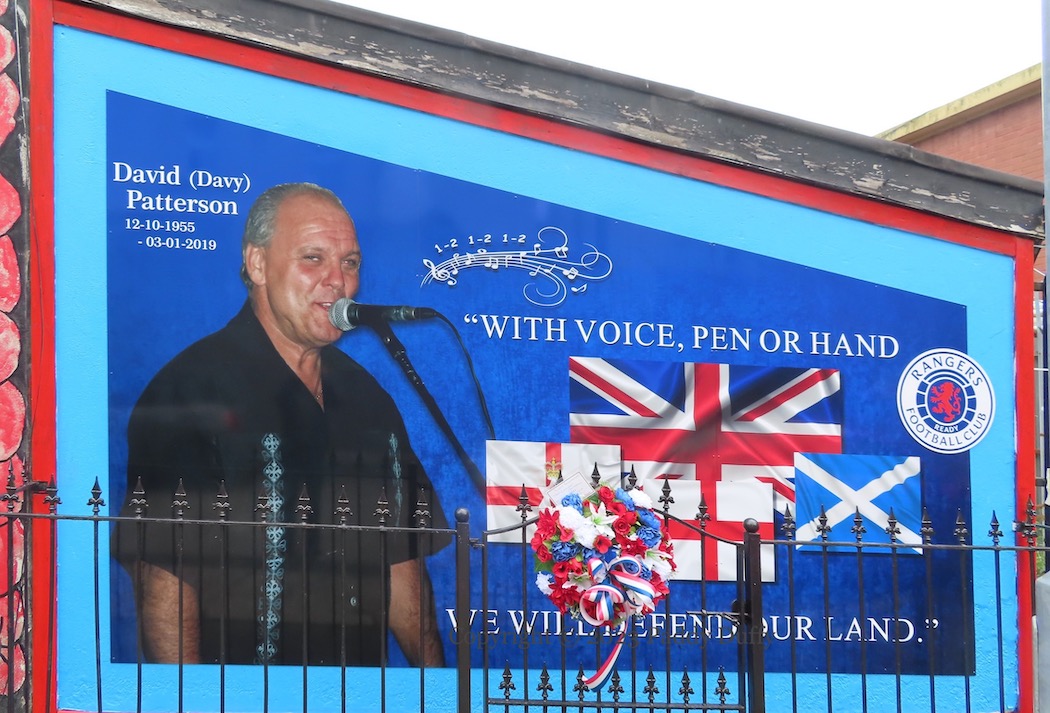
“With voice, pen or hand we will defend our land.” David (Davy) Patterson (12-10-1955 – 03-01-2019) was a member of the 1st East Belfast Rangers Supporters Club (Fb) and Albertbridge Glentoran Supporters Club (Funeral Times). This memorial board is the side-wall to the Somme Society mural (see Their Name Liveth Forevermore) and the Red Hand Commando memorial garden in Hunt Street, east Belfast.






 Paddy Duffy Collection