Please Wake Up!

This is a new tarp on Dee Street, east Belfast, in which a child asks a sleeping lion to “wake up”. Both are wrapped in the Union Flag. The (probable) context for the image is the idea that foreigners – and in particular, non-white, non-Christian, foreigners – have been moving to the UK and that over time their numbers have increased, without much notice, to such a level that English (or more broadly, the UK) people need to rouse themselves in order to notice and counter this.

We have a working principle that the level of investment in a piece’s production is an indicator of the extent to which the producer(s) believes it will be accepted (or at least countenanced) by the community in which it appears. This printed tarp is, as far as we know, the most sophisticated expression of anti-immigrant feeling so far (or at least, the most expensive to produce). Prior to this, there have been placards (One Big Clean-Up | Not A Dumping Ground | If Necessary We Must Shed Blood), a simple stencil (I Was A Stranger), a short-lived printed paste-up (Multiculturalism Is Genocide), and various appearances of “locals only” graffiti (2025 | 2024 | 2014 | 2014). According to a 2023 study from KCL, 32% of UK residents think the “Great Replacement” conspiracy theory is “definitely” or “probably” true, while 22% of Irish people (in 2024) think so (Gript/Electoral Commission).

Click image to enlarge
Copyright © 2025 Paddy Duffy
T07627 T07626

Woodstock Tartan

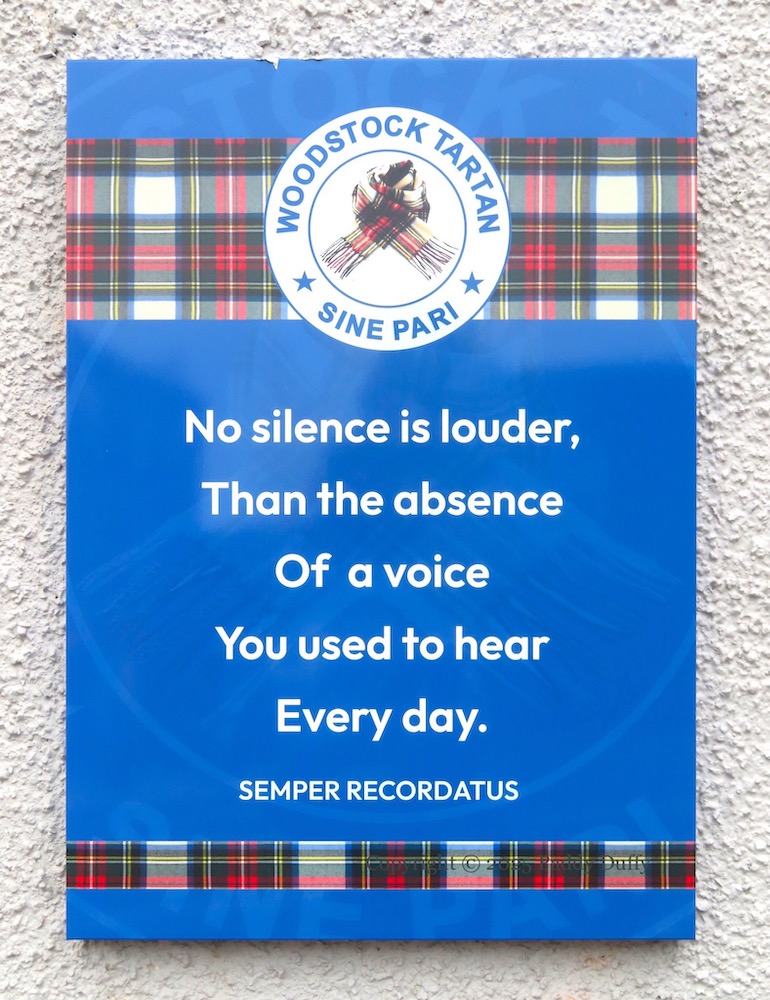
“Woodstock tartan – sine pari”.

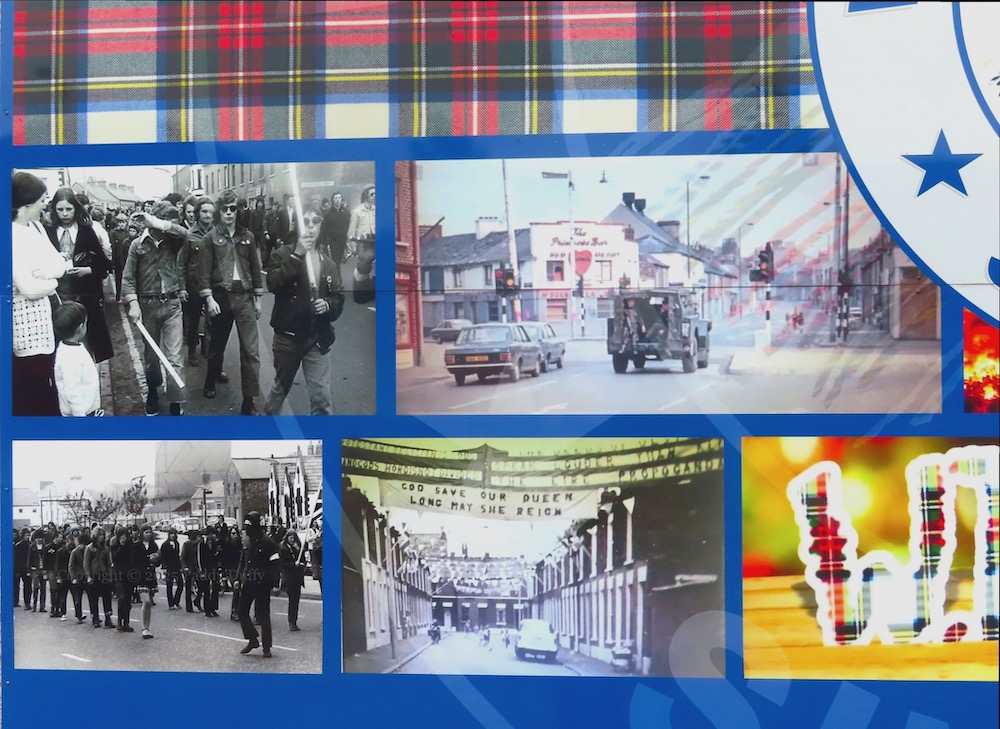
Tartan gangs were a short-lived phenomenon in the early 70s, bridging the gap between youthful trouble-making and para-militarism. The gangs as entities distinct from youth wings of paramilitary groups had largely disappeared by the late 70s, and the teens and young adults who were members then are now in their sixties and seventies and some have passed away (“No silence is louder, than the absence of a voice you used to hear every day. Semper recordatus”). This new (July 2025) board commemorates the camaraderie of the Woodstock Tartan in those early days: “We are young, we are one, we are tartan”.

The name “tartan [gang]” comes from the tartan clothing, particularly scarves, worn by the gangs. Gareth Mulvenna (2014 and in History Ireland) reports that the first pattern worn by the Shankill Young Tartans was in fact the Burberry tartan – a box of scarves was stolen during a trip to a Rangers match in Glasgow – but they later adopted the Royal Stewart tartan, which is predominantly red rather than tan. (It was made famous by motor-racer Jackie Stewart, who wore a tartan sticker on his helmet (Henry Ford).) The Woodstock tartan pattern (shown in the new board) is the ‘dress’ (white) variant of the Royal Stewart tartan.

The speakers at the board’s launch (Loyalist East Belfast on youtube) recall the activities (and fashions) of the Woodstock gang in the early 70s – building bonfires, attending matches, holding running battles with other gangs – and only obliquely mention the turn towards sectarian violence, ultimately joining the Red Hand Commando in 1972 in response to IRA attacks such as at the Four Step Inn (Mulvenna). In this 7-minute TV report about the Woodstock Tartans from May 1972 (youtube), an interviewee distinguishes the Tartans in east Belfast from gangs in England as defenders of their area: “when IRA mobs come out [from Short Strand] and attack this Protestant area, we have to beat them back, as the soldier don’t seem able to do this.” (See also this Time interview.)

Click image to enlarge
Copyright © 2025 Paddy Duffy
T07370 T07369 T07371 T07372 T07373 T07374

Join Your Local Band

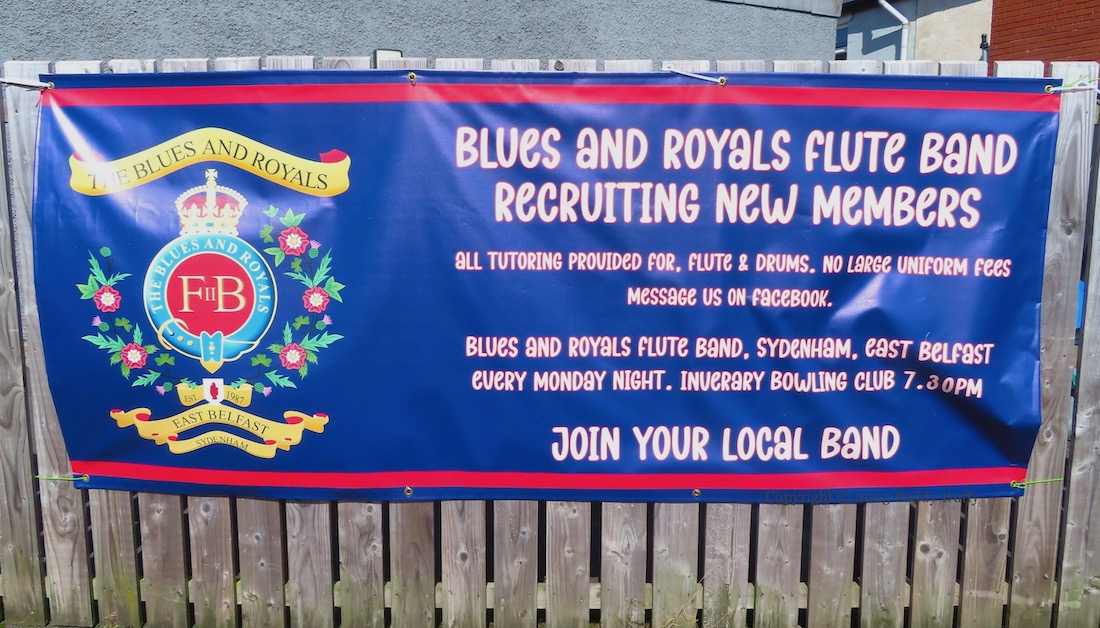
Here are three from Mersey Street, east Belfast.

Above, a recruitment tarp for the Blues And Royals flute band (Fb).

Below, (and on the wall above the flute band’s tarp) a NI Centenary board using the St Patrick’s saltire in the background. The saltire is an Anglo symbol of Ireland and was included in the Union Flag when the union was between Britain and Ireland and thus – like the word “Ulster” – has been reduced to signifying Northern Ireland after partition.

Last, street-art on the bridge over Conn’s Water.

Click image to enlarge
Copyright © 2025 Paddy Duffy
T07291 T07293 T07292

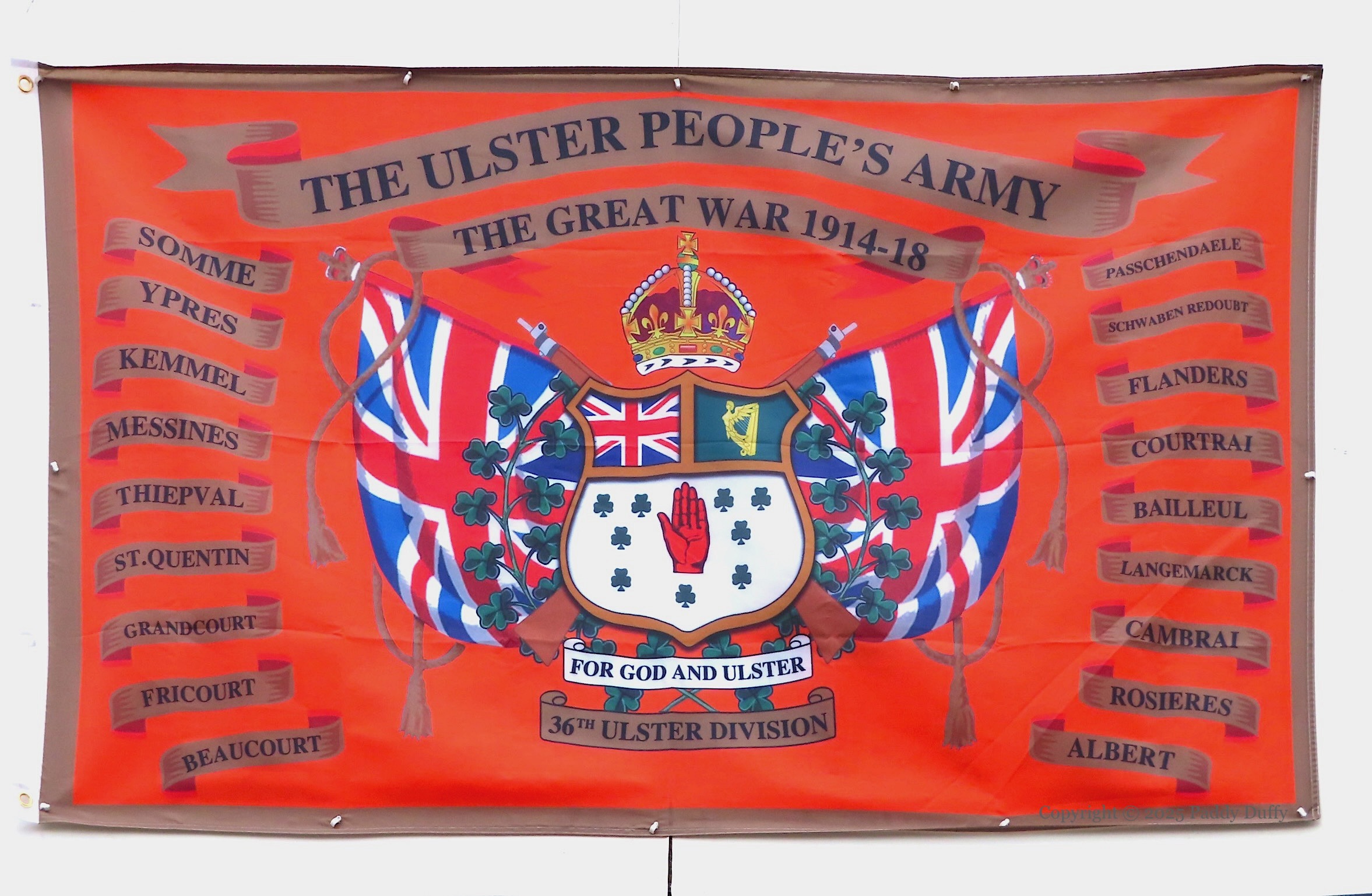
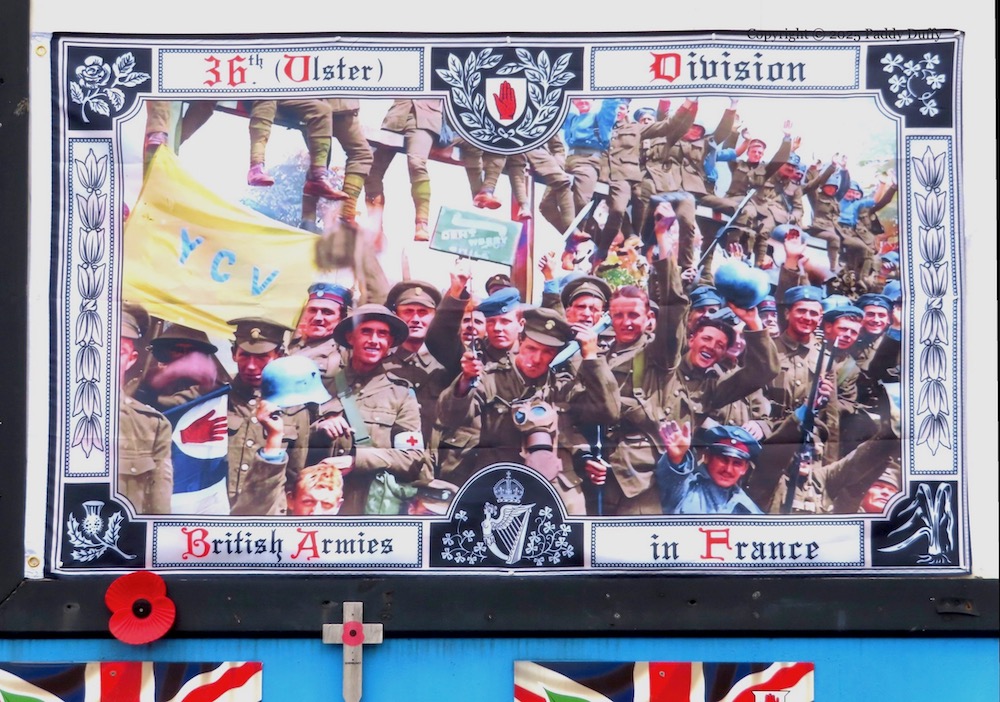
The Ulster People’s Army

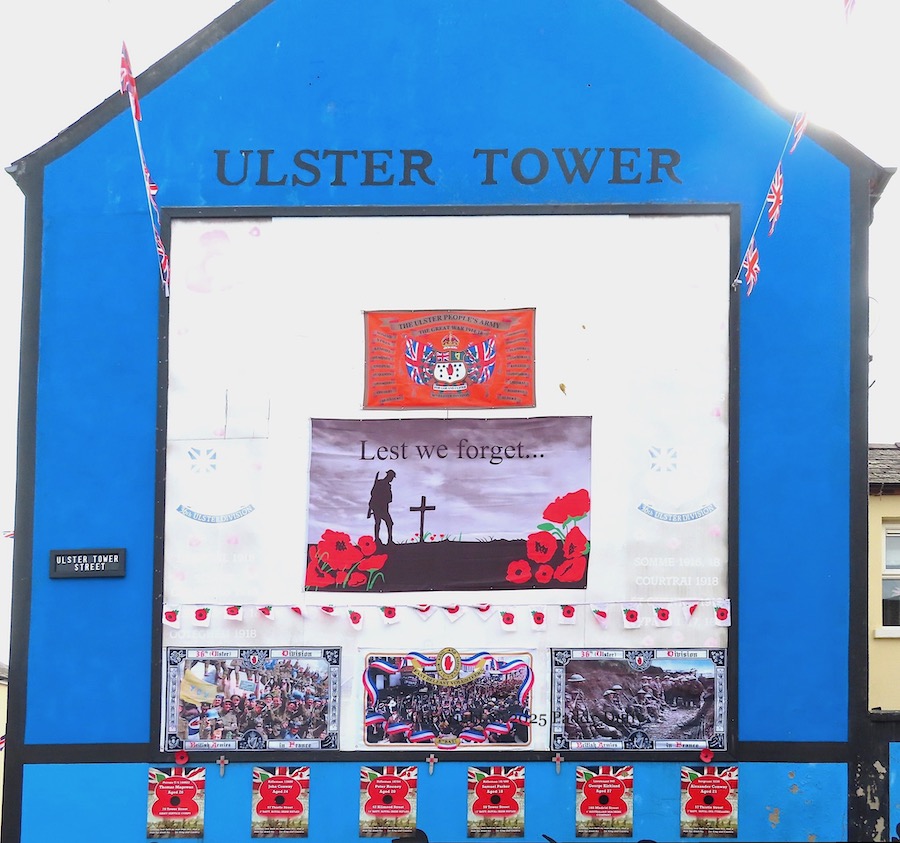
The image of the Ulster Tower at Thiepval in (Ulster) Tower Street, east Belfast, has now faded beyond recognition (see 2022 | 2016) and so been covered over with a variety of flags affixed to the wall.

First is “The Ulster People’s Army – the Great War 1914-18”, then a graveside mourner, and then three along the bottom, two from a series of “British Armies In France” showing images of the Royal Irish Rifles (with, unusually, the leek standing for Wales in the quartet of national flowers) and these two flanking a third showing the East Belfast regiment of the Ulster Volunteers transformed into the 8th battalion of the RIR (107th brigade, 36th Division), marching past a throng on their way to fight “for King and empire”.

Click image to enlarge
Copyright © 2025 Paddy Duffy
T07104 [T07103] [T07105]
T07110
[T07106] T07107 T07108 T07109
T07111 T07112

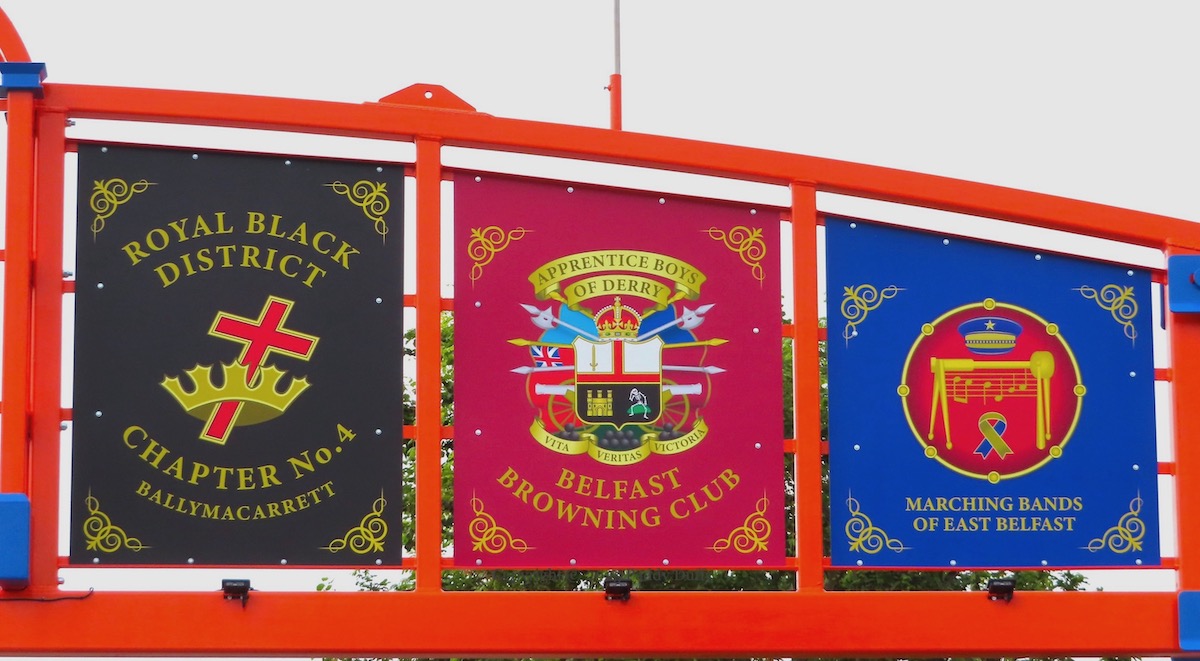
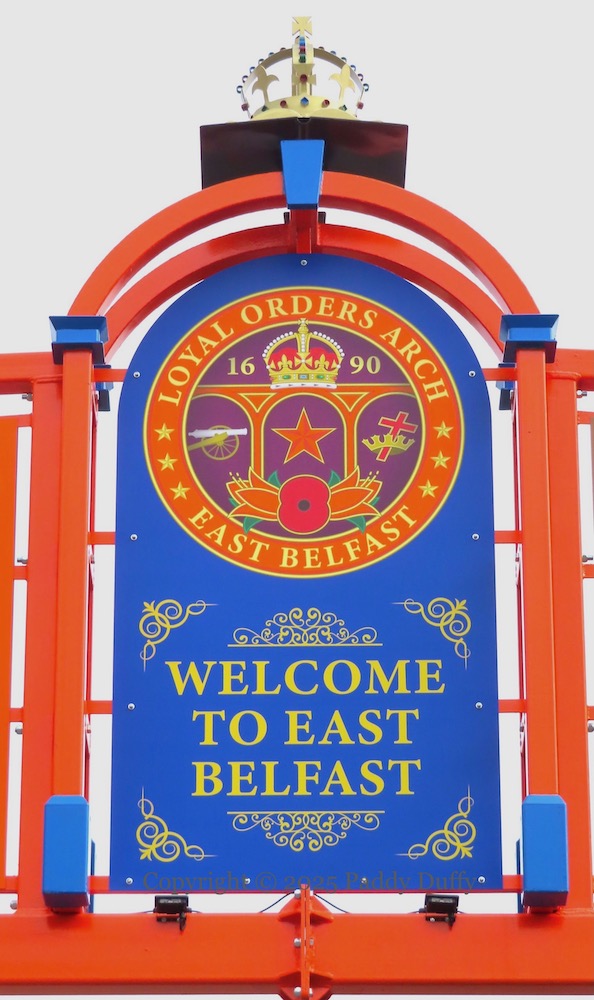
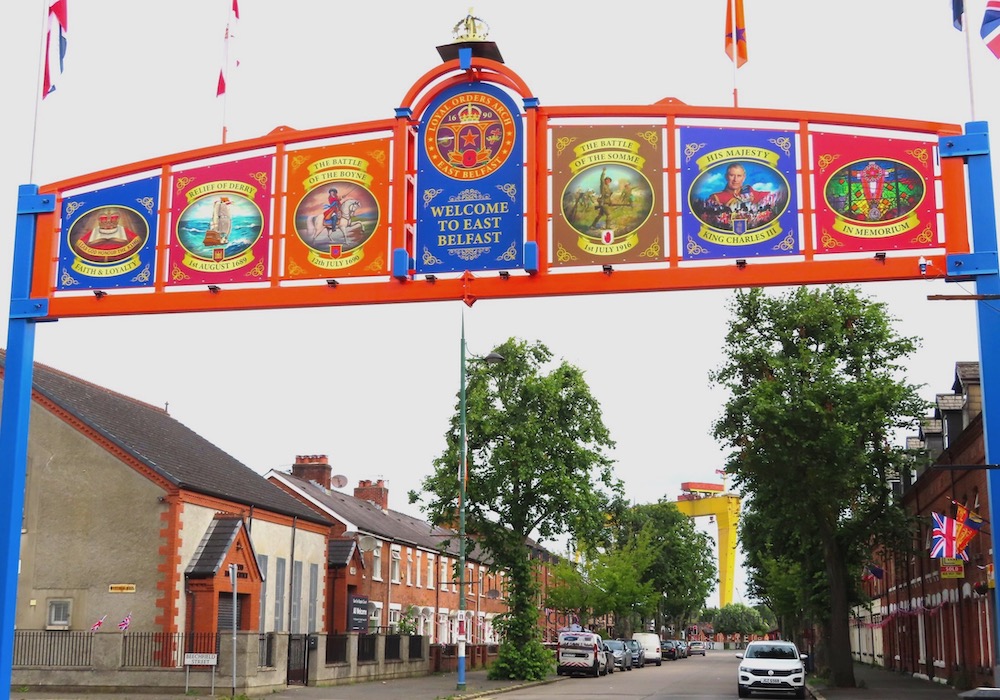
Loyal Orders Arch

The News Letter reports that the new arch at the junction of Templemore Avenue and Beechfield Street is the first new arch in east Belfast for fifty years (News Letter). There was long ago an arch in Dee Street (Fb).

On the northern side are the emblems of local lodges – Ballymacarrett Junior District LOL No. 3, Royal Arch Purple District Chapter No. 6, Ballymacarrett District No. 2 Women’s LOL, Ballymacarrett District LOL No. 6, Royal Black District Chapter No. 4 Ballymacarrett, Apprentice Boys Of Derry Belfast Browning Club – as well as “Marching Bands of east Belfast”.

On the southern side, we see (l-r) “Faith & Loyalty”, the Relief Of Derry, the Battle Of The Boyne, JP Beadle’s painting of the 36th Division going over the top at the Battle Of The Somme, King Charles III, the stained-glass window in Schomberg House in memoriam (not: “in memorium”) murdered OO members.

The arch was officially dedicated on June 30th. Ballymacarrett Orange Hall is a bit further down Templemore Avenue, on Albertbridge Road.

Click image to enlarge
Copyright © 2025 Paddy Duffy
T07093 T07095 T07096
T07097 [T07094] [T07098]
T07102 [T07101] T07100

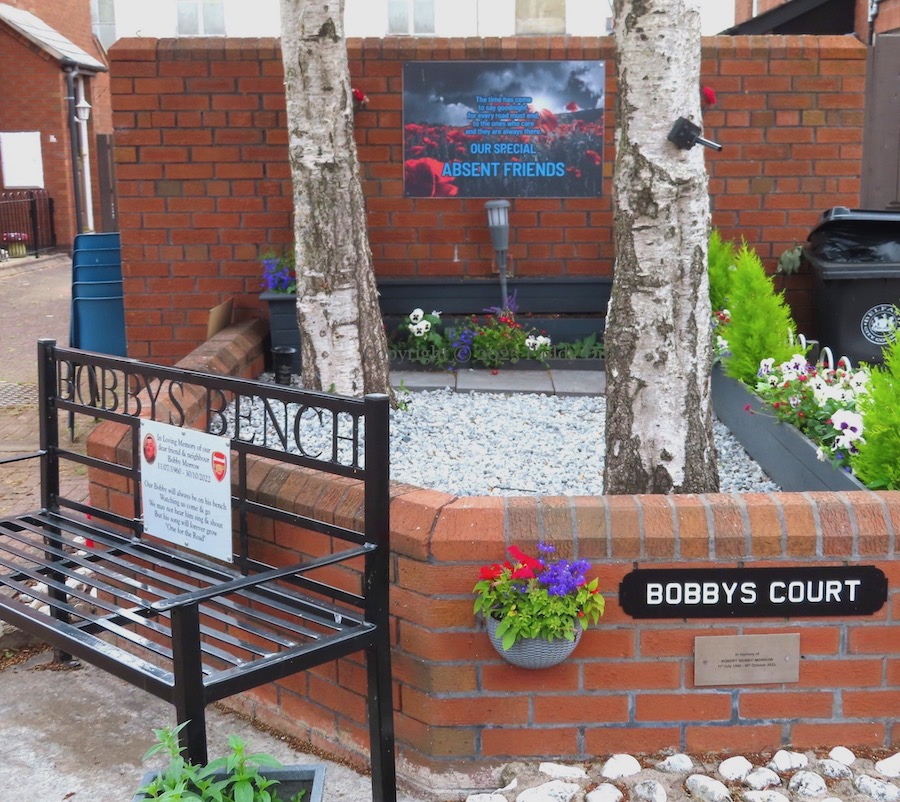
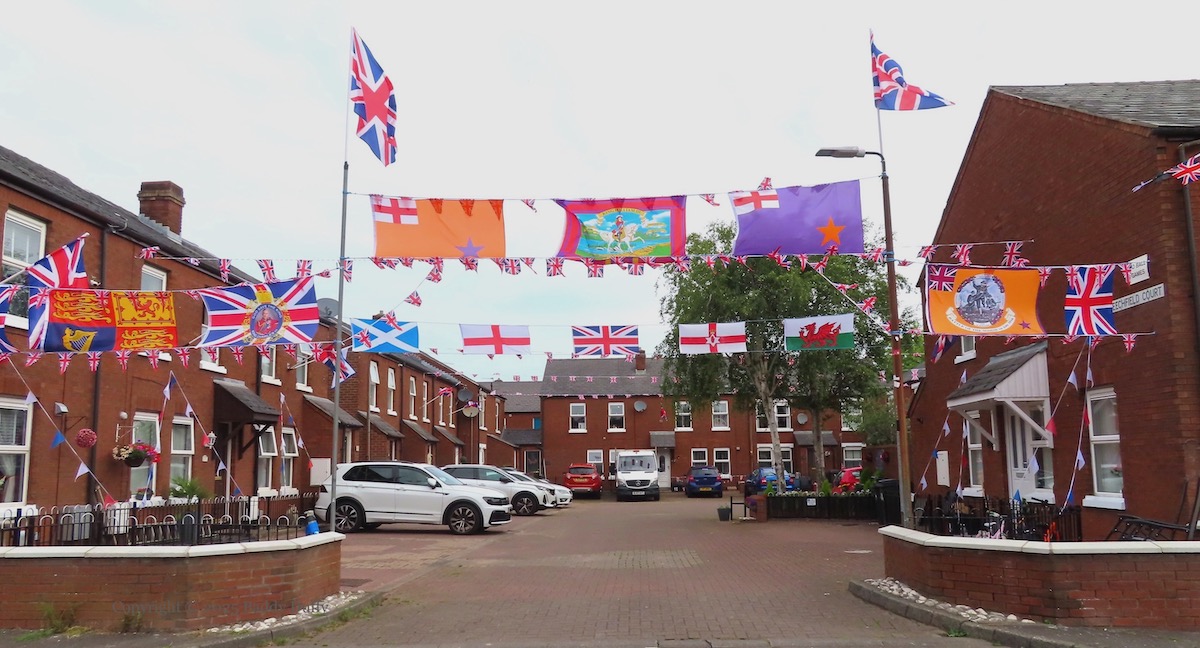
Our Special Absent Friends

These are images of the scene in the run-up to the Twelfth in Beechfield Court (near “Ulster” Tower Street in east Belfast), including a small memorial to a local man who died in 2022, Bobby Morrow (Funeral Times).

“The time has come to say goodnight, for every road must end, to the ones who care and they are always there, our special absent friends.”

“In loving memory of our dear friend & neighbour Bobby Morrow 11/07/1960 – 30/10/2022. Our Bobby will always be on his bench/Watching us come & go/We may not hear him sing & shout/But his song will forever grow/”One for the Road””

Click image to enlarge
Copyright © 2025 Paddy Duffy
T07113 T07114 [T07115] T07116

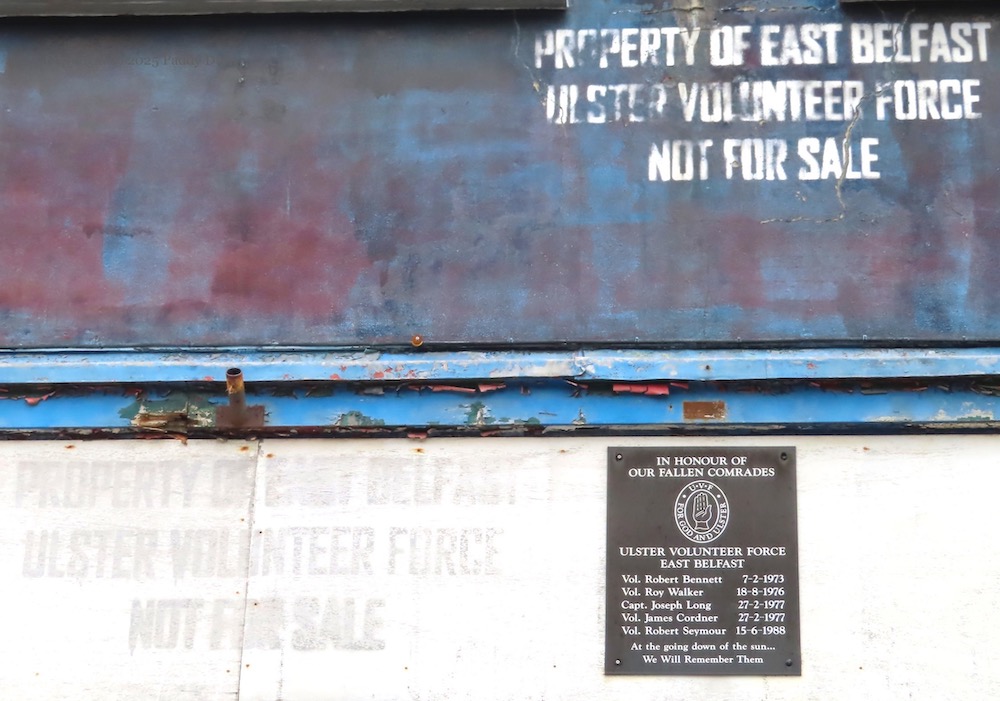
Property Of East Belfast UVF

This notice is on the outside of the Belvoir Bar in east Belfast: “Property of east Belfast Ulster Volunteer Force – Not for sale” alongside a plaque to “fallen comrades” Robert Bennett, Roy Walker, Joseph Long, James Cordner, and Robert Seymour. It seems that the bar has been shuttered since 2011 (Belfast Telegraph | Irish Times).

Newtownards Road, east Belfast, next to the WWI VCs memorial.

Click image to enlarge
Copyright © 2025 Paddy Duffy
T07117 T07118

Their Amazing Attack

This is a printed version Wilfrid Spender’s report of the first day of the Battle Of The Somme, replacing a previously painted instance that was in the same style as the adjacent mural.

“‘I am not an Ulsterman but yesterday the First of July, as I followed their amazing attack, I felt that I would rather be an Ulsterman than anything else in the world. My pen cannot describe adequately the hundreds of heroic acts I witnessed, the Ulster Volunteer Force, from which the Division was made, has won a name that equals any in history. Their devotion deserves the gratitude of The British Empire’ – Captain Wilfrid [not “Wilfred”] Spender, The Somme 1916″

Spender’s words are superimposed upon JC Beadle’s Attack Of the 36th Division (see Over The Top).

Carlingford Street, east Belfast

Click image to enlarge
Copyright © 2025 Paddy Duffy
T07083 T07084 [T07085]

Flora

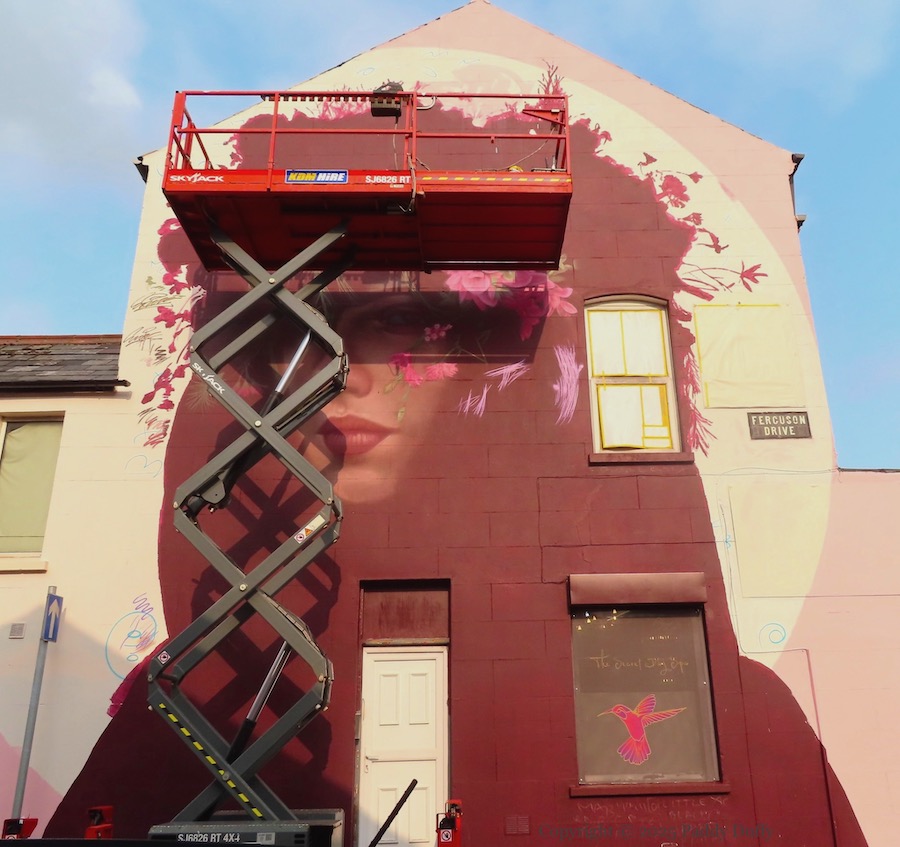
CS Lewis’s mother was Florence “Flora” Augusta Lewis. She studied arts, logic, and mathematics at Queen’s College (which became the Royal University during her studies, and is now Queen’s University) and taught Clive and his older brother Warnie Latin and French at home. She developed cancer when Clive was nine years old and died at age 46 on August 23rd, 1908, at the family home in Strandtown, east Belfast (Christian History Institute | Lifelong Learner | CS Lewis Institute | WP). Her grave is in Belfast City Cemetery (FindAGrave).

The Lewis family previously lived in the Dundela Villas (now the site of Dundela Flats) a few streets away from this new work by emic (web) along Belmont Avenue, which draws inspiration from Flora for its subject, and the local shops (The Secret Day Spa | Murphy & Bailey) for its palette.

The image above is from June 15th; the image immediately below, of the full, completed piece, is from June 20th. Two in-progress images are also included.

Ferguson Street, east Belfast

June 8th:

June 3rd:

Click image to enlarge
Copyright © 2025 Paddy Duffy
T07014 [T07015]
T07054 [T07055]
T06976 [T06975]
T06944 [T06943] [T06942]

Be Kind To Your Mind

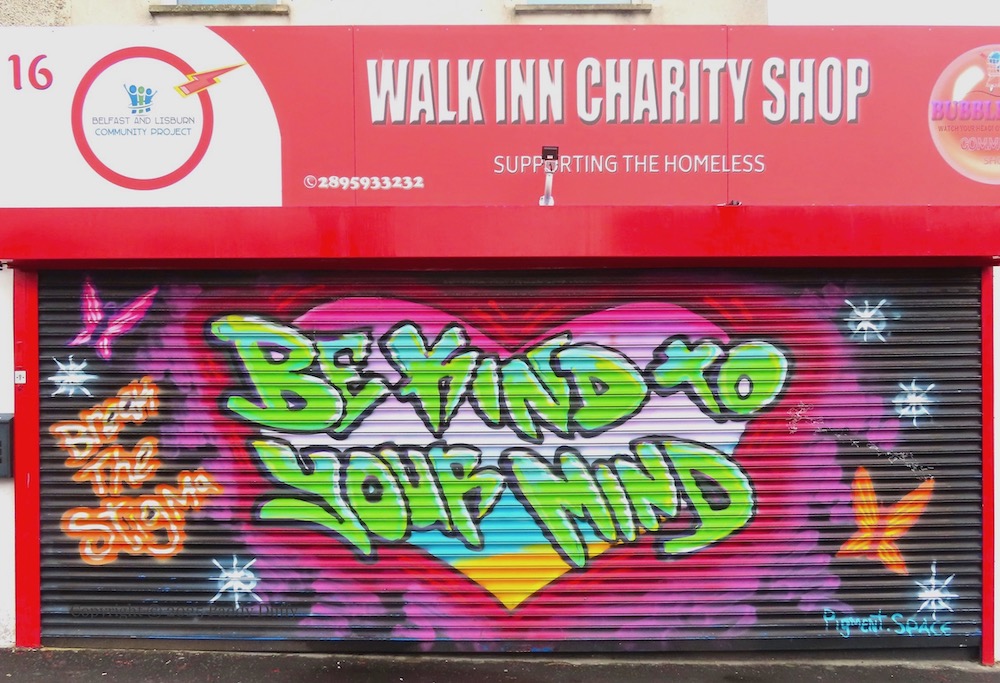
“Break the stigma – be kind to your mind” – mental-health messaging by Pigment Space (ig) on the shutters of the Walk Inn Charity Shop, Holywood Road, east Belfast – next to Forever Changes (Bill Harris hair salon) and The Holywood Arches (Arches café), and across from Be Your Own Kind Of Beautiful (Norah Mitchell flowers).

Click image to enlarge
Copyright © 2025 Paddy Duffy
T07017 T07018