The hand-painted UVF Scottish Brigade mural (see Boab Kerr) in Beechfield Street/Tower Street has been replaced by this new printed board. The plaque to Kerr has been retained, but four names have been added – David Totten, Brian Milligan, Billy Inglis, and Jim Holt, who is now the most prominent. Holt died in February 2021 (ACT Fb).
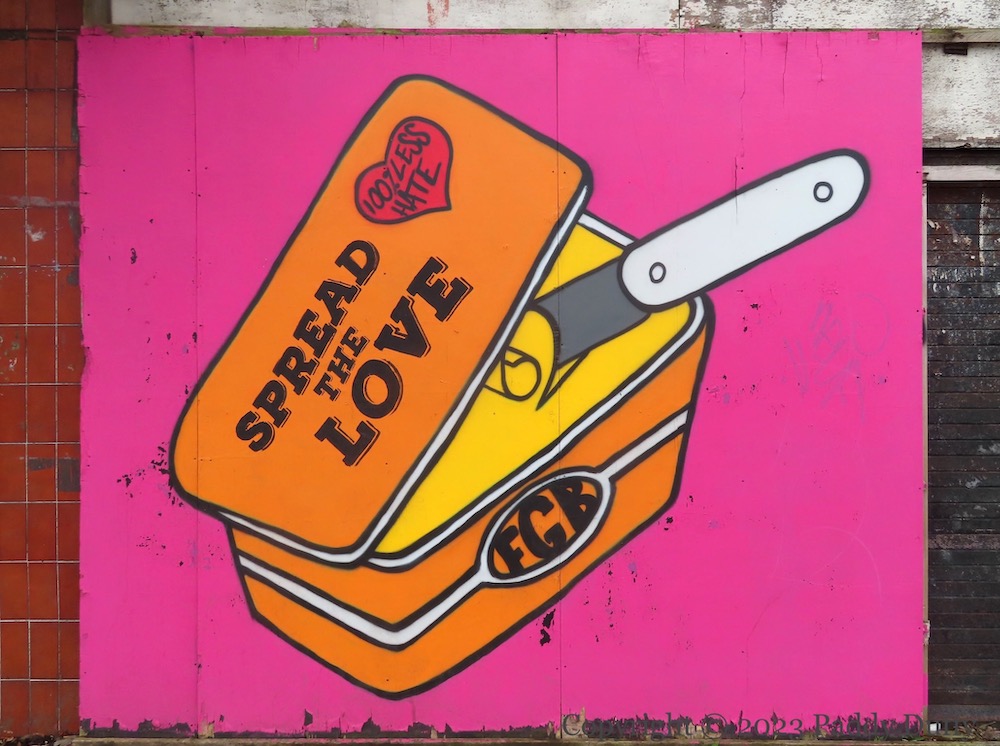
“100% less hate”, says street artist FGB (ig), ruthlessly taking over a site of Hallion’s Covid-era graffiti (see Inspiring Belfast | Between The Lines | It Hasn’t Gone Away You Know). Will an east-Belfast turf-war result? Or will both parties just move to the Vault’s new digs down-town (and in the Shankill)?
The mural’s design was previously a paste-up and a sticker (seen in a 2019 post) and a print (ig).
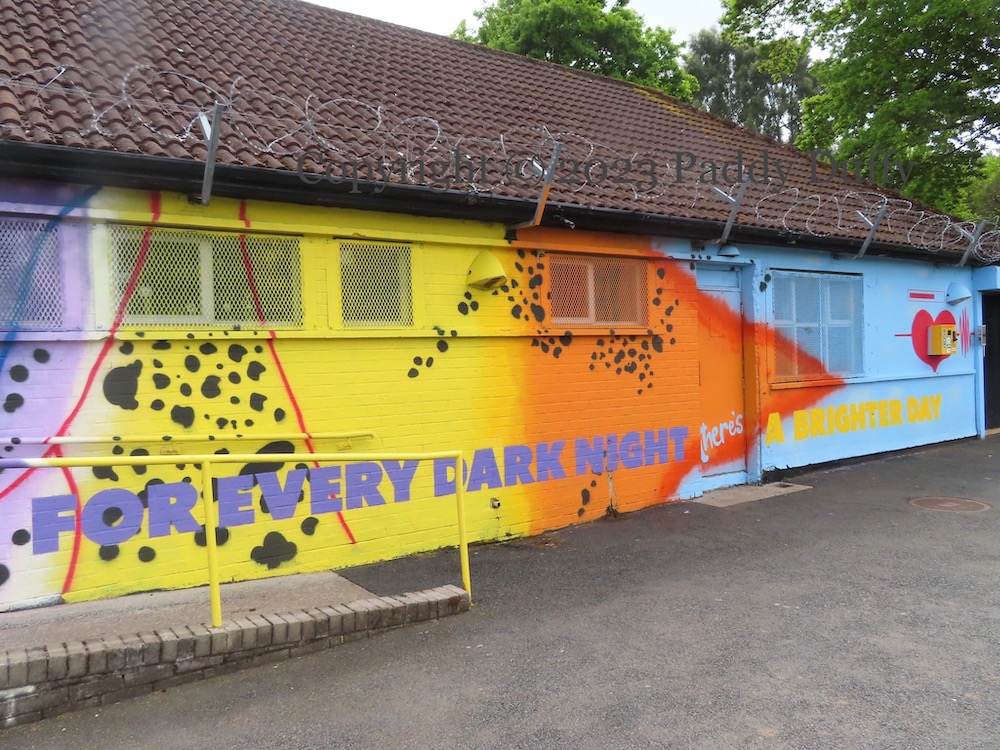
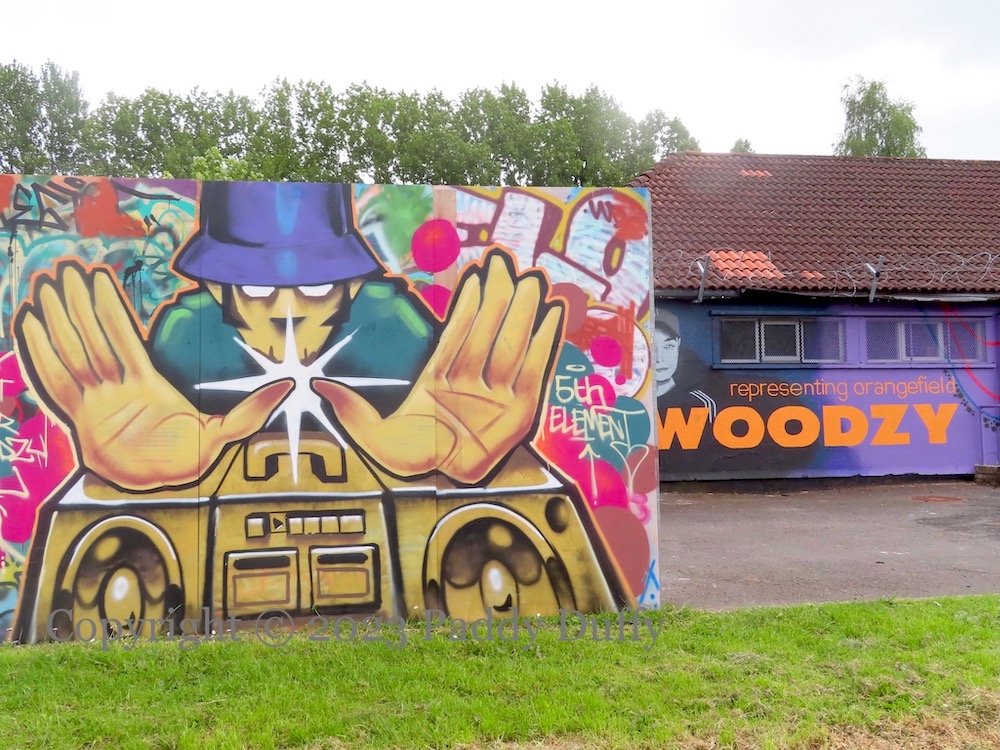
“For every dark night there’s a brighter day.” This mural on the pavilion in Orangefield Park encourages people –young men in particular – to take care of their mental health, and serves as a memorial to Adam “Woodzy” Woods, who died last (2022) May of an overdose (BBC). Skank FM has images of the launch (instagram). With assistance by 5th Element (ig).
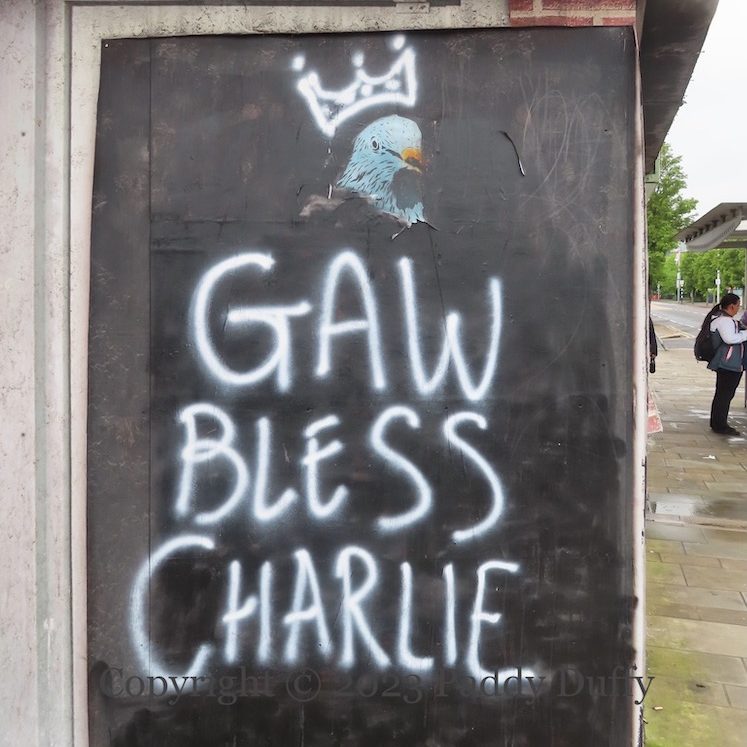
A traffic cone provides a makeshift flower holder in front of this board Clara Street board: “Grove Community Group [Baptist Church (web | Fb)] mourns the passing of Queen Elizabeth II 1926-2022″. Charter NI has images from last September of more bouquets and a piper at the board (tw).
The Con O’Neill bridge crosses the Knock river just before it meets the Loop river to form the Connswater, which used to be Con’s water, and provided a way for “men, horses and livestock to cross the river” (Con O’Neill).
The mural depicting such a crossing, by Friz (ig), is on a gable wall in the car park next to the bridge; the area is now known as The Hollow, as in “Hey, where did we go?/Days when the rains came/Down in the hollow/Playin’ a new game.” (For an image of bridge partially submerged and impassable in 2012, see Geograph | more images at Google Maps Places.)
Con lived c. 1600 but the bridge might well pre-date that time. It was refurbished as part of the Connswater Greenway project in ?2014?.
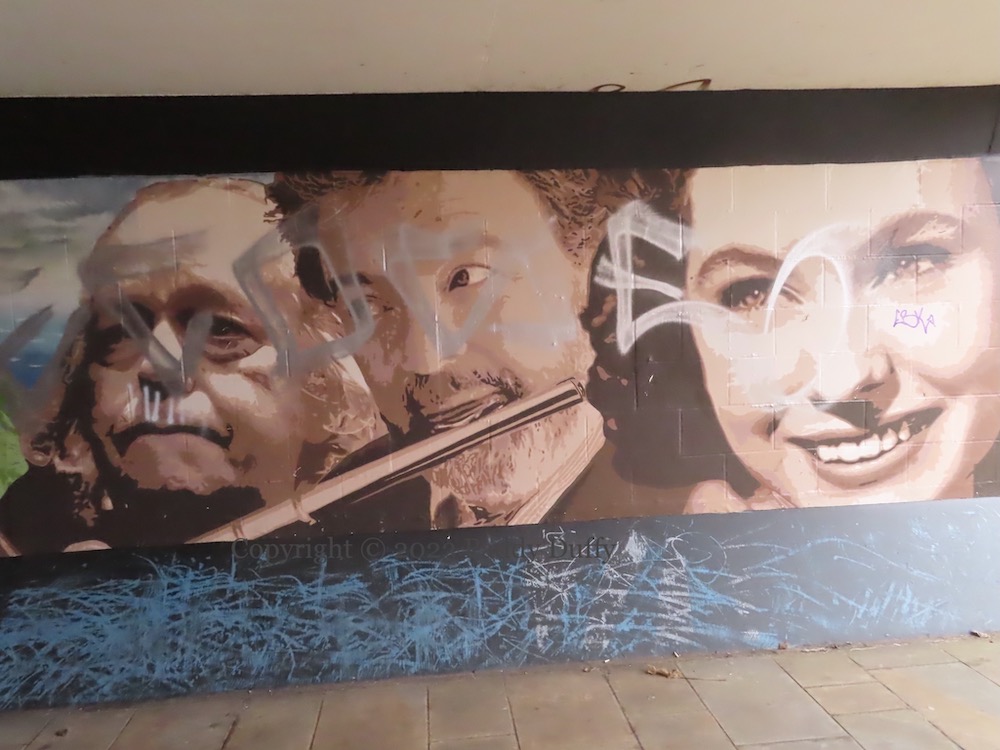
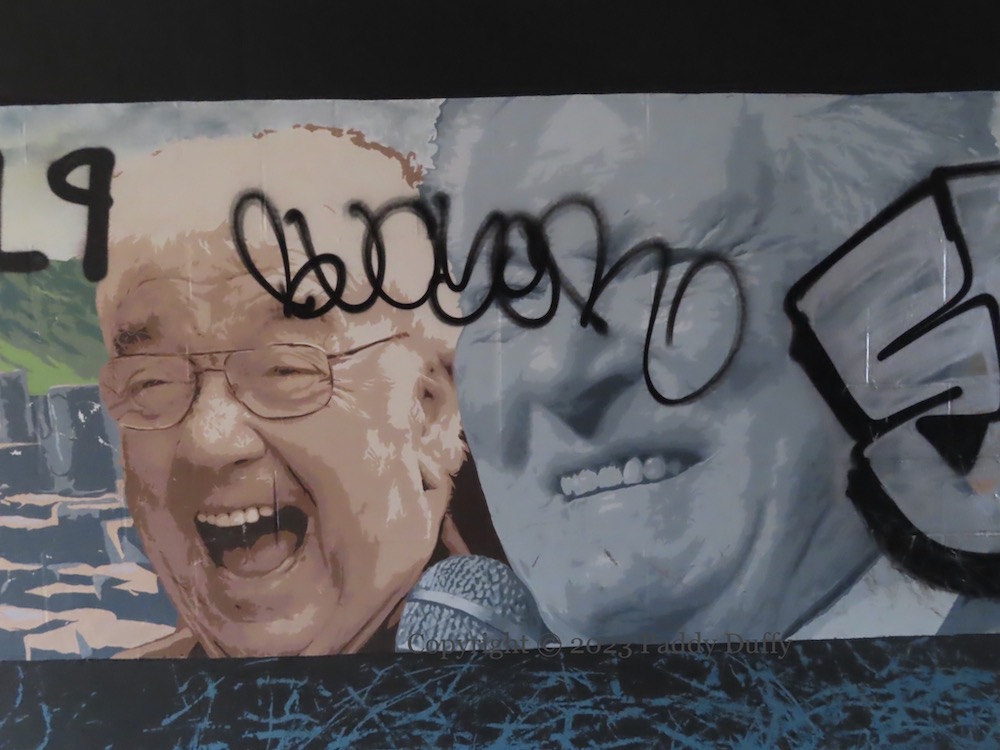
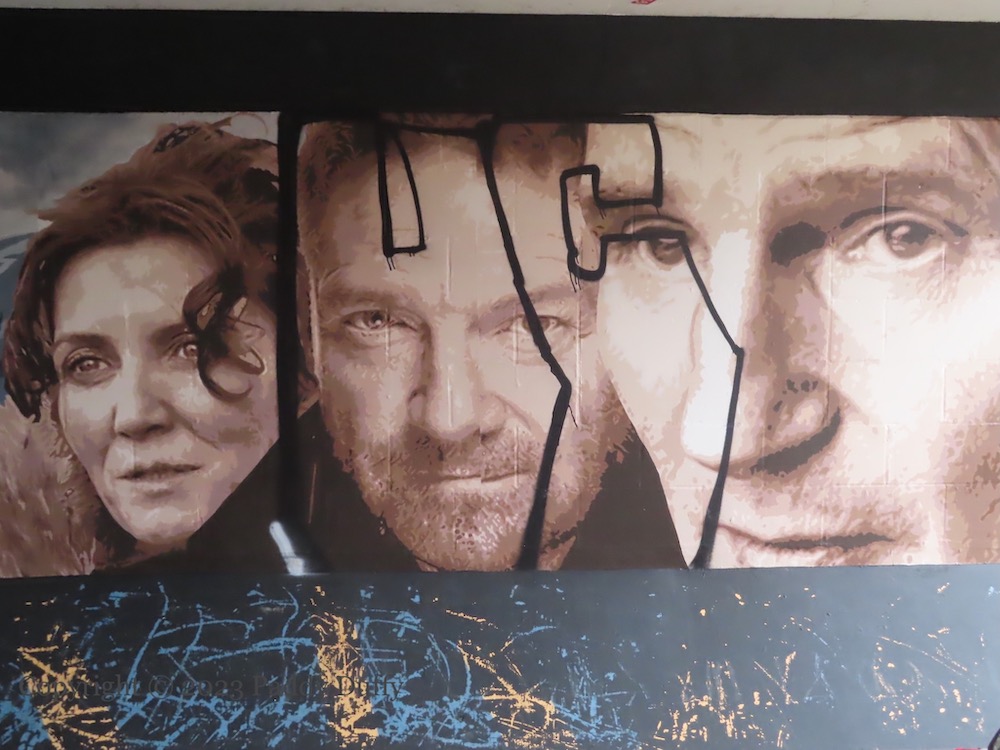
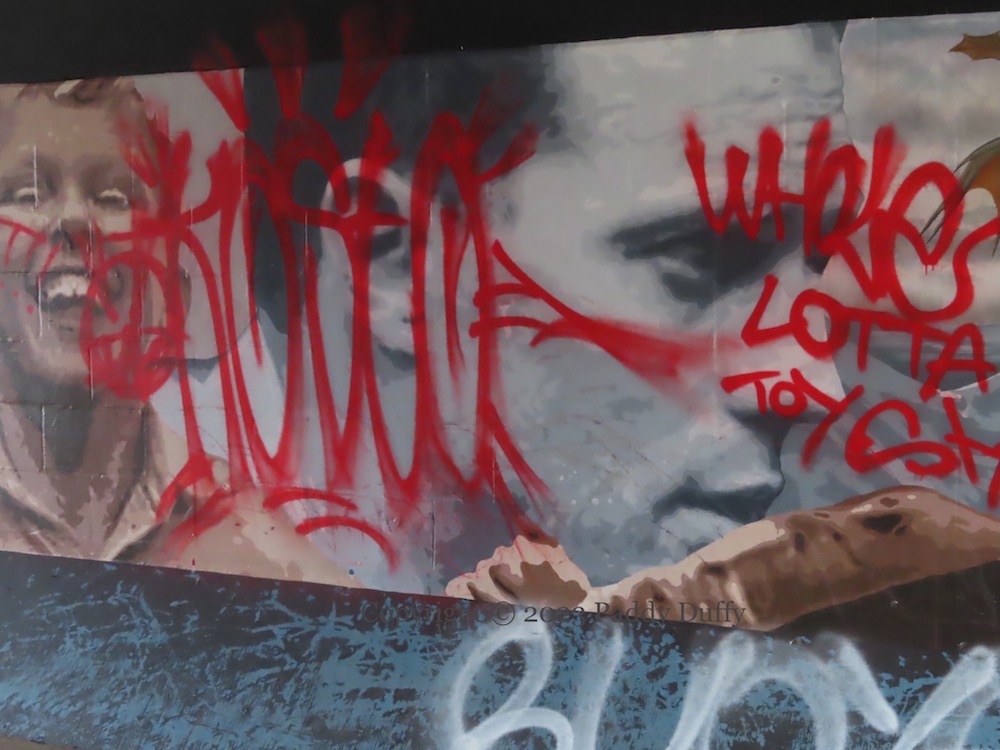
The underpass from Ballymacarrett Road to the Titanic Quarter station (formerly Bridge End and renamed in 2012 (BBC)) was remodeled in 2020, with new pavers and the removal of the bollards at the entrance to the underpass, and some new parking bays (ACS). In 2022 the old mural (Transformation, from 2012) was replaced with a gallery of famous faces – actors, musicians, comedians, and singers.
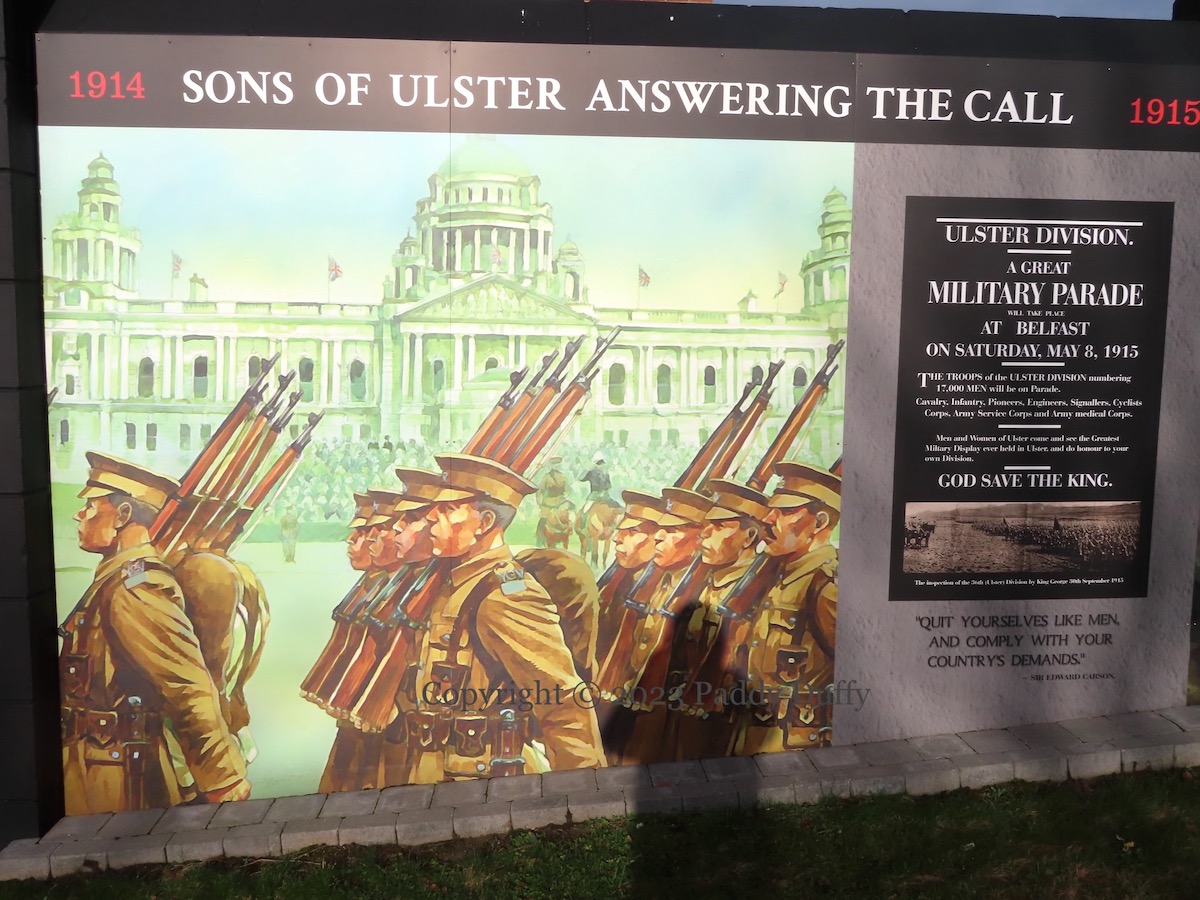
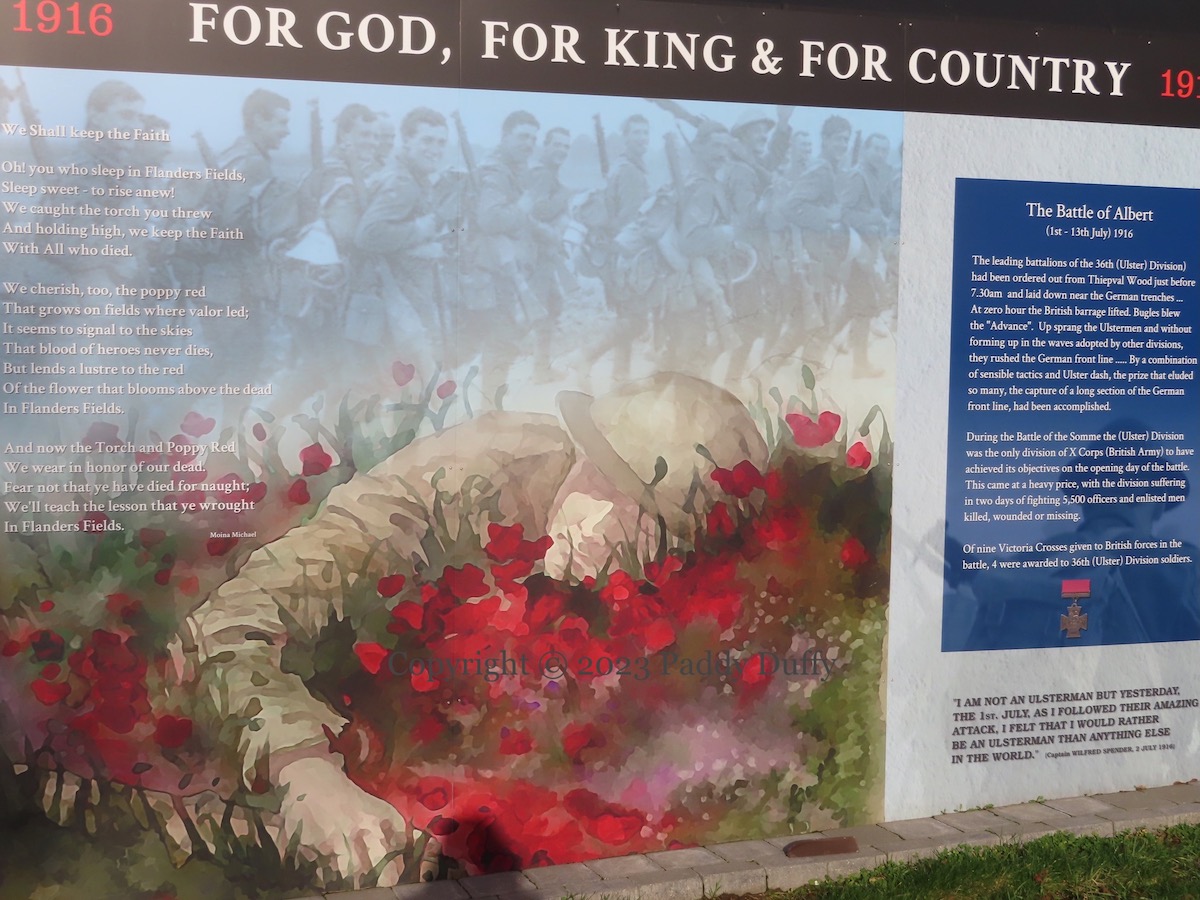
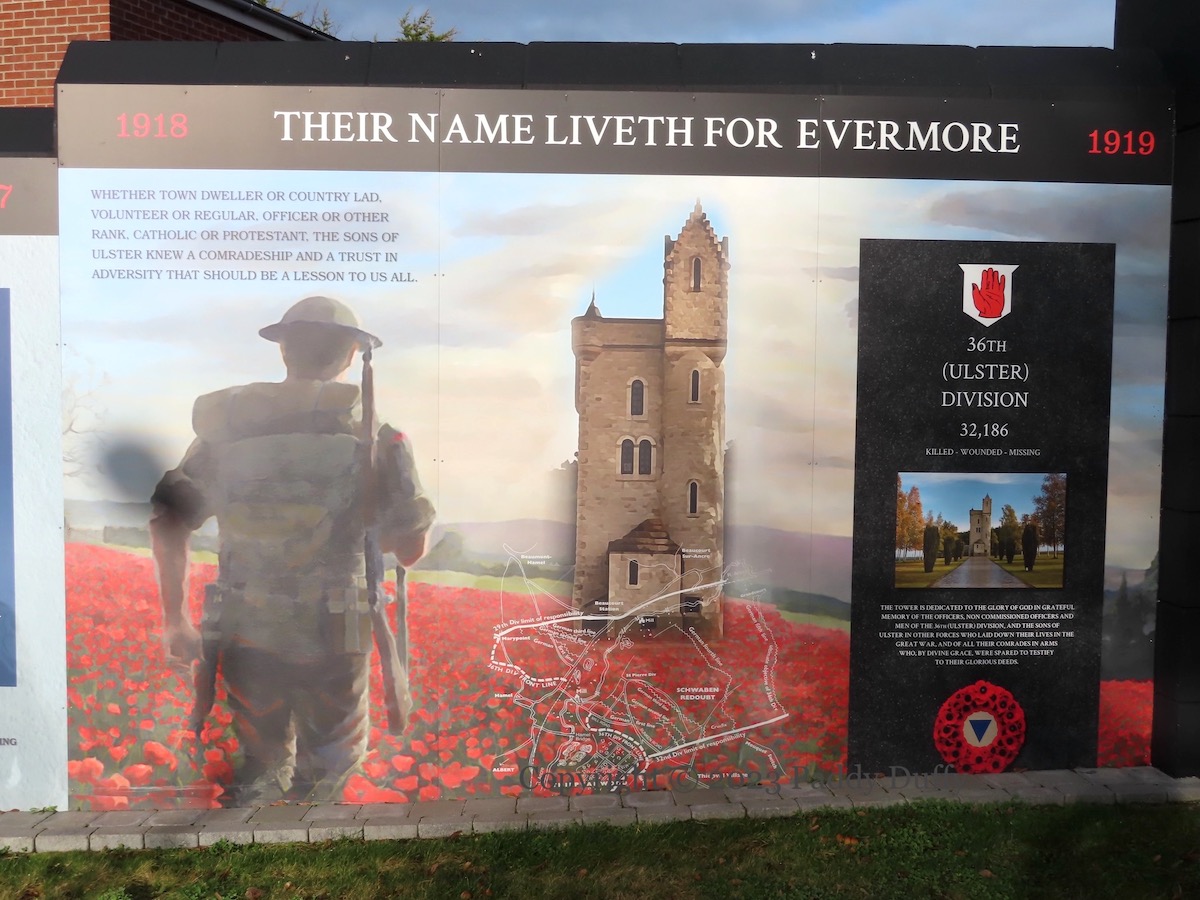
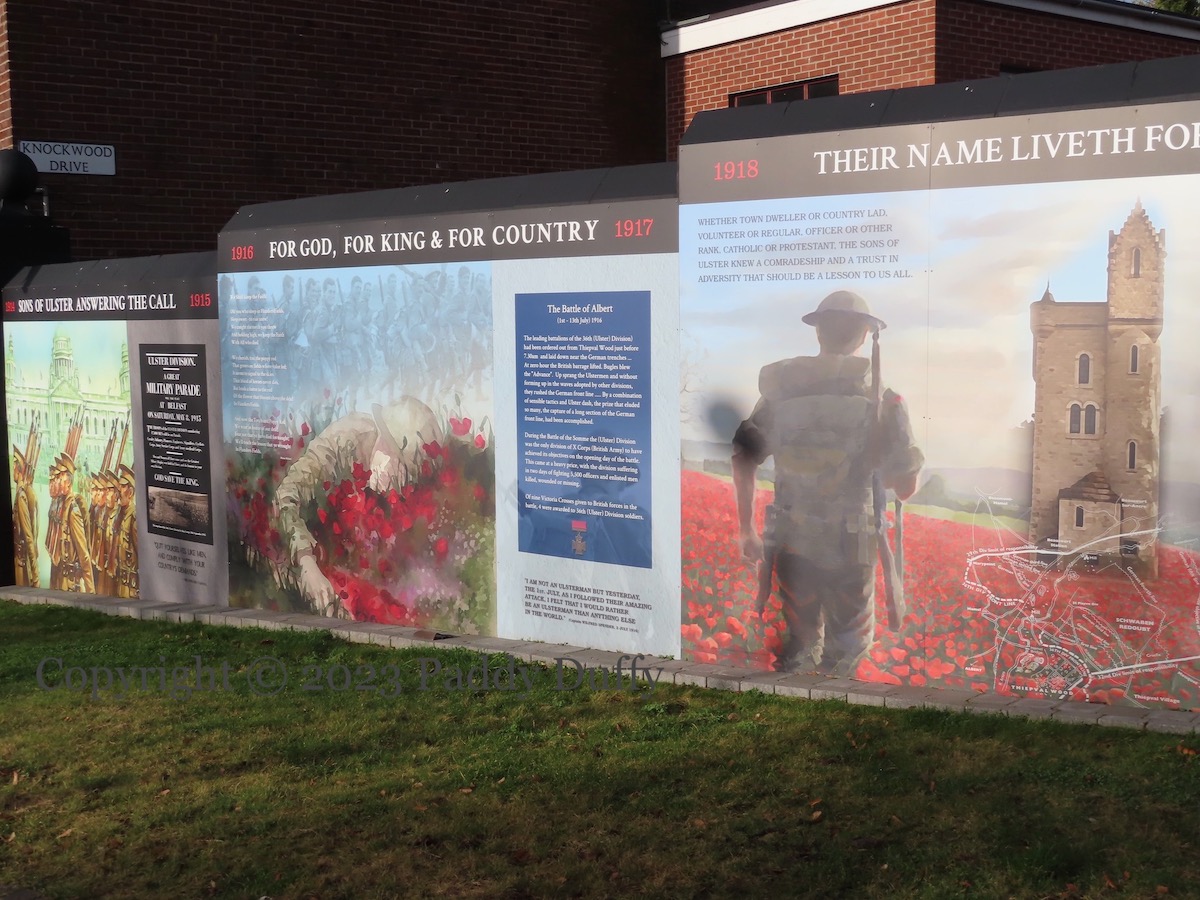
A history of the 36th (Ulster) Division in three panels along Knockwood Crescent in east Belfast:
1914 – Sons Of Ulster Answering The Call – 1915: “Ulster Division – a great military parade will take place at Belfast on Saturday, May 8, 1915. The troops of the Ulster Division numbering 17,000 men will be on parade. Cavalry, infantry, pioneers, engineers, signallers, cyclists corps, Army service corps and Army medical corps. Men and women of Ulster come and see the greatest military display every helf in Ulster, and do honur to your own Division. God save the King.” The original poster can be seen at Wartime Memories. “‘Quit yourselves like men and comply with your country’s demands.’ – Sir Edward Carson.” With a picture of “the inspection of the 36th (Ulster) Division by King George [V] 30th September 1915.
1916 – For God, For King & For Country – 1917: “The Battle of Albert (1st – 13th July) 1916. The leading battalions of the 46th (Ulster) Division) had been ordered out from Thiepval Wood just before 7.30am and laid down near the German trenches … At zero hour the British barrage lifted. Bugles blew the “Advance”. Up sprang the Ulstermen and without forming up in the waves adopted by other divisions, they rushed the German front line …… By a combination of sensible tactics and Ulster dash, the prize that eluded so many, the capture of a long section of the German front line, had been accomplished. During the Battle of the Somme the (Ulster) Division was the only division of X Corps (British Army) to have achieved its objectives on the opening day of the battle. This came at a heavy price, with the division suffering in two days of fighting 5,500 officers and enlisted men killed, wounded or missing. Of nine Victoria Crosses given to British forces in the battle, 4 were awarded to 36th (Ulster) Division soldiers.” With quotes from Wilfrid Spender (see I Would Rather Be An Ulsterman), and the poem We Shall Keep The Faith by Moina Michael. Please get in touch if you can identify the photo of soldiers going off to war at the top.
1918 – Their Name Liverth For Evermore – 1919: “Whether town dweller or country lad, volunteer or regular, officer or other rank, Catholic or Protestant, the sons of Ulster knew a comradeship and a trust in adversity that should be a lesson to us all.” “36th (Ulster) Division 32,186 killed, wounded, missing. The [Ulster] tower is dedicated to the glory of God in grateful memory of the officers, non commussioned officers and men of the 36th (Ulster) Division, and the sons of Ulster in other forces who laid down their lives in the Great War, and of all their comrades in arms who, by divine grace, were spared to testify to their glorious deeds.”







 Paddy Duffy Collection