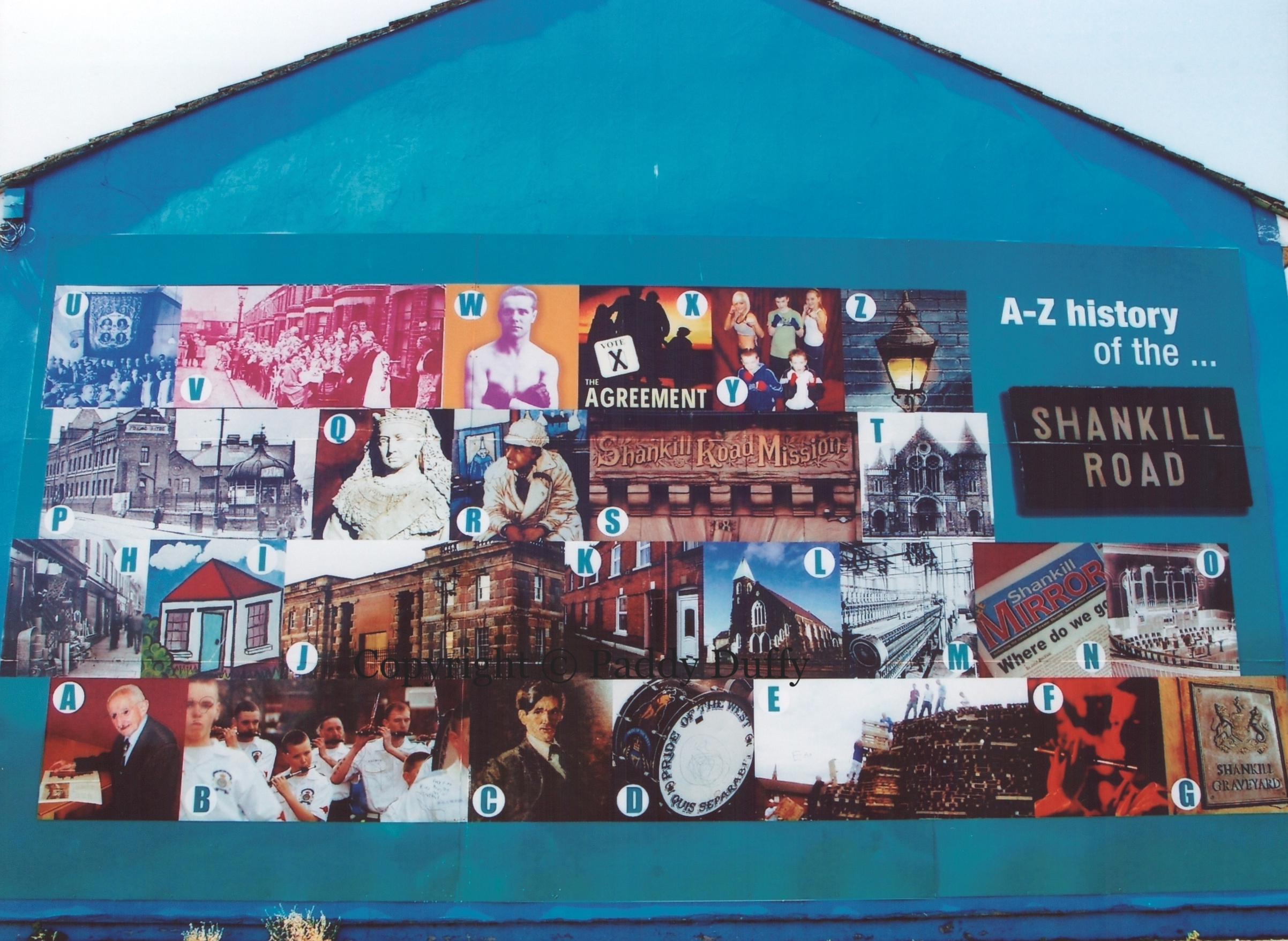
“The new mural [replacing Shankill Rd Supports Drumcree] presents and A-Z of the Shankill, celebrating history and tradition and depicting images of those who have become celebrated far beyond. Artist Lesley Cherry worked with members of the Lower Shankill Community Association to research this digital work which was installed May 2009.”
The Protestant Reformation is here attempted as a re-imaging theme in the lower Shankill. Luther’s signature is worked into the “stained glass” on the left.
Below, the accompanying text … “Hier stehe ich, Ich kann nich anders, Gott helfe mir.” Martin Luther 1483-1546. Unhappy with many of the Catholic church’s practices, Martin Luther, a monk, wrote what became know as ‘the 95 theses’. These challenged the authority of the church and were spread quickly around Europe via a new invention, the printing press. Keen to get luther to recant, the general assembly of the Holy Roman Empire summoned Luther to the town of Worms on the Rhine in 1521. An unapologetic Luther is said to have uttered this famous phrase which, translated means ‘Here I stand, I can do no other. God help me. Amen’. Thus began the Protestant Reformation.”
Shankill Parade, lower Shankill estate, west Belfast
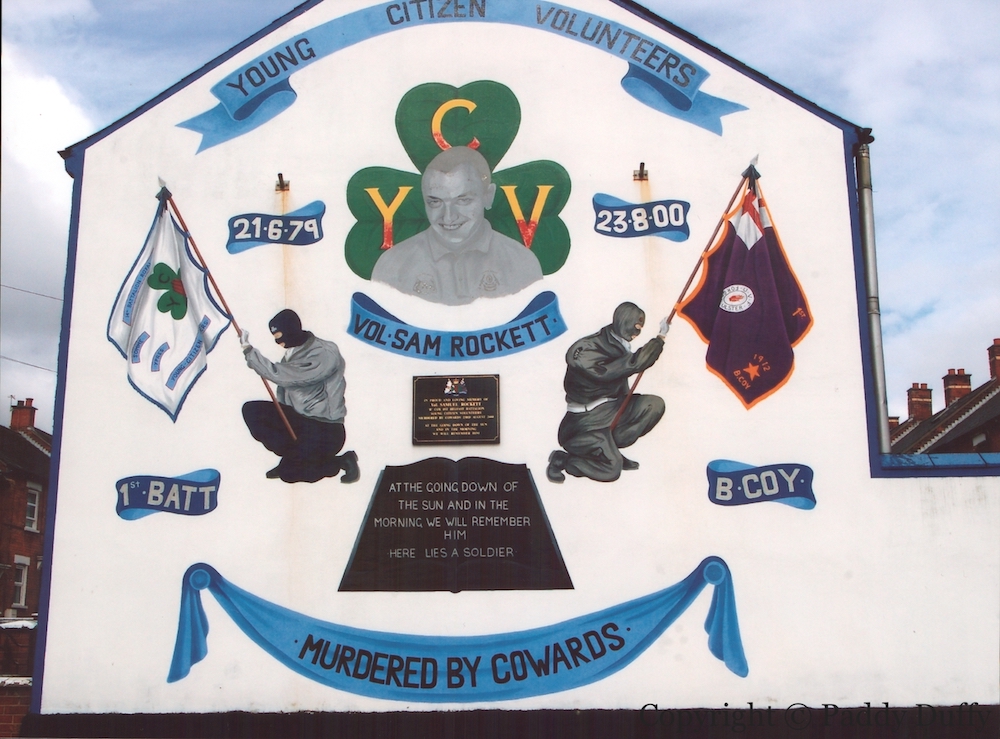
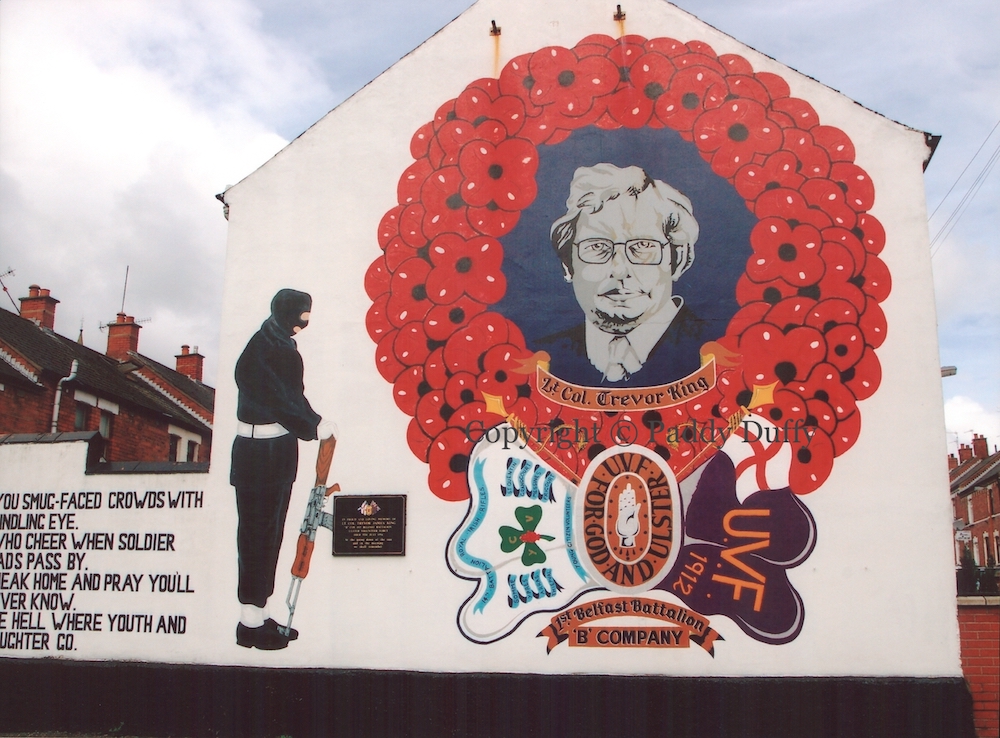
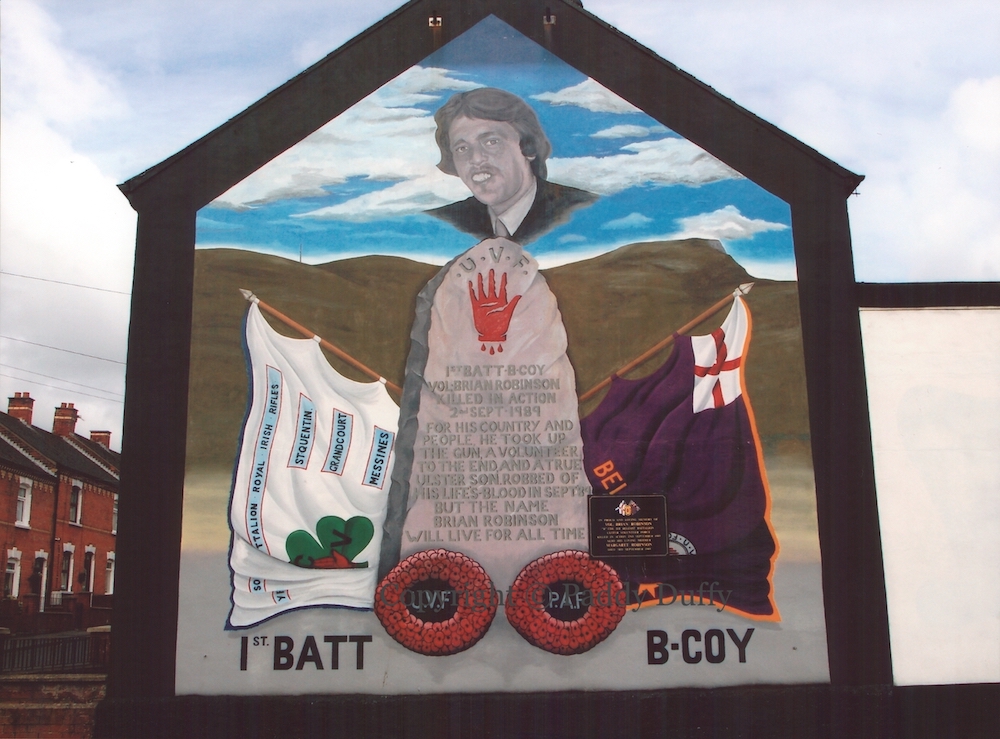
There are three murals (each with a plaque) to UVF volunteers from 1st battalion, B company, on three consecutive gables in Disraeli Street, presented here from south to north (i.e. heading towards Ohio Street).
First: “In proud and loving memory of Vol. Samuel Rockett, ‘B’ Coy 1st Belfast battalion, Young Citizen Volunteers. Murdered by cowards 23rd August 2000. ‘At the going down of the sun and in the morning we will remember them.’ ‘Here lies a soldier’”
The “cowards” in this case are the members of the UDA who killed Rockett (born June 21st, 1979) in front of his girlfriend and 18 month old child in an attack on her house in the lower Oldpark, during the feud between the UVF and UDA, sparked by Johnny Adair’s “loyalist day of culture” and removal of the UVF from the lower Shankill. In response to the purge (and attacks on the Rex bar), the UVF killed Bobby Mahood and Mr Jackie Coulter. Rockett was killed by the UDA in retaliation for their deaths; 1,000 people attended Rockett’s funeral (Irish Times). After Rockett died, the UVF killed David Greer, and the UDA then killed PUP member Bertie Rice in Tiger’s Bay on October 31st.
Second: Lt Col Trevor “Kingso” King served time for his part in the Battle At Springmartin in 1972, in which seven people, including a British soldier, died. In 1994, having been shot by the INLA and paralysed from the neck down, King took the decision to remove his own life-support (WP).
You smug-faced crowds with kindling eye Who cheer when soldier lads pass by Sneak home and pray you’ll never know The hell where youth and laughter go
Third: Brian Robinson was shot by the British Army in 1989 immediately after he had shot and killed a Catholic (Paddy McKenna) walking along Crumlin Road. This is the fifth version of the Brian Robinson mural in Disraeli Street, Belfast.
The plaque reads, “UVF 1st Batt B Coy Vol Brian Robinson killed in action 2nd Sept 1989. For his country and his people he took up the gun, a volunteer to the end and a true Ulster son. Robbed of his life’s blood in Sept ’89 but the name Brian Robinson will live for all time.
The plaque includes “Also his loving mother Margaret Robinson died 3rd September 1989”
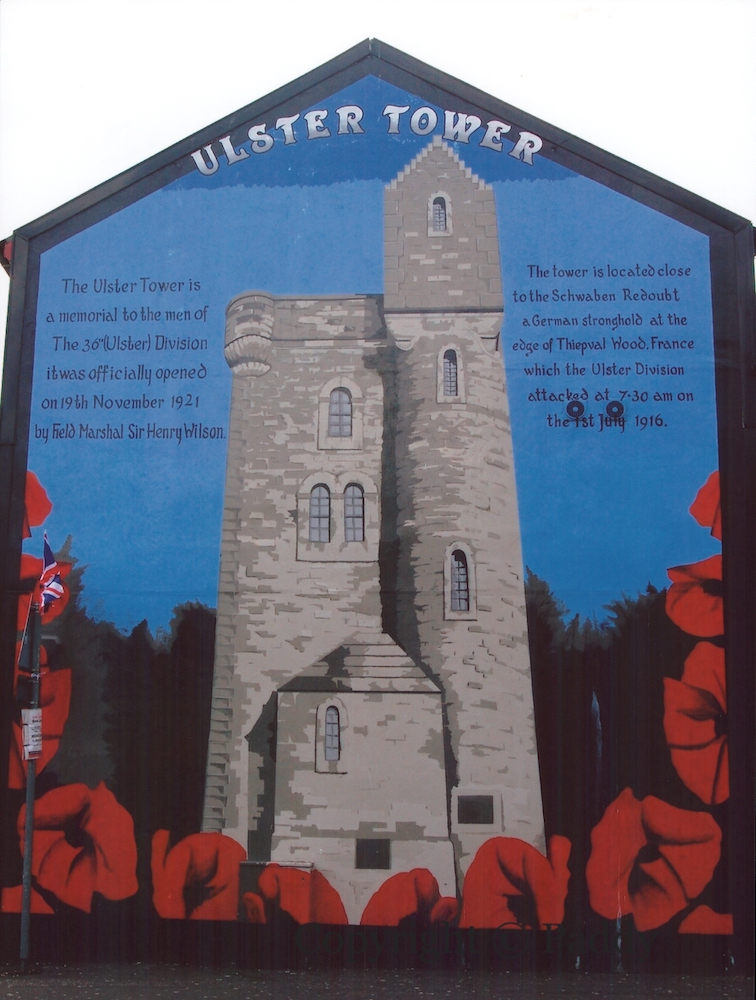
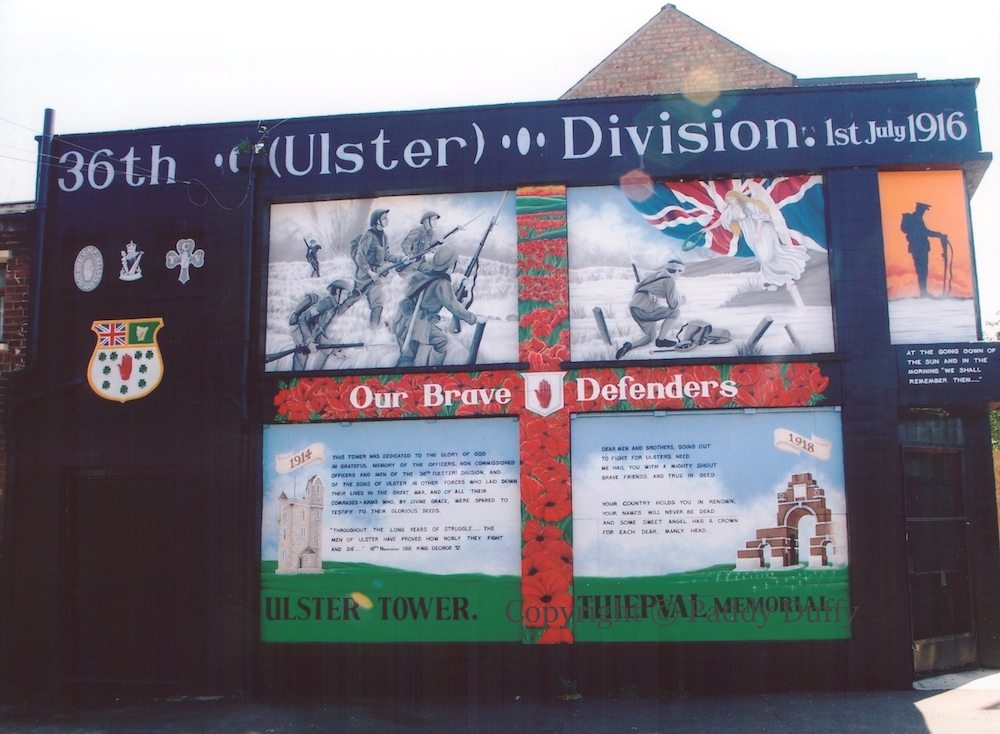
“The Ulster Tower is a memorial to the men of the 36th (Ulster) Division. It was officially opened on 19th November 1921 by Field Marshal Sir Henry Wilson. The tower is located close to the Schwaben Redoubt, a German stronghold at the edge of Thiepval Wood, France, which the Ulster Division attacked at 7.30 am on the 1st July 1916.”
“This mural was dedicated to the men of the 36th (Ulster) Division on 31st July 2010 by the West Belfast Athletic And Cultural Society. ‘Greater love hath no man than this, that a man lay down his life for his friends’ – John 15:13”.
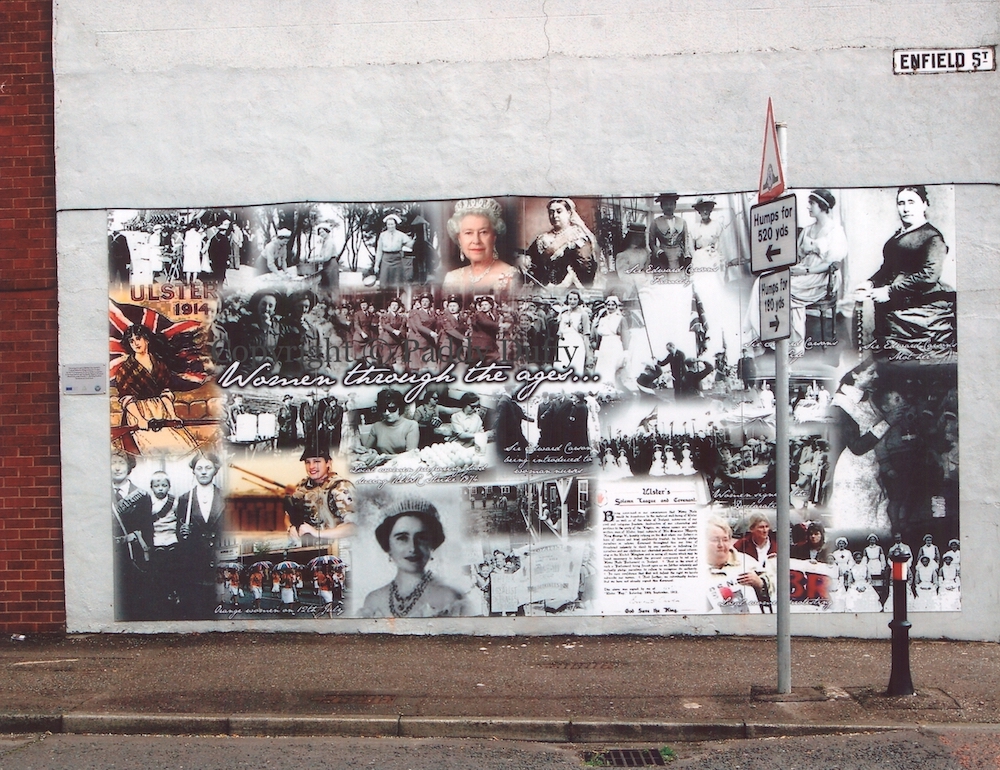
Conway Street (“Somme Street”), Shankill, west Belfast
A good part of this board is in fact dedicated to Edward Carson – in the top left are “Sir Edward Carson’s family”, “Sir Edward Carson’s wife”, and “Sir Edward Carson’s mother” and below them is a photograph of Carson presenting colours to the South Belfast Volunteers (see We Won’t Have Home Rule) and another (to the middle) of “Sir Edward Carson being introduced to woman nurses”. In the centre are “Local women preparaing food during UWC strike 1974”. Other images include English monarchs Victoria (Queen Of Ireland, Empress Of India) and Elizabeth, Ulster 1914, and the signing of the Ulster Covenant by women.
“This project is part of Belfast City Council’s Cultural Networks programme. It is funded by the EU Programme For Peace & Reconciliation In Northern Ireland And The Border Region Of Ireland (Peace III).”
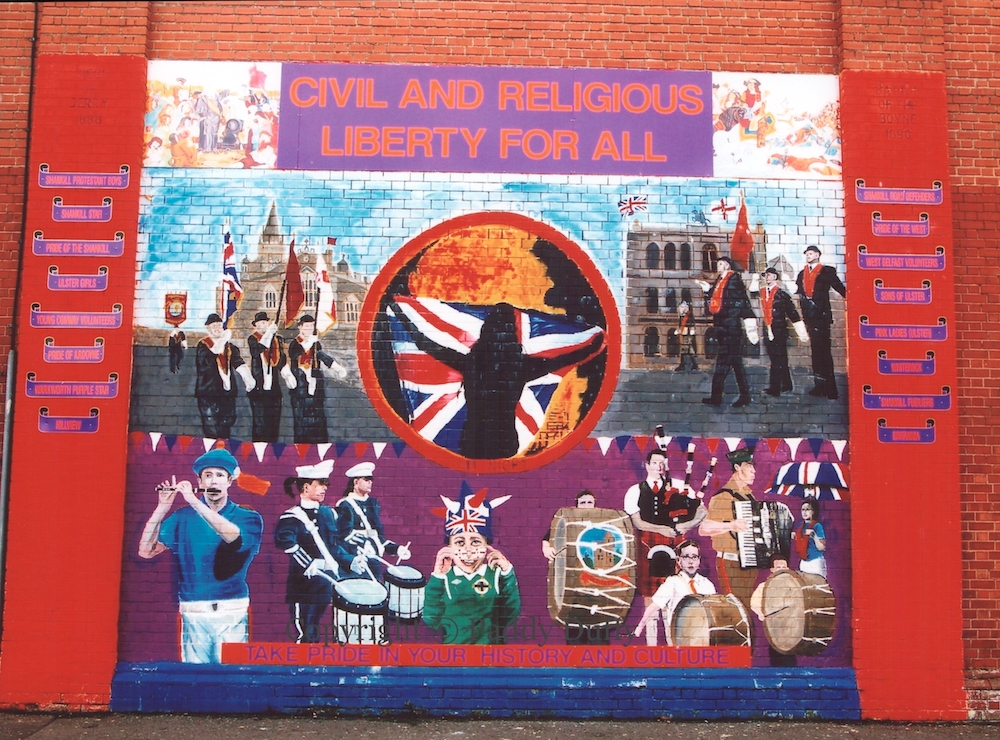
“Take pride in your history and culture”, namely: the Siege Of Derry and the Battle Of The Boyne (from the Jackson Mural in the Fountain); flute bands (Shankill Protestant Boys, Shankill Star, Pride Of The Shankill, Ulster Girls, Young Conway Volunteers, Pride Of Ardoyne, Warkworth Purple Star, Hillview, Shankill Road Defenders, Pride Of The West, West Belfast Volunteers, Sons Of Ulster, Pink Ladies (Ulster), Whiterock, Shankill Fusiliers, Britannia); Royal Black and Orange Order parades (marching past the Guildhall in Londonderry and the Clifton Street lodge in Belfast), 11th night bonfires, supporting the Northern Ireland soccer team, lambeg drumming, playing the pipes, accordion playing – with Union flags and bunting throughout.
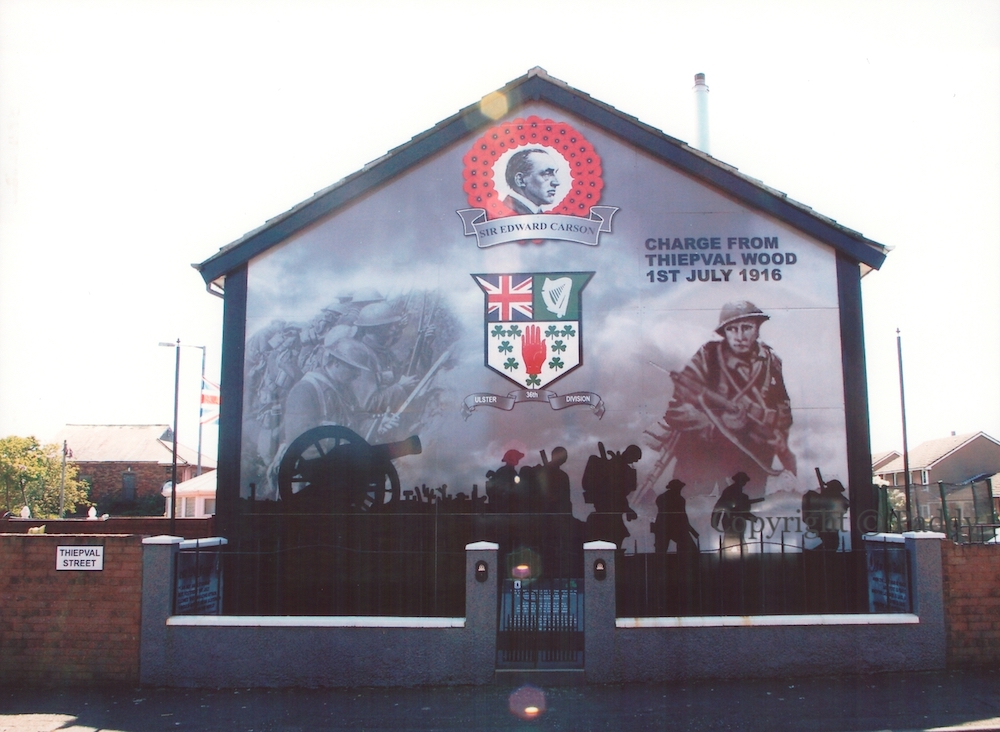
The nameplate on the lower corner of Northland Street now reads “Thiepval Street” and the Thiepval board above adorns the end wall (replacing an earlier mural to UVF A Company 5th platoon). On the other side of Conway Street is/was North Howard Walk where a plate now reads “Passchendaele Court“. The names are unofficial (as of November 15th, 2012). (See also “Somme Street”.)
The memorial stone is dedicated to the UVF company (and not to the WWI soldiers from the 36th (Ulster) Division who died in the charge from Thiepval Wood, July 1st, 1916): “This stone is dedicated to the memory of the fallen volunteers of No. 5 platoon A company 1st Belfast battalion Ulster Volunteer Force. ‘As poppy petals gently fall/Remember us who gave our all/Not in the mud of foreign lands/Nor buried in the desert sands//In Ulster field and farm and town/Fermanagh’s lanes and Drumlin’d Down/We died that violent death should cease/And Ulstermen might live in peace’ Lest we forget.”
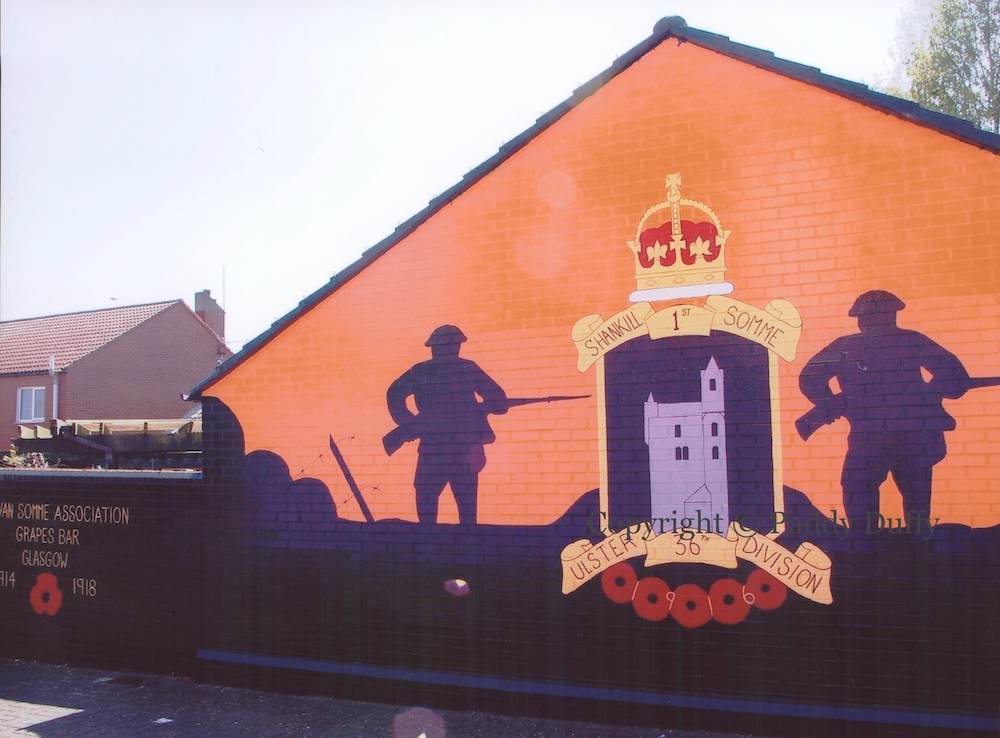
The Conway Walk mural was produced by the “Shankill 1st Somme [Association]” with support from the “Govan Somme Association, Grapes Bar, Glasgow”.
The four main panels of the mural (above) show the men of the 36th going over the top on the first day of the Somme (1st July 1916), the “angel of Mons” (WP), Ulster Tower (“This tower was dedicated to the glory of God. In grateful memory of the officers, non commissioned officers and men of the 36th (Ulster) Division, and of the sons of Ulster in other forces who laid down their lives in the great war, and of all their comrades in arms who, by divine grace, were spared to testify to their glorious deeds. ‘Throughout the long years of struggle …. the men of Ulster have proved how nobly they fight and die’ – 16th November 1918 King George V”), and Thiepval Memorial (“Dear men and brothers, going out/to fight for Ulster’s need/we hail you with a mighty shout/brave friends, and true in deed.//Your country holds you in renown/your names will never be dead/and some sweet angel has a crown/for each dear, manly head.”)
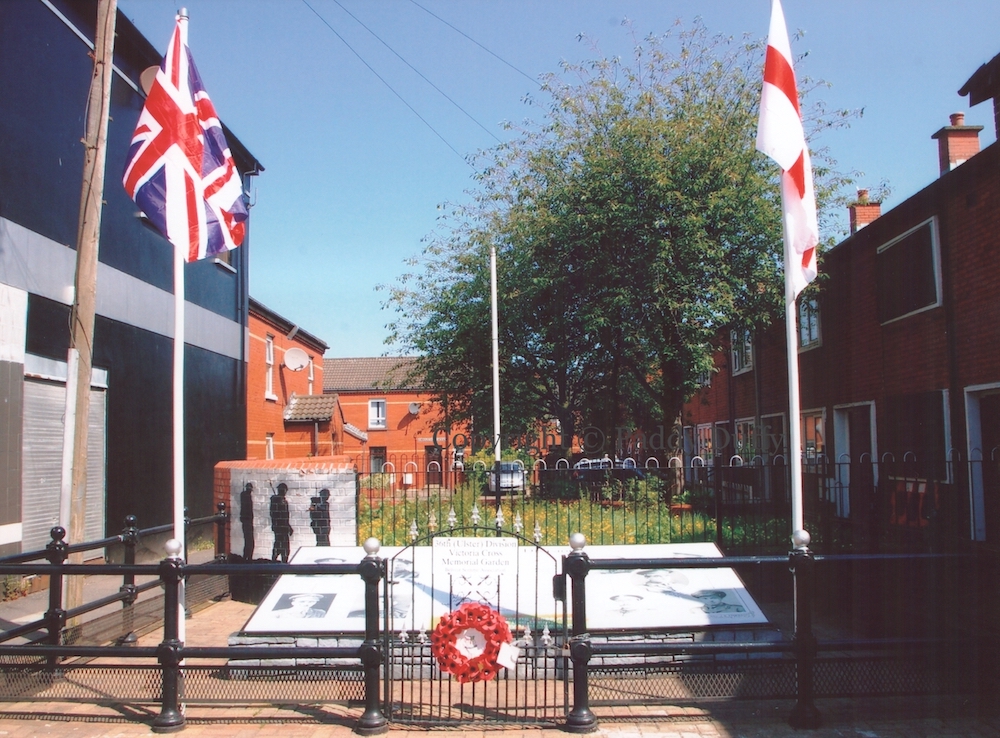
The memorial garden features the Victoria Cross winners from the 36th (Ulster) Division. For close-ups, see the Peter Moloney Collection.
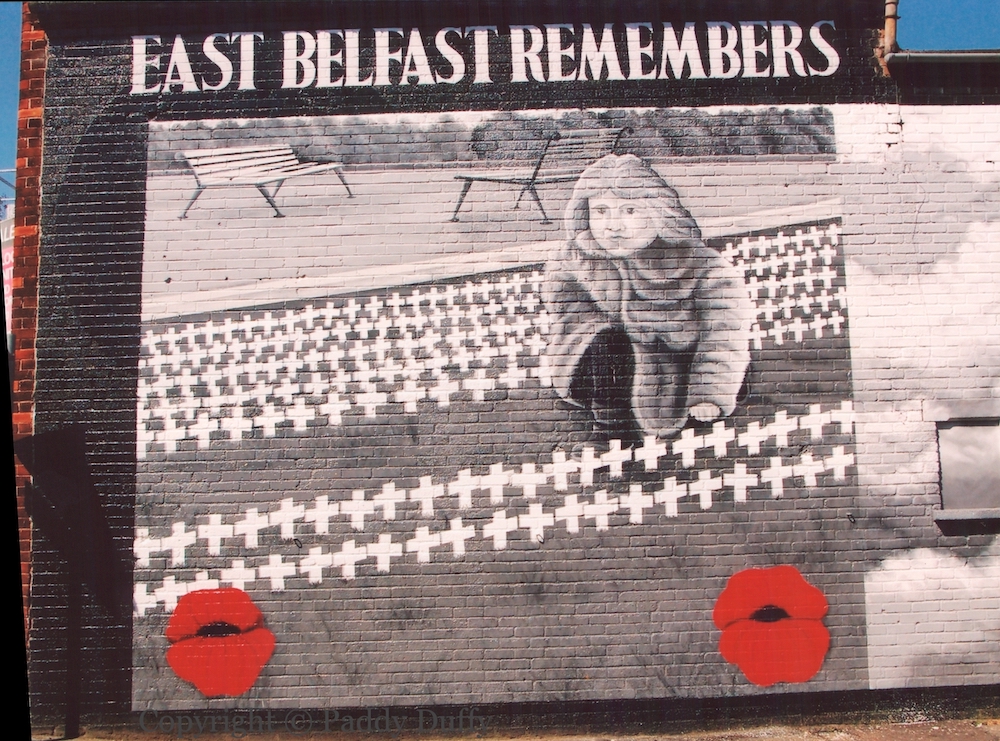
St Leonard’s Crescent (the old Newcastle Street) in east Belfast
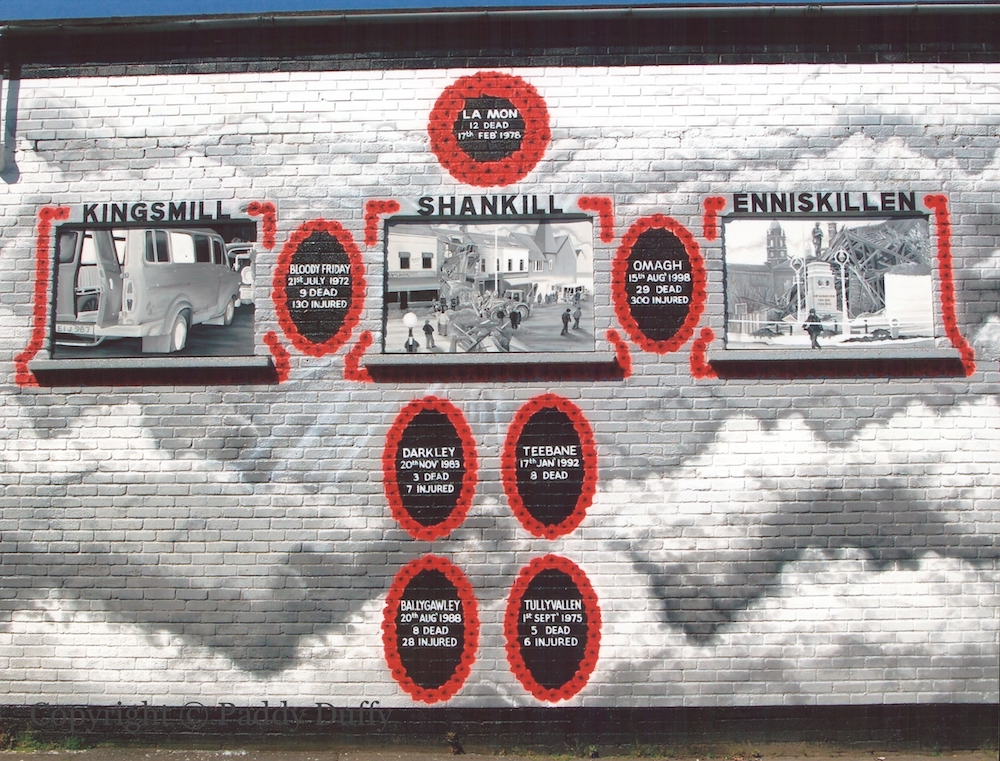
East Belfast remembers both the Great War and the victims of various attacks during the Troubles: in pictures: Kingsmill – Shankill – Enniskillen; in garlands of poppies: La Mon 12 dead 17th Feb 1978, Bloody Friday 21st July 1972 9 dead 130 injured, Omagh 15th Aug 1998 29 dead 300 injured, Darkley 20th Nov 1983 3 dead 7 injured, Teebane 17th Jan 1992 8 dead, Ballygawley 20th Aug 1988 8 dead 28 injured, Tullyvallen 1st Sept 1975 5 dead 6 injured.
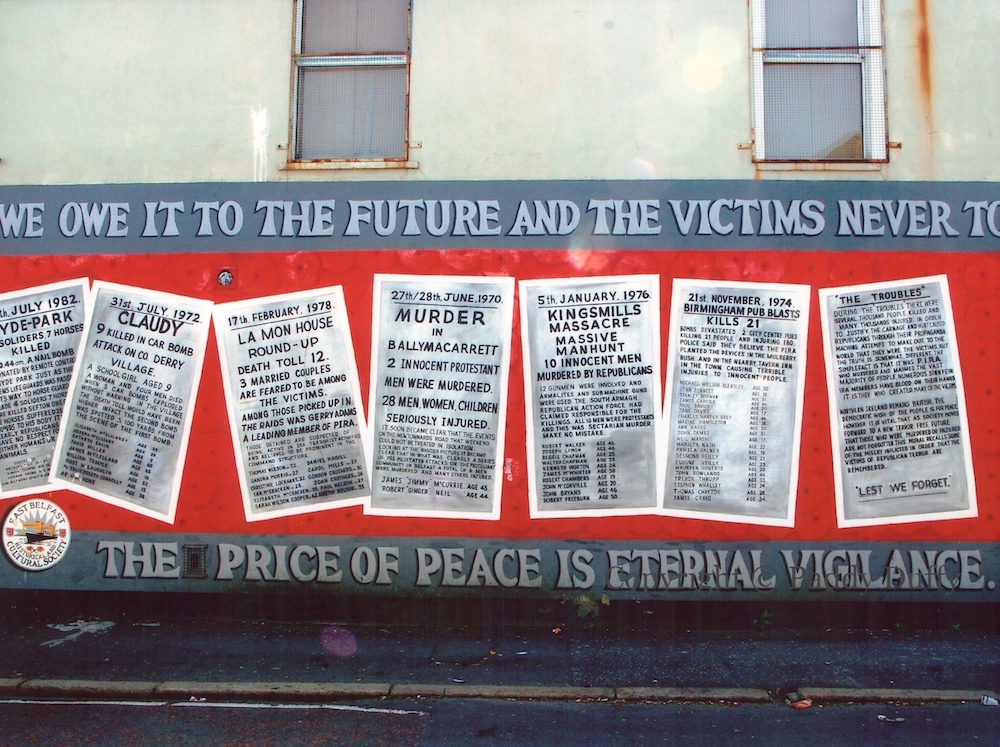
On the facing wall is a similar mural about deaths during the Troubles: “”The Troubles” – During the “Troubles” there were several thousand people killed and many thousands injured. In order to justify the carnage and hurt caused republicans through their propaganda machine attempt to make out to the world that they were the victims, but the truth is somewhat different. The simple fact is that it was PIRA who murdered and maimed the vast majority of people[.] [N]umerous Sinn Fein-IRA members have blood on their hands[.] It is they who created many of the victims. Northern Ireland remains British. The democratic wish of the people is for peace. However[,] it is vital that as society moves forward to a new terror[-]free future that those who were murdered or injured are not forgotten. This mural recalls some of the misery inflicted[,] in order that the victims of republican terror are not forgotten. “Lest we forget.”” “We owe it to the future and the victims never to forget the past – the price of peace is eternal vigilence.”
Individual panels recount the deaths at Hyde Park, Claudy, La Mon House, Ballymacarrett, Kingsmills [Kingsmill], and Birmingham.
Sponsored by the East Belfast Historical And Cultural Society – see Visual History 10.
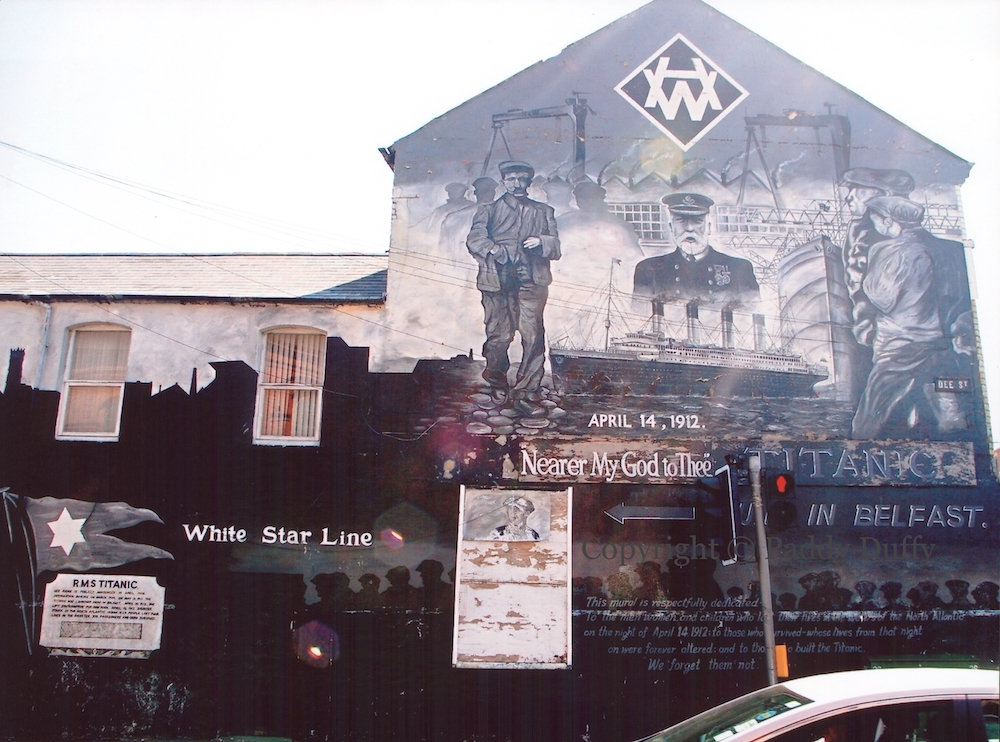
“Her name is publicly announced in April 1908. Designation begins in March 1909. On May 31. 1911, the Titanic was launched here in Belfast, April 10, 1912. She left Southampton for New York. April 14, 1912 disaster struck in the North Atlantic ocean, 1523 people lost their lives in the disaster, 705 passengers and crew survived.” “This mural is respectfully dedicated to the men, women and children who lost their lives in the waters of the North Atlantic on the night of April 14, 1912: to those who survived – whose lives from that night on were forever altered; and to those who built the Titanic [at Harland and Wolff]. We forget them not.”
Pictured in the centre of the mural is Captain Edward John “Ted” Smith.