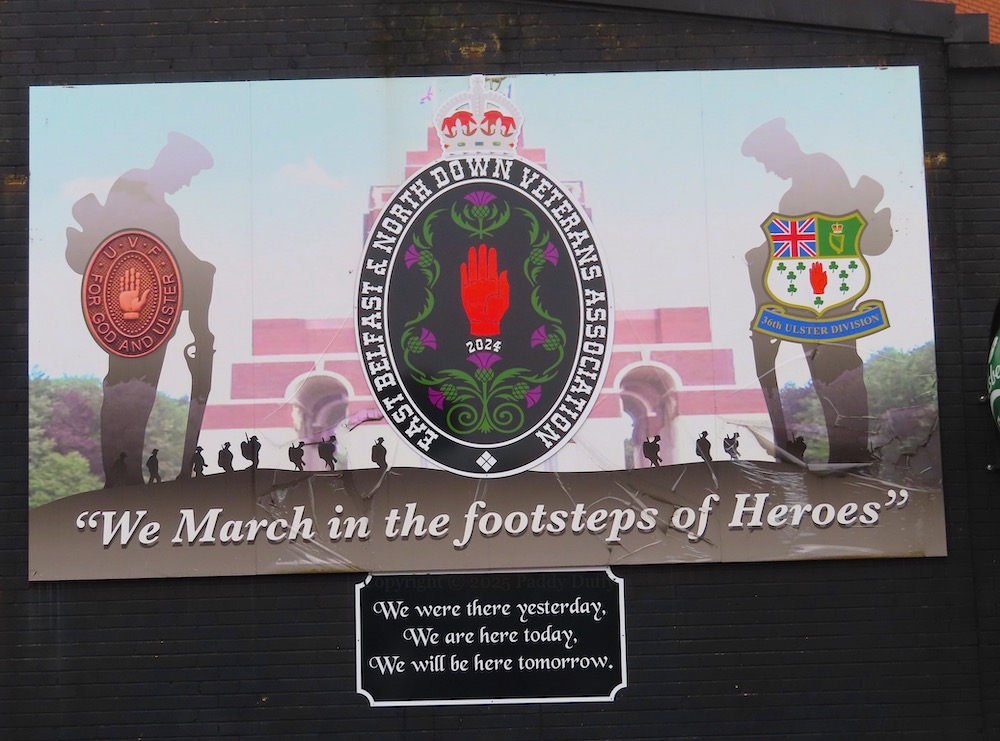
This is a new version of the board seen in 2022, in which the central emblem was of the 8th battalion of the Royal Irish Rifles, whereas it is now of the “East Belfast & North Down Veterans’ Association”.
Below, a small plaque reading “We were there yesterday, We are here today, We will be here tomorrow” has been added
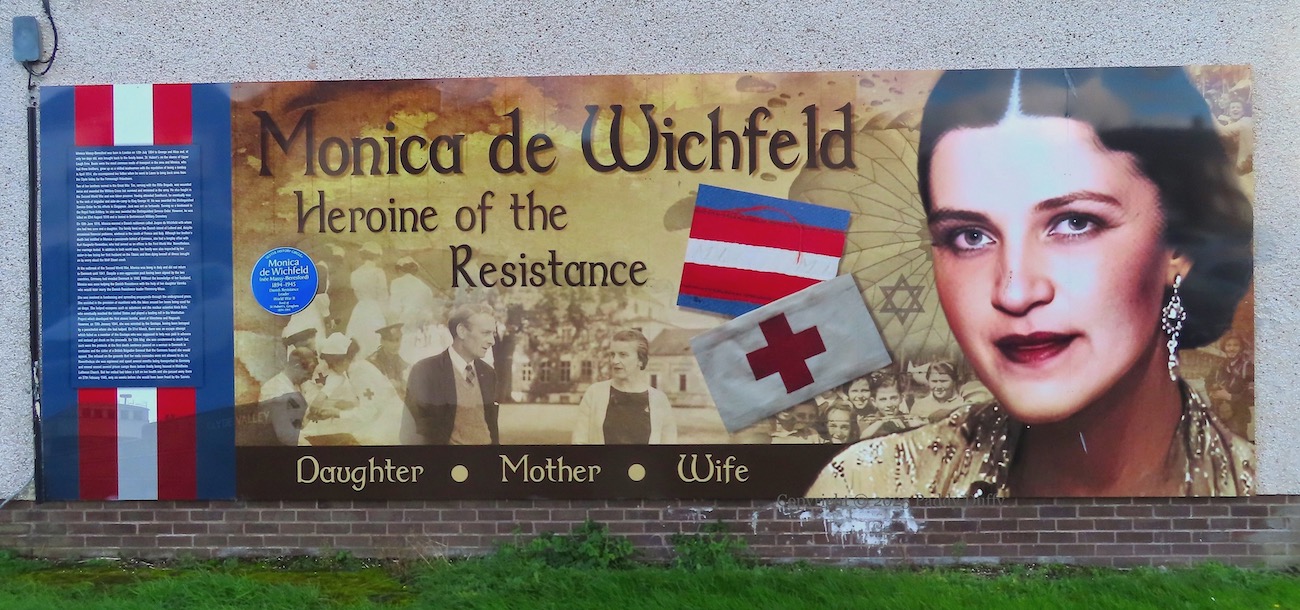
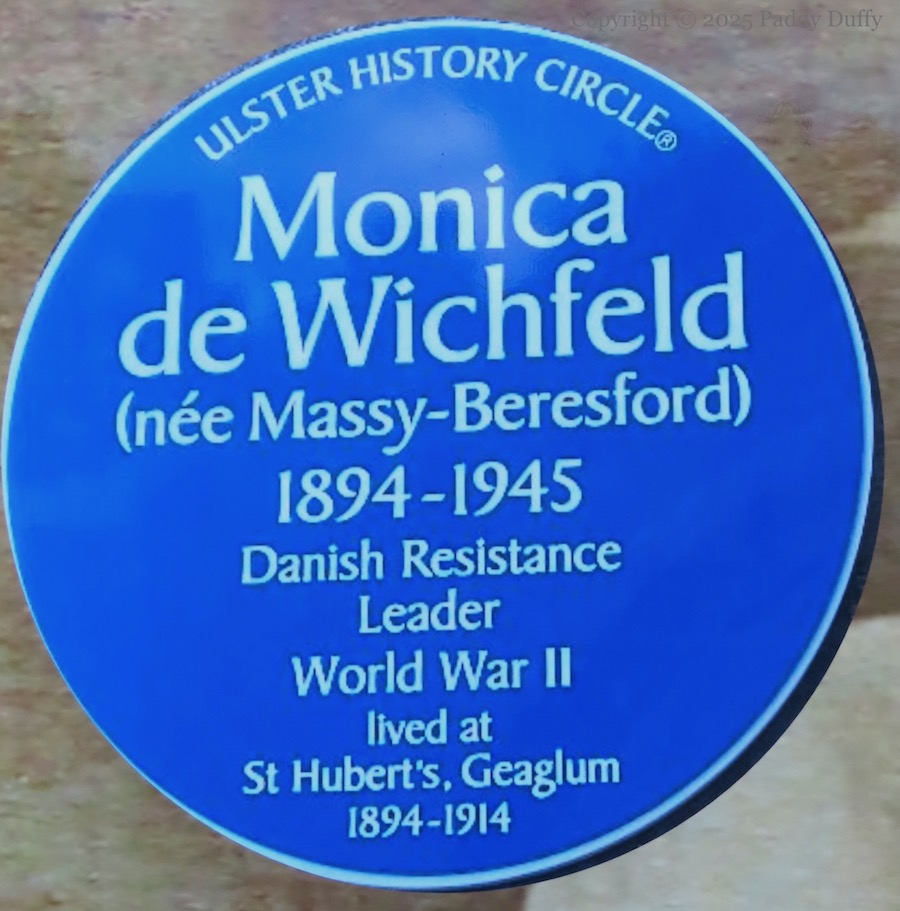
“Monica de Wichfeld, heroine of the resistance, daughter, mother, wife”. The blue plaque to Monica Massy-Beresford is at the Kinawley Holy Trinity church in Derrylin, Fermanagh, (Street View), near where she grew up. She moved to Denmark upon her marriage and had a long and varied career in the Danish resistance to the German occupation in WWII, raising money for the Communists, using her estate to shelter fleeing families and receive arms and train volunteers, and eventually heading the regional group on Lolland (WP).
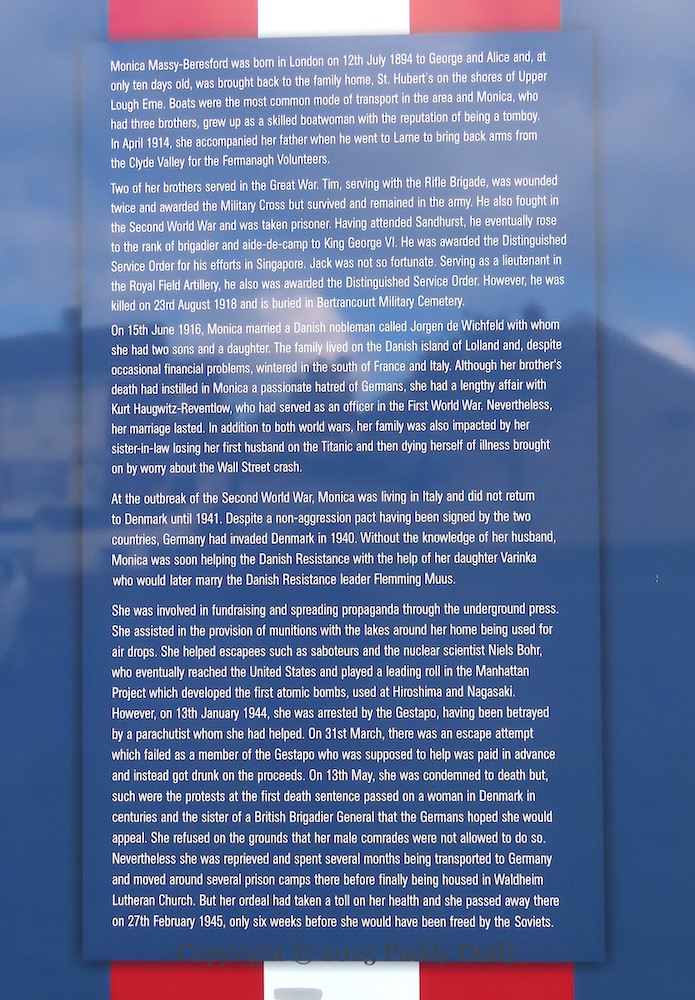
“Monica Massy-Beresford was born in London on 12th July 1894 to George and Alice and, at only ten years old, was brought back to the family home, St Hubert’s on the shores of Upper Lough Erne. Boats were the most common mode of transport in the area and Monica, who had three brothers, grew up as a skilled boatwoman with the reputation of being a tomboy. In April 1914, she accompanied her father when he went to Larne to bring back arms from the Clyde Valley for the Fermanagh Volunteers. … On 15th June 1916, Monica married a Danish nobleman called Jorgen de Wichfeld with whom she had two sons and a daughter. The family lived on the Danish island of Lolland and, despite occasional financial problems, wintered in the south of France and Italy. Although her brother’s death had instilled in Monica a passionate hatred of Germans, she had a lengthy affair with Kurt Huagwitz-Reventlow, who had served as an officer in the First World War. Nevertheless, her marriage lasted. … At the outbreak of the Second World War, Monica was living in Italy and did not return to Denmark until 1941. Despite a non-aggression pact having been signed by the two countries, Germany had invaded Denmark in 1940. Without the knowledge of her husband, Monica was soon helping the Danish Resistance with the help of her daughter Varinka who would later marry the Danish Resistance leader Flemming Muus. She was involved in fundraising and spreading propaganda through the underground press. She assisted in the provision of munitions with the lakes around her home being used for air drops. She helped escapees such as saboteurs and the nuclear physicist Niels Bohr, who eventually reached the United States and played a leading roll [role] in the Manhattan Project which developed the first atomic bombs, used at Hiroshima and Nagasaki. However, on 13th January 1944, she was arrested by the Gestapo, having been betrayed by a parachutist whom she had helped. On 31st March, these was an escape attempt which failed as a member of the Gestapo who was supposed to help was paid in advance and instead got drunk on the proceeds. On 13th May, she was condemned to death but, such were the protests at the first death sentence passed on a woman in Denmark in centuries and the sister of a British Brigadier General that the Germans hoped she would appeal. She refused on the grounds that her male comrades were not allowed to do so. Nevertheless she was reprieved and spent several months being transported to Germany and moved around several prison camps there before finally being housed in Waldheim Lutheran Church. But her ordeal had taken a toll on her health and she passed away there on 27th February 1945, only six weeks before she would have been freed by the Soviets.
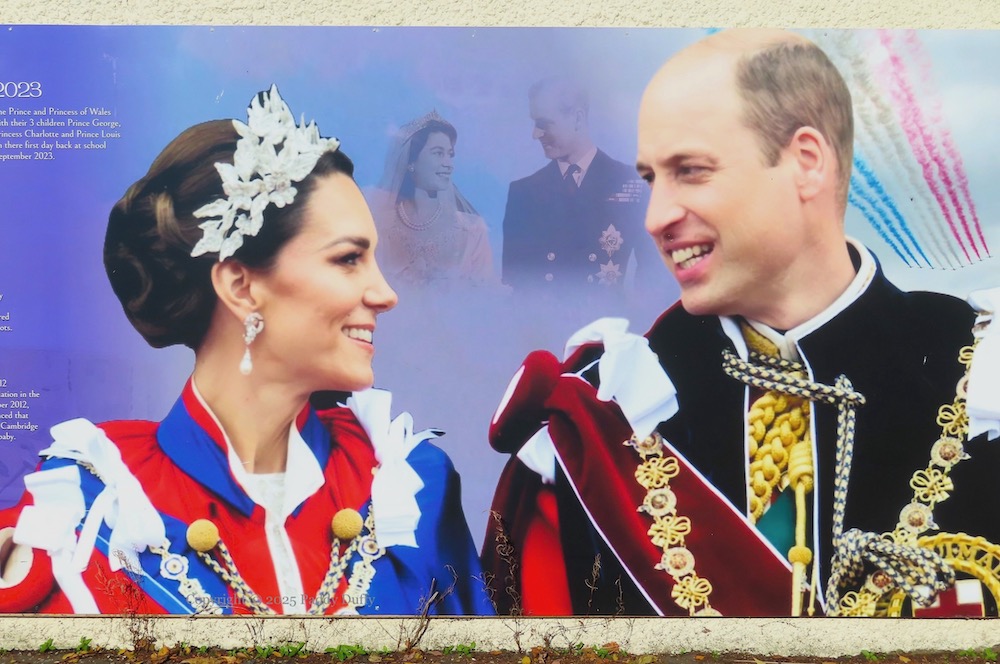
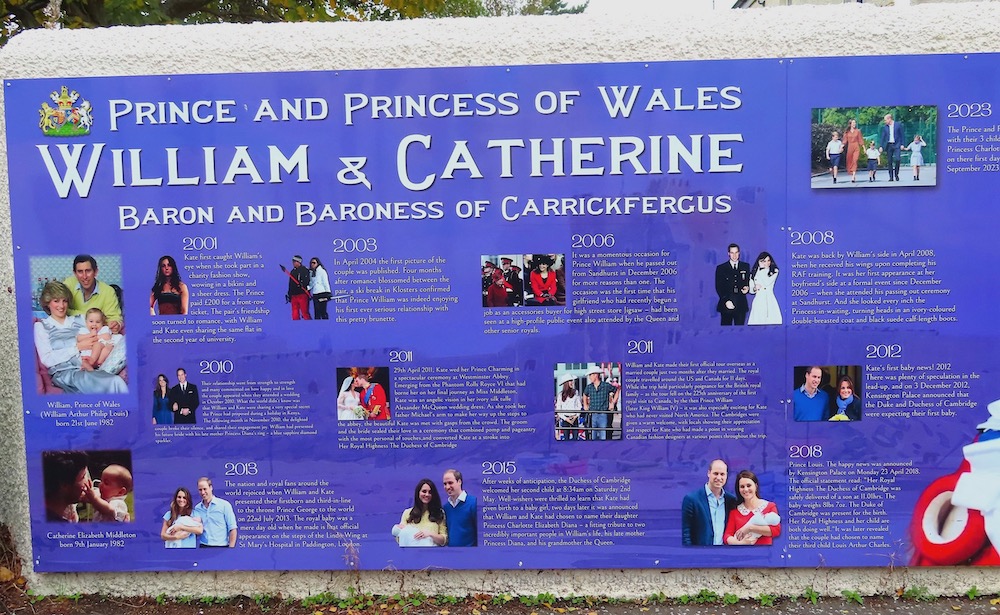
“William & Catherine, prince and princess of Wales, baron and baroness of [sic] Carrickfergus.” Prince William was granted the title of “Baron Carrickfergus” upon his marriage to Catherine Middleton in 2011; he was also made Earl Of Strathearn and Duke Of Cambridge (royal.uk). The couple visited Carrickfergus in 2022 (NI World), shortly after Charles acceded to the throne and William gained the title of Prince Of Wales.
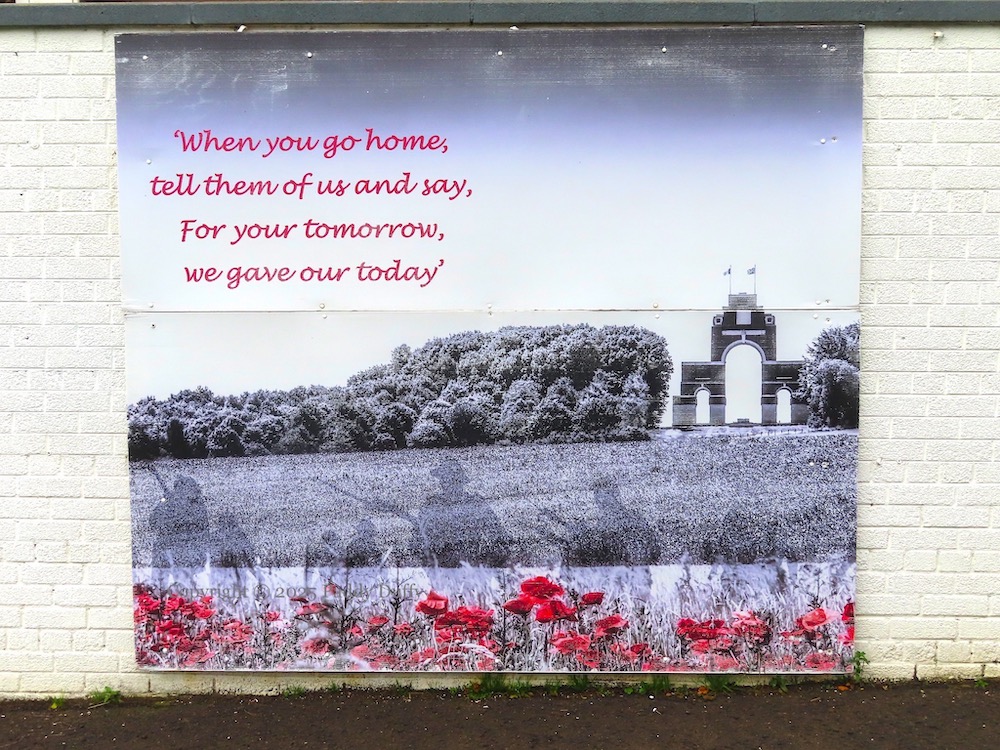
“When you go home tell them of us and say, ‘For your tomorrow we gave our today’.” The Thiepval Memorial commemorates British and South African soldiers who died in the Somme valley and have no known grave. The Battle Of the Somme took place from July 1st to November 18th, 1916, but soldiers were in the area from July 1915 until the end of the war; the Germans attacked in the Somme in the spring of 1918 (Operation Michael) and a second Battle Of The Somme took place in late August, 1918, as part of the Allies’ Hundred Days Offensive.
The words are from an epitaph by John Maxwell Edwards in the Kohima War Cemetery, Nagaland, India.
On June 7th, a Ballymena teenager was allegedly assaulted by two Romanian-speaking fourteen-year-olds, who were subsequently charged with attempted rape and denied bale. Rioting in Ballymena (Reuters gallery | youtube) beginning on the 9th spread to other locales in subsequent days, including Larne where the leisure centre was set alight on the third night (Guardian | youtube). More than 100 people from Ballymena were eventually arrested (Yahoo). Convictions of rioters – which police described as “race-motivated” and “hate-fuelled” – began on August 1st (PSNI); a 21-year-old man was sentenced to two years in jail earlier this month (Belfast Live). Two-thirds of the Roma population have left the town (Guardian).
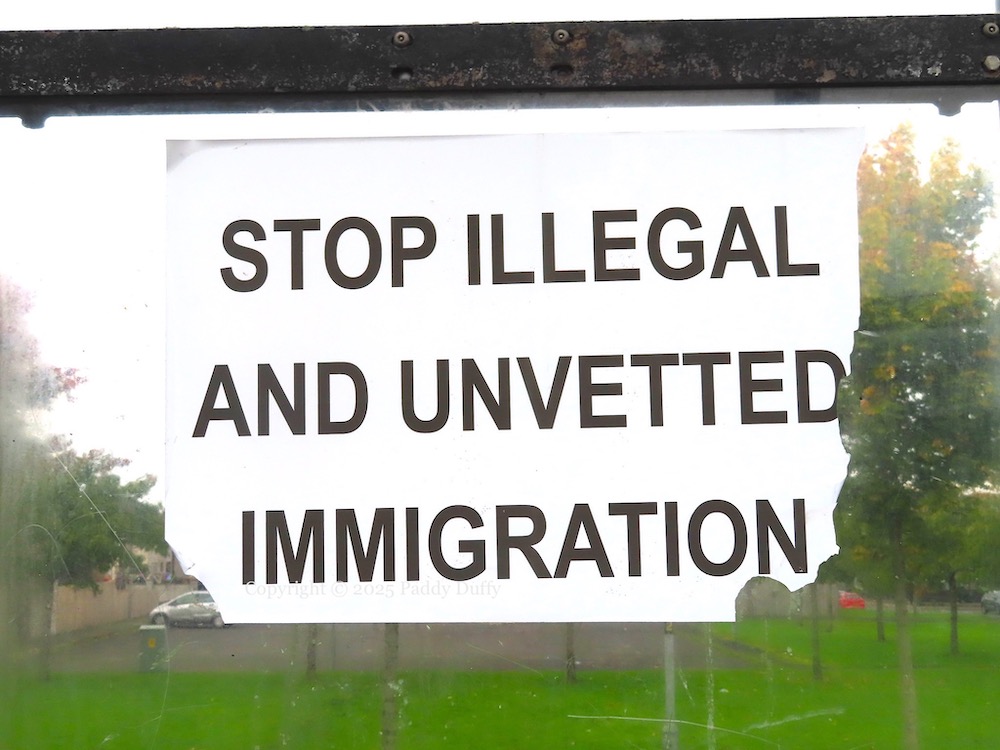
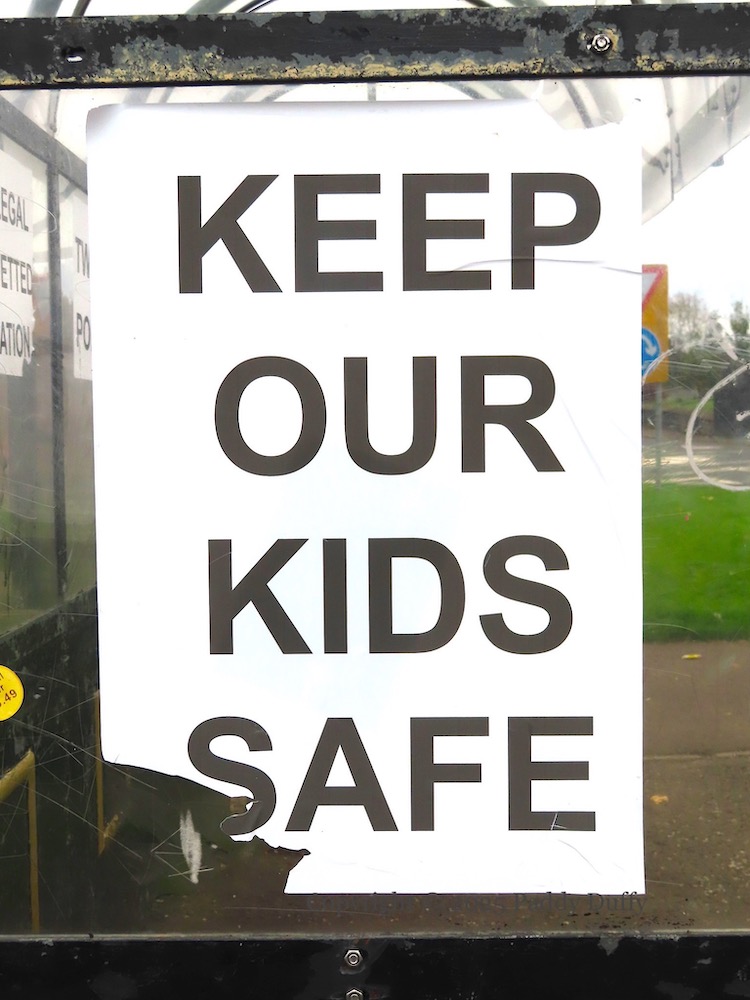
These flyers are stuck onto a bus shelter on Crebilly Road, Ballymena. “We are not racist; we are concerned parents”, “Two-tier policing”, “Stop illegal and unvetted immigration”, “Stop mass migration”, “Keep our kids safe”.
The upper Woodvale plaque “in memory of all those Protestants and members of the security forces who lost their lives in the greater Shankill area as a result of conflict” has sat unadorned since at least 2008 but now has a pair of boards to accompany it.
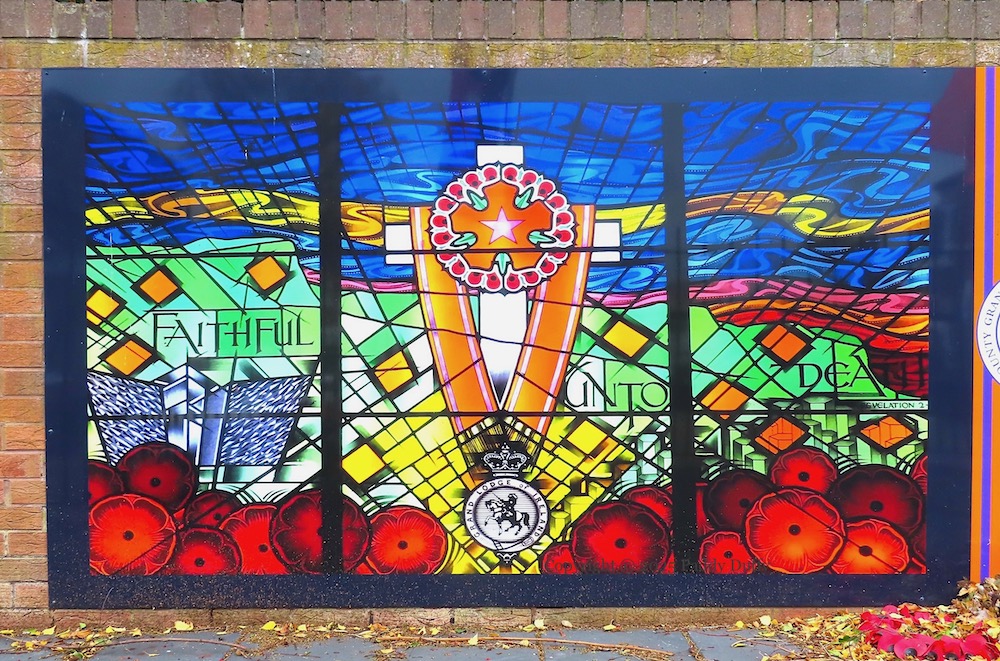
On the left, a reproduction of the “Faithful Unto Death” stained-glass window in the Museum of Orange Heritage in Schomberg House on the Cregagh Road (also reproduced in Newbuildings in 2022), along with the emblem of the Country Grand Orange Lodge Of Belfast (Fb).
On the right, a memorial to “all local residents whose lives were cruelly taken by Republican terrorists. Also those who selflessly gave their lives in the service of our country, and those who continue to do so.” (LOL “423” appears to be Banbridge Bible And Crown Defenders.)
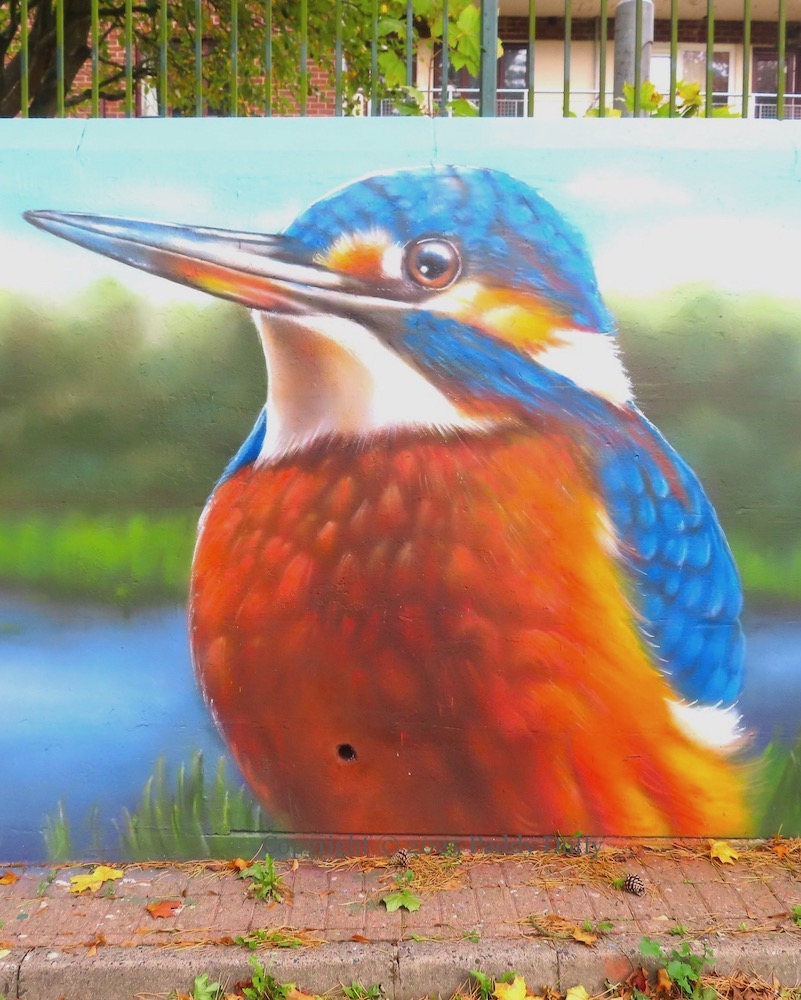
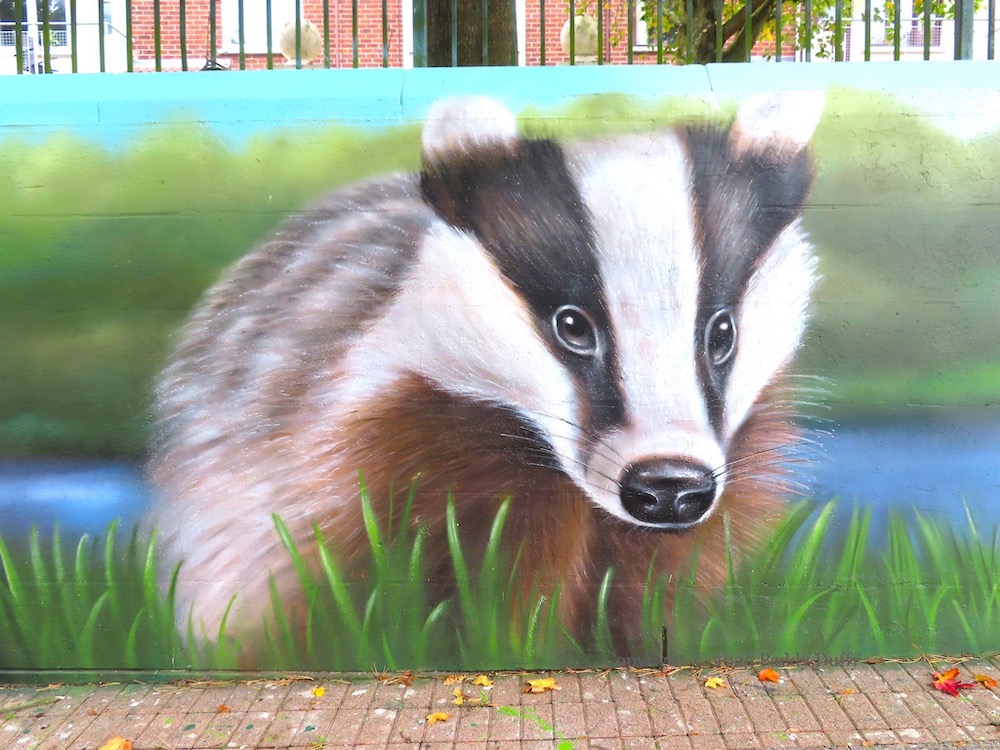
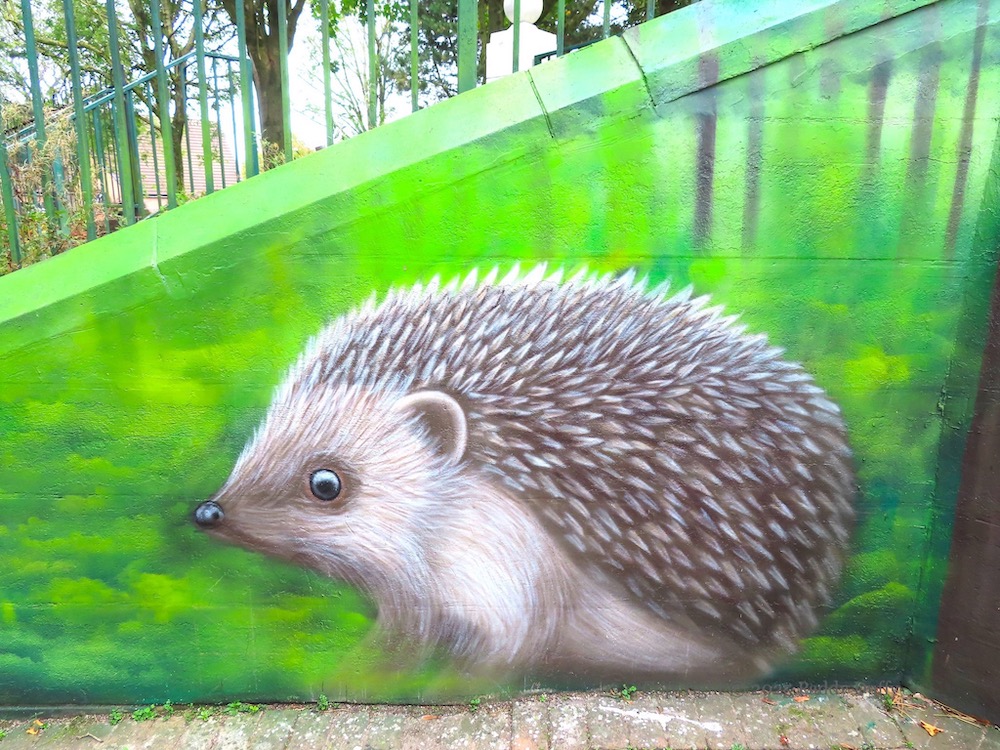
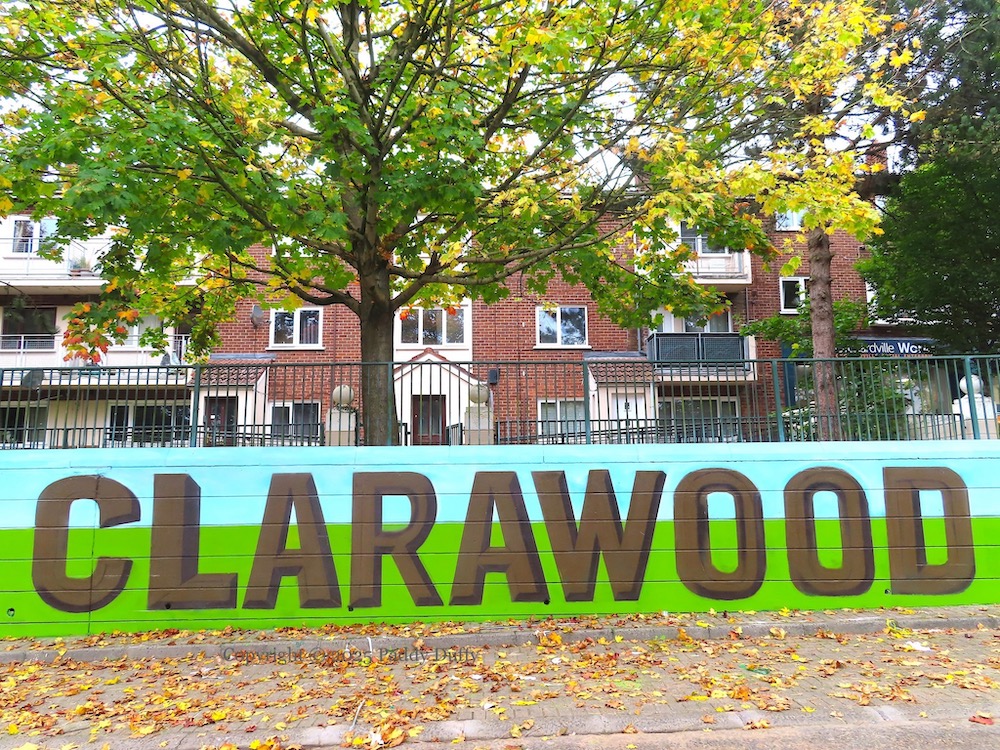
Here are a kingfisher, heron, badger, owl, squirrel, fox, and hedgehog by Glen Molloy (ig) in Knockwood Park, Clarawood, east Belfast. The closest place one might be able to see any of these creatures – particularly herons – is in the Marsh-Wiggle pond, along the Connswater (East Side Greenways).
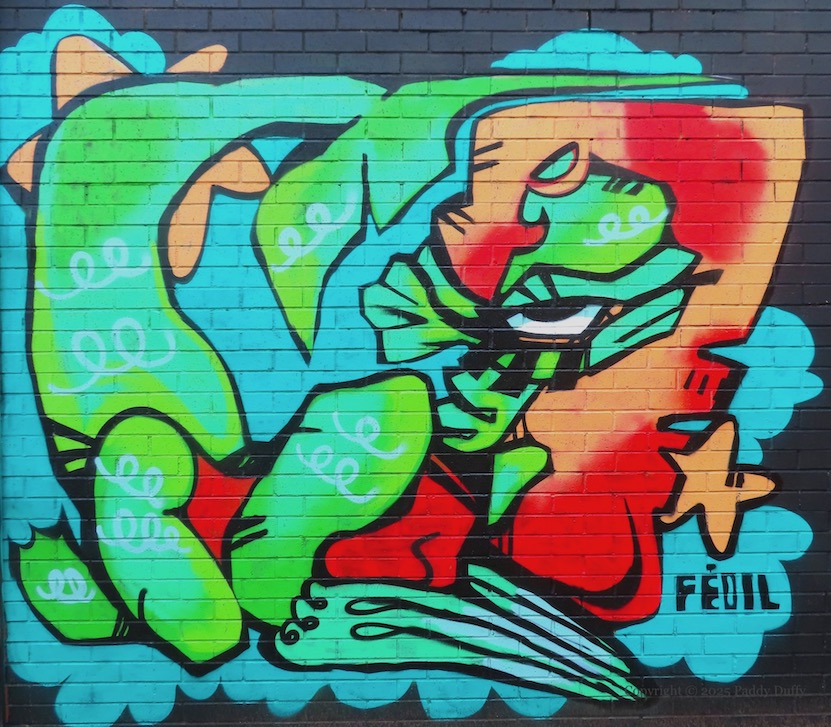
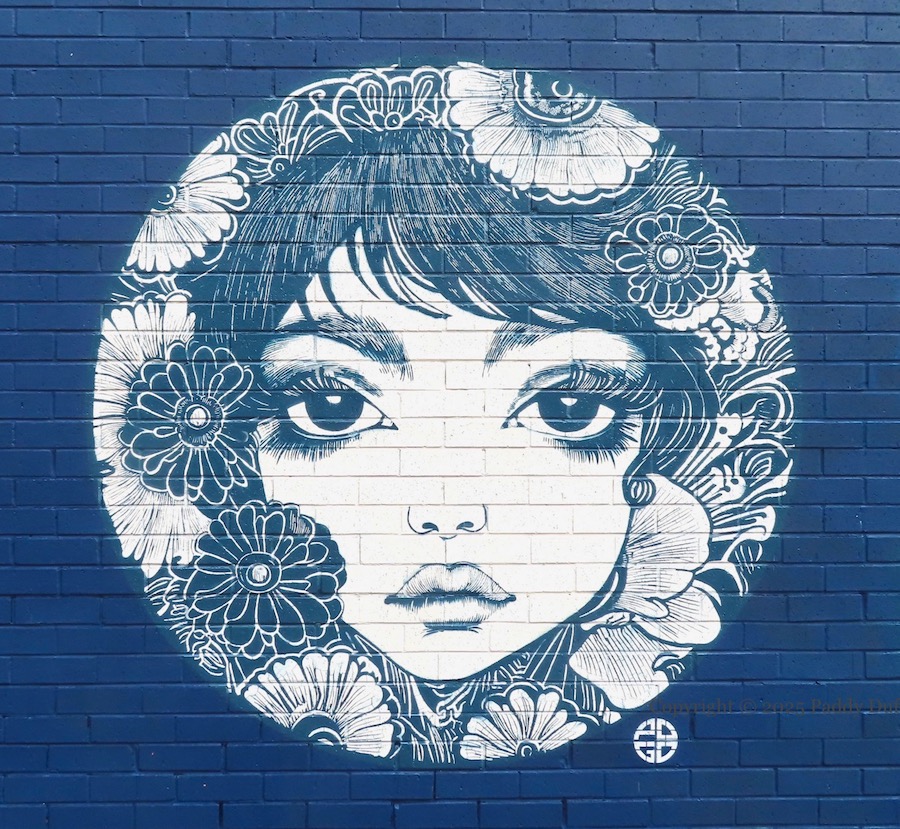
Here are the results of a paint-jam at Seacourt Prints (web) in Bangor at the end of September. The “peace” above is by Rob Hilken (web); the artists for the other pieces are noted beneath the individual photos.
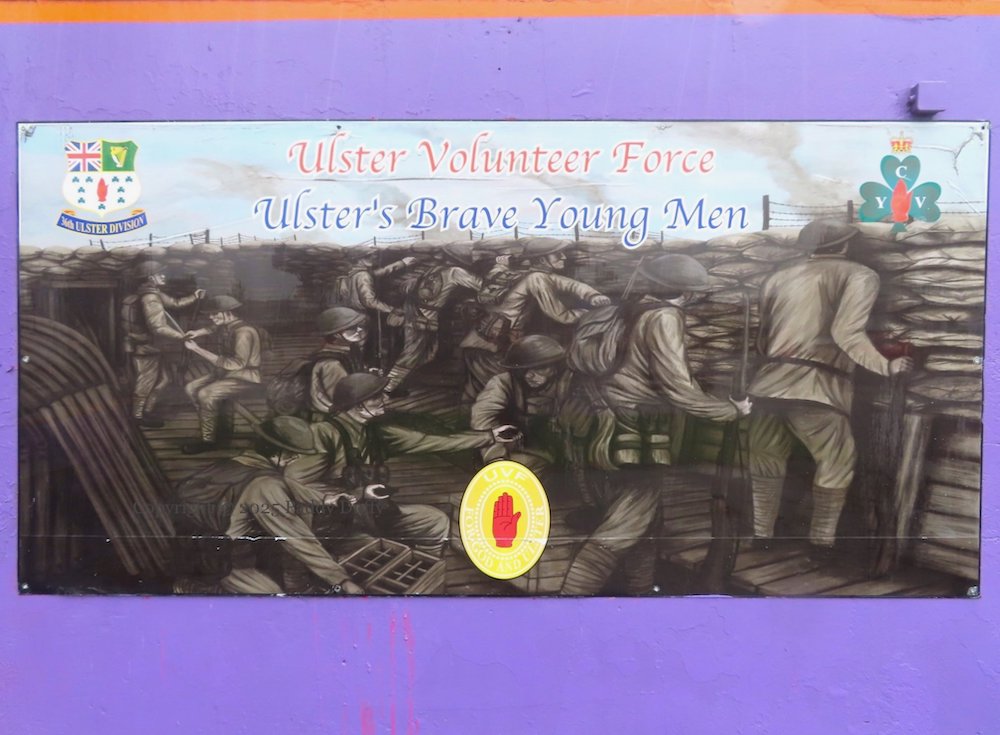
The background to the Avenue Road “Memorial to the 36th (Ulster) Division and to other men of Ulster who served in the Great War 1914 – 1918” has been repainted in the purple and orange of the UVF and the wall simplified by the removal of two smaller boards to each side of the main board (above) which shows soldiers looking out over the edge of a WWI trench. (For the the previous boards, see the Peter Moloney Collection.)
The seat is dedicated to “Jack”, an 11-year-old member of the Avenue Road Memorial flute band who died in 2019 (News Letter), with boxing gloves and emblem of the NI soccer association. 2 Timothy 4:7 says, “I have fought the good fight, I have finished the race, I have kept the faith.”
Avenue Road, Lurgan
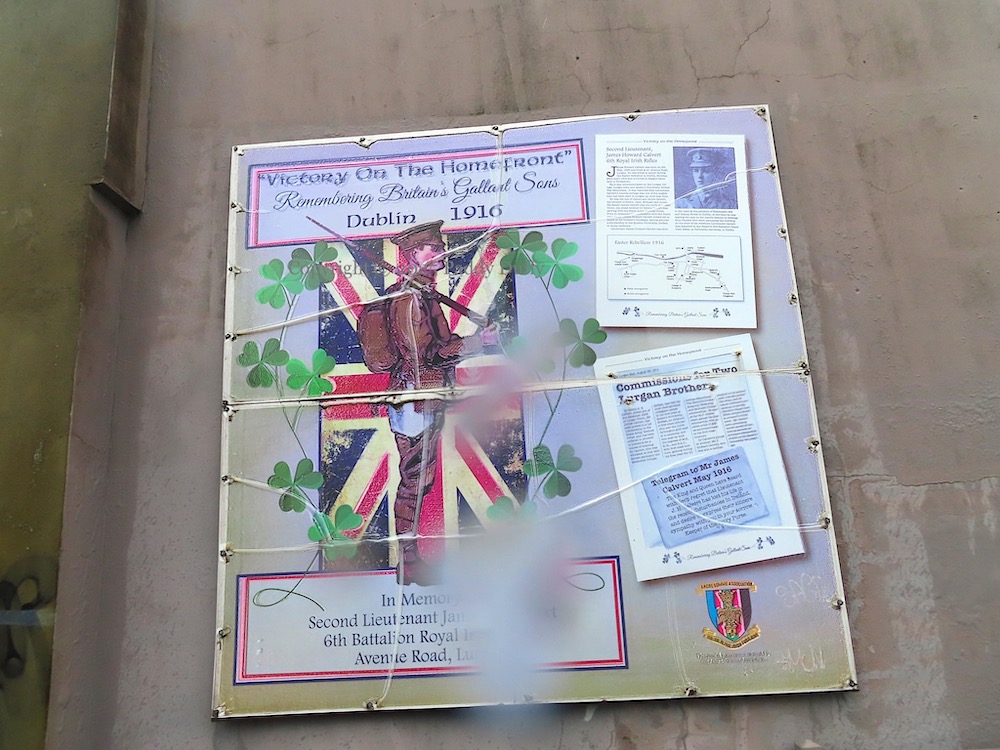
The final image is of a board in nearby King’s Park Mews to a soldier who died on “the homefront” – Dublin during the 1916 Rising – Second Lieutenant James Howard Calvert of the 6th Royal Irish Rifles.Calvert lived at 41 Avenue Road, Lurgan.
This entry updates 2023’s Harryville Says No with images of two additional boards/plaques erected by the 12th Battalion Royal Irish Rifles Memorial Association (Fb), “in honour of the men from Harryville [Ballymena] who made the ultimate sacrifice during the Battle Of The Somme from 1st July to 18th November 1916”.
“Remembering 57386 Sergeant John McNabney, formerly of No 9 Larne Street, 36th Divisional signal company, awarded the distinguished conduct medal, military medal with bar, and mentioned in despatches.” McNabney’s career and many decorations are described in Ballymena Guardian | Your Lurgan.




















 Paddy Duffy Collection