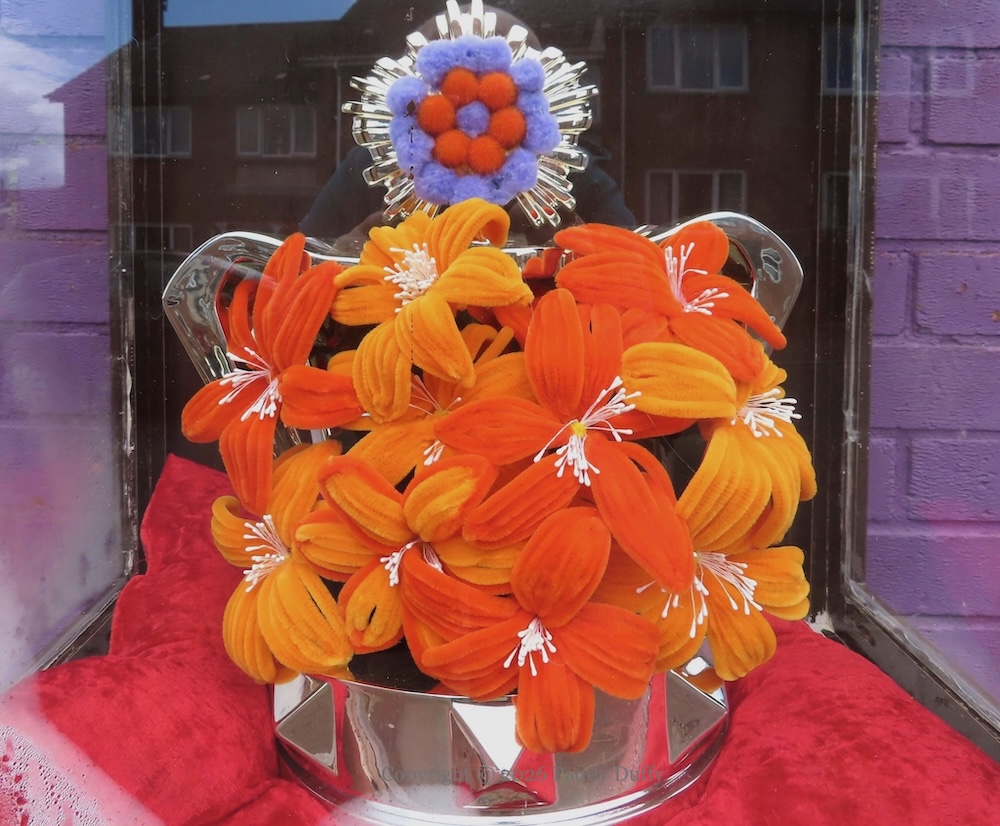
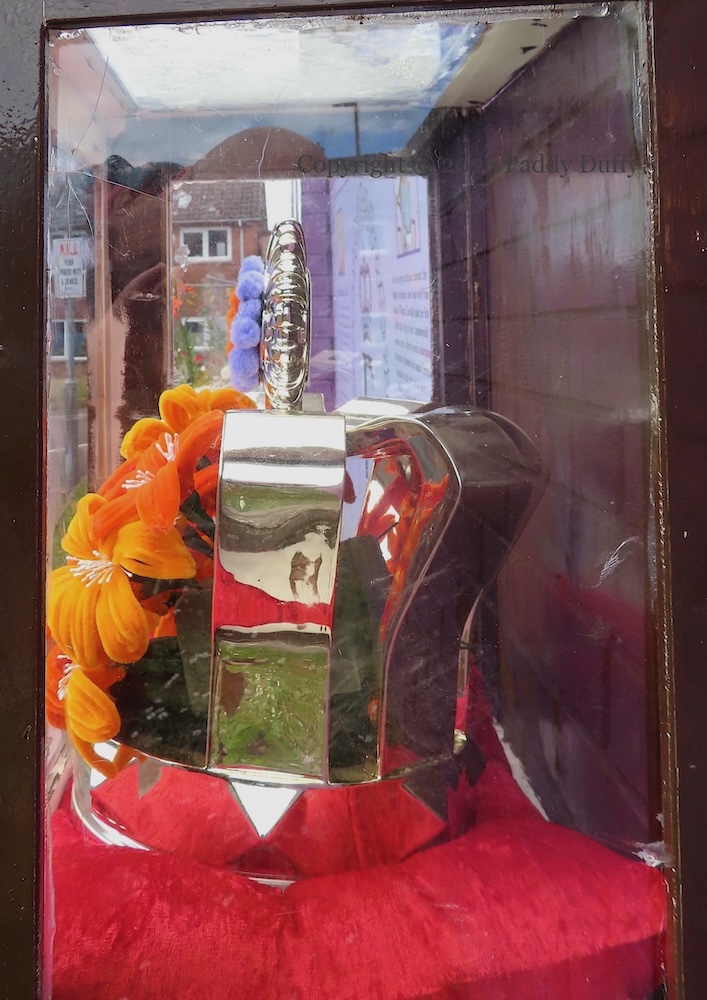
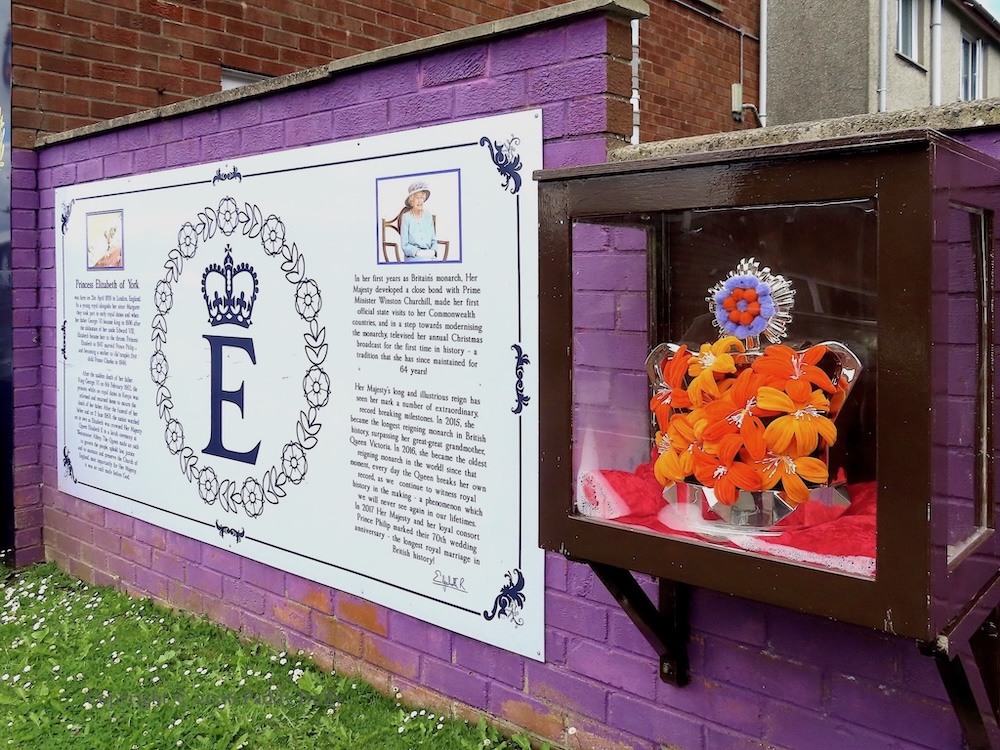
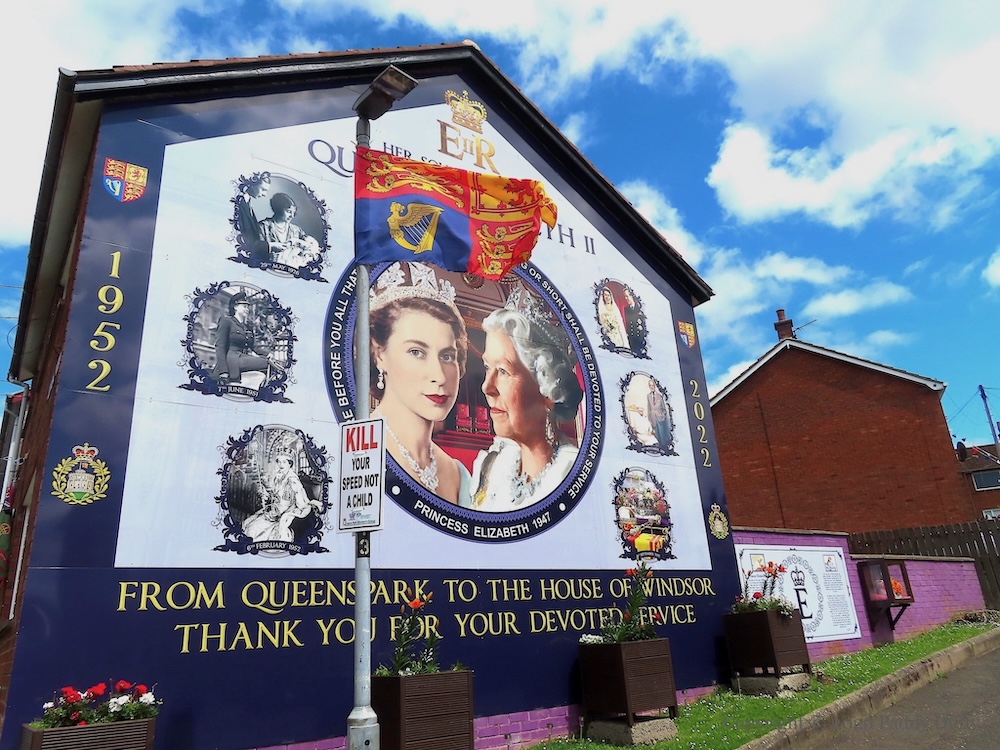
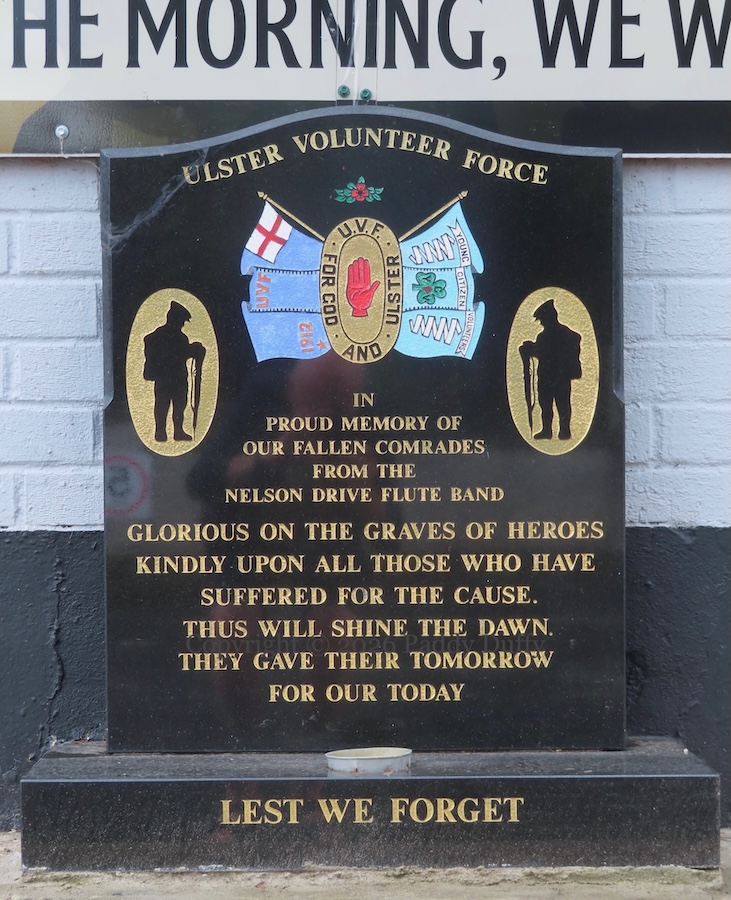
This entry updates one from May, which showed the replacement memorial board for QEII in Glengormley. To the right of the info board there is now a case containing a crown with a bouquet of orange lilies in front, and a smaller arrangement of orange and purple flowers (the colours of the UVF, though this is a UDA area) above.
“Marching mental health.” Light Of Foot is a non-profit organisation (web) supporting the mental health of bands-men and -women in Scotland and Northern Ireland. This flag is next to a Shankill Protestant Boys flag (Fb) and a large Union Flag in Eccles Street, west Belfast.
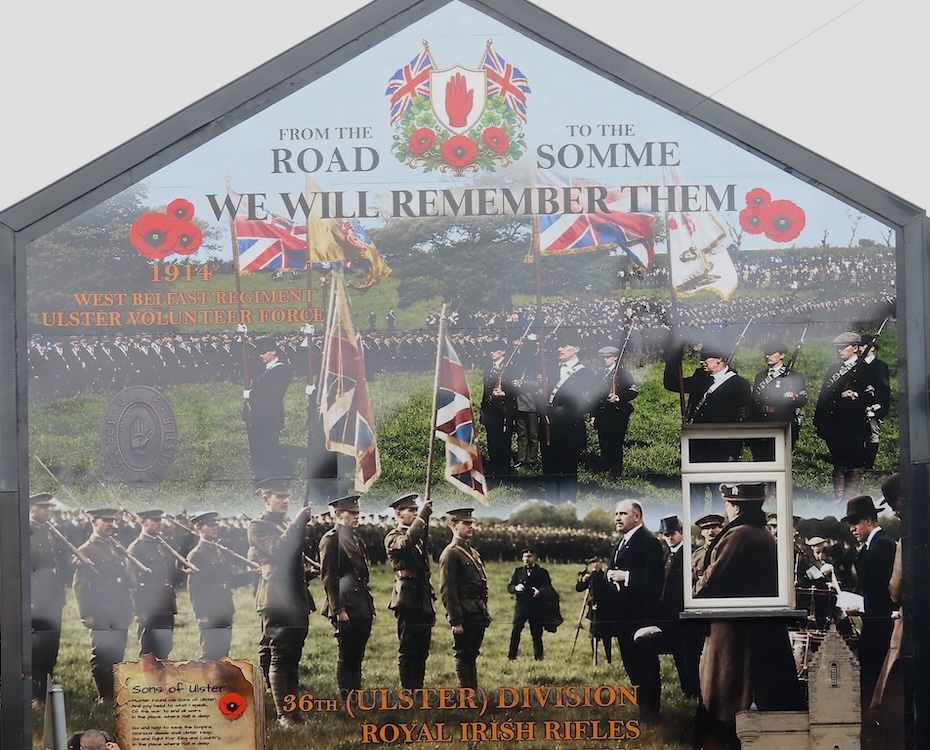
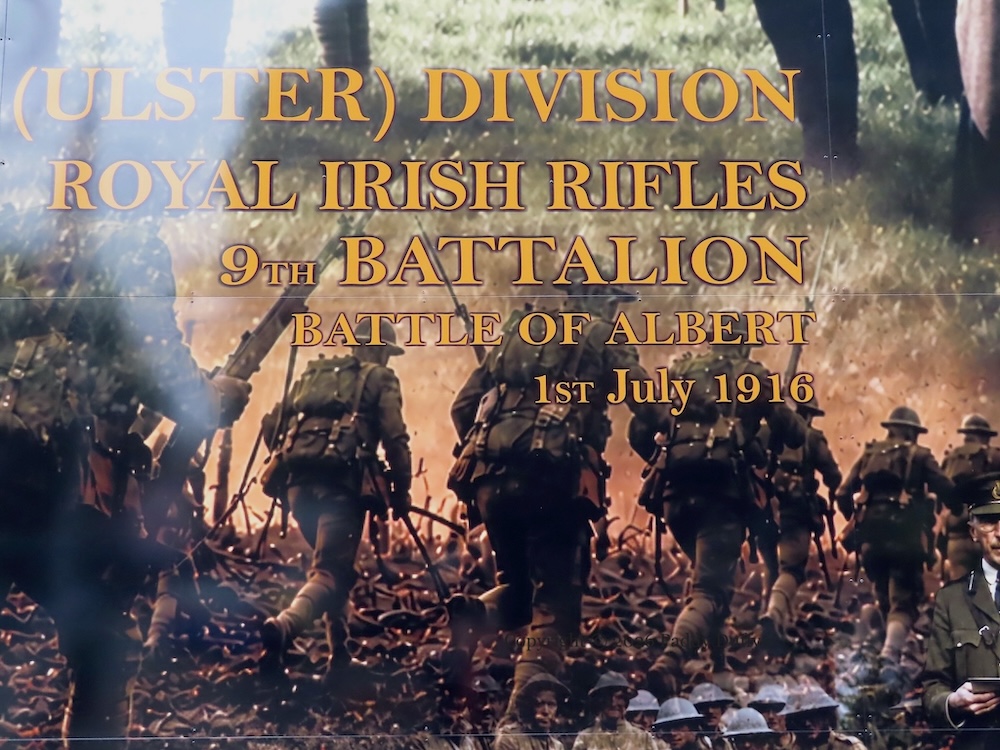
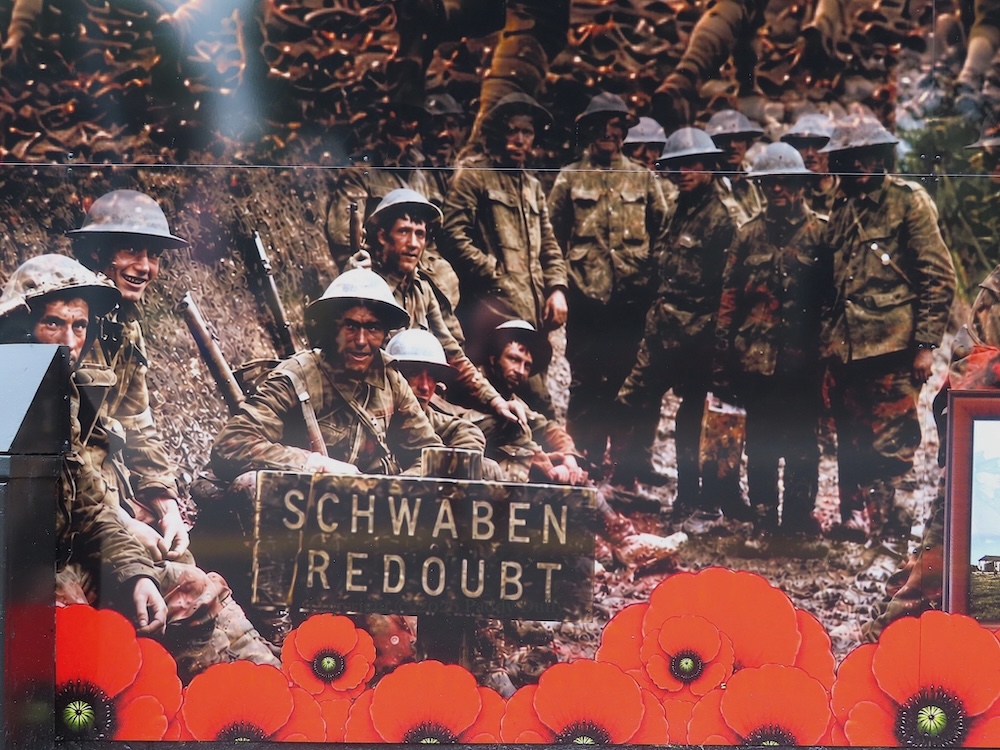
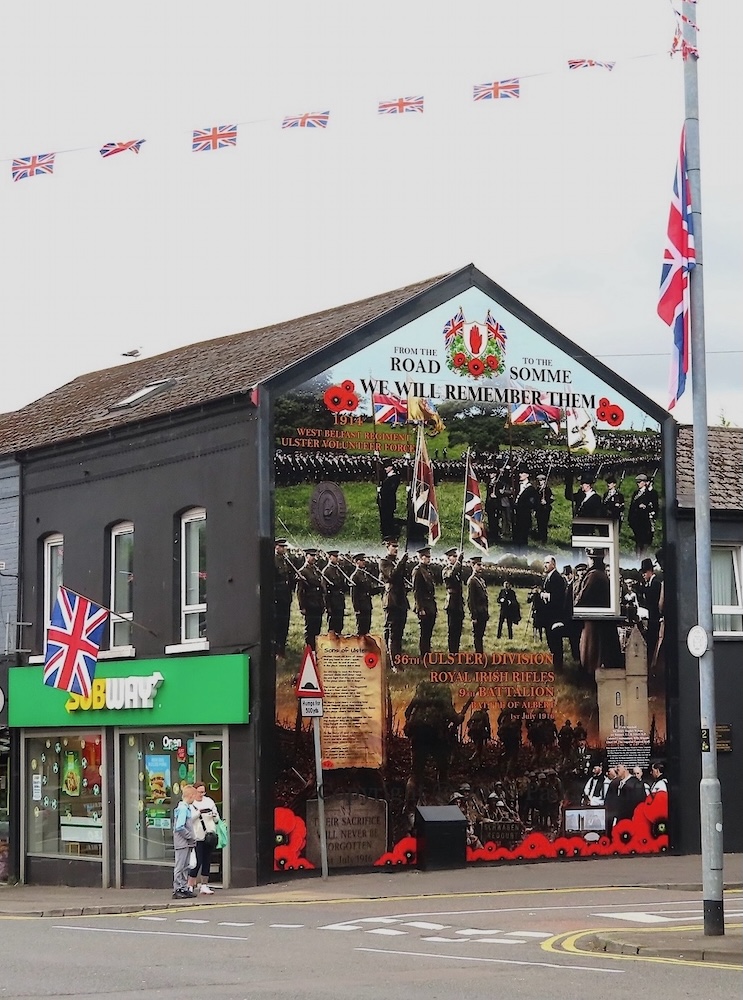
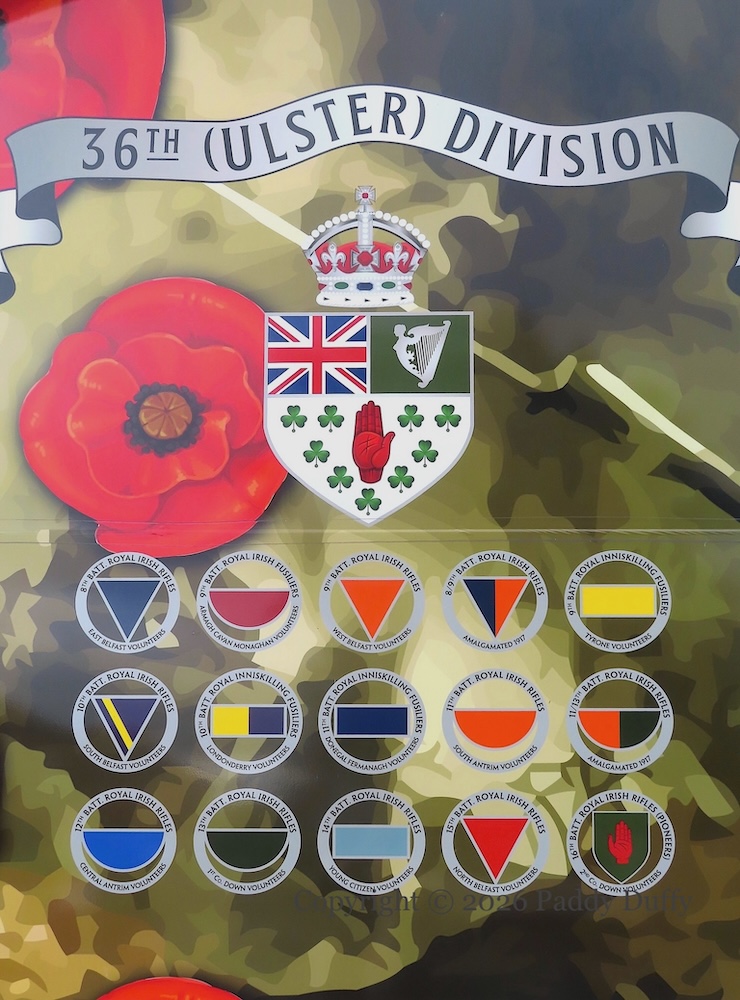
“1914 West Belfast regiment, Ulster Volunteer Force – 36th (Ulster) division, Royal Irish Rifles.” Men from the West Belfast Ulster Volunteers – which included the Shankill and Woodvale areas – joined the 9th battalion of the Royal Irish Rifles, which became part of the 107th brigade of the 36th division.
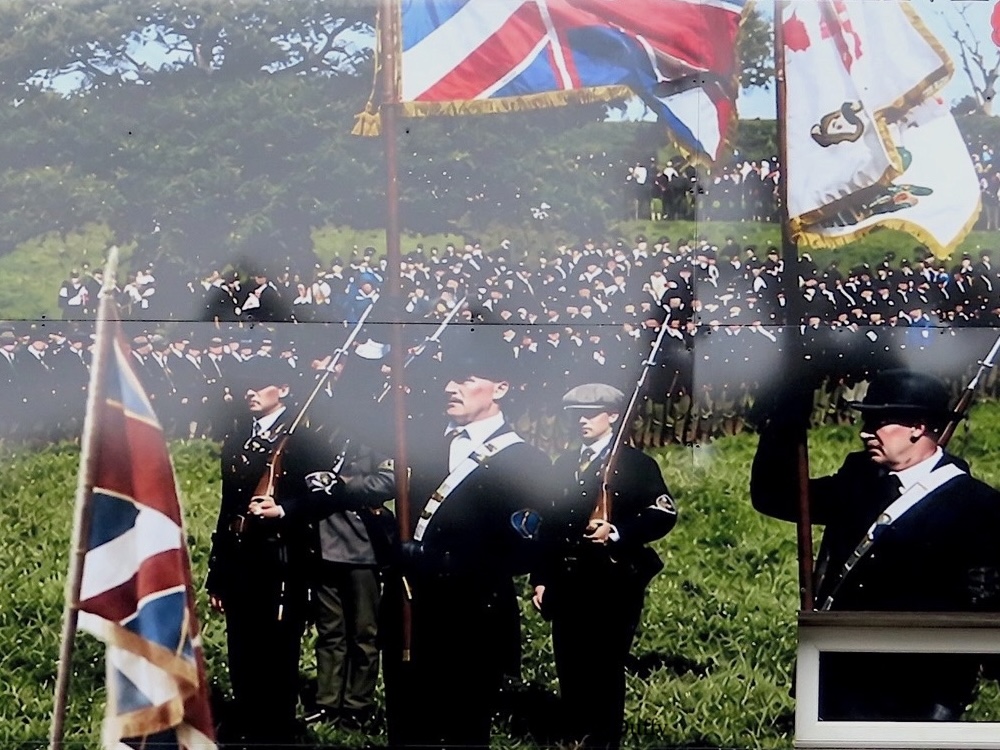
The main part of this new gable-sized board places two colourised photographs on top of each other. The first (upper) photo shows shows the first and second battalions of the West Down regiment being presented with their colours in May, 1914 (CyberProd). The second (lower) photo shows the first and second battalions of the West Belfast regiment receiving the Kings colours in May, 1914 (CyberProd).
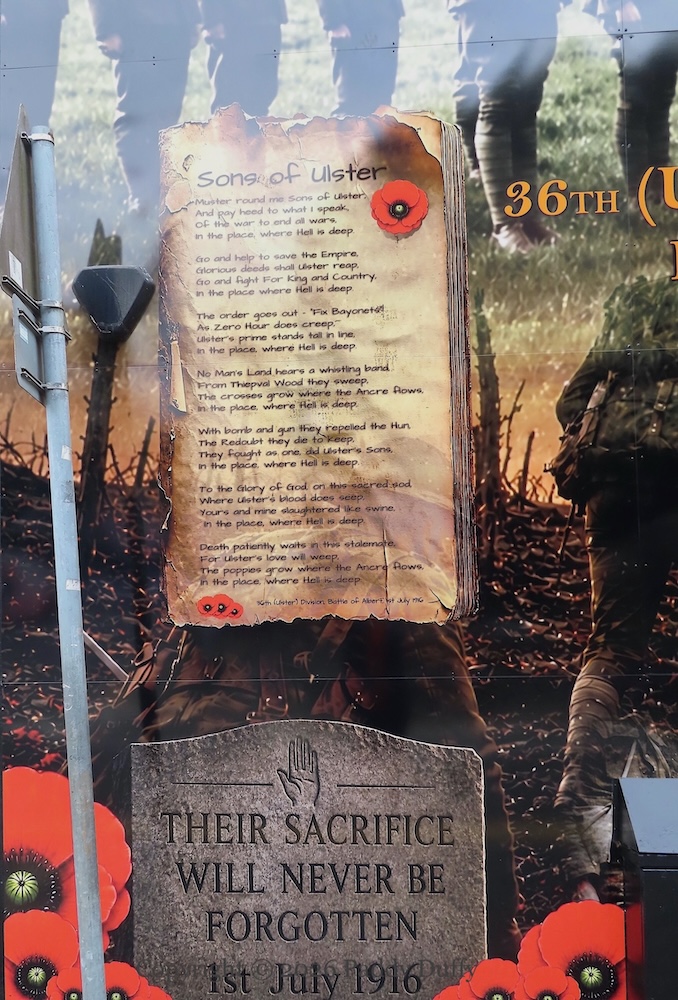
In the bottom left corner is a poem called “Sons of Ulster” written on a scroll: “Muster round me Sons of Ulster,/And pay heed to what I speak,/Of the war to end all wars,/In the place where hell is deep.//Go and help to save the Empire,/Glorious deeds shall Ulster reap./Go and fight for King and Country,/In the place where hell is deep.//The order goes out – “Fix Bayonets!”/As Zero Hour does creep,/Ulster’s prime stands tall in line,/In the place where hell is deep.//No-Man’s Land hears a whistling band,/From Thiepval Wood they sweep./The crosses grow where the Ancre flows,/In the place where hell is deep.//With bomb and gun they repelled the Hun,/The Redoubt they die to keep./They fought as one did Ulster’s Sons,/In the place where hell is deep.//To the Glory of God on this sacred sod,/Where Ulster’s Blood does seep,/Yours and mine slaughtered like swine,/In the place where hell is deep.//Death patiently waits in this stalemate,/For Ulster’s love will weep,/The poppies grow where the Ancre flows,/In the place where hell is deep.”
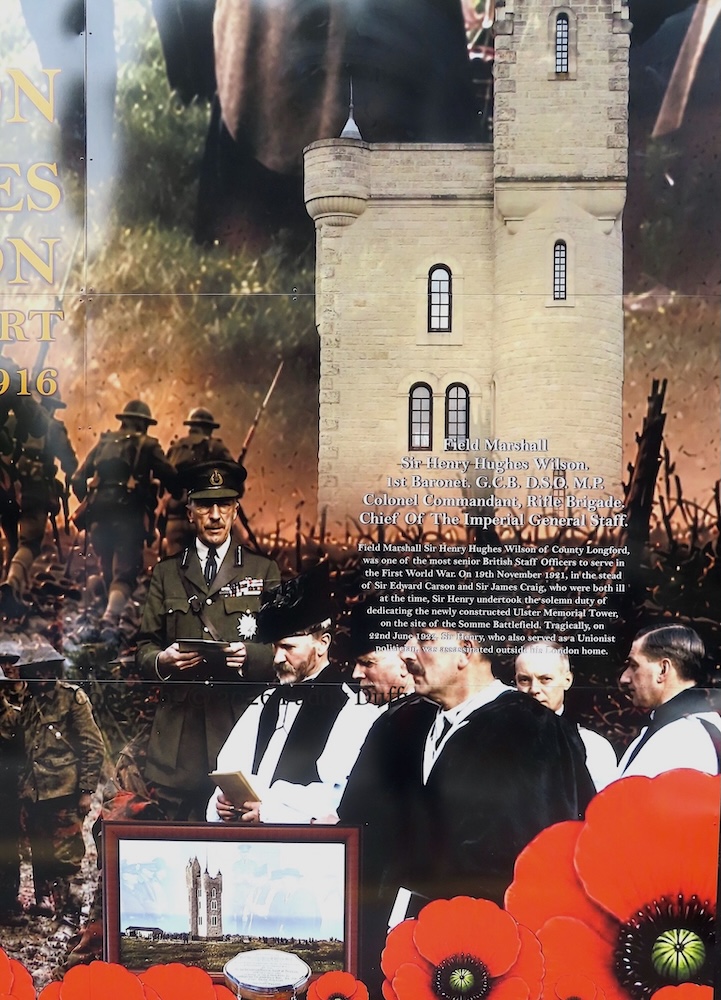
In the bottom right, the Ulster Tower is dedicated: “‘Field Marshall Sir Henry Hughes Wilson, 1st Baronet, GCB, DSO, MP, Colonel Commandant, Rifle Brigade, Chief Of The Imperial General Staff. Field Marshall Sir Henry Hughes Wilson of County Longford, was one of the most senior British Staff Officers to serve int he First World War. On 18th November 1921, in the stead of Sir Edward Carson and Sir James Craig, who were both ill at the time, Sir Henry undertook the solemn duty of dedicating the newly constructed Ulster Memorial Tower, on the site of the Somme battlefield. Tragically, on 22nd June 1922, Sir Henry, who also served as a Unionist politician, was assassinated outside his London home.”
Conway Street, Shankill, west Belfast, replacing Ulster Tower.
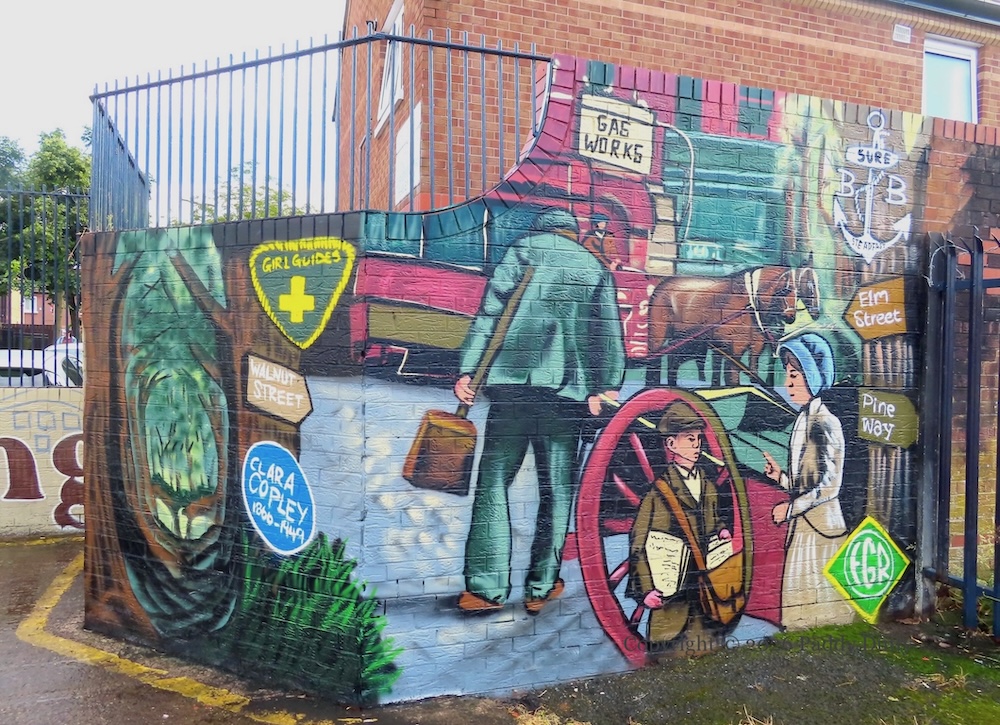
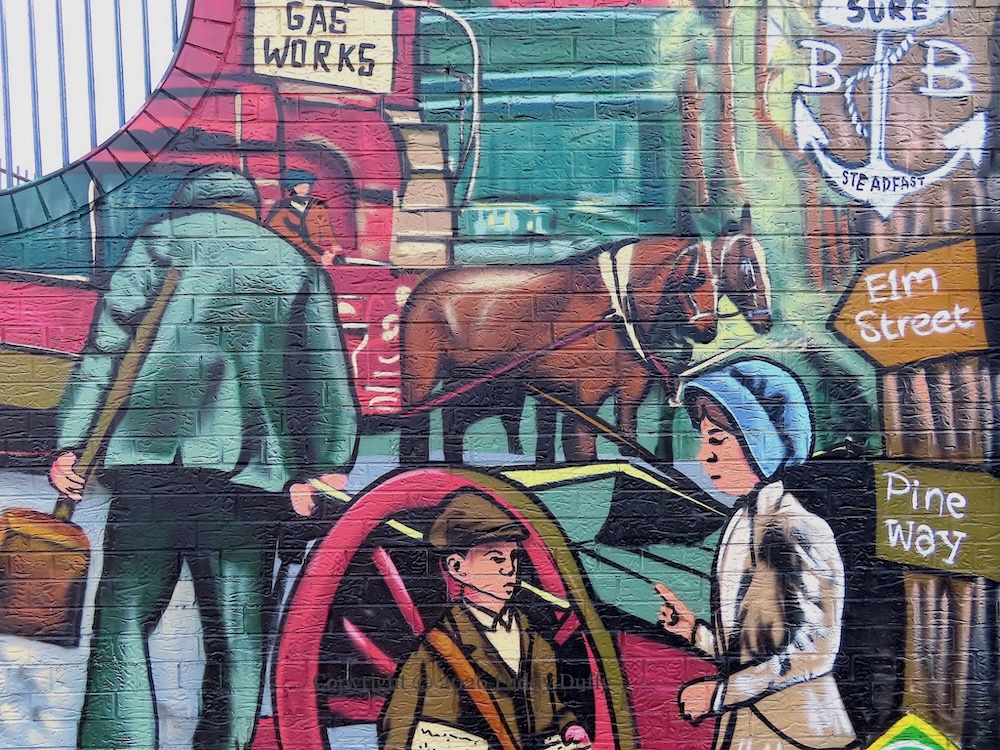
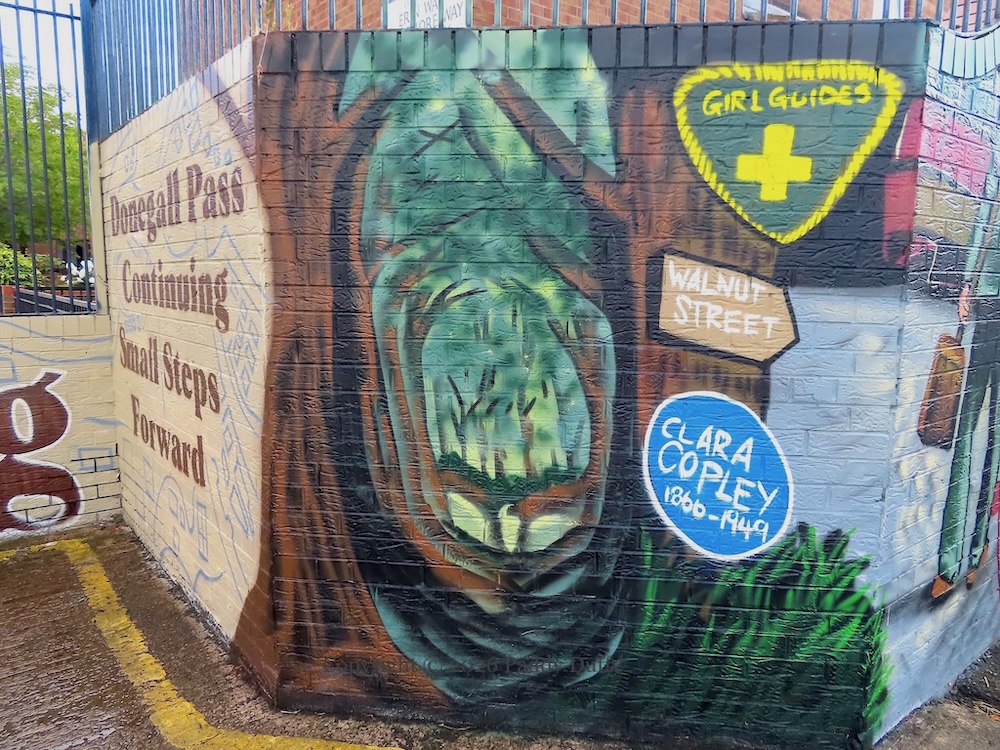
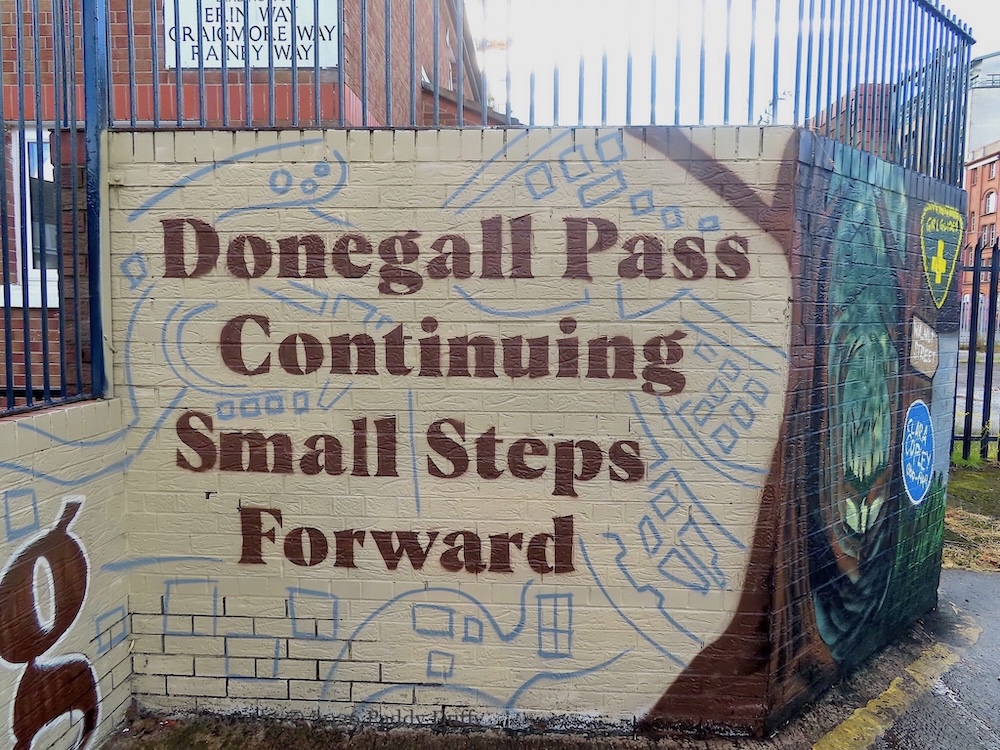
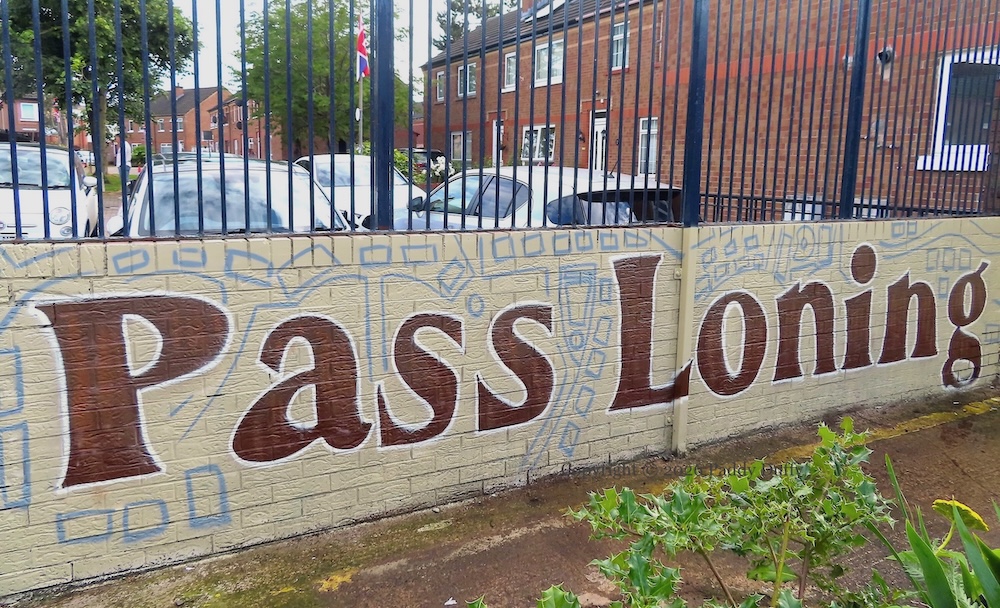
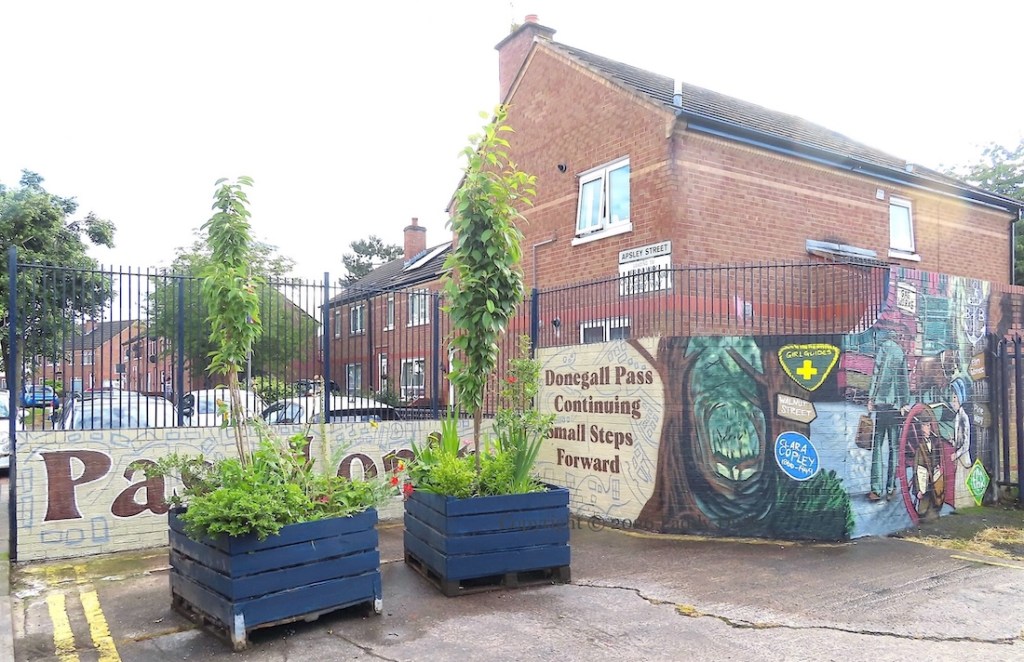
Donegall Pass began life in the late 1600s as a lane-way (loning, loney, loanen) made by one of the early earls of Donegall (the first three of whom were all called Arthur Chichester) through what was then Cromack Woods (Library Ireland). The woods are remembered in local street-names such as Walnut Street, Elm, Street, Pine Way (which are all included in the mural), as well as Cromac Street itself.
Clara Copley was born in Rotherham, moved to Liverpool, and then to Belfast c. 1900, where she lived for about fifty years. Her career was a colourful one that included running a fish-and-chip stall, an amusement arcade, a waxworks, a theatre, and a boxing ring, which was initially unlicensed but made official in 1936, when Copley was aged 70. She retired to a house in Donegall Pass where she died in 1949; there is a ‘blue plaque’ at the site (with an incorrect date of birth, faithfully reproduced here) in her memory. (DIB)
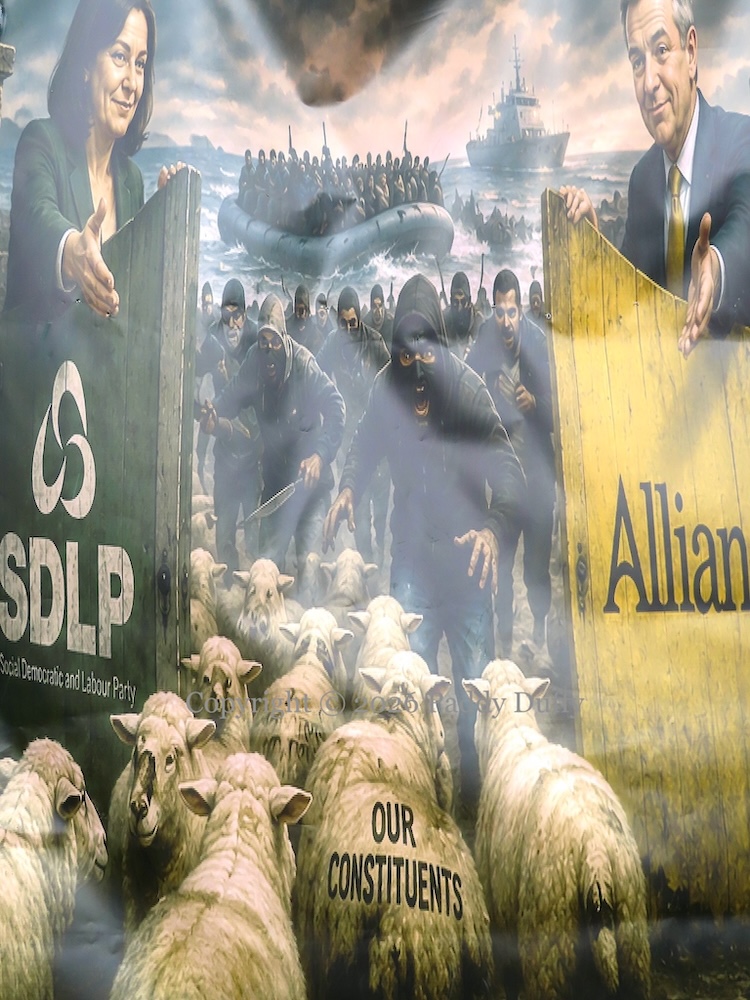
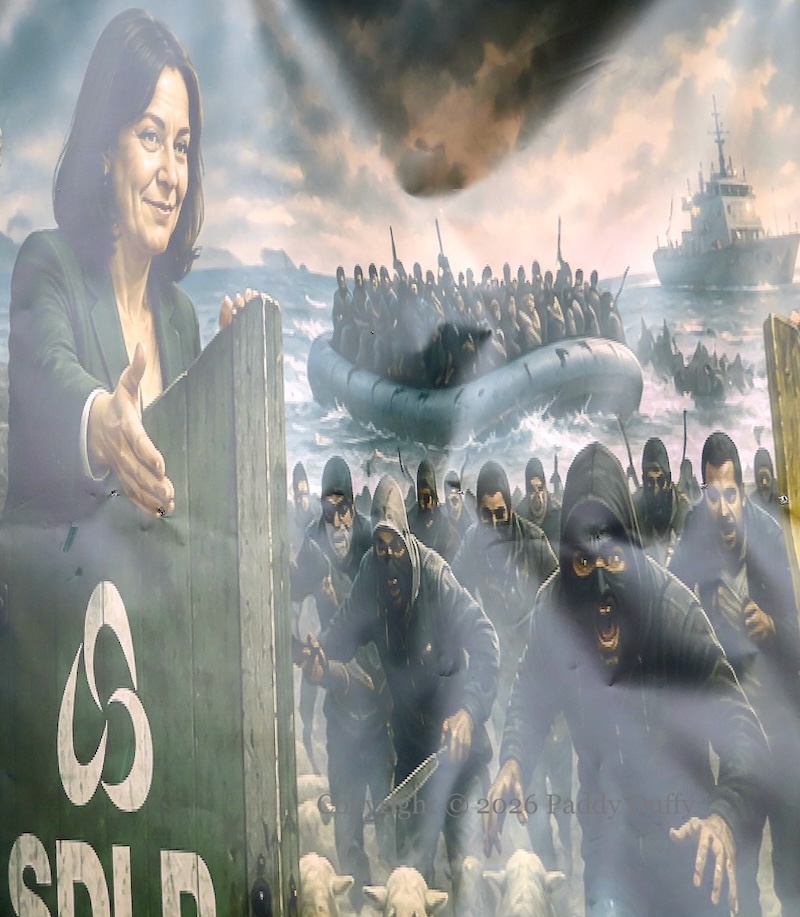
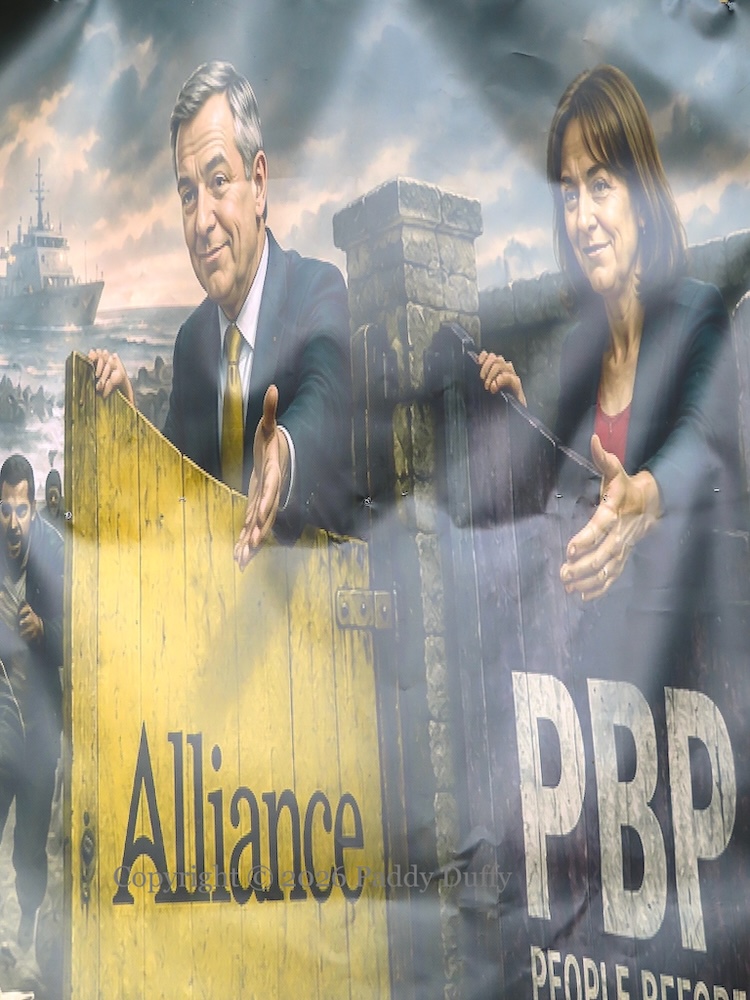
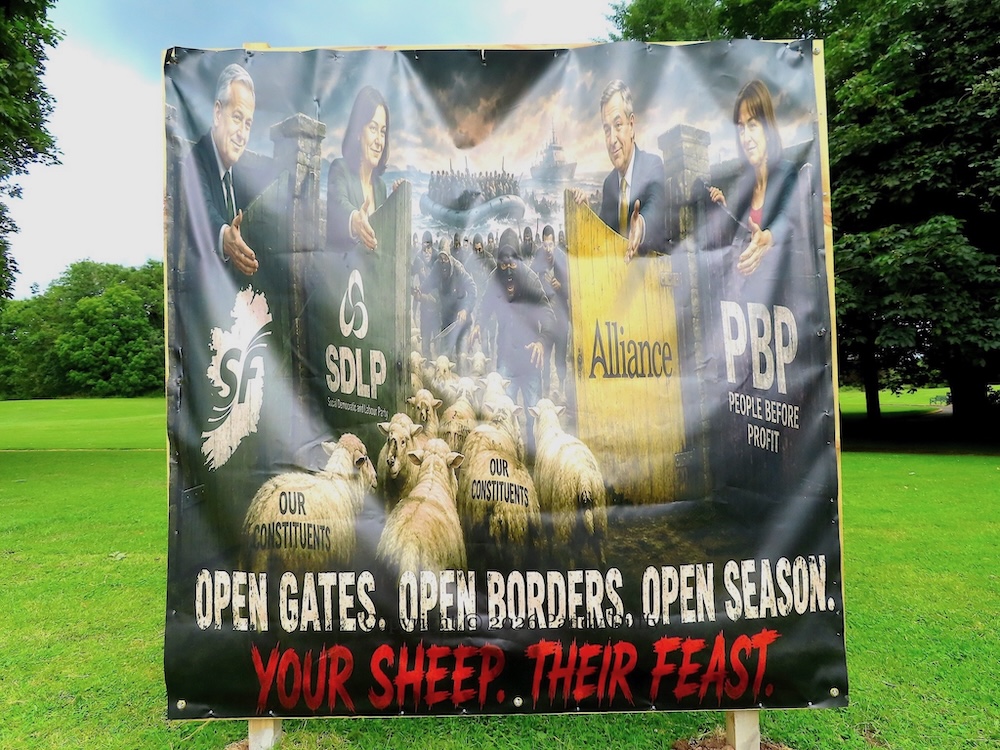
“Open gates. Open borders. Open season. Your sheep. Their feast.” Politicians from Sınn Féın, the SDLP, Alliance, and People Before Profit are shown opening the gates for masked and armed men who are coming from the sea and bidding them to enter a sheepfold of “our constituents”.
The PSNI are investigating the banner as a “hate incident” (rather than a “hate crime” – see A New Evil for the difference) (BelTel). The banner was later (July 1st) removed and replaced with Union Flags and an Ulster Banner (Belfast Media | News Letter).
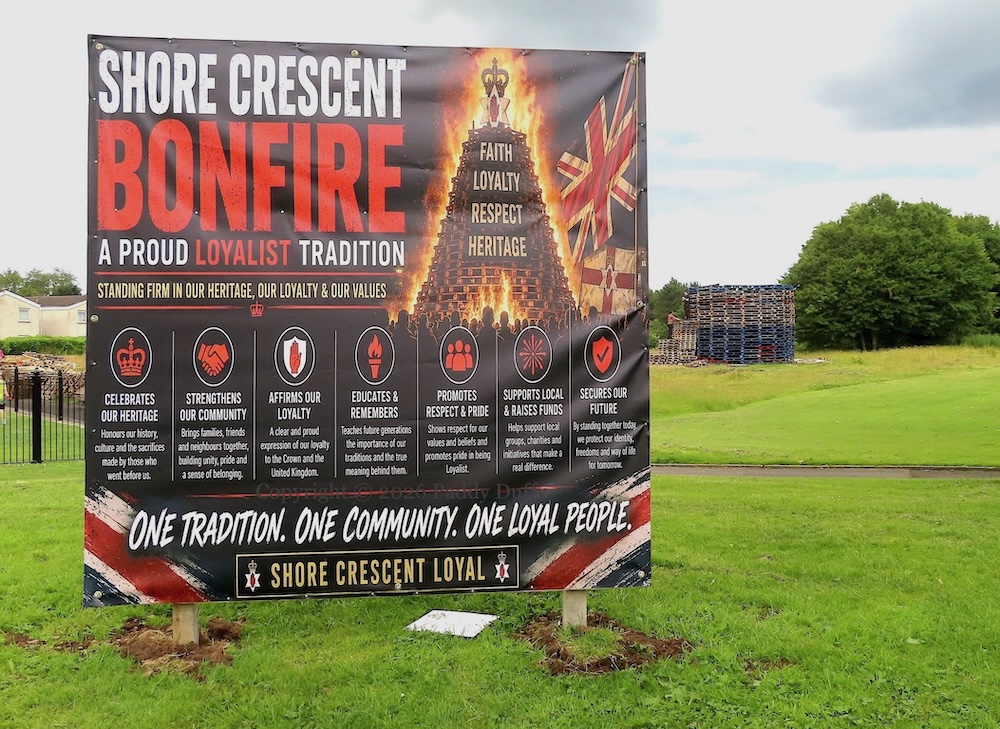
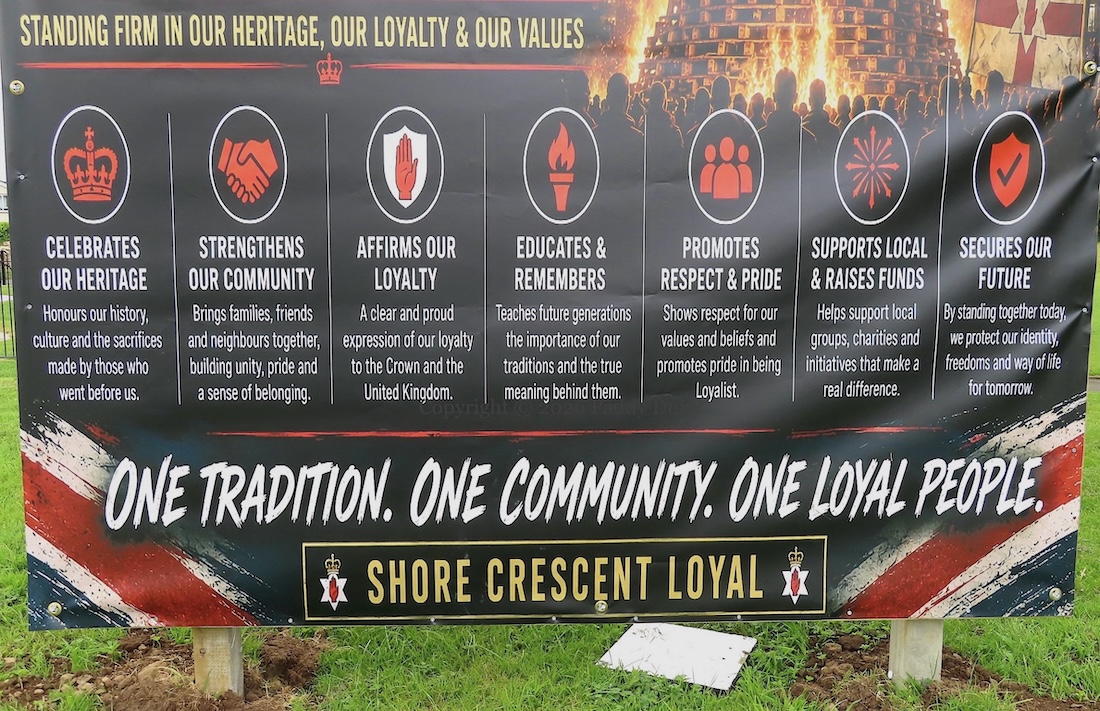
Shore Crescent prepares for Eleventh Night with a bonfire and a large sign explaining the positive impact of the tradition:
“Shore Crescent bonfire – a proud loyalist tradition. Standing firm in our heritage, our loyalty & our values. Faith – loyalty – respect – heritage. [The bonfire …] Celebrates our heritage – honours our history, culture and the sacrifices made by those who went before us; strengthens our community – brings families, friends and neighbours together, building unity, pride and a sense of belonging; affirms our loyalty – a clear and proud expression of our loyalty to the Crown and the United Kingdom; educates & remembers – teaches future generations the importance of our traditions and the true meaning behind them; promotes respect & pride – shows respect for our values and beliefs and promotes pride in being Loyalist; supports local [groups] & raises funds – helps support local groups, charities and initiatives that make a real difference; secures our future – by standing together today, we protect our identity, freedom and way of life for tomorrow. One tradition. One community. One loyal people. Shore Crescent loyal.”
Next to Loughside Playground, Shore Road, north Belfast
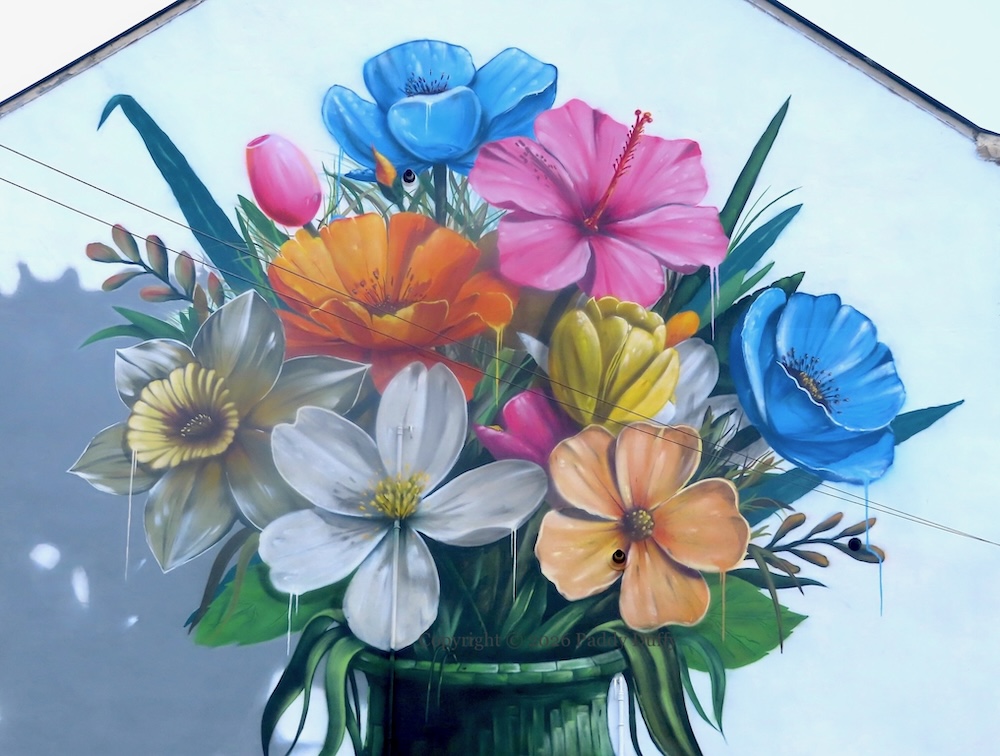
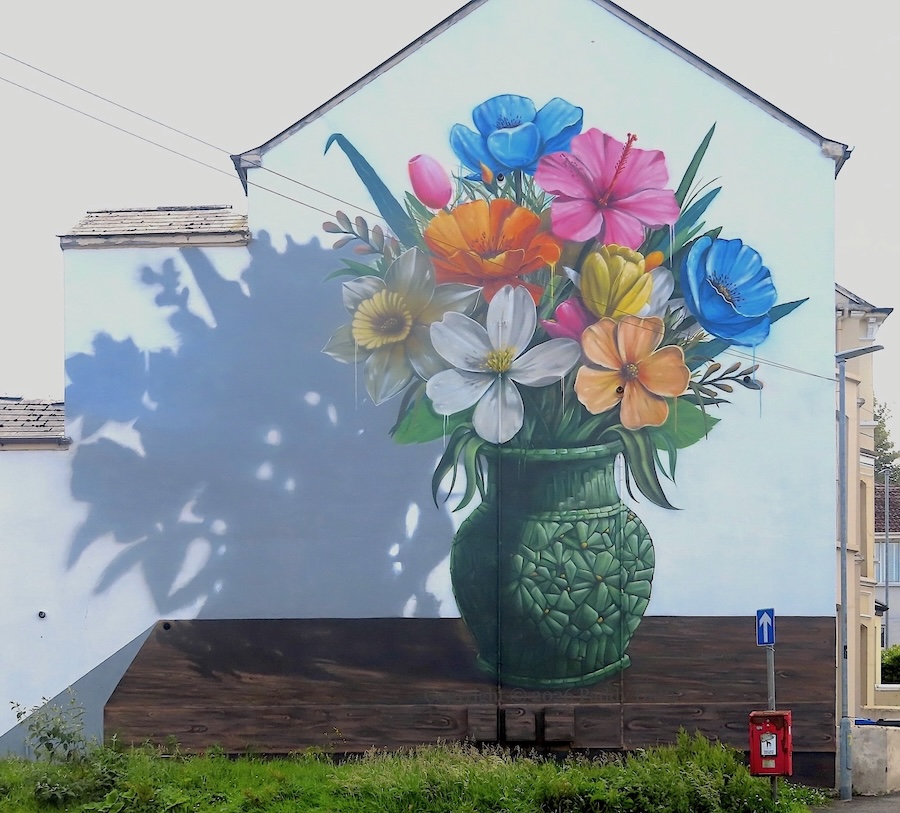
A variety of different flowers, including daffodil, flax, and orange lily, are arranged in a green vase representing Ireland – so described (ig) by painters Peaball (web).
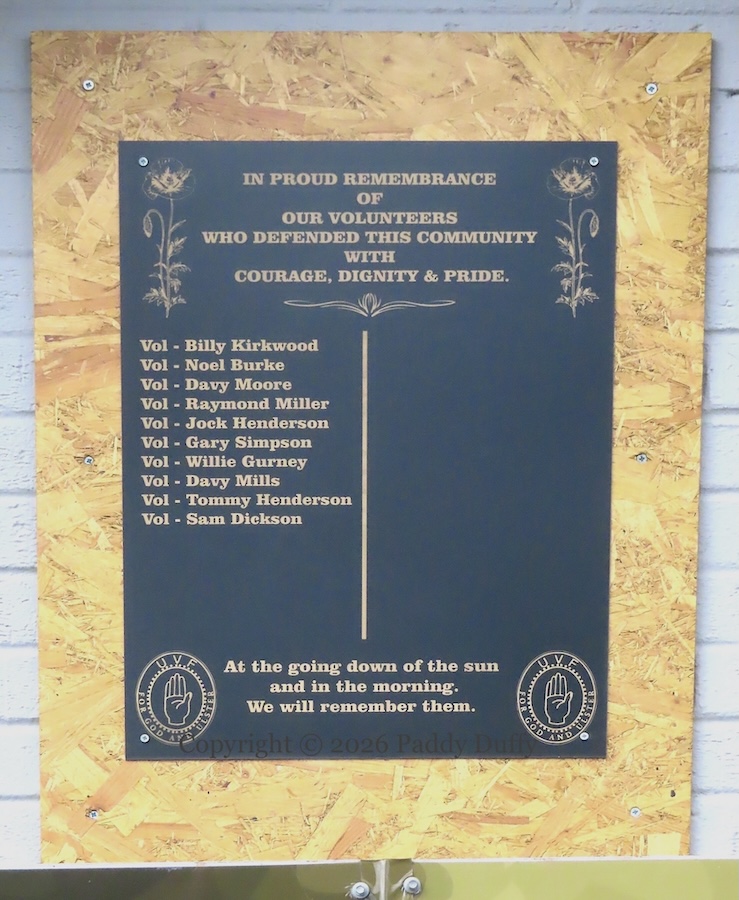
A UVF roll of honour has been added in the apex above the small memorial garden (now reduced to a single stone) in the Caw, Londonderry: “In proud remembrance of our volunteers who defended this community with courage, dignity & pride: Billy Kirkwood, Noel Burke, Davy Moore, Raymond Miller, Jock Henderson, Gary Simpson, Willie Gurney, Davy Mills, Tommy Henderson, Sam Dickson”. None of these appear to have died during the Troubles itself. There was previously a plaque to four volunteers who died in 1975.
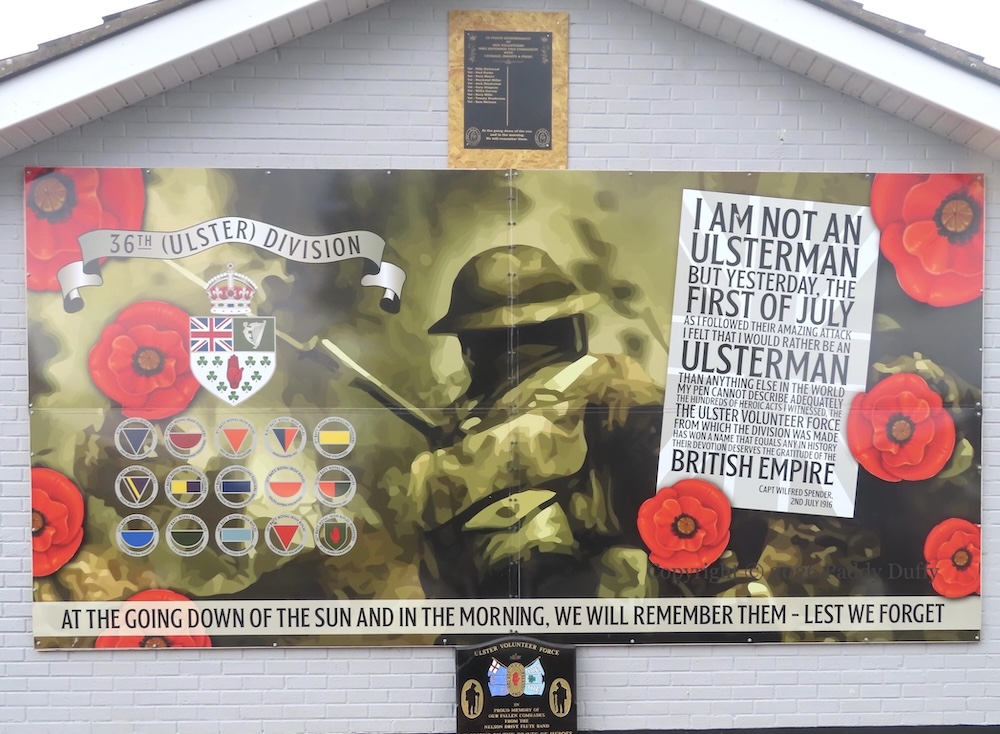
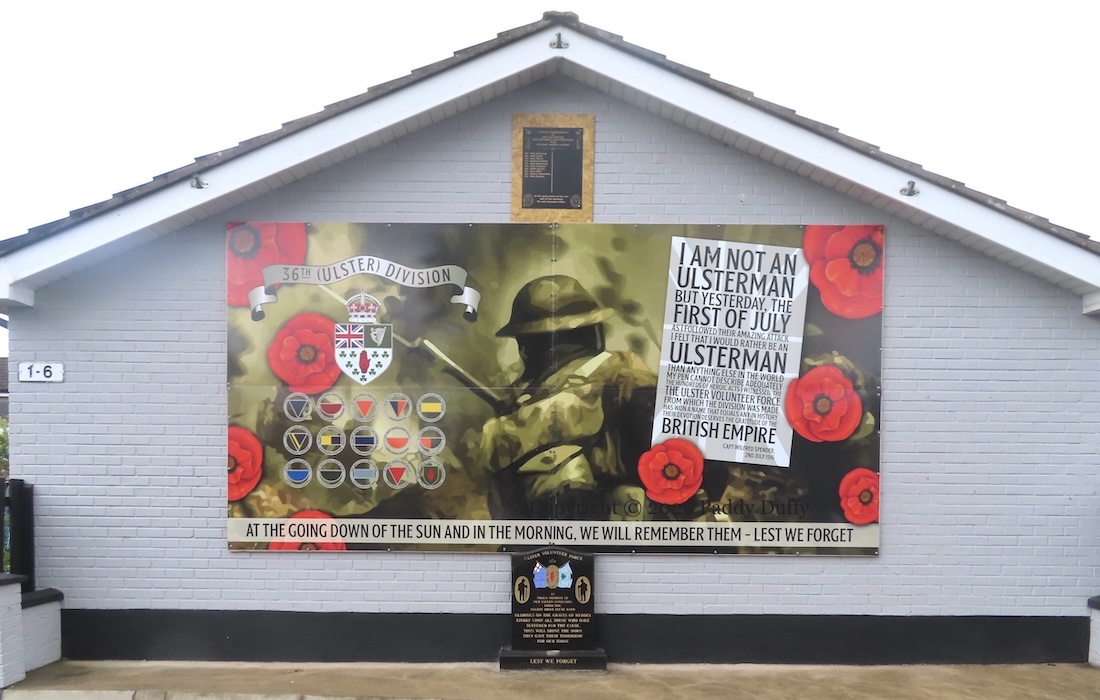
And Wilfrid Spender’s report on the 36th Division on the first day of the battle at the Somme (July 1st, 1916) is on the right – for the text, see Their Amazing Attack.
Sperrin Park, Caw, Londonderry, replacing Undefeated.
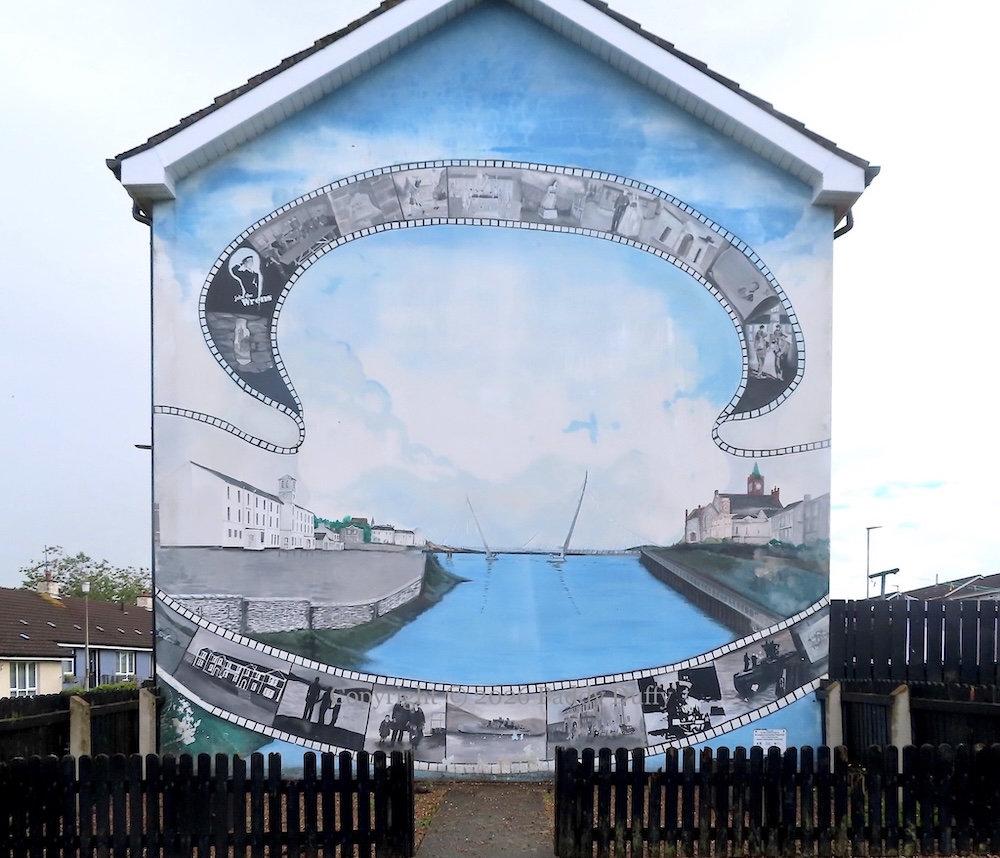
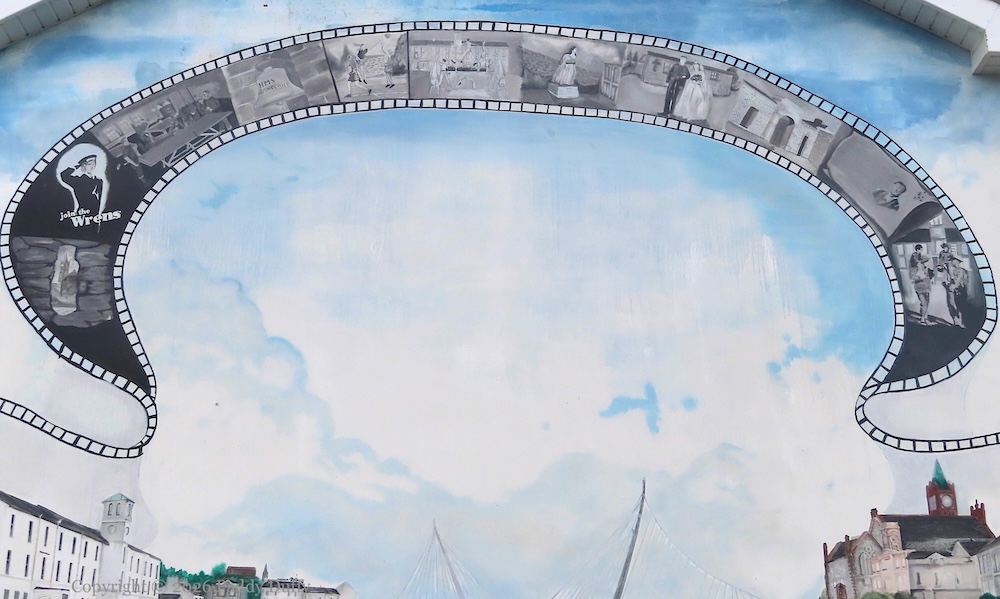
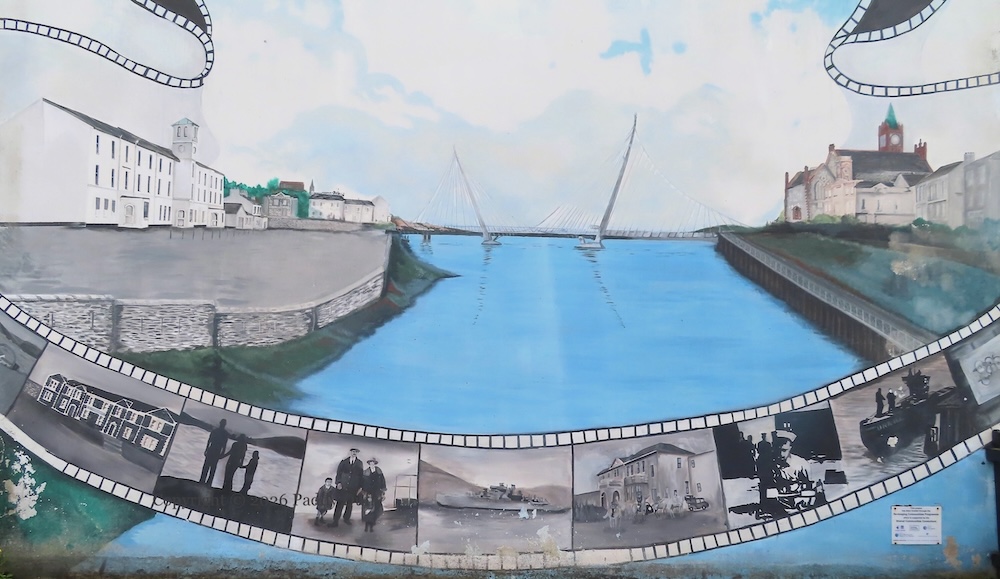
The Peace Bridge is shown spanning the Foyle between (the former) Ebrington barracks and the Guildhall, with a film-strip of images, many depicting naval and military scenes, above and below. The first few panels in the upper ribbon show a gap in the walls of Derry, a poster encouraging people to “Join the Wrens [and free a man for the fleet]” (the Women’s Royal Naval Service; see the poster at IWM), soldiers playing ping-pong in their barracks, and the ship’s bell of the HMS Londonderry (which served as a training ship during the Falkland War (WP)).
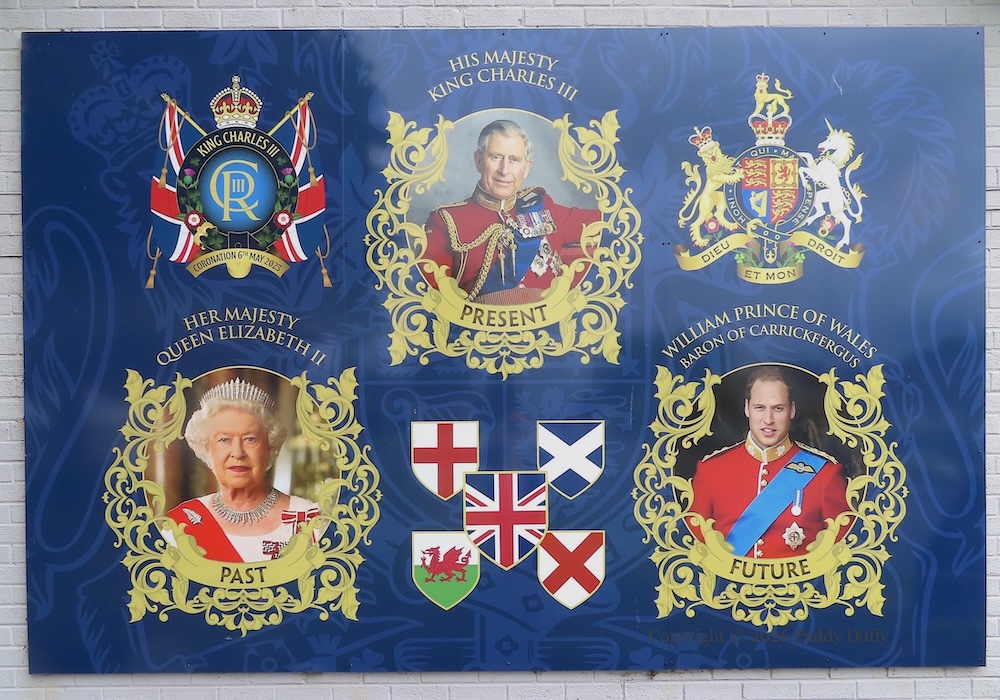
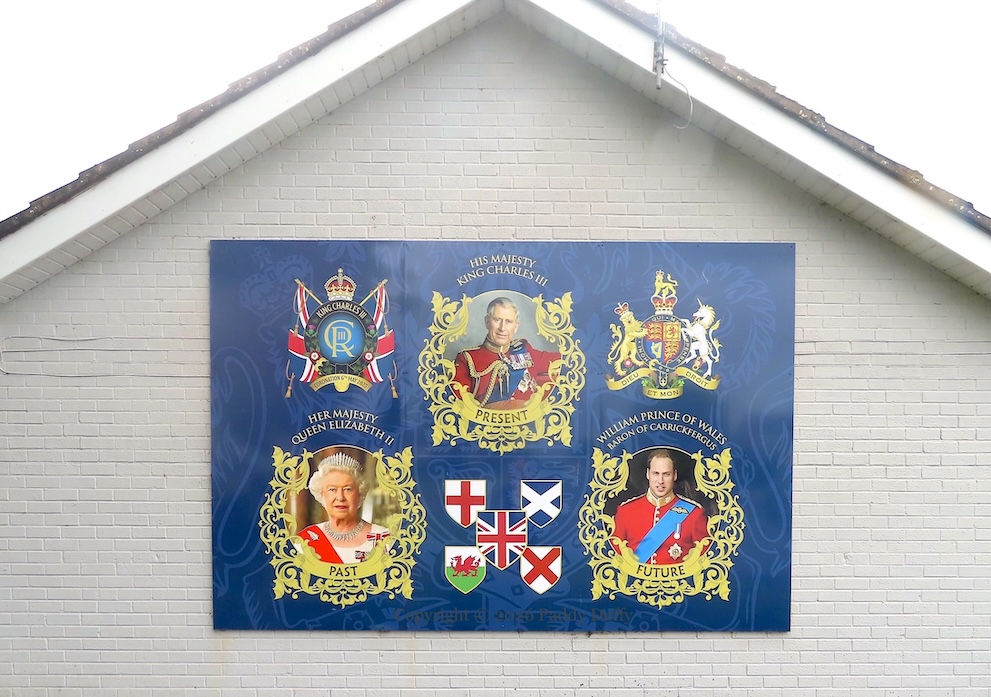
That is, king or queen “by the grace of God” or divine right. The first UK monarch to use the phrase was Henry V in the early 1400s and it has been used as a royal motto since then, up to and including the present-day monarchs shown on this board in the Caw, Londonderry.
On the left, the past – Her Majesty Queen Elizabeth II; in the centre, the present – His Majesty King Charles III; on the right, the future – William Prince Of Wales, Baron Of [sic] Carrickfergus.
The Welsh dragon is included alongside the three flags/crests that make up the Union Flag – St George’s Cross for England, St Andrew’s Saltire for Scotland, and St Patrick’s Saltire for Ireland.