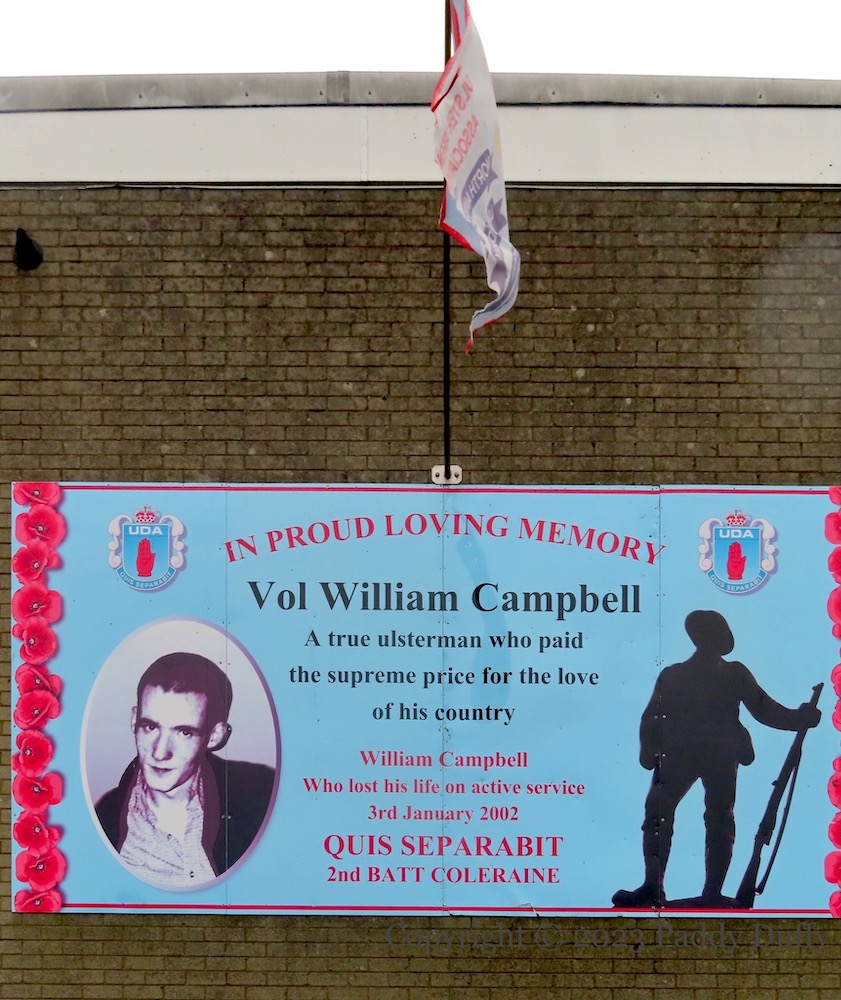
“In proud [and] loving memory: Vol William Campbell, a true Ulsterman who paid the supreme price for the love of his country. William Campbell, who lost his life on active service 3rd January 2002. Quis separabit. 2nd Batt Coleraine.”
This is the third memorial board to Campbell – who died at the age of 19 when a pipe-bomb exploded prematurely – replacing others seen in 2013 and in 2007.
Here is a small gallery of Portrush street art. From top to bottom, the pieces are by surfer by Aches (ig), Graeme McDowell by an unknown stencil artist (perhaps for the 2019 Open golf Irish News) on the side of the Springhill Bar, a surfing seagull in Eglinton St by FGB (ig), ‘Get Portrush a skate park’ and ‘Largey’s Lane’ by KVLR (ig) in Mark St Ln.
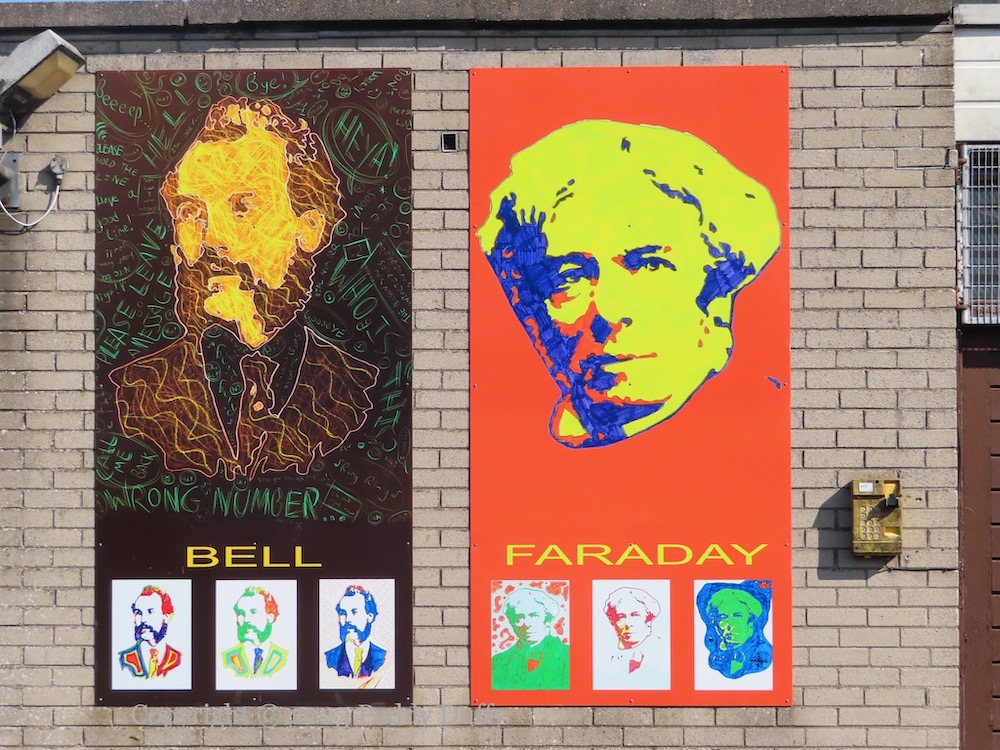
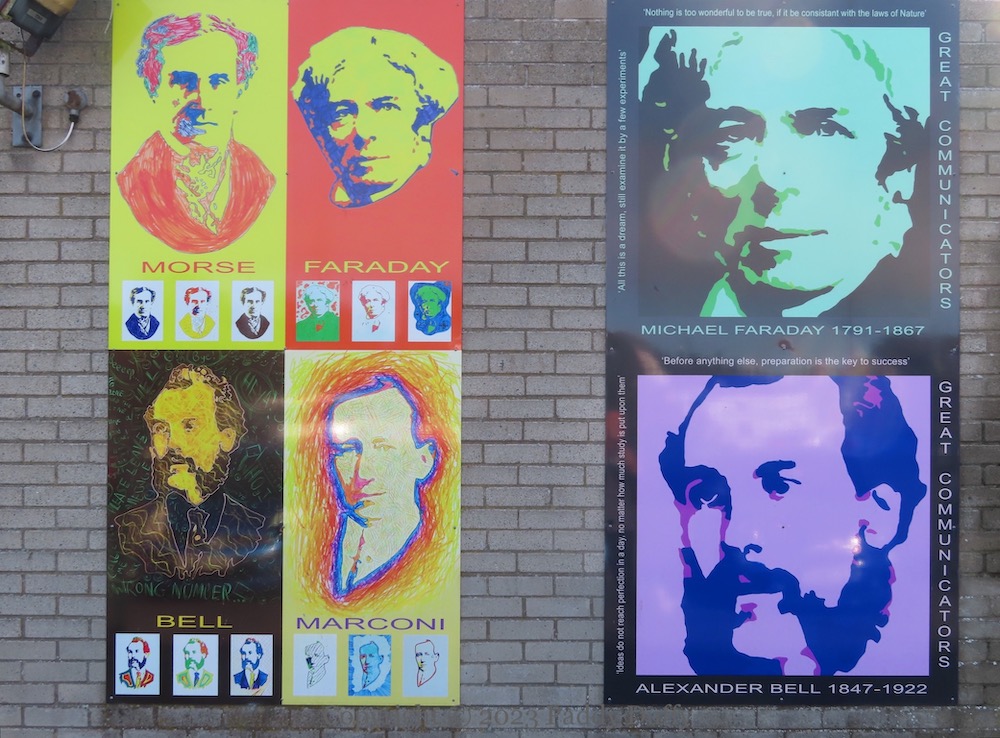
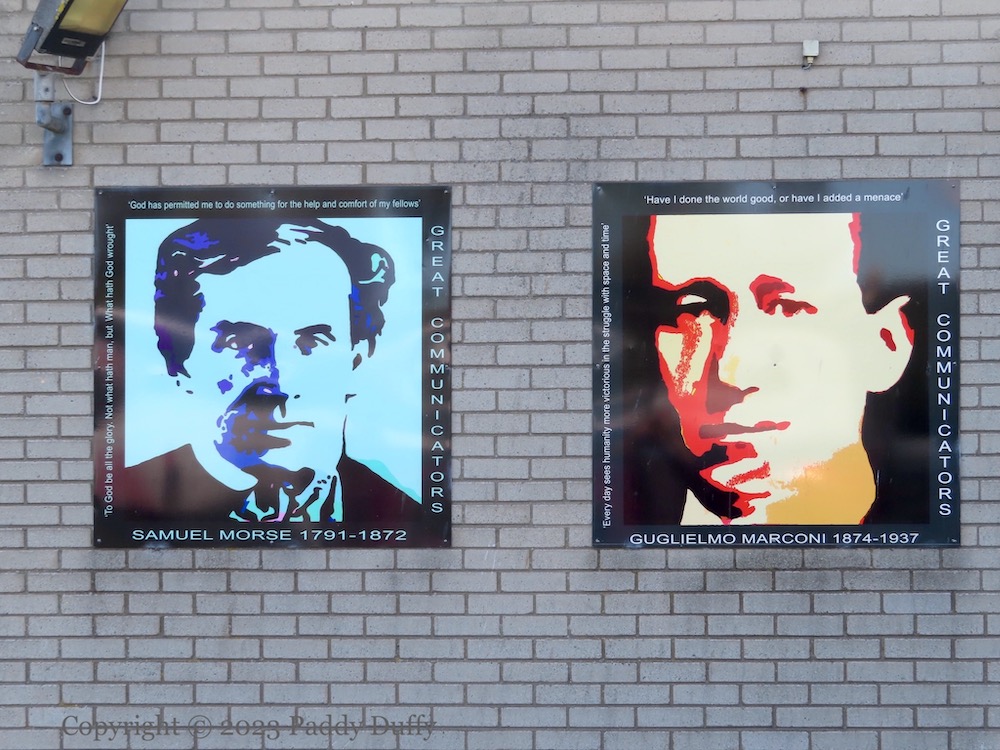
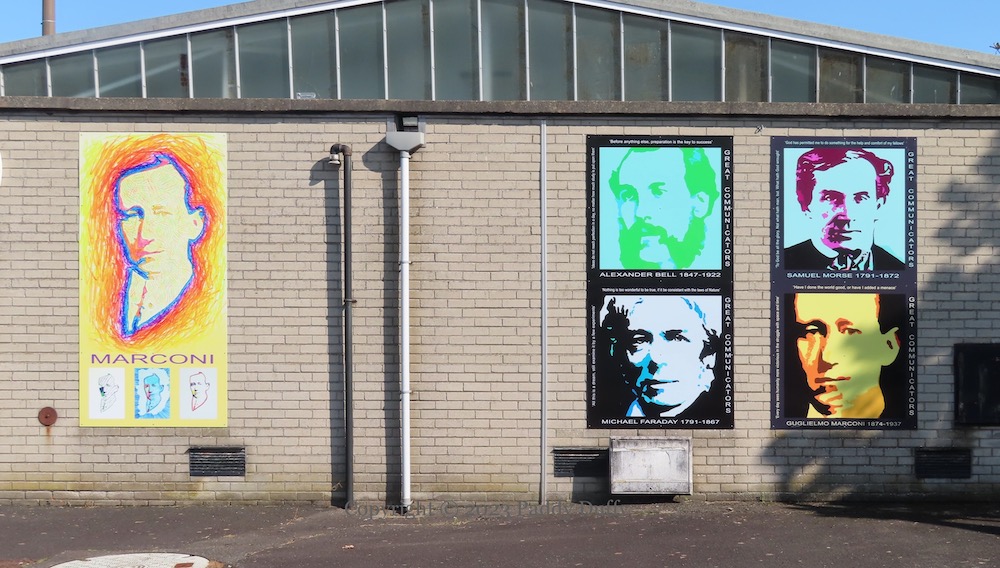
Local children painted portraits of four “Great Communicators” for the BT building at the corner of Main Street and Dundarave Road in Bushmills (NALIL). The set of less colourful boards, which also contain quotes, might be by adults.
Alexander Bell, 1847-1922: “Ideas do not reach perfection in a day, no matter how much study is put upon them.” “Before anything else, preparation is the key to success.”
Michael Faraday, 1791-1867: “All this is a dream, still examine it by a few experiments.” “Nothing is too wonderful to be true, if it be consistant [sic] with the laws of Nature.”
Samuel Morse, 1791-1872: “To God be all the glory. Not what hath man, but what hath God wrought.” “God has permitted me to do something for the help and comfort of my fellows.”
Guglielmo Marconi, 1874-1937: “Every day sees humanity more victorious in the struggle with space and time.” “Have I done the world good, or have I added a menance.” Marconi is well-known in Ballycastle for an 1898 transmission between the town and Rathlin.
Local landscape and landmarks of Bushmills on the exterior walls of BREF (Fb) at the end of Dundarave Drive, Bushmills, close to the Finn Mac Cool board and Bushmills Remembers.
The more familiar mythological figure in Northern Irish muraling — both CNR and PUL — is Cú Chulaınn (Visual History) but this Bushmills board features another larger-than-life figure, from slightly later mythology, Fıonn Mac Cumhaıll/Finn MacCool. In legend, Fionn ate the salmon of knowledge and became leader of the Fianna. His connection to the north Antrim coast is that he is the supposed creator of the “Giant’s Causeway”, the basalt columns that stretch out into the Atlantic Ocean, seemingly towards Scotland.
The Causeway and Finn are both used in the board shown above as symbols of the UDA North Antrim & Londonderry brigade’s 5th battalion/Giant’s Causeway Protestant Boys flute band (Fb) in Dundarave Road, Bushmills, which is about three miles from the Causeway. The board is also notable for its use of the flag of the proposed ‘independent Northern Ireland’, for which see (e.g.) We Must Share The Responsibility | One Island, Two Nations | Freedom Corner which features Cú Chulaınn.
The second image is a UDA/UYM emblem at the entrance to the estate. The third is further along. The last is not from Dundarave but from the exterior of a pub on Main Street.
Here is a small collection of street art from Portstewart. Above, is Dan Leo’s osprey in Strand Road. Below, a boy playing hide-and-seek by an unknown stencil artist; and finally, a number of images of JMK’s ‘A Tribute To Henry’ on The Crescent — “Henry” denotes Henry McCullough, Portstewart native and guitarist for Joe Cocker and Wings, who died in 2016 (WP).
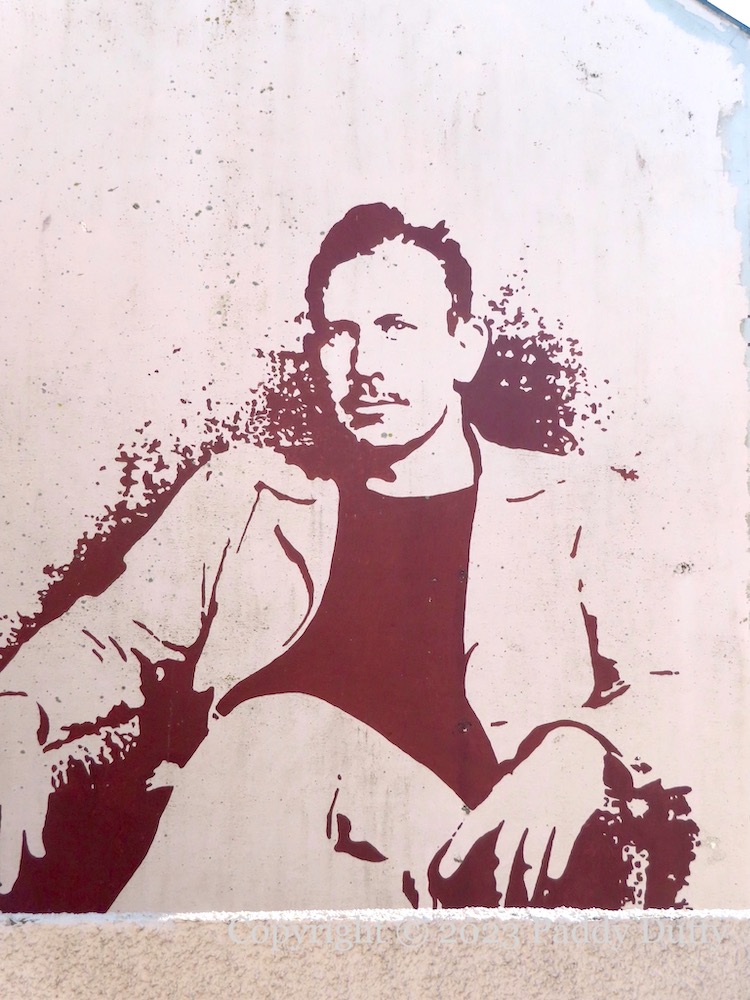
Today (December 20th) is the fifty-firth anniversary of John Steinbeck’s death in 1968. In 1952 he visited Northern Ireland to trace his Hamilton ancestors in Mulkeeragh, Ballykelly, Co. Derry (Irish Times) and wrote about it in Collier’s magazine.
The mural is on the side of (what was) the Hamely Gallery in Bushmills.
Limavady has been the home to an occasional Steinbeck literary festival since 2016 (Steinbeck Now).
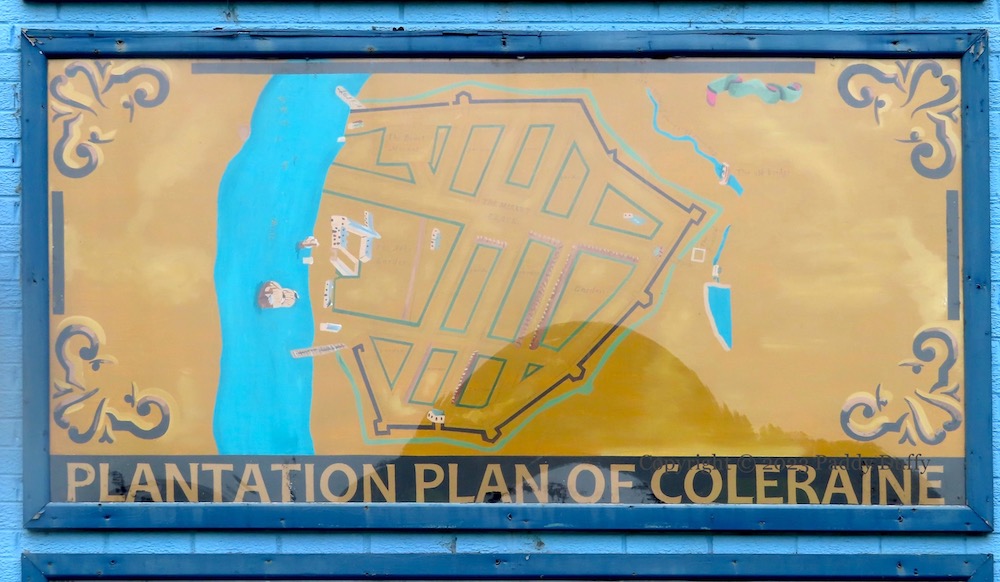
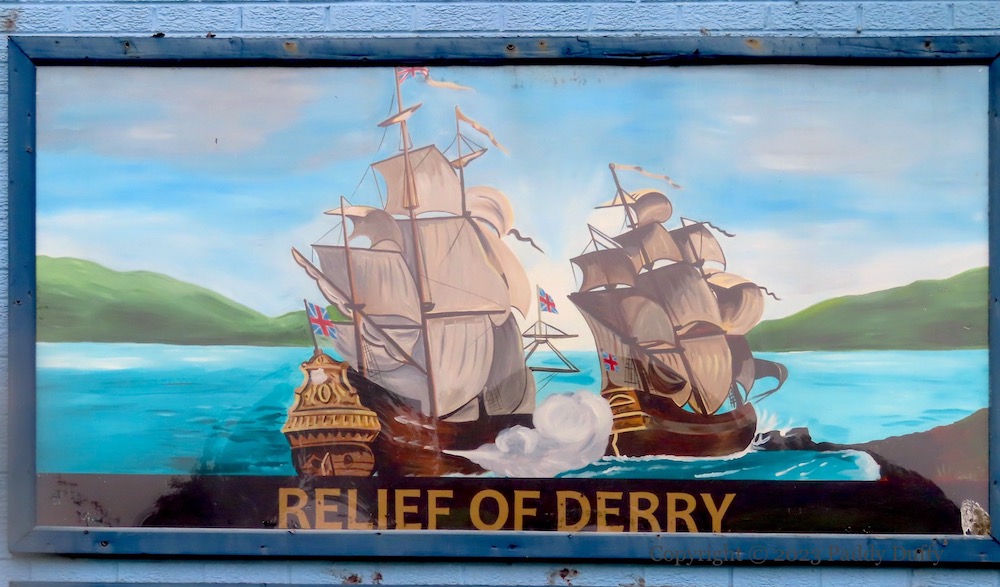
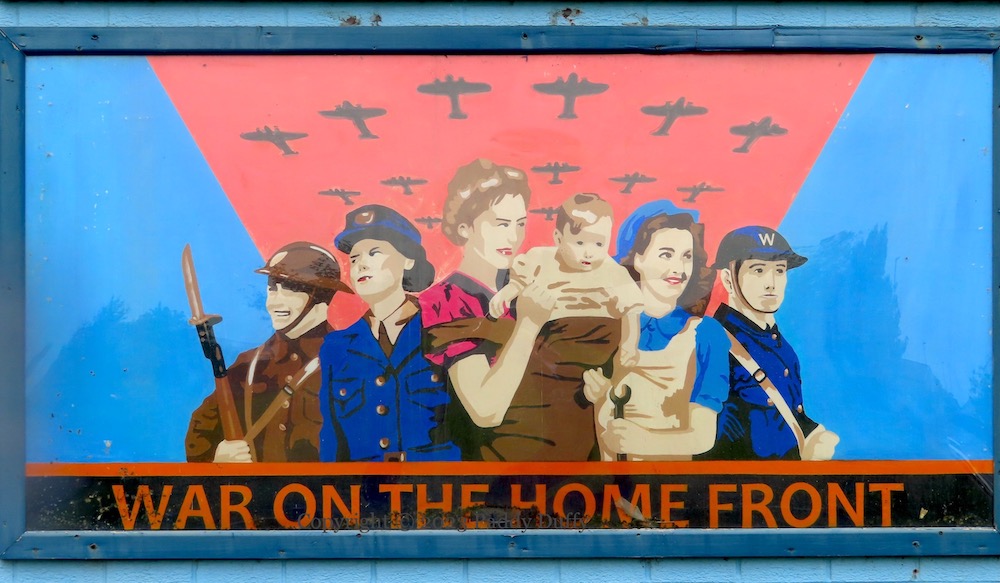
Footsteps through the history of Coleraine, from top to bottom: Martin Luther (c. 1521); John Knox, who led the reformation in Scotland (c. 1560); the plan of Coleraine (c. 1611); the relief of Derry (1689); the Williamite campaign (1690); (and then a jump to) WWI (“Christmas truce, western front”); WWII (“War on the home front”).
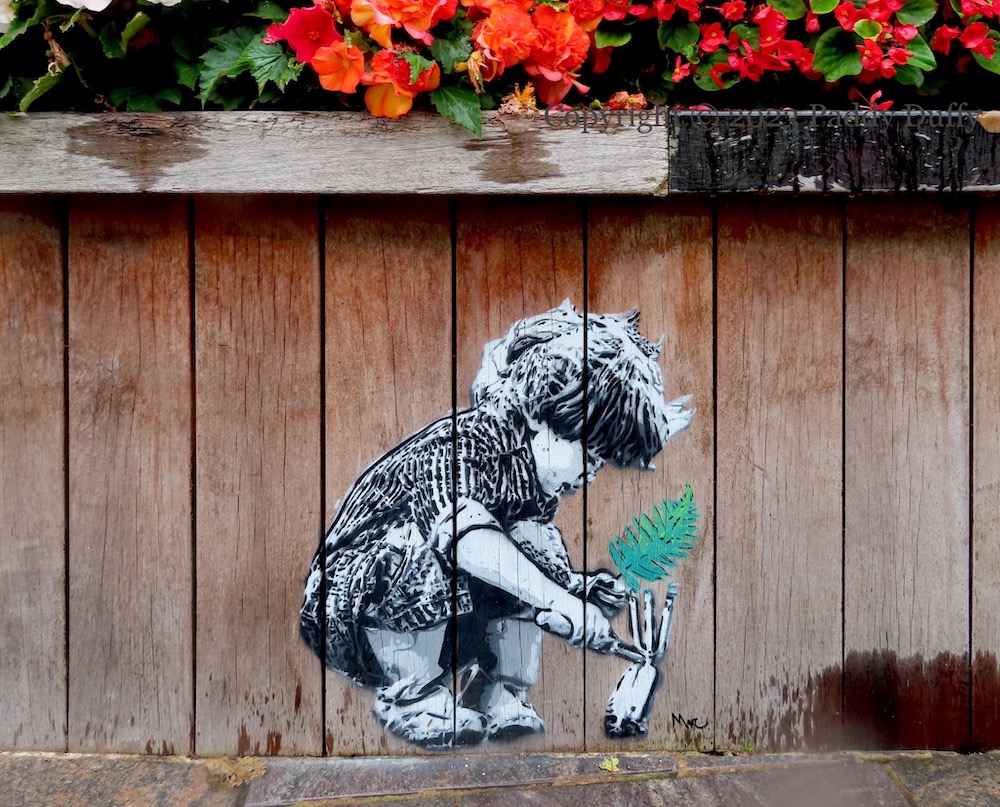
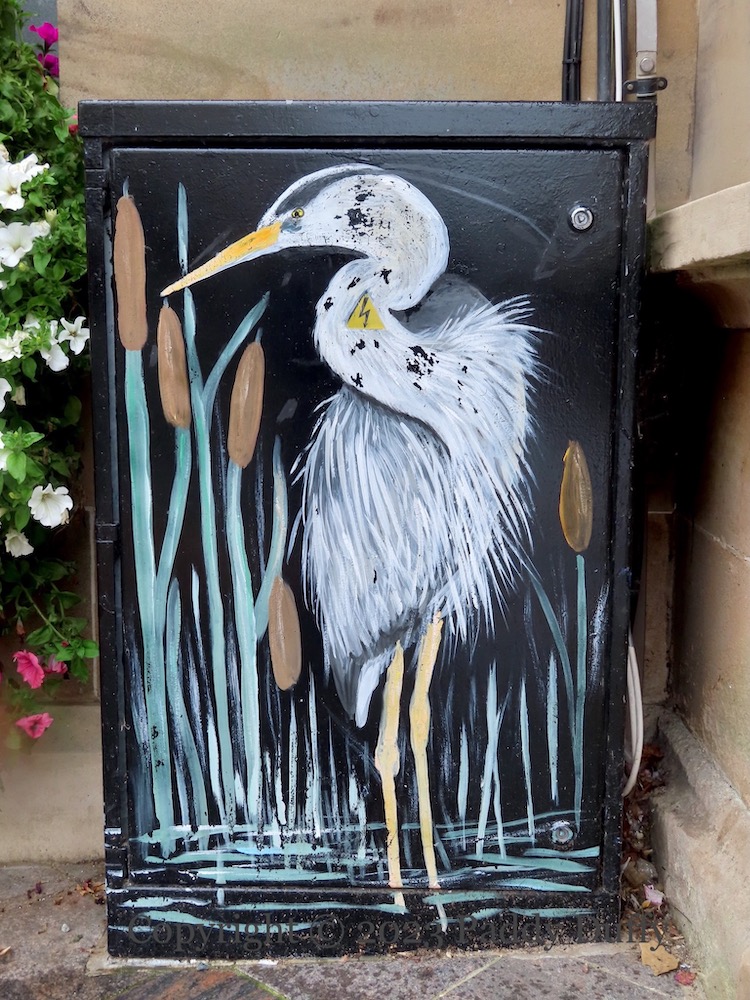
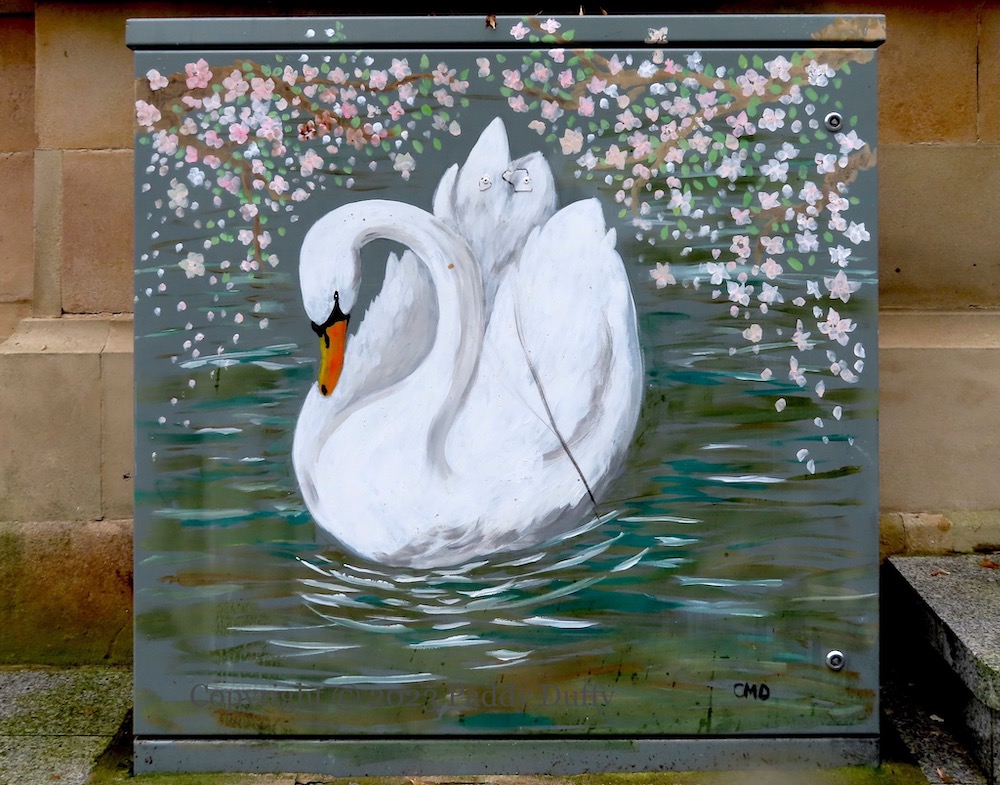
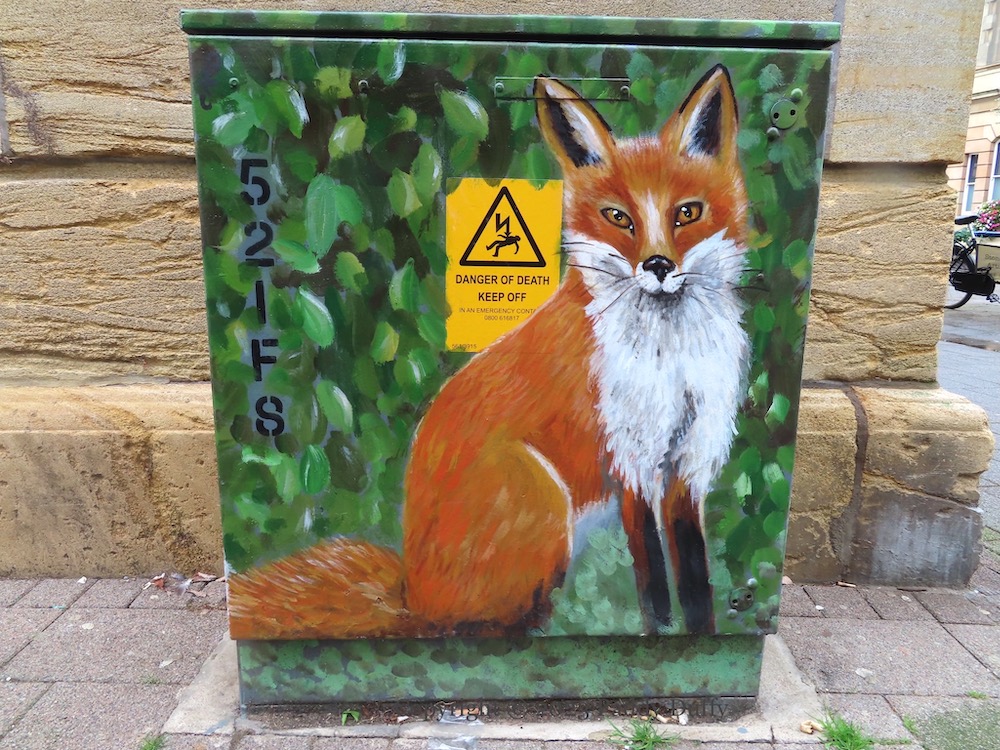
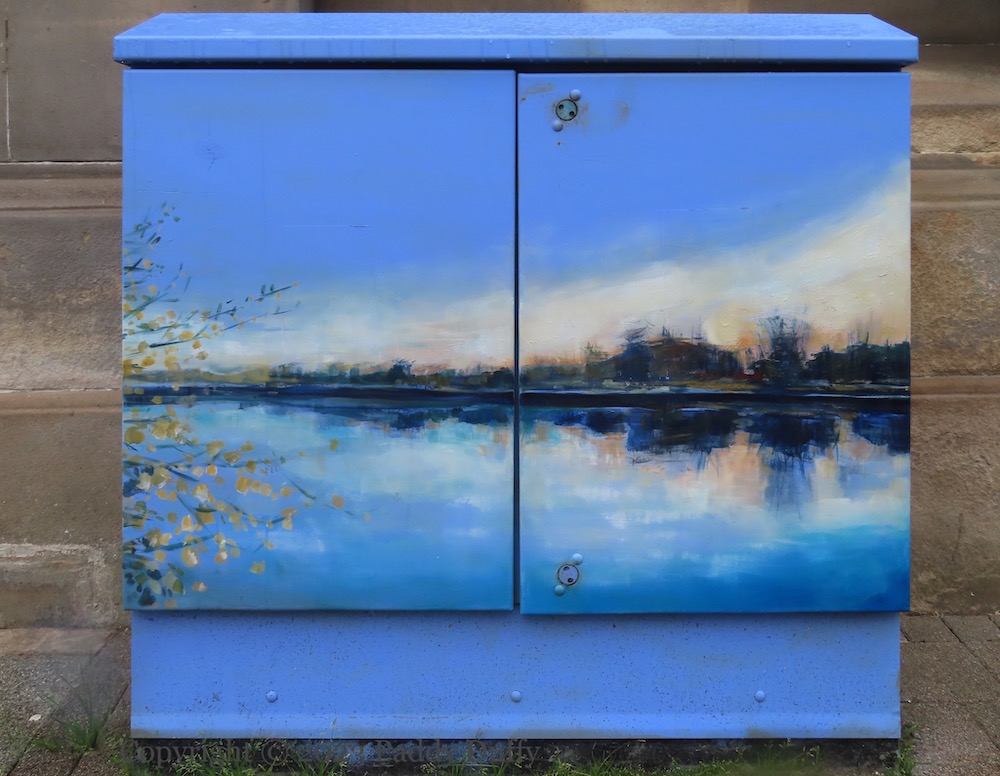
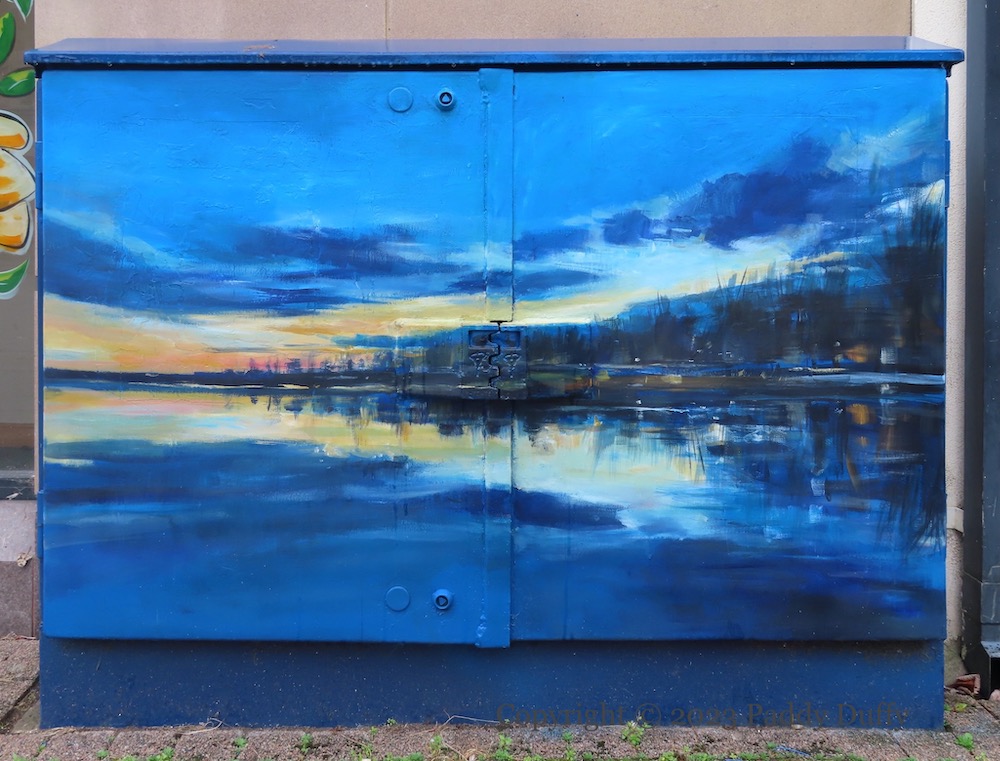
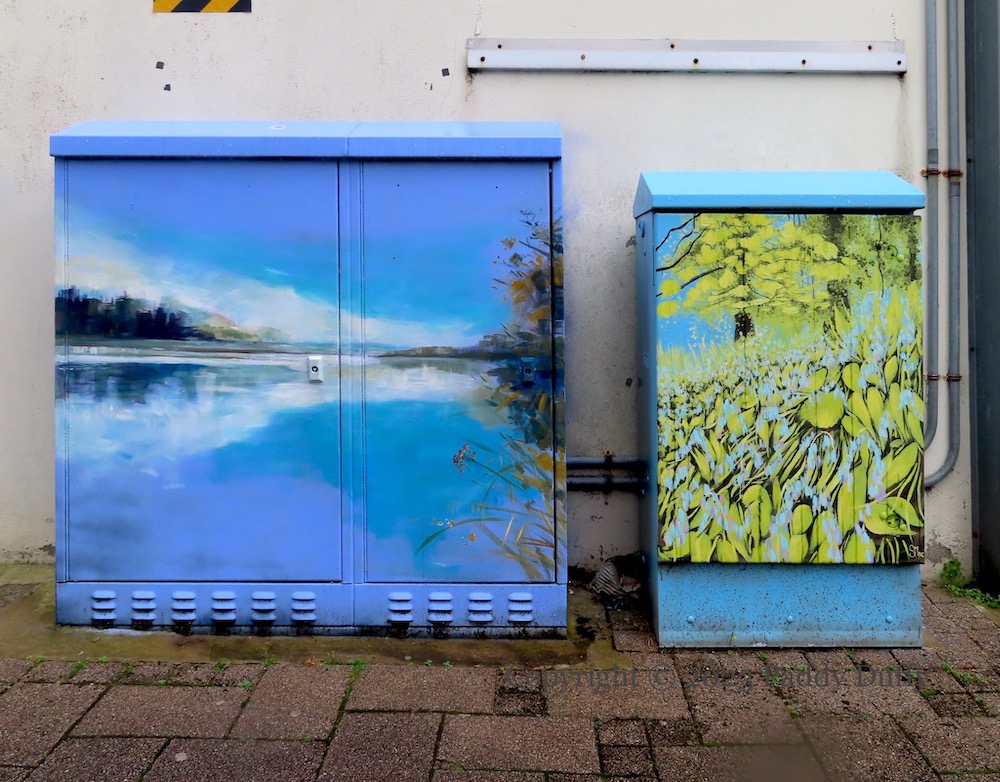
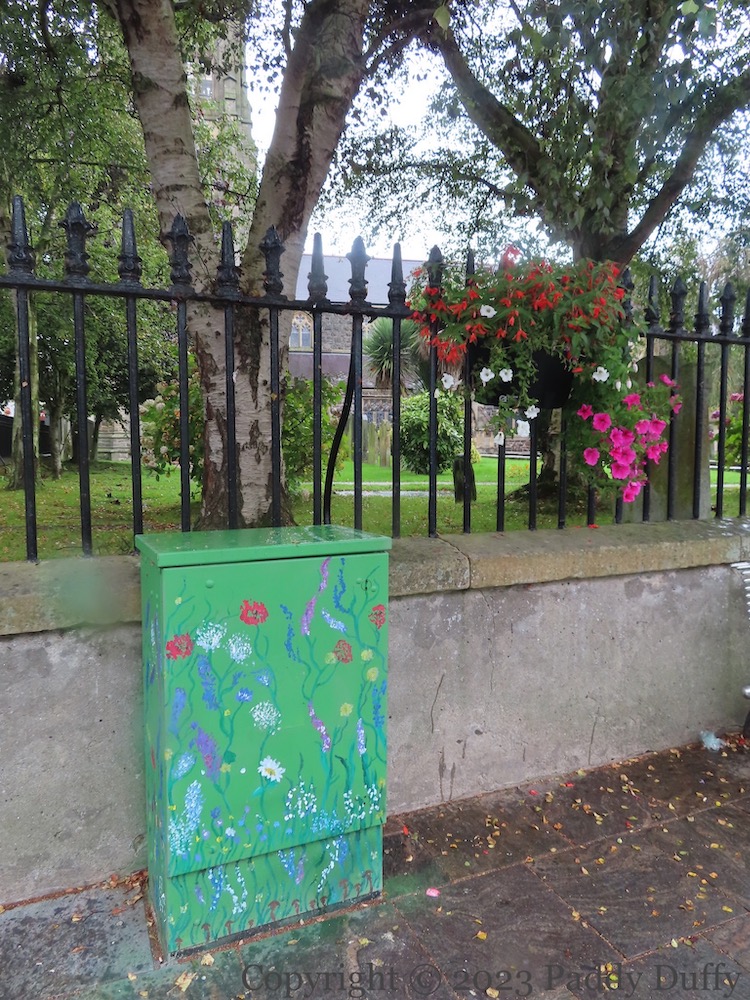
All of the pieces shown here were produced in the summer of 2023 for Coleraine’s ‘Revitalise’ programme, co-ordinated by Michelle McGarvey (ig) for Causeway Coast & Glens borough council with funding by the Department Of Communities. They are on utility boxes and planters all over the town centre.
For some of the large pieces of street art in the town, including many produced for ‘Revitalise’, see Nook Of The Ferns. More information and images can be obtained from Causeway Coast & Glens borough council (press release | map).
The first four are from Marc Holmes’s (ig) Voyage Of Discovery series.
On the right, Major Quality and Miss Sweetly from the lid of a Quality Street tin. The confectionery collection was itself named after J.M. Barrie’s 1901 play and Coleraine native “Hugh Thompson” [Hugh Thomson] (WP | NVTv) provided the illustrations for a 1913 edition (many can be seen at RBKC); these probably inspired the “soldier and lady” characters for the tins (the leads in the play are called Captain Valentine Brown and Miss Phoebe Throssel), though they were drawn by Harold Oakes (WP); the tins and ads from 1936 can be seen at Metro. The image reproduced here is from the 1950s.