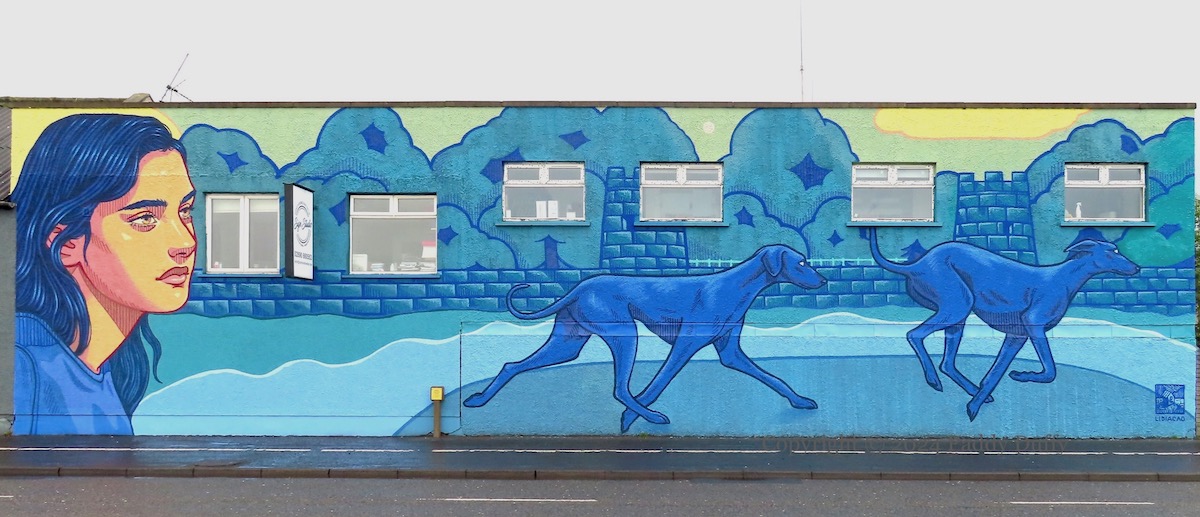
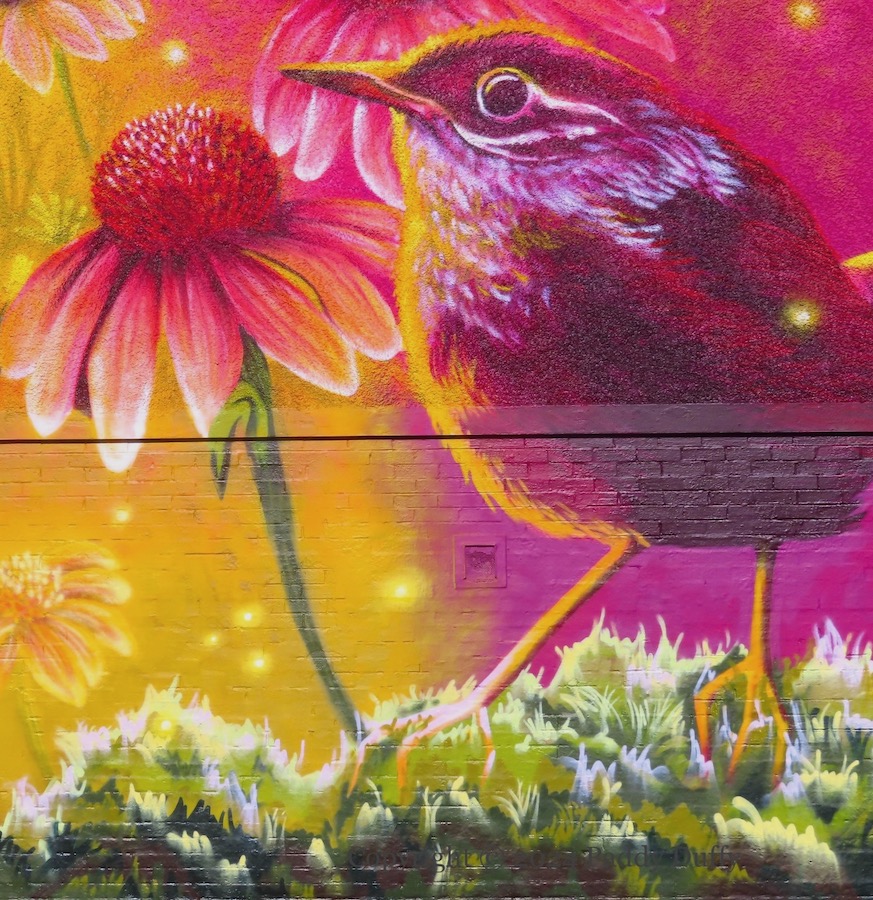
Here is a painting of a model from Femelle Studios (ig) by London artist Mr Cenz (web | tw) in Londonderry’s Waterside, with support from UVArts (ig). With “Death dealers out” graffiti to the right.
John Meeke signed the Ulster Covenant in Dervock Orange Hall in 1912 and went to war with the Ulster Volunteers. Willie Redmond, brother of John Redmond, had been jailed three times and was a nationalist MP at Westminster when, at age 53, he signed up for service.
Major Redmond went over the top with the 16th (Irish) Division at Messines Ridge and was hit by machine-gun fire. Private Meeke, a stretcher-bearer with the Royal Inniskilling Fusiliers in the 36th (Ulster) Division, found and stayed with Redmond under heavy fire, taking two bullets himself.
Redmond would die that night. He was awarded the Legion Of Honour by the French. His East Clare seat was taken by Éamon de Valera. Meeke survived after several surgeries. He was awarded the Military Medal by the British. After the World War, he joined the Specials and LOL 1001 in Benvarden before dying of TB in 1923 (NALIL | Irish Times | WP | BelTel).
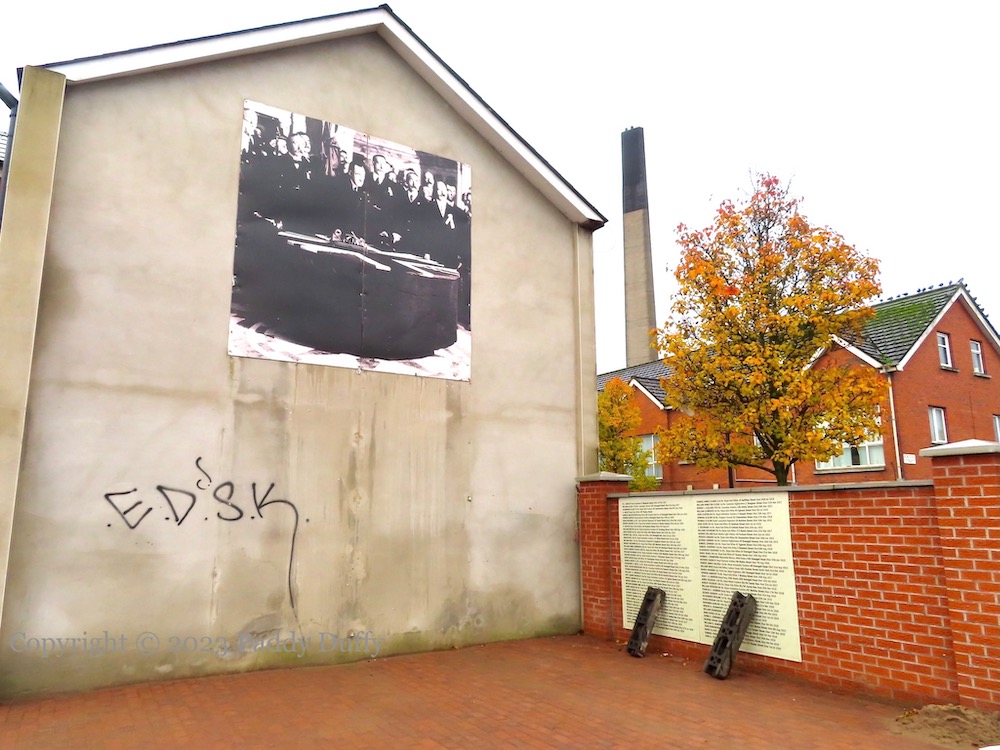
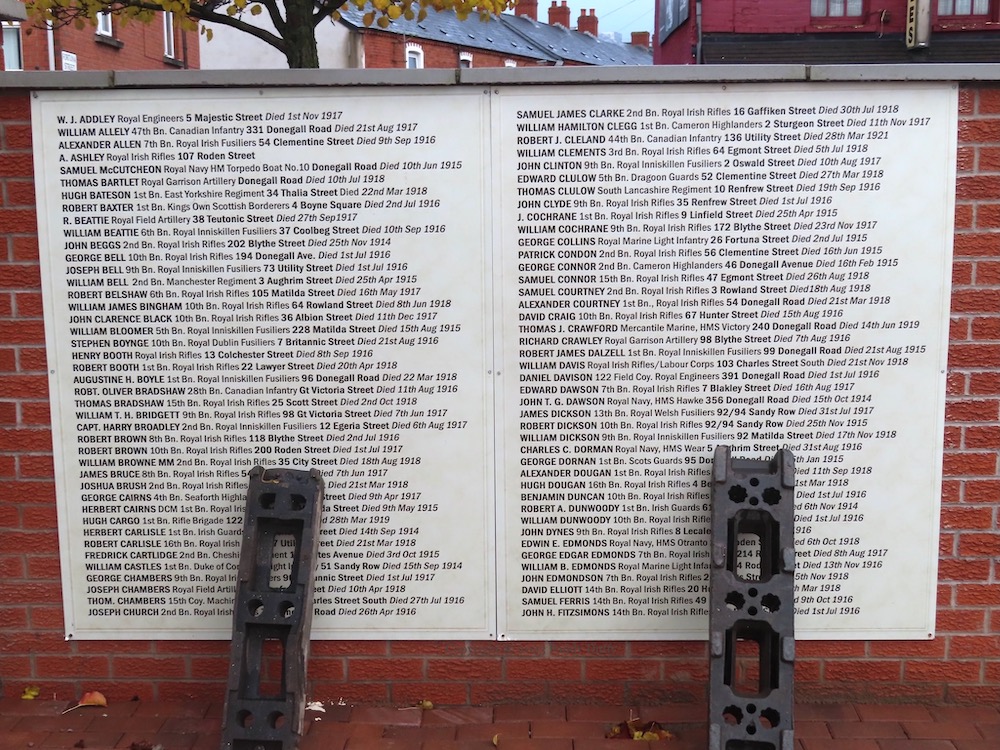
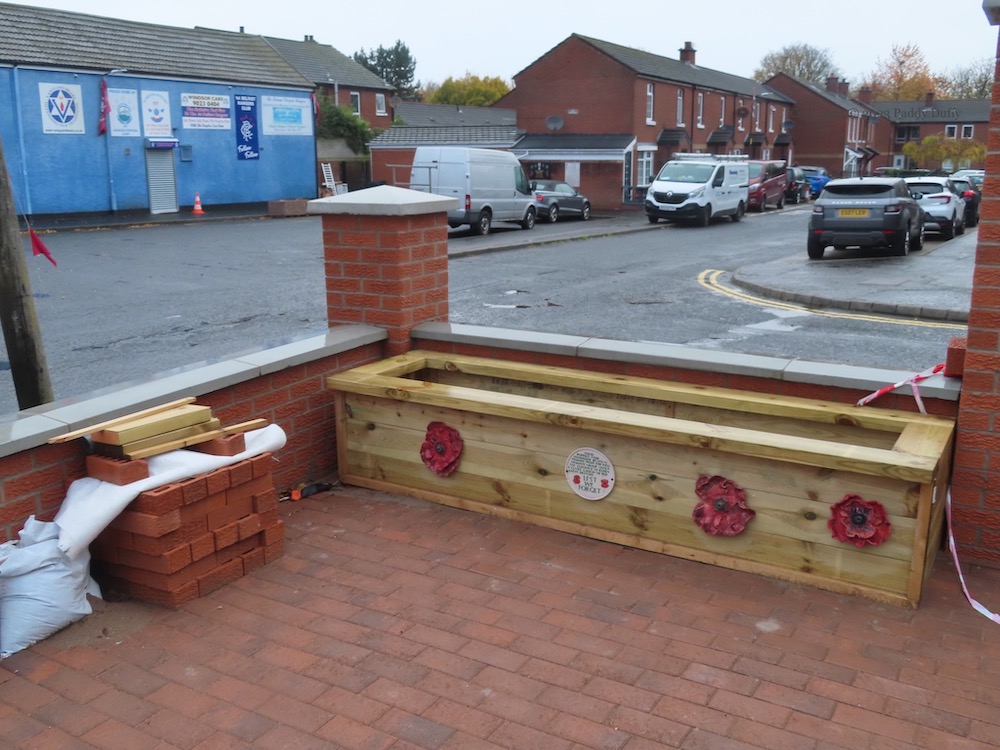
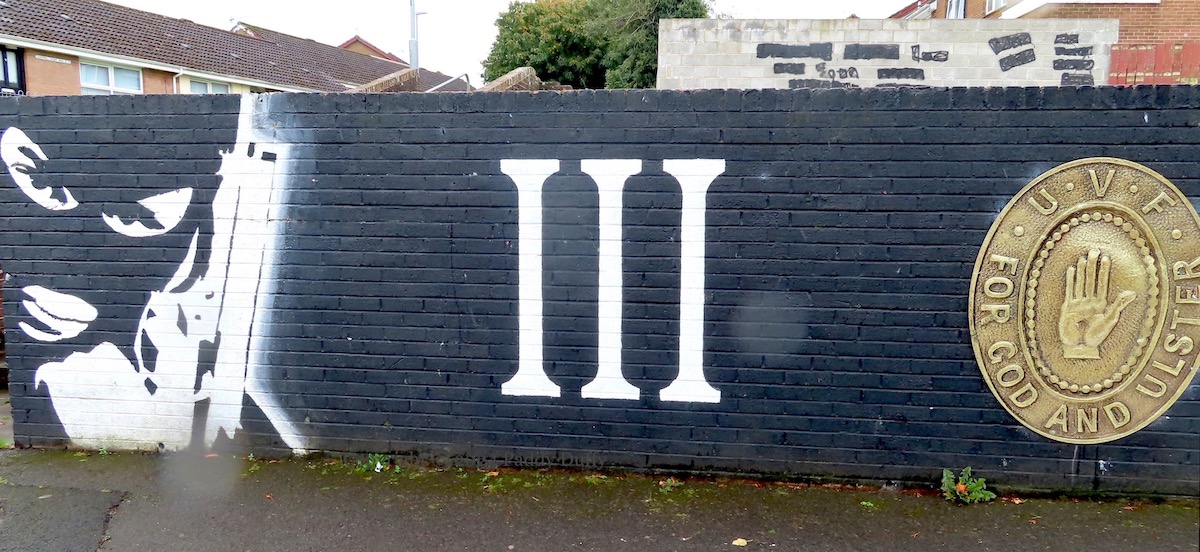
This mural (and its very odd accompanying plaque, for a public mural) is in the Ebrington Centre car park, in the Waterside, Londonderry.
The Menin Gate memorial, at the eastern edge of Ypres, Belgium, commemorates 54,896 Commonwealth soldiers who died in the area during WWI and whose bodies were not recovered. “To the armies of the British Empire who stood here from 1914 to 1918 and to those of their dead who have no known grave.”
The buglers below have remained unfinished since (at least) 2018.
Ebrington Street, off Bond’s Street, Londonderry, leading to the Ebrington Centre car park.
From the info plaque (shown last below): “This mural depicts three plinths which stand in the Island Of Ireland Peace Park in the city of Messen [Mesen]/Messines in Belgium. Each plinth represents the number of casualties for each division which was raised on the island of Ireland during the 1st World War. A total of 69,947 soldiers from the island of Ireland were either killed, wounded or reported missing during the four years which the war lasted. The price of freedom.”
The numbers given are: 36th (Ulster) division, 32,186; 16th (Irish) division, 28,398; 10th (Irish) division, 9,363.
This mural at the Ebrington Centre in the Waterside, Londonderry, commemorates the WWI dead and wounded from the entire island of Ireland.
The 10th (Irish) Division fought only briefly “in Flanders fields”, towards the very end of the war, having spent most of its time in Gallipoli (in the Ottoman Empire), Macedonia, Egypt, and Palestine. The 16th took part in the Somme, especially at “Guinchy” [Ginchy] and Guillemont, while the 36th were deployed on the first day (the Battle Of Albert).
The poem in the middle is the first half of John McCrae’s In Flanders Fields: “In Flanders fields the poppies blow/Between the crosses, row on row/That mark our place, and in the sky/The larks, still bravely singing, fly/Scarce heard amid the guns below.//We are the dead; short days ago/We lived, felt dawn, saw sunset glow/Loved and were loved, and now we lie/In Flanders fields.”
“Londonderry west bank loyalists” are “still under siege”, from two decades of “Republican violence” – “Between 1971 and 1991 the Protestant population of the Cityside declined by 83.4% as a result of Republican violence (Shirlow et al. 2005)”. (The words “as a result of Republican violence” are not included in the Shirlow article).
“Dedicated to the memory of the men and women who served with the UDR C.G.C (Conspicuous Gallantry Cross) under OPERATION BANNER during the Troubles. Lest we forget. Also in memory of local veteran Geoffrey Lindsay who passed away on the 12th November 2022.”
The Conspicuous Gallantry Cross is shown (in the close-up below) at the top of the board; it was awarded to the UDR retroactively in 2006 for its role in ‘Operation Banner’, i.e. the deployment of British Army troops to Northern Ireland – the regiment had been folded into the Royal Irish Regiment in 1992. The mural is specifically to the 5th (Co. Londonderry) battalion – here is a list of the 11 battalions (and bases).
There is also a UDR information board (and an Ulster Volunteers board) in the green-space in front of this mural – see Leckagh Remembers The Fallen.
The memorial mural to the 36th (Ulster) Division on the end wall has also been completed since last (2023) year – in-progress images for both murals from last August are included below. For the previous murals on these walls, see C07766.
Two other pieces are included, below: the UVF mural was seen last year in Pause, Reflect, Remember; the ‘Ignite the fire’ board appears to be new.
Leckagh Drive, Magherafelt
August 27th green-washing of previous mural:
August 27th in-progress image of mural immediately above:
The pillars under the Harbour Highway at Bridge Street were repainted on July 28th in a jam called “Hit The Coast”. The wall along the back of the space was also painted, along with the large piece above on the back wall of Ruby’s, to give approximately 37 total pieces. Where known, the artist(s) is given in the caption.
These images were taken on August 2nd, after Wee Nuls repaired several pieces that were vandalised soon after painting (BelTel).
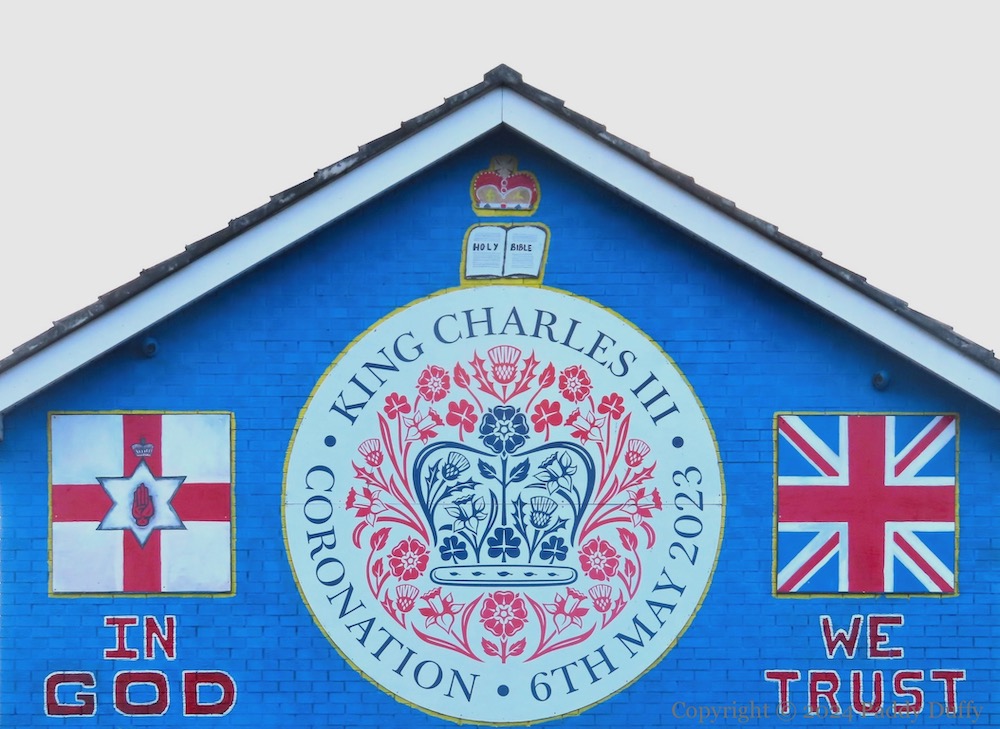
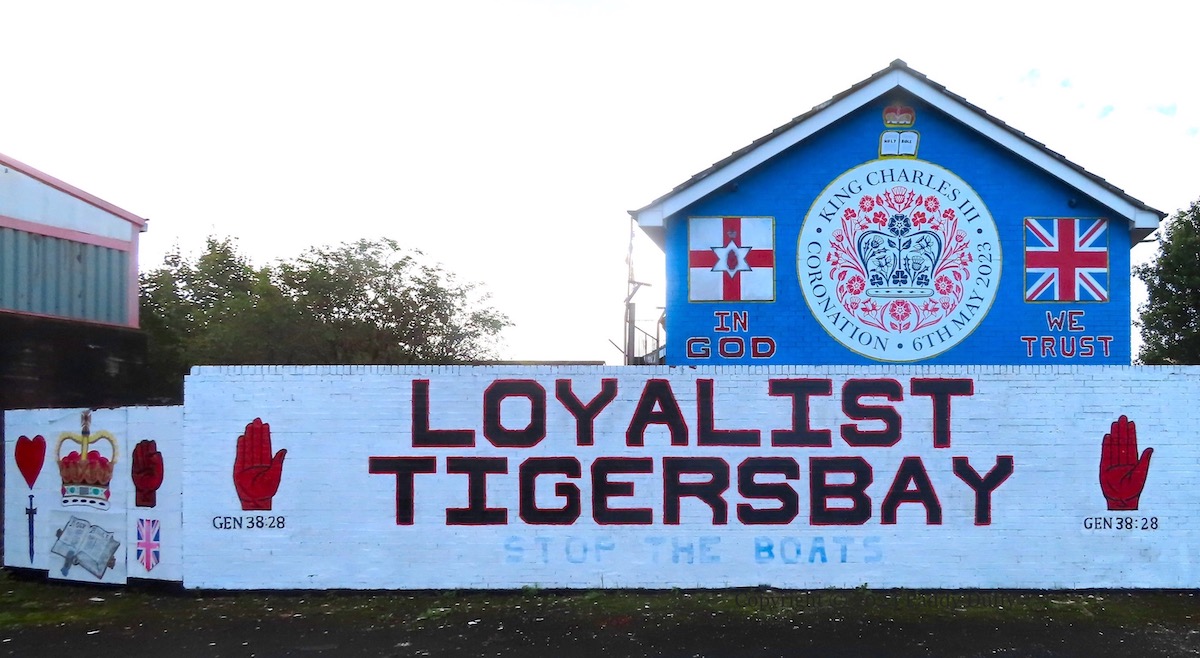
The board remembering Queen Elizabeth II below the Old Warren “community transformation” board has been updated with the accession and coronation of Charles III: “Lisburn is proud of the history and heritage of our royal family – faith, blood, service, sacrifice – God save the King” with images of William III, the present king Charles III, and his mother and predecessor Queen Elizabeth II. For a (brief!) explanation of the line from William (1689) to Elizabeth (1952), see Elizabeth, Queen Of Orange.
For the previous (QEII remembrance) board (and an image of the old UDA mural at the top of the estate which is included in the “Before” panel on the left), see Conflict To Peace.
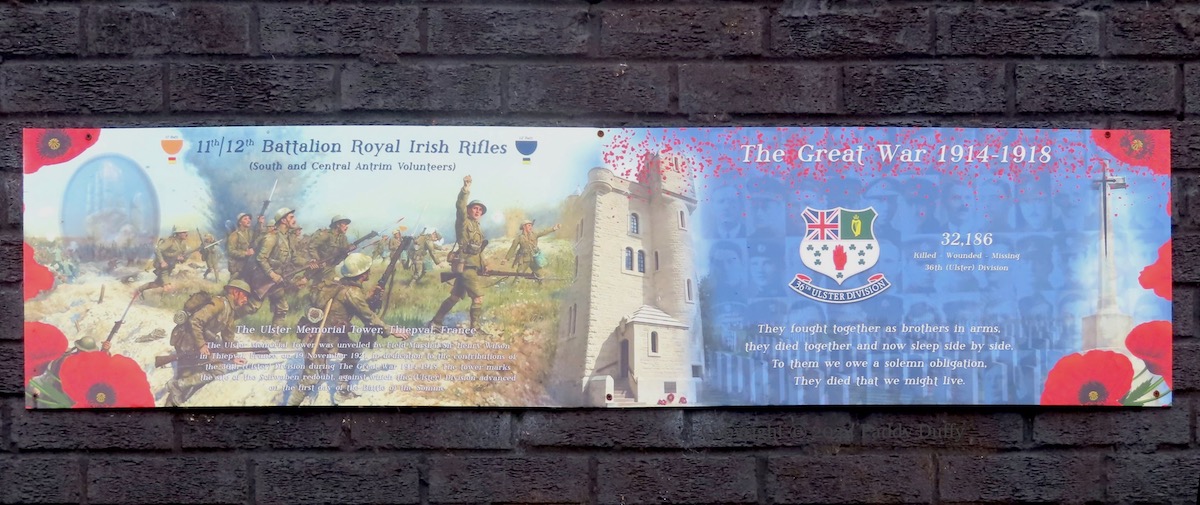
A new board was unveiled on July 1st 2024, by the 1st Raven Somme Society and The Loyal (Fb) at the Raven social club (Fb), putting together the Ulster Tower (see e.g. A Thought Is Not A Lot), JP Beadle’s painting of the 36th going ‘over the top’ (see The Trenches Have Vanished Under The Ploughs) and Wilfrid Spender’s famous quote about the first day of the Battle Of The Somme (see I Would Rather Be An Ulsterman).
This board takes the place of the King Charles board (seen previously in Long Live The King), which has been moved to the other side of Castlereagh Street and joined by the board that it replaced, to Queen Elizabeth (both on top of some old (2012) panels depicting east Belfast of yesteryear – see Shipyard Workers).