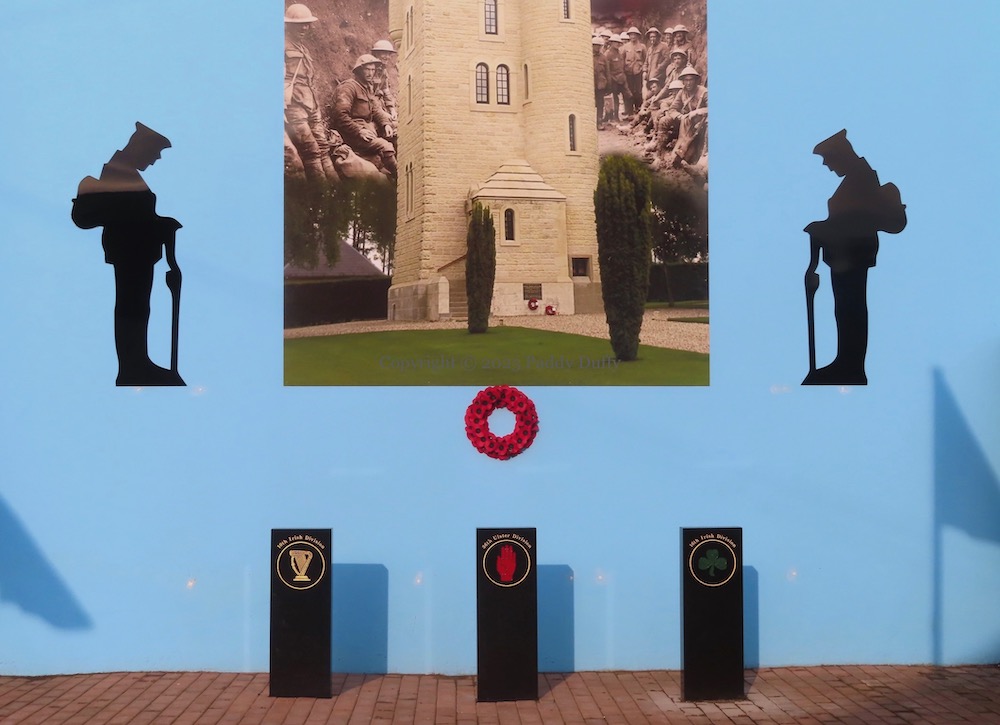
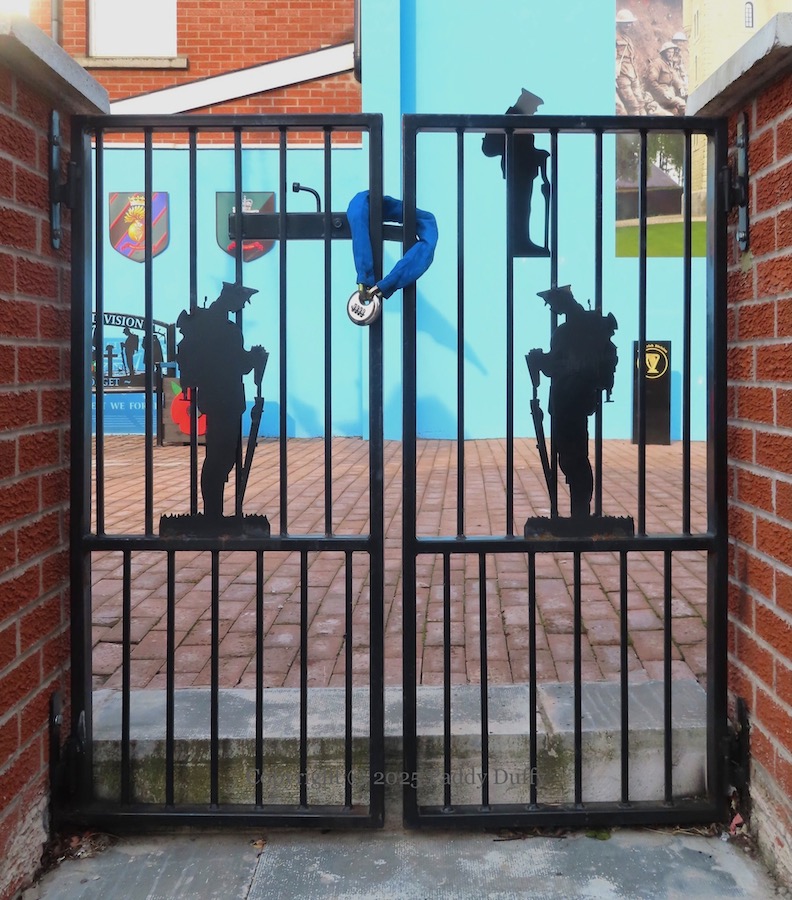
The memorial garden in Barrington Gardens at long last appears to be finished. The house on the corner of Donegall Road was knocked down in 2012 or 2013 and work began converting the waste ground into a memorial to local Great War casualties in late November 2023. See this entry for images from both November 2023 and October 2024.
Since 2024, three pillars have been added below the main board, one each for the 10th (Irish) Division, 36th (Ulster) Division, and 16th (Irish Division) – for the service of the three divisions, see The Cost Of War, We Are The Dead, and (for the particular story of John Meeke and Willie Redmond) Comrades In Arms – and an iron bench to the 36th has been placed below the crests of the YCV, Inniskilling Fusiliers, Royal Irish Fusiliers, and the Royal Irish Rifles on the side-wall to the left.
Silhouetted graveside mourners appear on either side of the main board and in the gates to the garden
Love’s 1967 album ‘Forever Changes’ (listen on youtube) features the faces of the five band-members pressed together into the shape of a heart, or Africa. The bottom face was originally drawn (by Bob Pepper) without a smile (WP).
By Graffic (ig) on Hollywood Road, east Belfast, on the shutters of the Bill Harris hair salon.
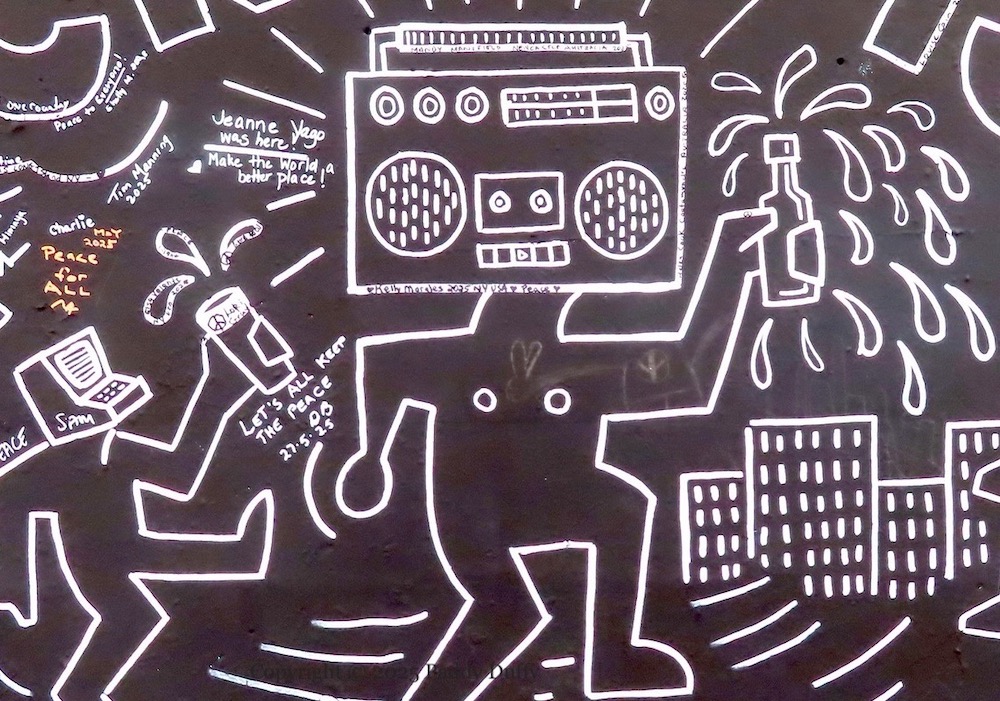
Boombox-head, computer-head, and light-bulb-head are having a good time in this new piece by Leo Boyd (web) on the Cupar Way war-wall (or: “peace” line), riffing on a vintage Keith Haring piece, 1986’s Crack Is Wack.
A statue to Winifred Carney was unveiled, along with another to Mary Ann McCracken, in the grounds of Belfast City Hall on Friday, March 8th (BCC). At her left hand is a typewriter. Carney was a qualified secretary and typist, and became secretary of the Irish Textile Workers’ Union in 1912, in which position she met James Connolly, who was secretary of the Belfast branch of the ITGWU. The 1913 manifesto addressed ‘To The Linen Slaves Of Belfast’ (marxists.org), exhorting “our toiling sisters” in the mills to join the organisation, was signed by Carney, Connolly, and Ellen Gordon.
Her uniform, and the amorphous pistol (or holster?) in her right hand, refer to her membership of Cumann Na mBan and participation in the Easter Rising of 1916. Carney was in the GPO when it was taken over and was among those who surrendered at the end; during the occupation she typed up dispatches from the Moore Street headquarters. A News Letter editorial described the statue as smuggling terrorists onto the grounds of city hall.
“Winifred Carney, born in Bangor, was a suffragist and a committed trade unionist. She was an organiser in the Irish Textile Workers’ Union and became James Connolly’s personal secretary, political confidante and friend. In 1913, She and Connolly wrote the Irish Textile Workers’ Union manifesto entitled ‘To the Linen Slaves of Belfast’. It was a time when Belfast workers, mostly women and children, were working long hours in horrific conditions, barefoot and hungry. “D’oıbrıgh Winnie ar son oıbrıthe Bhéal Feırste, go háırıthe ar son na mban agus na bpáıstí a bhíodh ag obaır sna muılte ar fud na cathrach. “Many Belfast mills are slaughterhouses for the women and penitentiaries for the children.” Chomh maıth leıs an obaır a rınne sí ar son na gceardchumann, ba Phoblachtánach í Winnie a bhí ına ball de Chumann na mBan agus d’Arm Cathartha na hÉıreann. As an officer in the Irish Citizen Army, Winnie was present with Connolly in the Dublin General Post Office during the 1916 Easter Rising and has since become known as ‘the typist with the Webley’. Carney stood as a Sınn Féın candidate in the 1918 elections, but in an ‘unwinnable’ seat. She retained her commitment to socialism and in 1924, Winifred joined the Northern Ireland Labour Party. Here she met her future husband, George McBride, like her a committed socialist. George was a Protestant from Shankill Road who fought at The Battle of the Somme with the 36th (Ulster) Division. Tá Winnie curtha ı Reılıg Bhaıle an Mhuılınn ar Bhóthar na bhFál ın ıarthar Bhéal Feırste.”
This is an old piece by Friz (web) on the T13 building between the Titanic centre and the H&W cranes, originally a warehouse, then an indoor skydiving venue, and most recently an “urban sport park”.
Various street artists and writers painted the underpass at the end of Kyle Street that goes into Victoria Park (Belfast City Council). Here (top to bottom) is work by Friz (web), emic (web), GWELO, Wee Nuls (web), NOYS (ig), Rob Hilken (web), BORE, FGB (web), Imogen Donegan (ig), Jam (ig) + GoodRobottt (ig), Danni Simpson (web) + Karl Fenz (web)
With support from the Eastside Partnership (web), Connswater Greenway (web), and National Trust (web).
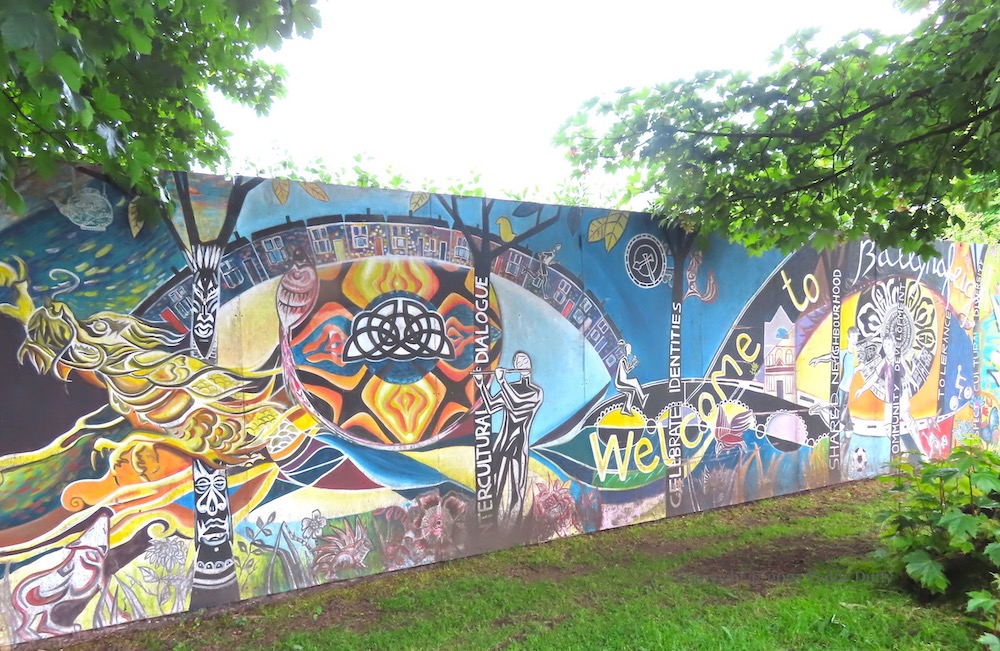
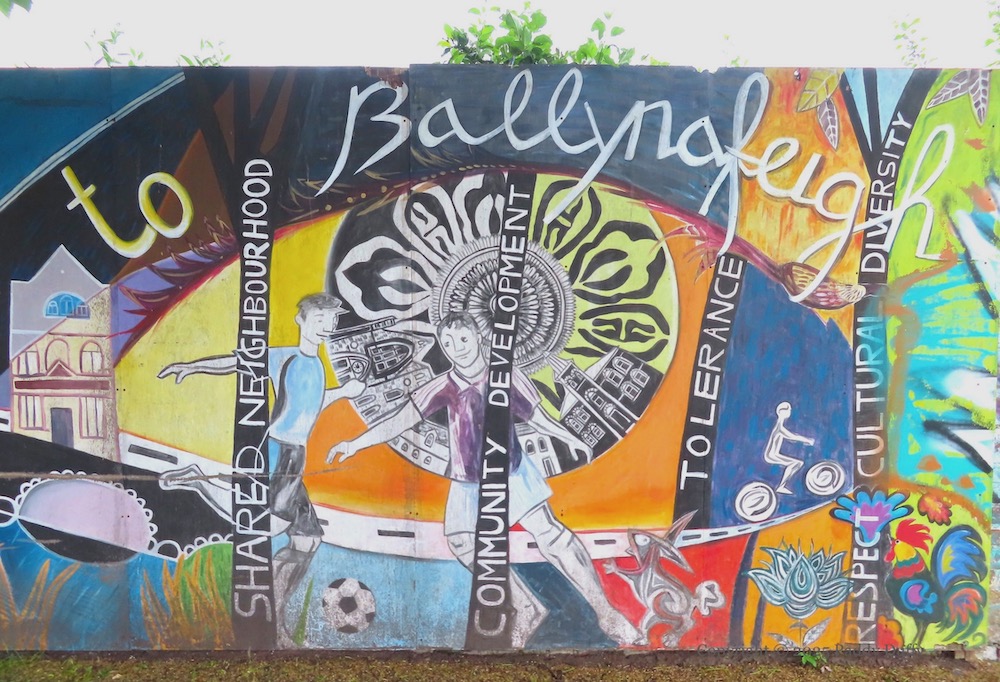
Ballynafeigh is the neighborhood just across Ormeau bridge, containing Annadale flats and surrounding streets – home to Ormeau Road UDA/UFF and Ballynafeigh Apprentice Boys flute band (Fb). The painted boards shown here was painted by Daniela Balmaverde (web) with help from local volunteers and presents imagery from non-Western cultures along with slogans on tree-trunks: “Cultural dialogue”, “Celebrate identities”, Shared neighbourhood”, “Community development”, “Tolerance”, and “Respect cultural diversity”.
The mural is at the Ormeau Road entrance to Ormeau park opposite Candahar Street. The Brigada Romona Para mural was previously in this spot.
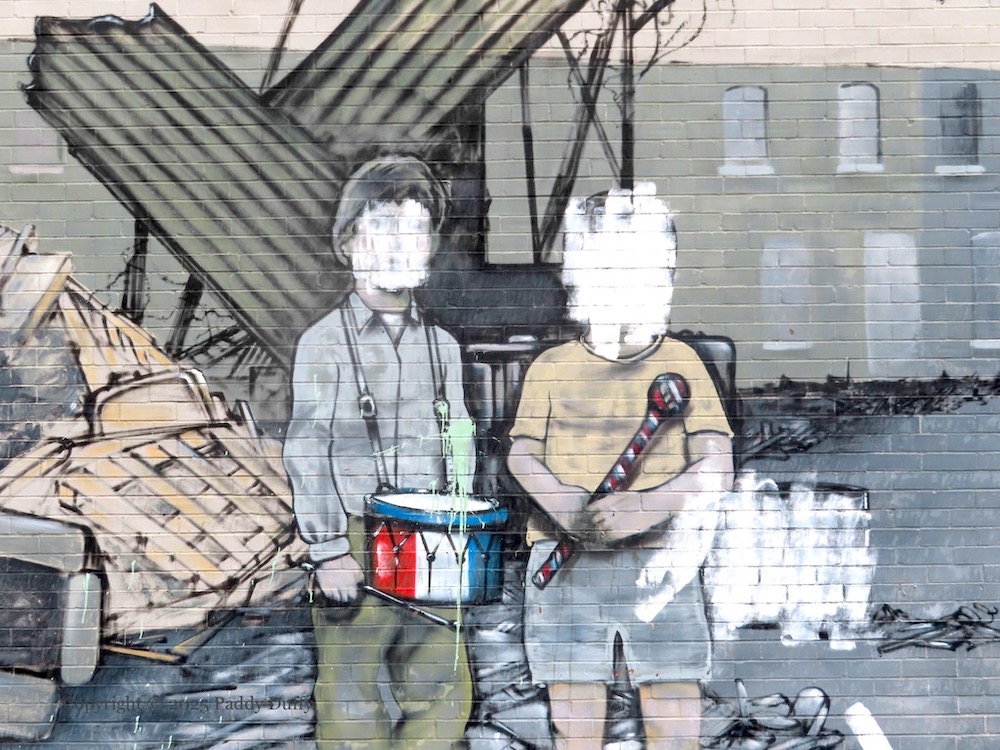
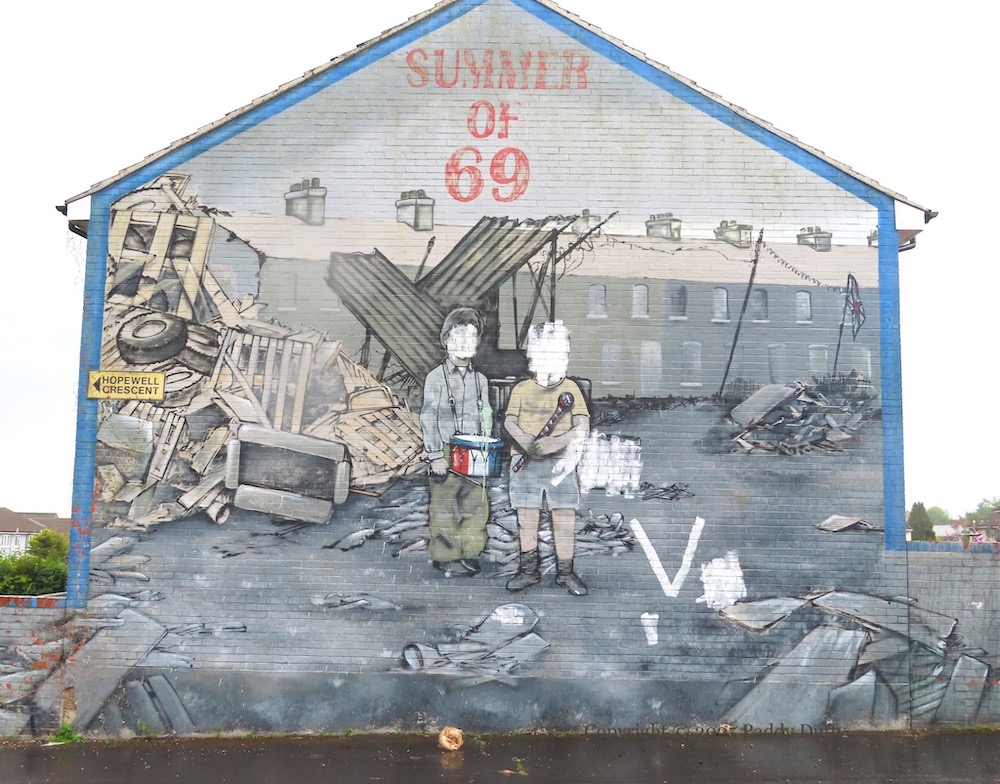
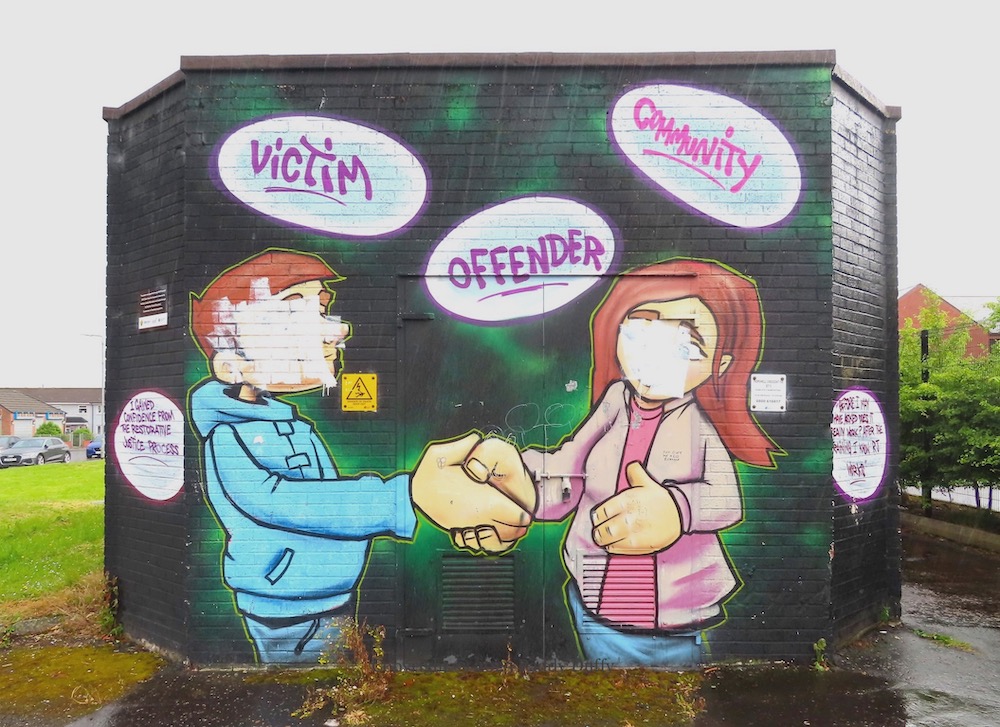
The faces in two wall-paintings in the lower Shankill estate have been painted out. It is not known if there is a specific point to this or whether it is simple vandalism.
Here is a selection of art from the Cupar Way section of the west Belfast “peace” line. Some of the artists were visitors who were in town for Hit The North 2025 (Roo, Philth, Sky High – all of which were immediately blacked out). We also see work by Ohhi Ohno, SNAK, NOTA, KAYOS, Junk Graff, and others.