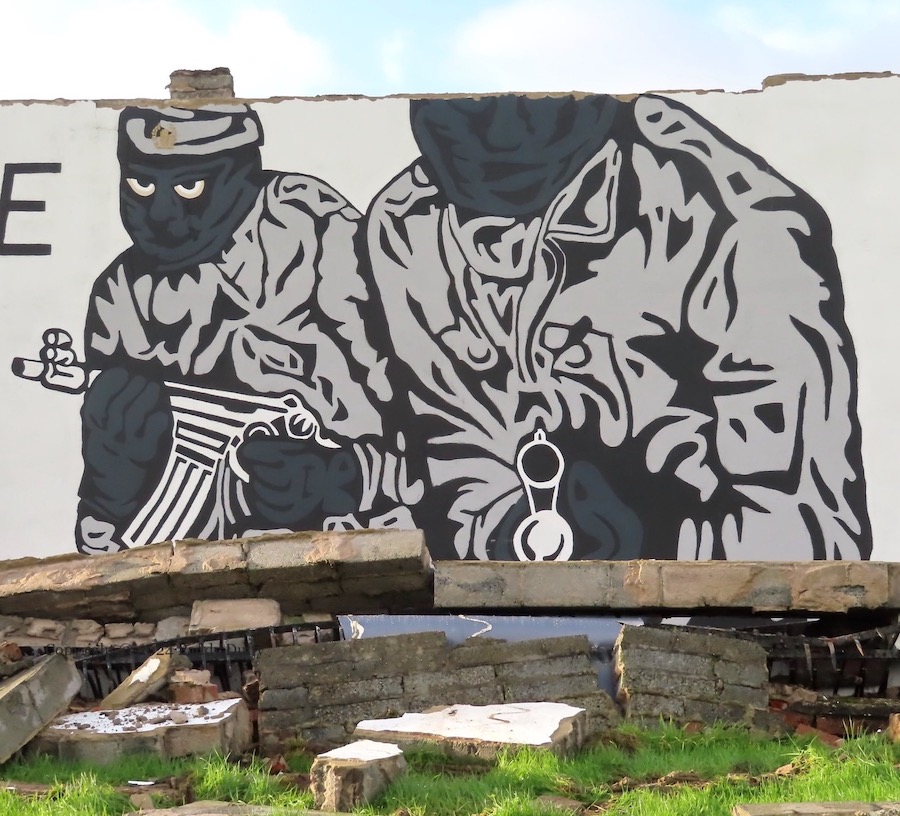
Storm Darragh originally took only the top third off the UVF “Prepared for peace, ready for war” mural in Mount Vernon (see Taken By Storm) but the entire wall was subsequently demolished – as shown in these images – due to concerns about its safety. The Sunday World reports that residents in the estate do not want the mural to be repainted; the wall is/was NIHE property (pdf).
“The flowers that bloom tomorrow are the seeds you planted today” – this is another in the series of murals sponsored by Wild Belfast (web) as it attempts to increase the habitats for birds. The ‘house martin’ painting at Cliftonville and the ‘swifts’ painting in Bruce Street are now joined by a piece by Lost Lines (ig | Rhea Hanlon) in Rossmore Drive, south Belfast, featuring house sparrows. Like the others, this piece include bird boxes, mostly in the top right of the wide shot, last below.
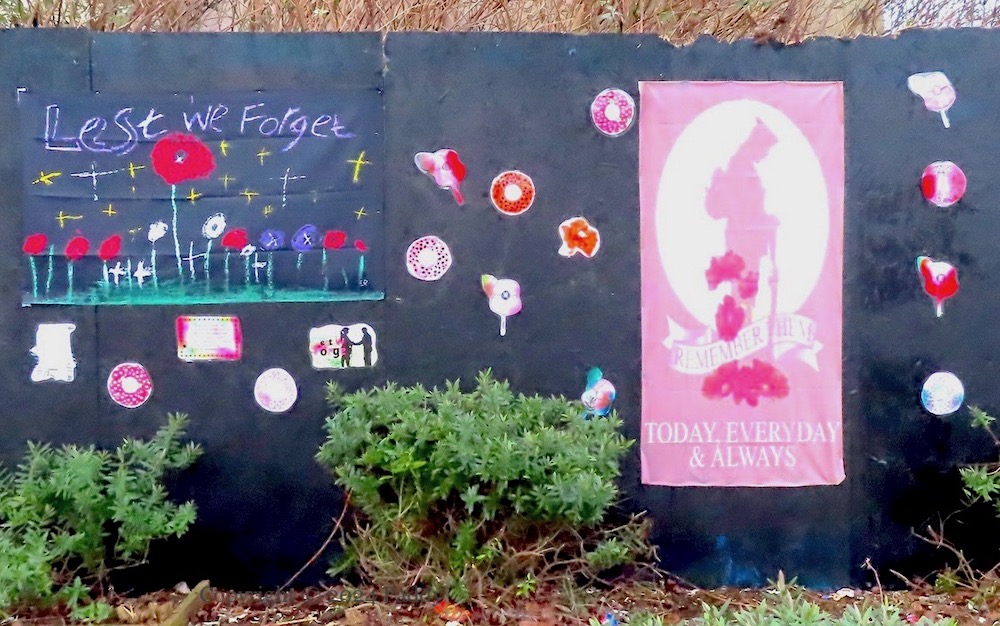
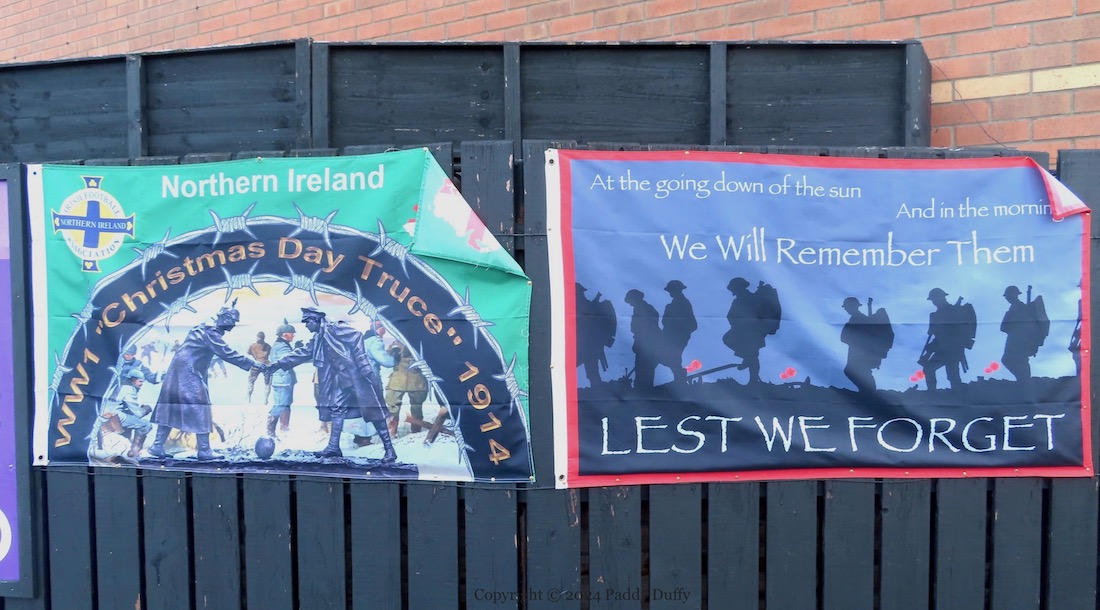
There was a David Ervine mural (and memorial sculpture) on the building at the corner of Albertbridge Road and Montrose Street South in east Belfast but the corner unit was knocked down and over time the hoarding around the site became dilapidated and graffitied. The hoarding has been given a new coat of paint and decorated with WWI memorial banners and small children’s cut-outs.
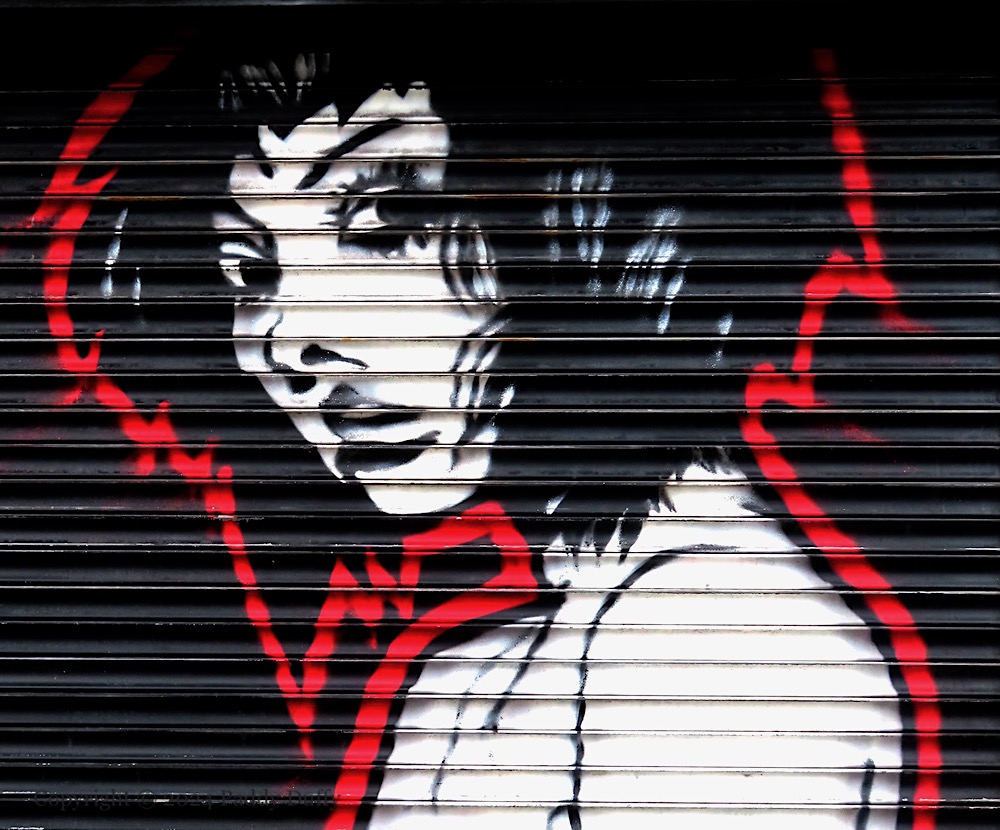
This is an older piece but one seen only on weekends and in the evenings because it is painted on shutters, specifically the shutters of DC-Rays (formerly D-Rays) hair salon (Fb) in Albertbridge Road, east Belfast.
The work was painted by Glen Molloy (ig) c. 2017; for other pieces in this style, see the gallery of ten famous faces in Corporation Street from 2016 or the Three Jimmys in Exchange Place from 2017.
At the heart of this east Belfast homage to the healing power of soccer are German and British soldiers shaking hands over a ball in ‘no man’s land’ on the Western Front, on Christmas Day, 1914. The image is not from a contemporary photograph but a modern one of a 2014 sculpture depicting such an even by Andy Edwards (TruceStatue) (who also did the Pat Jennings sculpture in Newry – seen in Pat Jennings). For more images of the WWI soccer statue, see WWI Cemeteries.
It’s not clear that matches between opposing forces – rather than simple fraternisation – were actually played; see Wikipedia for a review of the evidence.
The Pitt Stop caravan is a new community-services centre run by the Residents’ Association (Fb) in Pitt Park, east Belfast, a stone’s throw from the Ballymac Friendship Centre (Fb). The relationship between the two is unclear – this Sunday World article quotes one person as saying the some residents felt themselves excluded from the Centre and that the “good people of Pitt Park” need “access to a facility”. The article also suggests possible connections to the local UVF and to drug-dealing; the Association denounced the write-up in a brief Facebook post.
The Park itself was renovated in 2024 (Belfast Live before | after).
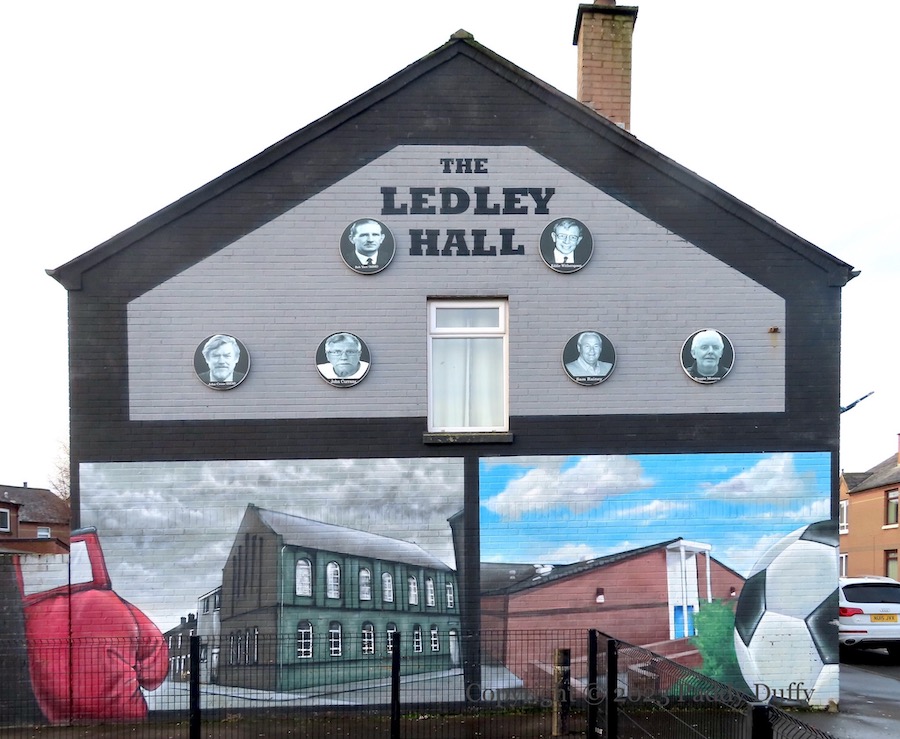
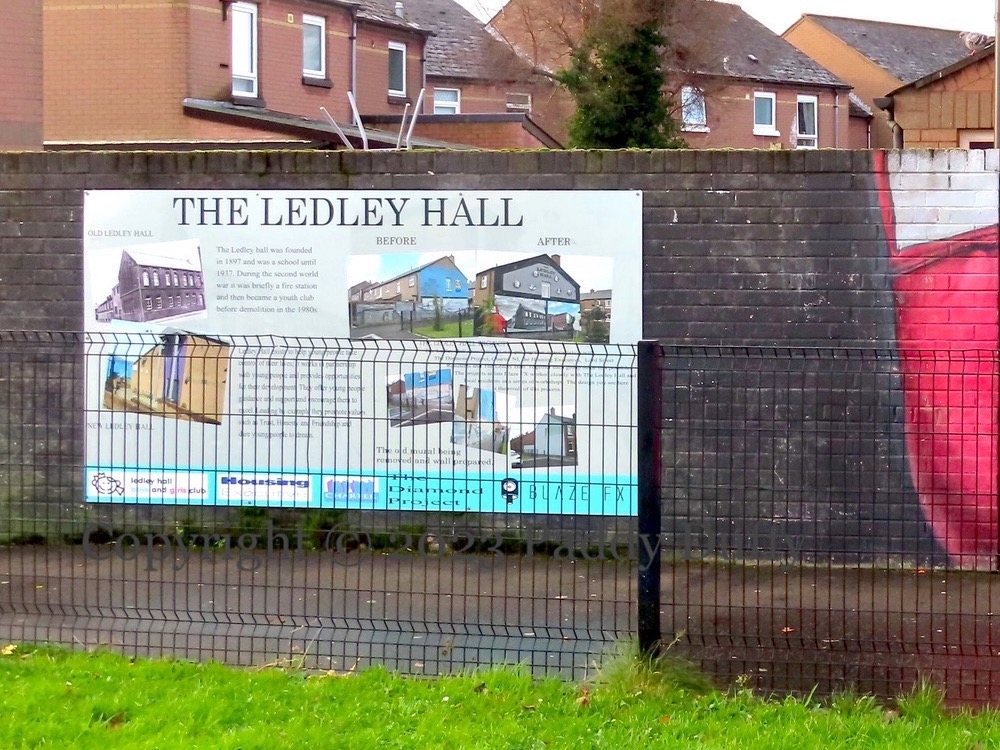
This is a repainting of the Ledley Hall/Queen’s Jubilee mural at the junction with Kingswood Street, part of the 2016 re-imaging of Lord Street, east Belfast, sponsored by the Housing Executive and CharterNI. The mural shows the hall past and present and features local figures Bob Yarr (OBE), Eddie Witherspoon, John Cross (BEM), John Currans, Sam Rainey, and Reggie Morrow.
The ‘Lord Street Remembers’ piece is from 2015, by Glenn Black and Ken Maze of Blaze FX (web).
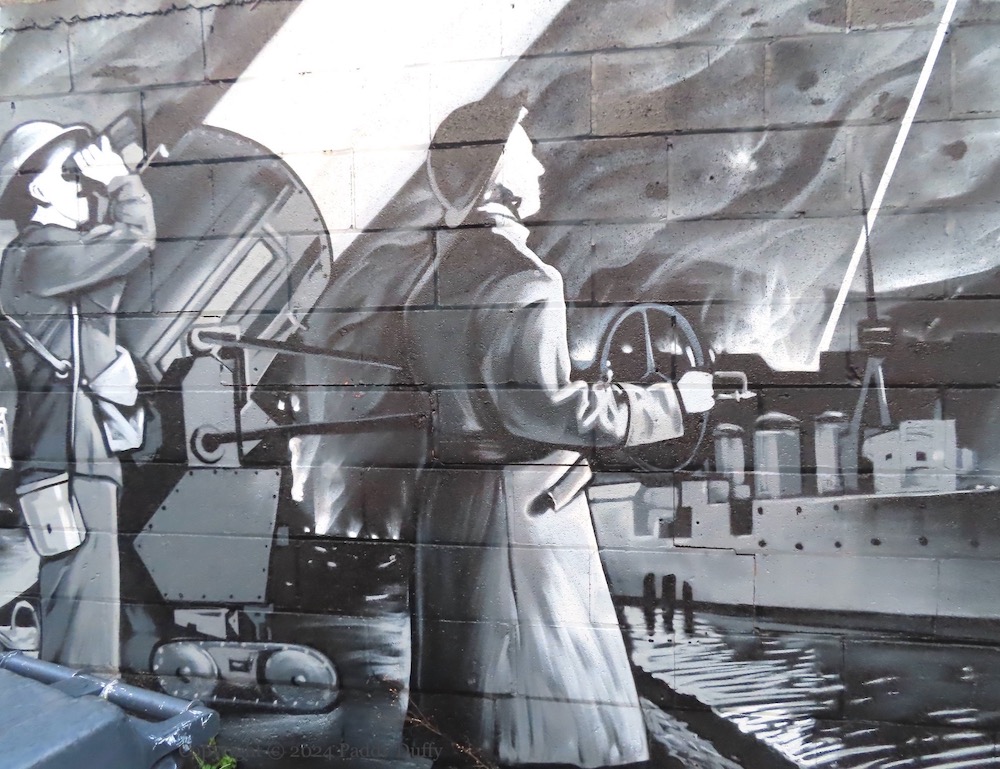
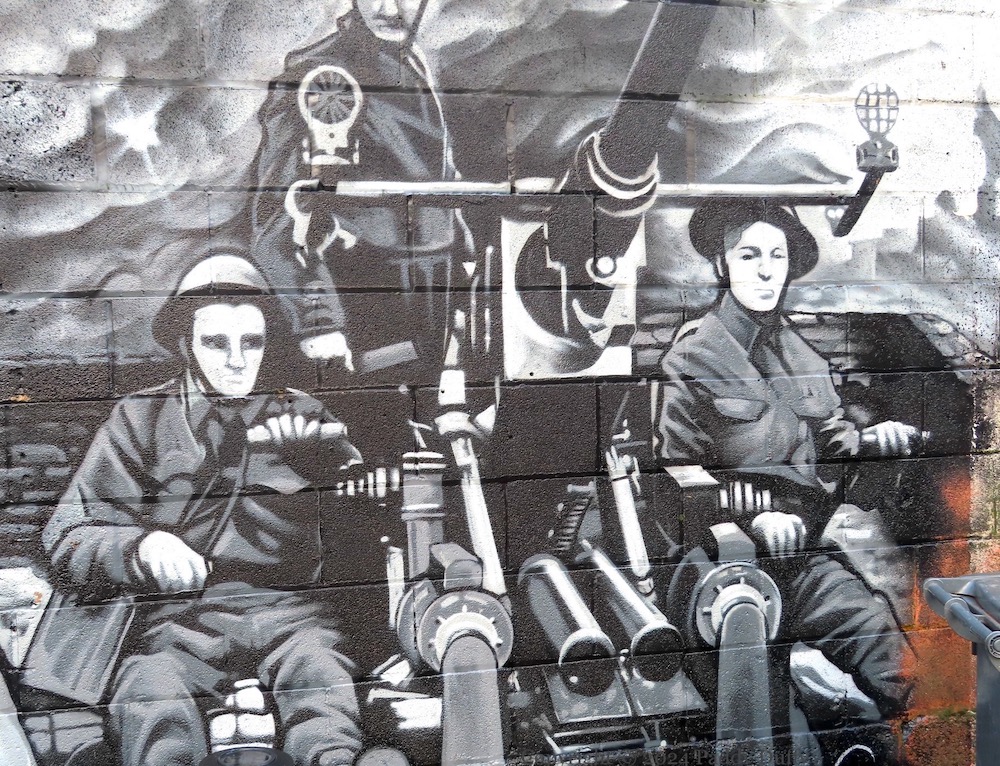
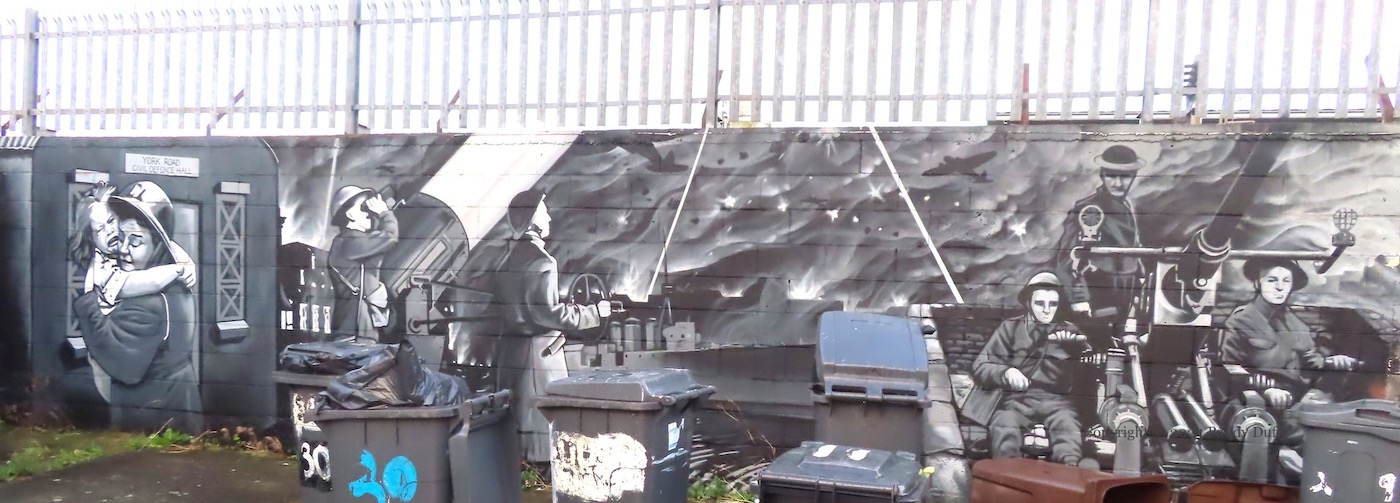
The HUBB community centre (Fb) in north Belfast has, since 2010, been based in what used to be a World War II Civil Defence air-raid shelter, which it cleaned and renovated (Tele). The original hall is depicted in this mural on the side of the HUBB.
In 1940, Belfast was protected by thirty-eight anti-aircraft guns. The German Luftwaffe flew a reconnaissance flight over Belfast on November 30th, 1940 and a test mission of eight planes on April 7th, 1941 concluded that Belfast’s defences were, “inferior in quality, scanty and insufficient” (Hogg). 150 bombers would blitz Belfast the following week, on Easter Tuesday, April 15th, and the seven guns that had been in operation ceased firing, believing, falsely, that RAF planes were also in the sky (WP).
Belfast was bombed by the Germans four times in April and May of 1941. In the blitz of Easter Tuesday, 1941, more than 900 people died, 1,500 were injured, and half the houses in Belfast were damaged (WP). According to Elaine Hogg’s research in the ‘Darker Side Of Belfast’ series, 100,000 people left the city in the remainder of the month, due to shock, fear, and the squalid conditions and unruly behaviour that followed the bombing.
The UVF hooded gunmen mural in Mount Vernon, which “greets” drivers coming off the M2 at the Shore Road, has been damaged by Storm Darragh, which had winds of 90 m.p.h. and more, with the apex and a further 6 feet of masonry coming down. (Belfast Live gallery of NI damage | BBC gallery of UK storm damage.)
This wall is NIHE property (pdf) and the need for repair or reconstruction might delay any repainting of the mural.
The mural in this location dates back to 2001 (here are images from 2006 and 2012) and was touched up in 2022 (T01300 | X10660). The original mural – which dates back to the ceasefire era (1995) – was on a gable at the front of the estate but the entire block of houses was razed – see T00138 | D00382.
This new Glengormley street art pays tribute to an elephant from Bellevue Zoo during WWII.
In response to the blitz of April 1941, thoughts turned to what might happen if the zoo was bombed. Thirty-three animals that would be dangerous to the public (if they escaped) were executed. A zoo-keeper, Denise Weston Austin, brought Sheila, an Asian elephant, to her home on the Whitewell Road, where she lived for several weeks, before being returned to the zoo in time for the bombing of May. (See WP for dates of the Belfast blitz.) For photographs of Sheila and Denise, and the tale of how Sheila’s absence was discovered, see Wartime NI.














 Paddy Duffy Collection