
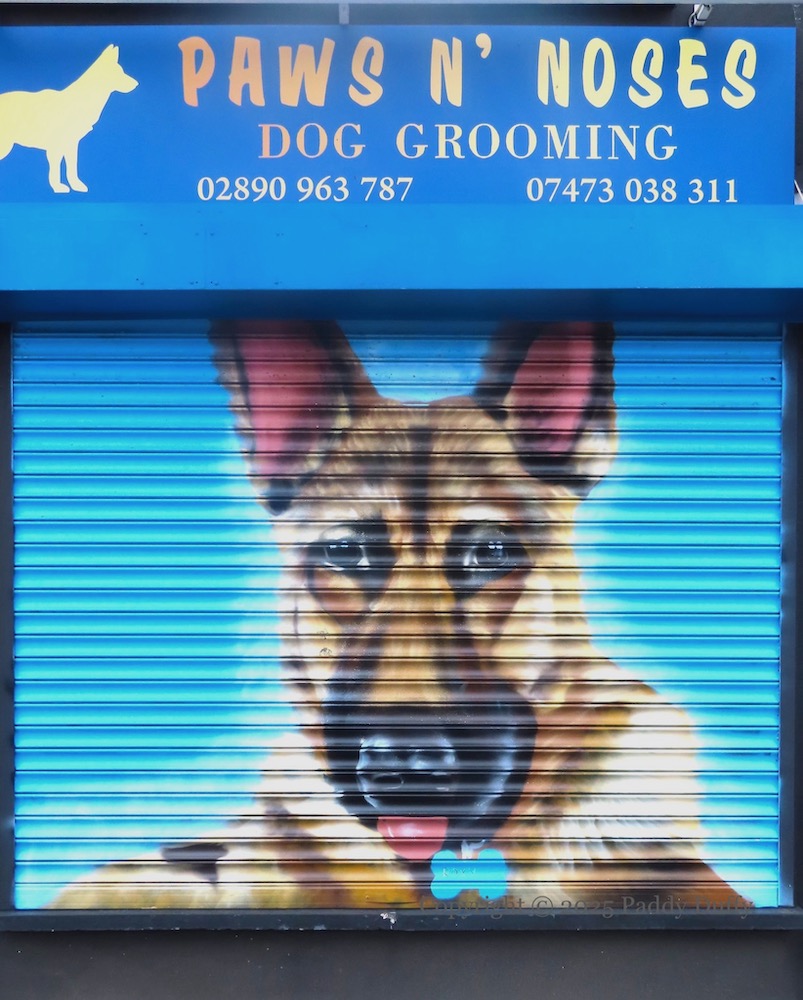
A friendly Alsation on the shutters of Paws N’ Noses (Fb) dog-grooming salon on the Ballyclare Road, Glengormley, Newtownabbey
Click image to enlarge
Copyright © 2025 Paddy Duffy
T07087 T07086
A friendly Alsation on the shutters of Paws N’ Noses (Fb) dog-grooming salon on the Ballyclare Road, Glengormley, Newtownabbey
Click image to enlarge
Copyright © 2025 Paddy Duffy
T07087 T07086

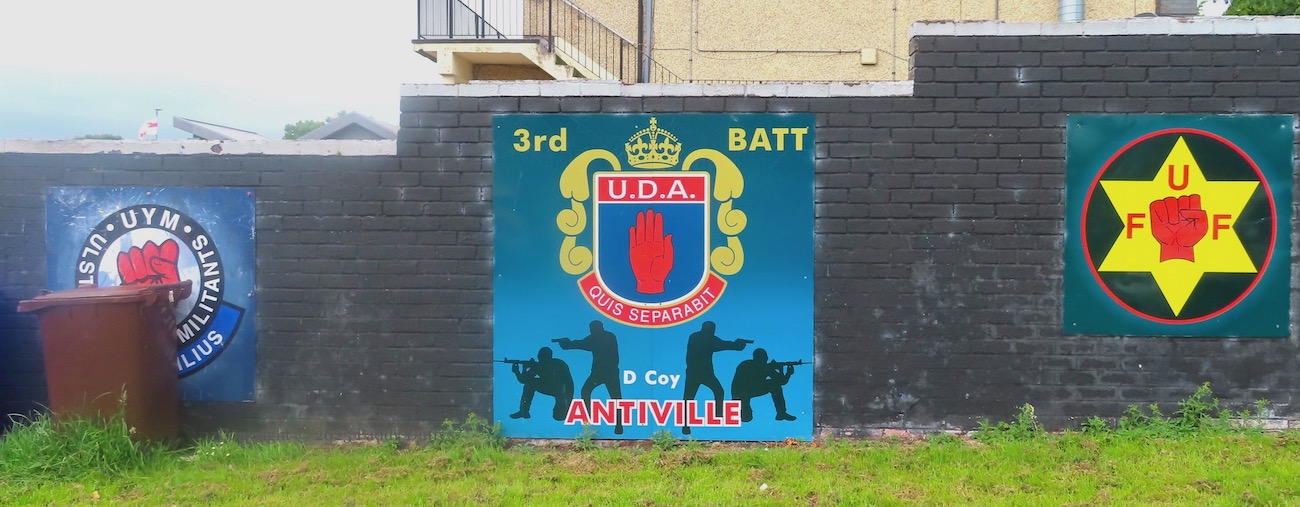
This entry updates Dieu Et Mon Droit from 2023. The boards are showing some signs of wear, and the large ‘Eddie The Trooper’ board is missing.

Click image to enlarge
Copyright © 2025 Paddy Duffy
T07060 [T07061] T07062 T06073
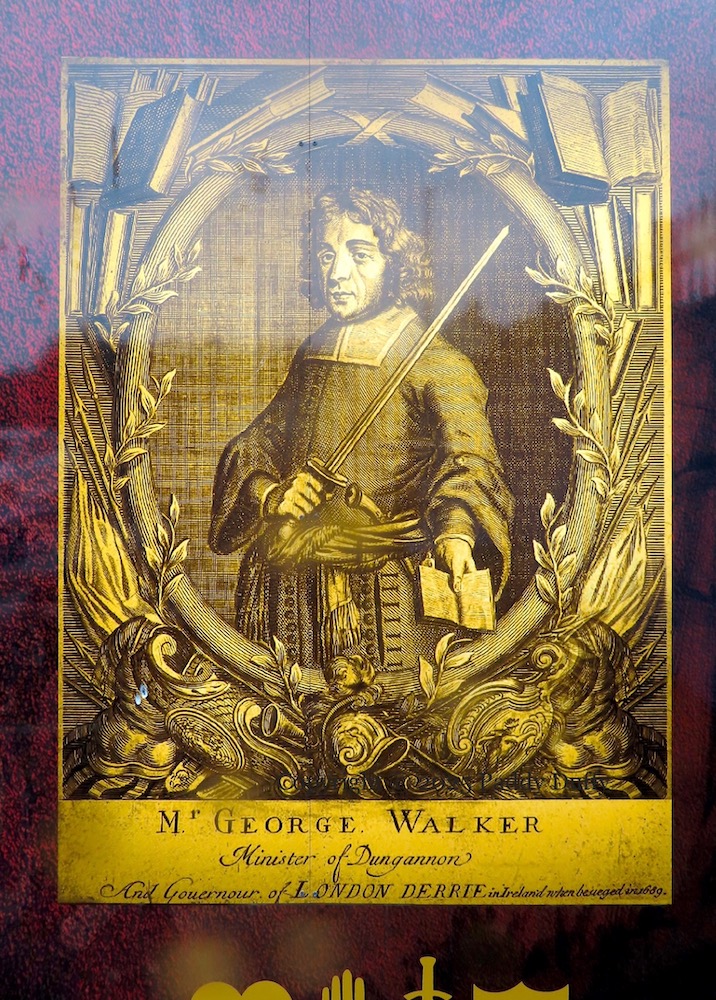
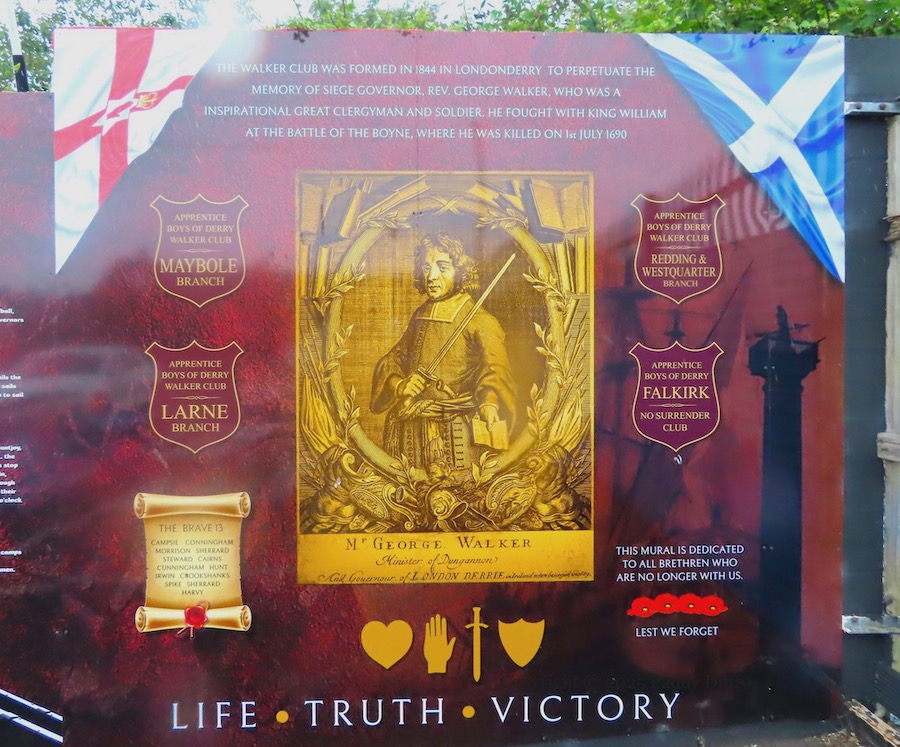
“Mr George Walker, Minister of Dungannon and Gouernour of London Derrie in Ireland when besieged in 1689.” Walker evacuated from Dungannon after Lundy’s troops pulled out and became joint governor of Derry after Lundy’s authority collapsed, first with Henry Baker and later with John Mitchelburne.
Walker put himself at the centre of his own “True Account Of The Siege Of London-Derry” (which can be read at archive.org) and drew criticism for minimising the role of Presbyterians (Walker was Anglican/CoI).
After the siege, Walker went on a victory tour of Scotland and England; while in London, he argued against a Derry trial for Lundy, on the ground that Lundy still had support there. He returned to Ireland in time to greet William III in June 1690 when William travelled from Carrickfergus to Belfast (see June 14th, 1690) and he went south with William to the Boyne, where he was shot and killed. (DIB | DIB | WP)
“The Walker Club was formed in 1844 in Londonderry to perpetuate the memory of siege governor, Rev. George Walker, who was a[n] inspirational great clergyman and soldier. He fought with King William at the Battle of the Boyne, where he was killed on 1st July 1690.”
The image of Walker is a line-engraving by John Savage, viewable at Sinclair Genealogy. “Life, truth, victory” is a translation of Londonderry’s Latin motto “Vita, veritas, victoria”.
These new boards are at the Rangers Supporters’ Club (Fb) in Boyne Square/Greenland, Larne.



Click image to enlarge
Copyright © 2025 Paddy Duffy
T07081 T07080
T07075 T07077 T07076 T07078 T07079
T07082

This is a printed version Wilfrid Spender’s report of the first day of the Battle Of The Somme, replacing a previously painted instance that was in the same style as the adjacent mural.
“‘I am not an Ulsterman but yesterday the First of July, as I followed their amazing attack, I felt that I would rather be an Ulsterman than anything else in the world. My pen cannot describe adequately the hundreds of heroic acts I witnessed, the Ulster Volunteer Force, from which the Division was made, has won a name that equals any in history. Their devotion deserves the gratitude of The British Empire’ – Captain Wilfrid [not “Wilfred”] Spender, The Somme 1916″
Spender’s words are superimposed upon JC Beadle’s Attack Of the 36th Division (see Over The Top).
Carlingford Street, east Belfast

Click image to enlarge
Copyright © 2025 Paddy Duffy
T07083 T07084 [T07085]
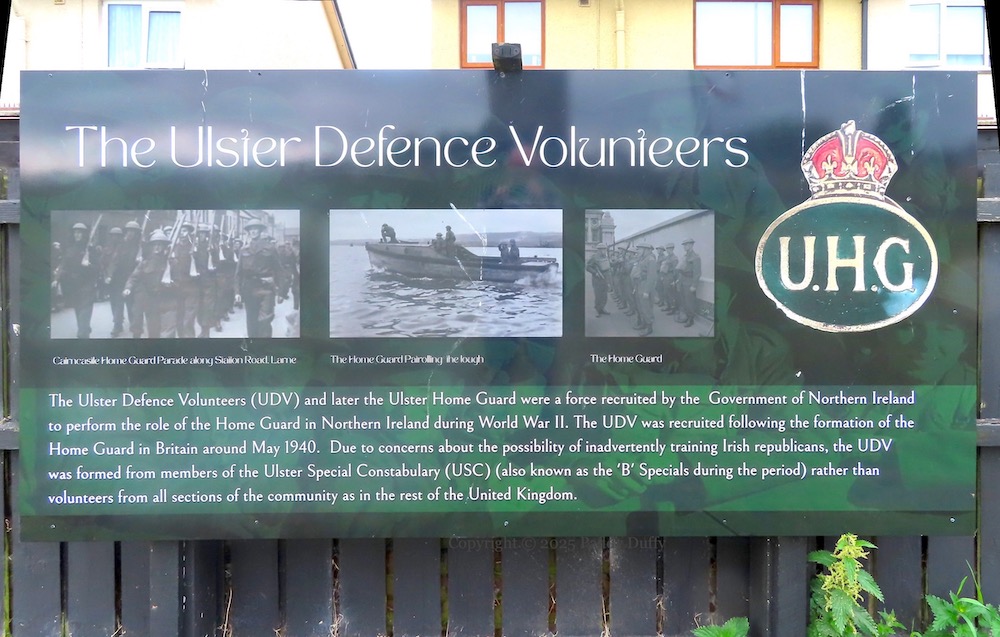
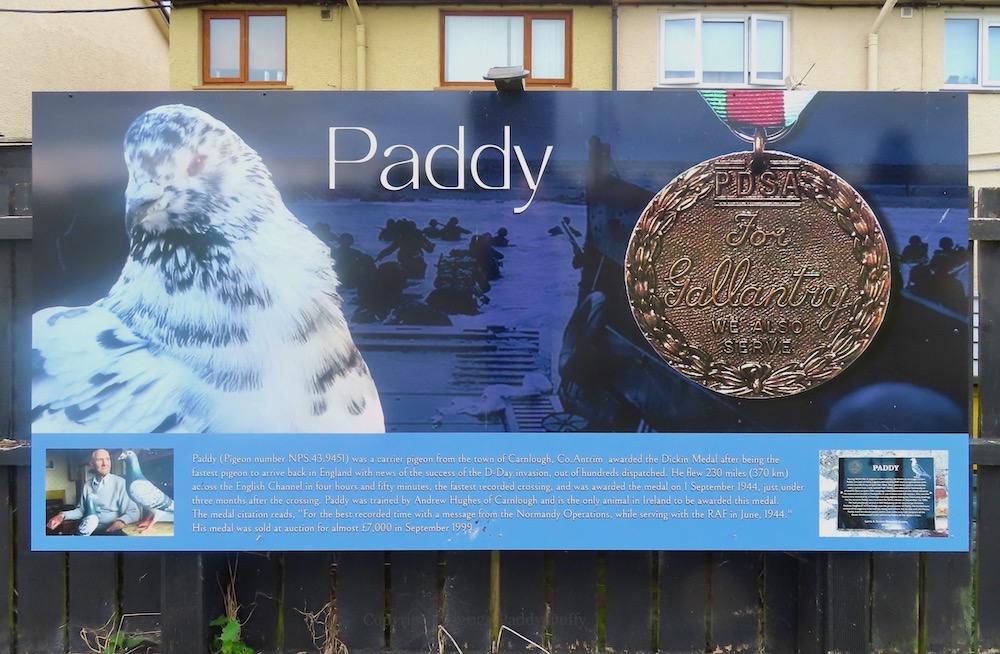
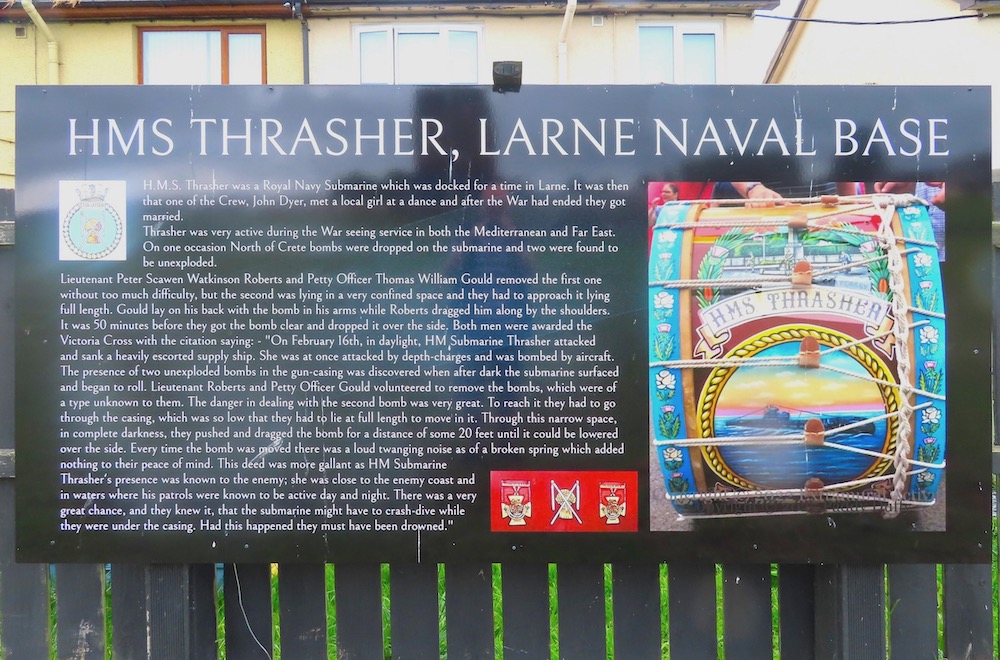
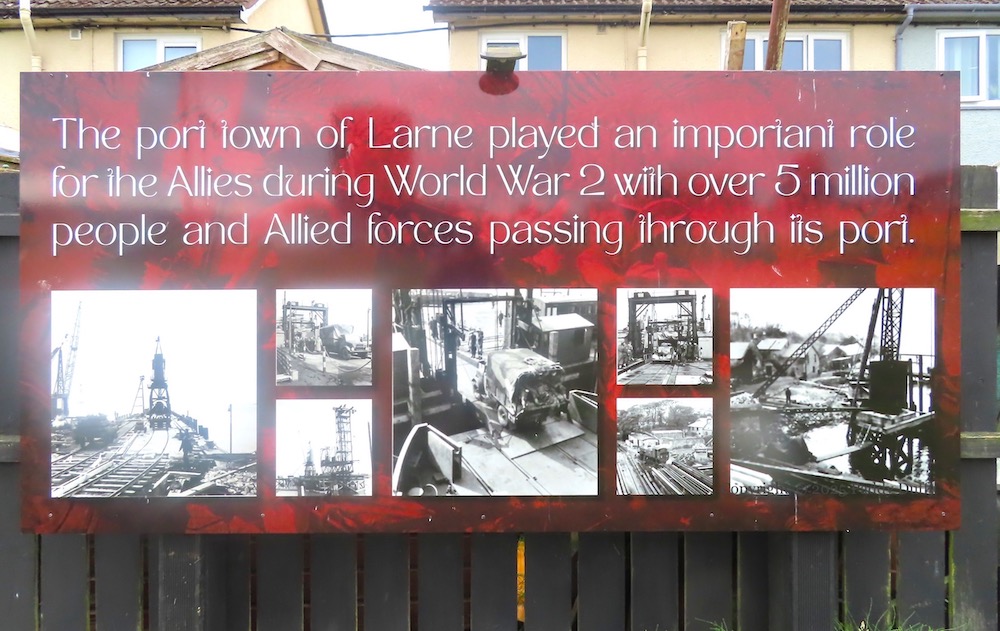
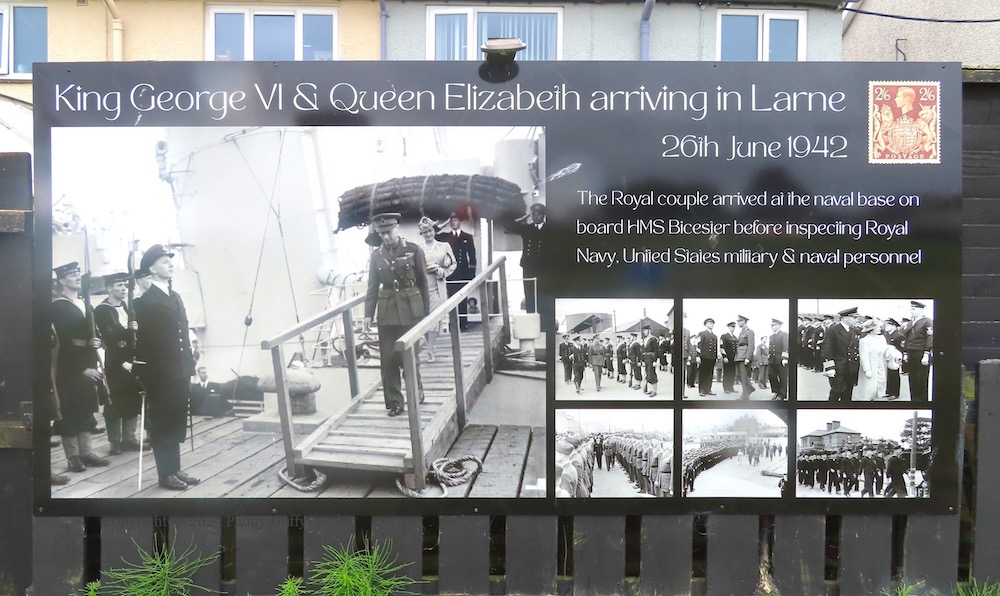
This is a series of ten boards in Craigyhill, Larne about WWII. (It replaces a set of twelve UDA boards – see The Loyalist Executioner.)
From left to right (top to bottom) their subjects are:
the Ulster Defence Volunteers/Ulster Home Guard, formed from the B Specials;
Paddy the pigeon;
submarine HMS Thrasher (using an image from the Seosamh Mac Coılle collection);
HMS Larne, a minesweeper built in Renfrew, Scotland;
the port of Larne through which passed “over 5 million people and Allied forces”;
Kilwaughter Castle, a training ground for UK and American troops;
the royal visit of King George VI and Queen Elizabeth in June 1942;
James Stuart Steele of Ballycarry, who served in both WWI and WWII;
the Larne Spitfire, one of seventeen spitfires funded by a Belfast Telegraph fund-raising drive (Wartime NI | see also the Ballymena spitfire in Per Ardua Ad Astra);
local casualties of WWII – “In remembrance of those from town of Larne that paid the supreme sacrifice during the Second World War”.
Shanlea Drive, Craigyhill, Larne




Click image to enlarge
Copyright © 2025 Paddy Duffy
T07064 T07065 T07066 T07067 T07068 T07069 T07070 T07071 T07072 T07073 T07074

British Army forces were deployed to Northern Ireland On August 14th, 1969, under the operational name “Operation Banner”. It began as peace-keeping, in co-operation with the RUC, but soon became a counter-insurgency operation, which lasted until the Agreement in 1994 and officially ended, under a provision in the Agreement, on July 31st, 2007.
These plaques are beside the front door of the Royal British Legion in Hamilton Road, Bangor. The social club associated with the branch closed in May (Co Down Spectator).
“This plaque is to celebrate the platinum jubilee reign of Her Majesty Queen Elizabeth II 1952-2022. This plaque was presented by the Ulster Defence Regiment CGC Bangor Branch and the Royal British Legion Bangor Branch.”
“Operation Banner (14th August 1969 – 31st July 2007) This stone is dedicated to all members of Her Majesty’s Armed Forces and Civilian Emergency Services who served during Operation Banner from Bangor and the surrounding District. ‘As Poppy Petals gently fall, remember us who gave our all/not in the mud of foreign lands nor buried in the desert sands/in Ulster field and farms and town/Fermanagh’s lanes and drumlin’d Down/we died that violent death should cease/and Ulstermen might live in peace.'”
Click image to enlarge
Copyright © 2025 Paddy Duffy
T07051

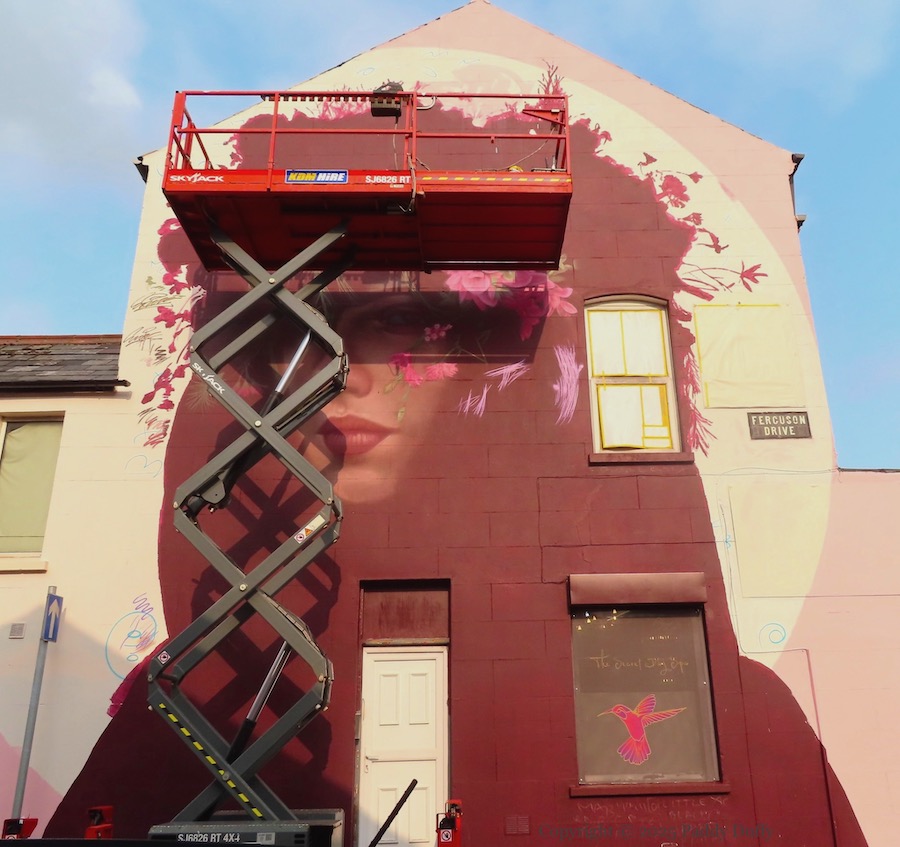
CS Lewis’s mother was Florence “Flora” Augusta Lewis. She studied arts, logic, and mathematics at Queen’s College (which became the Royal University during her studies, and is now Queen’s University) and taught Clive and his older brother Warnie Latin and French at home. She developed cancer when Clive was nine years old and died at age 46 on August 23rd, 1908, at the family home in Strandtown, east Belfast (Christian History Institute | Lifelong Learner | CS Lewis Institute | WP). Her grave is in Belfast City Cemetery (FindAGrave).
The Lewis family previously lived in the Dundela Villas (now the site of Dundela Flats) a few streets away from this new work by emic (web) along Belmont Avenue, which draws inspiration from Flora for its subject, and the local shops (The Secret Day Spa | Murphy & Bailey) for its palette.
The image above is from June 15th; the image immediately below, of the full, completed piece, is from June 20th. Two in-progress images are also included.
Ferguson Street, east Belfast

June 8th:

June 3rd:
Click image to enlarge
Copyright © 2025 Paddy Duffy
T07014 [T07015]
T07054 [T07055]
T06976 [T06975]
T06944 [T06943] [T06942]

“North Down Defenders flute band [Fb], est. 2004. In memorium [sic] T. Mercer, R. Shaw, K. Shaw, G. Shaw, D. Shaw, A. Johnston, P. Magee, S. Stewart, J. Mills.”
This piece perhaps takes the place of the NDD mural at the entrance to the estate, which was replaced in 2024.
The three emblems with fists and “73” in the central emblem are from the Ulster Freedom Fighters.
Carrowdore Gardens, Kilcooley, Bangor

Click image to enlarge
Copyright © 2025 Paddy Duffy
T07037 T07036
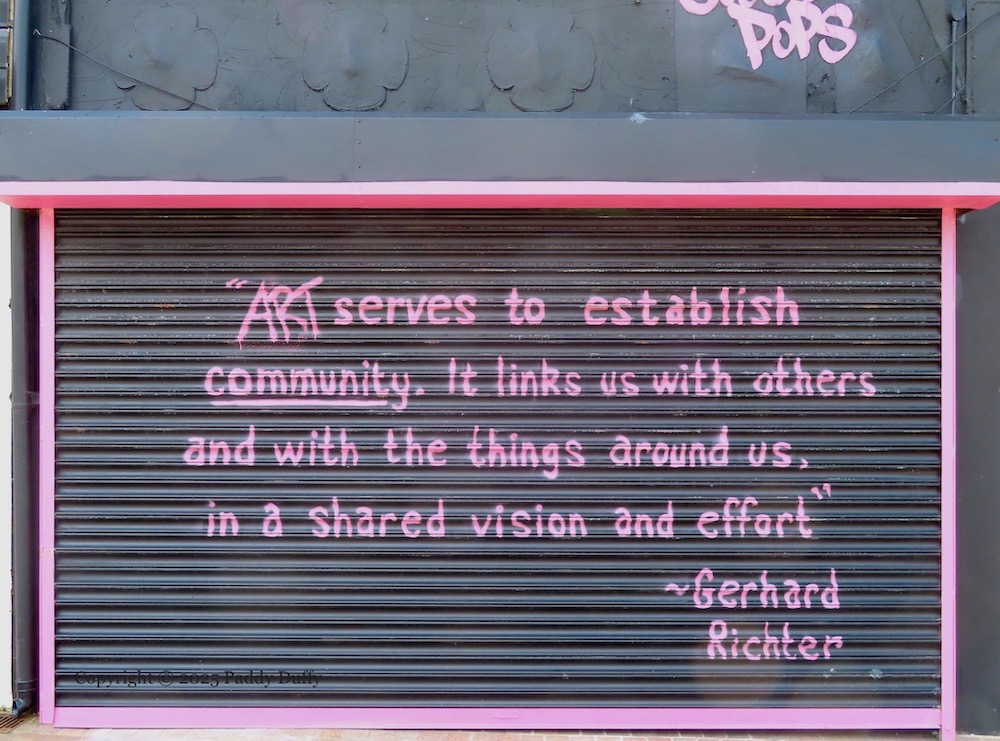
“‘Art serves to establish community. It links us with others and with the things around us in a shared vision and effort’ – Gerhard Richter”. The quote is collected in Richter’s ‘Notes 1962’ (Archive.org registration required), from the beginning of his career, in the year after he escaped from East to West Germany and the two murals he had produced for his diplomas were painted over.
By Jossie Pops (ig) in High Street, Bangor
Click image to enlarge
Copyright © 2025 Paddy Duffy
T07052
 Paddy Duffy Collection