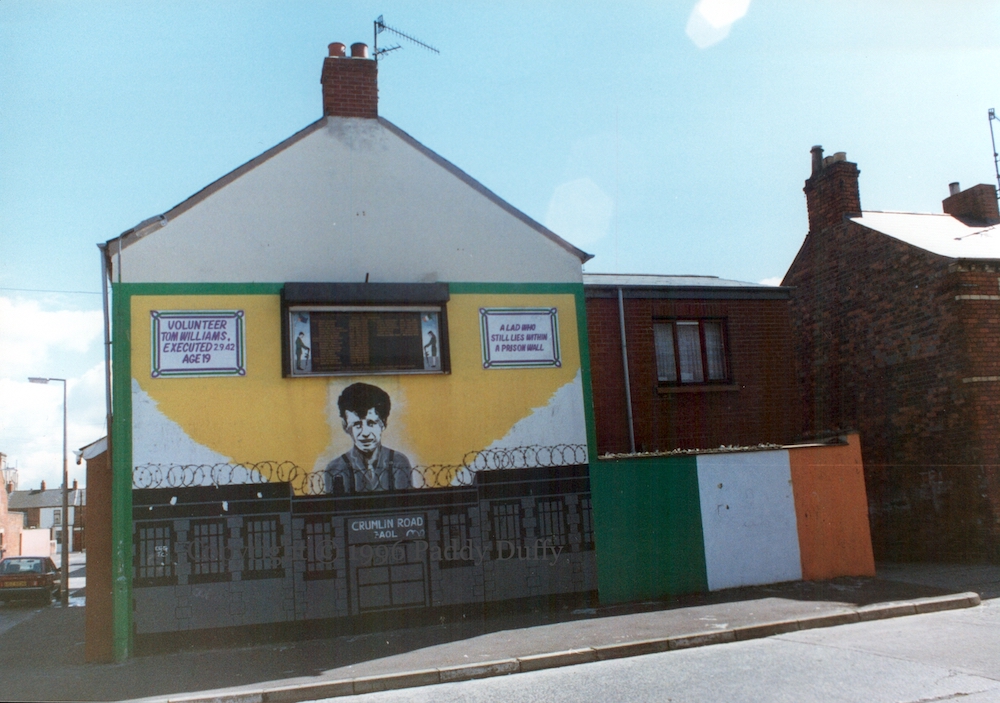
Tom Williams

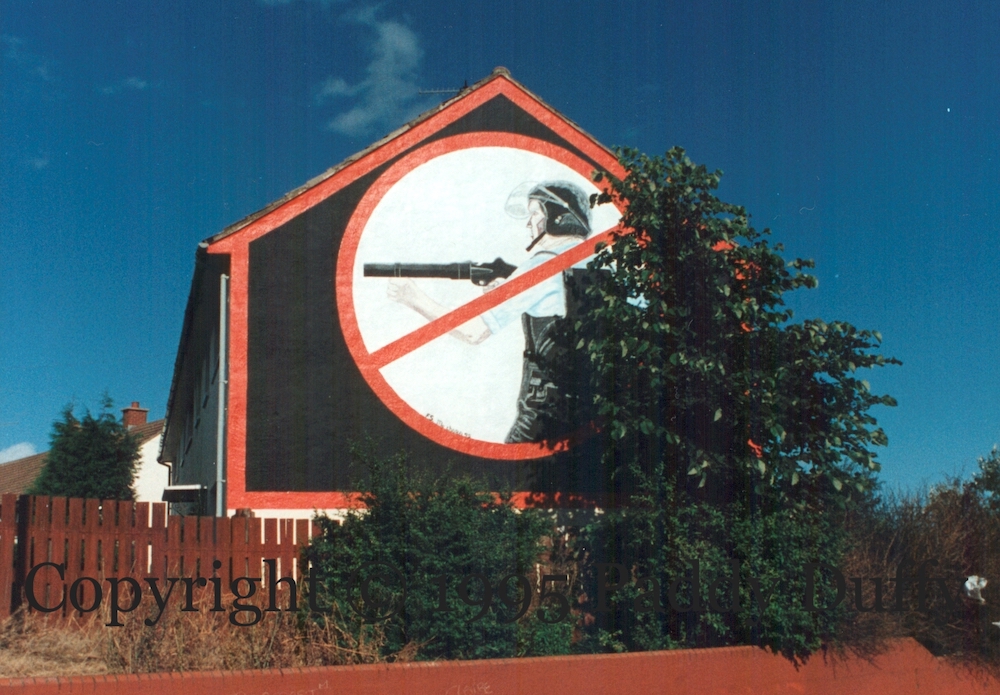
“Volunteer Tom Williams, executed 2.9.42 age 19. A lad who still lied within a prison wall.” Williams was the leader of a unit from C company, 2nd battalion, Belfast IRA, that killed RUC Constable Patrick Murphy. Williams took sole responsibility, hoping that it would save the lives of the other seven (including two women) who had taken part in the ambush. The six men were jointly convicted of the killing but only Williams was ultimately hanged, after appeals from Ireland (not yet officially ‘The Republic Of’), the Vatican, and the US State Department (RN). He was buried on the grounds of Crumlin Road gaol (and his coffin would eventually be exhumed and reburied in Milltown in 2000).

This is the second Tom Williams mural at this spot; the first was painted in 1992; both were painted by Gerard “Mo Chara” Kelly. There is a plaque to Williams above his front door in Bombay Street.

Kashmir Road, west Belfast
Click image to enlarge
Copyright © 1996 Paddy Duffy
T00178 T00168
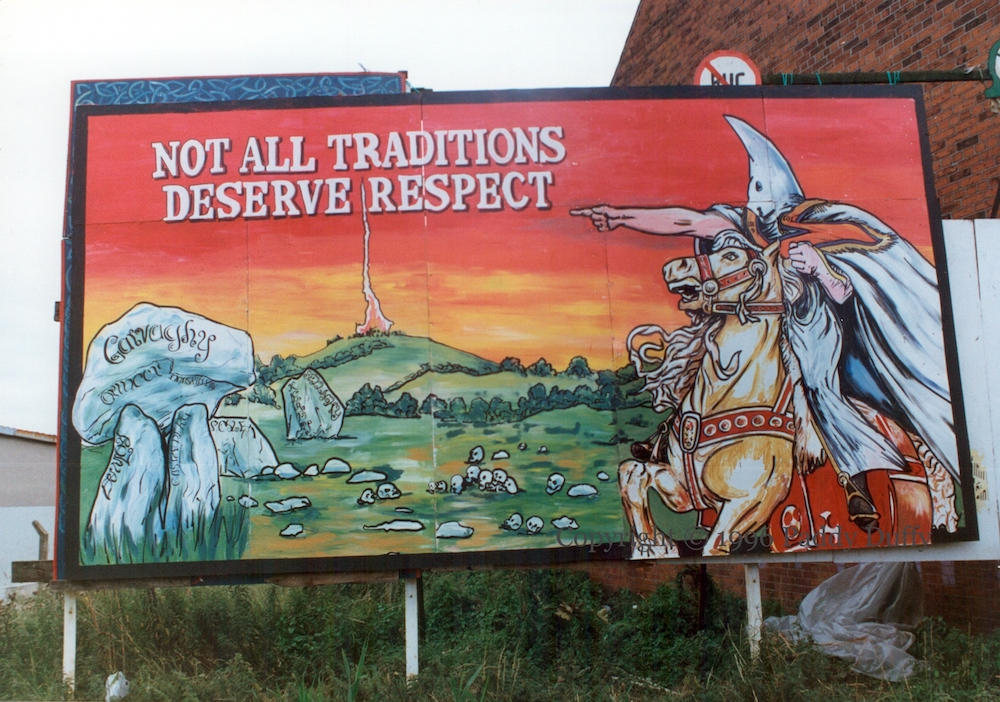
Not All Traditions Deserve Respect

This Falls Road board is a comment on the “traditional routes” taken in Garvaghy (Portadown) and Ormeau (south Belfast) and other small towns (Enniskillen, Dunloy, Castlederg, Ros[s]lea, Keady, and Bellaghy) by the Orange Order – which now pass through CNR areas.

The horse comes from Nuada And Indech At The Second Battle Of Moytura by Jim Fitzpatrick but its rider has been changed from a Celtic warrior to an Orangeman wearing the cloak and hood of the Ku Klux Klan. The landscape is from his The Tuatha Dé Assemble For Battle, with stones turned into skulls. For more on Jim Fitzpatrick’s art in murals, see the Visual History page.

Click image to enlarge
Copyright © 1996 Paddy Duffy
T00167

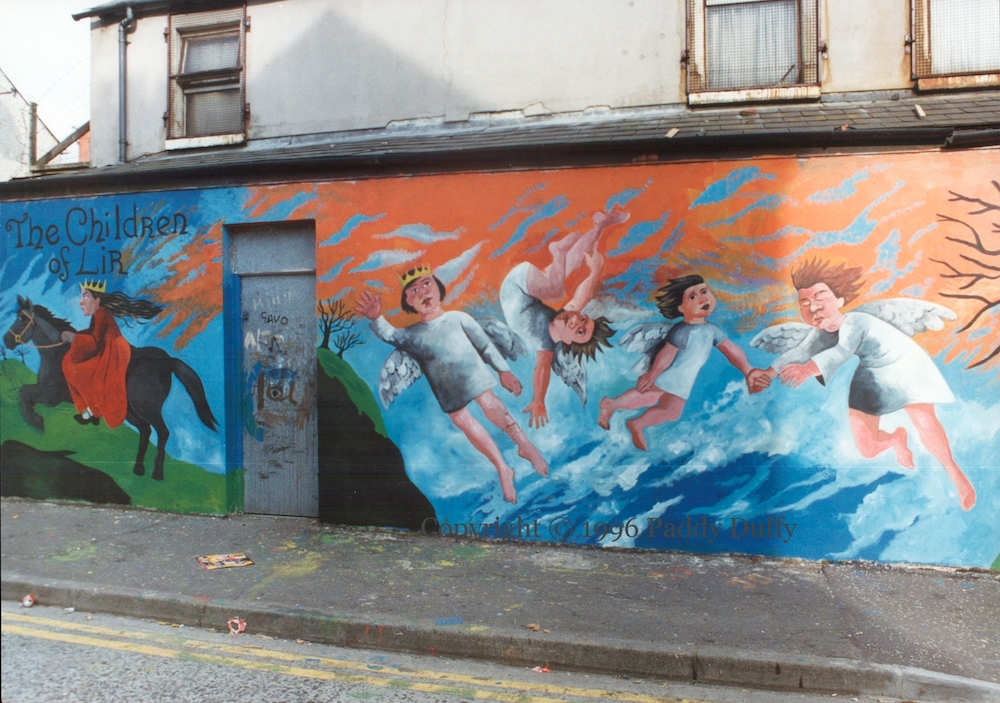
Children Of Lear

In Irish mythology, the four children of Lear – Aodh, Fıonnghuala, Fıachra, and Conn – were turned into singing swans for 900 years by their step-mother Aoıfe, who is seen on the left riding away from the site of her stepchildrens’ metamorphosis at Loch Daırbhreach (in modern Co. Westmeath). They are then restored to human form by a Christian monk but, being 900 years old, die immediately.

“Lır” (in Irish) is the genitive of (the Irish) “Lear” and the story is often referred to in Irish as “Clann Lır“; neither “Lear” nor “Lır” is pronounced like the English “(King) Lear”.

Crocus Street, west Belfast

Click image to enlarge
Copyright © 1996 Paddy Duffy
T00166

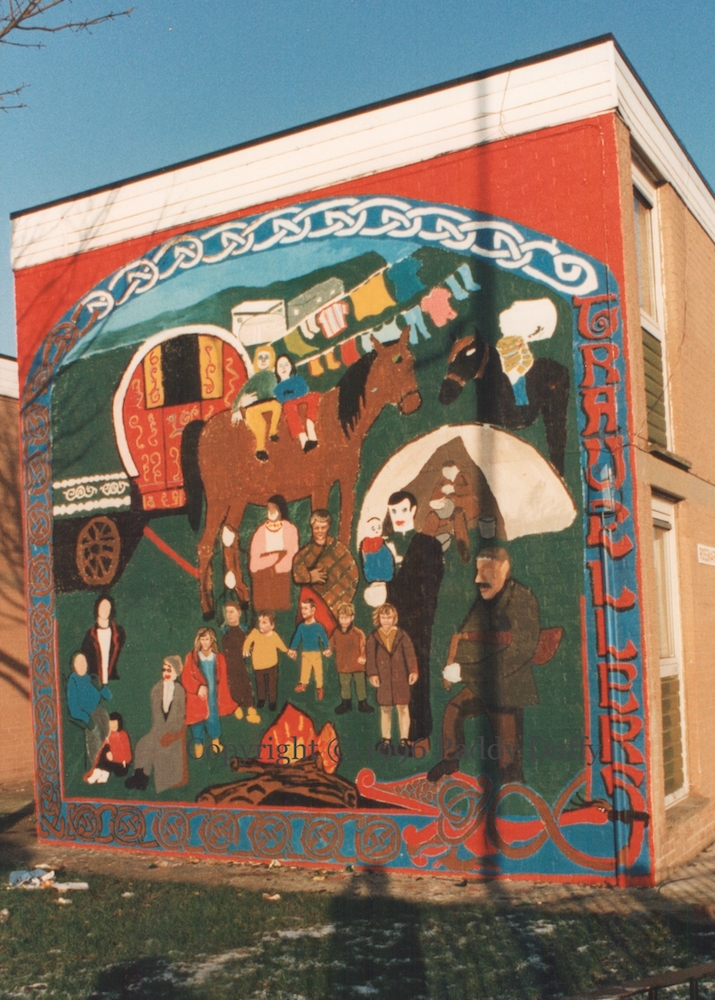
Travellers

The immediate reason for this mural depicting traveller life is unknown. In 2006 (ten years after this mural) there were about 24,000 travellers living on the island of Ireland (WP | 1995 Report on travellers in Ireland (archive.org) | a good summary of the 2011 and 2016 numbers (CSO pdf).) About 2,000 were living in Northern Ireland, some at a site on the Glen Road (RTÉ has video from the site in 1987) close to this mural in Rossnareen.

Replaces the Alosa/Fuıseog mural.

Click image to enlarge
Copyright © 1996 Paddy Duffy (no date given)
T00183

An Gorta Mór

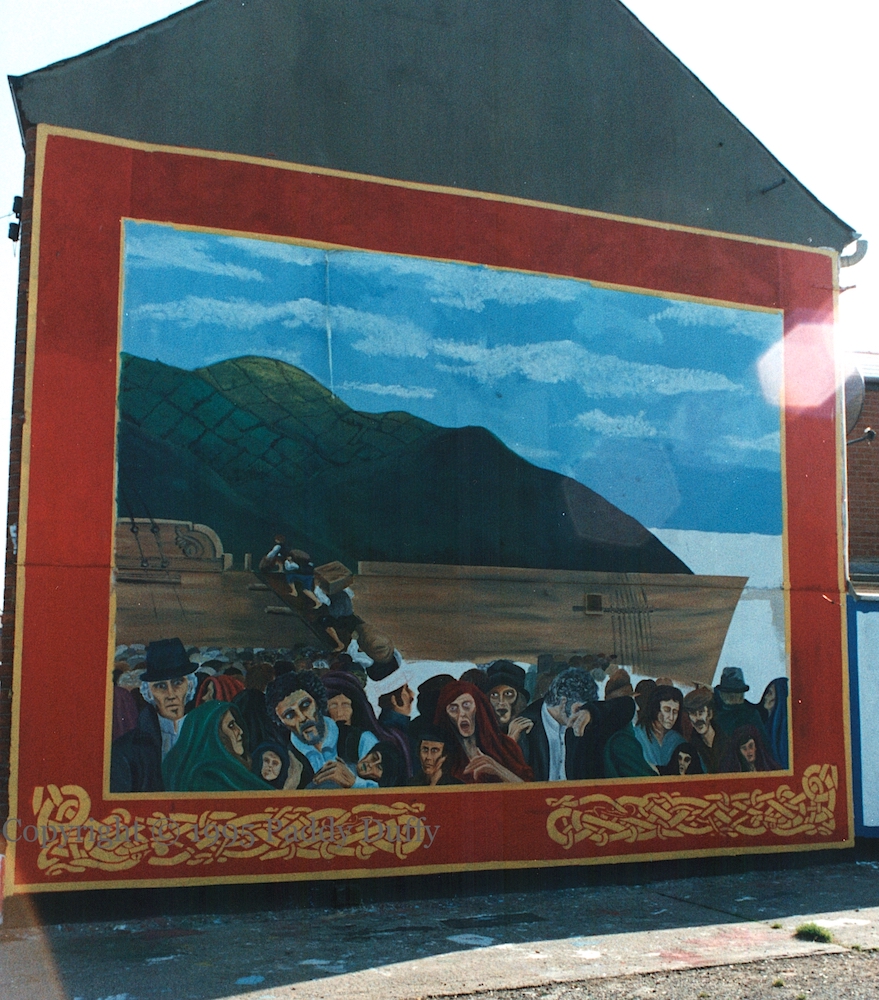
This is one of about nine murals painted in 1995 for the 150th anniversary mural of An Gorta Mór/the Great Hunger (Visual History).

There is a wall to the right that reads, “There was no famine; it was genocide.” (See the Peter Moloney Collection.)  

The dove on the chimney and the green ribbon below are a nod to the other main movement during this period, the release of political prisoners as a leading goal of the peace process.

Signed “Roısín Byrne & Kathy Rooney”.

Falls Road at Fallswater Street, west Belfast

Click image to enlarge
Copyright © 1995 Paddy Duffy
T00182

Bobby Sands

This is the second Bobby Sands mural on the wall of the offices of Sınn Féın and An Phoblacht/Republican News on the Falls Road. For the first, see The Spirit Of Freedom. Gone from that first mural is the lark in barbed wire, replaced by a skyline of Maze/Long Kesh watch-towers, but the smiling Sands and the quotation from him remain: “Everyone, republican or otherwise, has his [here: “his/her”] own [particular] part to play”.

This wall has its own Visual History page.

Sevastopol Street, west Belfast

Click image to enlarge
Copyright © 1995 Paddy Duffy
T00087 [T00207]

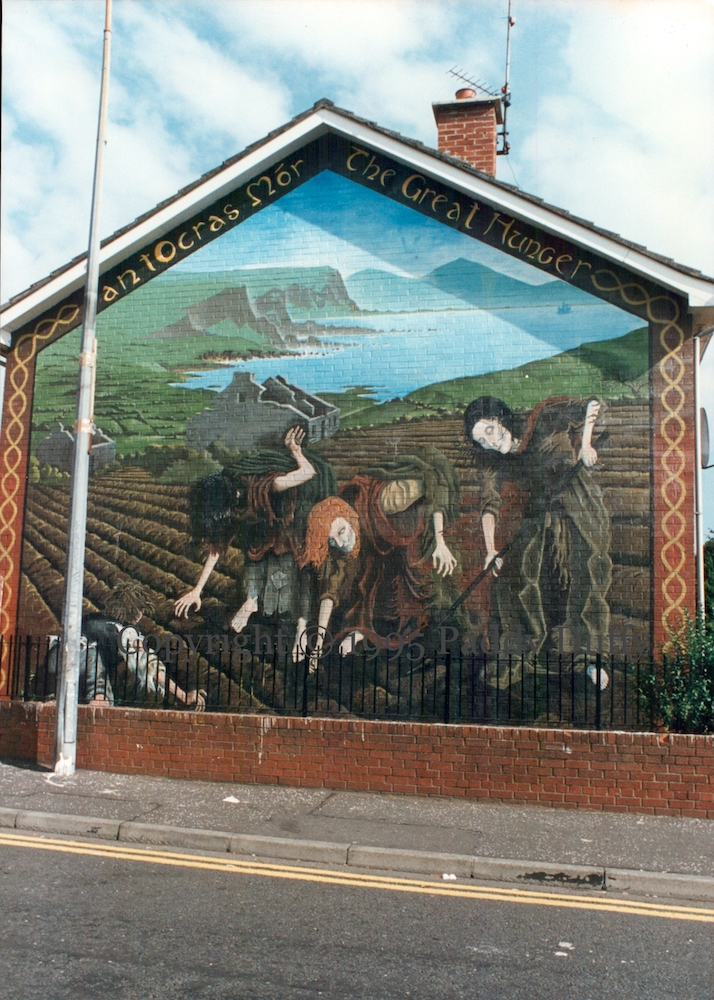
An tOcras Mór

This New Lodge mural shows people on the coast, near abandoned buildings, trying to grow crops during the period of the Great Hunger (1845-1852).

“An tOcras Mór” (a literal translation of “the great hunger/famine”) is usually (in Irish) “An Gorta Mór” or “An Drochshaol”.

The left-most and right-most figures are from Searching For Potatoes In A Stubble Field in the Illustrated London News. ILN images are a staple of Belfast muraling on the Great Hunger: see the Visual History page on the Great Hunger. (Here is a list, with links, of all of the illustrations of Ireland in ILN from the period 1845-1852.)

The two central figures, and the composition of the three women together, come from Millet’s The Gleaners. (Thanks to Jeryn Mayer for this pointer.)

Painted by “Farset Artists” – Jonny McKerr (later the street–artist JMK), Paul McCullough, Eamon Monaghan, and Dee Fitzsimons.

Click image to enlarge
Copyright © 1995 Paddy Duffy
T00181

Emigration

Irish people climb on-board ship in order to escape the Great Hunger. The mural is based on The Embarkation, Waterloo Docks Liverpool in the Illustrated London News. This is one of about nine murals painted in 1995 on the Great Hunger (Visual History).

Oakman Street, west Belfast

Click image to enlarge
Copyright © 1995 Paddy Duffy
T00180

Érıu

“Ardoyne Fleadh Cheoıl – meon an phobaıl a thógáıl tríd an chultúr” = “building community spirit through culture”.

“Eıre [Éire] (Éıru [Érıu]), a queen of the Tuatha Dé Danann, slain at the battle of Taıltean [Taılteann] (Telltown [Teltown], Co. Meath) 1698 BC.” Érıu is placed in a neolithic setting and is releasing a dove which flies off in a trail of stars. (In the repainted version, the date given is 698.)

Brompton Park, Ardoyne, Belfast

Here is the previous Ard Eoın Fleadh Cheoıl mural in this location.

Click image to enlarge
Copyright © 1995 Paddy Duffy (no date given)
T00157 [T00162]