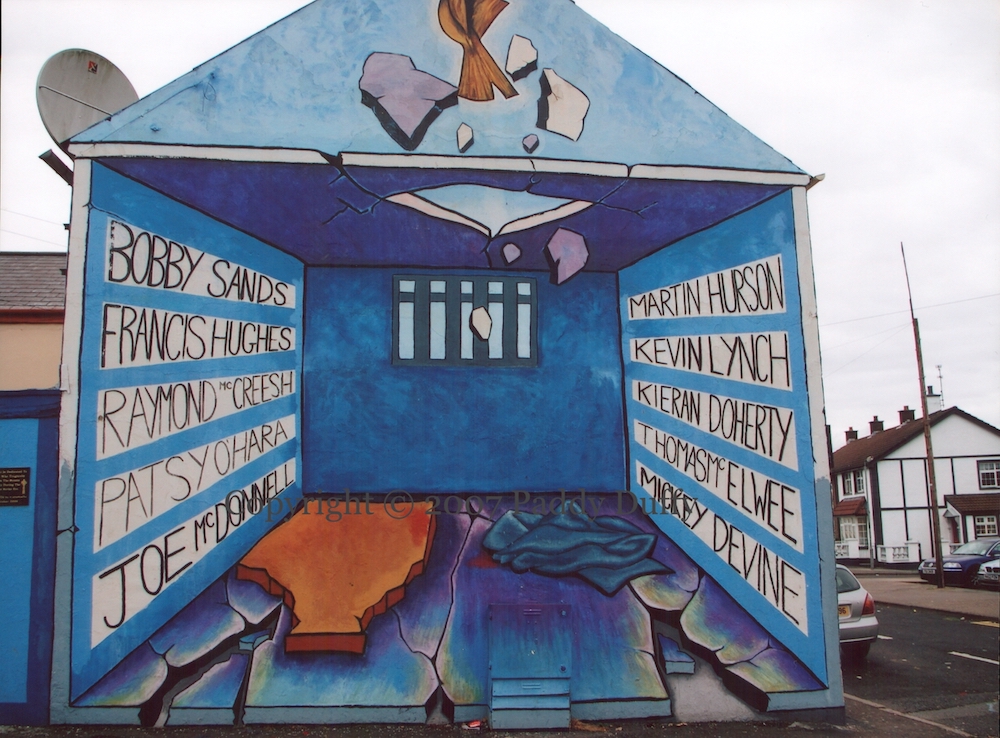
A lark (rather than a dove) bursts through the ceiling of a H-Block cell lined with the names of the ten deceased 1981 hunger strikers. “This mural is dedicated to all those who tragically died on the streets of Derry during the hunger strike era. Suımhneas Dé dá nanamacha. 3rd October 2006.”
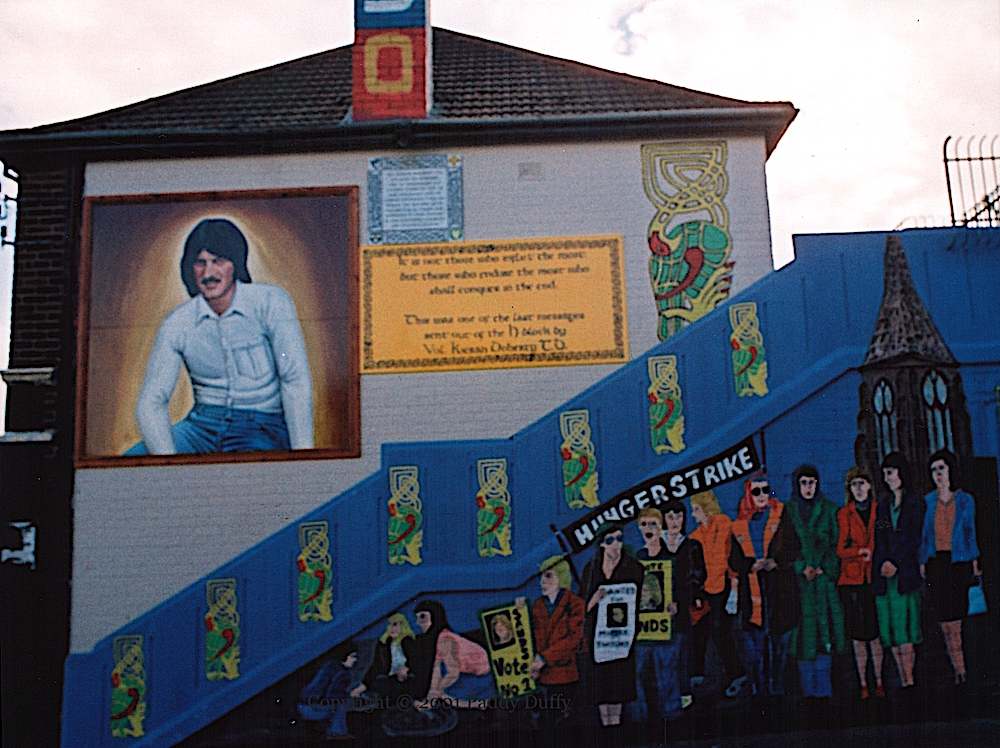
Kieran Doherty was elected TD (Teachta Dála) for Cavan-Monaghan three weeks into his 1981 hunger strike. He held the position for two months, until he died on August 2nd. The portraits, plaques, and mural of marchers are in his home area of Andersonstown. The words “It is not those who inflict the most, but those that can endure who shall conquer in the end” is an echo of Terence MacSwiney, whose hunger strike in 1920 lasted 74 days, one more than Doherty’s.
This board on the back of Free Derry Corner (Visual History) commemorates the thirtieth anniversary of the second hunger strike and the ten strikers who died.
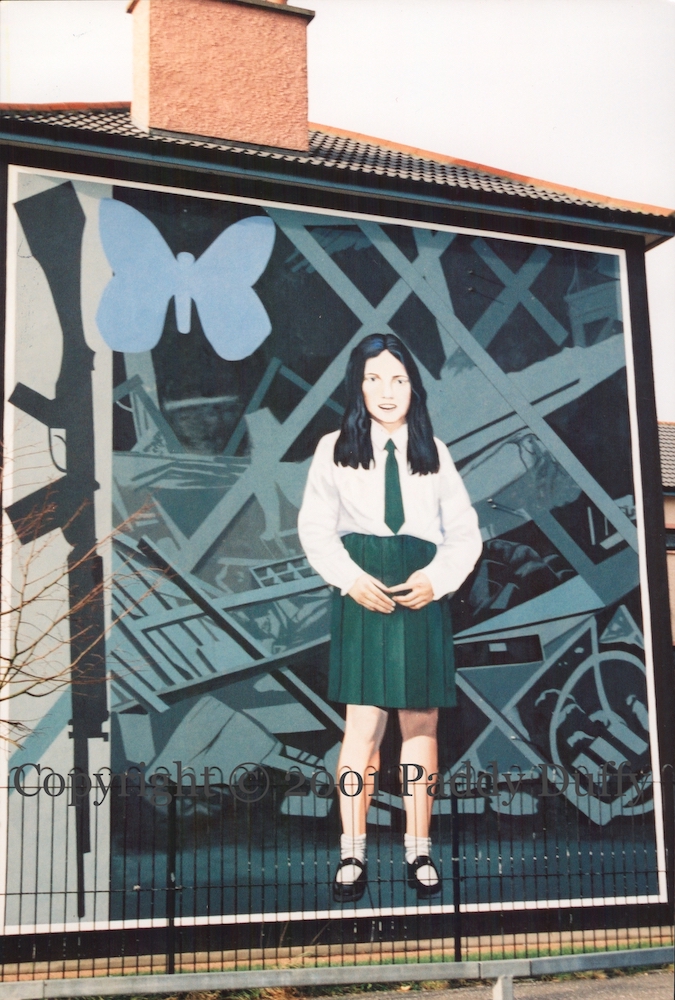
The subject for the fifth mural by The Bogside Artists (Visual History) is Annette McGavigan, the first child to be killed by British forces in the Troubles, in 1971 (WP).
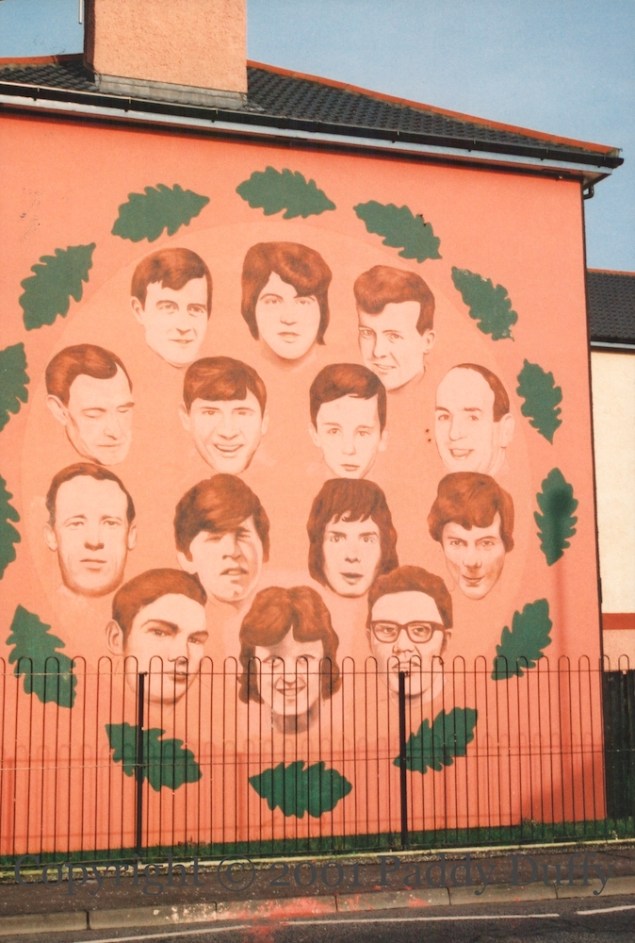
The fourth mural by the Bogside Artists (Visual History) shows the faces of the fourteen people who died on or as a result of Bloody Sunday, January 30th, 1972, shot by the “gun-happy louts” (as described by the Belfast UDA; Vanguard also called for their removal – see the entry for Robert McKinnie in Lost Lives) of the 1st Parachute Regiment; 15 more people were injured.
By row, the victims portrayed are: Michael McDaid, John Young, Paddy Doherty John Johnston (d. June 16th), Hugh Gilmour, Gerry Donaghy, Barney McGuigan Gerry McKinney, William Nash, Kevin McElhinney, Jackie Duddy Jim Wray, Michael Kelly, William McKinney
The portraits are presented within a circle of oak leaves – symbol of Derry – one for each person.
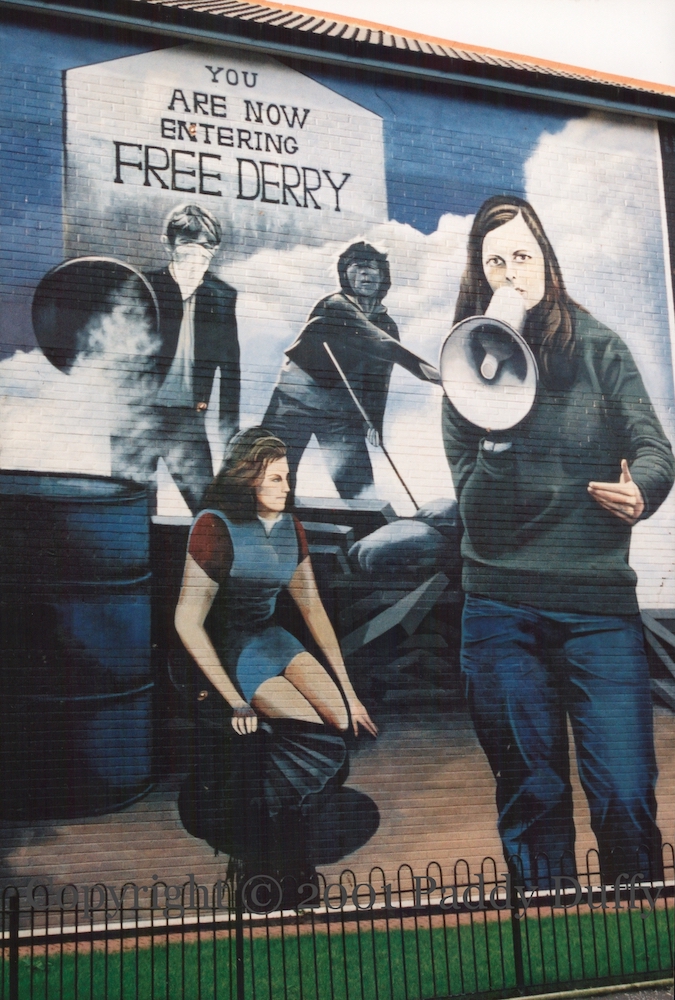
The second mural by the Bogside Artists (after The Petrol Bomber – Visual History) also depicts the battle of the Bogside and features Bernadette Devlin (later McAliskey). Devlin was elected to the British parliament in 1969 at age 21 and was imprisoned in December for her role in the August uprising. The mural reproduces a classic photograph showing Devlin with a megaphone in front of protesters and Free Derry Corner. It replaces another ‘Battle of the Bogside’ mural. The Bogside Artists explain the mural and its history in this short video.
The sixth mural from the Bogside Artists commemorates the 1980 hunger strikes, first in Long Kesh and subsequently in Armagh Women’s Prison. The main figure is Raymond McCartney; the female figure is perhaps Mary Doyle (the other two female strikers were Maıréad Farrell and Maıréad Nugent).
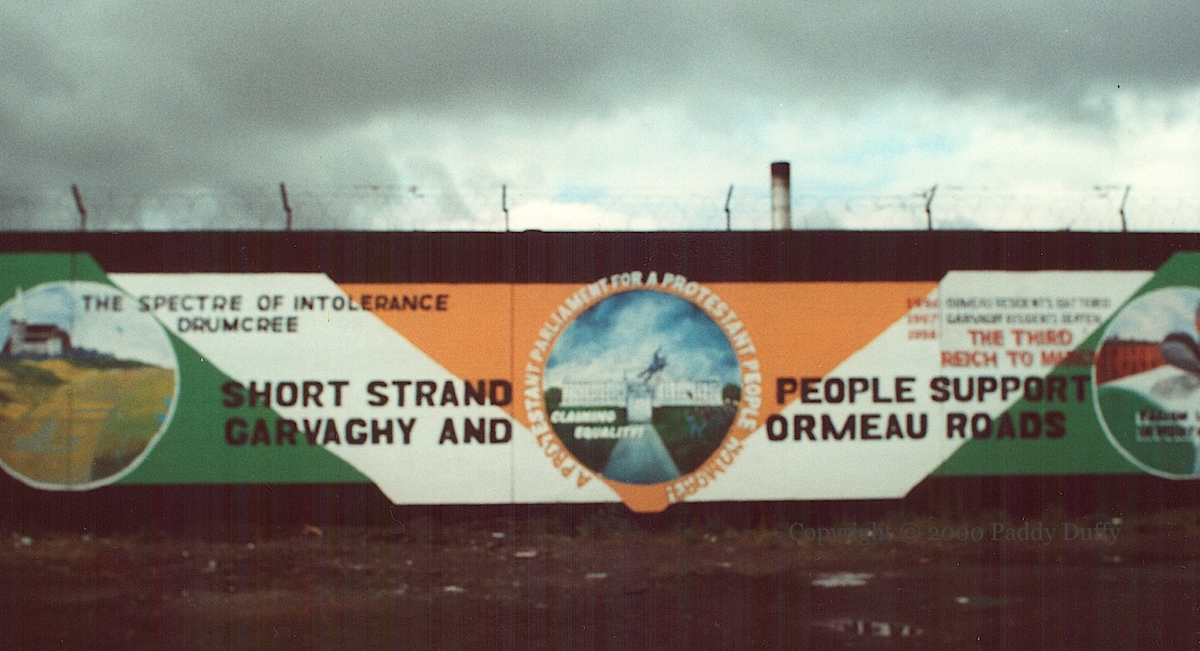
Northern Ireland’s first Prime Minister, James Craig, said in 1934, that Stormont was “carrying on a Protestant Government for a Protestant People” (NI Parliamentary Debates), though the phrase has now been transformed into the doubly alliterative “A Protestant parliament for a Protestant people”. In the centre of a long mural at the waste-ground at the top of Mountpottinger Road, people carrying Irish Tricolours tear down the statue to Northern Ireland’s most prominent leader, Sir Edward Carson, that stands outside Stormont, “claiming equality”.
The main issue that has tested the resolve of governments both local and national to the equality declared in the 1998 Belfast (Good Friday) Agreement is Orange Order parading through nationalist areas, such as the Garvaghy Road below Drumcree church in Portadown, and the Ormeau Road in south Belfast.
“Short Strand people support Garvaghy and Ormeau Roads.” On the left: The spectre of intolerance – Drumcree.” Centre: “A Protestant parliament for a Protestant people no more!” On the right “1996: Ormeau residents battered; 1997: Garvaghy residents beaten; 1998: The third reich to march.” and “Fascism lives! in Portadown”.
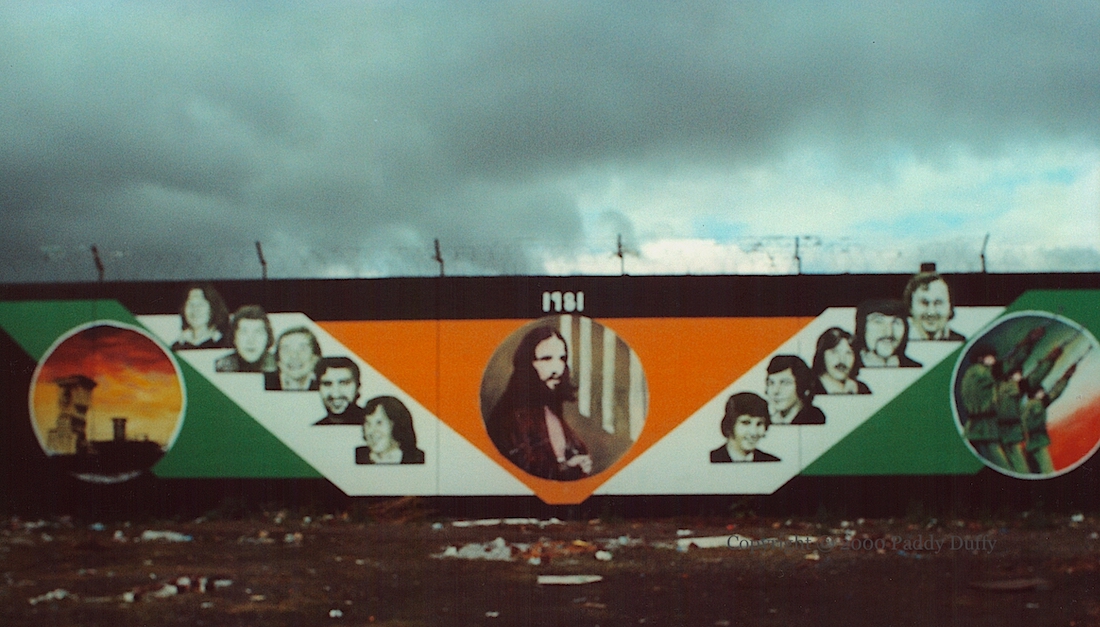
The piece is next to a hunger-strikers commemoration piece with ten portraits on shaped wooden boards against a painted background with blanket-man Hugh Rooney in the center. Between the two is a “spirit of freedom” lark and the names of the ten deceased 1981 strikers.
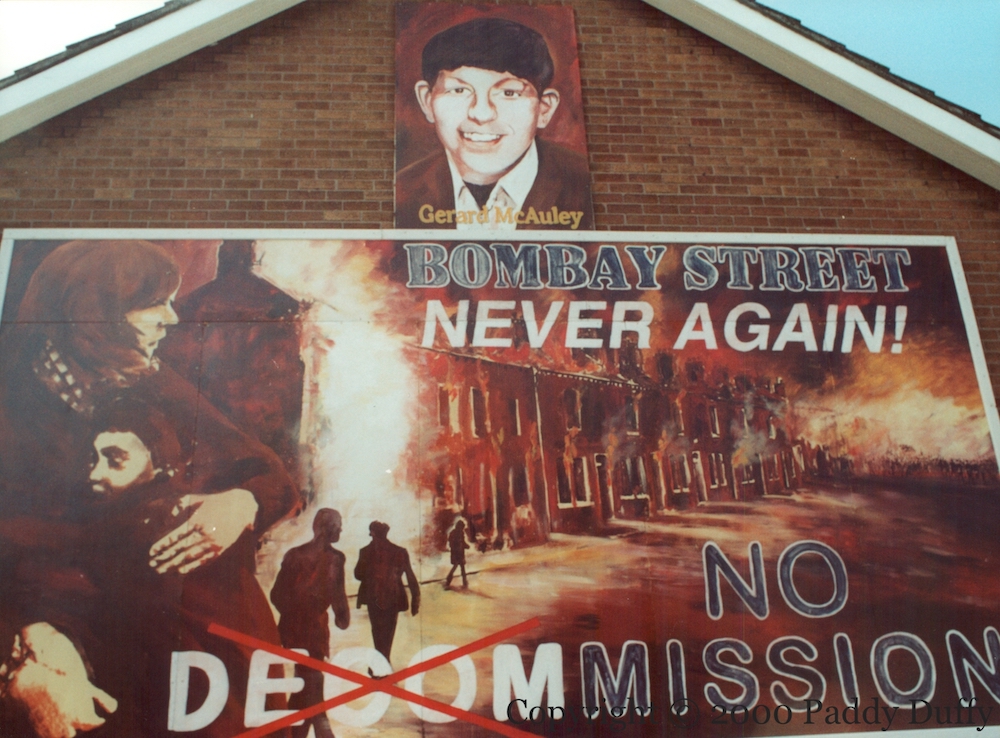
In August, 1969, families, mostly Catholic, were driven out and their homes burned in Bombay Street (and surrounding streets), between the Falls and Shankill (RTÉ news report). The defenselessness of the community then is reflected in the urging for “No decommission” in the present. Fıan Gerard McAuley (aged 15) was shot in nearby Waterville Street.
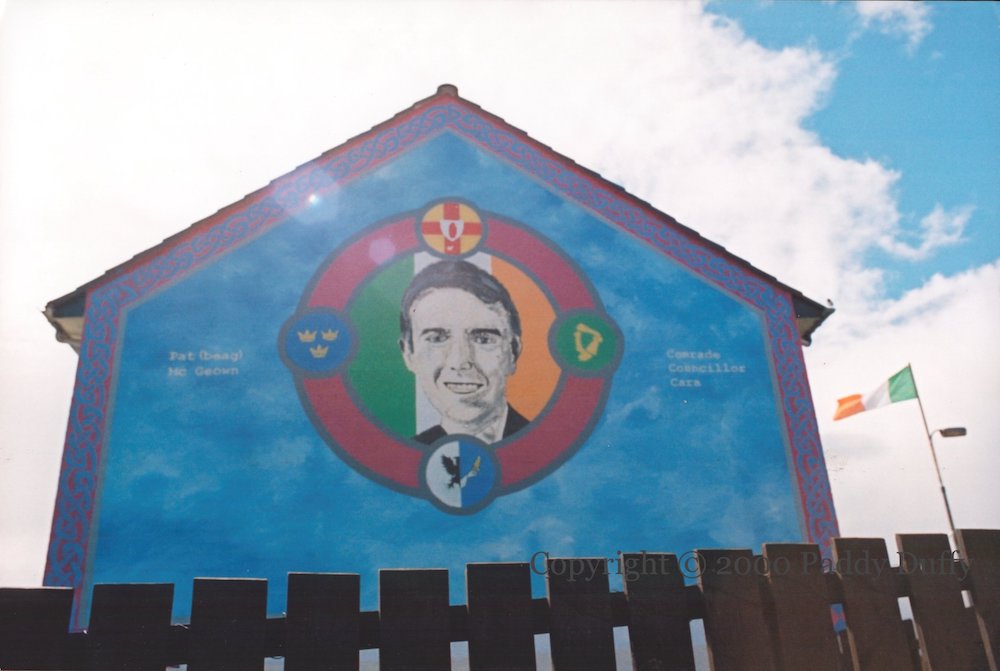
“Comrade, councillor, cara [friend].” Pat McGeown was a 1981 IRA hunger striker whose family intervened when he lapsed into a coma. After his release in 1985 he also worked for Sınn Féın and was elected to Belfast City Council in 1993. He died in 1996 of a heart attack. He is also remembered by a plaque on the Sınn Féın office on Falls Road.




 Paddy Duffy Collection