Here is a gallery of the street art in the Project24 space along Queen’s Parade (which continues on from the art on the main road – see Remember To Daydream), updating the gallery in How About This For Art? The buzzard, toad, and turtle are all by Keyto (ig) and the partial face is by Kate Whiteman (web); the artist of the final piece is perhaps COZ (ig).
Here is a gallery of street art from a repainting at the end of June of the boarded up shop-fronts along Queen’s Parade, Bangor. The images from top to bottom in this post follow the art east from the Project24 space towards Main Street:
Side-Eye Birds by Strangford (ig) Sup Moon And Sun Save The Tiger Shark by Keyto (ig) Squid by Fox & Bear Swan by Kate Whiteman (ig) Hold Me In This Wild Wild World by Sweat, Tears, And The Sea (ig) Remember To Daydream by Lost Lines (ig) Stars by Cha Cha (ig) (organiser of the jam and tour guide for the Bangor Street Art tour) Koi Pond by Anie Poole (ig) Flowers by Alexandra (ig)
“Our wee champ.” 21-year-old boxer Liam McGuinness, of Gleann ABC (Fb), died by suicide in October 2010, one of the many people to take their own lives in west Belfast that year among the 313 in all of Northern Ireland (Irish Examiner | Guardian | NI Assembly). A vigil was held in September (in Twinbrook) to commemorate the suicides there (BBC); another was held in the days after McGuinness’s death (BBC); a forum on the topic was held by Sınn Féın. The mural in his memory and in support of suicide awareness is outside the club, off the Glen Road in Hannahstown.
The source of James Connolly’s quote involving the phrase “from the plough to the stars” is unknown, on-line, at least. As a result, there is no definitive version of it. Here it is given as “The Irish people will only be free when they own everything from the plough to the stars” but more reliable sources – though still without citation – give it as “A free Ireland will control its own destiny from the plough to the stars” (RTÉ | People’s World). Whatever its exact nature, the remark might have been in the context of explaining the use of the plough in the stars, the Starry Plough, Ursa Major, for the flag of the Irish Citizen Army (History Ireland).
The Starry Plough currently serves as a symbol of the IRSP (web). The painting shown above is on an electrical box in St James’s Park (near the new Connolly centre); the other painting, below, which might still be in progress, is outside the IRSP’s Costello House on the Falls Road
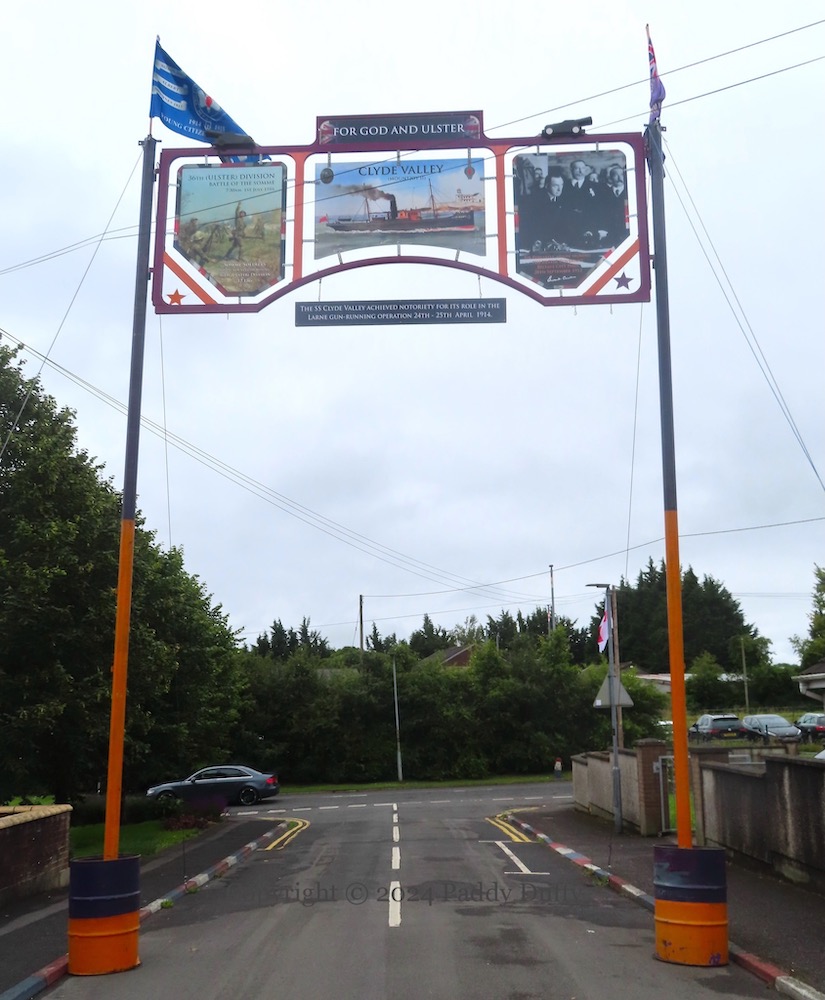
The Millbrook arch has three panels: “36th (Ulster) Division, Battle Of The Somme, 7:30 am 1st July 1916”; the Clyde Valley (Mountjoy II) “The SS Clyde Valley achieved notoriety for its role in the Larne gun-running operation 24th-25th April 1914”; “Sir Edward Carson signing the Ulster Covenant, Belfast City Hall 28th September 1912”.
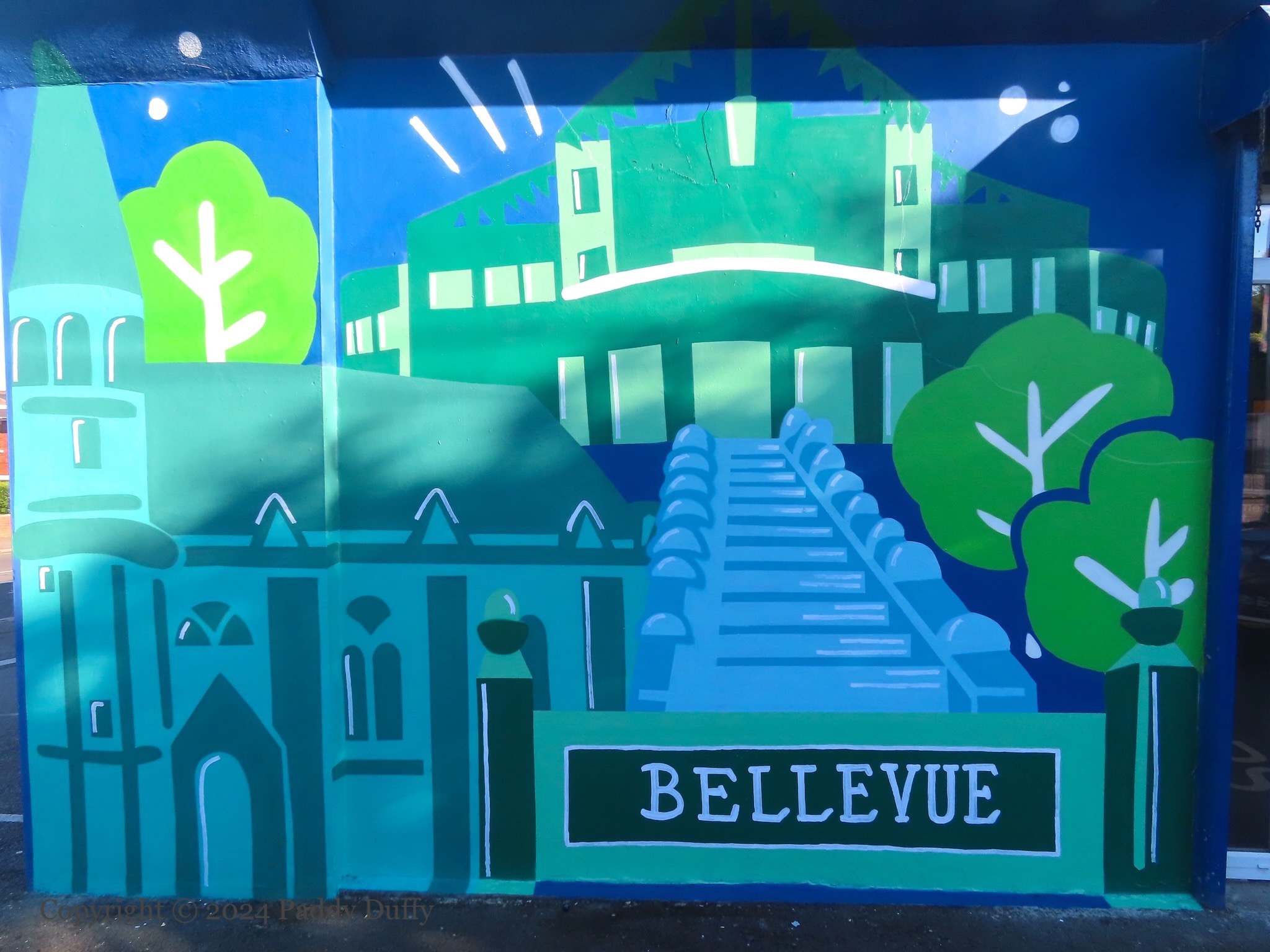
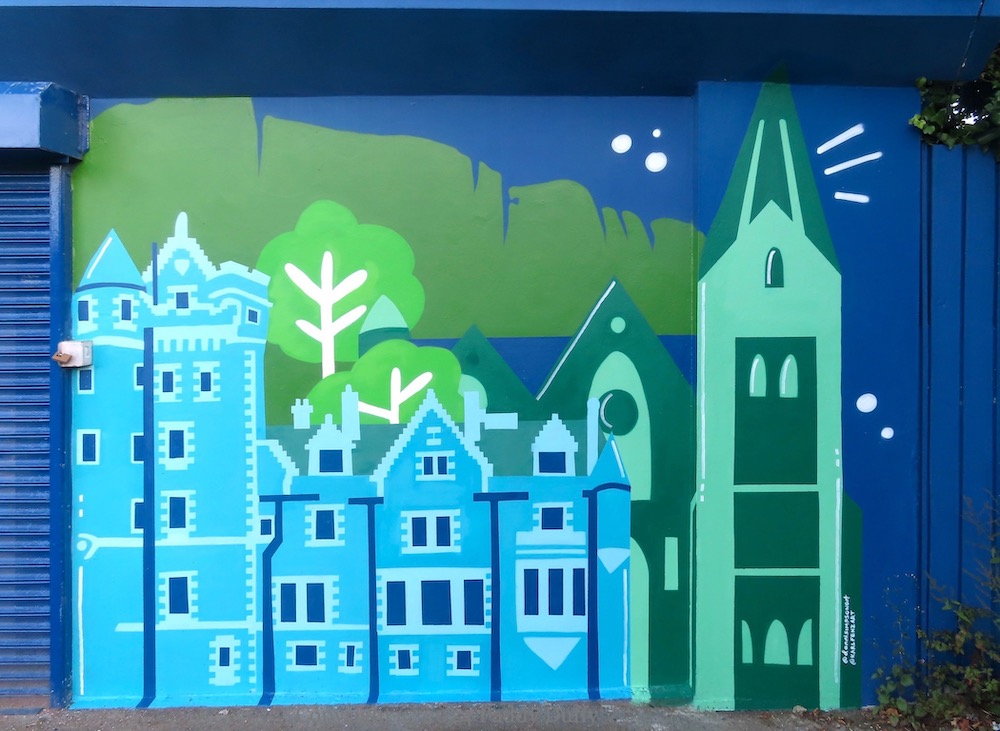
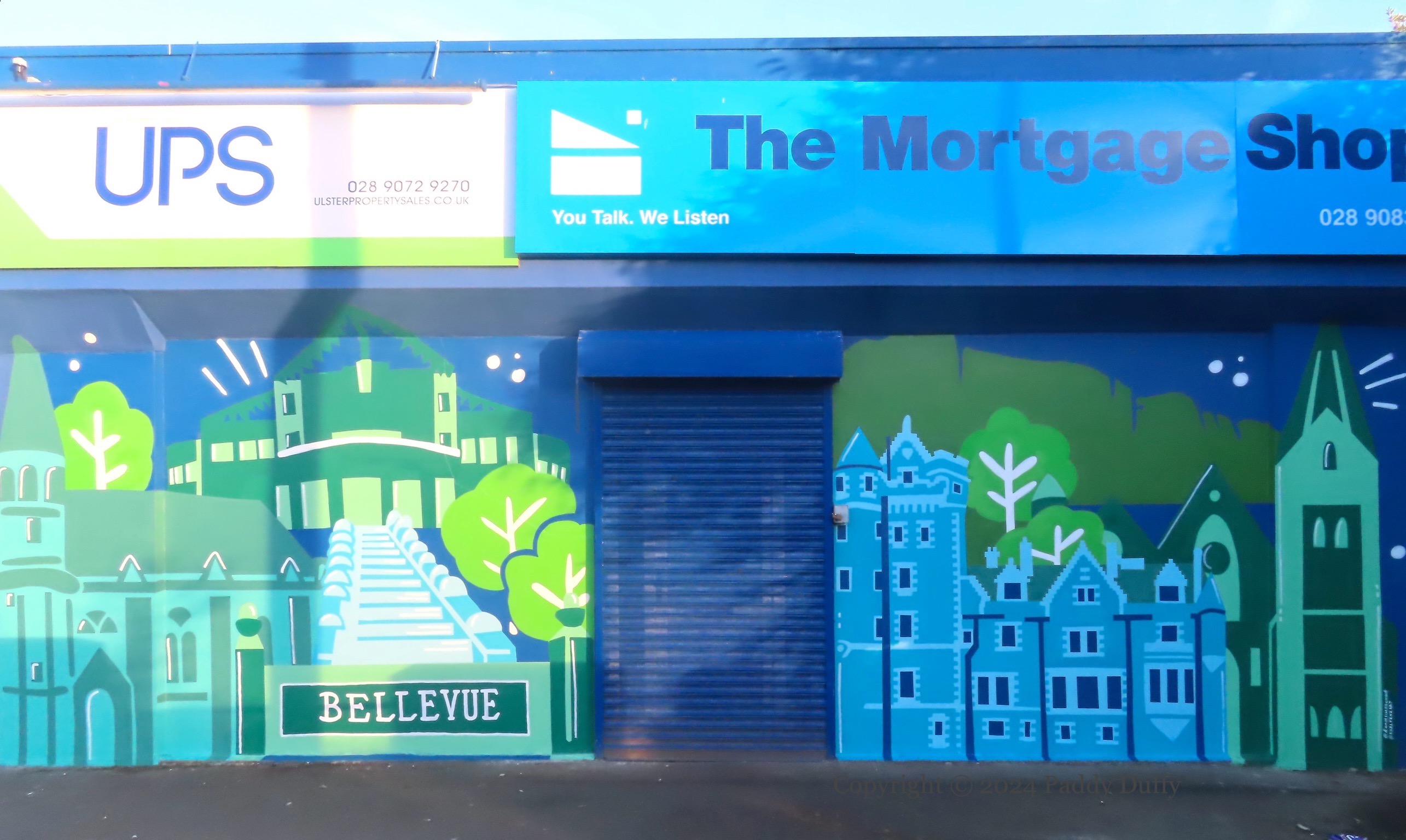
Here are four north Belfast landmarks that are still standing in the shadow of Cavehill, though not all of them are in great shape. From left to right:
Chapel Of The Resurrection (as seen from Innisfayle Park – Street View), originally built in the 1860s as part of the Belfast Castle estate and from 1938 until 1972 a (public) Church Of Ireland chapel (WP), after which it was left derelict until recently being turned into luxury apartments (Property News) as part of “Donegall Park Gardens”;
the Bellevue steps (official title, the “Grand Floral Staircase”) – the currently overgrown steps and a vintage photograph of the steps in happier times can be seen in Everyone Wants To Eat – leading to Floral Hall, which now provides storage space for the zoo – full history at ‘Lord Belmont’ | BelTel;
Belfast Castle;
(perhaps) the former Fortwilliam Park Presbyterian on the Antrim Road (News Letter | BelTel) – once Belfast’s tallest spire (BelTel) – which in 2019 became Immaculate Heart Of Mary/Eaglaıs An Ċroí Ṁuıre Gan Smál (web) saying only the (Catholic) Latin mass.
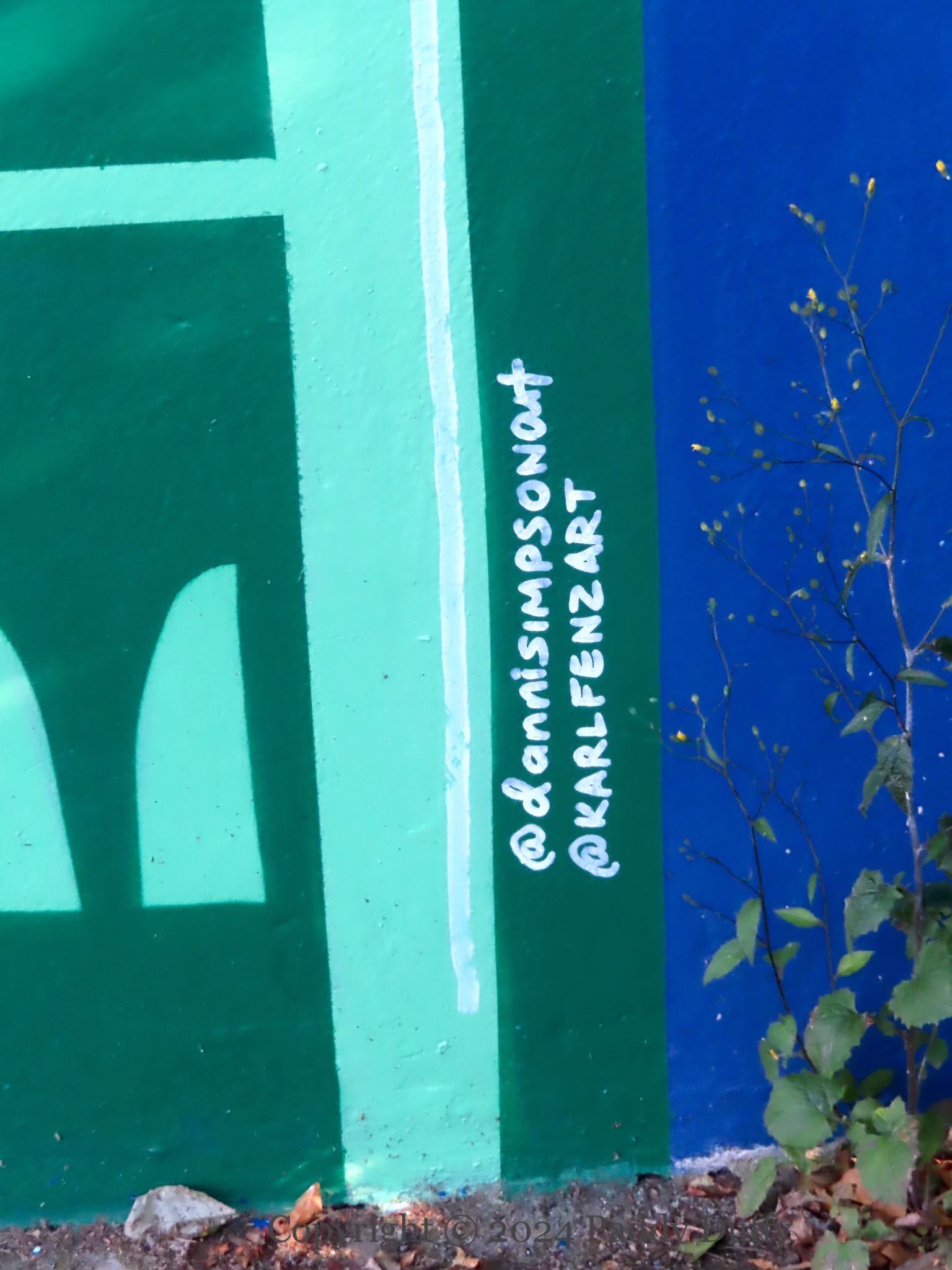
The art is on the walls of UPS estate agents’ at the top of Cavehill Road, north Belfast, by Danni Simpson (web) and Karl Fenz (web), who also did the swan, the fox, and the squirrel on other local establishments.
In May and June, Palestinian artist Taqi Spateen (web | ig) toured various cities in England and Scotland (Leeds, Glasgow, Bristol, Stroud, London) as part of the Bethlehem Cultural Festival, producing a wall-painting at each stop. Thereafter, he came to Belfast, where he painted three pieces, beginning with this small piece on the side of the Sunflower bar in Kent Street, showing a person with a head encased in concrete trying to hammer themselves free.
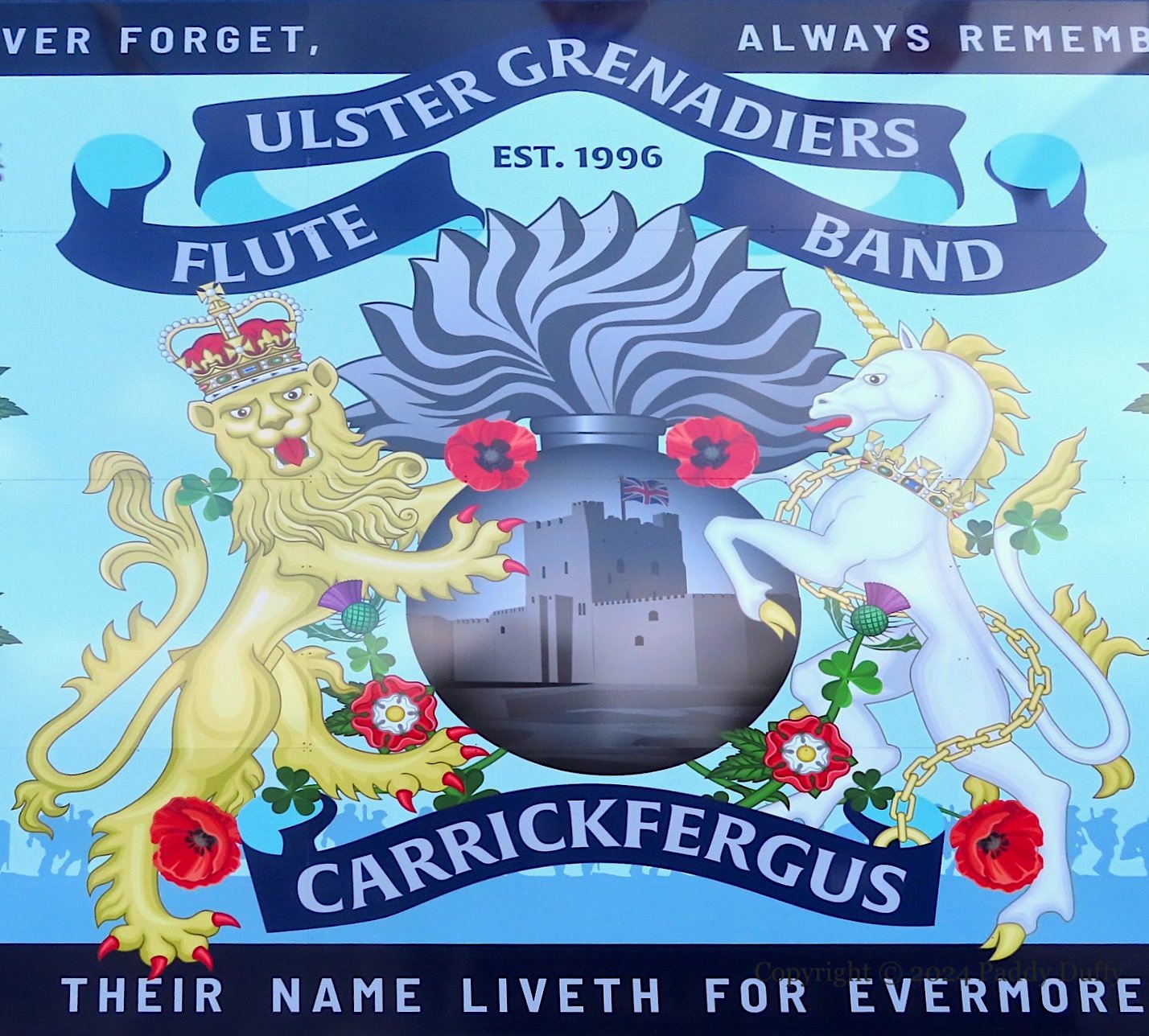
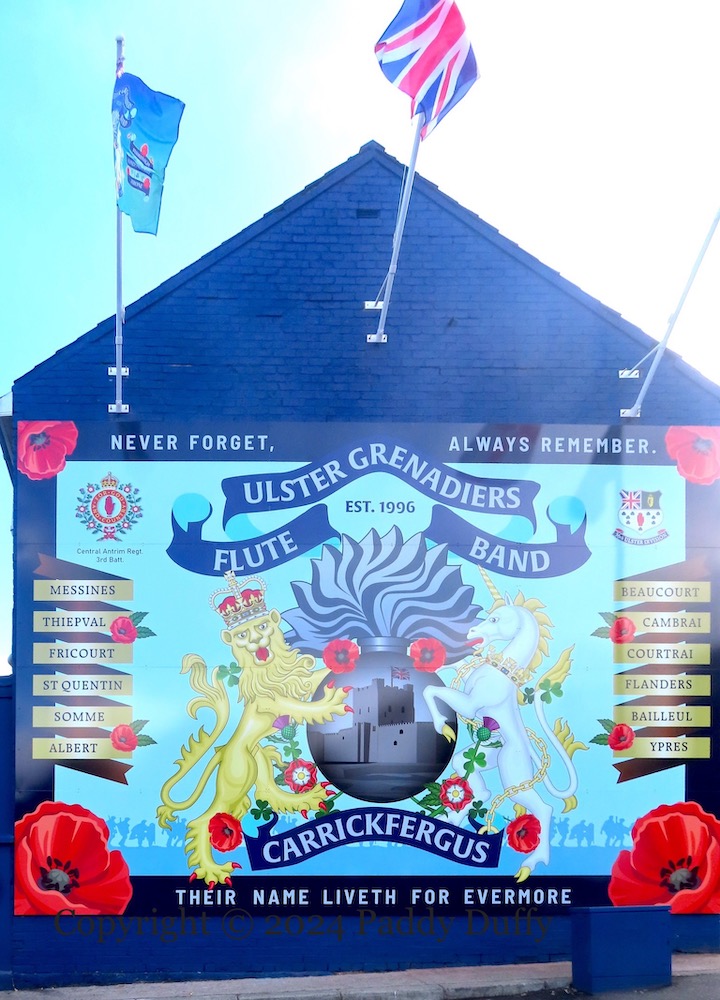
The grenade at the heart of the ‘Grenadier’ emblem is an old spherical grenade, with a spout of fire; the classic “pin-and-pineapple” design dates to 1915 (WP Mills Bomb). Various regiments then put a symbol on the surface of the grenade (see e.g. East Belfast Volunteers); here, the Ulster Grenadiers flute band (Fb) have added Carrickfergus castle flying a Union Flag to the grenade at the centre of a new board erected on June 7th, 2024 (youtube video of the launch).
The battles listed on either side of the central emblem are battles in which the 36th Division took part, though by that time, grenadiers were not a specialised unit and each infantry platoon (of about 60 men – Schilling) would have both hand-grenade and rifle-grenade sections (Reddit) equipped with 100+ grenades (The World War).
“Welcome to Carrickfergus, a host town of “The Twelfth” 2024. It’s coming back to our home town. Join us on “The Twelfth” to help celebrate the 334th anniversary of The Battle of the Boyne.”
Carrickfergus was one of nineteen host towns for Twelfth “demonstrations” this year (GOLI); the parade went from the top of Sunnylands, through the town, and out to the grounds of the rugby club (GOLI). “It’s coming back” is perhaps in reference to the fact that Carrickfergus is the town where William III landed in 1690 before making his way to Belfast, Lisburn, and the Boyne – see June 14th, 1690.
The image above is of William III landing at Brixham in Devon, England, but the central panel (immediately below) and the fake “blue plaque” celebrate the 1690 landing of William at Carrickfergus. The postcard reproduced in the central panel, as well as an old Londonderry mural which also reproduced it, can be seen in the Peter Moloney collection. For details of the landing, and William’s subsequent travels to Whitehouse, Belfast, Lisburn, and the Boyne, see June 14th, 1690.