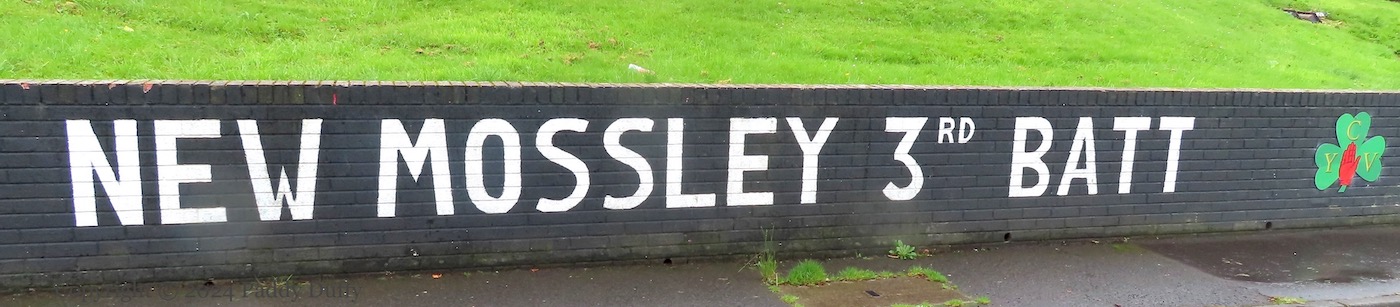
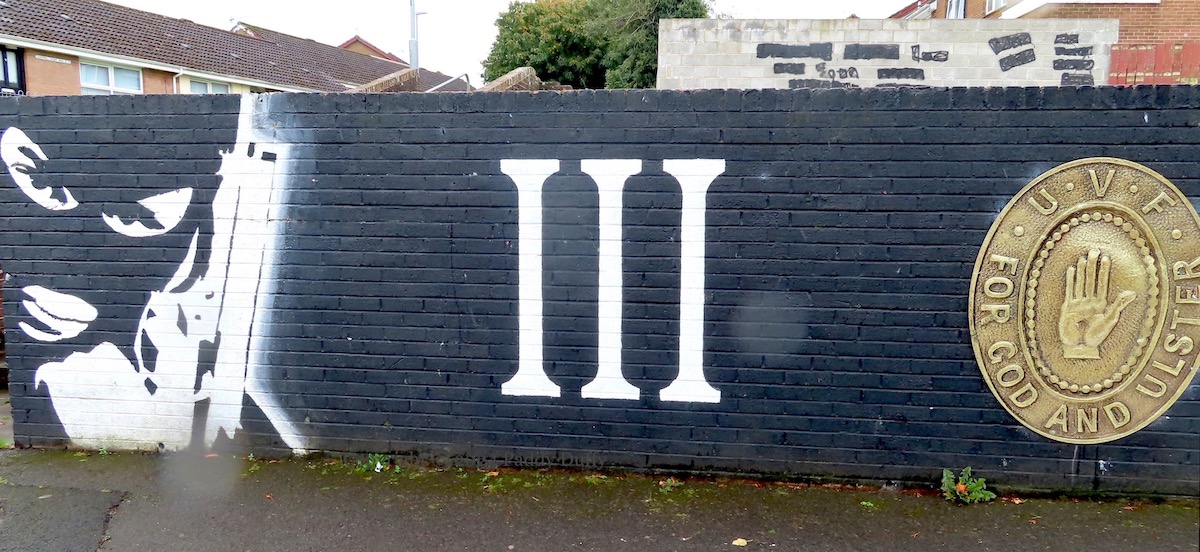
The hooded gunman at the New Mossley playground – seen previously in Welcome To New Mossley Play Area – has been upgraded with a golden UVF emblem (shown last, below), and has been joined by two new pieces: the printed board above and the low wall below. The 3rd battalion also includes Rathcoole, Mount Vernon, and Tiger’s Bay.
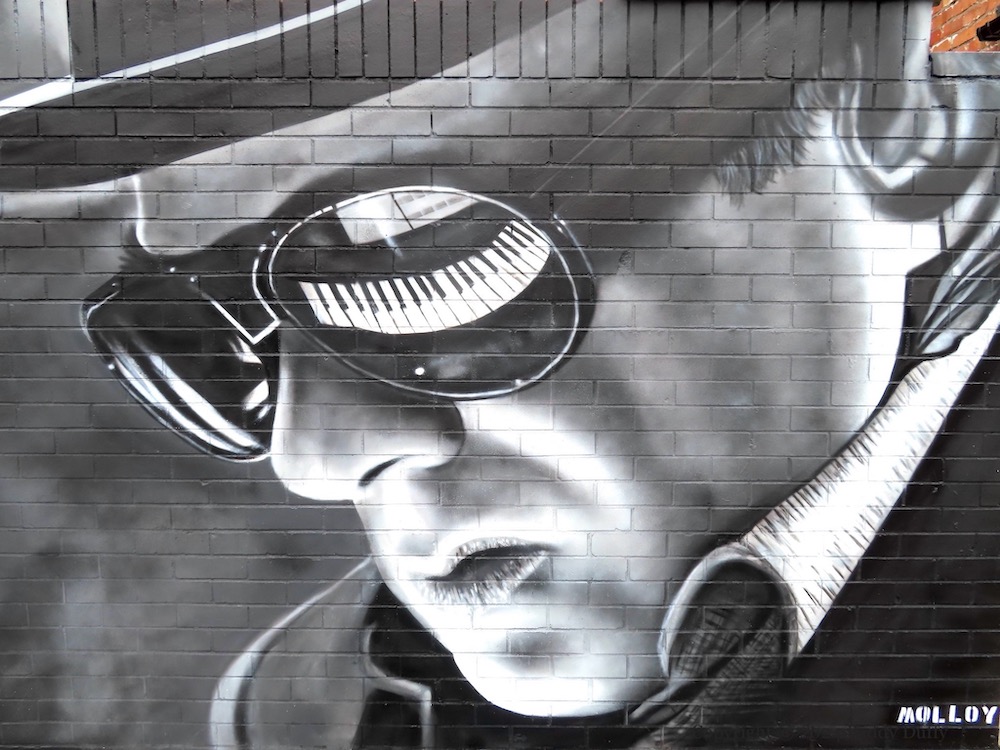
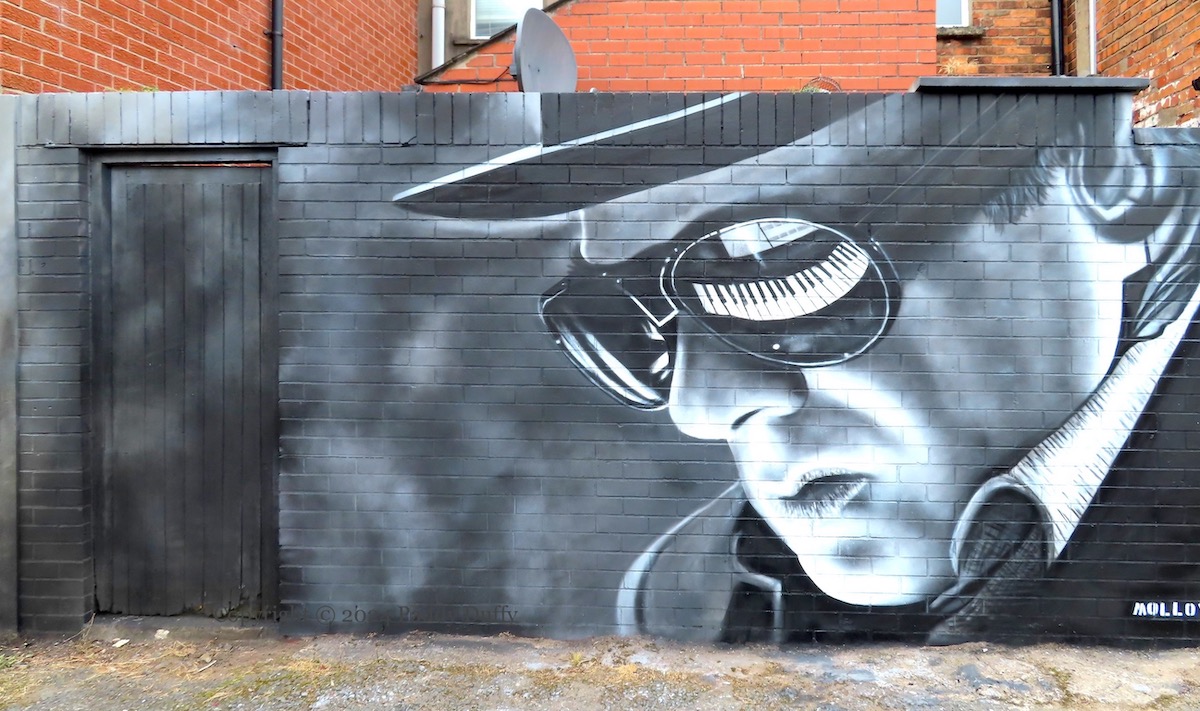
Van Morrison was born in 1945 at 125 Hyndford Street in east Belfast and recalled the sights and sounds of his early life there in the spoken-word track ‘On Hyndford Street’ from the 1991 album Hymns To The Silence (youtube). (The song also concluded his 70th birthday concert in Cyprus Avenue – youtube).
This painted tribute is by Glen Molloy (Fb) in the alley between Abetta Parade and Hyndford Street, roughly behind 135 Hyndford Street (and close to The Hollow – see Days When The Rains Came).
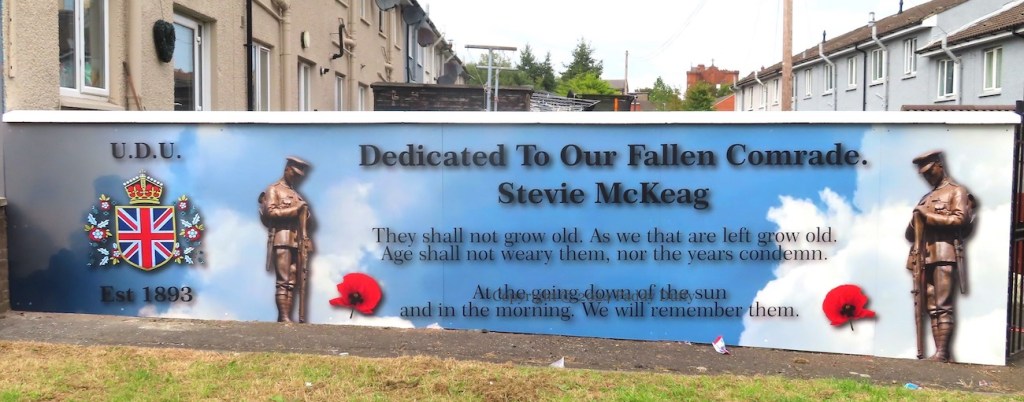
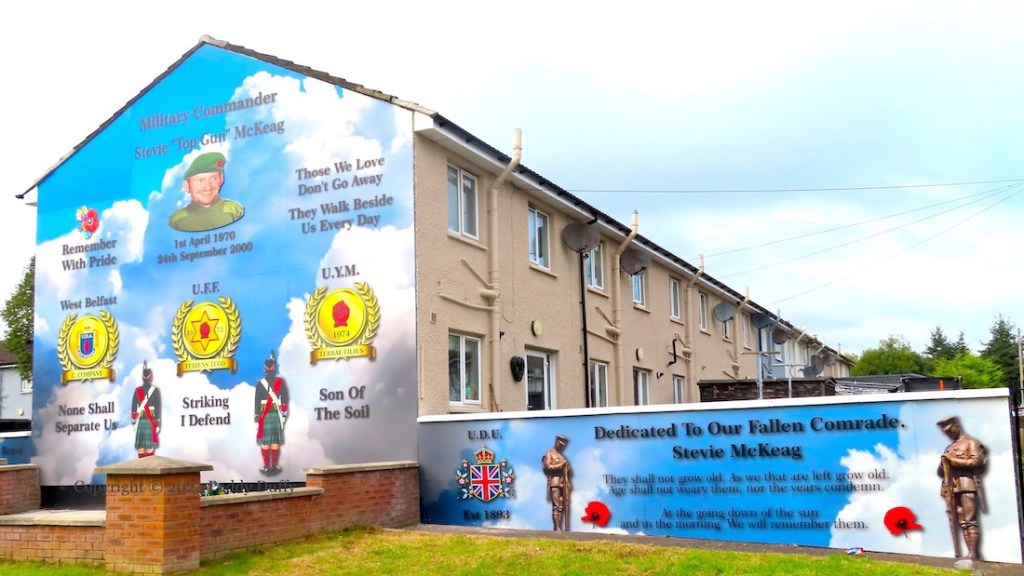
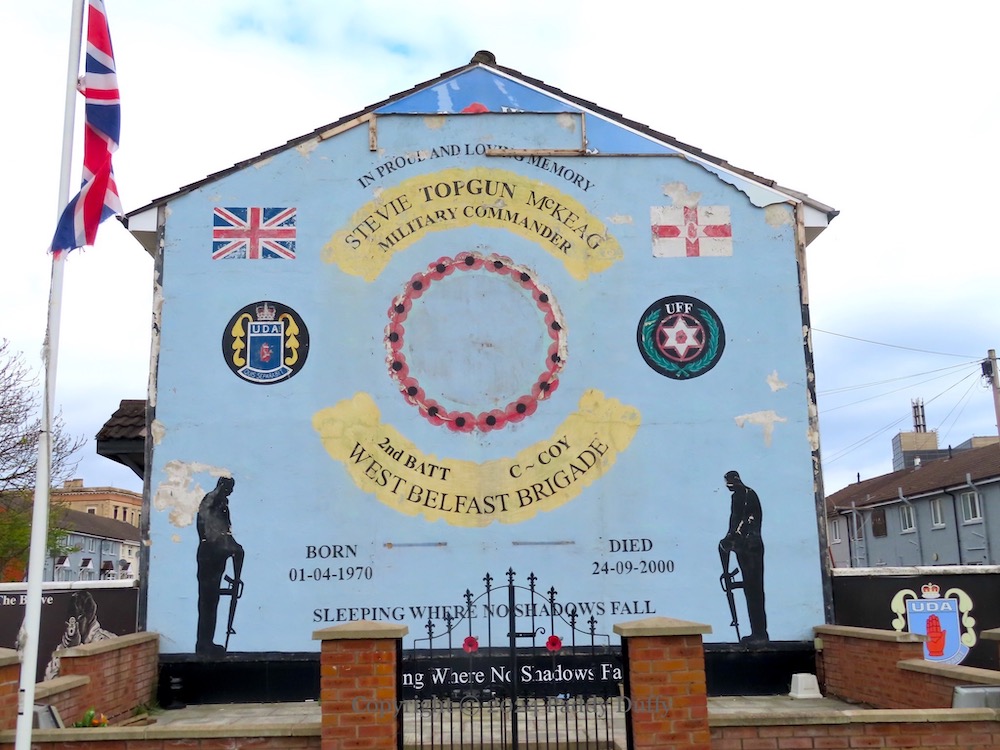
After a long spring and summer of inaction, a new tribute to UDA assassin Stevie “Top Gun” McKeag has been put in place in the lower Shankill, replacing the flat-capped version of 2016.
In Tolstoy’s War And Peace, the prince Andrei Bolkonsky at one early point remarks, “It is not given to people judge what’s right or wrong. People have eternally been mistaken and will be mistaken, and in nothing more so than in what they consider right and wrong.” But after he is wounded at the Battle Of Austerlitz in 1805 and again in 1812 at the Battle Of Borodino, he loses his admiration for the blood-thirsty Napoleon and for war in general, and comes to think that events are a function of many individual decisions.
Stevie McKeag, hit-man for the UDA’s second battalion (west Belfast) ‘C company’, killed at least a dozen Catholics between 1990 and 1998 (WP). The version presented on the left-hand side-wall (just below) begins, “It is not given to people to judge what’s right or wrong. People have internally been mistaken and will be mistaken …” which seems to be contradictory, and then continues “… and in nothing more than in what they consider right and wrong” which is difficult to parse so as to give the intended meaning.
The mirrored hooded gunmen on either side of the quote come from an old mural in the estate – see UDU-UFF-UDA.
The smiling McKeag is here shown in the main panel wearing a green beret (as is the anonymous volunteer in the side-wall) and commando jumper (with shoulder patches) as though he were a “military commander” in the Commandos or Royal Marines of the British Army. The UDU, the poppies, and the graveside mourners in the right-hand side-wall are used to put McKeag’s actions in the context of resistance to Home Rule and the British Army’s role in the Great War.
For the composition of the main panel, as well as its use of boards on top of the background, compare with the UDA piece in the Woodvale. The translation into English of the UDA’s, UFF’s, and UYM’s Latin mottos – [Quis separabit] / None shall separate us | Feriens tego / Striking I defend | Terrae Filius / Son Of The Soil – is unusual, as is the bouquet of flowers behind the poppy.
For more, including the mourning soldiers, see the entry at Extramural Activity.
“Land of the free because of the brave”. “Remember with pride”. “Those we love don’t go away/They walk beside us every day”. “Dedicated to our fallen comrade”.
April 25th, 2024: The boards were taken off, revealing an older version that stood 2010-2015.
[In the middle circle there were, over the years, a series of printed portraits of McKeag (and one painted version). For the version from 2014, see M11119; see also the image 2011, which links back to other versions from 2010, 2009, 2008, and 2007).]
May 3rd, 2024: Scaffolding in front of the wall
This layer of paint (and plaster?) was also taken off, to reveal the remains of the original King Rat mural on the wall – see X15041 in the Seosamh Mac Coille collection.
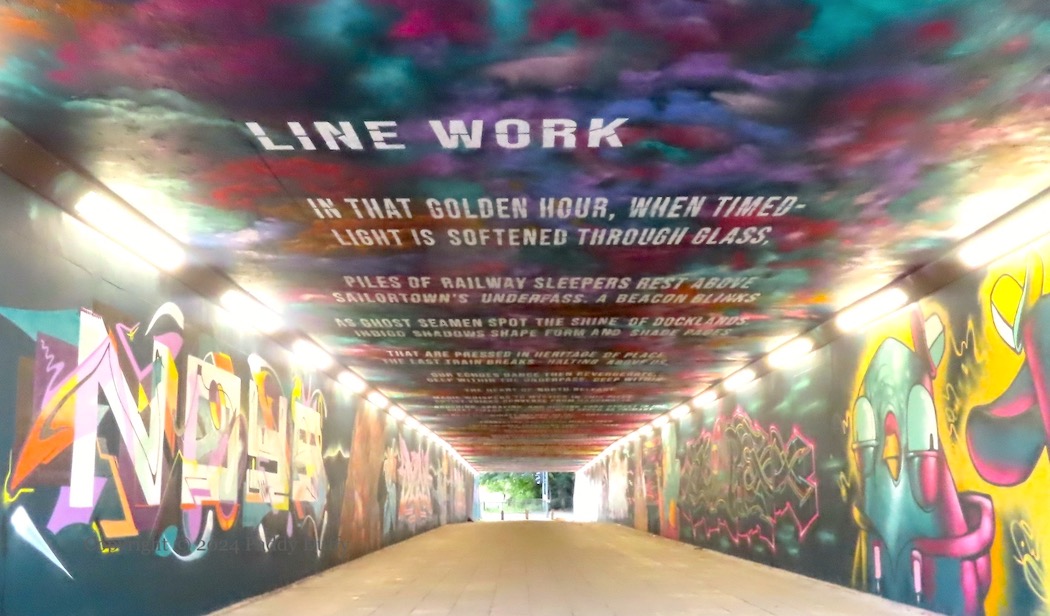
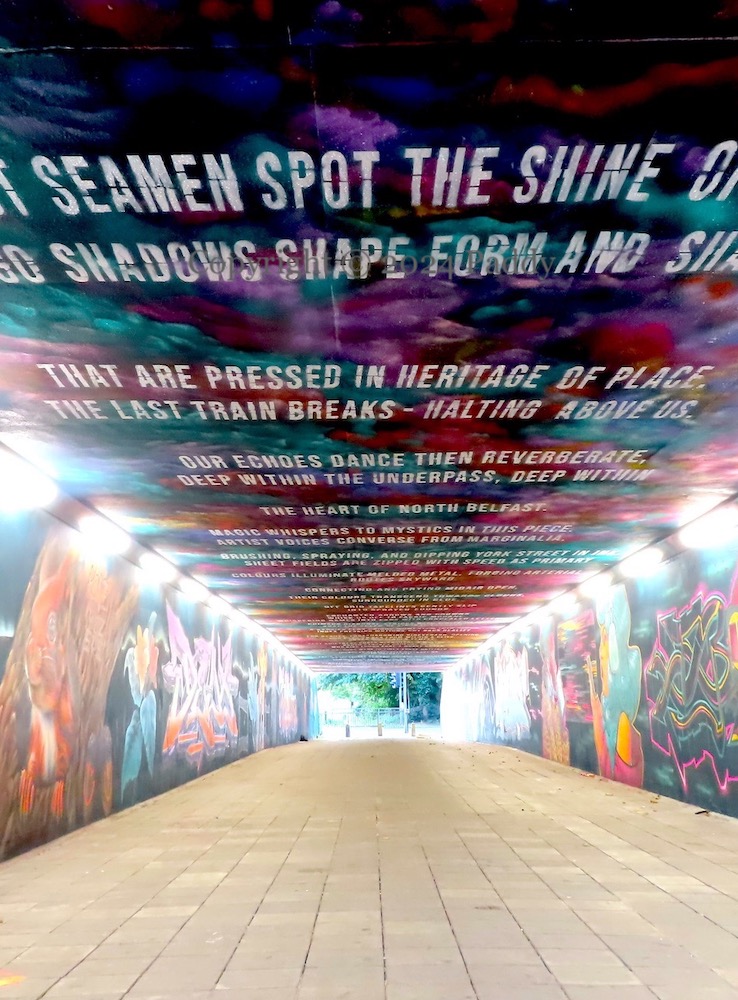
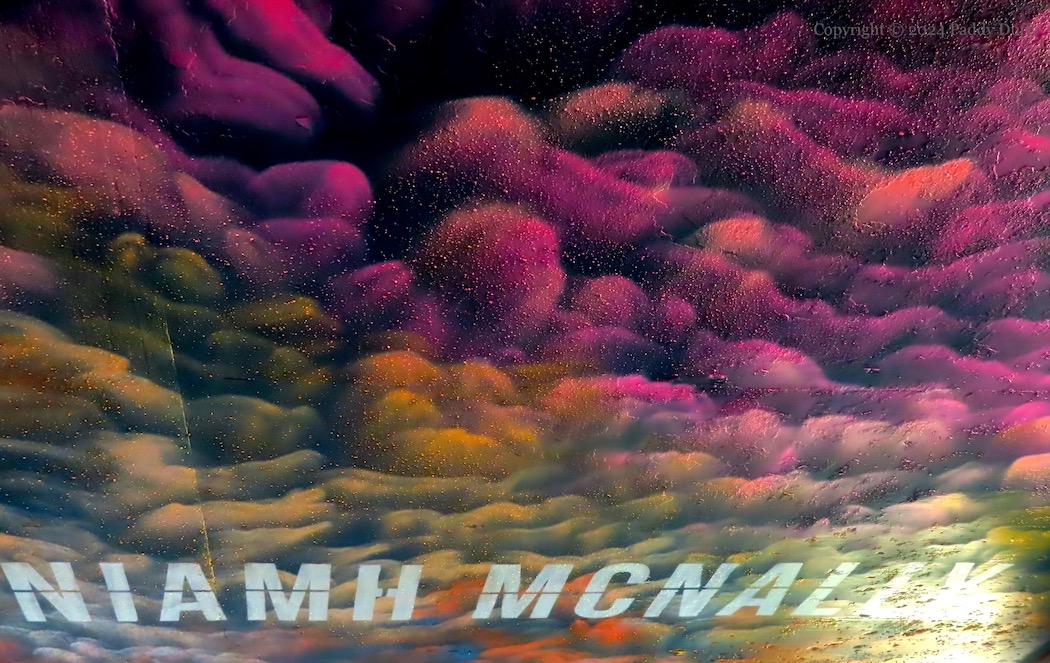
As part of Tunnel Vision paint-jam that added street art along the sides of the underpass at York Street station, a poem by Niamh McNally (ig) – Line Work – was added to the ceiling.
Benjamin West painted The Battle Of The Boyne in 1778 and his composition – with William moving from left to right on a white horse and Marshal Schomberg dying in the bottom-right corner – has become the standard representation in loyalist culture, perhaps due to versions of it appearing on the covers of songbooks for the Orange Order and the Apprentice Boys soon after (Belinda Loftus 1982 Images In Conflict). It appears here on the wall of Whitehead Orange Hall, along with a board connecting service by Irish soldiers in British forces in WWI and Afghanistan (see previously: The Sacrifice Remains the Same in east Belfast).
These images show the scene at Dunraven Court, a Choice (web | Fb) social housing community in east Belfast.
The main piece (above) shows photographs purporting to be of the 36th (Ulster) Division during WWI, above the title “Dulce et decorum est pro patria mori”/”It is Sweet and Honourable to die for one’s country” (which WWI poet Wilfred Owen called “the old lie“) and two epigrams: (left) “And you unborn then, remember that their luck, skill, and nerve where pushed to the limits and they were young like you” and (right) “They layed down the glory of their youth upon the altar of freedom”.
The first is a paraphrase of Cecil Day-Lewis’s poem in homage to the airmen of WWII’s Battle Of Britain, which ends: “And you, unborn then, what will you make of it—/This shadow-play of battles long ago?/Be sure of this: they pushed to the uttermost limit/Their luck, skill, nerve. And they were young like you.”
The second does not appear to be a quotation; it is perhaps inspired by Lincoln’s Letter To Mrs Bixby (WP), perhaps via the film Saving Private Ryan (youtube).
On the wall below the large piece are plaques to Cordner, Long, Bennett, and Seymour from the Troubles-era UVF – see Standing Guard – and to their right ‘Poppy Trail’ plaques of local WWI casualties Joseph Agnew, William Lowry, John Dornan, John Ritchie, William Reid, James Rea, and Robert Atkinson.
A little way into the complex we find a small memorial garden to two UVF volunteers, deceased post-Agreement: Lee Wilson and David Stewart.
Compared to the image (from 2021) seen in The Sacrifice Remains The Same, a blue background and a new wall of Poppy Trail plaques (for the Poppy Trail see this 2017 entry on the board) have been added to the Cosy Somme Association’s tribute to British Army soldiers from the 36th (Ulster) Division in WWI and the modern-day Royal Irish Regiment. (See also the image in Alain Miossec’s collection from earlier this year.)
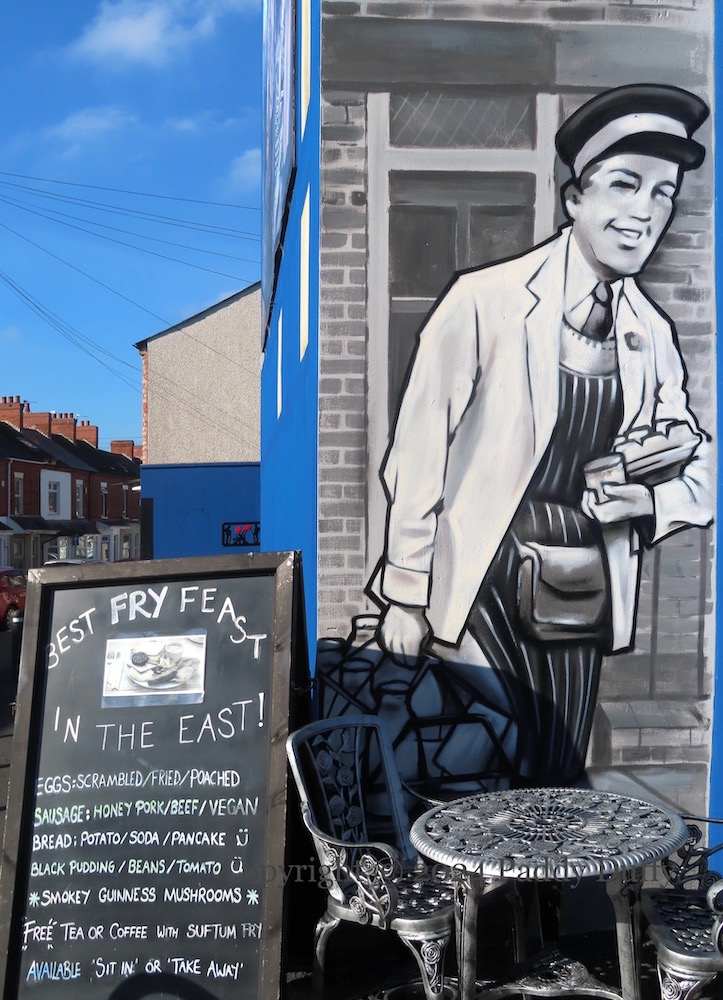
Ogilvie Street, east Belfast, with a bonus image below of the milkman just around the corner, next to Piccola Parma.
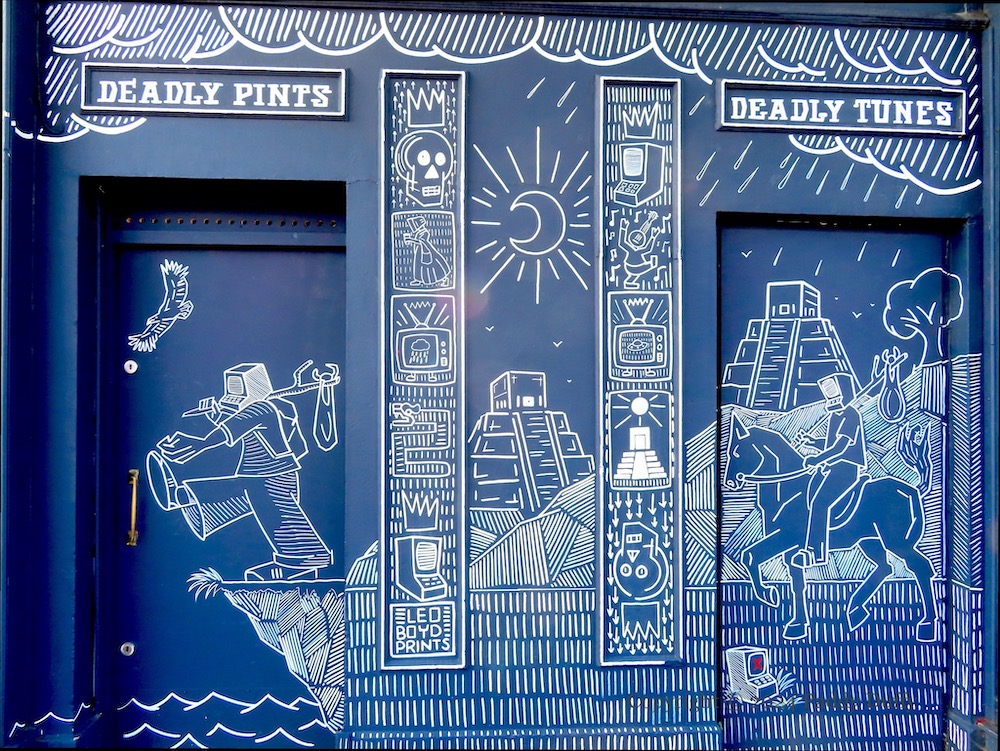
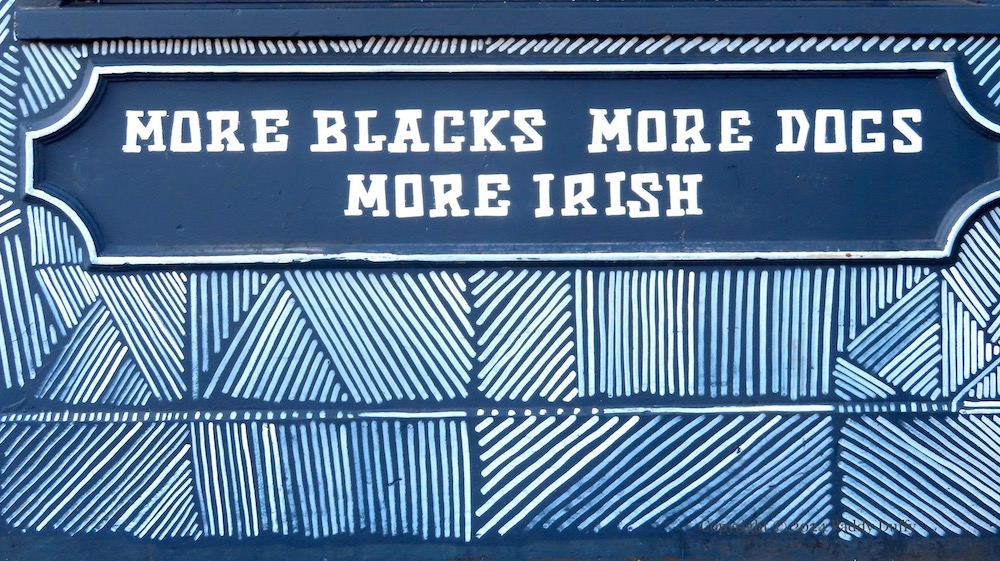
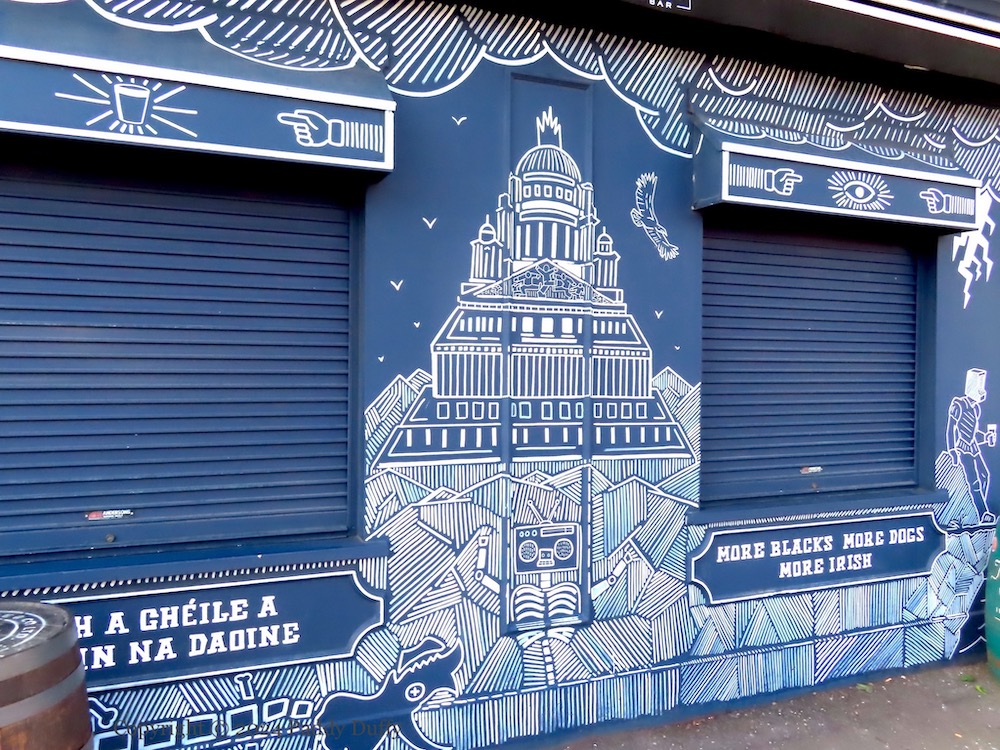
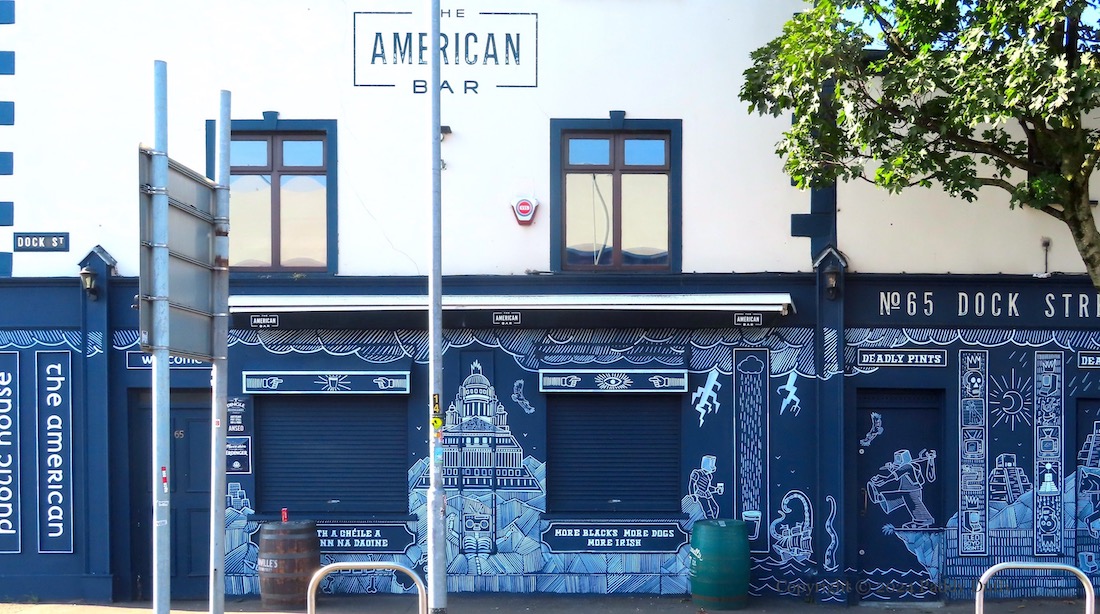
“Deadly” here means “excellent” or “terrific”, perhaps from the idea of “hitting the (living!) target” (Stack) – it is a piece of southern slang that artist and print-maker Leo Boyd (web) perhaps picked up on his journey from Bristol to Dublin to Belfast (Boyd | Atom) where he is one of the Vault Studios artists (Vault).
The Ballycraigy bonfire from 2021 (Fb) is at the centre of a new free-standing board that was added this (2024) summer. Around the outside, the rose and thistle are joined by the orange lily and the poppy, rather than the shamrock and daffodil of the “four nations”.
For the similar board on the gable wall in the distance, see Lead The Way.
On the green at Hollowburn Road, in the Ballycraigy estate, Antrim.
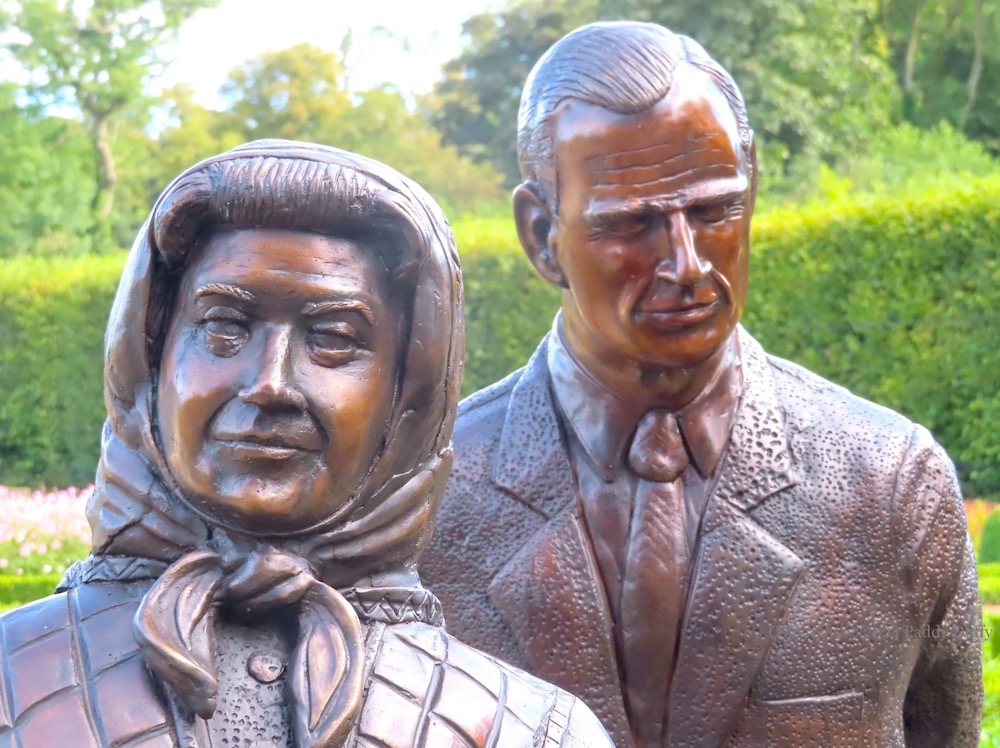
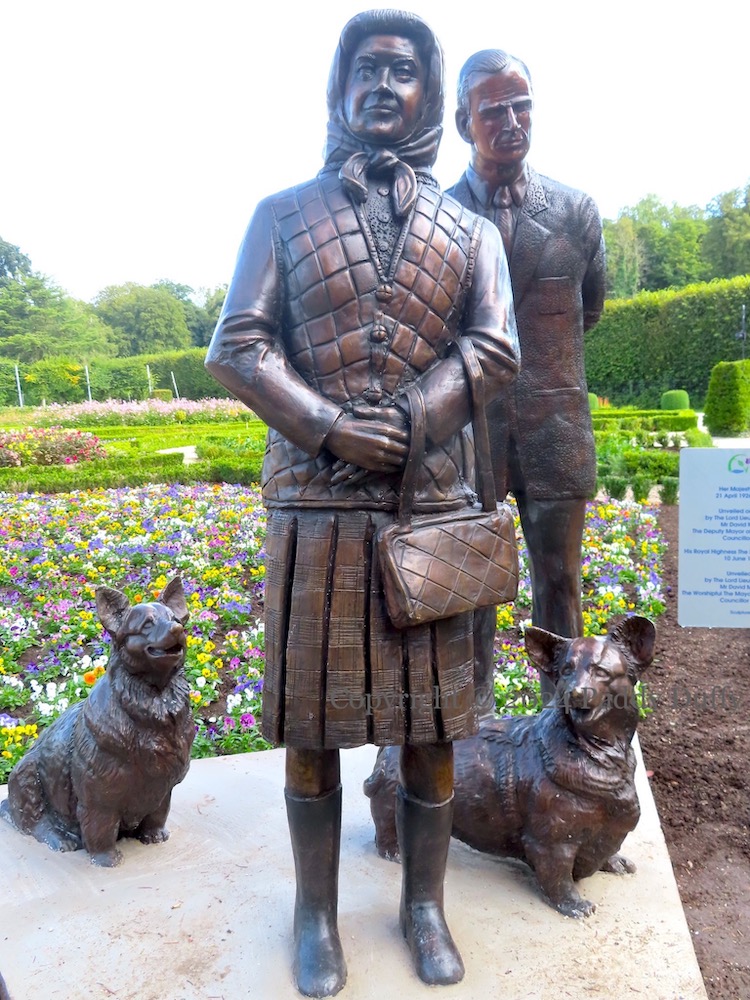
According the Antrim & Newtownabbey Council press-release, the new statue of Queen Elizabeth (and two corgis) unveiled on September 6th next to last year’s statue of Prince Philip in Antrim Castle Gardens “captures Her Majesty in a dignified pose, reflecting her grace, steadfastness and lifelong service to public service”. Others are not so sure that it captures Elizabeth at all, including the A&N’s own councillor Vera McWilliam, who told the BBC that “it does not resemble the queen in any shape or form” (BBC); the controversy was reported on as far afield as Australia, India, and the US.













 Paddy Duffy Collection