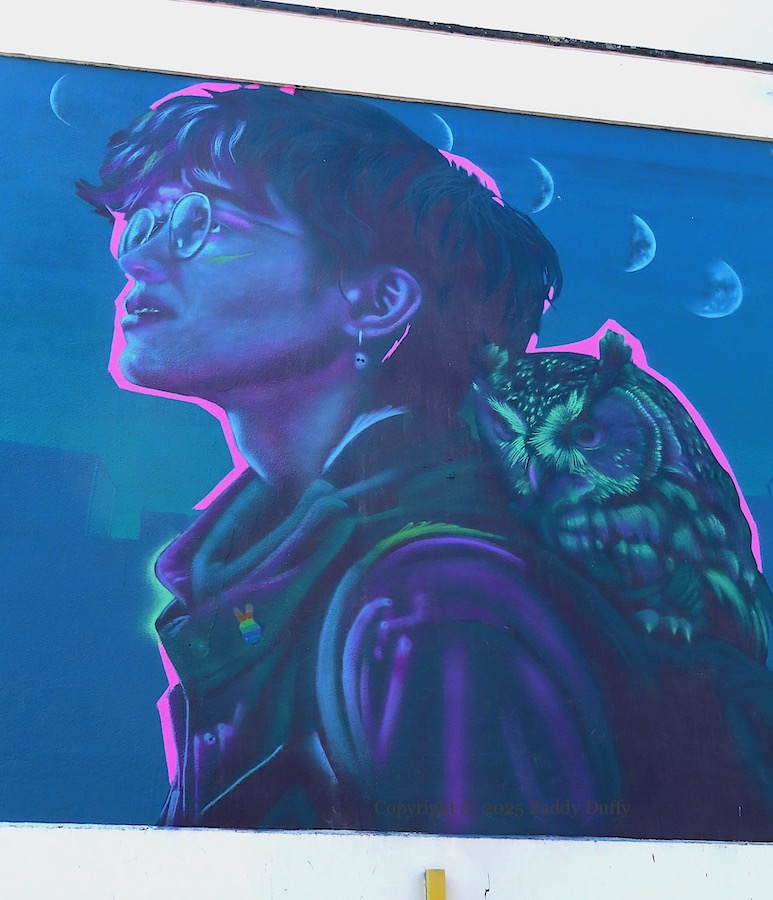
A student makes their way through the cycles of the moon, with Pride pin, skull earring, and owl familiar (and horcrux scar on the cheek?) to guide the way.
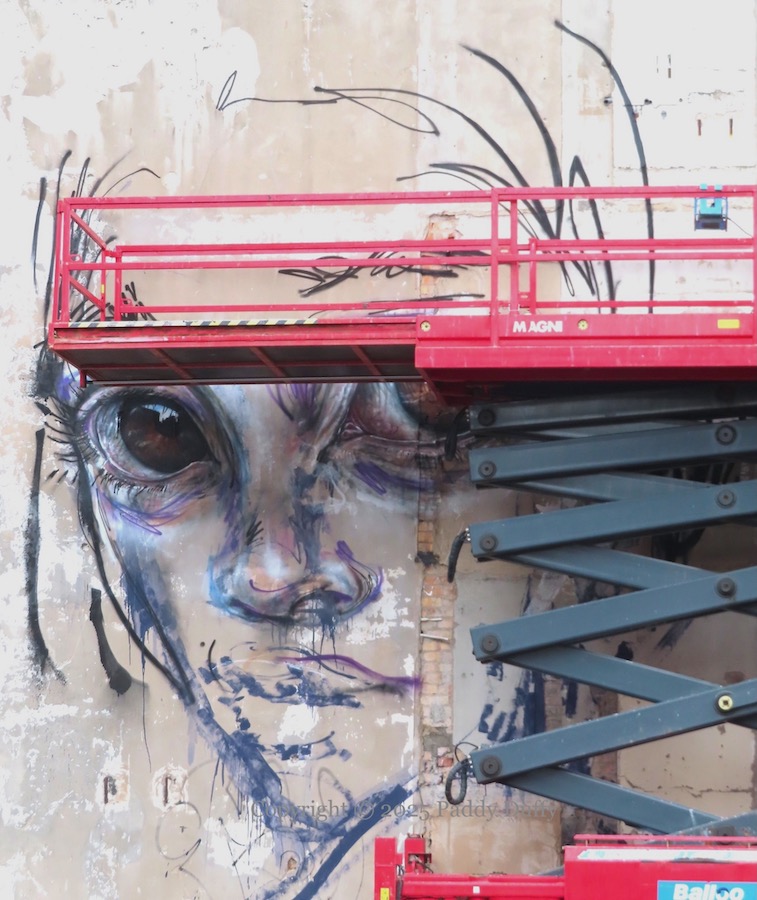
Street art by emic (web) at Belfast Royal Academy on the Cliftonville Road, north Belfast.
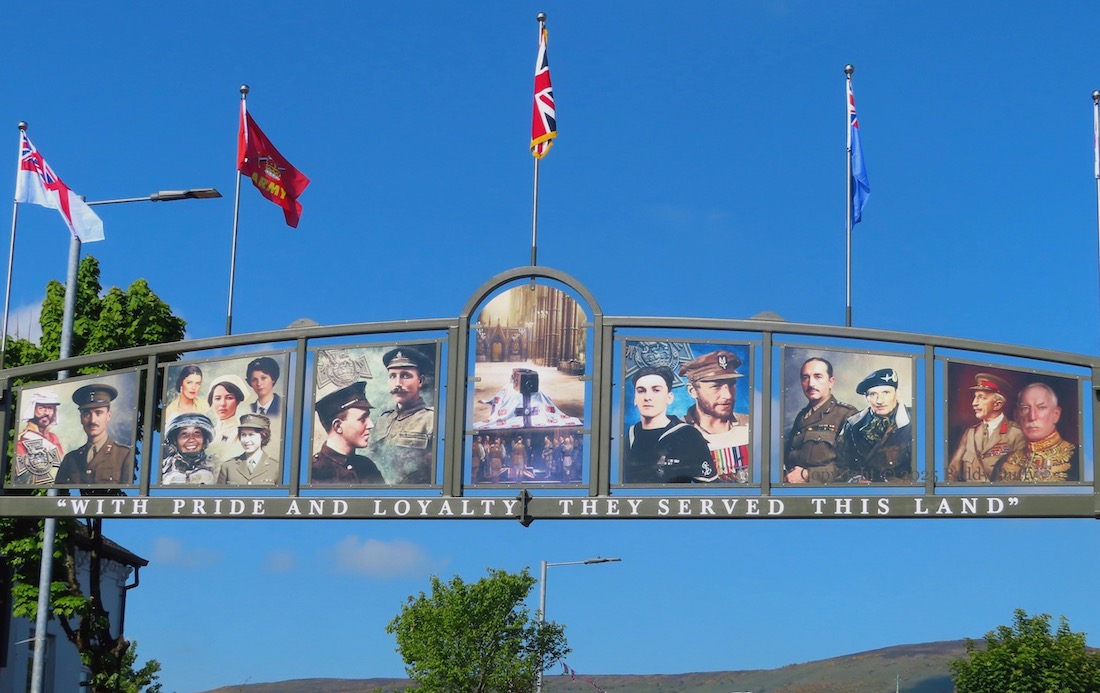
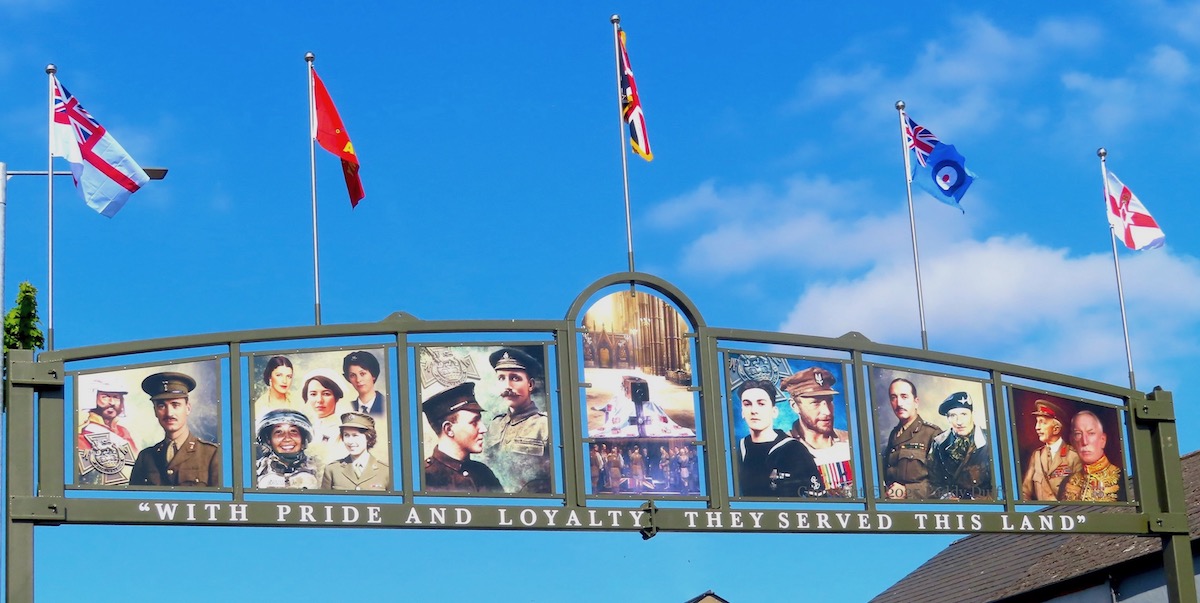
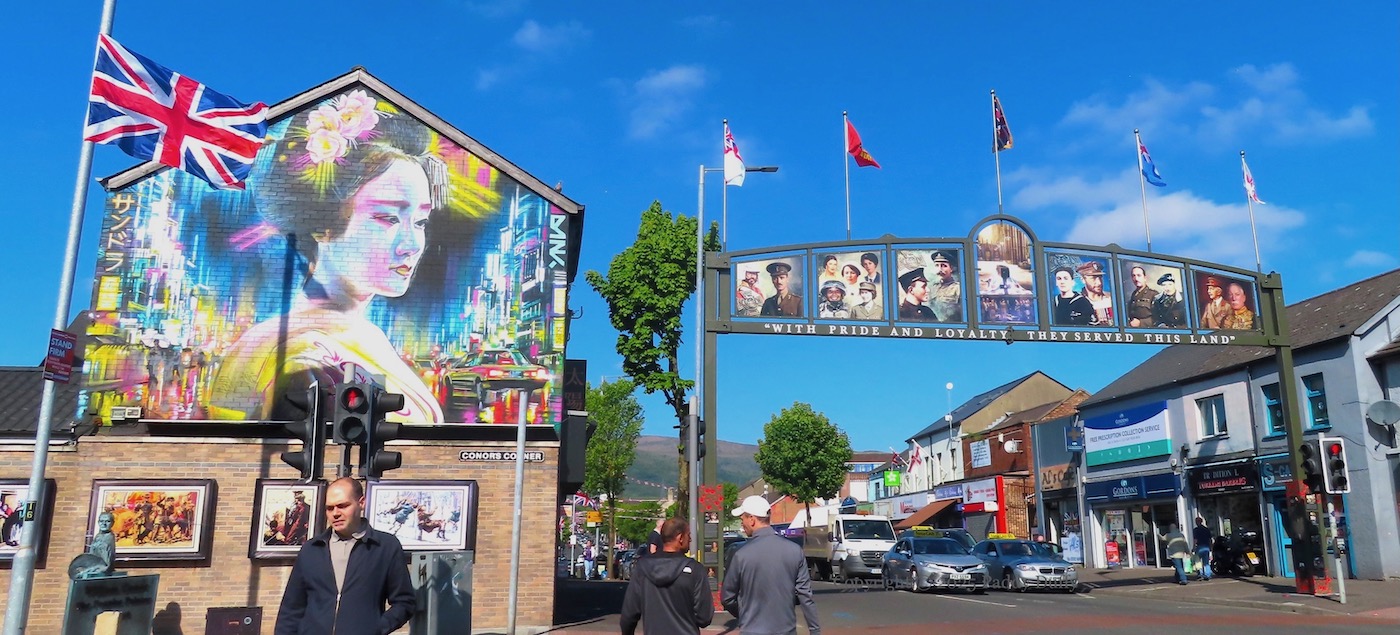
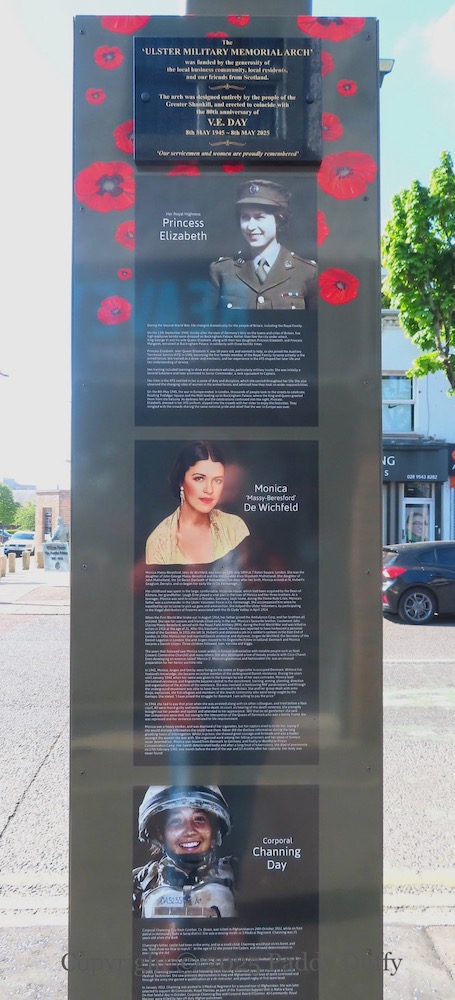
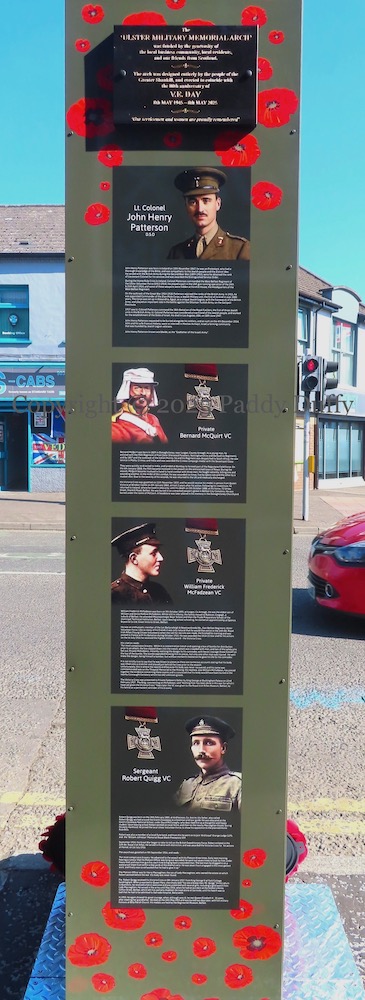
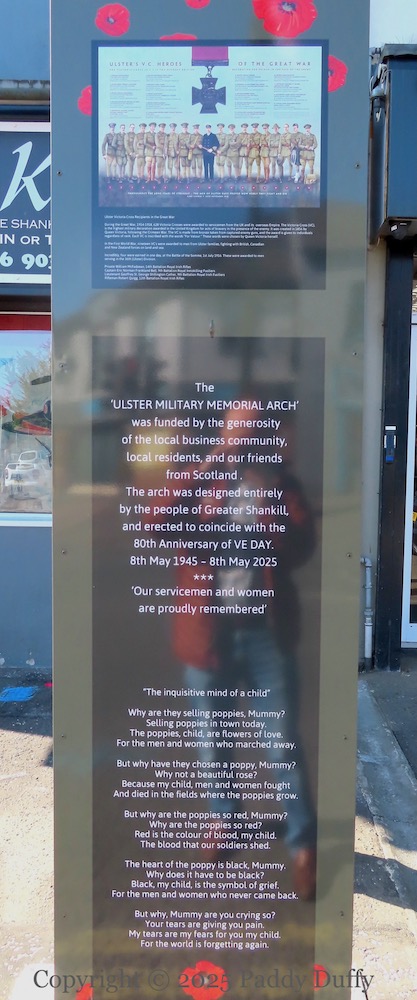
“The ‘Ulster Military Memorial Arch’ was funded by the generosity of the local business community, local residents, and our friends from Scotland. The arch was designed entirely by the people of the Greater Shankill, and erected to coincide with the 80th anniversary of VE Day 8th May 1945 – 8th May 2025. Our servicemen and women are proudly remembered.” For images of the VE Day launch, see the BelTel.
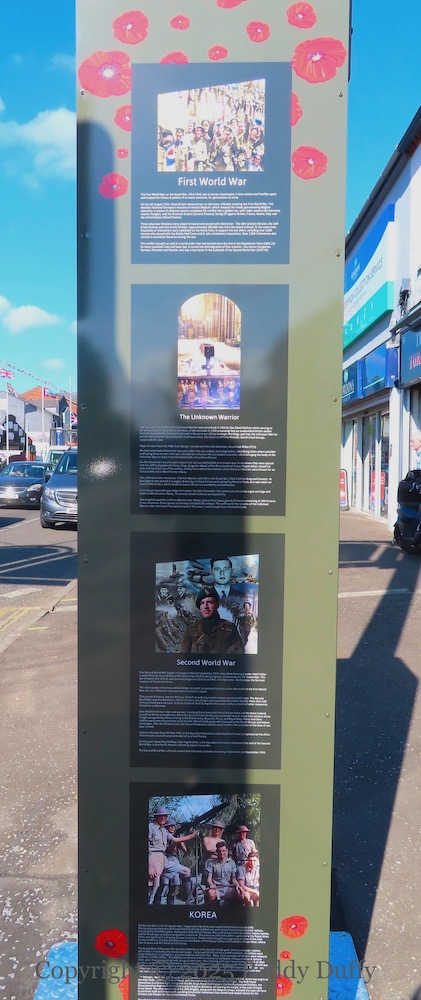
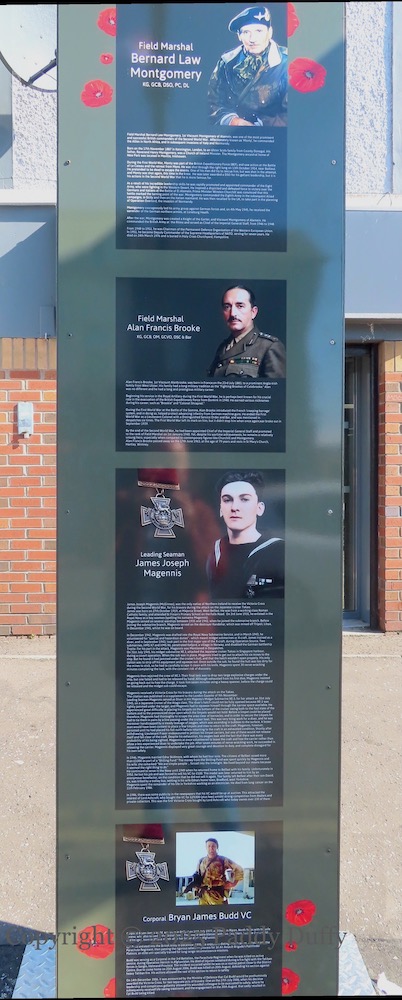
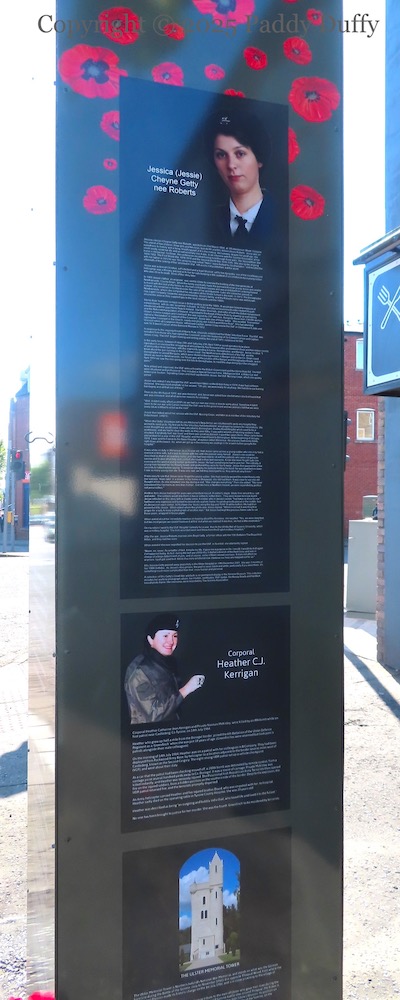
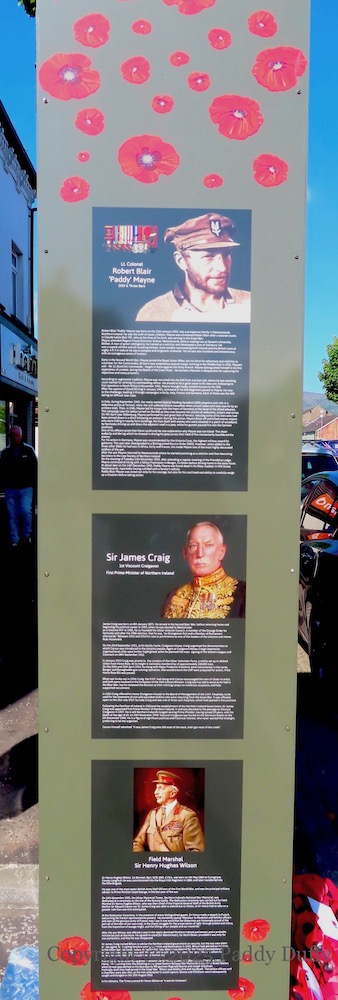
Pictured on Peter’s Hill side of the arch (bearing the quote “With pride and loyalty they served this land”) are (left to right) … Private Bernard McQuirt (a VC winner in 1858 during the Indian Rebellion) and Lt Colonel John Henry Patterson Monica De Wichfeld (raised in Fermanagh and Danish resistance member), Jessie Roberts (a nurse for the Ulster Volunteers and (in WWI) for the Volunteer Aid Detachment, serving in Birmingham and in Wimereux, France; she gets a very long entry on the info panels (see below), as her biography is not available on-line), a (unidentified) nurse, Corporal Channing Day (a medic killed in Afghanistan, 2012), Princess Elizabeth Private William Frederick McFadzean and Sergeant Robert Quigg the tomb of “the unknown warrior” (central panel) Leading Seaman James Joseph Magennis and Lt Colonel Robert Blair ‘Paddy’ Mayne Field Marshal Alan Francis Brooke and Field Marshal Bernard Law Montgomery Field Marshal Sir Henry Hughes Wilson and Sir James Craig
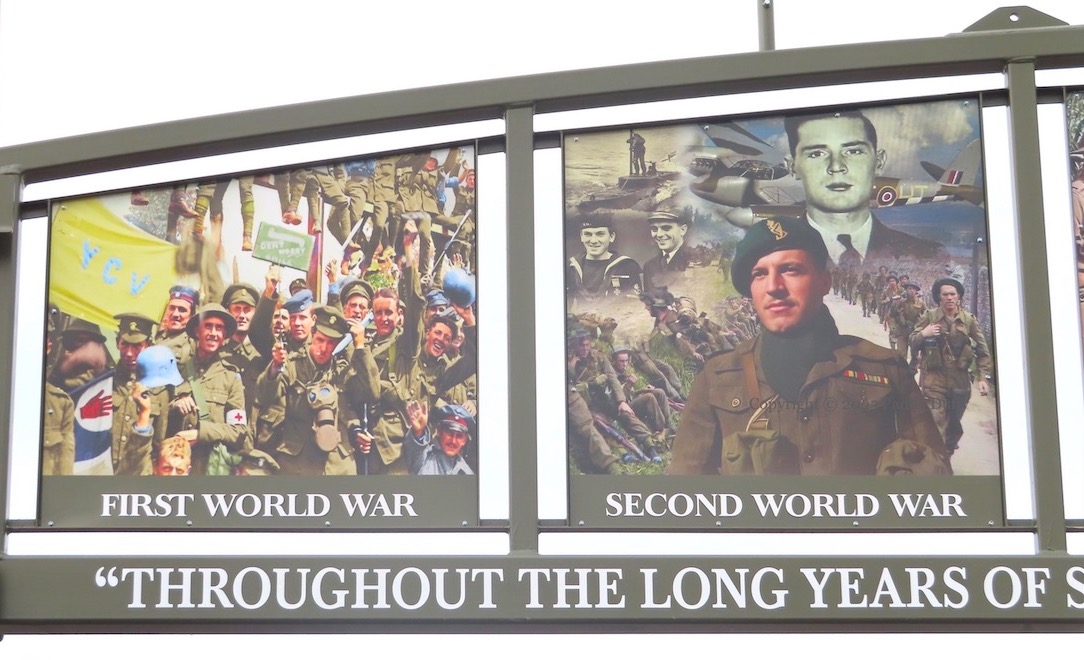
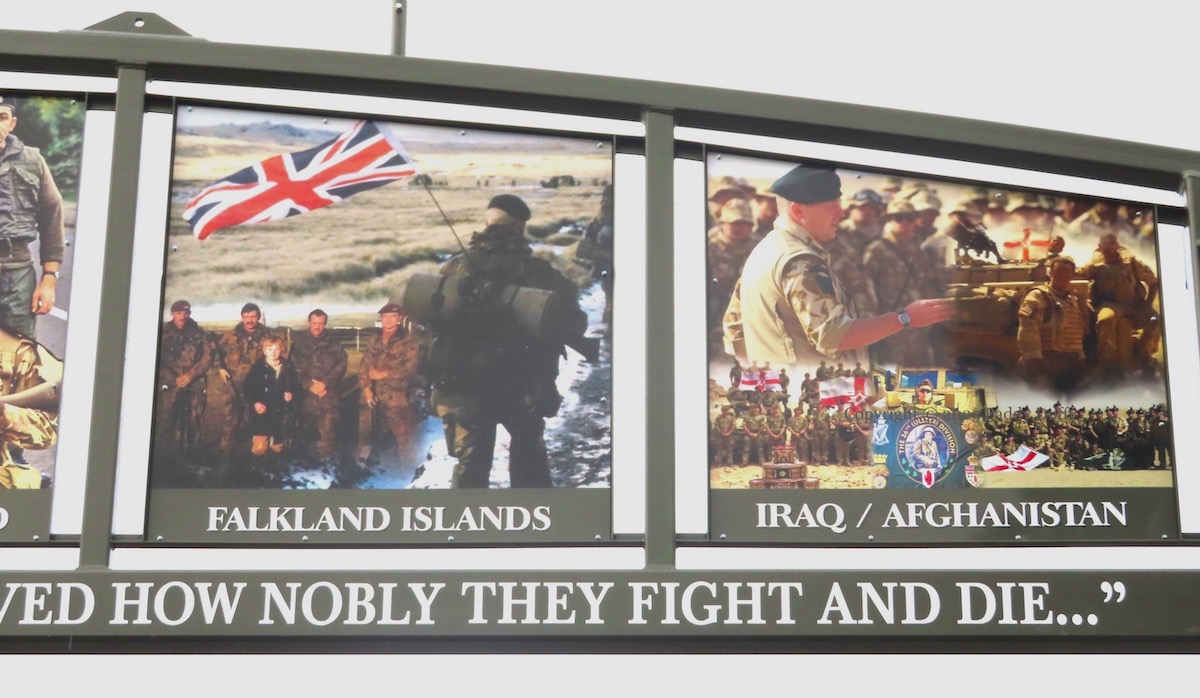
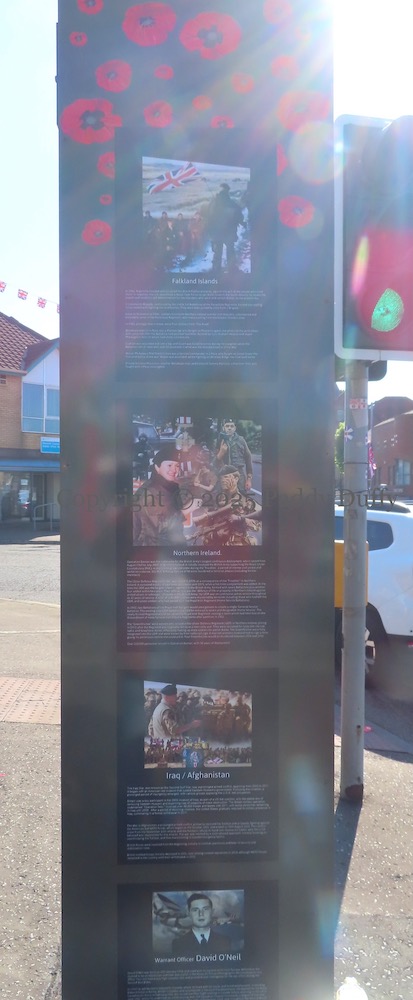
On the other/Shankill side of the arch, bearing the quote “Throughout the long years of struggle … the men and women of Ulster have proved how nobly they fight and die”, the ‘WWII’ panel includes (top right) Warrant Officer David O’Neill, a Canadian Air Force pilot hailing from Ballymena, lost in 1943, and the ‘Northern Ireland’ panel features (left) Corporal Heather CJ Kerrigan, a UDR Greenfinch killed by the IRA in 1984. These two are also profiled in the info panels around the legs of the arch, along with Corporal Bryan James Budd, a 3rd Para soldier killed by friendly fire in Afghanistan, 2006.
Also included is JF Willcocks’s poem Poppies (sometimes called The Inquisitive Mind Of A Child): Why are they selling poppies, Mummy? Selling poppies in town today./The poppies, child, are flowers of love. For the men who marched away./But why have they chosen a poppy, Mummy? Why not a beautiful rose?/Because my child, men fought and died in the fields where the poppies grow./But why are the poppies so red, Mummy? Why are the poppies so red?/Red is the colour of blood, my child. The blood that our soldiers shed./The heart of the poppy is black, Mummy. Why does it have to be black?/Black, my child, is the symbol of grief. For the men who never came back./But why, Mummy are you crying so? Your tears are giving you pain./My tears are my fears for you my child. For the world is forgetting again.”
Children play among and with the landmarks of the world – riding the Sydney opera house, building the pyramids out of sand, climbing the Eiffel Tower, building the Taj Mahal from blocks, blowing on a windmill, and swinging from Samson and Goliath.
This is an old (2016) piece by Friz (web), still in excellent shape on the wall of Currie Primary school, off the Limestone Road in north Belfast.
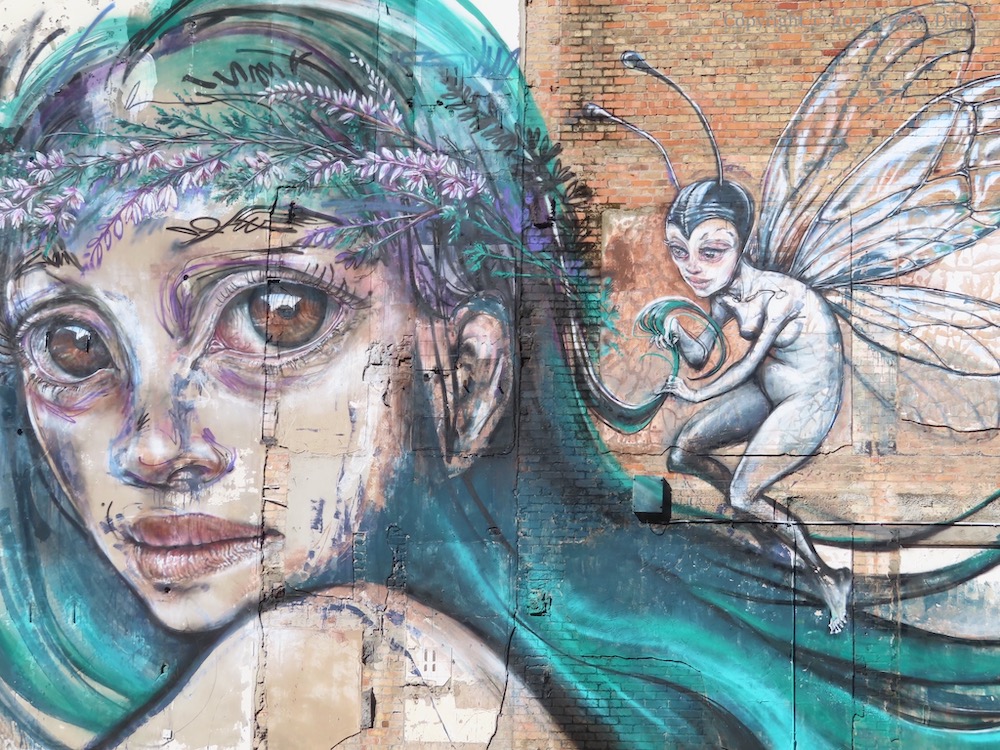
“I wished I was more like Nature. Her secret is: patience.” Street art by German artist Hera Of Herakut (ig) in Academy Street for Hit The North 2025 (Seedhead Arts).
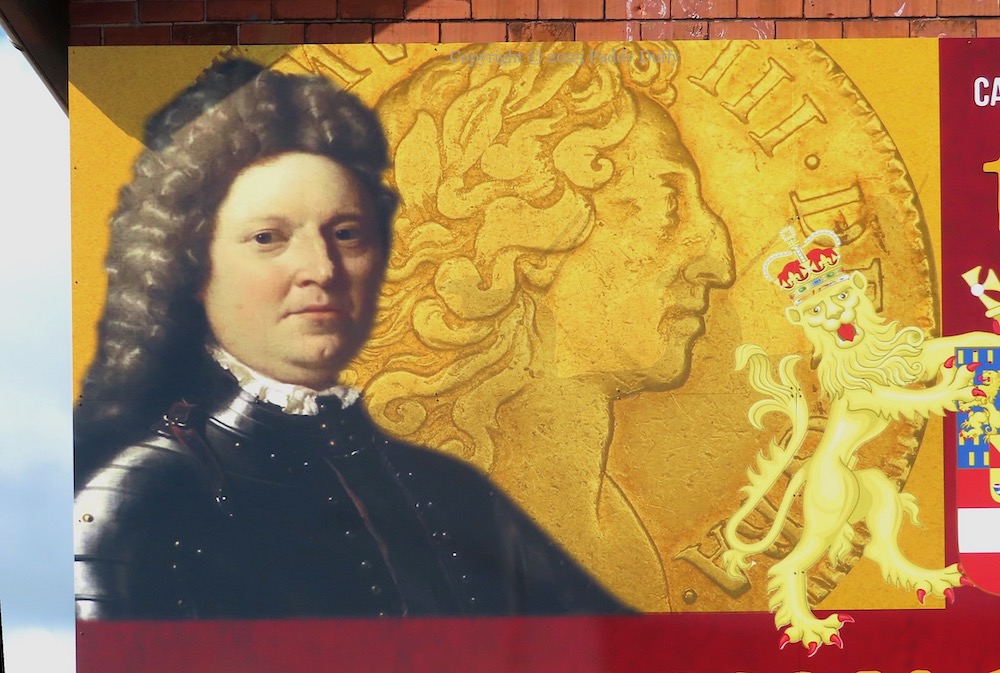
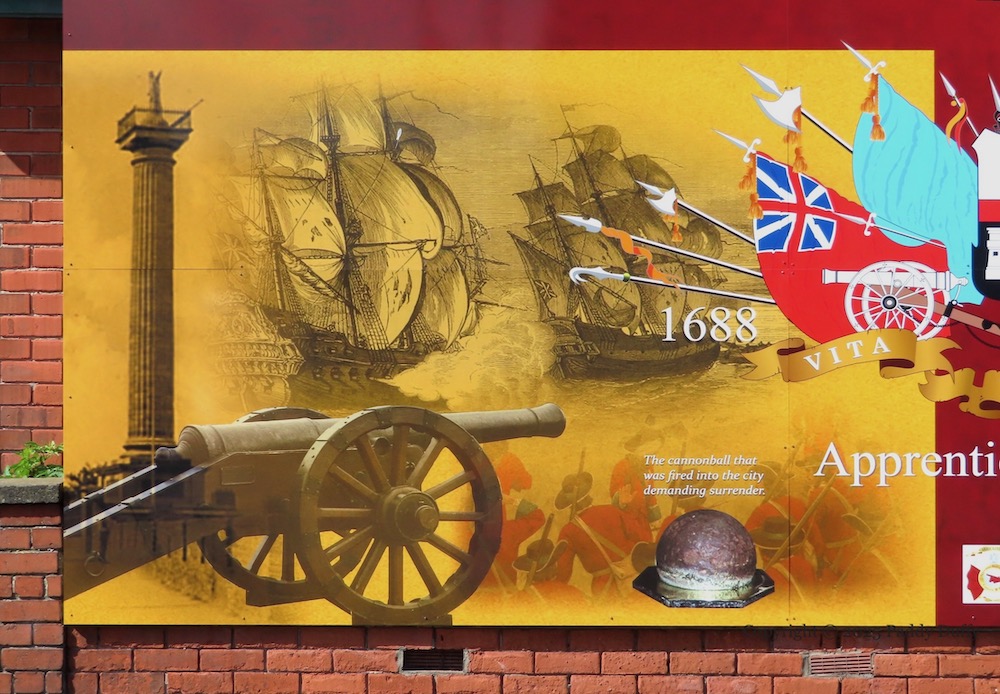
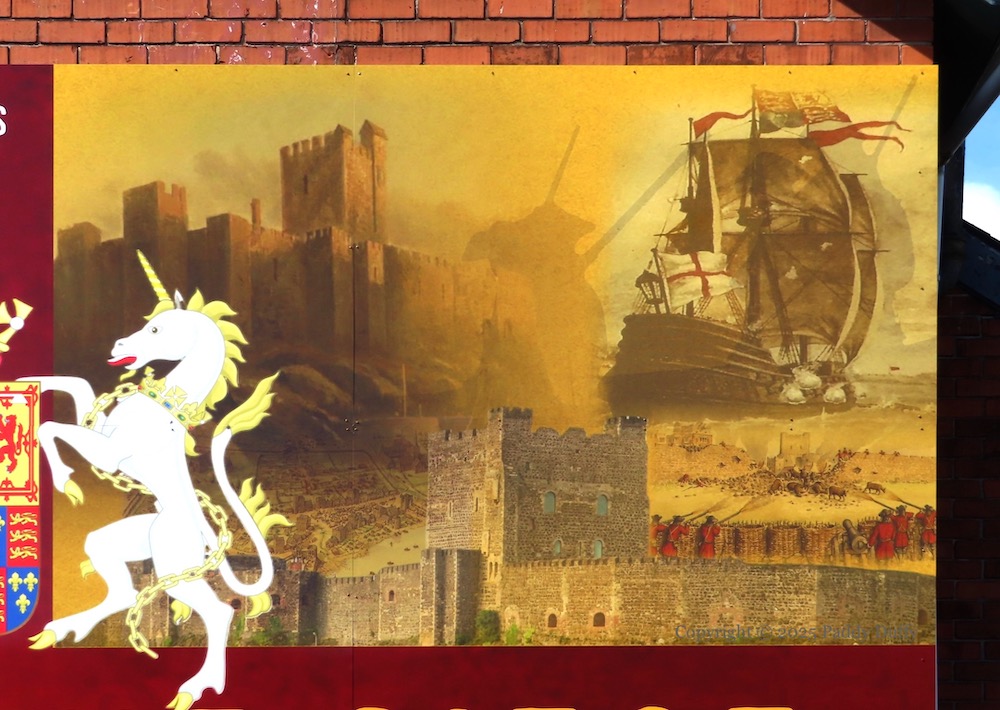
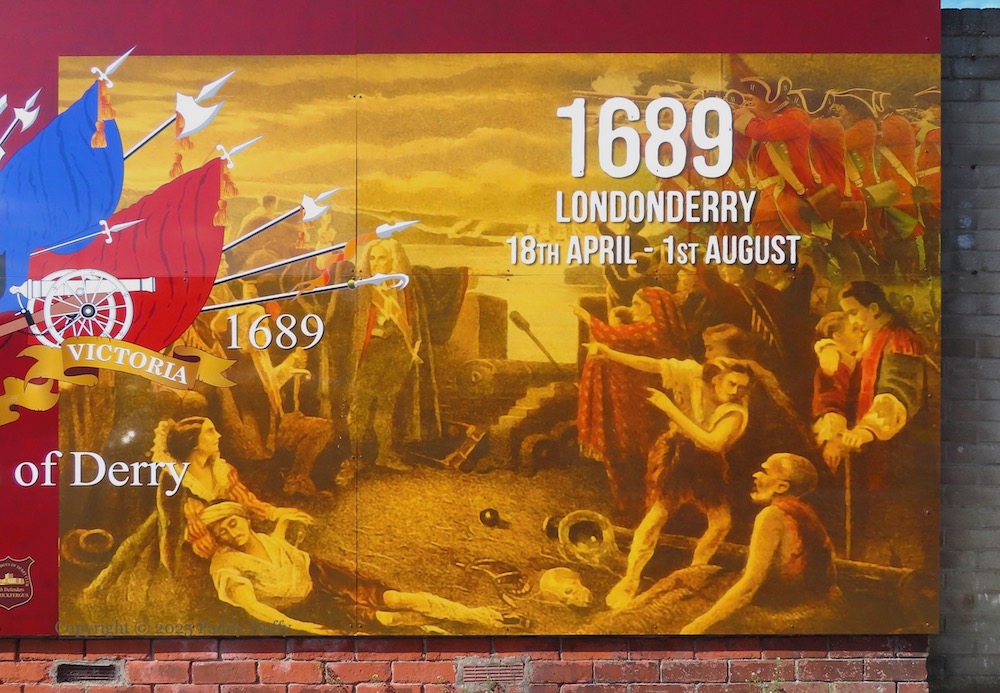
English forces under Kirke came to the aid of the besieged Protestants in Derry, “breaking the boom” across the Foyle and ending the siege at the end of July, 1689. The next wave of forces sailed for Belfast Lough, and together with the troops from Derry, set siege on August 20th to a garrison of Jacobite forces stationed in Carrickfergus castle, who soon began to run low on gunpowder, and surrendered. (WP | NIWorld)
This new board in Davy’s Street, Carrickfergus, focuses mostly on the siege of Derry, though gives the dates of the Carrickfergus siege at the top. Schomberg appears in the top-left quadrant of the board – he would go on to die on at the Boyne in 1690; in the top-right is the Carrickfergus castle and the Mountjoy; in the bottom-left are Walker’s statue and the canon ‘Roaring Meg’; bottom-right is a painting of the Derry inhabitants celebrating the end of the siege; top-centre is the coat of arms of William and Mary; and bottom-centre is the Londonderry coat of arms.
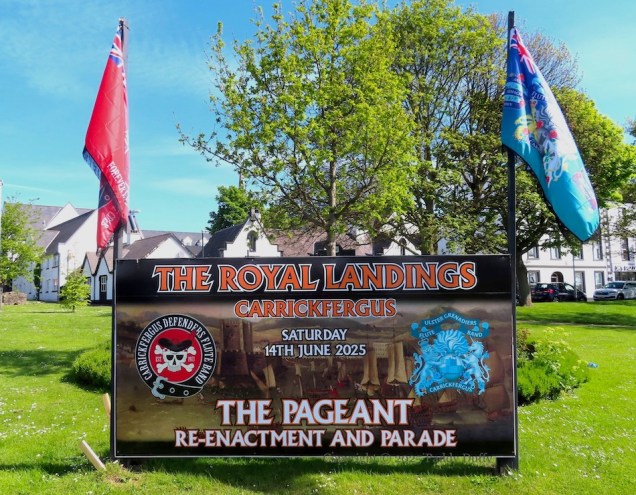
“The Royal Landing, Carrickfergus, Saturday 14th June 2025. The pageant, re-enactment, and parade.”
William III, statholder of Holland, landed at Torbay, England, in November, 1688 with 250+ ships and 30,000 men in order to overthrow the Catholic convert James II who had become king in 1685. As king of England, William was automatically made king of Ireland, but he and his forces had to go to Ireland to win the island from James and the forces loyal to him. Schomberg had already successfully besieged Carrickfergus in 1689, allowing William to land on June 14th, 1690. The image used as a background is Pocock’s oil painting of the landing, which is held by the National Maritime Museum.
The Royal Landing event involves a parade – involving the Carrickfergus Defenders flute band (Fb) and the Ulster Grenadiers flute band (Fb) – from Woodburn fields to the marina, where King Billy’s landing will be recreated (Fb).
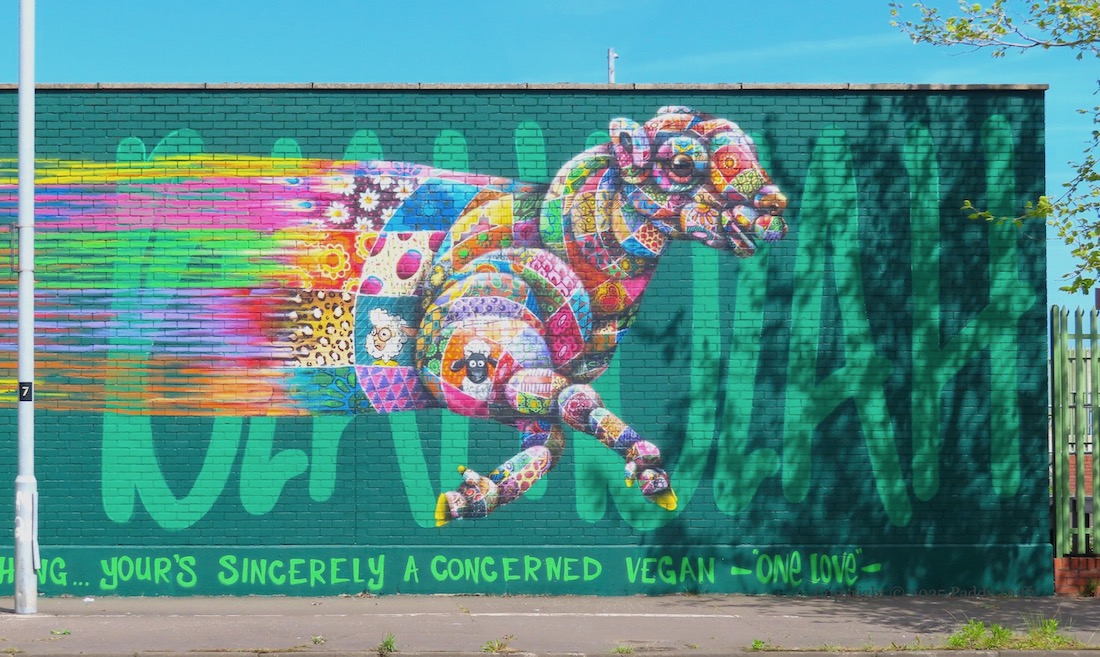
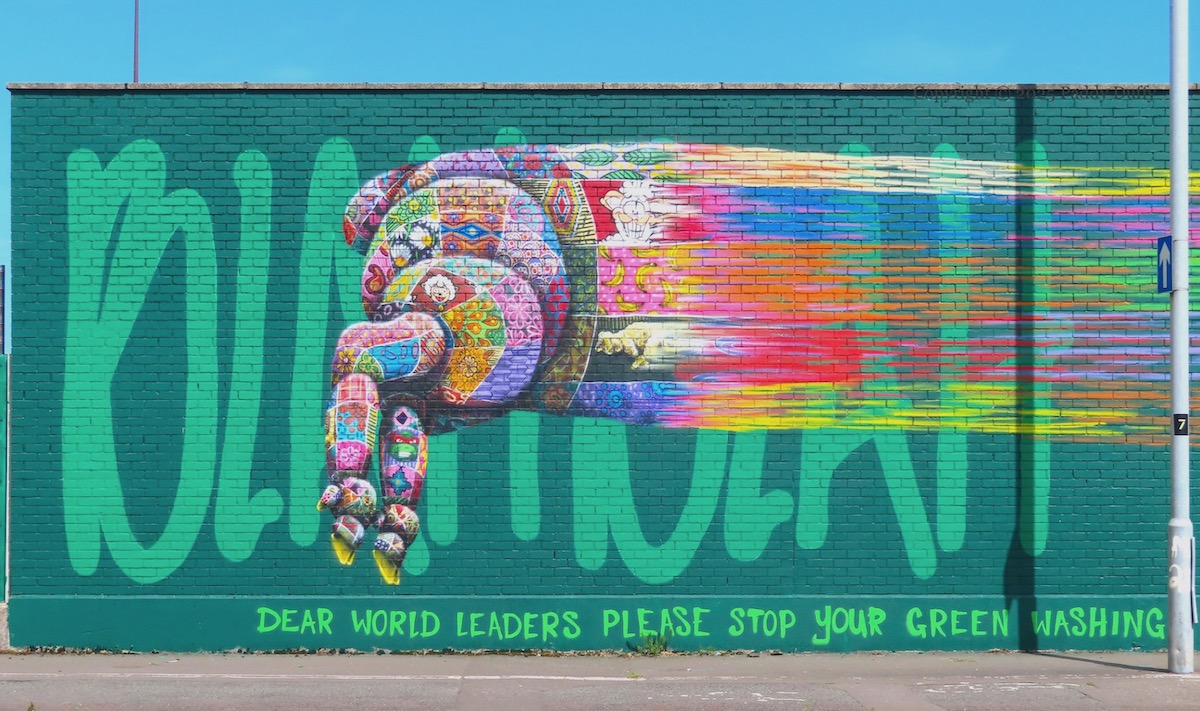
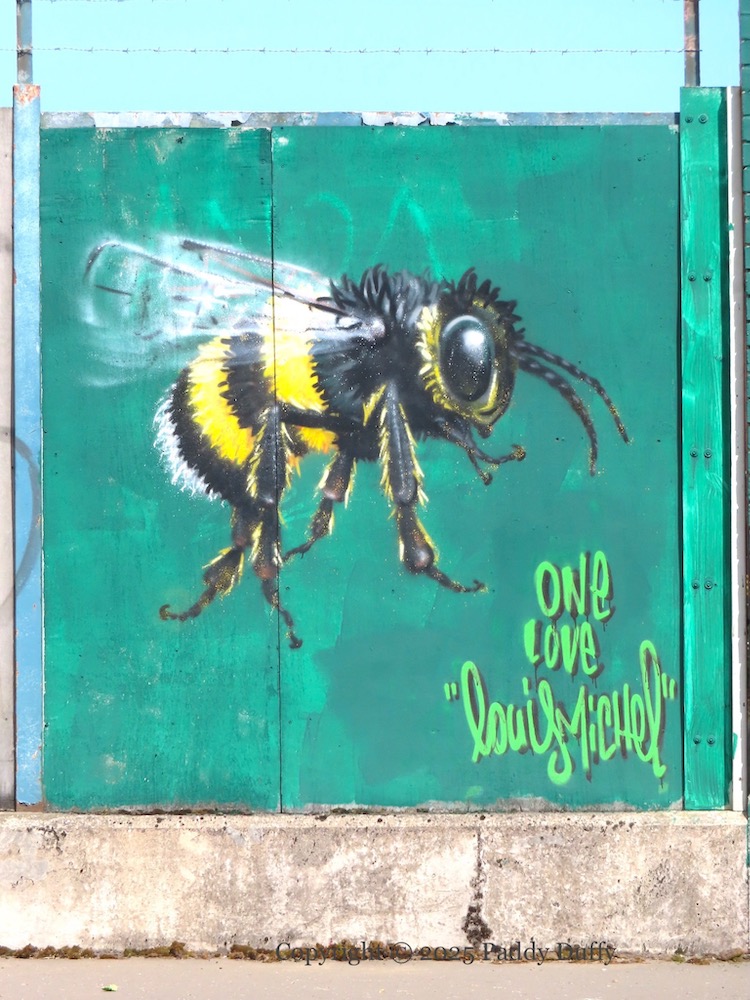
“Dear world leaders, please stop your green-washing … yours sincerely, a concerned vegan” – street art by “One Love” Louis Masai Michel (ig) in Whitla Street for Hit The North 2025 (Seedhead Arts).
39 Allied divisions – 12 of them British – participated in the Normandy Landings – officially “Operation Neptune” – that took place on June 6th, 1944; in planning for the operation, the original “D-Day” was June 5th, but bad weather postponed it until the following day, when 160,000 troops stormed the beaches of the Bay Of The Seine. By the end of August, Paris had been liberated, and by the following May, victory in Europe had been achieved. 2024 was the eightieth anniversary of D-Day and 2025 the eightieth anniversary of VE Day, on May 8th.
This D-Day board and VE Day mural are in Edlingham Street, Tiger’s Bay, north Belfast. Also included below is a WWI memorial electrical box in Mervue Street, though as can be seen from the board (immediately below) the ‘graveside mourner’ silhouette is becoming a generic symbol of lost UK forces.
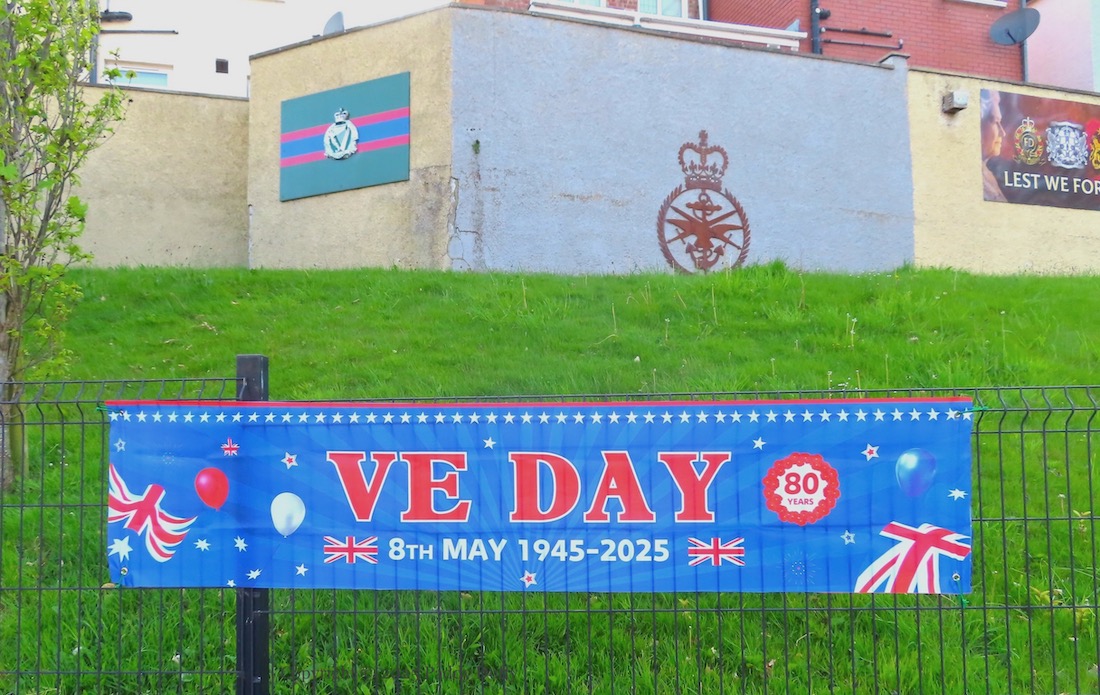
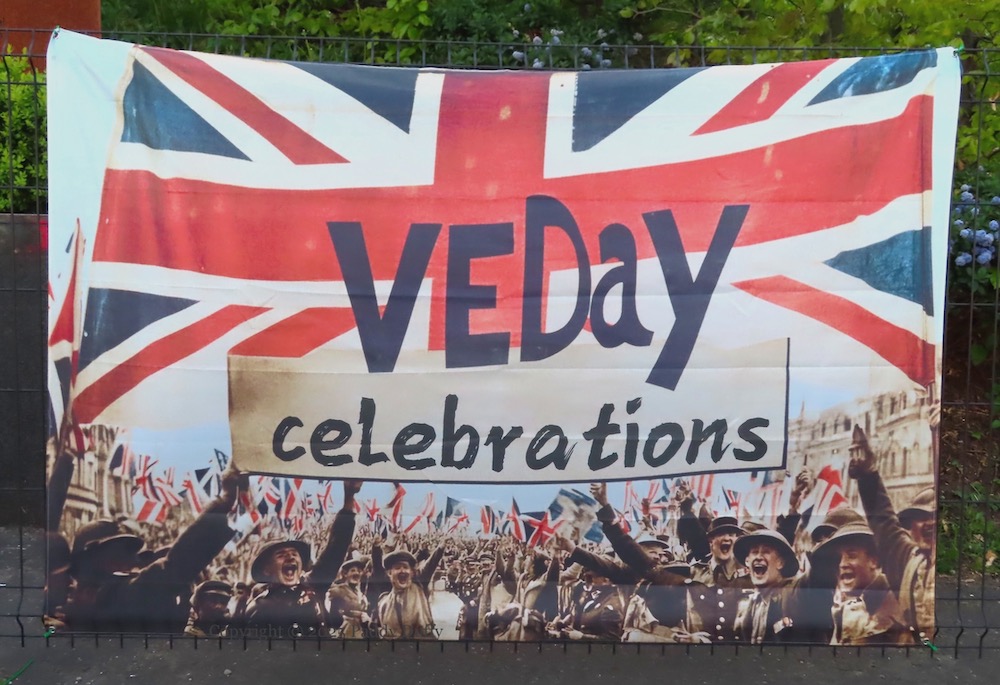
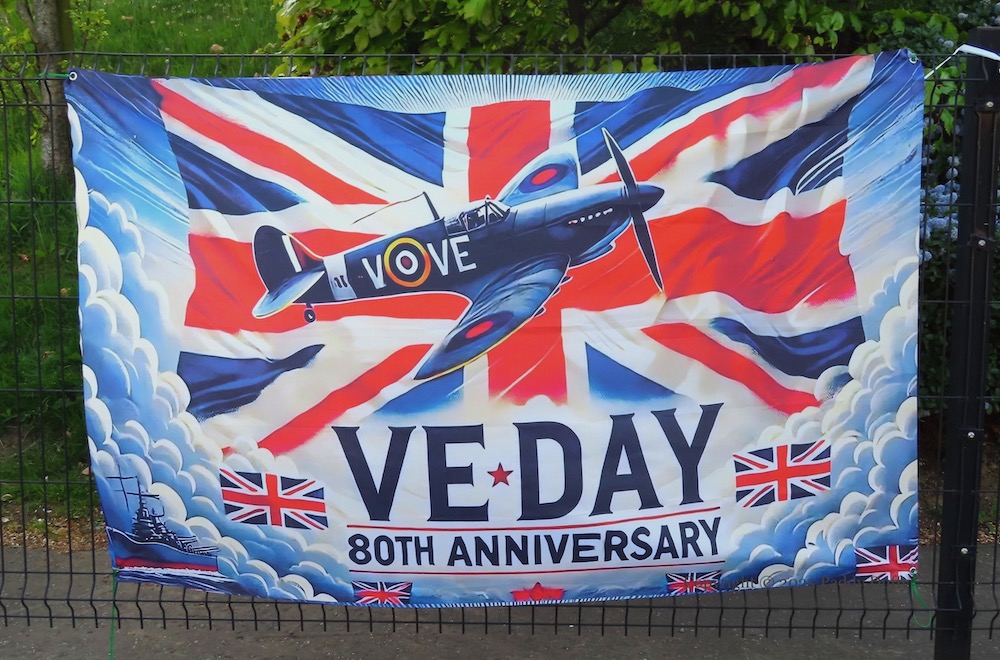
The eightieth anniversary of VE (“Victory In Europe”) Day is May 8th. Commemorative events in Belfast include a walking tour of the city centre (City Council) and a dance on the HMS Belfast (IWM); for events elsewhere in Northern Ireland, see VE-VJDay80. Pubs will be open for an extra two hours (until 1 a.m.) on the day.
Shore Road, north Belfast. For the monument and the “Lest We Forget” board in the background, see Remembrance Sunday.


















 Paddy Duffy Collection