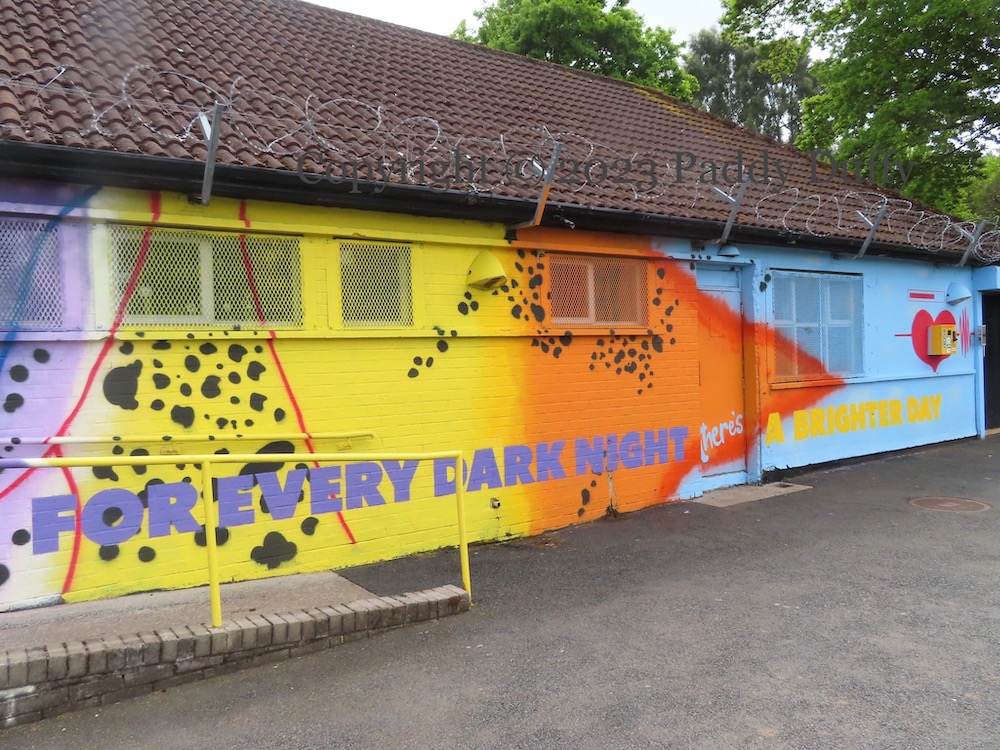
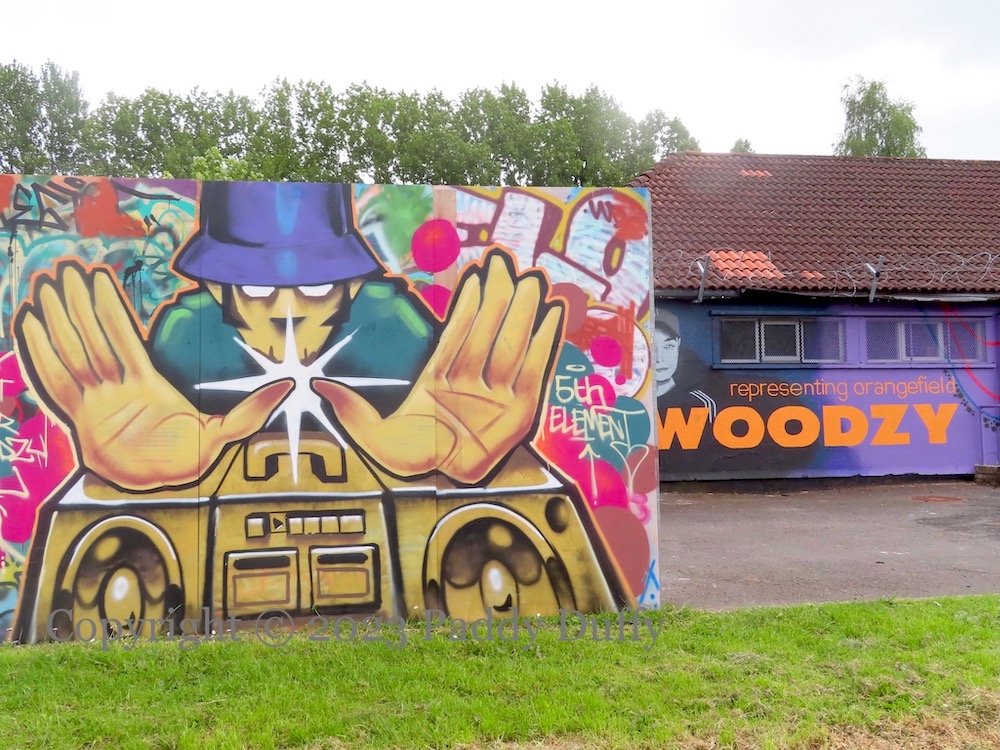
“For every dark night there’s a brighter day.” This mural on the pavilion in Orangefield Park encourages people –young men in particular – to take care of their mental health, and serves as a memorial to Adam “Woodzy” Woods, who died last (2022) May of an overdose (BBC). Skank FM has images of the launch (instagram). With assistance by 5th Element (ig).
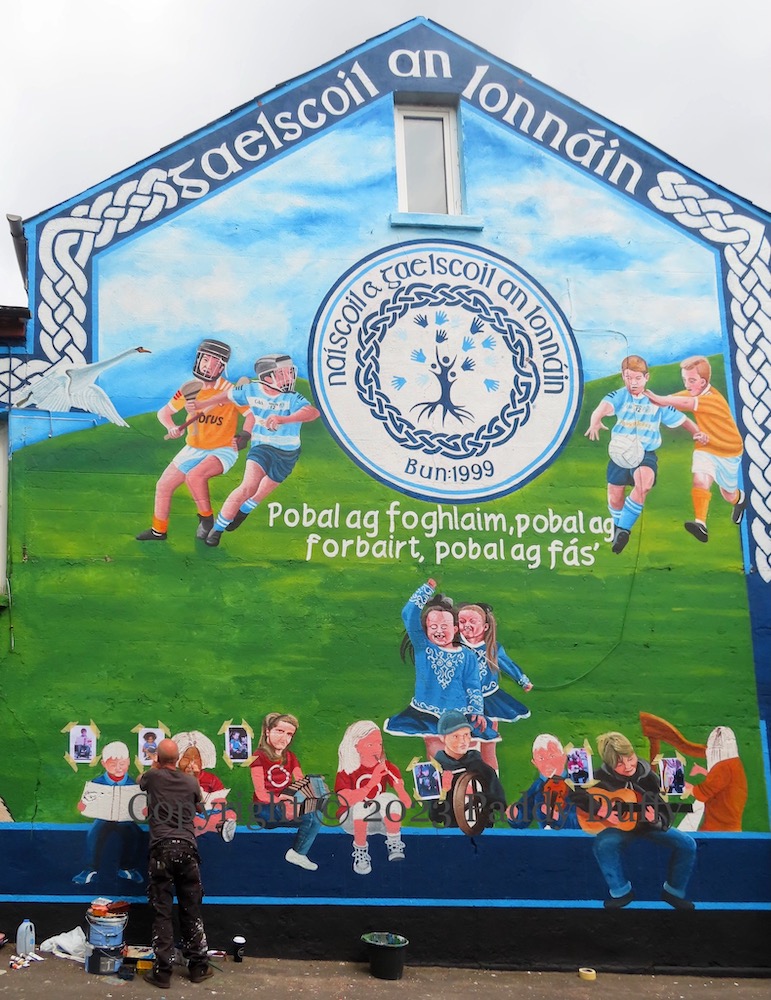
“Pobal ag foghlaım, pobal ag forbaırt, pobal ag fás” [a community learning, developing, growing]
Students from “Naíscoıl & Gaelscoıl An Lonnáın (Fb) bun[aithe] 1999″ [Nursery-school and Irish-language [primary] school of the loney, founded 1999] are shown playing Gaelic games, Irish dancing, and playing traditional instruments (and the guitar). On the left are representations from Irish mythology: the Children Of Lear and Setanta killing Culann’s hound (and taking the name Cú Chulaınn in taking its place), along with hedge-row school (see Hedge Row School).
The origin of the name is unclear; the nearest loney [lane] was the “Pound” loney, so-called because of the animal pen just outside Barrack Street, used to store livestock before moving on to the markets the following day (Rushlight | Uachtar Na bhFál). (The Pound Loney is included in the mural in Durham Street – see Et In Arcadia Ego.)
The other well-known loney in Belfast is the “buttermilk loney” which was either/both what is now Ballysillan Park (that is, connecting Olpark with the horsehoe bend) or the top part of the loney that connected Wheatfield (the top of Ardoyne) to the Ligoniel junction and on towards the old Ligoneil House (there are a mixture of usages in this Belfast Forum thread); this image from the 1930s might show the lane in (what was still at the time) the hills above Oldpark; a new housing-development towards the top of the Ballysillan Park is euphemistically called “Buttermilk Loney”. (It is also said to have been a prior name of Skegoniell Avenue (Belfast History).)
(The Uachtar Na bhFál page also mentions “Turf” loney, “Mountain” loney, and “Killoney”.)
The history of the Irish word “lonnán” is unclear. Uachtar na bhFál says the word is of Scots origin (perhaps as “loanin”). (See this BelTel article on the opening of the Ulster-Scots centre in 2014.) Spelled “lonnen”, it is also a Geordie word (Heslop’s Northumberland Words | wiktionary). The Irish News and Belfast Live, working from the same (uncited) press-release about Páırc An Lonnáın (which is along the Westlink below Raıdıó Fáılte), state that “loney” comes from the English word “loaning”. The Irish word “lonnán” does not appear in Dinneen 1904; Dinneen 1953 defines it (hyper-specifically) as “a grassy recess running up into high basaltic cliffs”.
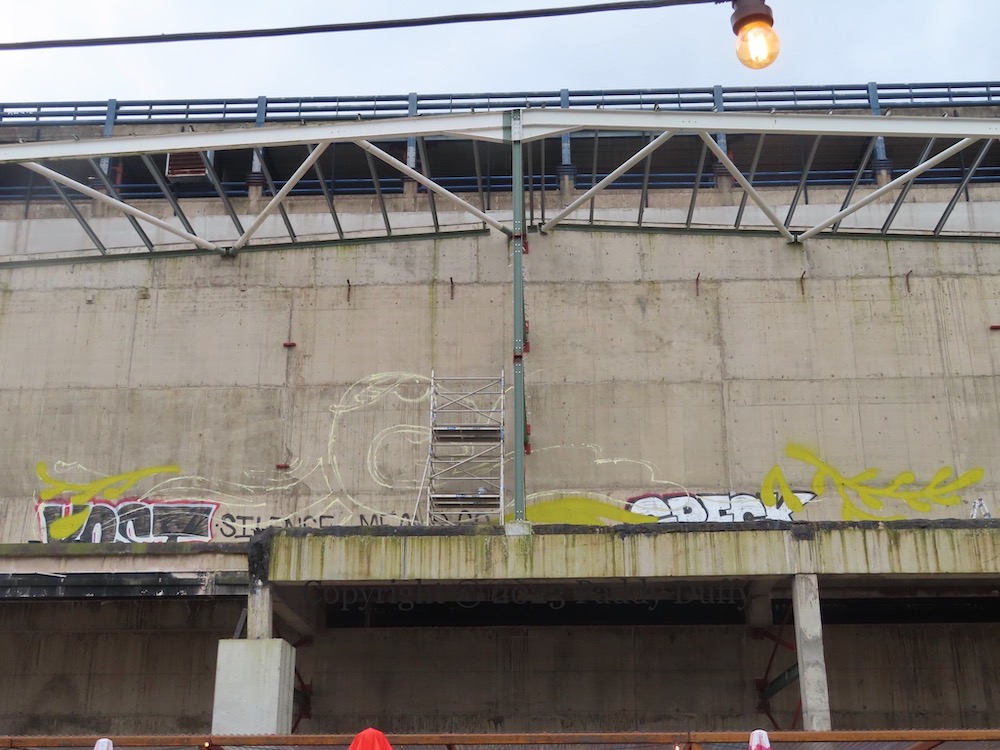
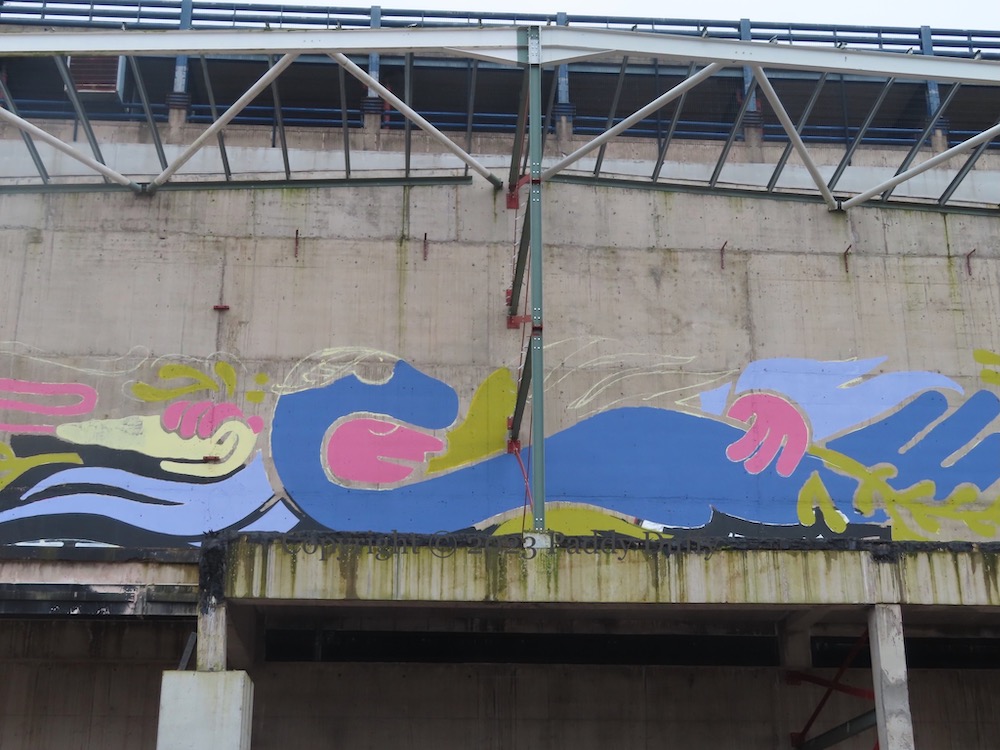
The image above and immediately below are from May 19th, as the mural was nearing completion; other ‘in-progress’ images are as dated below. Here are images of the completed work.
“Our revenge will be the laughter of our children” – The words of Bobby Sands are illustrated on an electrical box on the Whiterock Road, Belfast, with silhouettes of children at play in nature.
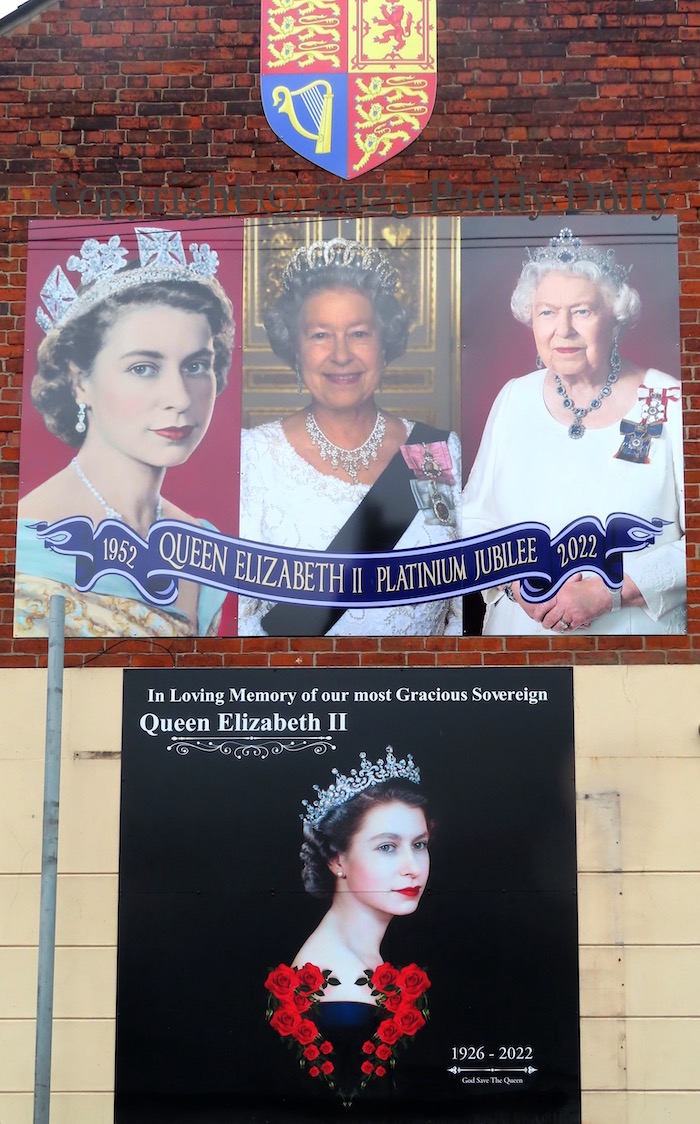
“In loving memory of our most gracious sovereign – Queen Elizabeth II 1926-2022. God save the Queen.” The platinum (70th) jubilee of Queen Elizabeth II, celebrated in June, 2022, was followed a short time later by her death, on September 8th. These two boards in Maldon Street, mark the two events.
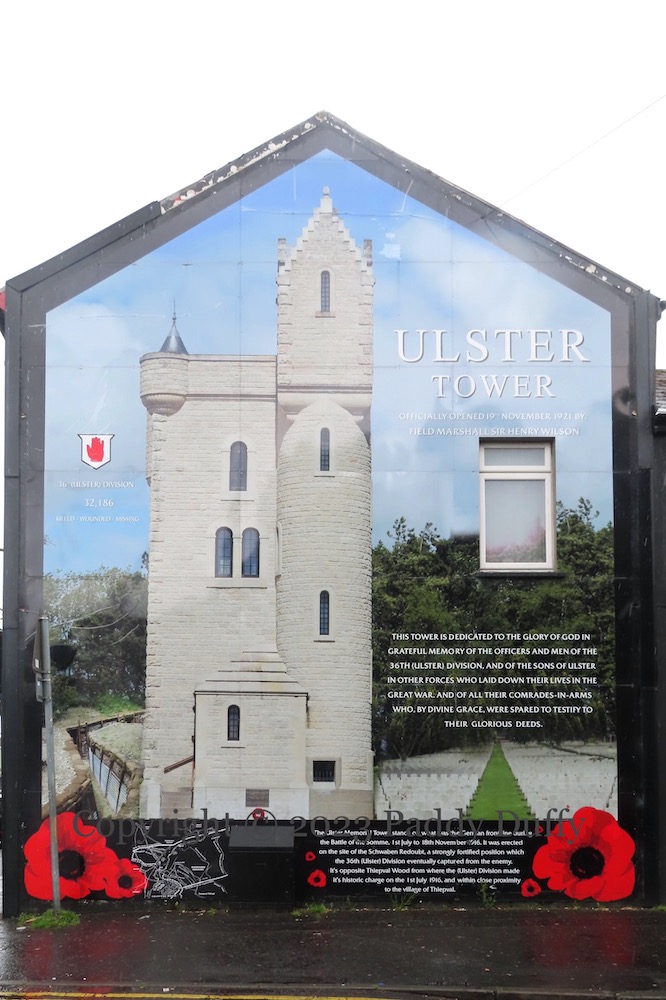
The map in the lower left corner of this WWI commemorative mural shows the defensive lines of both the Allies and the Central Powers. As the inscription on the mural describes, the Ulster Tower is situated close to the Schwaben Redoubt, the primary objective of the 36th Division on the first day of battle.
“Ulster Tower, officially opened 19th November, 1921, by Field Marshall Sir Henry Wilson.” “This Tower is dedicated to the glory of God in grateful memory of the officers and men of the 36th (Ulster) division, and of the sons of Ulster in other forces who laid down their lives in the Great War, and of all their comrades-in-arms who, by divine grace, were spared to testify to their glorious deeds.” “The Ulster Tower stands on what was the German front line during the Battle Of The Somme, 1st July to 18th November 1916. It was erected on the site of the Schwaben Redoubt, a strongly fortified position which the 36th (Ulster) Division eventually captured. It’s opposite Thiepval Wood from where the (Ulster) Division made it’s [sic] historic charge on 1st July 1916, and within close proximity to the village of Thiepval.” “32,186 killed, wounded, missing.” “Greater love hath no man than this that a man lay down his life for his friends.”
The “Shankill Boys” were the roughly 700 men of the West Belfast battalion of the Ulster Volunteers who were almost all killed at the Somme. (This board – or a previous copy of it – was previously in Carnan St.)
As with all of the Belfast battalions, West Belfast had a “USSF” [Ulster Special Service Force] – its emblem is in the top left of the second board, below. (See previously USSF and Carving Out A Place In History) The other emblem is that of the ‘Greengairs Thistle Flute Band’ (web). Although the background comes from WWI, the roll of honour lists modern-day volunteers from the UVF. Thomas Chapman, James McGregor, Robert McIntyre, William Hannah, and Robert Wadsworth are portrayed in Carnan Street – see C. Coy Street. The modern-day C Company, formed in 1974, is named after the Four Step Inn, which was bombed in September 1971 (see Four Step).
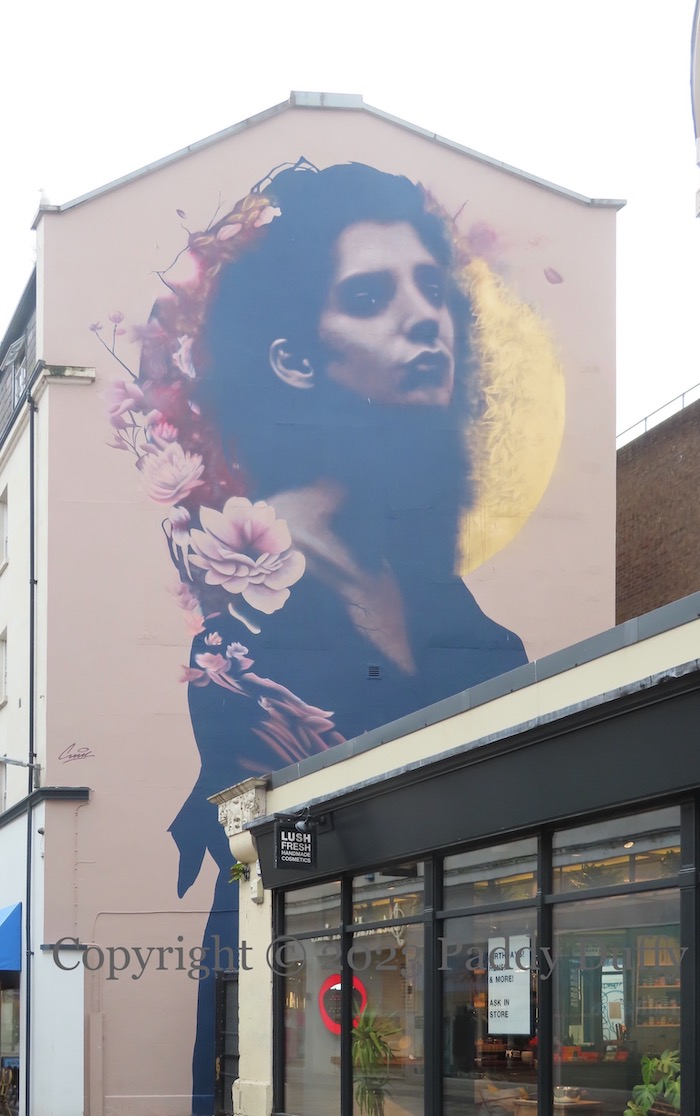
Work by emic (ig) in Castle Lane, Belfast, perhaps picking up a theme from Friz’s Under The Cherry Blossoms in Castle Arcade which focused on the castle and grounds in the era of Arthur Chichester. Chichester’s castle burned down in 1708 and by 1800 the castle and its grounds were vanishing under buildings akin to the nearby corn market and Belfast entries (WP).
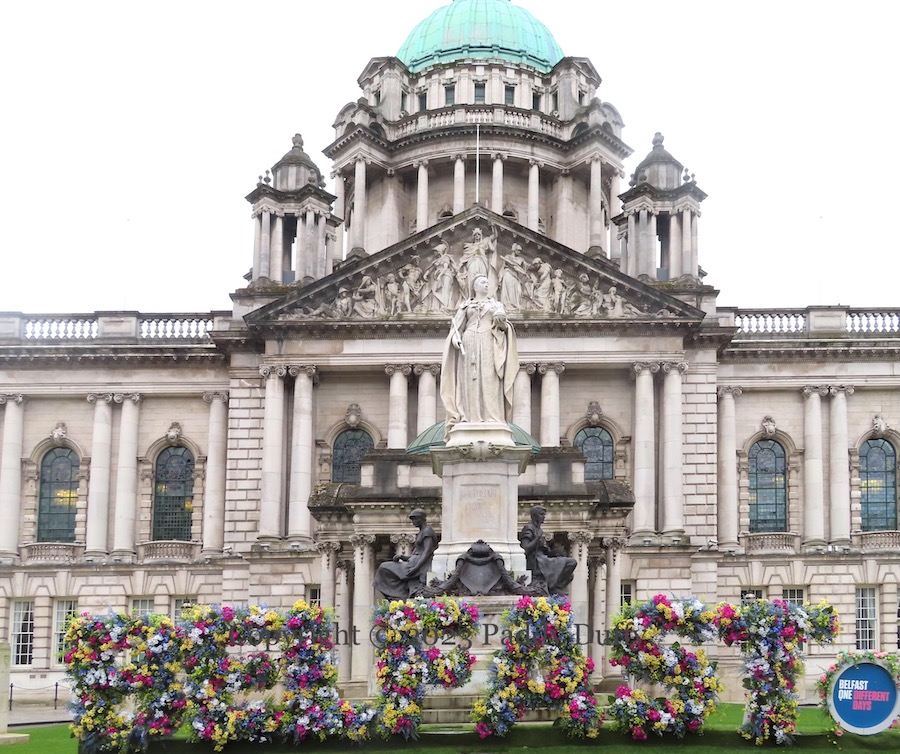
An 11-metre-wide set of bouquets spelling out “Belfast” has been installed in front of Belfast City Hall as the initial event of the Belfast One Business Improvement District’s campaign for 2023-2024. The calendar of events can be found here.
The Seal Folk or Selkies are shape-shifting creatures in island mythologies from Man to Ireland to the Scottish isles to the Faroes to Iceland. Seals in water, they can take off their skins and become (beautiful) humans on land. Without their skins, they cannot return, and so they can be captured by humans who hide their skins. A few tales can be found at Scotland’s Stories.









 Paddy Duffy Collection