The Holywood Arches

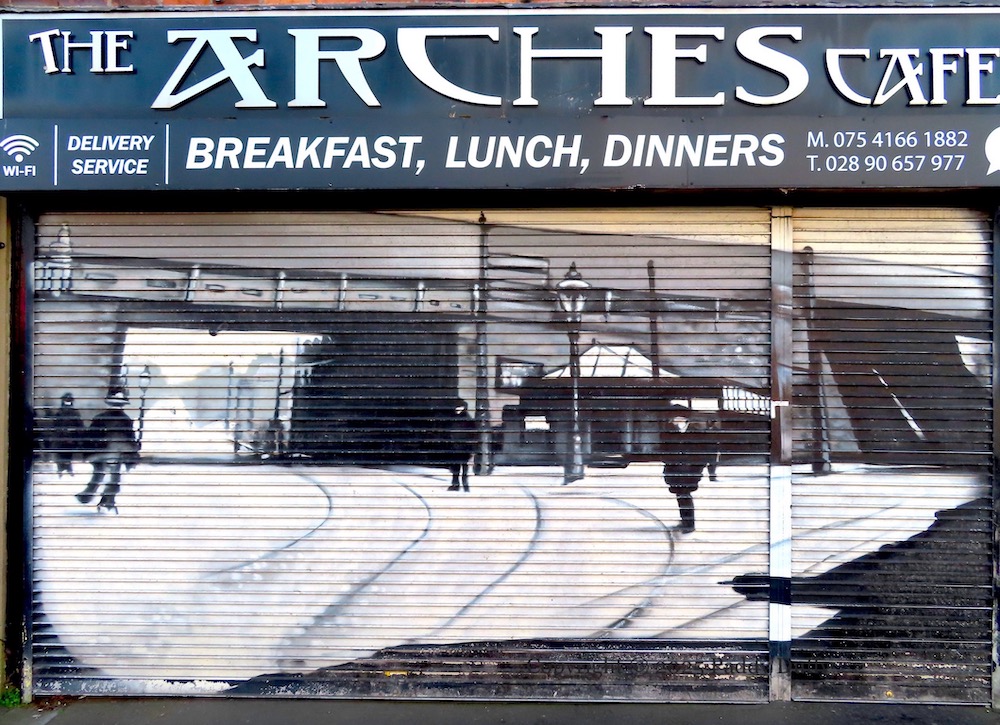
The area around the junction of the Newtownards Road and the Holywood Road in east Belfast is known as the “Holywood Arches”. The name comes from the fact that – up until 1950 – the old Belfast & County Down railway line from Comber (and beyond that from Newtownards or Newcastle) crossed over both streets on top of two large arches, wide enough to allow traffic in both directions and tall enough to accommodate double-decker buses (see e.g. this image on Pinterest).

This mural is on the shutters of the nearby Arches Café (web); the vintage photograph reproduced can be seen in this pdf from Eastside Partnership.

See also: Step Back In Time about a train crash in 1945 at Ballymacarrett station (on the Bangor line) that killed 22.

Click image to enlarge
Copyright © 2025 Paddy Duffy
T06440
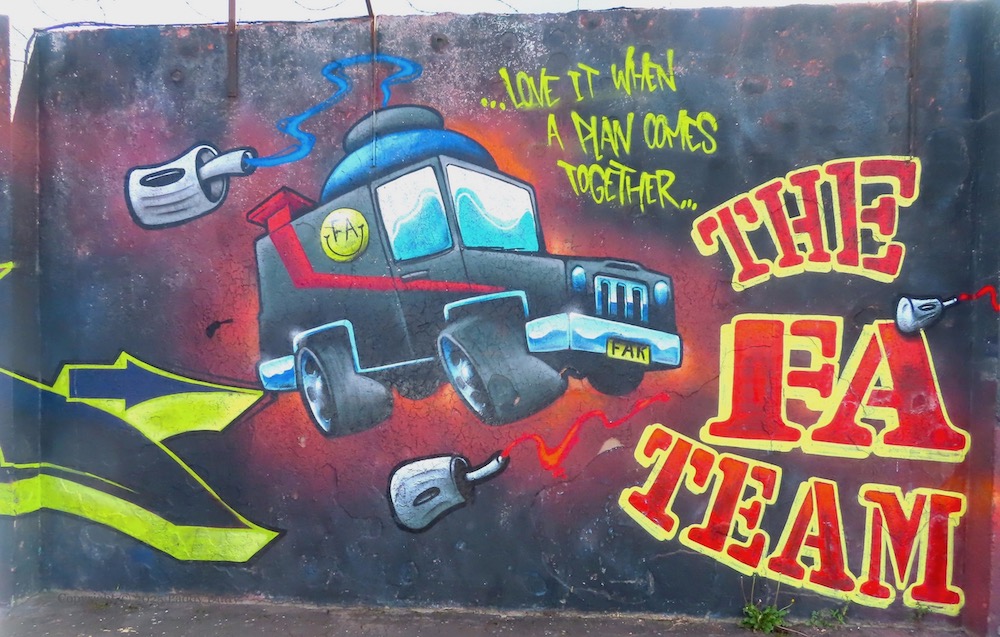
When A Plan Comes Together

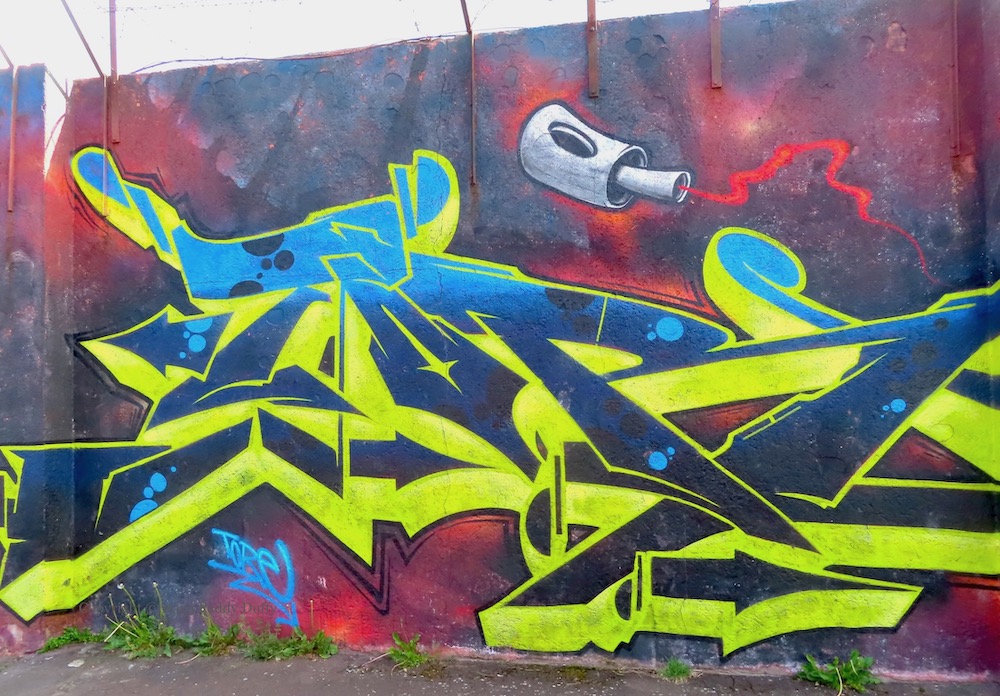
“I love it when a plan comes together” was the catch-phrase of Hannibal Smith, leader of the (fictional) A-Team, a crew of US soldiers from the Viet Nam war, on the run from the military police and working as hired guns back in the States, in the US television show of the same name. The font used in “THE FA TEAM” (below), like the font used in the show’s title card and credits, imitates military stencils.

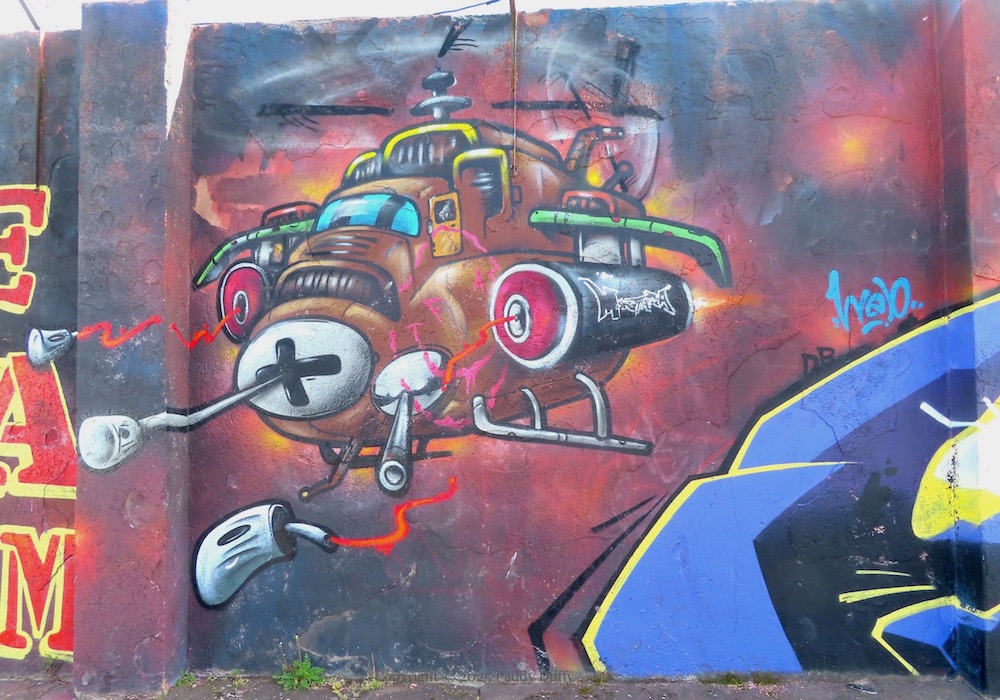
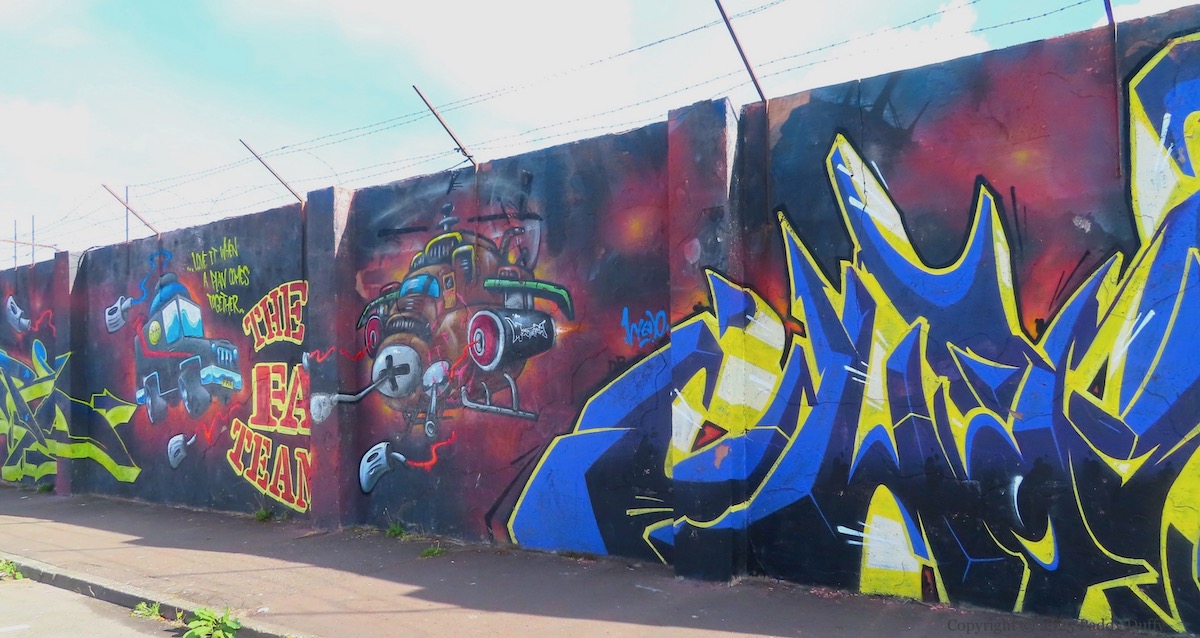
There were 98 episodes of the action-series (WP), and it felt as though at least 97 of them involved the gang’s GMC Vandura van being turned into an armed vehicle and used in a spectacular, guns-blazing, escape from and/or assault on the bad guys, assisted by daredevil helicopter-flying by Howling Mad Murdock. Both vehicles have been modified in the Foreign Assassins (Fb) graffiti art shown here with spray cans that are firing their caps as missiles.

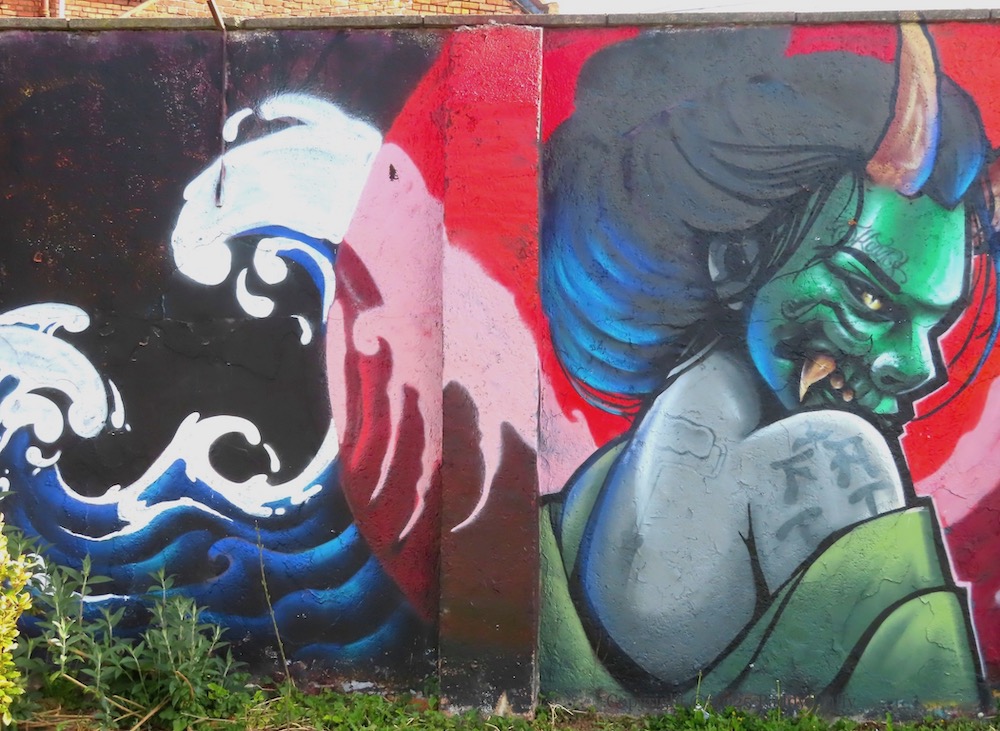
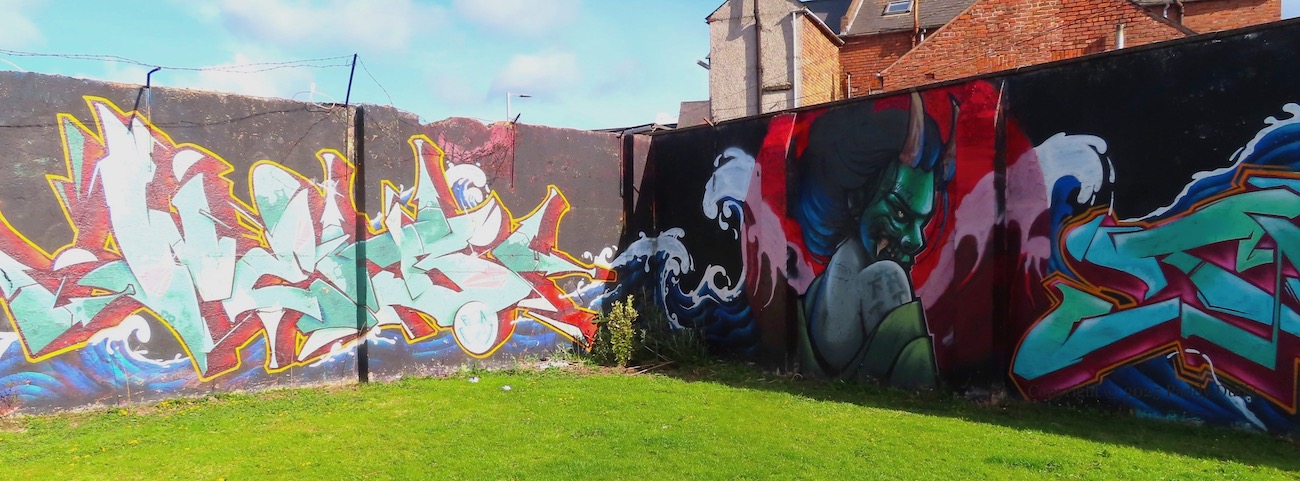
The art replaces Stranger Kings on the Comber Greenway in east Belfast.

Click image to enlarge
Copyright © 2025 Paddy Duffy
T06447 T06446 T06448 T06449 T06450
T06451 [T06452] T06453 T06454

The Main Man

“The Main Man” is John (“Wee John”) McKillop, a life-long super-fan of the Ruaırí Óg teams who died at the end of July 2023 at the age of 60 (Saffron Gael | BelTel). This is a repainting of the mural on the side of the Lurig Inn (Fb) in Cushendall; for the previous version, including information about the scene depicted, see Bound Together from 2023.

Click image to enlarge
Copyright © 2025 Paddy Duffy
T06434 T06433 T06435 [T06436]

Your Promise Maintained

This board in memory of Queen Elizabeth is on the Orange Hall in Carncullagh Road, which is home to LOL 534 and RBP 401. It was unveiled by Jim Allister at the end of 2022 (Dervock Community Fb).

“Queen Elizabeth II 1926 – 2022. “It’s worth remembering that it is often the small steps, not the giant leaps, that bring about the most lasting change.” Dervock thanks you for your service.” “On her twenty-first birthday, 21 April 1947, Princess Elizabeth pledged “I declare before you all that my whole life whether it be long or short shall be devoted to your service and the service of our great imperial family to which we all belong”. “Your Promise Maintained” – Thank You for Your Service Ma’am.”

“Our late Queen’s greatness came from her steadfast faith in Jesus Christ. On Christmas Day 2002 the Queen state, “I rely on my faith to guide me. I know that the only way to live my life is to try to do what is right. To give of my best in all that the day brings, and put my trust in God.” Jesus says in John 14:6, “I am the way and the truth and the life. No-one comes to the Father except through me.”

With the signatures of masters Roland Hill, James McMaster, and reverend Campbell Mulvenny of Dervock Presbyterian Church.

Last below: a tarp celebrating the coronation of King Charles III

Carncullagh Road, Dervock

Click image to enlarge
Copyright © 2025 Paddy Duffy
T06420 T06421 T06422

Memory Without End

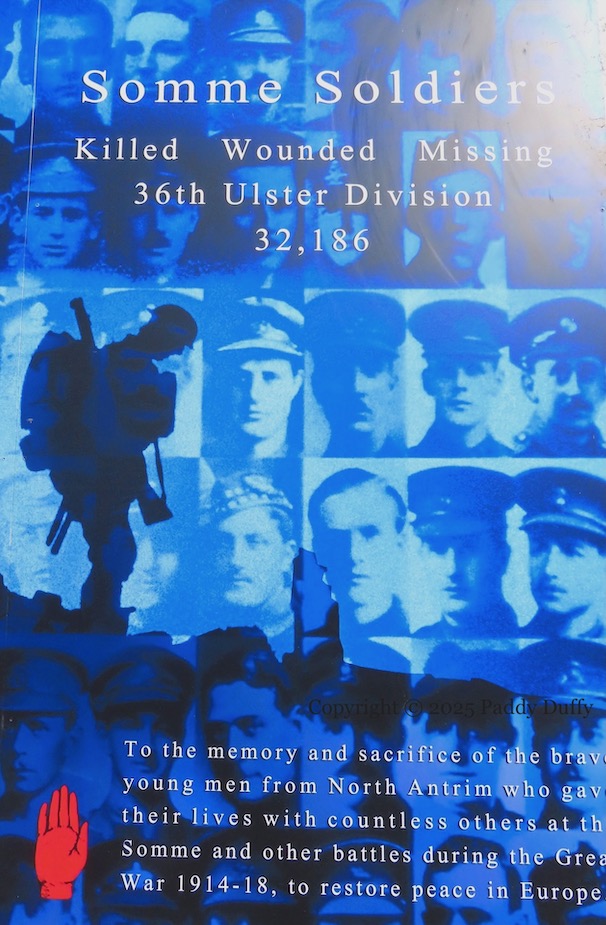
This is a 36th Division memorial board, with special attention to the men from the North Antrim regiment of the Ulster Volunteers (IWM), who in WWI were part of the 12th (Central Antrim) battalion of the Royal Irish Rifles and fought at the Somme (War Time Memories). The 36th Division in total suffered approximately 2,000 deaths and 3,000 casualties on the first day of the Somme offensive, July 1st, the Battle Of Albert (Royal Irish).

“1st July 1916. Somme soldiers killed, wounded, missing, 36th (Ulster) Division: 32,186.” “1-7-1916 7:30 a.m. remember”, “For these things do I weep; my eyes flow with tears – Lamentations 1 Vs. 16“, “Their name liveth for evermore”, “To the memory and sacrifice of the brave young men from North Antrim who gave their lives with countless others at the Somme and other battles during the Great War 1914-18, to restore peace in Europe. To them bravery was without limit, to us memory is without end.”

On the left-hand side is John McCrae’s poem ‘In Flanders Fields‘.

Castlecat Road, Dervock

Click image to enlarge
Copyright © 2025 Paddy Duffy
T06417 T06418 T06419

From Scotland, To Ulster, To America

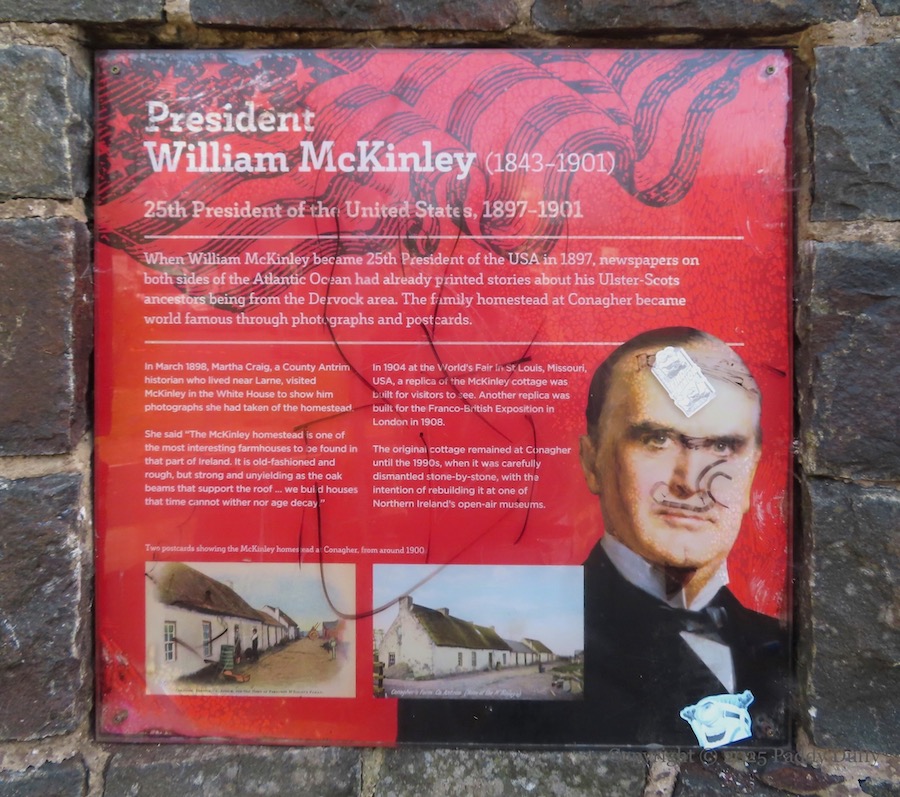
William McKinley served as the 25th president of the United States, from 1897 to 1901, when he was assassinated six months into his second term. His paternal line goes back from Ohio – which is where William was born in 1843 and was the state he would represent in the House – to Pennsylvania and previously to Ireland and Scotland, though there is some confusion as to who moved where and when.

This installation is in Riverside Park in Dervock, County Antrim. The second board below states that McKinley’s great-great-grandfather James emigrated to the Province Of Pennsylvania in 1743 from Conogher/Conagher, a townland to the west of the village. (Another source gives “David” but cf. this family tree.) Previously, ancestors had come to Ulster from Scotland, though again the history is uncertain – the information on the boards makes connections to both Robert The Bruce and the Williamite army.

The fourth (missing) panel had the heading “Proud of his Ulster-Scots roots”; it can be seen in this News Letter article concerning Francis McKinley’s participation in the 1798 rebellion – in the same vein, it cites a New York Press article that claims the emigrants of 1743 were “driven from their homes for their opposition to English misrule”.

Click image to enlarge
Copyright © 2025 Paddy Duffy
T06412 T06413 T06414 T06415

The Journey Of Heritage And Culture

Here are two boards in Riverside Park, Dervock, celebrating the town’s “heritage and culture”.

Above: “Kennedy Kane McArthur, Dervock born and bred. 1912 Stockholm Olympics marathon gold medal winner, new World Record.” Ken McArthur emigrated to South Africa at age 20 and ran his first marathon at 28. Four years later, he represented South Africa at the Olympics and was victorious in the marathon (WP). There is footage of the race at olympics.com. There is a display of boards honouring McArthur on an abandoned building in Dervock.

Below: “The journey of heritage and culture has shown us who we are, the memory of our past will let a new future begin.” Members of the (contemporary) Dervock flute band (Fb) stand on the Scottish St Andrew’s Saltire, above a black-and-white photograph (from NI Archive) of drumming – including Lambeg drumming (Discover Ulster Scots) – from about 1920.

Also in Riverside Park: a tribute to US president Andrew Jackson.

Click image to enlarge
Copyright © 2025 Paddy Duffy
T06416 T06424

Kevin McKeeman

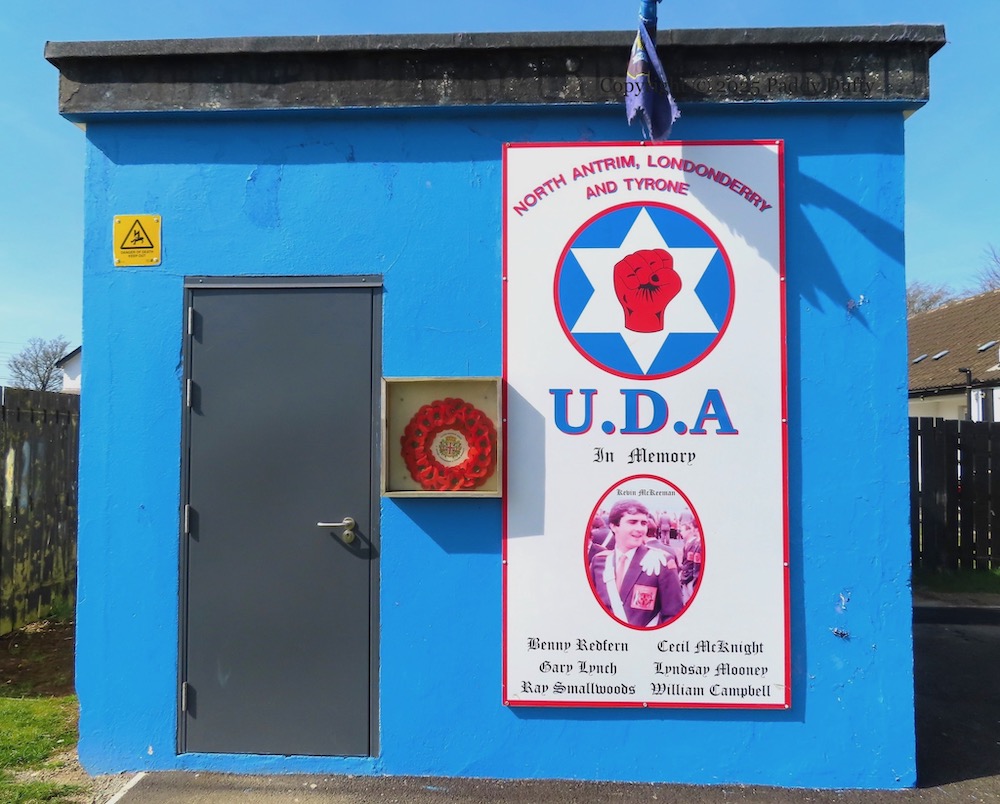
As can be seen from the photography, Kevin McKeeman was a flute band member, perhaps part of the local Dervock Young Defenders (Fb) though the patch shown is not the current one.

He is named here alongside six “North Antrim, Londonderry, And Tyrone” UDA members – “Benny Redfern, Gary Lynch, Ray Smallwoods, Cecil McKnight, Lyndsay Mooney, William Campbell” – who are named (together) on a number of murals in Londonderry and along the north coast – for background on them, see UDA Memorial.

The memorial board is now accompanied by a poppy wreath and blue background on the substation in McArthur Avenue, Dervock – compare with the images from 2019 in Tony Crowley’s collection.

Click image to enlarge
Copyright © 2025 Paddy Duffy
T06425 T06426

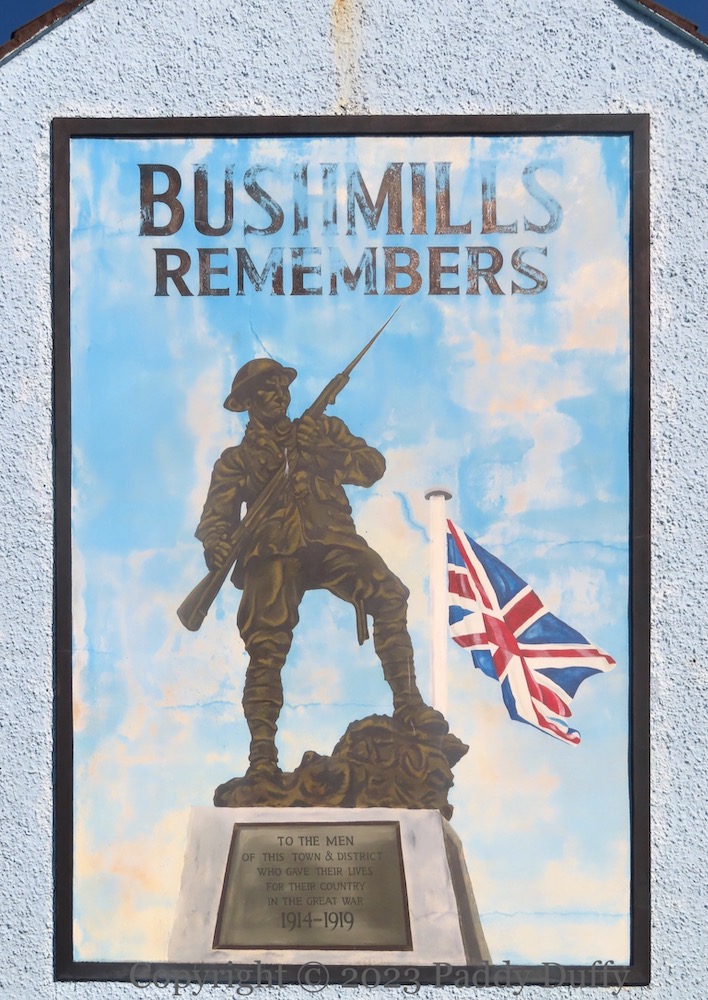
Bushmills Remembers

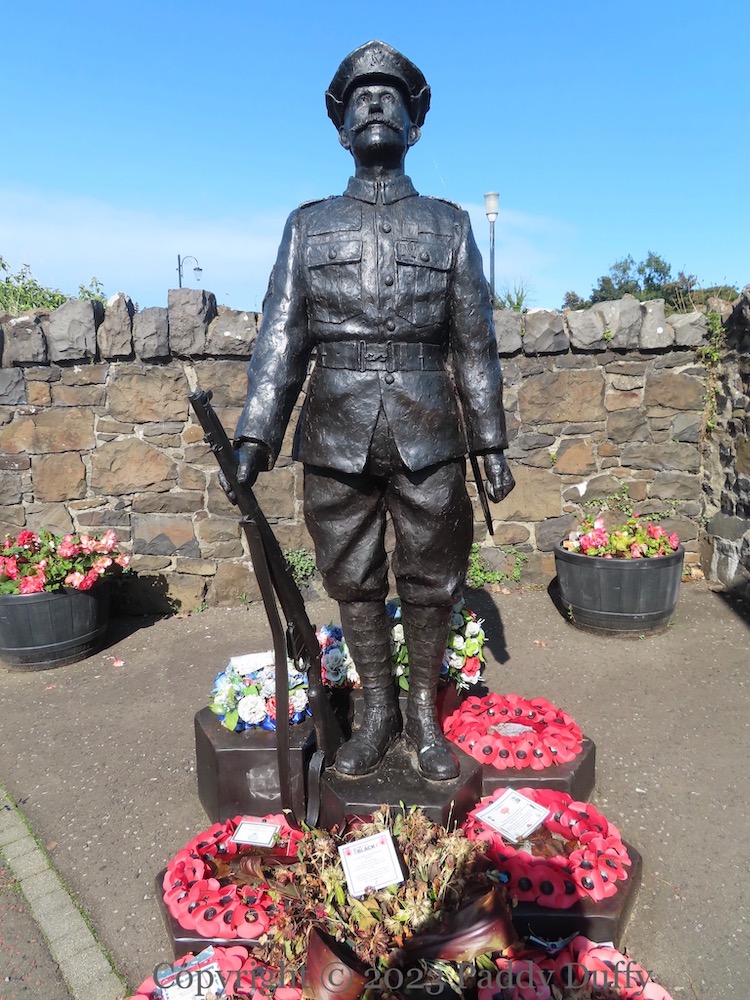
153 men of the 12th Battalion Royal Irish Rifles (which included men from Ballymena and other Central Antrim Volunteers) died on the first day of the Battle Of The Somme, July 1st, 1916. The 12th’s Robert Quigg received the VC for his actions in the evening, rescuing wounded men from no-man’s-land. He is remembered by the statue and plaque (shown below) in Bushmills; he was from Ardihannon townland near the Giant’s Causeway and before the war commanded the Bushmills unit of the Ulster Volunteers (WP).

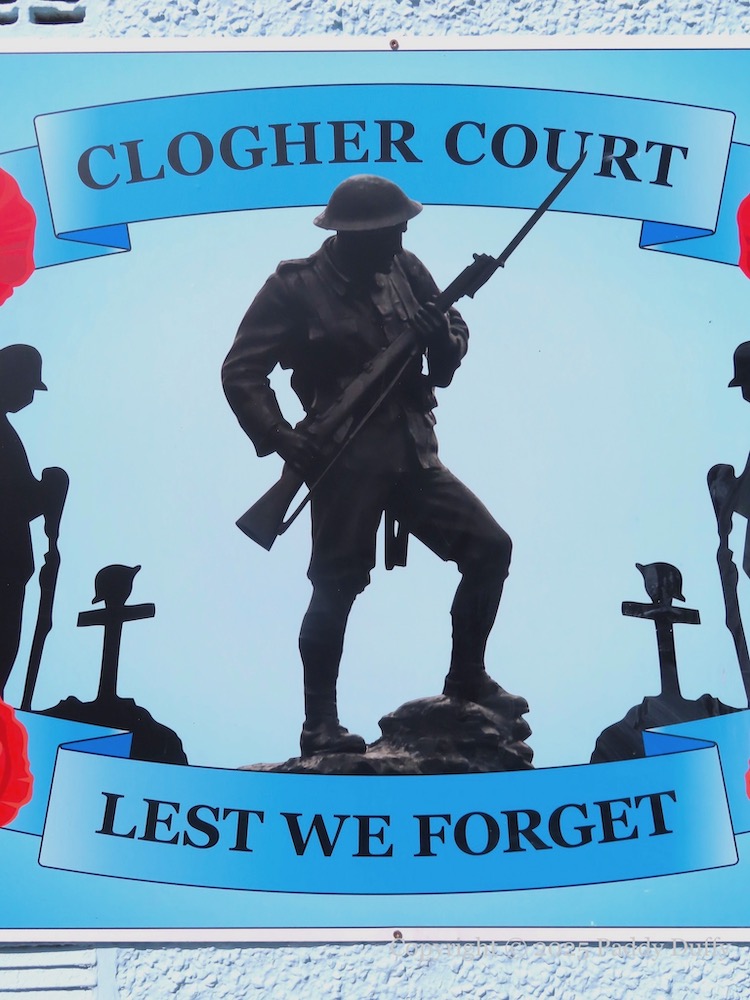
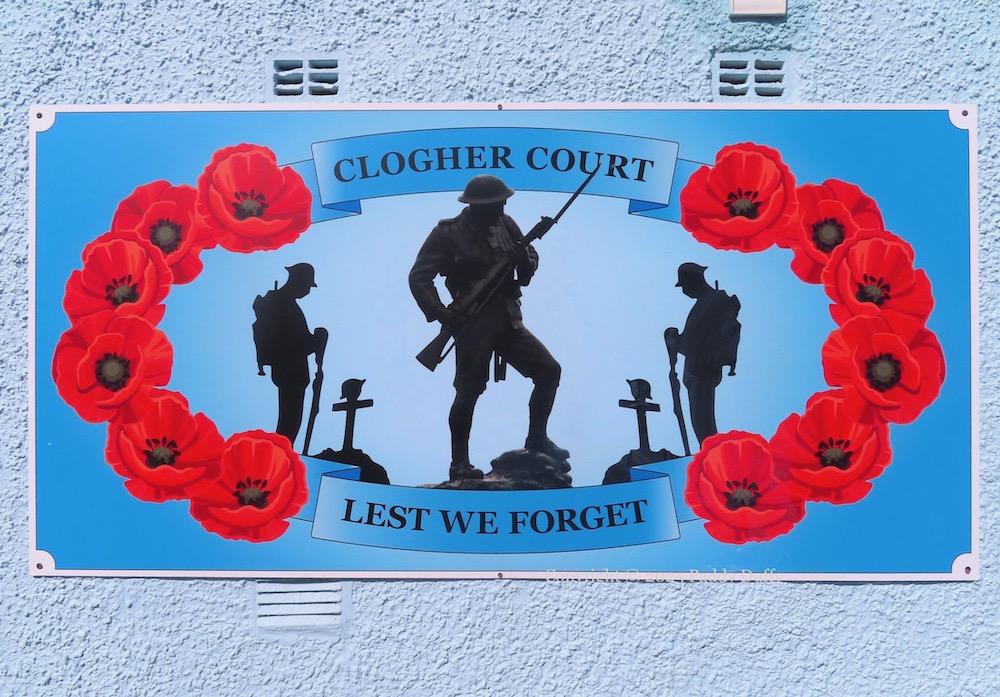
The boards are in the Dundareve estate, Bushmills, and the Quigg statue is on Main Street, just west of the estate. The boards both depict the War Memorial statue in the middle of the roundabout at Main Street and Dunluce Road.

Click image to enlarge
Copyright © 2025/2023 Paddy Duffy
T06432 T06431
T03311 T03312 T03315