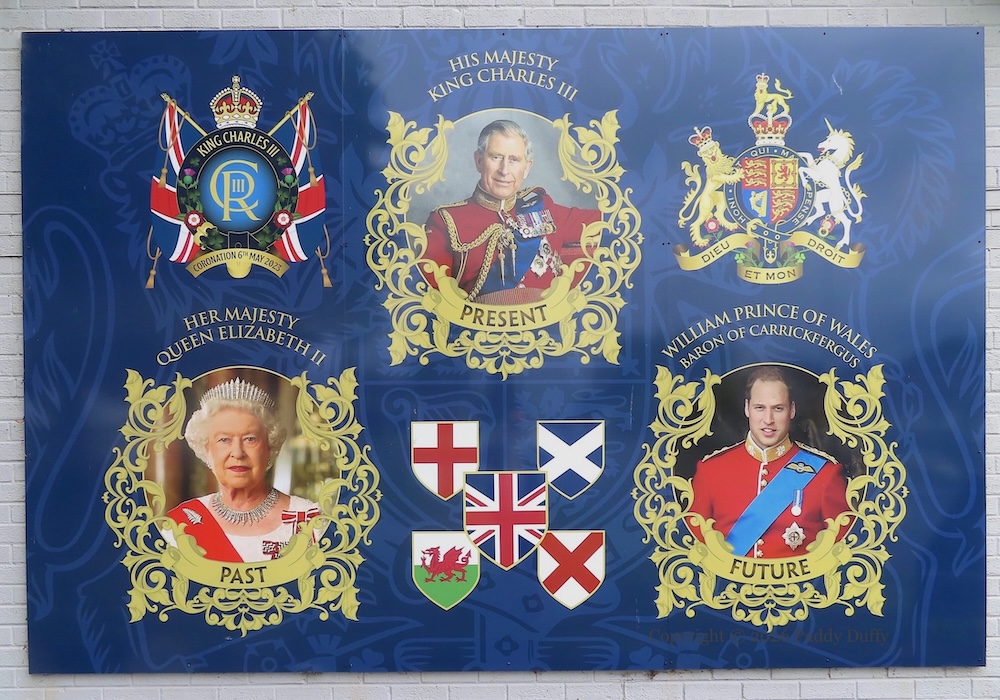
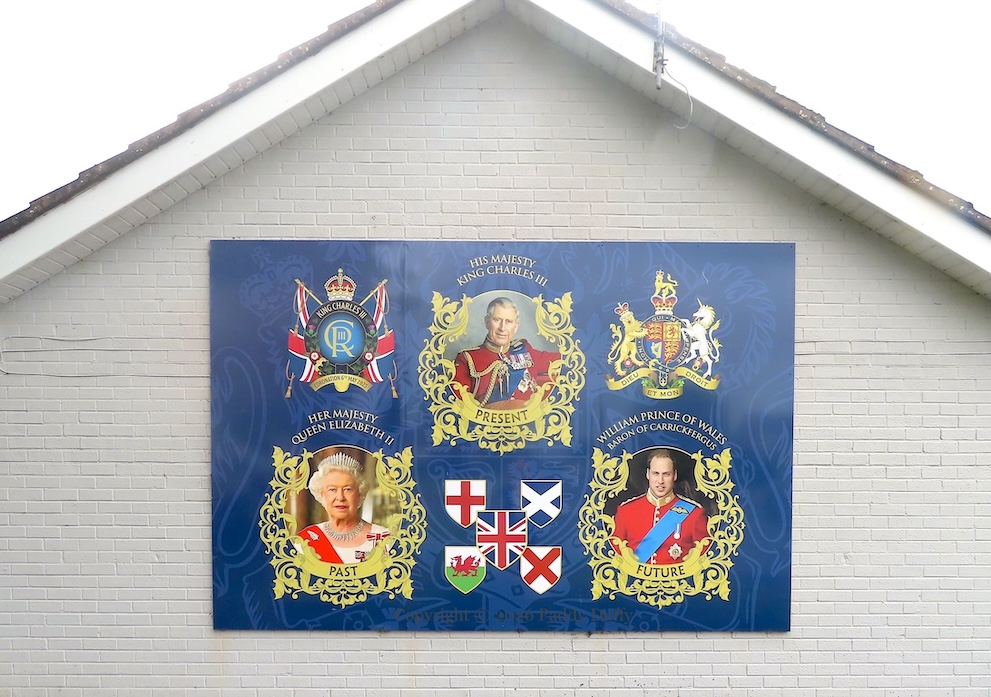
That is, king or queen “by the grace of God” or divine right. The first UK monarch to use the phrase was Henry V in the early 1400s and it has been used as a royal motto since then, up to and including the present-day monarchs shown on this board in the Caw, Londonderry.
On the left, the past – Her Majesty Queen Elizabeth II; in the centre, the present – His Majesty King Charles III; on the right, the future – William Prince Of Wales, Baron Of [sic] Carrickfergus.
The Welsh dragon is included alongside the three flags/crests that make up the Union Flag – St George’s Cross for England, St Andrew’s Saltire for Scotland, and St Patrick’s Saltire for Ireland.
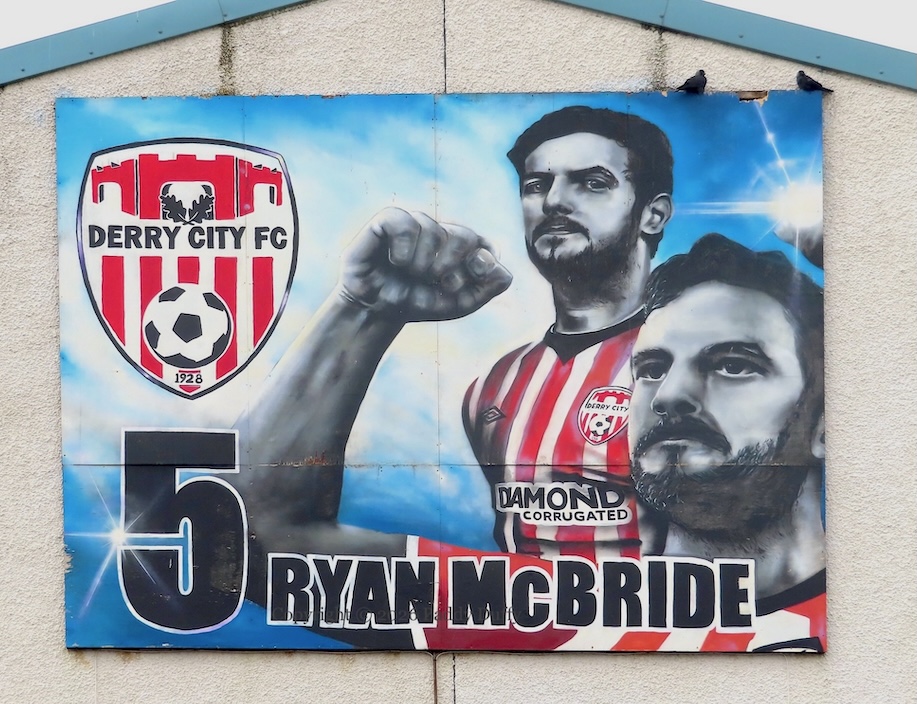
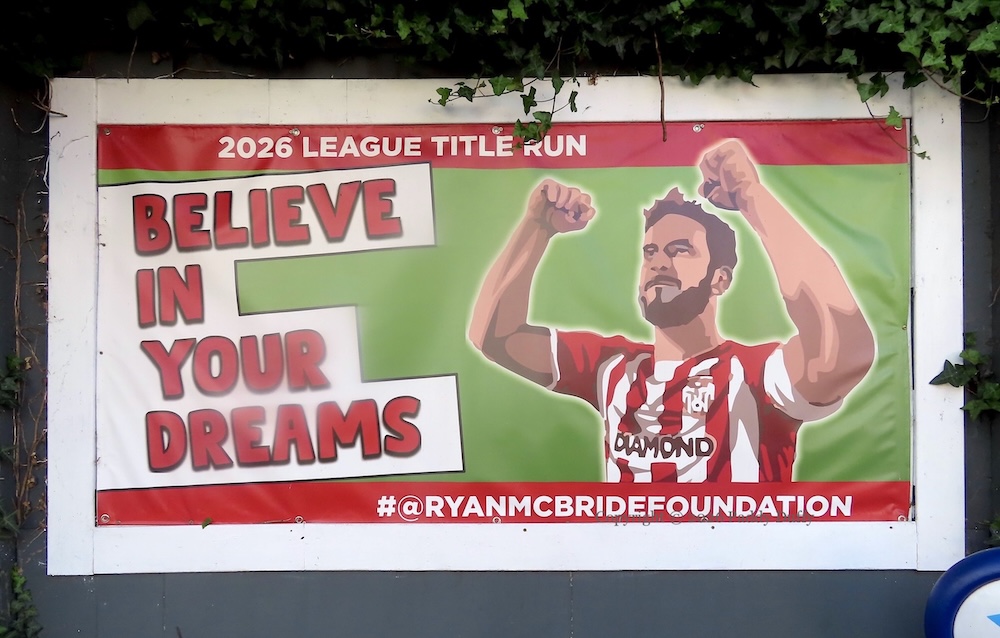
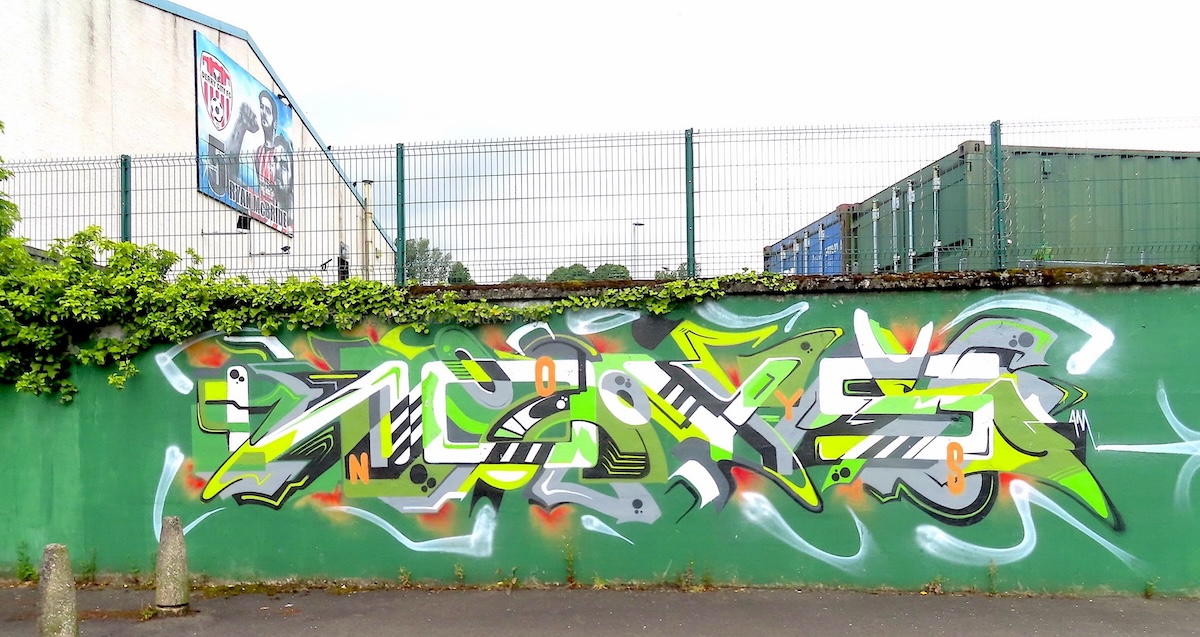
Ryan McBride was a Derry City FC defender and captain who died suddenly in 2017 at the age of 27 (BBC). The stadium was renamed, and the Ryan McBride foundation (web) was established, in his honour.
The piece above (by Ray Bonner) is at the Brandywell stadiums; the banner below is in Lecky Road.
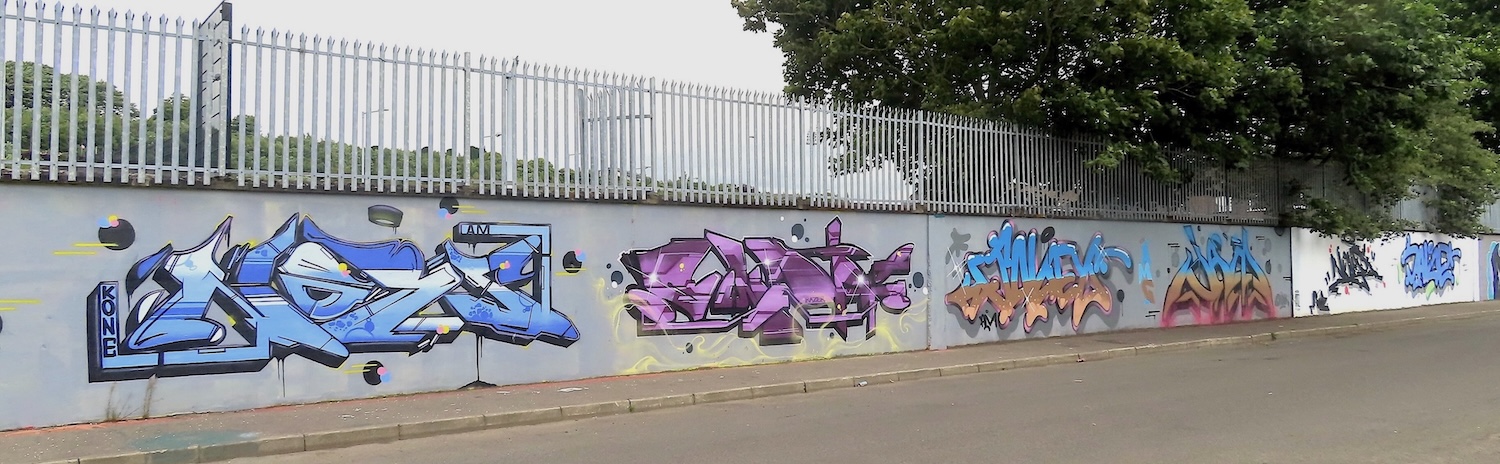
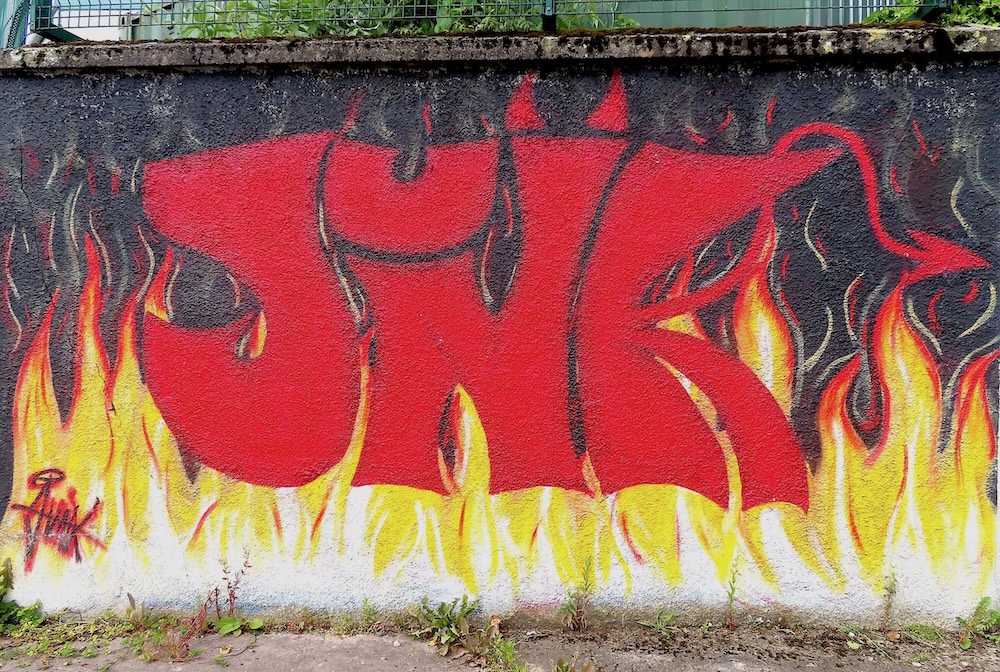
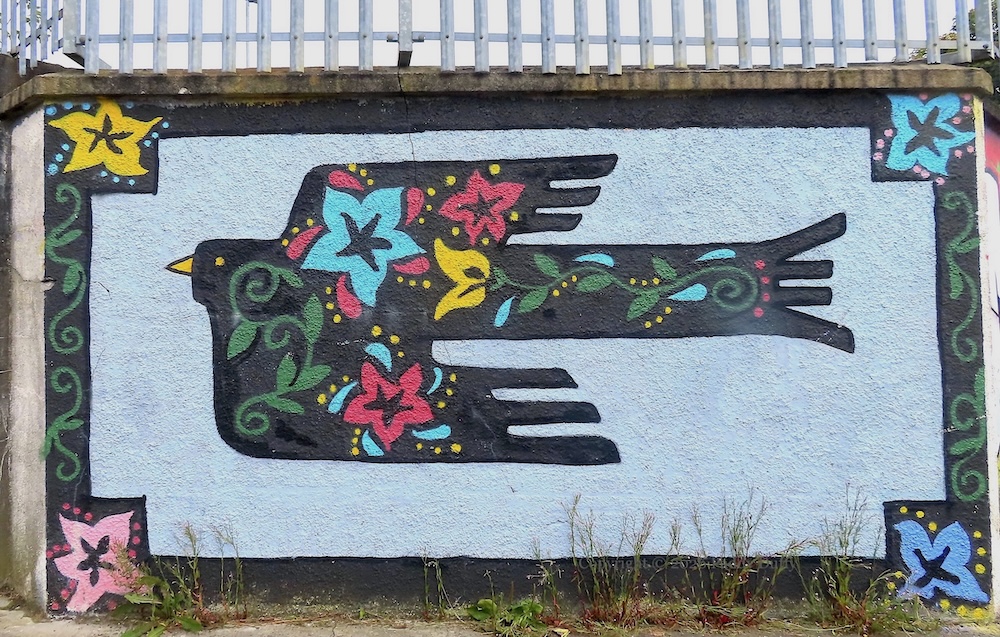
Here is a small gallery of the wild-style and street-art in the street (formerly Anne Street) above Glendara, Derry. The most-recently painted works are the left-most quartet above, including (l-r) work by NOYS (ig), Dave Bonzai (ig), Kyle McGinley (writing “Jakey”) (ig), and Jam2 (ig).
The other three are older (2025) pieces at the rear gate of the Brandywell stadiums. Above the older NOYS piece is a board remembering Ryan McBride.
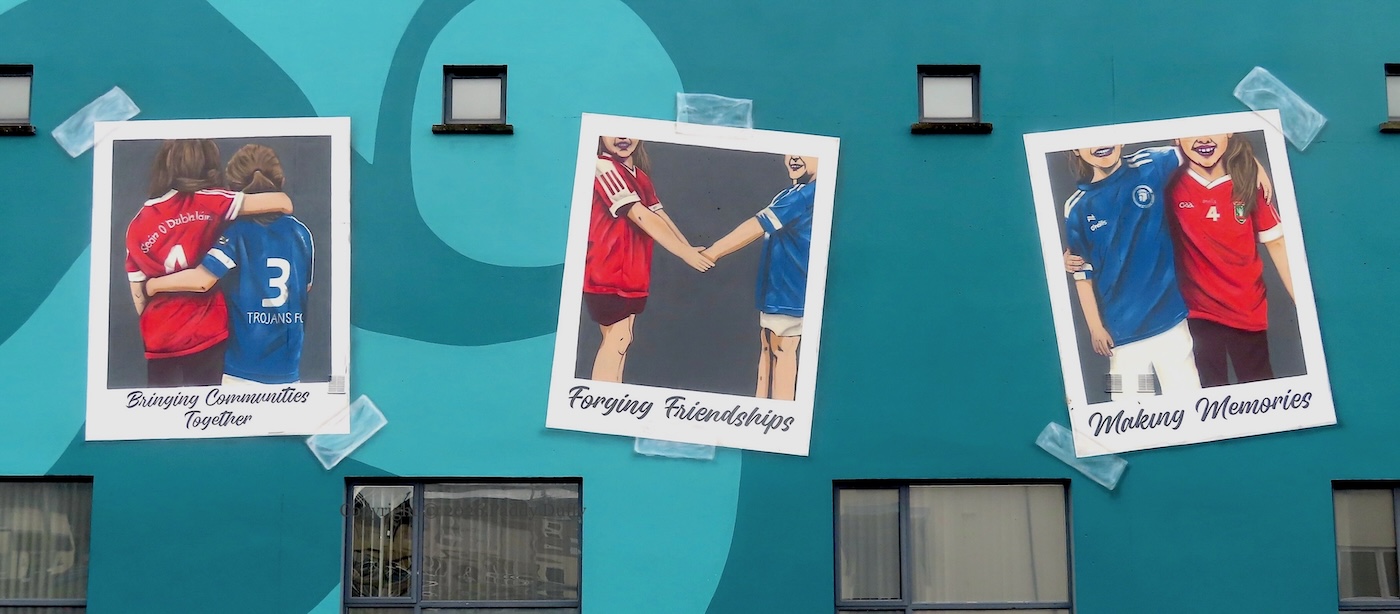
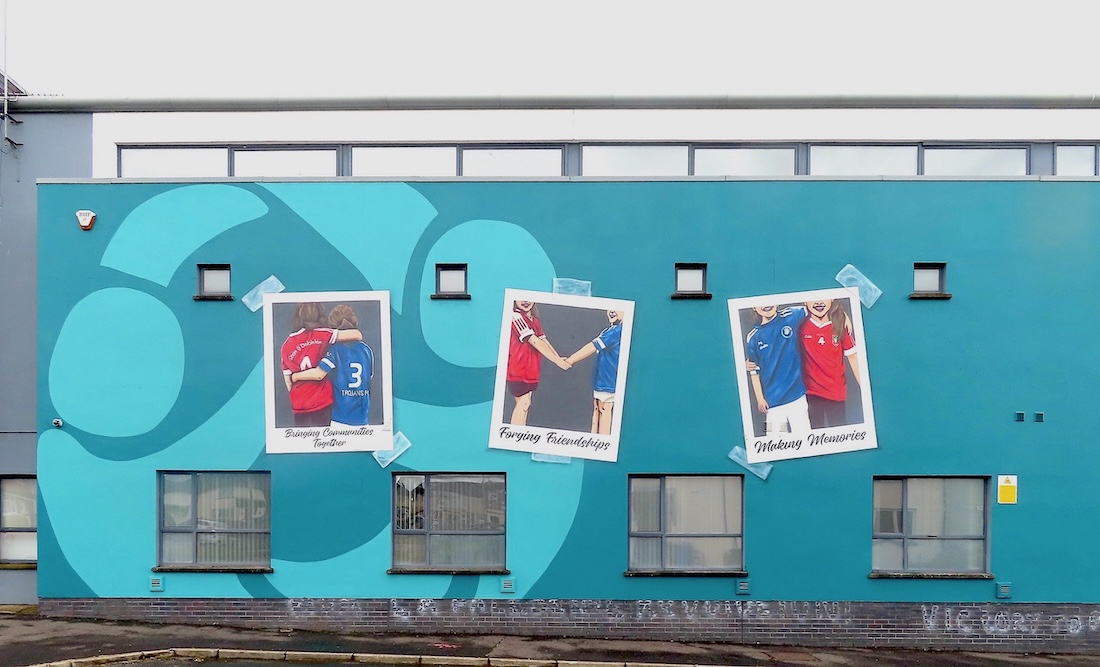
Girls from Seán Dolans GAC (Fb) and Trojans Youth & Community Group (Fb) are “bringing communities together”, “forging friendships”, and “making memories”.
Painted by Peaball (web) with support from Féıle Derry (web) on what is now the Health For Life (Fb) building on Linsfort Drive in Creggan, Derry
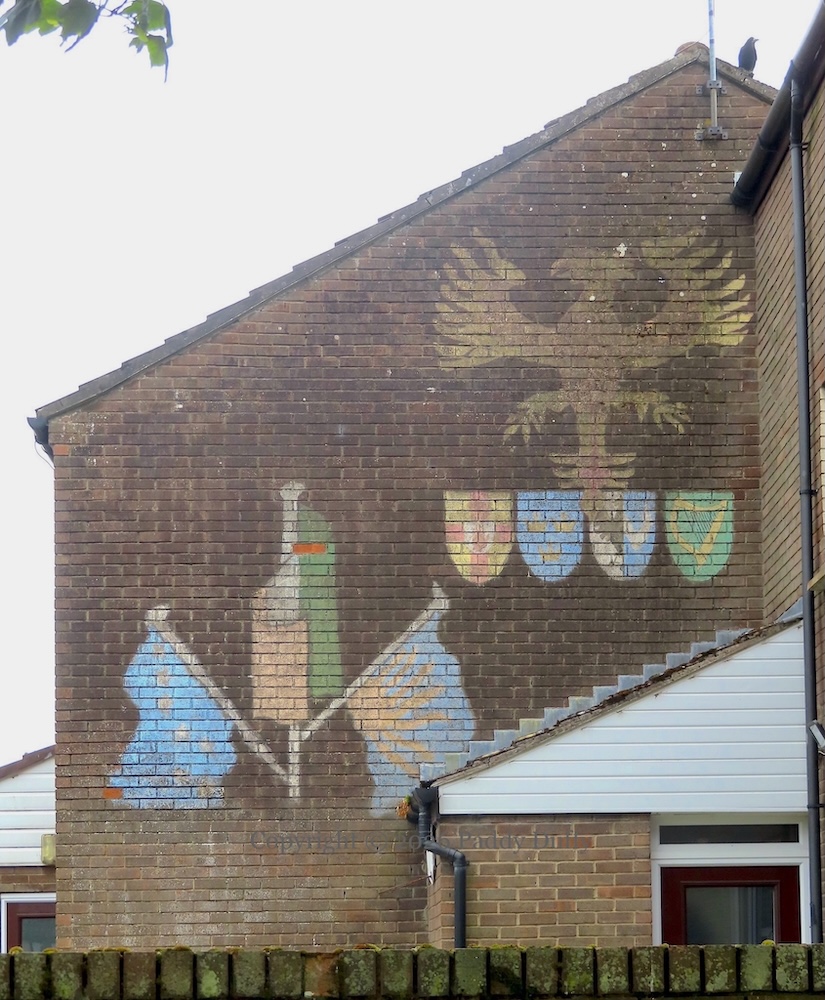
This mural, painted in 1981, still exists as is and is thus the oldest original mural in the north. It shows a phoenix rising from the shields of the four provinces and a stand of three flags: Starry Plough, Tricolour, and Sunburst.
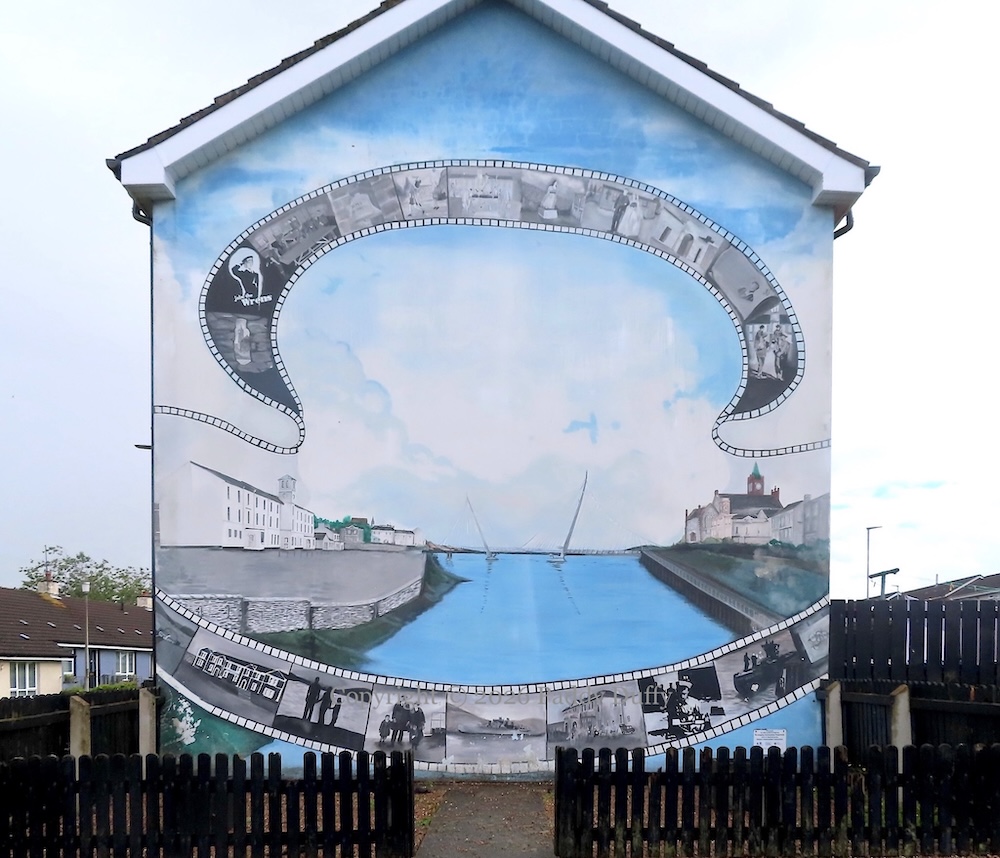
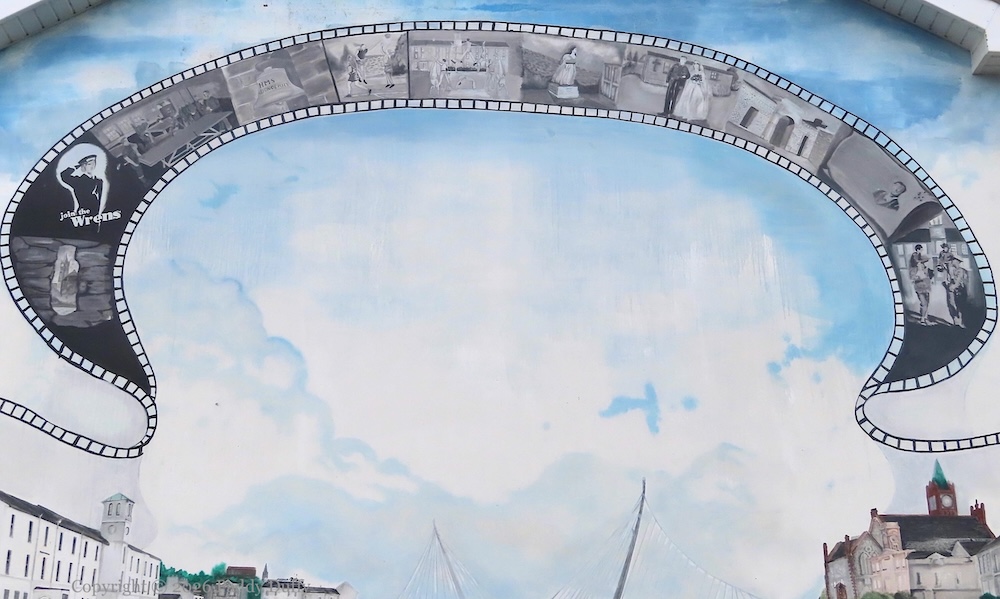
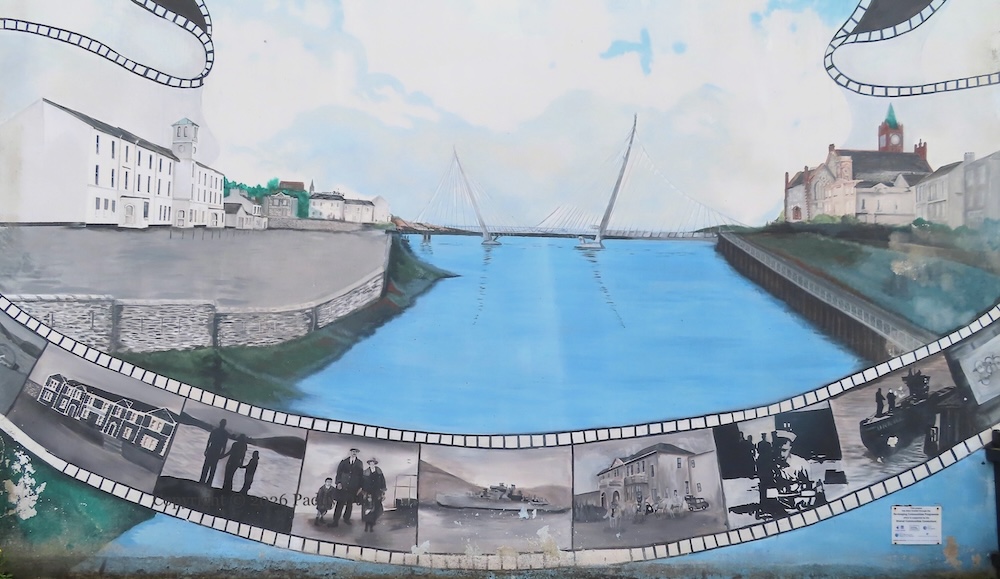
The Peace Bridge is shown spanning the Foyle between (the former) Ebrington barracks and the Guildhall, with a film-strip of images, many depicting naval and military scenes, above and below. The first few panels in the upper ribbon show a gap in the walls of Derry, a poster encouraging people to “Join the Wrens [and free a man for the fleet]” (the Women’s Royal Naval Service; see the poster at IWM), soldiers playing ping-pong in their barracks, and the ship’s bell of the HMS Londonderry (which served as a training ship during the Falkland War (WP)).
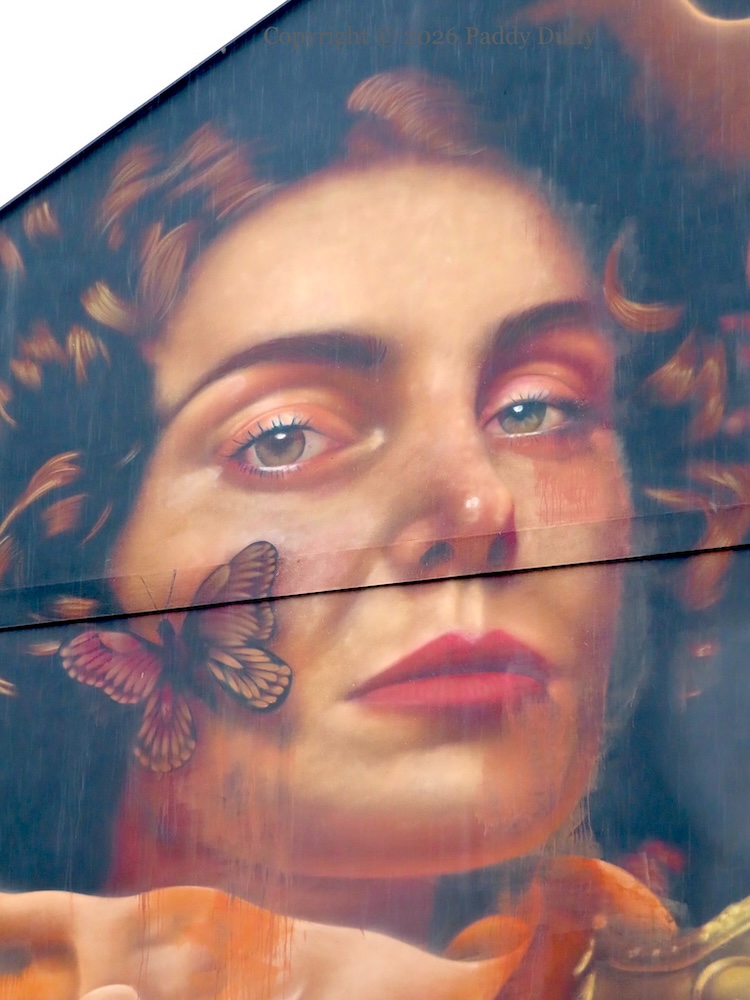
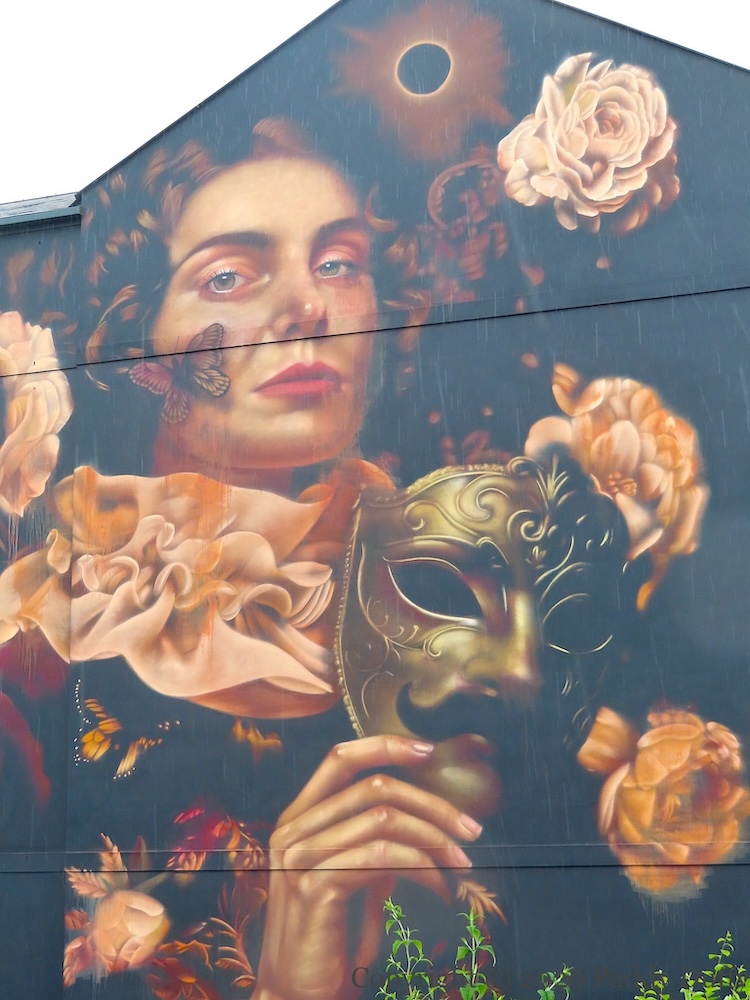
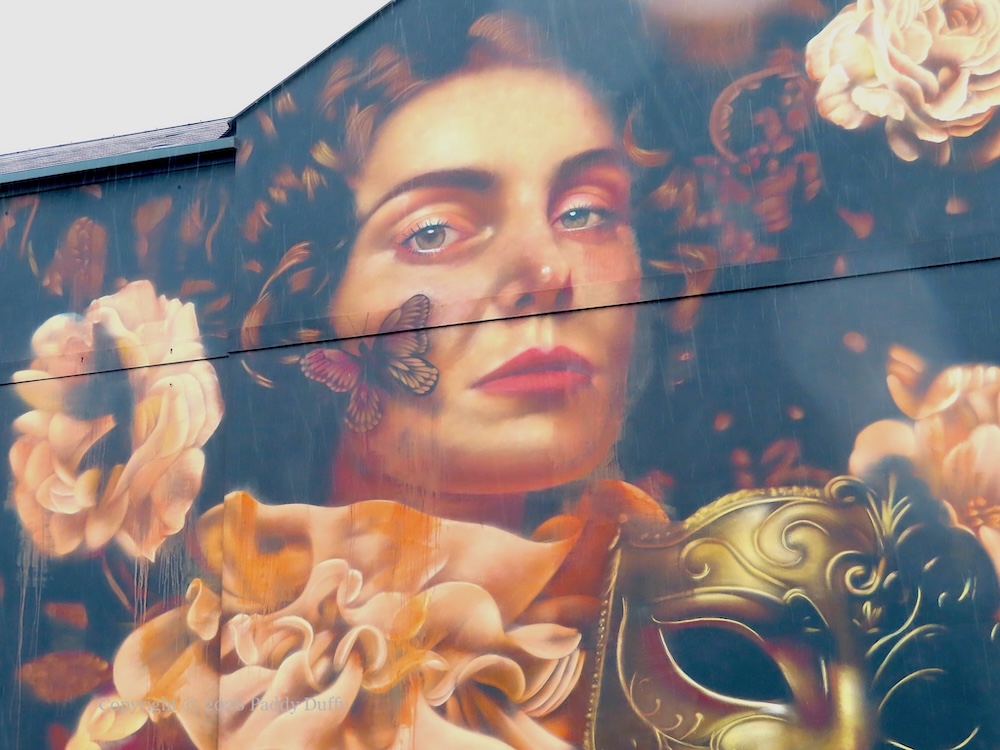
Annie Russell was born (1868) and raised in Strabane, Ireland. She studied at Girton College, Cambridge, and took a job at the Royal Observatory in Greenwich as a “computer”, photographing and analysing sunspots. She married Walter Maunder in 1895 and was admitted to the Royal Astronomical Society in 1916. She died in 1947.
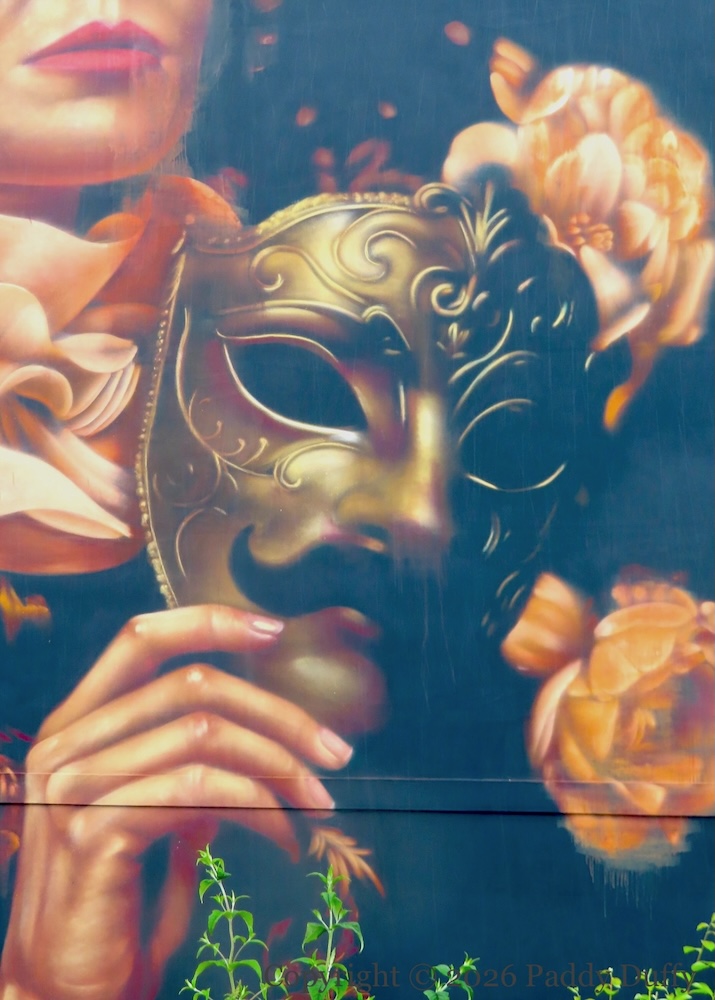
The mural references Maunder’s work in a number of ways: the eclipse in the apex is a reference to Maunder’s work on eclipses – she travelled to Norway in 1896, India in 1898, Algiers in 1900, and Mauritius in 1901 in order to photograph and research the solar eclipses; the butterflies are a reference to the “butterfly” diagram for sunspots (WP).
Most particularly referential is the mask with a moustache that she is holding. This is a reference to the treatment of women in the academic and scientific communities of the time: as a woman, she received no degree for her studies at Cambridge; as a married woman she was compelled to give up her position at the Observatory; she had been first nominated for membership of the Society more than twenty years earlier; her work in her first year at the Observatory was not credited to her and the butterfly diagram was initially attributed solely to Walter.
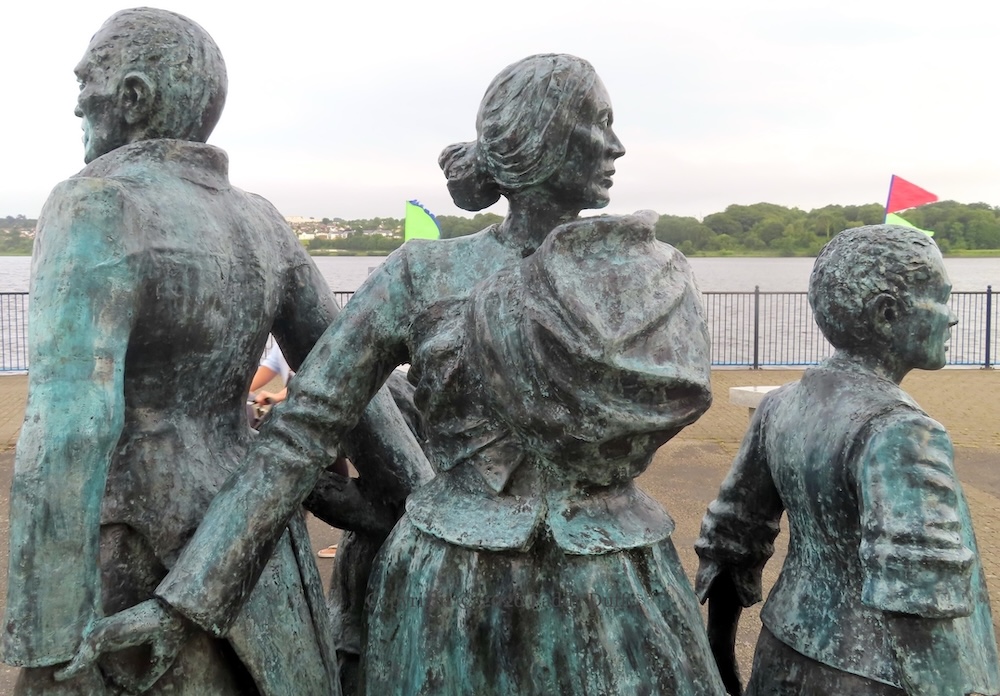
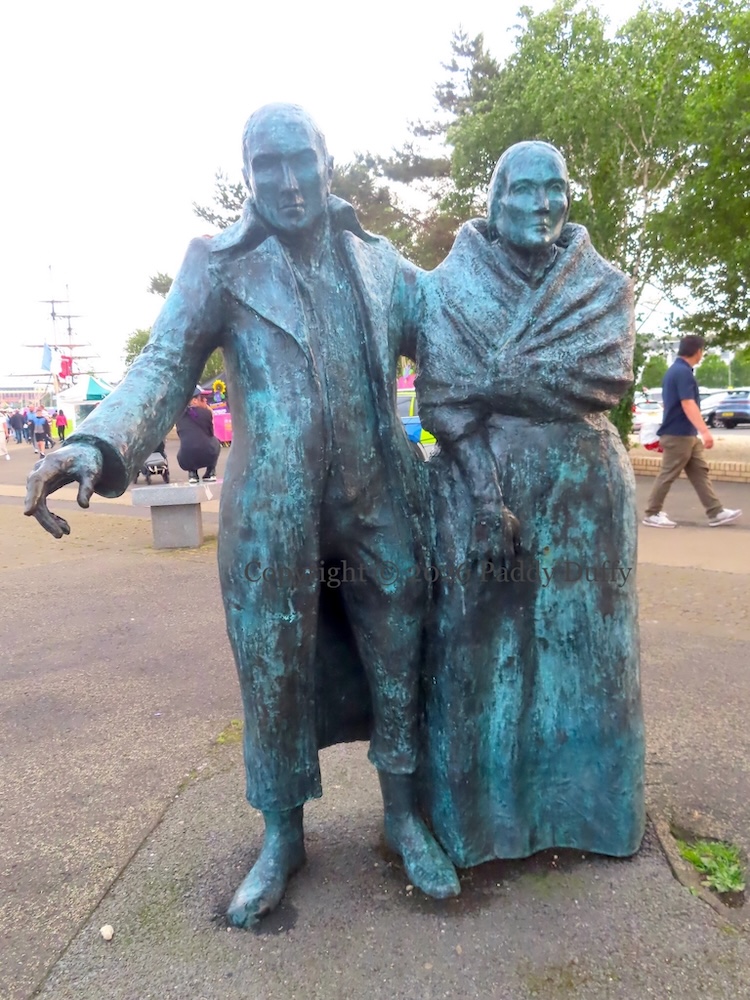
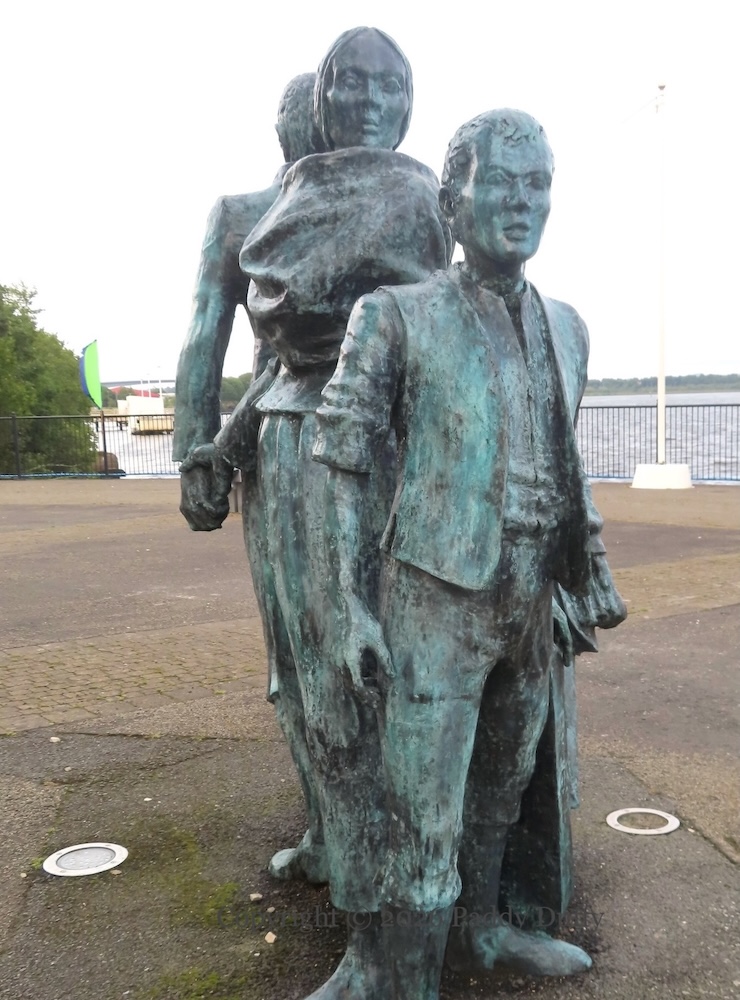
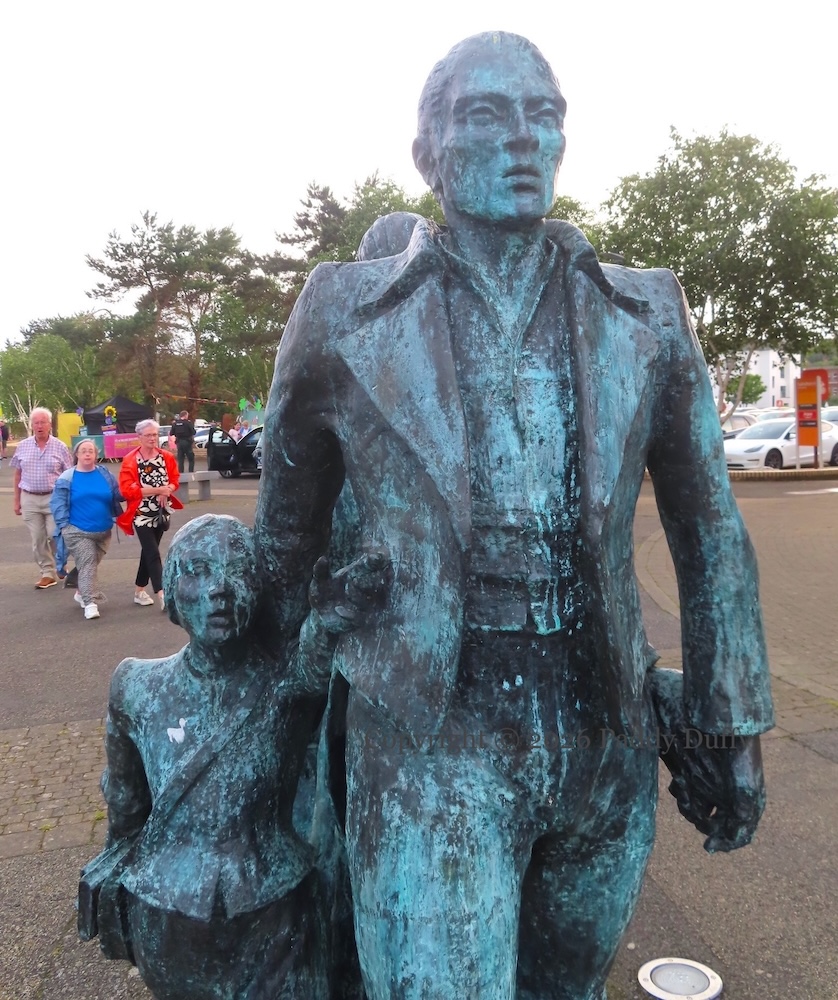
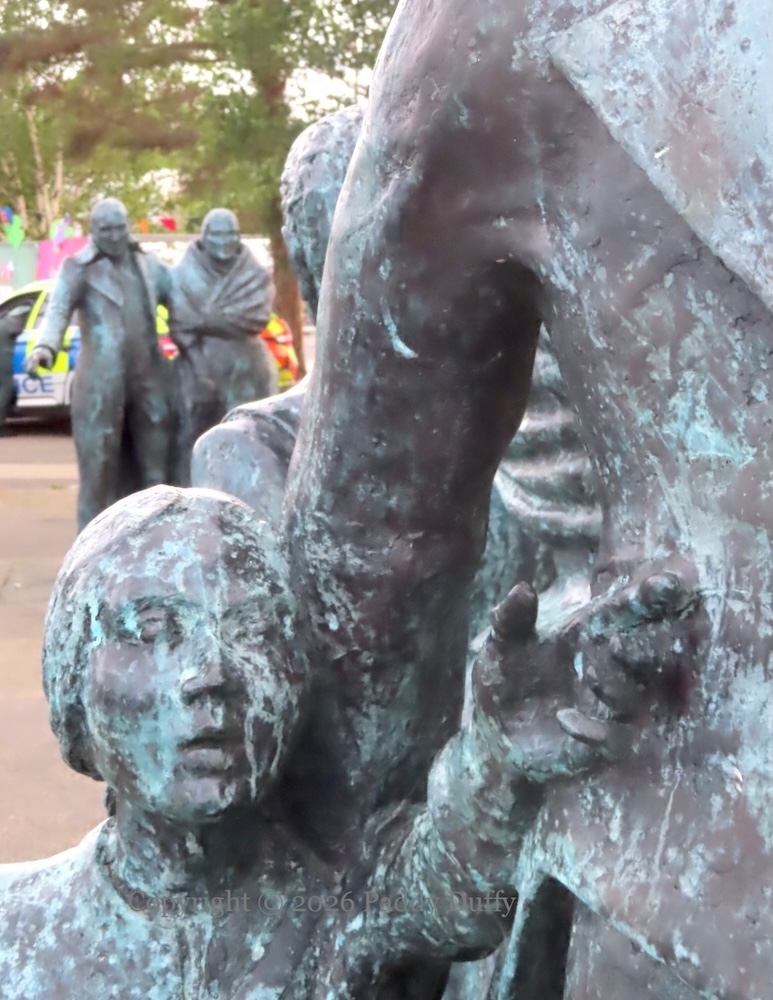
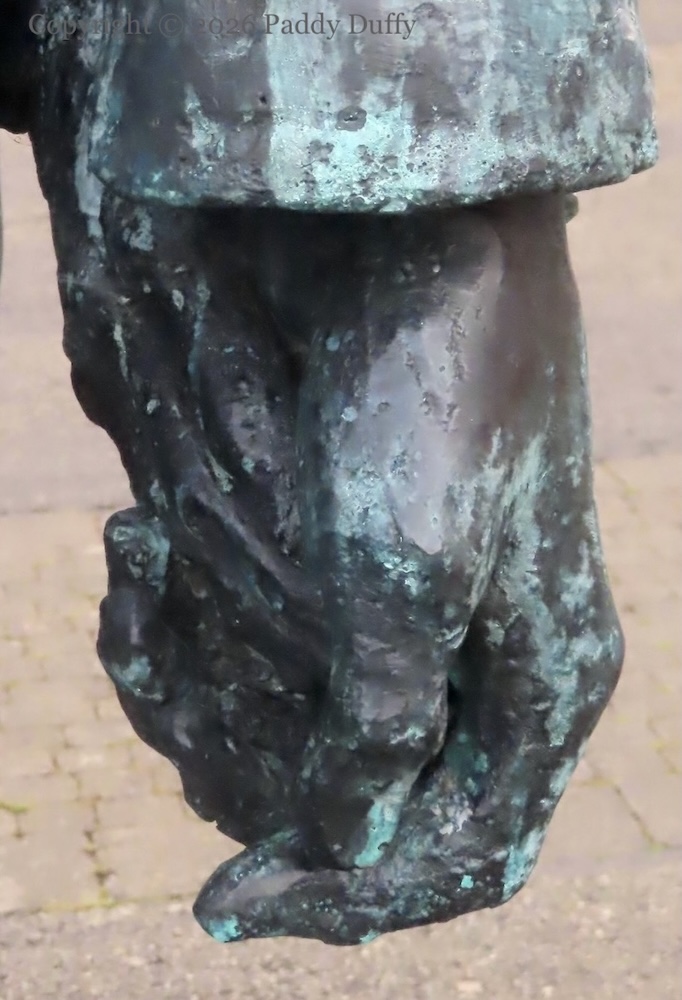
‘The Emigrants’ is a set of three statues (two of which are shown here) created by Eamonn O’Doherty in 1990 (DIB) which stood for many years in Waterloo Place (Peter Moloney has images) until c. 2008, when they were (put into storage and eventually) moved to the waterfront, at a point where ships would have departed for North America during the Hunger.
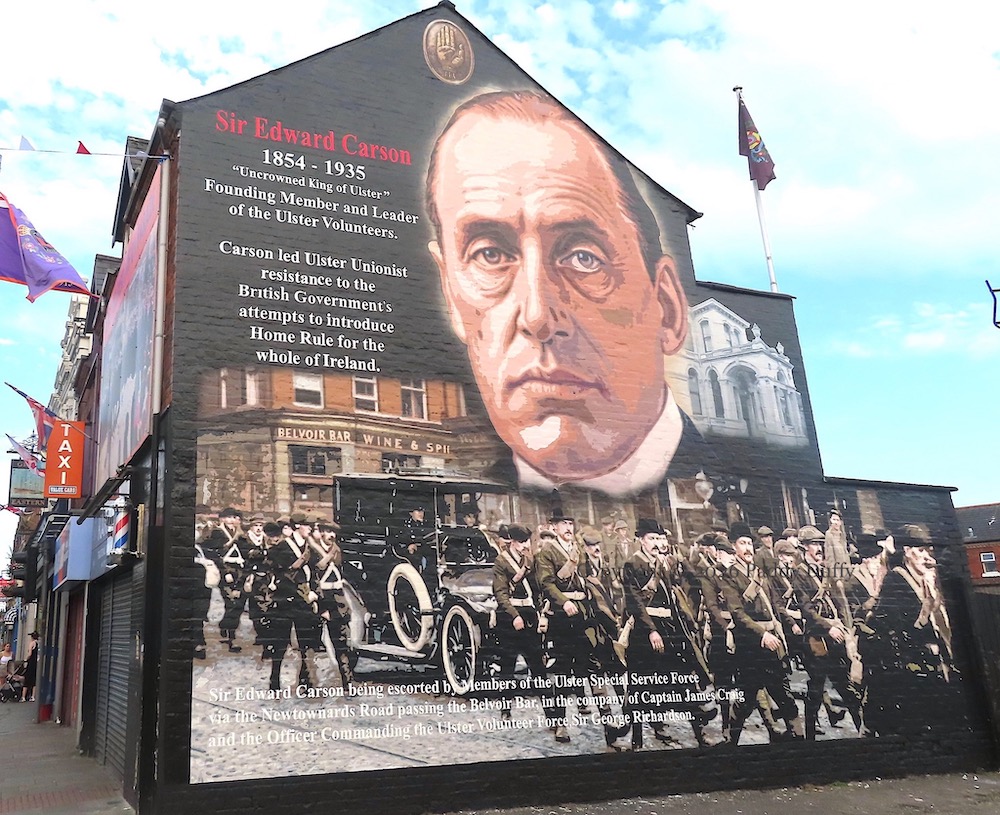
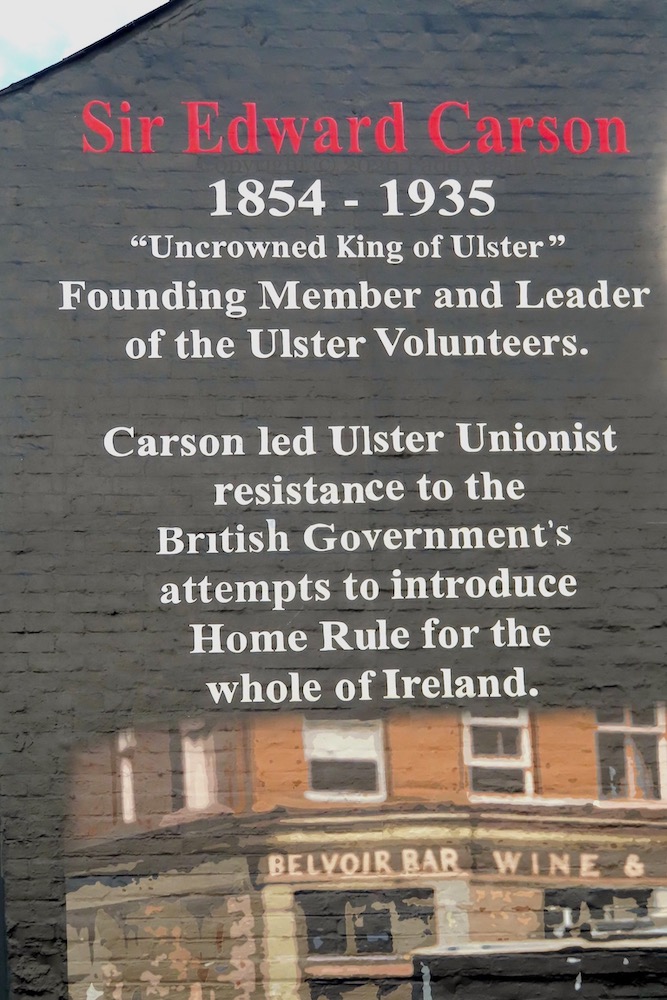
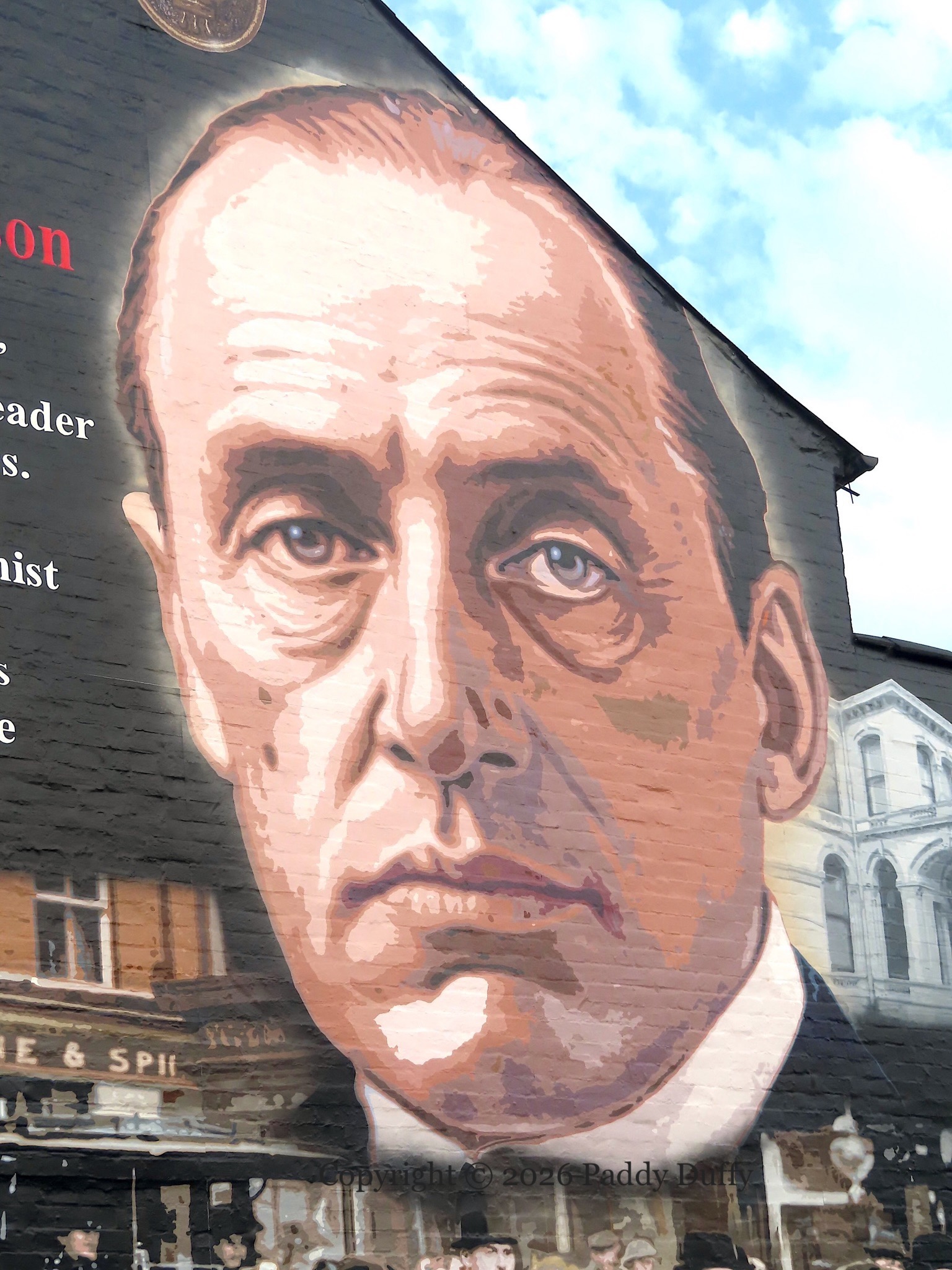
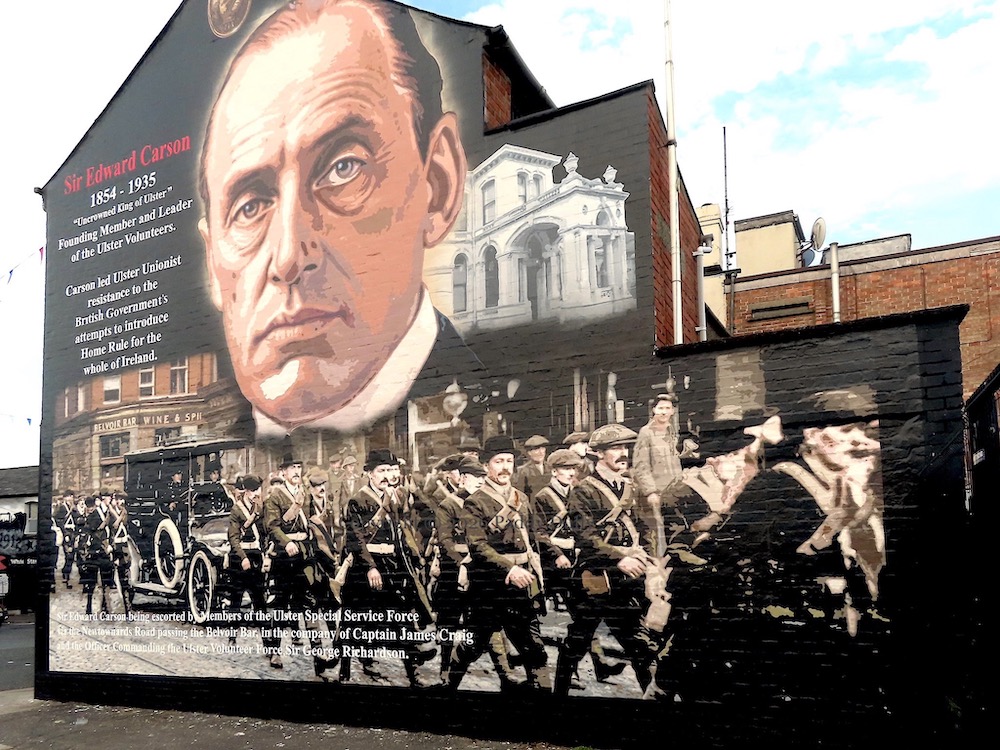
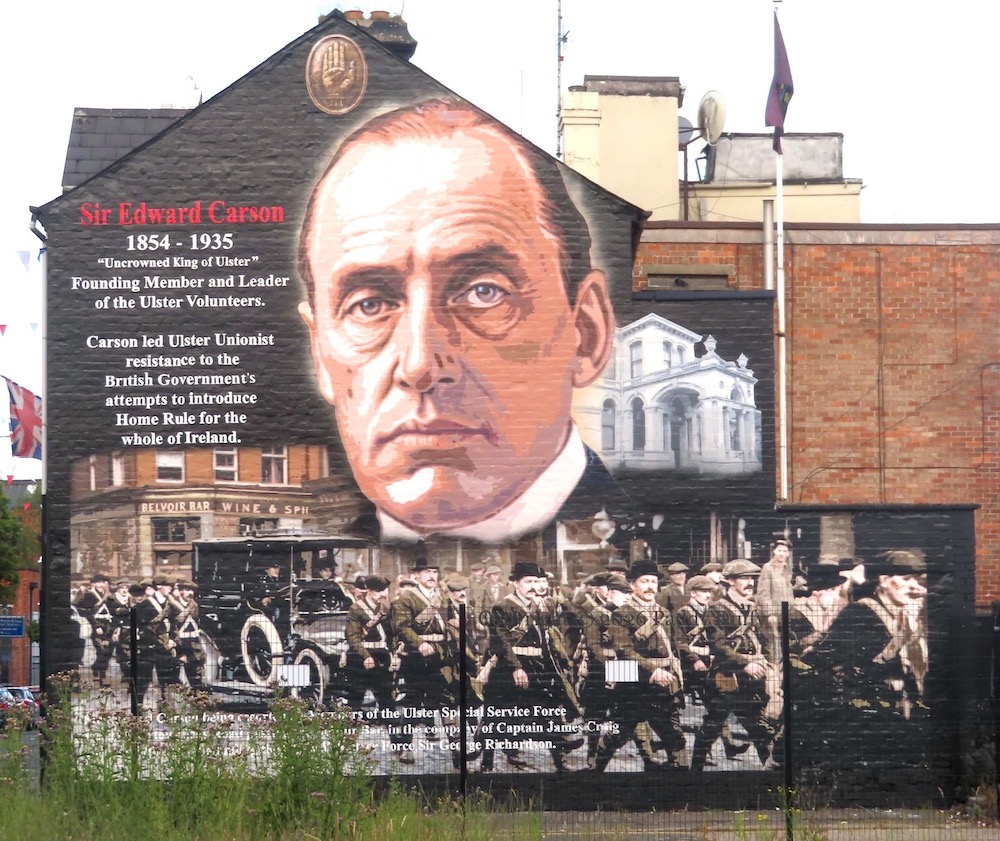
Text above: “Sir Edward Carson 1854 – 1935 “Uncrowned King of Ulster” Founding member and leader of the Ulster Volunteers. Carson led Ulster Unionist resistance to the British Government’s attempts to introduce Home Rule for the whole of Ireland.”
The epithet “uncrowned King” seems to be generally used of Carson and not attributable to any one source. Here is a September 1912 newspaper article that calls Carson the “uncrowned King of the North” and relays criticisms of a Carson reception in Portadown as “a parody upon a royal reception” and “an insult to the King”. A May 1914 review of (the book) The Reign Of Edward Carson refers to “King Carson”. (Here is a postcard depicting Carson as a king upon a throne – Postcards Ireland.)
The phrase is an echo of and response to the phrase “uncrowned king of Ireland”, which was used of both O’Connell and Parnell. Here is an 1847 article describing both O’Connell and the Napoleonic Governor-General of Algeria (WP) as “uncrowned monarch[s]”. According to WP, the epithet was first applied to Parnell in 1880, because he was so popular during a tour of the United States and Canada. At the end of James Joyce’s story ‘Ivy Day In The Committee Room’ a character recites a poem about Parnell, beginning “He is dead. Our uncrowned king is dead” (archive.com).
The wording “the British government’s attempts to introduce Home Rule” is more forthright than we are used to. Typically the resistance is simply to “Home Rule”. This wording makes clear that the Ulster Volunteers were a private militia preparing for the possibility of fighting the regular British Army and Navy. By being so explicit, this wording suggests that we are currently living through a time in which loyalists consider the “British government” to be insufficiently British, just as was the case in 1912.
Text below: “Sir Edward Carson being escorted by members of the Ulster Special Service Force on the Newtownards Road passing the Belvoir Bar in the company of Captain James Craig and the Officer Commanding of the Ulster Volunteer Force Sir George Richardson.”
According to a Regimental Band Fb post, “Sir Edward Carson was speaking at the Reform Club in Royal Avenue. There was an opinion that the British Government were going to try and arrest him so he was escorted to the safety of Craigavon House [shown on the right of the mural]. This photo was taken on the 20th March, 1914.” This October 1913 article, in addition to calling Carson “Ulster’s Uncrowned King”, notes that he travelled with a detective and carried a revolver.
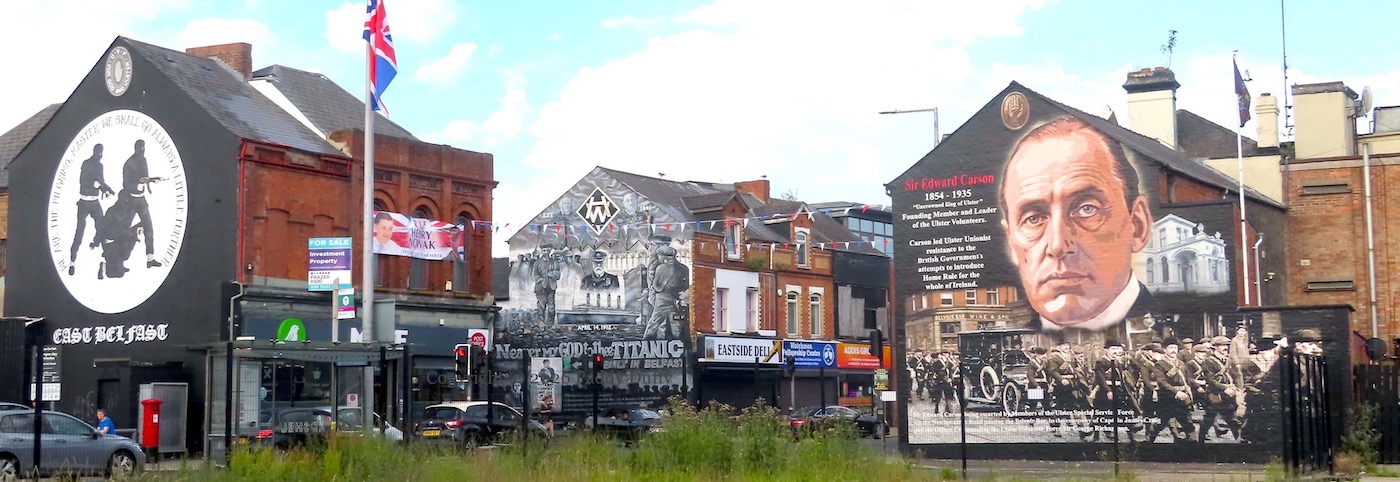
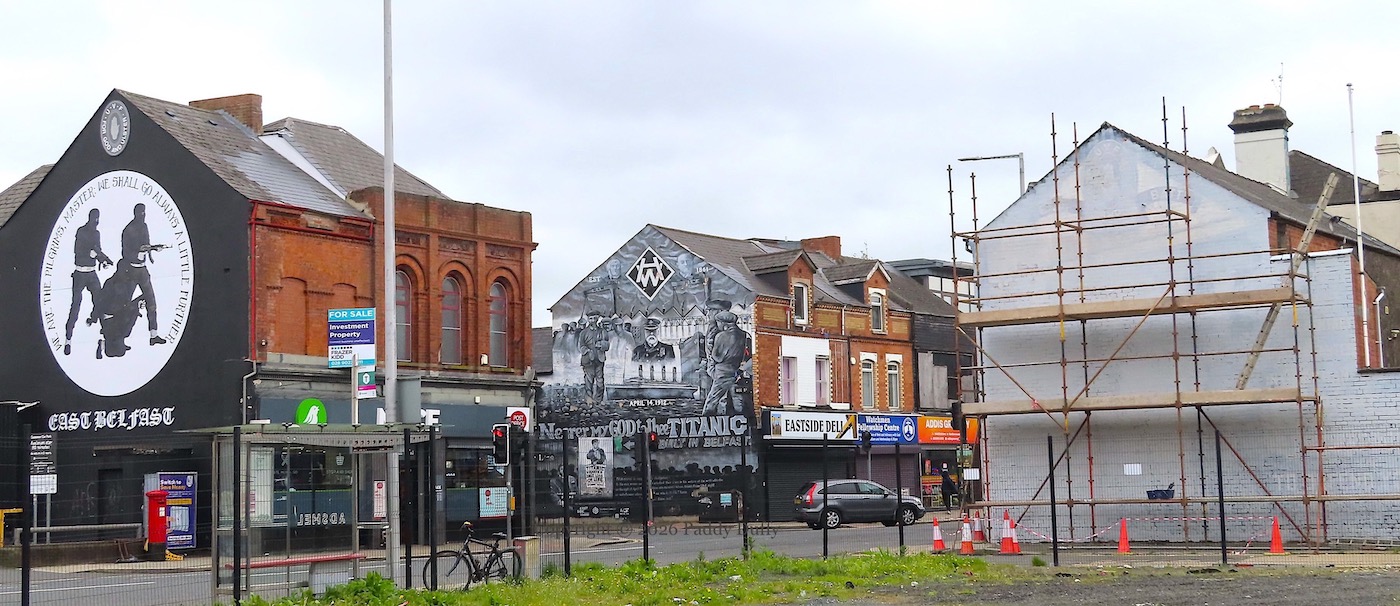
By Dee Craig (Fb), presumably, replacing his hooded gunmen mural The Right To Defend Yourself, on the Newtownards Road at (the former) Bright Street.

 Paddy Duffy Collection