Times Change

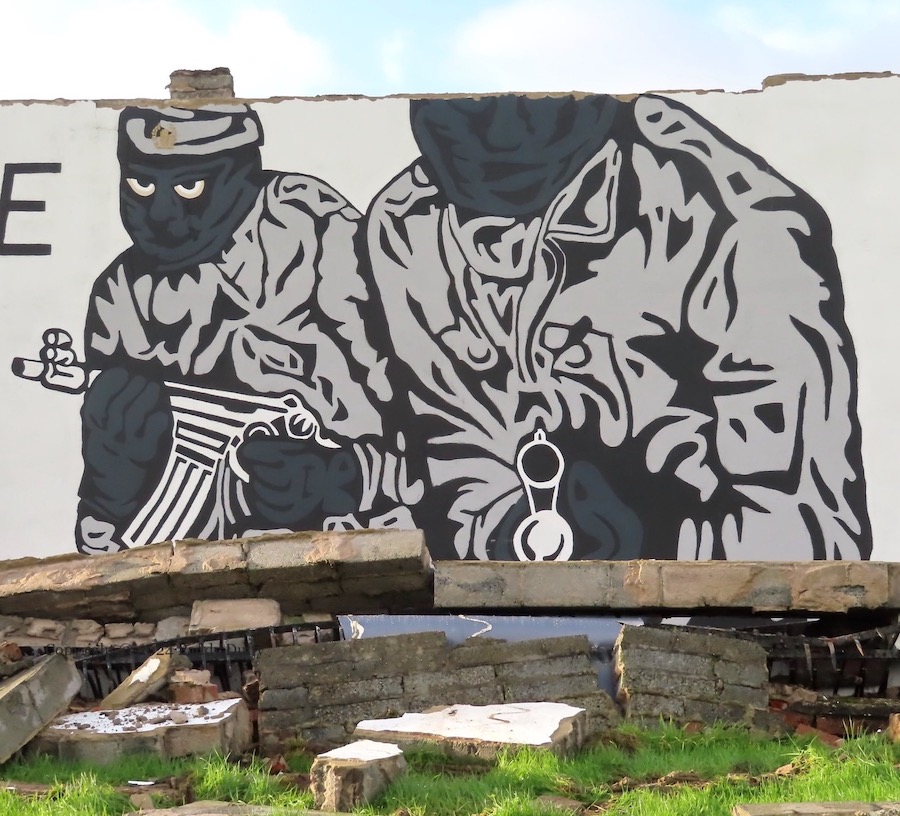
Despite the quote “Times change; we need to change as well” (attributed to Nelson Mandela, though perhaps only from Francois Pienaar in the film Invictus) the riot going on in black-and-white is not from the past (as in this east Belfast mural) but the present, and in particular from the 2021 riots on Lanark Way (BelTel) which is the site of this new mural. Similarly, the mural depicted in the background of the riot scene is not from the past – it was refreshed in 2022 and continues to loom over Mount Vernon and the off-ramp from the motorway – see Prepared For Peace, Ready For War.

The mural thus asks young people to decide between two visions of present-day life: the grey world of violence and the colourful world of programmes from R-City – Communities Integrated Through Youth (www.rcitybelfast.com), including “one-one mentoring”, “leadership for life” (QUB), and “SHE” [Supporting Her Empowerment].

Click image to enlarge
Copyright © 2024 Paddy Duffy
T04798 T04797 T04801 T04796 T04795 Marty Lyons

Older But No Wiser

Steeple Veterans flute band is a part-time band drawing on “veterans” or “old boys” of the Steeple Defenders (which used to have a board nearby). The “older but no wiser” tag-line is exemplified by the fact that they dress up in costume each 12th for the return leg of the day– in 2023 they adopted Jurassic Park as their theme, with members dressed as dinosaurs, park rangers, and explorers. The black ribbons in the bottom corners are perhaps in memory of member David Johnston, who died last year (2023) (Belfast Live | BelTel).

Also included (below) is a tribute to Elizabeth II on the occasion of her platinum jubilee, a few months before she passed away in September, 2022, added next to the Somme mural seen in Ulster Volunteer Forces.

Seacash Drive/Parkhall Road, Antrim.

Click image to enlarge
Copyright © 2024 Paddy Duffy
T04791 T04792 antrim round tower

Fidei Defensor

“His majesty King Charles III D.G.Rex.F.D. [Dei gratia rex; fidei defensor – King by the grace of God; defender of the faith]” successor and son of Queen Elizabeth II (1926-2022) and father to William, the current Prince Of Wales and Baron Carrickfergus (no “of”).

Each of the corners of the board shows a quarter of the royal standard, including, in the bottom left, a ‘maid of Erin’ flag representing the kingdom of Ireland, which has been present in the standard (of England, of Great Britain, of the United Kingdom) since 1603. Shortly after partition (1922) it was used as the banner of arms of the Irish Free State and later adopted as the arms of Ireland and of the President but it continues to be used in the UK royal standard. (For a history of the royal standard, see Prothero, Faul, & Grieve one | two.)

Thalia Street, south Belfast

Click image to enlarge
Copyright © 2024 Paddy Duffy
T04789

June 14th, 1690

On this day 334 years ago (in the Julian calendar, which would be June 24th in the Gregorian), King William III landed at Carrickfergus and began his journey, via Belfast and Lisburn, to the Boyne river (outside Drogheda) where he successfully led his forces against those of James II.

After landing in Carrick, William rode by horse to Whitehouse, half-way to Belfast, where he met his commander-in-chief, the Duke Of Schomberg, who had been in Ireland since the previous August and laid siege to, and taken, the Jacobite garrison in Carrickfergus, making William’s landing there possible (WP).

This new large board at Monkstown Old Boys (Fb) celebrates William’s landing and journey to Whitehouse, which is the point closest to Monkstown.

The image reproduced in the centre of the board (see below; a crisper version can be found at Orange Heritage) shows William meeting Schomberg at the eponymous White House, where Glas Na mBradán (the Salmons’ Stream) made a small port. Dalaradia has a 3-D flyover of what the White House and surrounding area might have looked like at the time. The remains of the White House have been restored and now house an interpretive centre (Bangor Historical Society | Causeway Coastal Route).

(For more on William’s journey from Carrick to Belfast see George Benn’s (1877) A History Of The Town Of Belfast p. 180 ff and Millin’s Sidelights (1938) – a contemporary map of the area appears at the bottom of the page. “Lord Belmont” also has a two-part history of William’s journey from Carrick to Belfast and on to Lisburn.)

Other images of William’s landing at Carrickfergus can be found in an old Bobby Jackson mural in the Fountain, Londonderry, (see the Peter Moloney collection) and in the Glenfield estate in Carrickfergus (see The Liberties Of England). There is also a statue of William in Carrickfergus harbour – see The Landing Of SARS-CoV-2 At Carrickfergus, March 2020.


The text on the board and the other images are as follows:

[The portrait of William is by Godfrey Kneller and part of the collection in the National Gallery Of Scotland.]

[The following text appears to be an excerpted and slightly modified version of a page at Orange Heritage.]

“King William was in Ulster from Saturday, June 14th, 1690 until Thursday, June 26th, only 12 days, yet he left behind a legend full of proud memories. For his part he liked what he saw. “This country is worth fighting for,” he said.

“His departure from London had been held up by parliamentary business till the end of May, when he announced that he could wait no longer and adjourned Parliament.

“Early in the morning of June 4 he set out, but on June 11th he embarked on board the yacht “Mary” with a fleet escorted by Sir Cloudesley Shovell’s squadron. On June 14th the hills of Ireland came in sight and in the afternoon the fleet cast anchor off Carrickfergus. He was rowed ashore in the Rear Admiral’s barge and at about 3.30 p.m. landed at the Old Quay under the shadow of the great Norman Castle.

[The 1973 painting of the Quaker greeting William is by Thomas Everard Spence and held by Carrickfergus Council – see Art UK. The Union Flag on the right lacks the St Patrick’s Cross – this would not be added until after the 1801 Act Of Union.]

The Garrison of the Castle had drawn up a Guard of Honour and the townspeople added their applause. The chosen spokesman was a Quaker, whose principles forebade [sic] him to doff his hat, or use such titles as Sir and Majesty. He got over the difficulty by taking off his hat and laying it on a stone and then stepping forward and saying “William, thou art welcome to thy Kingdom” which pleased the King so much that he replied: “you are the best bred gentleman I have met since I came to England.”

“With these words he mounted his horse and set off for Belfast. Half-way along the shore was the little port of Whitehouse, where most of the army disembarked. The Commander-in-Chief, the Duke of Schomberg, and his senior commanders were waiting here to welcome the King. To cover the disembarkation, earthworks has [sic] been thrown up by the engineers at Fort William and garrisoned by troops ready for action.”


[The following text perhaps draws upon the BBC page on the Battle Of The Boyne.]

“Battle of the Boyne: Although the battle has been commemorated on 12th July for more than 200 years, it actually took place on 1st July according to the old Julian calendar, and on 11th July according to the Gregorian (which replaced the Julian calendar in 1752). It was the last time that two crowned Kings of England, Scotland and Ireland faced each other on the battle field.”
[By the time of Britain’s adoption of the Gregorian calendar in 1752 the calendars had moved (in 1700) another day apart, making them eleven days apart at that time. However, eleven days rather than ten were added to all prior dates, even those before 1700 and further back, to yield July 12th as the date of the Battle in 1690.]

[The two paintings of the Battle Of The Boyne are by Jan Wyck. The painting of William on horseback is part of the (UK) Government Art Collection; the 1693 painting of the battle-field can be found in the National Gallery Of Ireland.]


[This statue of William is in the grounds of Kensington Palace (WP).]

[The painting of William and Mary is actually two portraits blurred together. See e.g. History Extra.]

[The following text appears to come from the royal.uk page on William and Mary.]

“In 1689 Parliament declared that James had abdicated by deserting his kingdom. William (reigned 1689-1702) and Mary (reigned 1689-94) were offered the throne as joint monarchs.

They accepted a Declaration of Rights (later a Bill), drawn up by a Convention of Parliament, which limited the Sovereign’s power, reaffirmed Parliament’s claim to control taxation and legislation, and provided guarantees against the abuses of power which James II and the Stuart Kings had committed.

The exclusion of James II and his heirs was extended to exclude all Roman Catholics from the throne, since ‘it hath been found by experience that it is inconsistent with the safety and welfare of this protestant kingdom to be governed by a papist prince’. The Sovereign was required in his coronation oath to swear to maintain the Protestant religion.”


Click image to enlarge
Copyright © 2024 Paddy Duffy
T04770 T04771 T04772 T04769
T04768 T04773 T04775 [T04774]

His Majesty King Charles III By The Grace Of God

September 8th, 2022, is the date of the accession of Charles – then Prince Of Wales – the UK crown, upon the death of his mother Elizabeth at ten past three in the afternoon (as shown on the clock in the bottom left of the wide shot, below). At Balmoral Castle, the Royal Standard (in the top left of the wide shot, below) was lowered and immediately raised again, as the monarchy immediately moved to Charles and he was present in the building (WP).

The unnamed figure on the left is William, the son of Charles and his first wife, Diana, and the current Prince Of Wales. William’s son, George, on the right, is known as “Prince George Of Wales” (and his siblings similarly) rather than (as here) “George, Prince Of Wales.” The title “Prince Of Wales” is reserved for the heir to the UK throne, currently William.

“His Majesty King Charles III by the Grace of God of the United Kingdom of Great Britain and Northern Ireland and of His other Realms and Territories, King, Head of the Commonwealth, Defender of the Faith.”

Devenish Drive, Monkstown, Newtownabbey, with funding from the Housing Executive (NI World) to replace the UDA hooded gunman seen in Open & Shut.

Click image to enlarge
Copyright © 2024 Paddy Duffy
T04766c T04765 [T04767]

Four Lads Had A Dream

‘Four Lads Had A Dream’ is the name of Rangers song (youtube) but here the dream is not “to start a team” in Glasgow but to start a flute band in Monkstown, Newtownabbey. The result of the efforts of the four men – John Black, Freddie Maltman, Brian Crothers, Trevor Wilson – was Monkstown YCV flute band (Fb), formed in 1974 and so celebrating its fiftieth anniversary this year, 2024. To mark the occasion, the band has installed the series of boards shown here along a low wall in Cloyne Crescent; it will also visit the Somme and play at the Last Post ceremony which takes place at eight every evening at the Menin Gate (web).

The information board is transcribed (verbatim) at the bottom of this entry. A Bo Kerr from Rathcoole is also mentioned in the creation of also mentioned in the creation of the KAI tartans in Rathcoole – see the IWM link in The Famous.

The board showing words from a soldier’s diary, along with an image of soldiers marching, also appeared in the Village, south Belfast – see May I Never Hear Such Cries Again.

In the Royal Irish Rifles of WWI, Central Antrim became the 12th battalion (War Time Memories Project). For the Central Antrim Volunteers see The Central Antrim Regiment | South And Central Antrim Volunteers and 1916 Battle Of The Somme. Robert Quigg (of the 12th Rifles) was awarded the VC – see VCs Of The 36th.

Click image to enlarge
Copyright © 2024 Paddy Duffy
T04776 T04777 T04778 T04779 T04780 T04781 T04782 T04783 [T04784]

“Four lads had a Dream. Back in 1974, a group of lads were having a card school in the old rent office in Abbeytown Square. One of the lads, John Black, asked they group if they would go with him to meet Billy Greer about asking for help to start up a band. Freddie Maltman, Brian Crothers and Trevor Wilson all agreed to accompany him. So off they went to see Billy Greer, who gave them a look of disbelief and replied “son, do you realise what it would take to do this?” John replied “no.” After a while, Billy Greer said “leave it with me, I will go and get back to you.” A couple of weeks later, the lads once again met with Billy Greer, and he introduced them to a man named Robert ‘Bo’ Kerr.

The following week, Robert had brought a book with him and the amount of names in it was amazing. A lot of the people in the book were from Rathcoole. At this stage, Robert also brought down his brother, Brian ‘Bo’ Kerr, to help. The band managed to get a lend of some old side drums, some flutes and a bass drum. Roberts father also repaired some flutes for them. A lot of fundraising followed, such as street collections in the Monkstown area, and the community was very generous to the cause of the band. Robert ‘Bo’ Kerr was due to get married that year and he gave up his wedding fund money towards the purchase of four new side drums from Matchetts in Belfast and a bass drum from Willy Hewitts over in Sandy Row.

The bands first parade was an invite to Glenarm where Hughy Brown was the first band captain. The band numbers were rising, but it didn’t take too long to see who was going to make it and who wasn’t, and therefore the numbers fell slightly. John Black for one learnt his lessons very quickly to never lie to the band captain. Hughy Brown gave all the fluters a tune to learn at home, the next week they all arrived at practice and Hughy went along and asked, one by one, “well lads, did you learn The Ducks for me this week?” And they all replied “yes.” He picked out John Black to stand on the chair and play it. That was him in the bad books straight away as he had told lies and hadn’t learnt it! Hughy went mad and told him “Blackie, never in your life waste my time again if you want to stay in this band, don’t come back next week if you haven’t learnt what I give you!” After that, the flute corps was second to none.

Throughout the years the band has had its ups and downs like every other band we lost quite a few members due to being incarcerated during the troubles or by passing away. However, over the past few years we have went from strength to strength! The hard work and dedication from our members is second to none, with some of our members travelling from various locations in Newtownabbey, Carrickfergus, Shankill, East Belfast, Scotland and Liverpool.

This year 2024 we will be celebrating our 50th Anniversary with the purchase of a new uniform and a pilgrimage to the Battlefields of the Somme, culminating in playing at the Last Post ceremony at the Menin Gate, this will be one of the milestones that Monkstown will proudly mark.”

“The Battle Of Messines June 1917. Men from the Royal Inniskilling Fusiliers and Royal Irish Rifles celebrating their victory at Wytschaete.”

“We surge forward. Bayonets sparkle and glint. Cries and curses rent the air. Chums fall, some without a word … and others … Oh, my God! May I never hear such cries again! There goes the YCV flag tied to the muzzle of a rifle. That man had nerve! Through the road just ahead of us we had crossed the sunken road. We could see khaki figures rushing the German front line. The Inniskillings had got at them.”

The Ulster Fry

Discover Ulster-Scots (web) has added some more boards in north Belfast, joining the recent gallery of famous figures at Mountcollyer Avenue (see The Scots In Ulster).

Above, Alexandra Park Ave: “The Ulster Fry – Ulster-Scots put the Ulster into the Ulster Fry with our famous soda and potato farls. Farl is an Ulster-Scots word describing the quarter round shape of the breads.” Breakfast fries as we now think of them date back only to the Victorian period and became popular particularly after WWII (WP). Soda farls (and soda bread) go back further, to the 1830s and 1870s when baking soda began to be commercially manufactured and cheaply available (ACS). Recipes can be found at the Discover Ulster-Scots ‘Food Traditions’ page.

Below, from Upper Canning St: “Ulster-Scots distilleries made Belfast a global centre of whisky production. Historic Ulster-Scots brands like, Dunville’s, Mitchell’s and McConnell’s are making a comeback in the 21st century.” “Ulster-Scots also invented ginger ale and brown lemonade in Belfast. Ross’s and Cantrell & Coughran (C&C) were the pioneers, with Belfast ginger ale later taken worldwide by another Ulster-Scot who founded Canada Dry.” The labels shown use the “-y” spelling, perhaps in order to emphasise the Scottish association rather than the Irish. Cowan’s appear to have used both spellings (“whisky” and “whiskey”) in their labelling – see the gallery at Bloggin’ Fae The Burn. Dunville’s now appear to use the “-ey” spelling exclusively (web).

Finally, in North Queen St: “Ulster-Scots have been making Belfast a better place for over 400 years. Many of Belfast’s leading charitable, religious and educational institutions were founded by Ulster-Scots.” with images of BRA (James Crombie), Clifton House (possibly William Tennant is intended), the Linen Hall Library (a list of founders can be found on page 11 of this History), the Assembly buildings (of the Presbyterian church), and Queen’s (John Mowat).

See also: the Visual History page on Ulster-Scots murals.

Click image to enlarge
Copyright © 2024 Paddy Duffy
T04764 T04726 T04727 T04728 T04729 T04730

Computer Says No

The Vault artists (ig) are making good use of the gallery space at their new digs in Marlborough House. FGB (ig) had an exhibition during HTN (entitled “He’s Not Right In The Head” – ig) and new work by Leo Boyd (ig) is on display this week.

The ad above is in Waring Street, in Belfast city centre. Included below is the same piece in paint form, in Kent St for HTN24.

Click image to enlarge
Copyright © 2024 Paddy Duffy
T04761 T04592

Kai Johansen’s Bar

Kai Johansen was a Danish international who played for Rangers from 1965-1970, most famously scoring the only goal in the 1966 Scottish Cup final against Celtic (WP). He retired in 1970 and went on to manage two teams in South Africa, as well as owning businesses, including pubs and tanning salons, in Denmark and Scotland (Herald). The pub mentioned in the board above is perhaps “Kai Johansen’s Bar” at 564 Govan Road, Glasgow (images at Follow Follow).

“Every week in Glasgow, to watch the boys in blue/We wanted to form a band, of us there was just a few./We sat in Johansen’s bar, sometimes, he joined us too./He treated us like his sons, and nobody understood why/But through this hospitality, we become adopted sons of Kai./Now we have our name, we will now make it stand./Known as Rathecoole’s finest, the Sons Of Kai flute band.”

See previously: The Famous | Welcome To Our Homeland | We’re From The Coole.

Derrycoole Way, Rathcoole, Newtownabbey

Click image to enlarge
Copyright © 2024 Paddy Duffy
T04760 T04759 in loving memory of friends and family always remembered never forgotten