Belfast Butchery

“Belfast Pogroms 1920-1922.” Against the backdrop of the first Dáıl, the War Of Independence, and the debate in Westminster over the fourth Home Rule bill (it would be passed in November 1920), northern Protestants began to assert their de facto independence from the rest of Ireland – both in economic and in military terms.

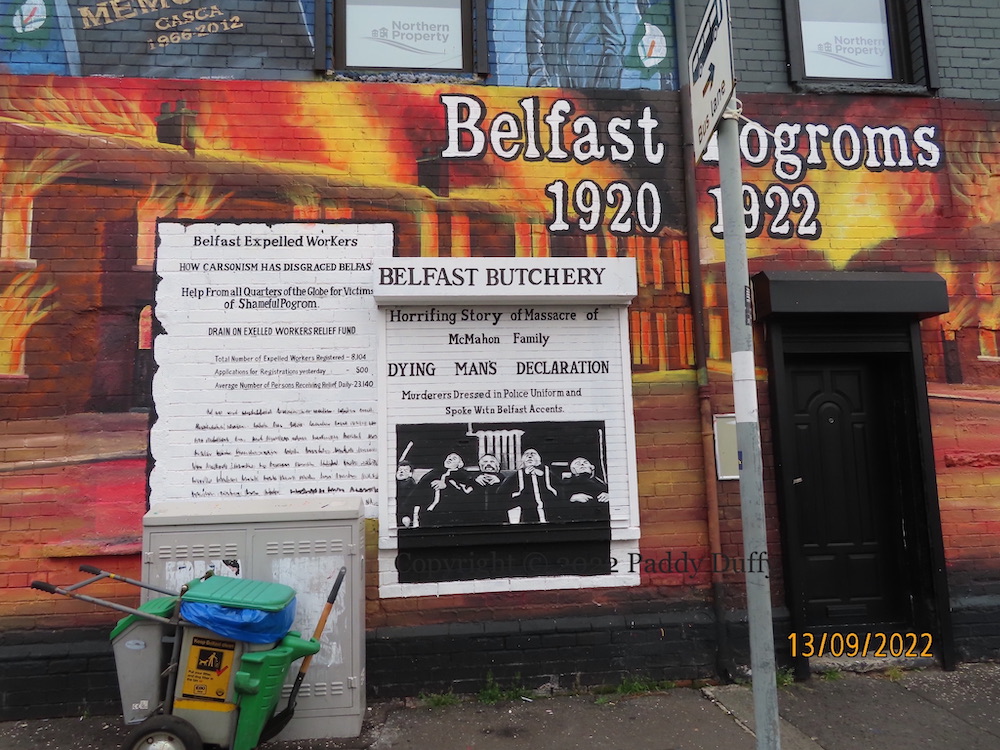
On July 12th, 1920, Edward Carson spoke to a crowd in Derry and, addressing the government in Westminster, said “if you are yourself unable to protect us from the machinations of Sınn Féın, and you won’t take our help; well, then, we tell you we will take the matter into our own hands.” (Treason Felony). Nine days later, the “clearings” of Catholics from Belfast shipyards and mills began, with about 5,700 Catholics and 1,850 socialists (“rotten Prods“) being expelled from Workman Clark and Harland & Wolff yards, and in total 10,000 workers from yards and mills over the next two weeks (History Ireland). In combination with the straitened economic circumstances of the time (post WWI) thousands (23,140 according to this mural, which reproduces a flyer derived from the Irish News of October 6th, 1920 – via The Irish Story’s account of the start of the “Belfast Pogrom”) were on relief.

Militarily, in October, 1920, the Ulster Special Constabulary was established (drawing on members of the Ulster Volunteers, which had been reconstituted in June 1920, and the 21,000 members of the Ulster Imperial Guards (WP)) as an alternative to the Royal Irish Constabulary in fighting actions by the IRA in Belfast, Derry, and elsewhere in the north. On March 23rd, 1922, two officers of the Specials were killed in Belfast city centre by the IRA. In reprisal, two Catholic civilians were killed in the Short Strand, and in the early hours of March 24th, a party of five men, four dressed in RIC uniforms, burst into the home of Catholic businessman Owen McMahon and shot McMahon, his six sons, and one of his employees – only two of the sons survived. District Inspector John Nixon of the RIC was suspected of leading the attack on the McMahon household – see The RIC Murder Gang and Pat And Dan Duffin. (The headlines are from the Freeman’s Journal of March 25th, 1922 – see Joe Baker’s 80-page account of the murders of summer 1922; the photograph of the McMahon corpses that is reproduced in the mural can be seen at Slugger.)

This is the first half a new mural in Ascaıll Ard Na bhFeá; the “1922” part can be seen in Executed.

“Belfast Expelled Workers – How Carsonism has disgraced Belfast – Help from all quarters of the globe for victims of sh[a]meful pogrom – Drain on Ex[p]elled Workers[‘] Relief Fund. Total number of expelled workers registered – 8,104; Applications for registrations yesterday – 500; Average number of persons receiving relief daily – 23,140.”

“Belfast Butchery – Horrif[y]ing story of massacre of McMahon family – Dying man[‘]s declaration – Murderers dressed in police uniform and spoke with Belfast accents.”

Click image to enlarge
Copyright © 2022 Paddy Duffy
T00803 [T00802]
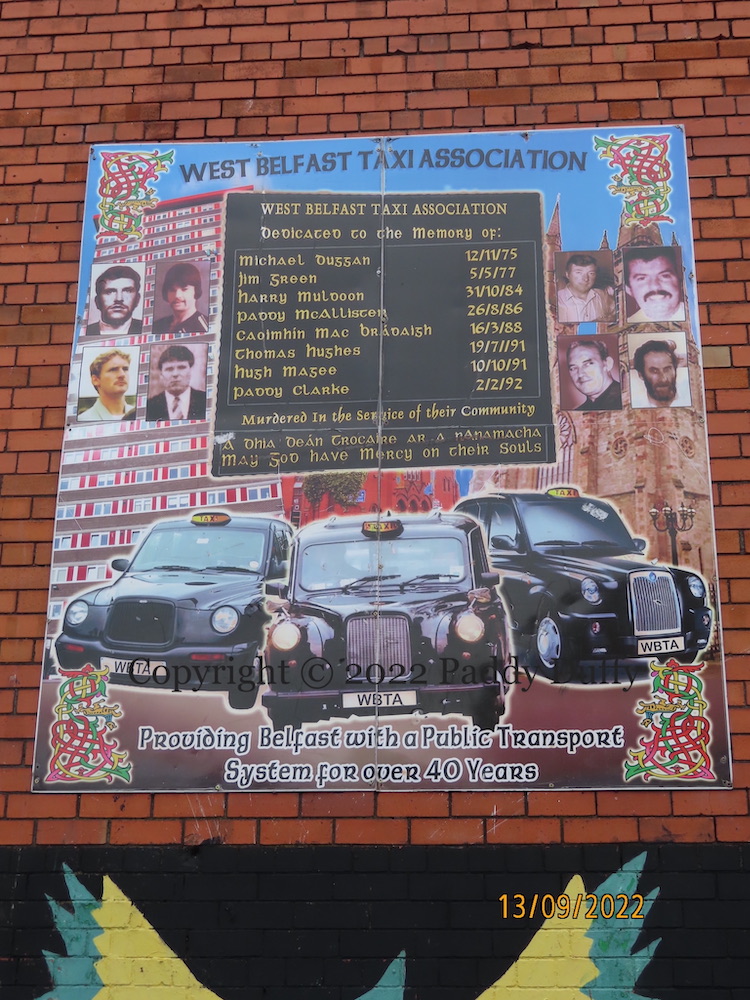
Alternative Transport, Alternative Location

Pieces of the long Beechmount Avenue wall have moved to different locations due to the construction of new fencing and other improvements. The WBTA Alternative Transport board is now above the longest-surviving mural in Belfast, the Clowney Street phoenix.

Click image to enlarge
Copyright © 2022 Paddy Duffy
[T00800] T00801

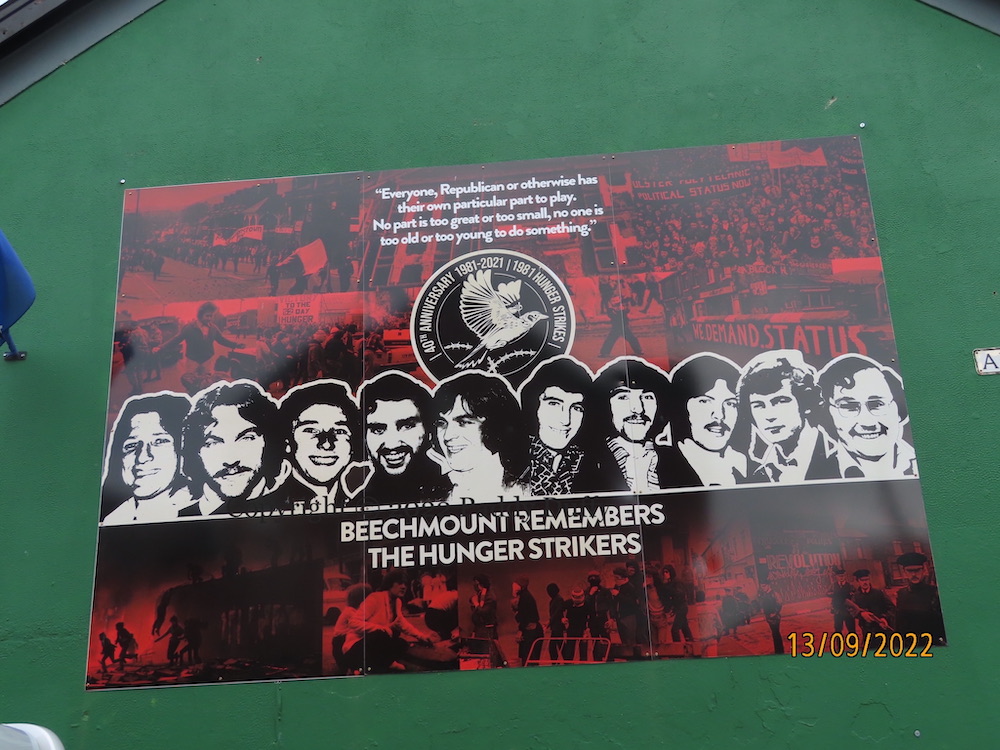
Beechmount Remembers

This board was mounted in AMCOMRI Street for the fortieth anniversary of the 1981 hunger strike, with photographs from the area in the background, including the Revolution mural at the bottom of Beechmount Avenue in 1996-1997.

“Everyone, Republican or otherwise, has their own particular part to play. No part is too great or too small, no one is too old or too young to do something.”

Click image to enlarge
Copyright © 2022 Paddy Duffy
T00798 [T00799]

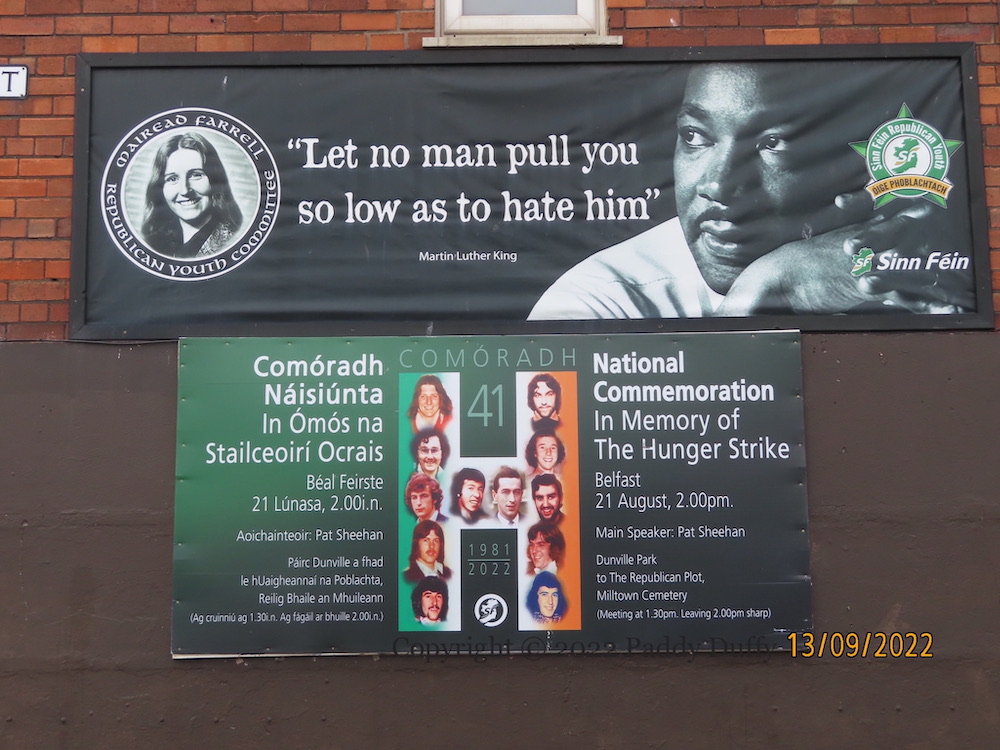
Let No Man Pull You So Low As To Hate Him

This Sınn Féın Youth/Maıréad Farrell Youth Committee banner uses Martin Luther King to advocate for non-violent protest (featured previously in Always Avoid Violence). Below is a call to attend a 41st-anniversary commemoration of the 1981 hunger strike.

Beechmount Street, west Belfast

Click image to enlarge
Copyright © 2022 Paddy Duffy
T00797 [T00815]

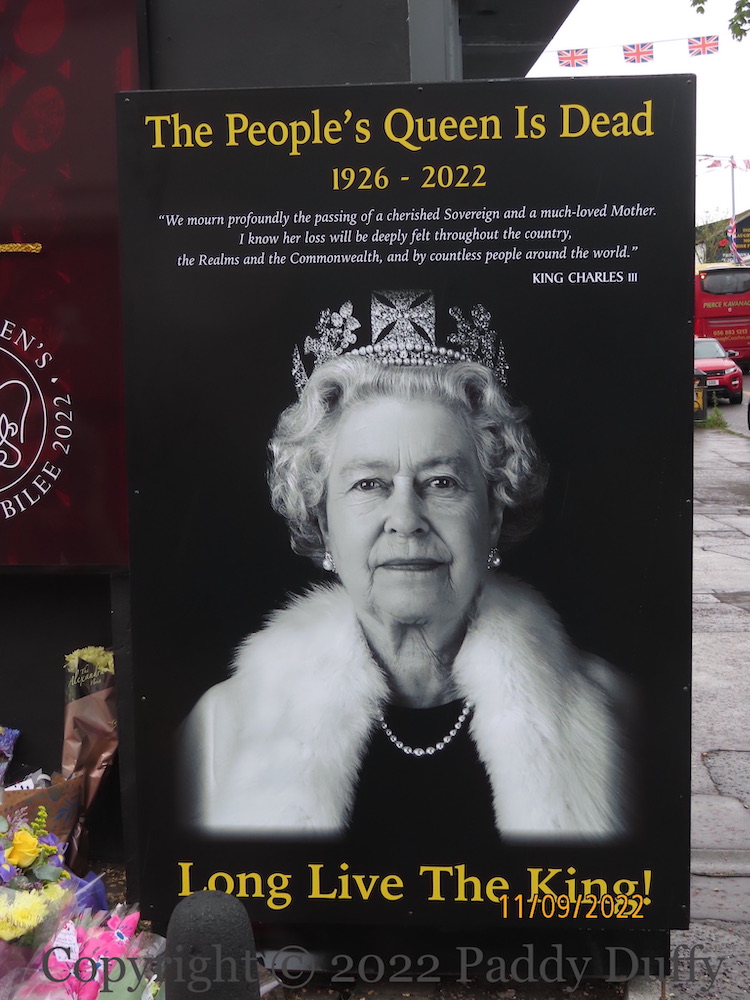
The People’s Queen Is Dead

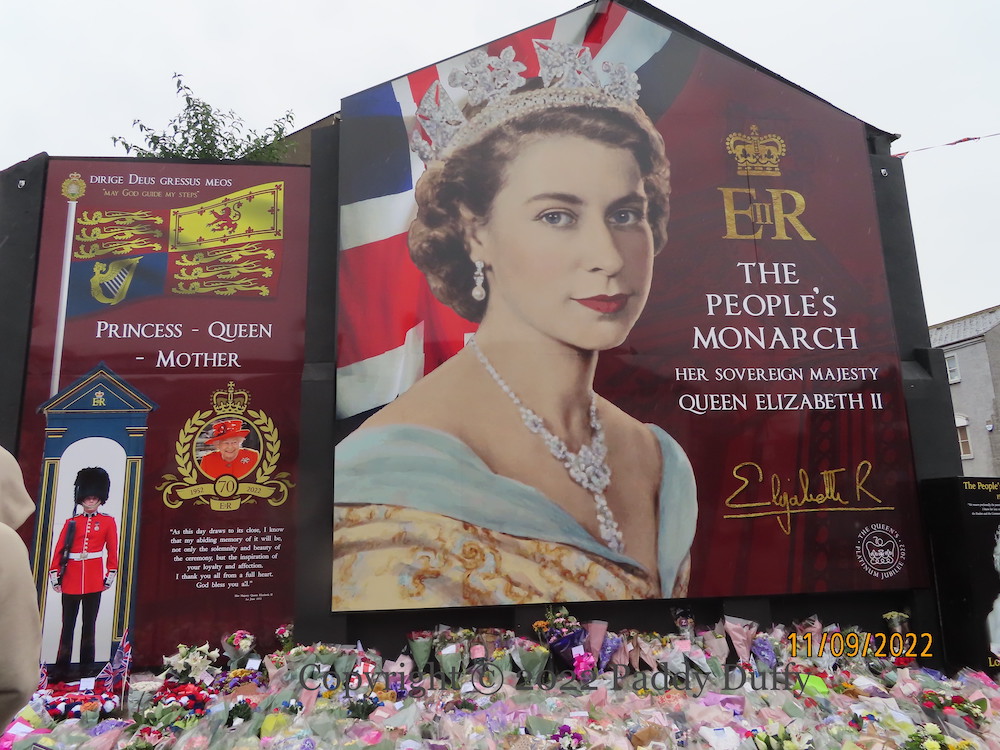
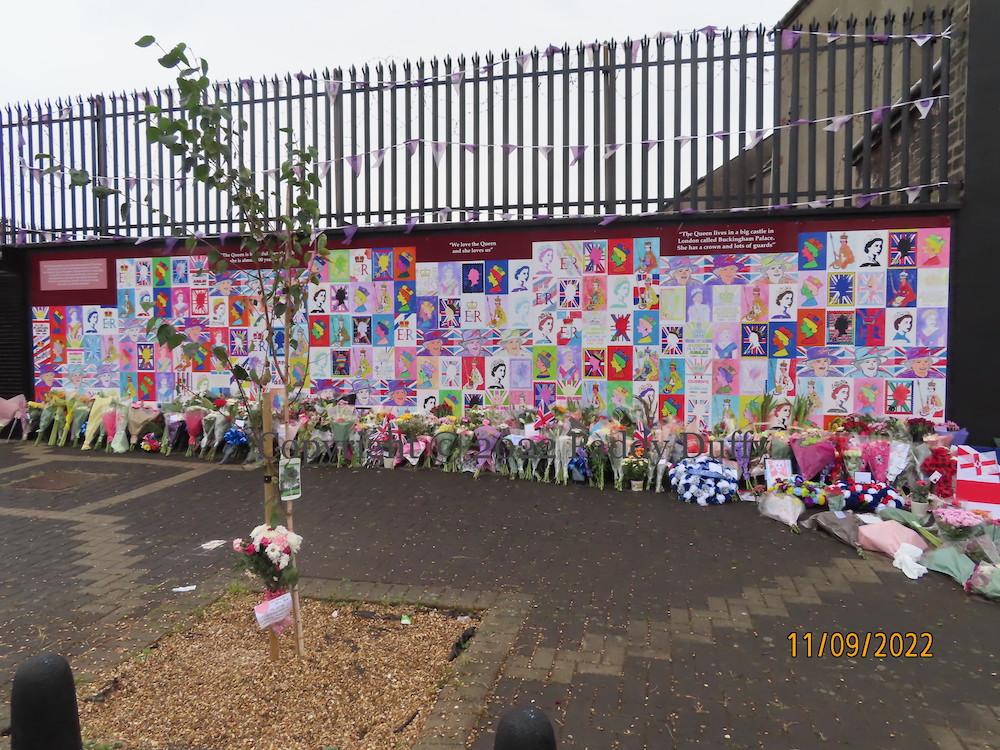
Upon news of Queen Elizabeth’s death, the platinum jubilee mural at the bottom of Crimea Street became a memorial, with hundreds of bouquets being laid before it and a “wall of condolences” set up. (For the mural itself, see The People’s Monarch.) In addition, to the right-hand side has been added a small commemoration of her passing, with a quote from her son, the newly acceded King Charles:

“We mourn profoundly the passing of a cherished Sovereign and a much-loved Mother. I know her loss will be deeply felt throughout the country, the Realms and the Commonwealth, and by countless people around the world”; “Long live the king!”

The fifteen commonwealth “realms” (previously called “dominions”) share a monarch – formerly Elizabeth II and now Charles III – while the commonwealth comprises 41 additional nations, including some which are now republics: Barbados, for example, became a republic on November 30th last year (2021) but is still in the Commonwealth (WP). Additional countries might take the passing of Elizabeth as a suitable juncture at which to sever ties (Edinburgh News has a round-up | for the Bahamas see Caribbean National Weekly | for Canada see Toronto Star).

Click image to enlarge
Copyright © 2022 Paddy Duffy
T00791 [T00792] [T00793] T00794 [T00795] T00796

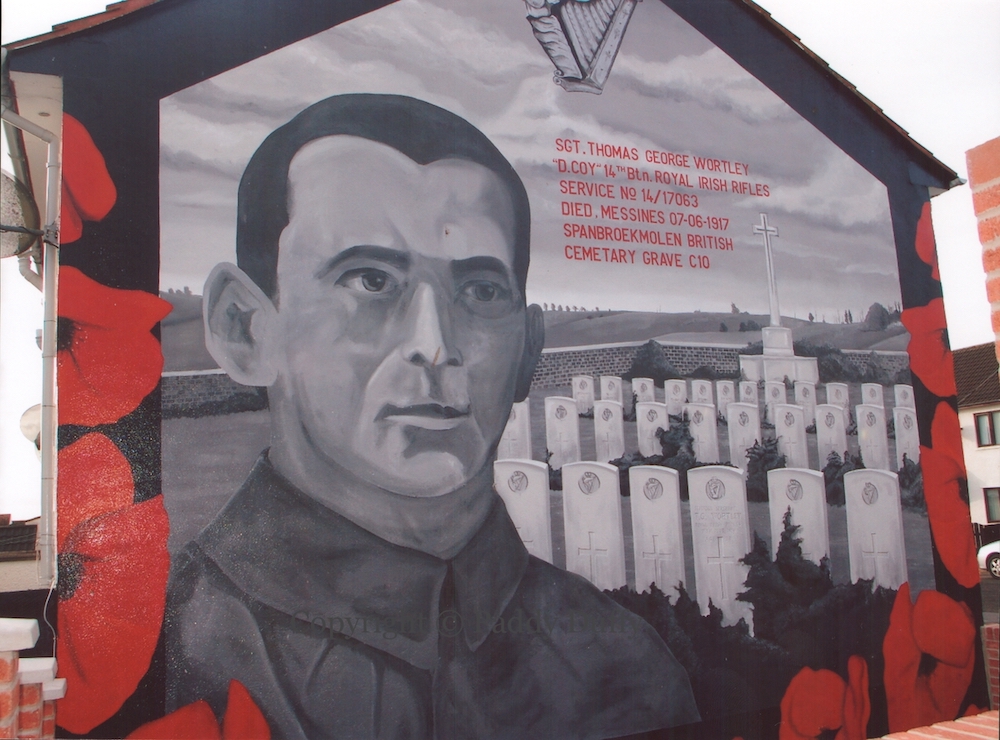
Thomas George Wortley

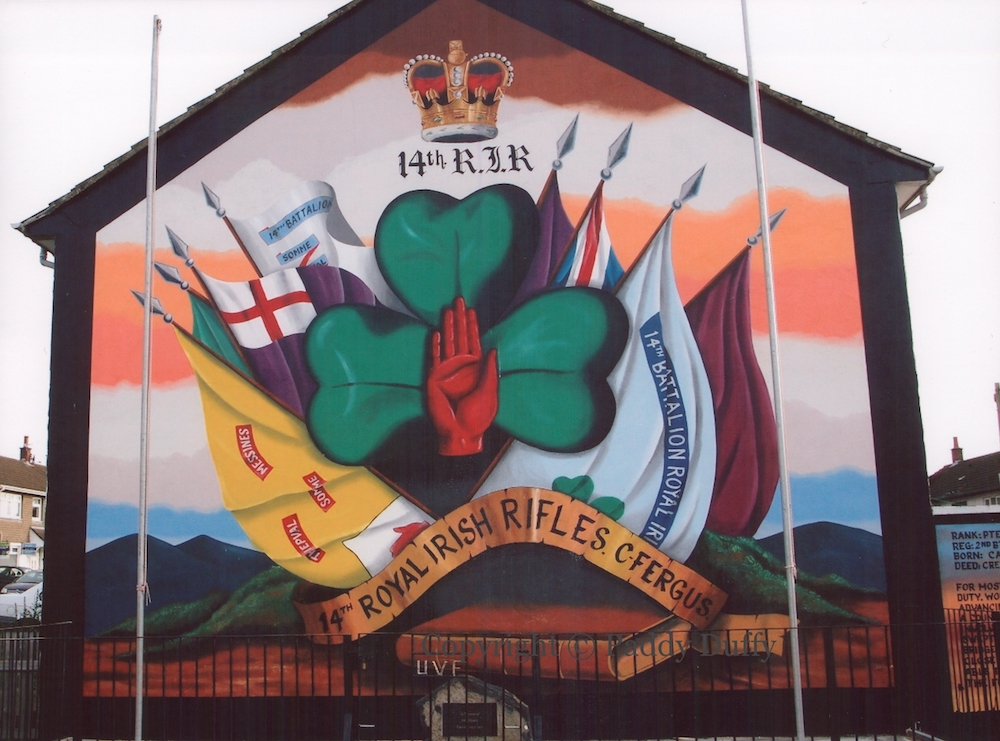
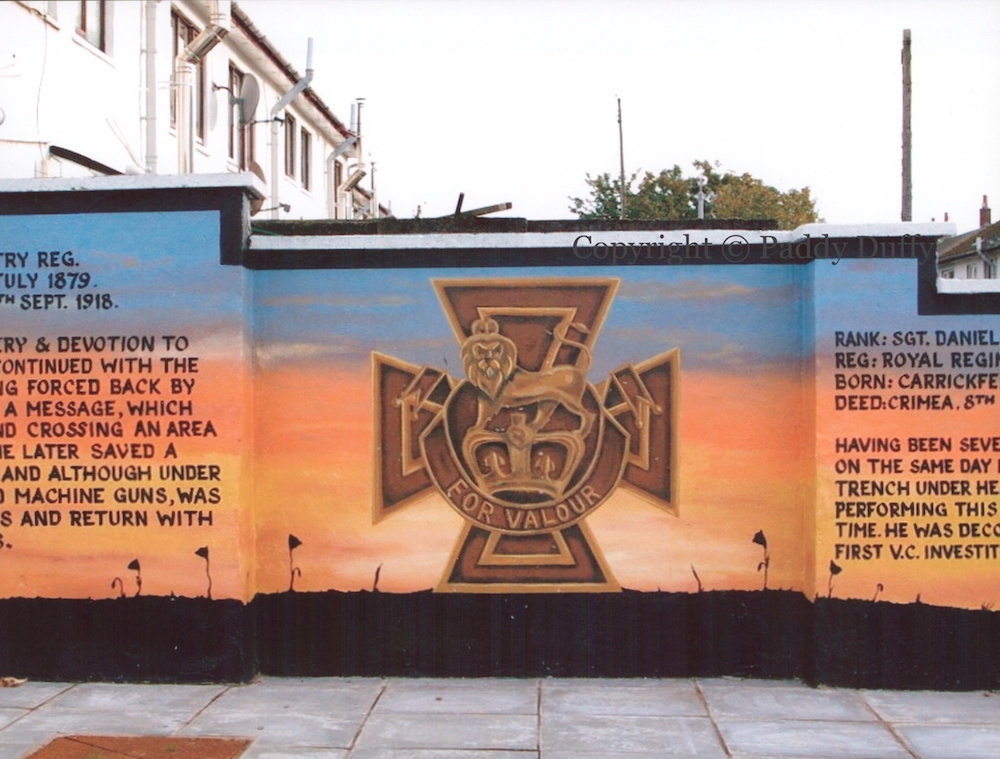
“Sgt. Thomas George Wortley , “D Coy” 14th Btn. Royal Irish Rifles, Service No. 14/17063, Died Messines 07-06-1917, Spanbroekmolen British Cemetary Grave C10″. Wortley was born in Carrickfergus, lived in Belfast, died on the first day of the battle at Messines (findagrave), buried in a small cemetery of British soldiers, many from the 36th (Ulster) Division, in Spanbroekmolen on the Ypres Salient in Flanders (WP) – shown in the mural – and is remembered in Carrickfergus with a parade each year on the date of his death (carrickfergusrollofhonour).

Maple Gardens, Carrickfergus

Click image to enlarge
Copyright © 2012 Paddy Duffy
T00651

Time In Hell

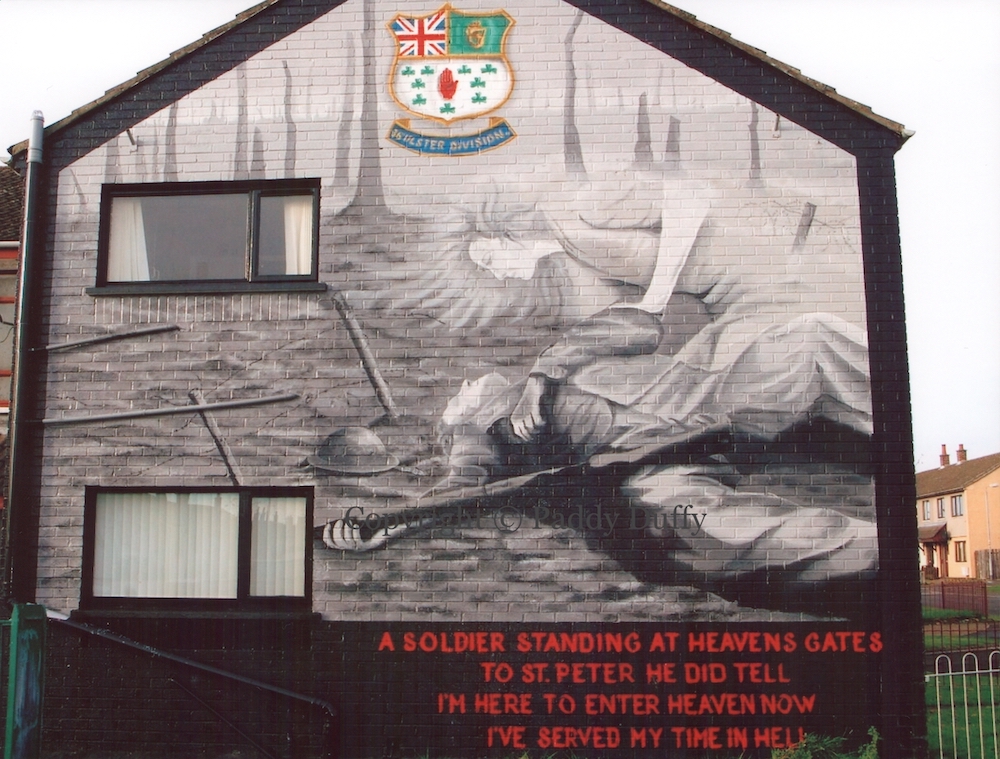
A dead WWI soldier in the scorched Belgian countryside is comforted by an ethereal figure who will convey him to heaven: A soldier standing at heaven’s gate/To St. Peter he did tell/I’m here to enter heaven now/I’ve served my time in hell – a variation on James Donahue’s WWII Soldier’s Poem (WP). The poem was previously used of Republicans in a 1981 mural in Derry (see I Refuse To Change/M00151).

The Larches, Carrickfergus

Click image to enlarge
Copyright © 2012 Paddy Duffy
T00635