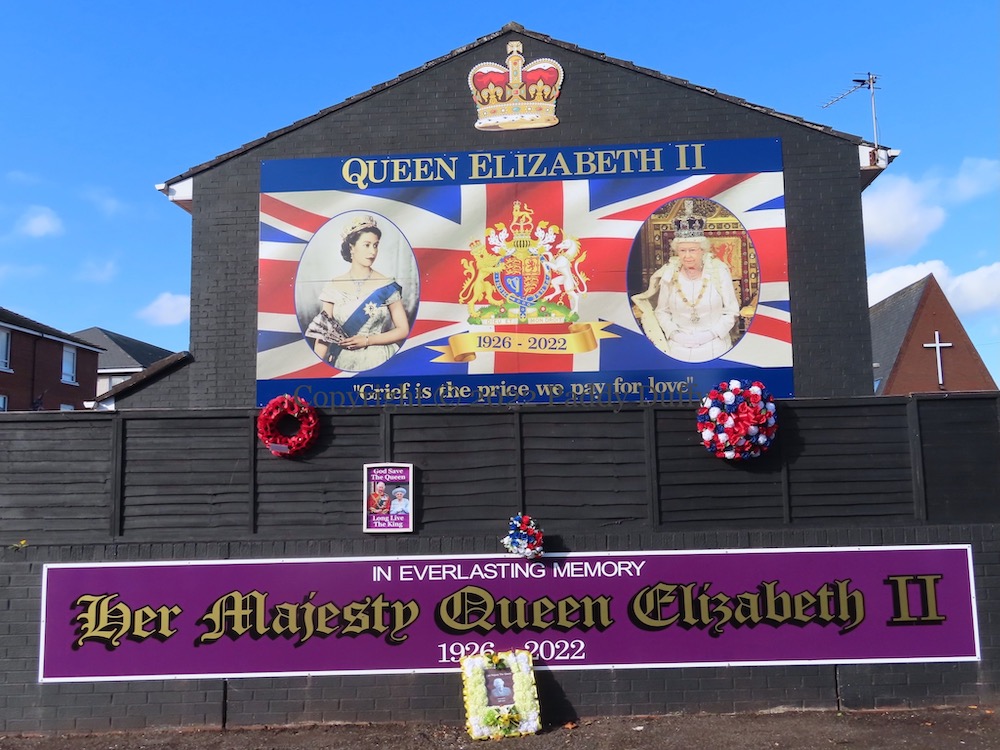
Elizabeth II, queen of the United Kingdom, passed away on September 8th, at the age of 96, in the same year of her platinum jubilee, the 70th anniversary of her accession. The phrase “grief is the price we pay for love” comes from a message from Elizabeth in consolation with the relatives of those killed in the “9-11” attacks in 2001 (text at The Guardian).
“In everlasting memory – her majesty Queen Elizabeth II – 1926-2022.” “Long live the King”
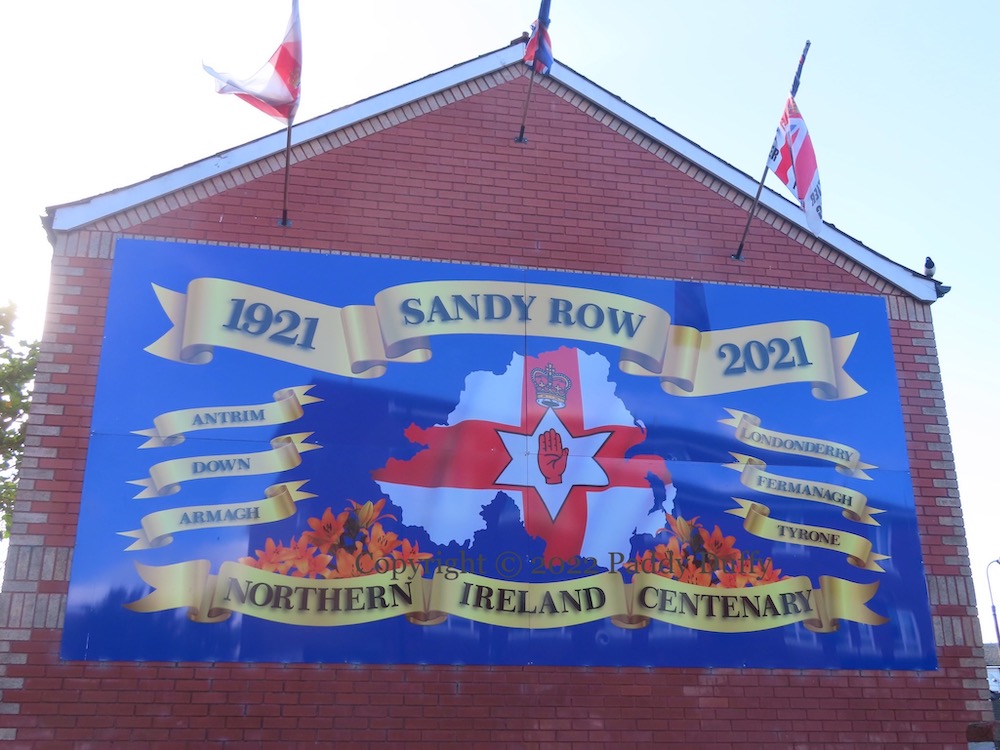
“From Sandy Row to the house of Windsor: happy diamond jubilee 1952-2012. God save the Queen.” Although the coronation was held in June 1953, Elizabeth acceded to the throne immediately upon the death of George VI, on February 6th, 1952. This board was previously on an adjacent wall but has been moved to this location (on top of the ‘Our Wee Country’ mural, replacing a damaged mosaic) to make way for the NI centenary board shown below.
The Irish Football Association (web | tw) is the governing body for Northern Irish soccer, overseeing both domestic and international events. The original Our Wee Country (fan organisation Web | tw) mural was in Carnforth Street, east Belfast.
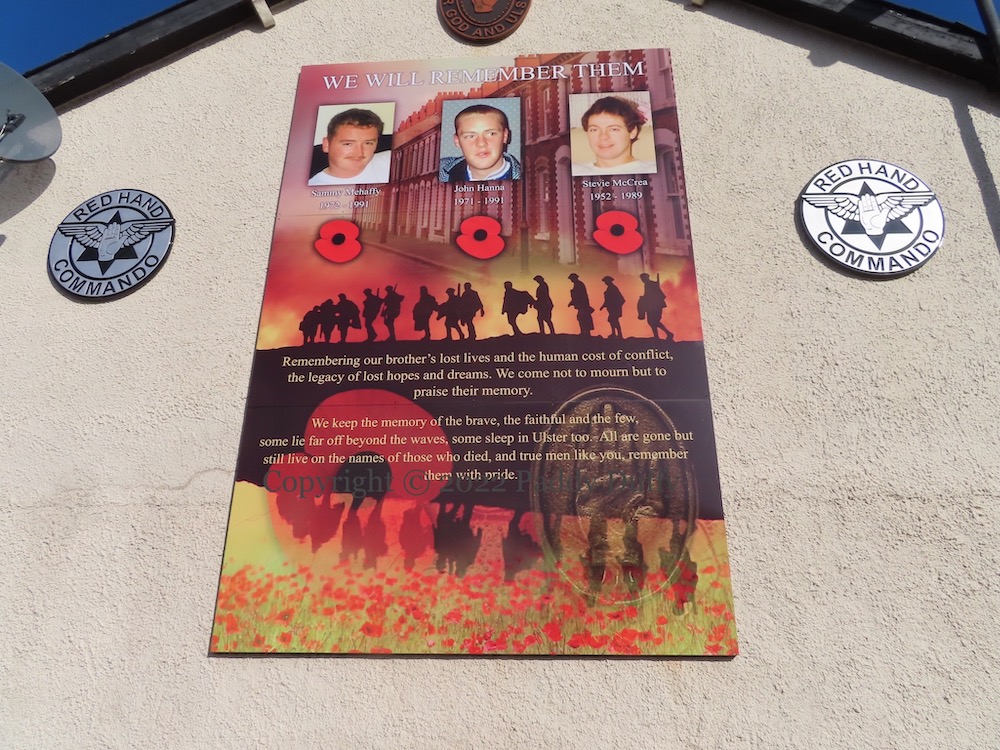
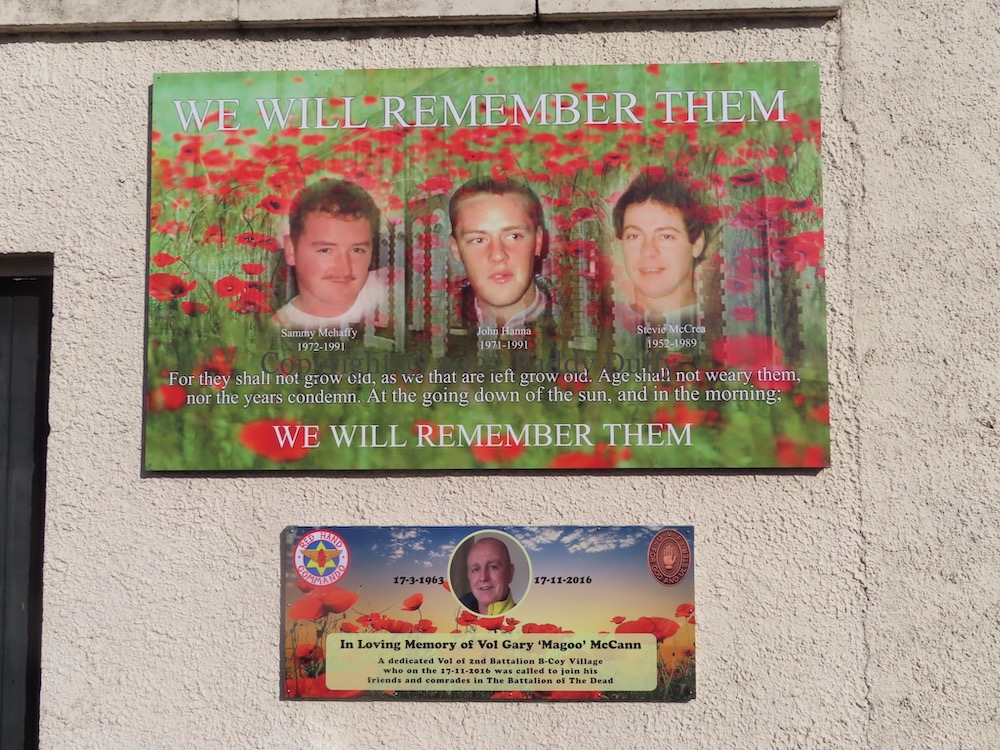
There are two boards, a large one on a gable and a smaller one on the side wall, to slain UVF members John Hanna (died 1991-09-10), Stevie McCrea (1989-02-18) and Sammy Mehaffy (1991-11-13), with poppies and image from WWI.
Gary “Magoo” McCann is also honoured, as “a dedicated Vol of 2nd Battalion C Coy Village who on the 17-11-2016 was called to join his friends and comrades in the Battalion of The Dead” in a new Red Hand Commando board on Frenchpark Street below the memorial to Sammy Mehaffy, John Hanna, and Steve McCrea. Tributes were paid by South Belfast Protestant Boys and Linfield Supporters Club who called him “a Village legend”.
The Ulster Political Research Group (UPRG) (Fb) is an advisory body to the UDA and produced Common Sense (available at CAIN) in 1987 (and before that, in 1979, NUPRG produced Beyond The Religious Divide, which is mentioned in the long-standing John McMichael mural in Lemberg Street (see We Must Share The Responsibility); this is the side-wall to the new C Coy South Belfast UDA/UFF/UDU/UYM/LPA mural in Tavanagh Street.
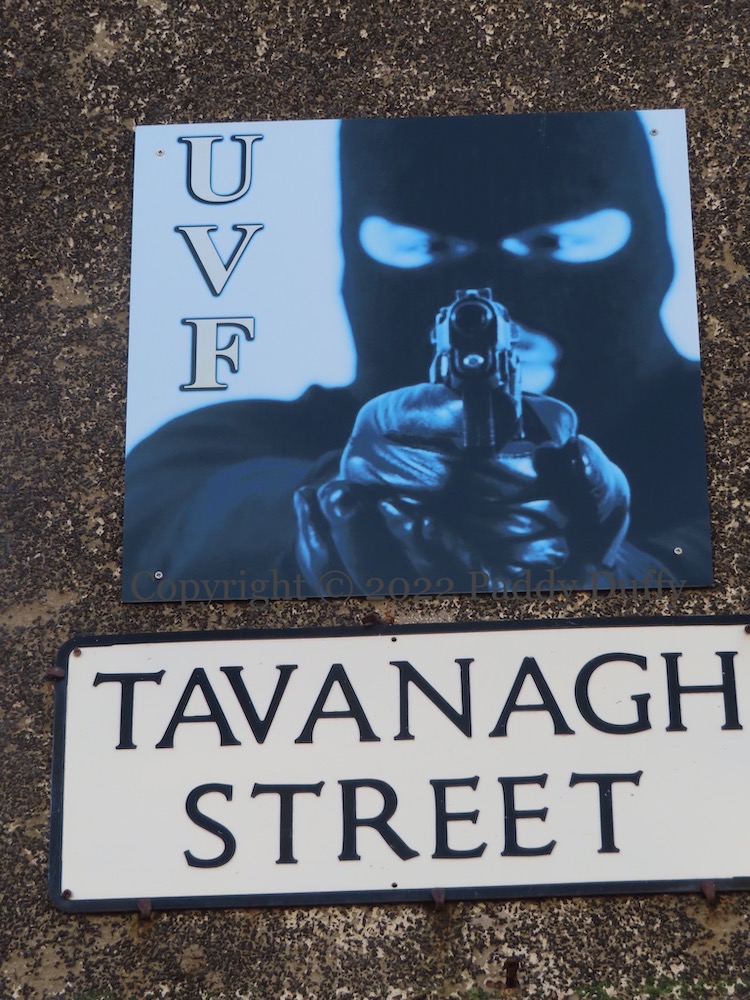
Small boards (the same size as the Poppy Trail individual commemorative boards, as in XXXVI) were erected circa 2018 at most of the street corners along Broadway in the Village area of south Belfast. Many are UVF emblems but this one of a hooded gunman aiming at the viewer is a remarkable return to openly paramilitary imagery in the neighbourhood.
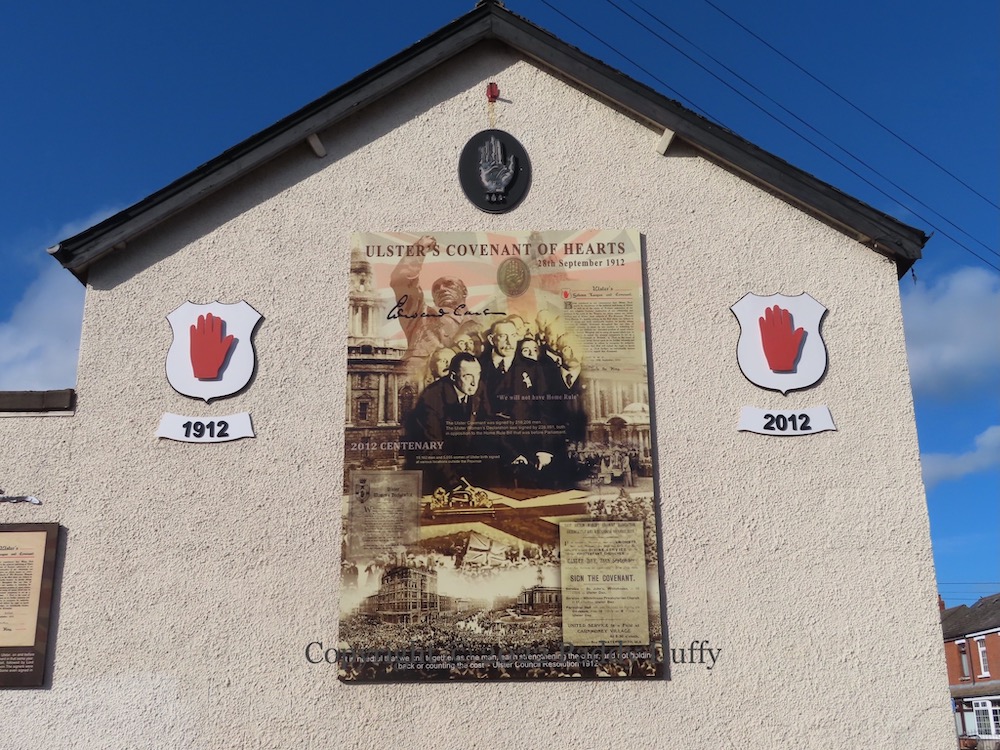
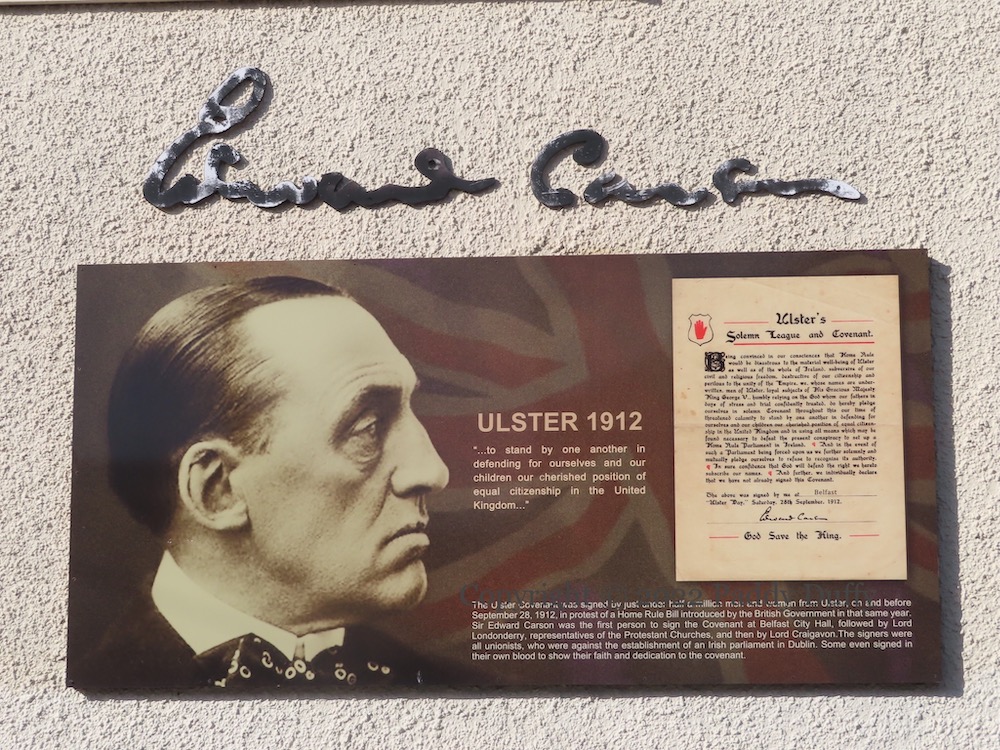
“Ulster’s covenant of hearts” is the title given to the main board in this collection commemorating the 100th anniversary of the signing of the Covenant in 1912 and the figure of Edward Carson, leader of the Ulster Unionist Party, founder of the Ulster Volunteers, and first signatory of the covenant.
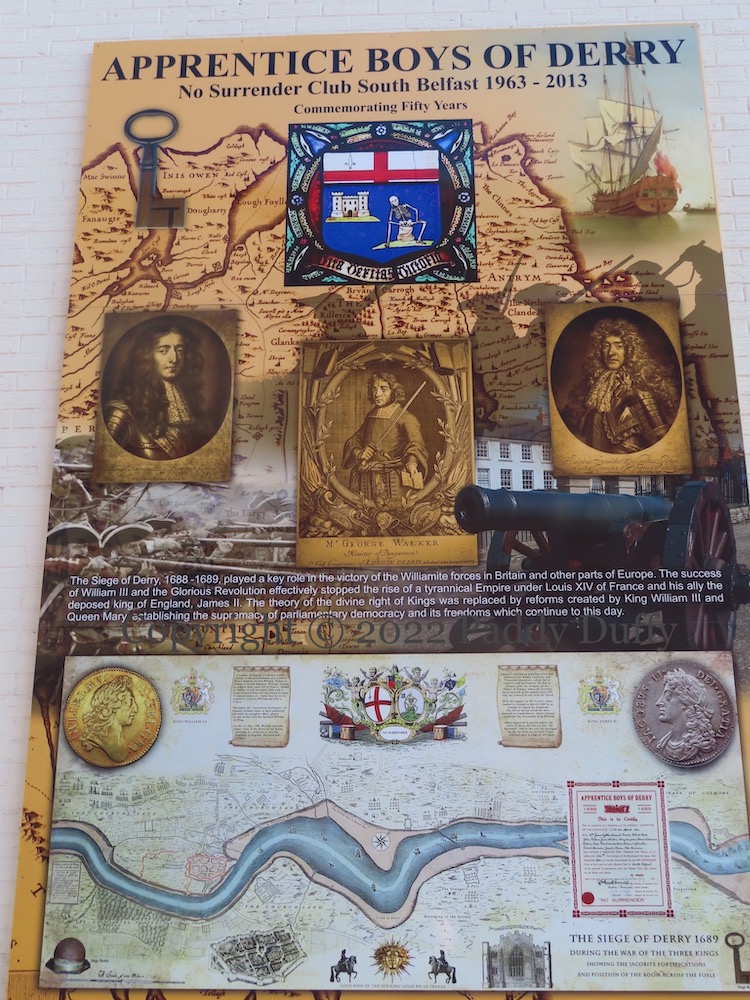
Oak Street is a fitting place for a mural about the Siege of Derry, as the oak leaf, shown to the left and right of the board above (and in the wide shot, below) is a symbol of the town, “doire” meaning an oak grove. The gates to the city were locked by thirteen apprentices, against the wishes of Governor Robert Lundy who wised to surrender the city. When the deposed king James II and his army arrived and demanded the surrender of the city of Derry, the cry from within was “No surrender!” The city was then besieged for 105 days until relief arrived in the form of ships of the navy of the newly crowned William & Mary.
The board shown above celebrates 50 years of the No Surrender Club South Belfast (1963-2013) a club affiliated with the Apprentice Boys Of Derry.
South Belfast MP Robert Bradford was assassinated by the Provisional IRA in Finaghy at a meeting with constituents; the caretaker of the community centre, Ken Campbell, was also killed by the fleeing attackers. Taking place in late 1981, with the hunger strikes having ended only a month before, the killing was noted around the world and raised fears of broad civil unrest (BBC | NYTimes). The board above serves as a substitute for an earlier mural to Bradford on the adjacent gable wall.
Young Conquerors Flute Band mural in Pine Street, south Belfast, connecting the band to local soldiers who died in WWI. The two boards to either side show a photograph of the original Donegall Pass Defenders Flute Band, which lasted a short time in the 1970s before the formation of the Conquerors in 1977 (Fb). The second shows the patch of the band.
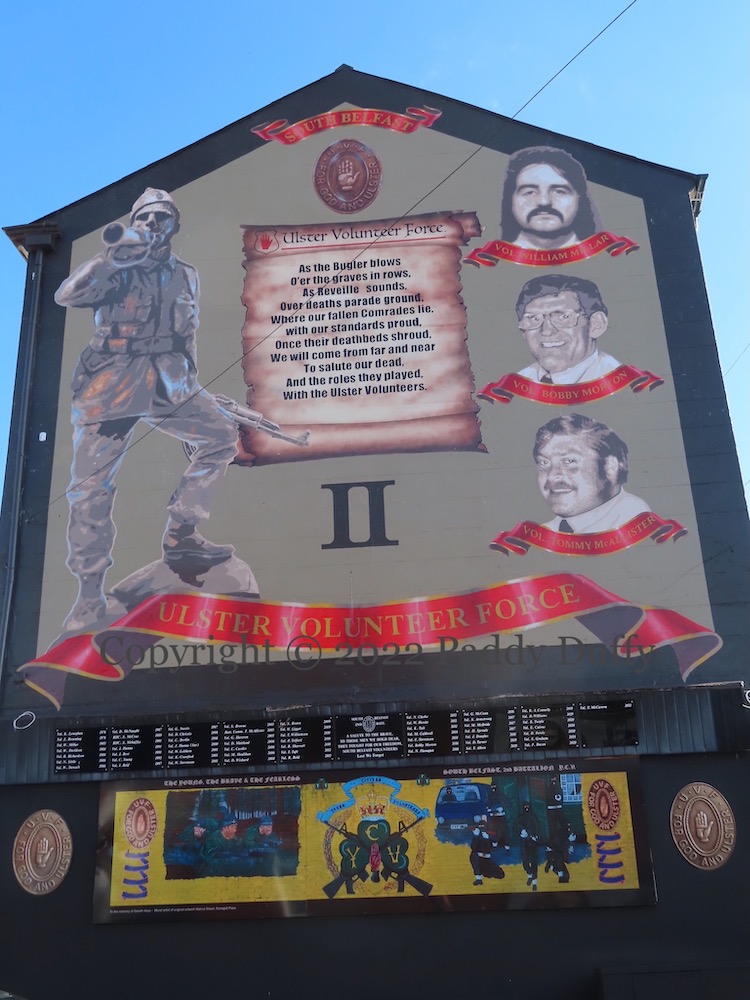
The bugler in period uniform and the language of the poem are reminiscent of WWI but all of the UVF mural, roll of honour, and reproduction of an old YCV mural refer to the modern UVF and in particular to William Millar [sometimes given as “Miller”], Bobby Morton, and Tommy McAllister. Millar and Morton were ambushed by the RUC on the 16th of March 1983 – Millar died and Morton was injured (Long Kesh Inside Out). Millar was included in an old Cregagh mural – see C00956). Morton died in 2016 (Young Conquerors), hence his portrait shows him as an older man. The same is true of McAllister’s portrait, though no information about him is readily available.
“As the bugler blows/O’er the graves in rows/As reveille sounds/Over death[‘]s parade ground/Where our fallen comrades lie/With our standards proud/Once their deathbeds shroud/We will come from far and near/To salute our dead/And the roles they played/With the Ulster Volunteers.”
The mural was launched on March 19th (ACT) in Pine St. Below the new mural are a roll of honour and a board reproducing a former mural by Gareth Keys one street over, in Walnut Street – see The Young, The Brave, The Fearless.





 Paddy Duffy Collection