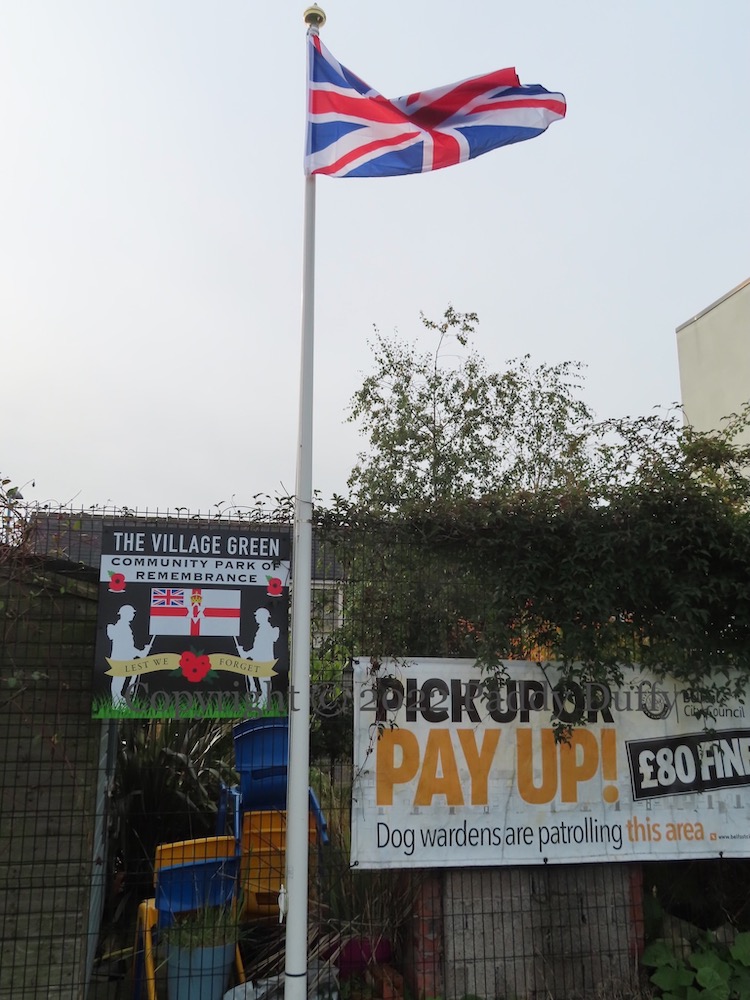
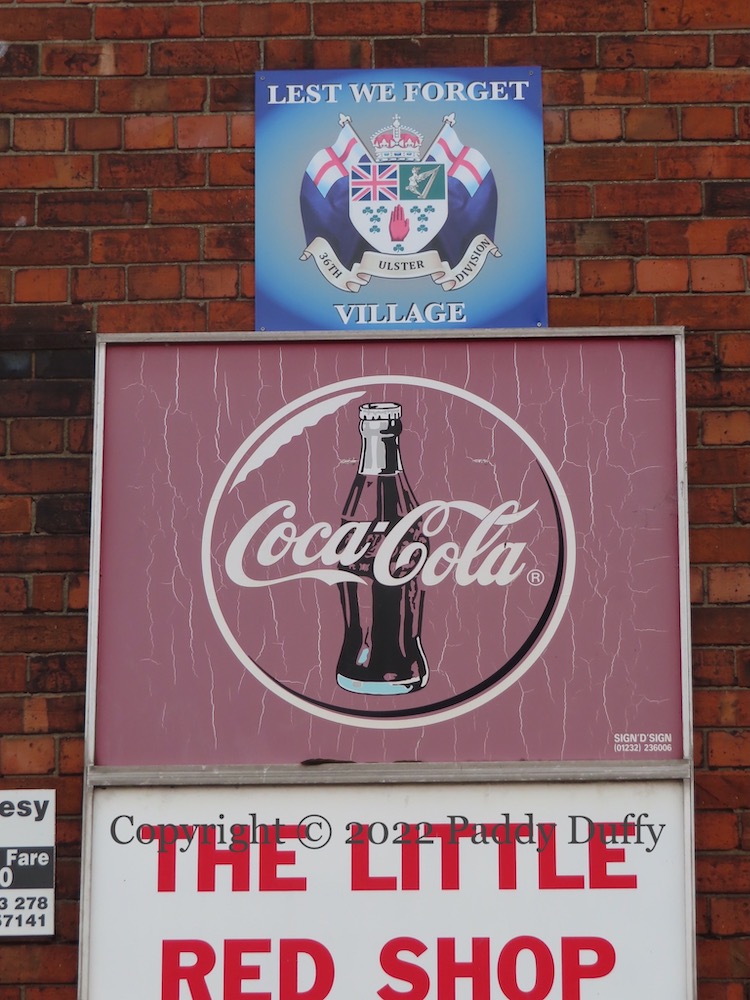
Part of the most recent development of the upper streets in the Village was not to rebuild the two rows of houses on Ebor and Nubia/Moltke streets and in their place construct a park – the Village Green – and playground. This new board on the outside railings make the park a “community park of remembrance” for WWI, showing an Ulster Banner with a Union Flag in the canton.
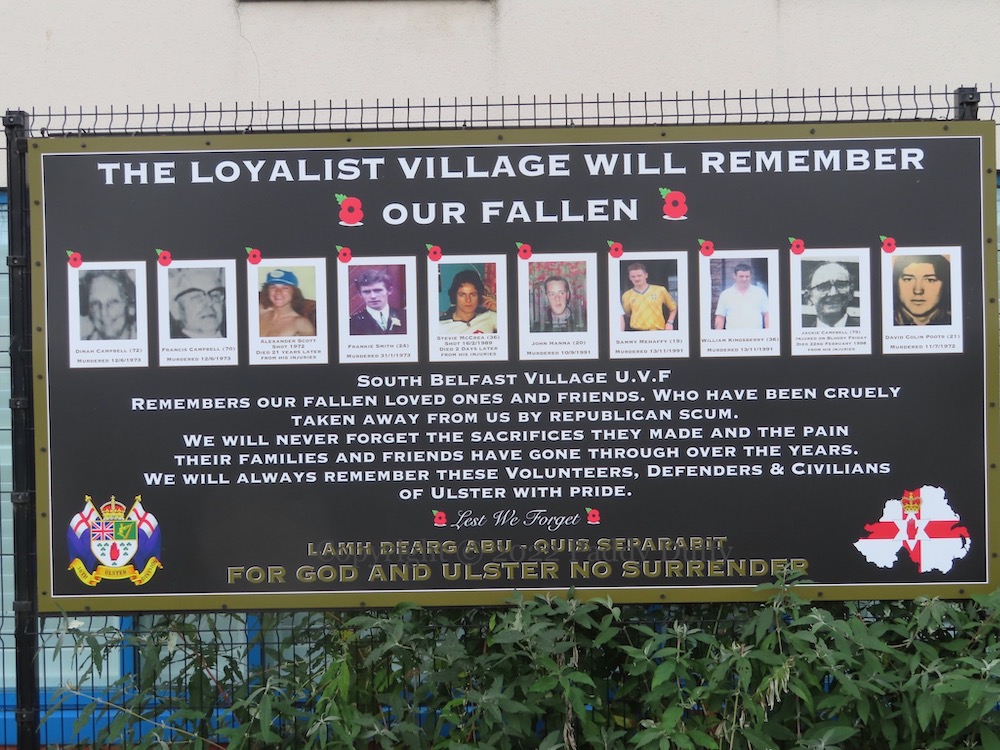
There is also a memorial to “loved ones and friends”, “volunteers, defenders & civilians” of the South Belfast UVF (though there is 36th (Ulster) Division emblem in the corner) who were “cruely taken away from us by republican scum”: Dinah Campbell, Francis Campbell, Alexander Scott, Frankie Smith, Stevie McCrea, John Hanna, Sammy Mehaffy, William Kingsberry, Jackie Campbell, David Poots.
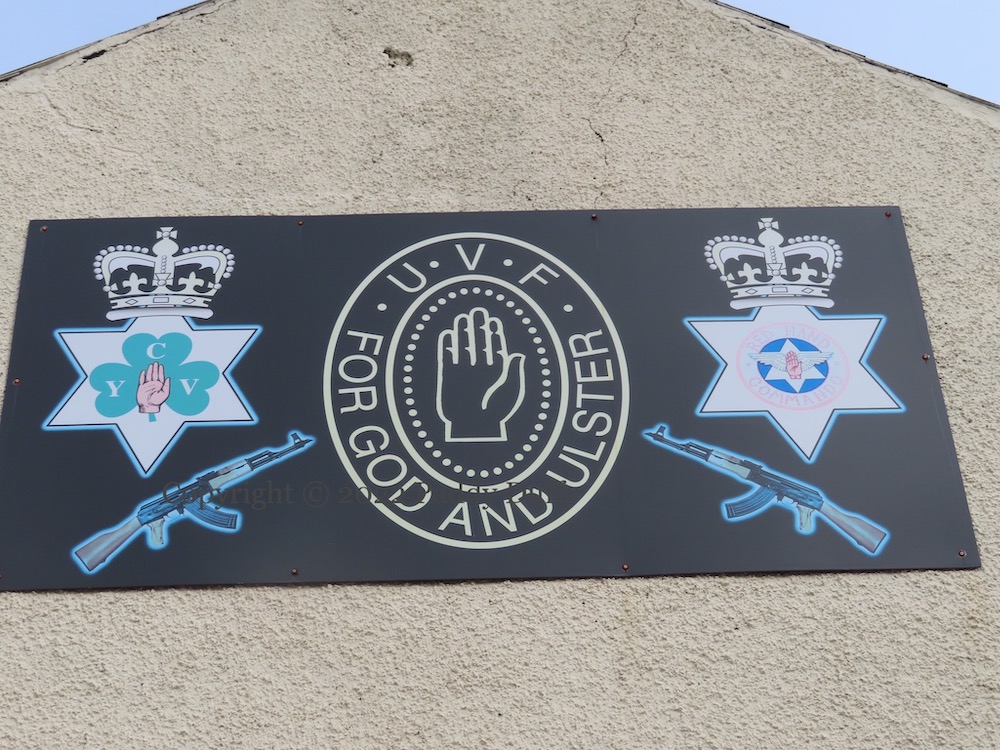
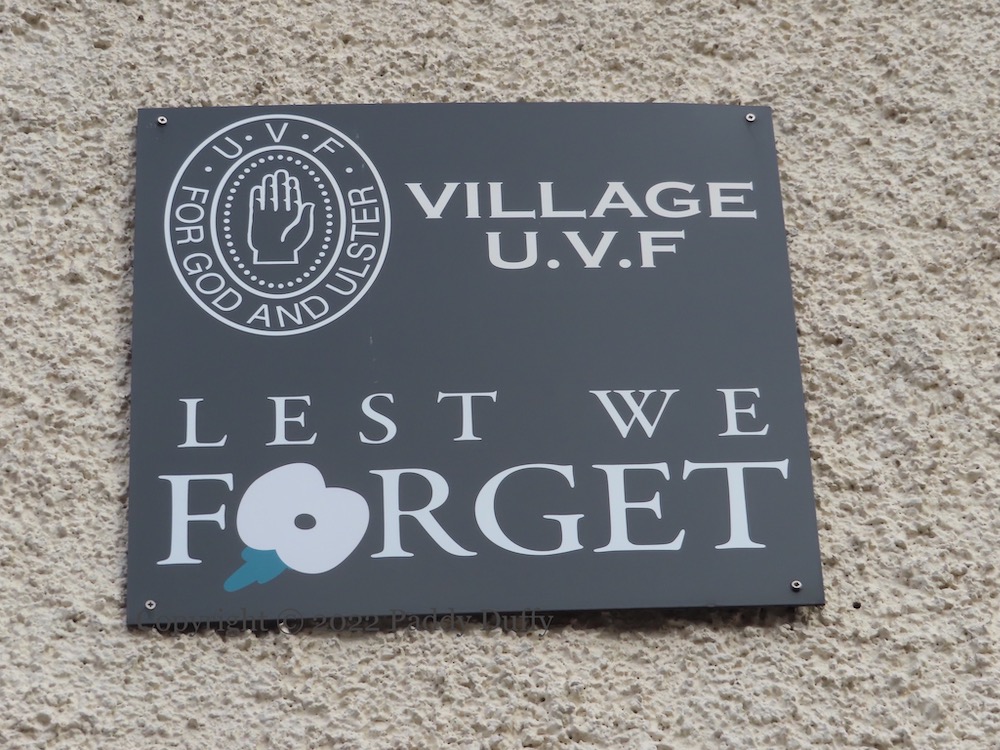
Territorial markings of the UVF are posted on the new development on the east side of the Village. These images are all from the Kitchener Drive, which has new houses in Kitchener St and Soudan St.
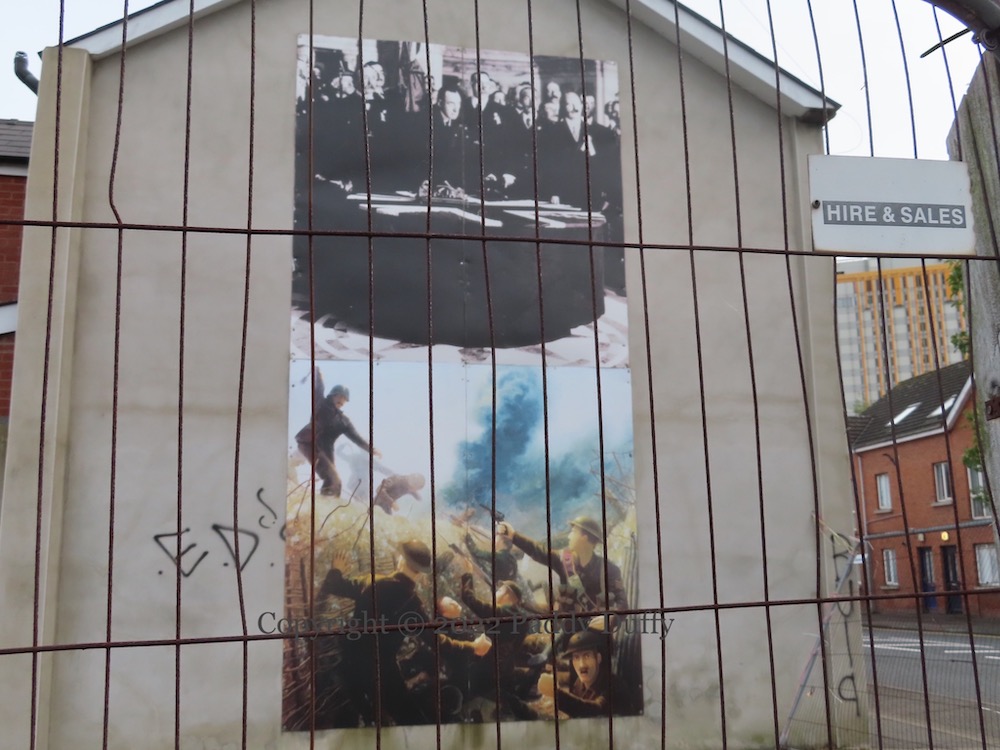
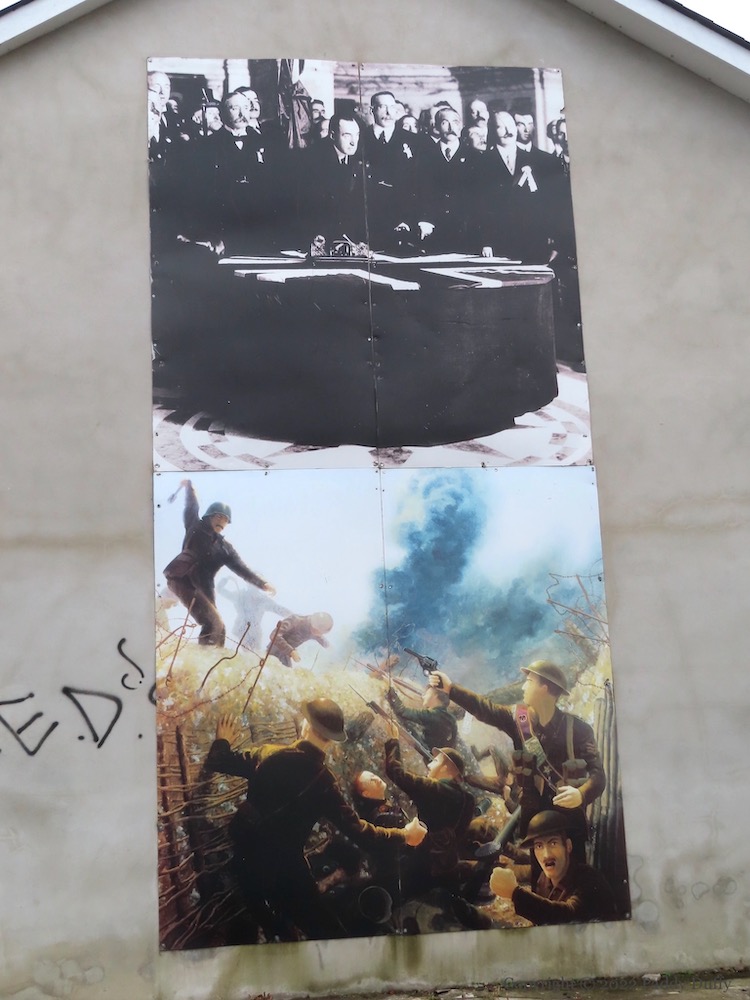
Here are a pair of boards in Barrington Gardens, Belfast: above, the signing of the Ulster Covenant, on September 28th, 1912; below, an attack on British trenches, perhaps intended to represent a scene from the first day of the Battle Of The Somme, July 1st, 1916.
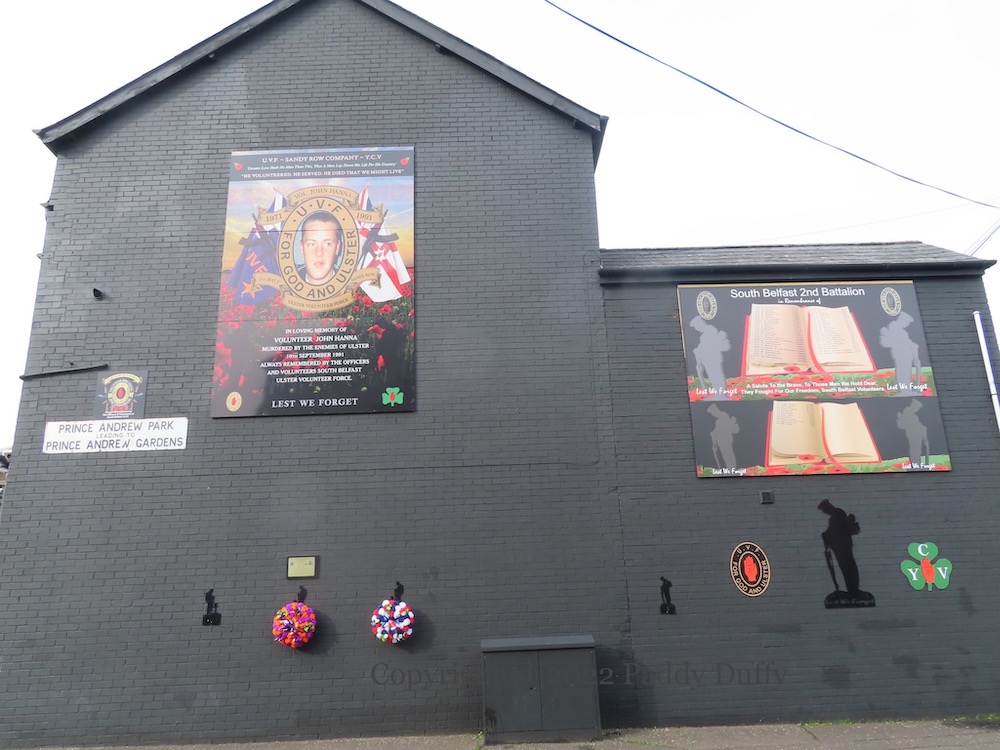
UVF volunteer John Hanna was 19 years old when he was killed by “the enemies of Ulster” (the IRA) at his home on Donegall Road in the Village. This new board is in Prince Andrew Park, just off Donegall Road. “Always remembered by the officers and volunteers South Belfast [2nd Batt Sandy Row] UVF”.
On the side-wall, the poppies and the downcast soldiers come from the first World War but the names are all of modern UVF and RHC volunteers, from 1976 to the present day.
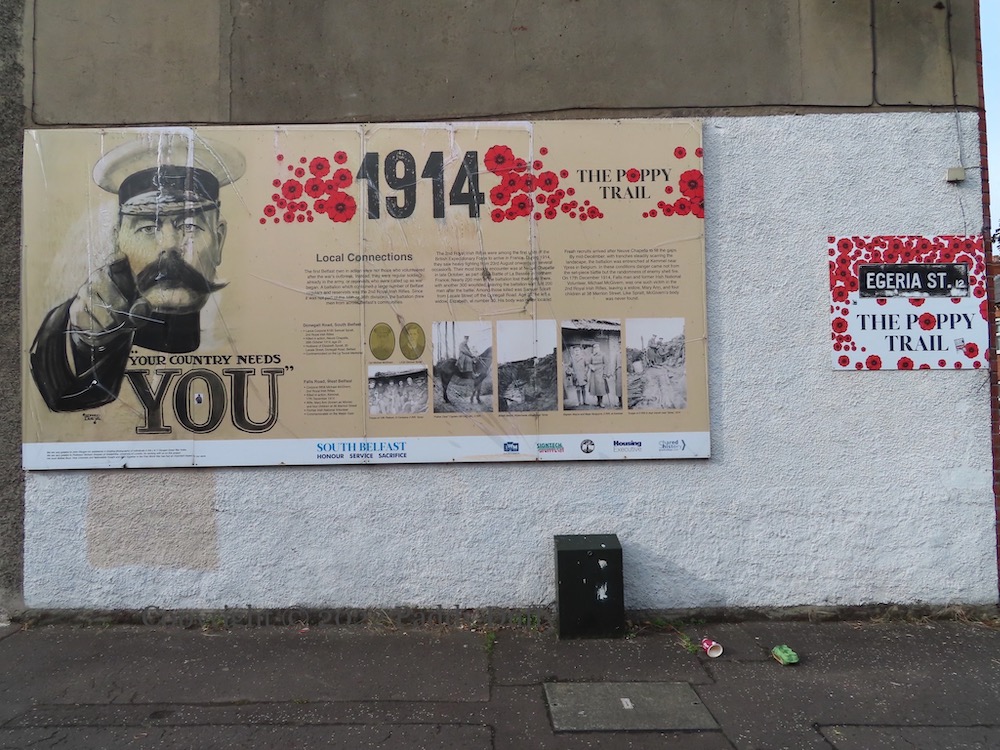
“The first Belfast men in action were not those who volunteered after the war’s outbreak. Instead, they were the regular soldiers already in the army, or reservists who were called up as war began. A battalion which contained a large number of Belfast regulars and reservists was the 2nd Royal Irish Rifles. Since it was not part of the 16th or 36th divisions, the battalion drew men from across Belfast’s communities.”
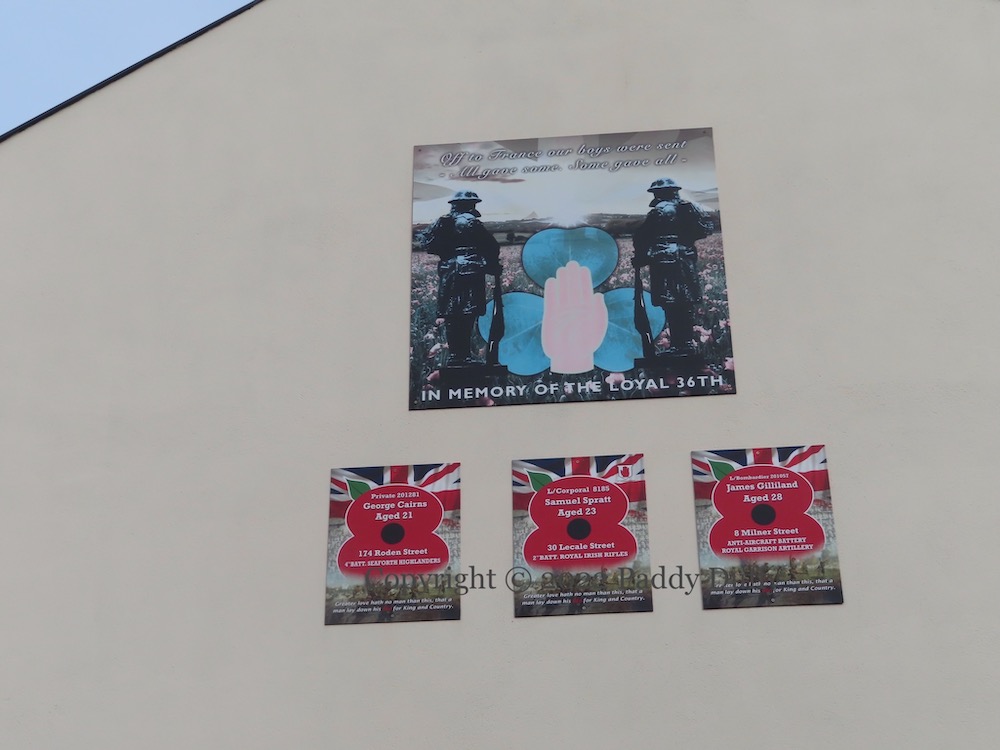
Thus begins the 1914 board on south Belfast’s “Poppy Trail” launched on February 29th, 2016. The 1914 board features the stories of Lance Corporal Samuel Spratt (from Lecale Street, off the Donegall Road) who died at Neuve Chappelle in August 1914 and Corporal Michael McGivern (from Merrion Street, off the Falls Road) who died at Kemmel in December.
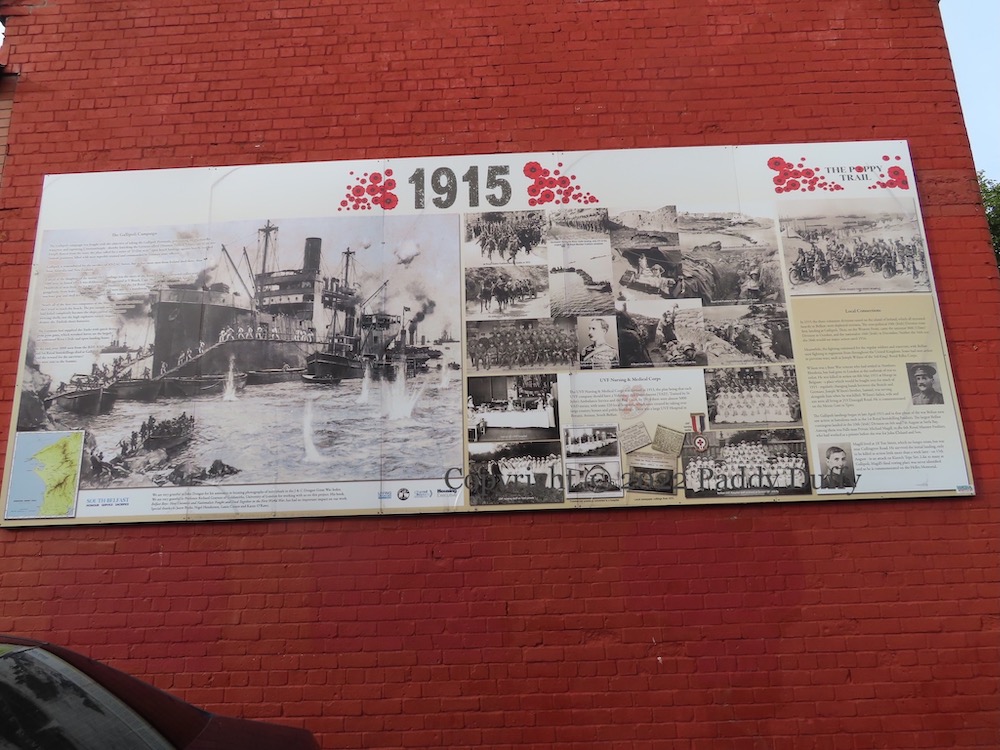
The 1915 board focuses on the Gallipoli campaign, claiming that “more men from Ireland died there than from Australia and New Zealand.” The ship on the left-hand side is the River Clyde, a converted collier, carrying men from the 1st Royal Dublin and 1st Royal Munster Fusiliers, who were decimated as they tried to reach shore — “only 372 of the original 900 1st Royal Munster Fusiliers remained”.
As with the 1914 board, the 1915 board includes the stories of men from both south and west Belfast, in this case, Joseph Wilson, who hailed from Donegall Road and died in Belgium, and Michael Magill, from the Divis area, who died at Gallipoli.
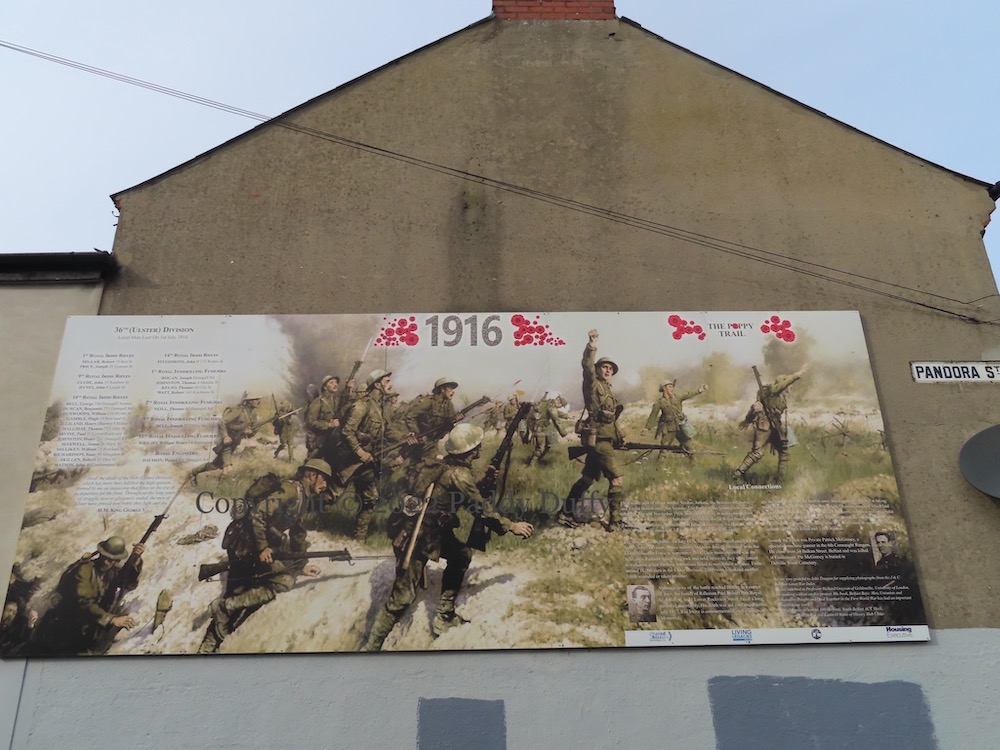
In the 1916 board, JP Beadle’s Battle Of The Somme, Attack Of The Ulster Division is reproduced in the 1916 installment of the Poppy Trail in south Belfast. (For more on the painting, see belfastsomme.com.) In addition to listing local men lost in on July 1st – from places such as Roden, Matilda, Kitchener, Barrington, Blythe, Ebor, Rowland, Abingdon, and Combermere Street – it also features an individual from each community who served and died, in this case, Rifleman Paul Irvine from Lower Rockview Street and Private Patrick McGinney from Balkan Street (in the Divis area).
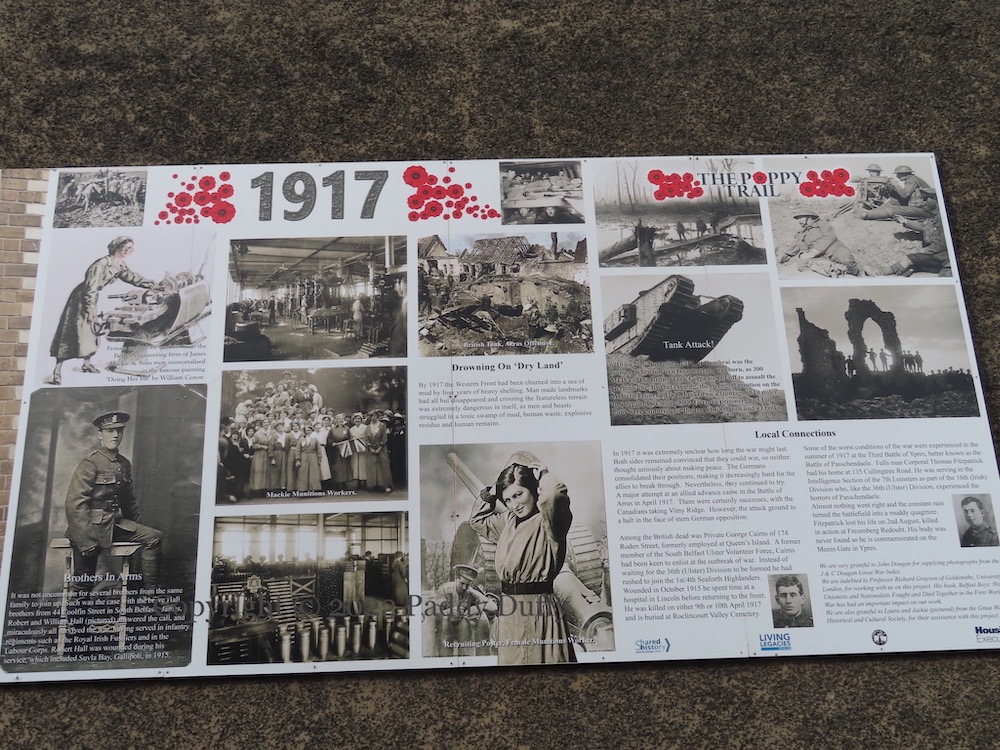
The 1917 board in the Poppy Trail series celebrates female munitions workers as well as making local connections to the battles of 1917: George Cairns of Roden Street and Thomas Fitzpatrick of Cullingtree Road.
Egeria Daphne, Pandora, Euterpe streets, south Belfast. The HMS Hawke board is on the other side of Donegall Road, in Barrington Gardens.
HMS Hawke was a Royal navy WWI cruiser sunk by German U-boat on October 1st, 1914. It was a training ship, which meant that among the 542 sailors who lost their lives on the Hawke, 75 of them were 16 year-old boys. Five of the deceased were from the Donegall Road area.
Queen Elizabeth (prior to her death) was the sovereign of more than 50 commonwealth nations whose flags form the border of this platinum jubilee board in Pakenham Street, Donegall Pass, south Belfast.
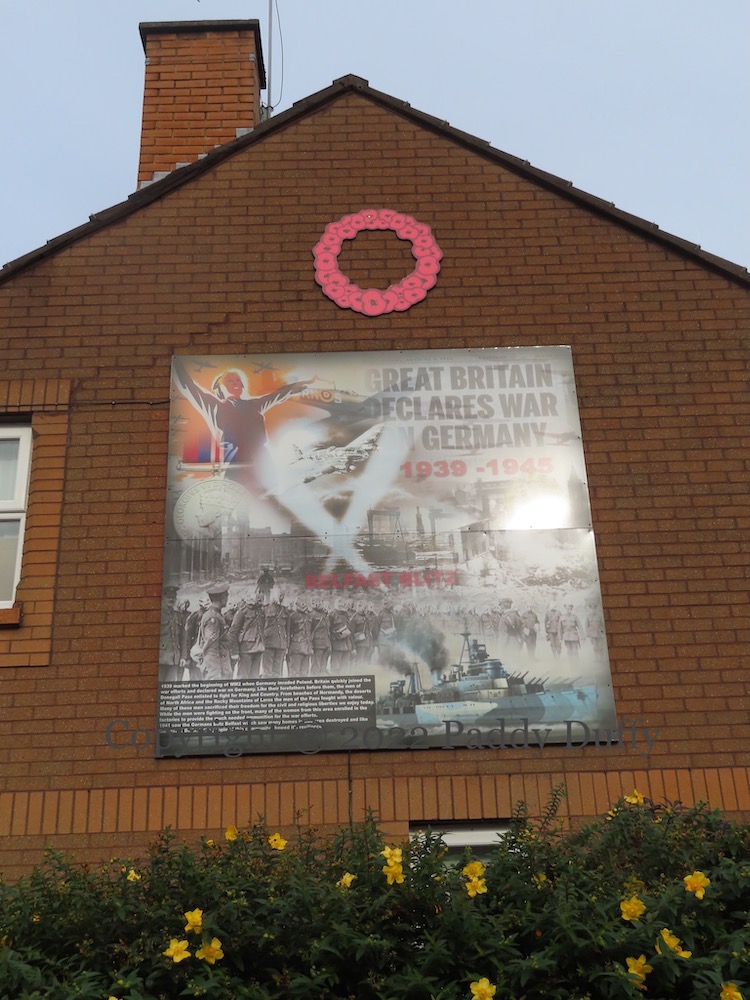
Here are the four boards on Lindsay Street, south Belfast, from east to west.
Above: “Great Britain declares war on Germany 1939-1945. 1939 marked the beginning of WW2 when Germany invaded Poland. Britain quickly joined the war efforts and declared war on Germany. Like their forefathers before them, the men of Donegall Pass enlisted to fight for King and Country. From beaches of Normandy, the deserts of North Africa and the Rocky Mountains of Leros the men of the Pass fought with valour. Many of these men sacrificed their freedom for the civil and religious liberties we enjoy today. While the men were fighting on the front, many of the women from this area enrolled in the factories to provide the much needed ammunition for the war efforts. 1941 saw the Germans Blitz Belfast which saw many homes in this area destroyed and like the rest of Belfast, the people of this community shows it’s [sic] resilience.”
“The war is over. Armistice Day 1918. 11th month, 11th day, 11th, hour.” “But in their eyes shall shine the holy glimmers of goodbyes … Their flower the tenderness of patient minds, and each slow dusk a drawing down of blinds.” Lines from Wilfred Owens’ (1893-1918) ‘Anthem For Doomed Youth‘ on a new board in Lindsay Street.
The text at the bottom reads: “The last three months of WWI became known as the hundred days. Realising they were defeated an armistice was signed by the Germans. Germany finally surrendered and WWI ended on November 11th 1918. The terms of the agreement called for the end of fighting along the entire Western Front to begin a precisely 11 am that morning. Records show that the last British soldier killed in WWI was Private George Edwin Allison of the 5th Royal Irish Lancers. He was killed at Mons at 09:30 am, just 90 minutes before the ceasefire.”
Computer-generated board in Lindsay Street showing a map of the northern end of the Western Front and images of soldiers marching, on horseback, and in the trenches: Donegall Pass remembers 1914-1918 – the great sacrifice. Lest we forget. Here are commemorated the many local men who during the Great War of 1914-1918 gave the most that man can give: life itself for God for King and Country.
“It is needful that we knit together as one man, each strengthening the other, and not holding back of counting the cost” – Ulster [Unionist] Council Resolution 1912.” “Ulster’s solemn league and covenant. Ulster Day 28th September 1912.” The Council met on September 23rd and 471,000 people signed the covenant (figures here) on or around the 28th – Ulster Day – led by Sir Edward Carson.
This pair of boards depict (above) the signing of the Ulster Covenant and (below) the 36th Division – formed largely from the Ulster Volunteers that were formed after the Covenant – in the trenches in WWI. It is reported that some soldiers wore their Orange Order collarettes into battle. The painting is by Carol Graham.
The pair was moved to this wall after the house on the corner was knocked down – see Out Of The Rubble.
RHC volunteer Stevie McCrea (born 31.5.52, killed 18.2.89) was imprisoned for his role in the killing of 17 year-old Catholic James Kerr in a Lisburn Road garage, on the same day as the RHC bombed Benny’s Bar in Sailortown. He was killed in an IPLO attack on the Orange Cross (the Shankill Social Club). This Village mural is the second tribute to McCrea this year – see also A True Soldier Of Ulster in the lower Shankill, near the former location of the Orange Cross in Craven Street.
The text on the board reads: “Stevie was raised in The Village Area of South Belfast. He was just a young man when The Troubles started but without hesitation answered the call by joi[ni]ng the Village RHC. He soon started making a name for himself by putting himself on the front line with his brothers in arms in the RHC. These men where [sic] one of the most active units in Ulster by taking the fight the republicans. In 1972 at the height of The Troubles Stevie was sentenced to life for his part in a retaliation shooting and was imprisoned in Long Kesh. After serving 15 years with dignity and courage he was released. On the 16th February 1989 just after receiving his last pay cheque [from a transitional work scheme] he decided to join a few friends in The Orange Cross Club in the Shankill area. This would be his last drink as republican scum decided to target the Loyalist club. Stevie sacrificed himself to protect his friend by throwing himself in front of a hail of bullets. Stevie died 2 days later from his injuries in the Royal Victoria Hospital.”
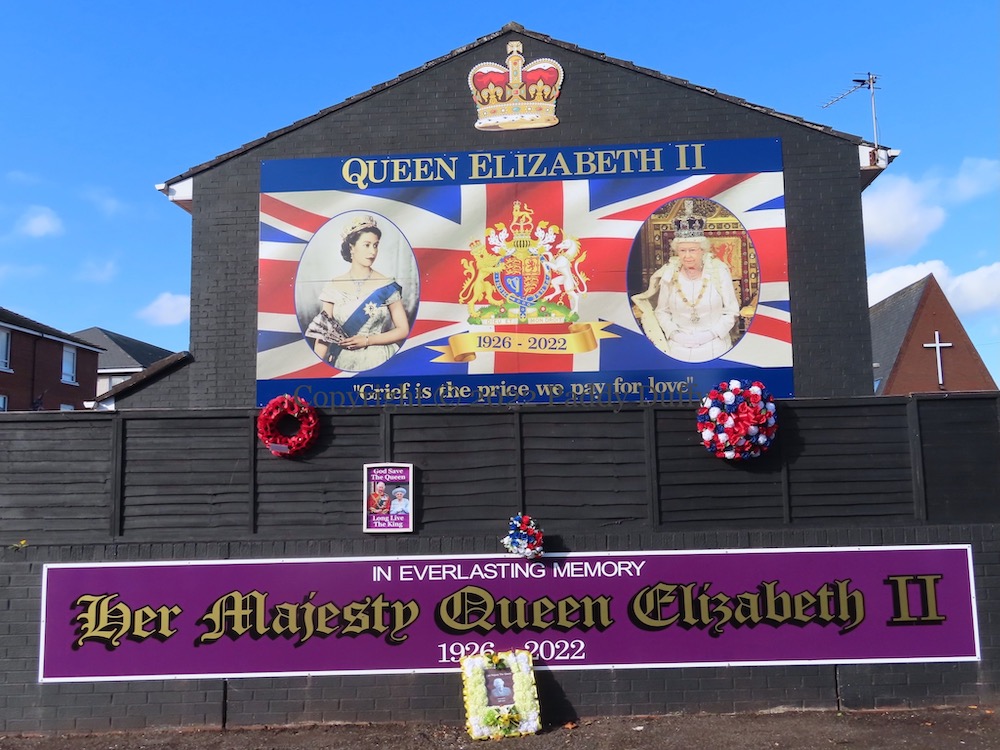
Elizabeth II, queen of the United Kingdom, passed away on September 8th, at the age of 96, in the same year of her platinum jubilee, the 70th anniversary of her accession. The phrase “grief is the price we pay for love” comes from a message from Elizabeth in consolation with the relatives of those killed in the “9-11” attacks in 2001 (text at The Guardian).
“In everlasting memory – her majesty Queen Elizabeth II – 1926-2022.” “Long live the King”






 Paddy Duffy Collection