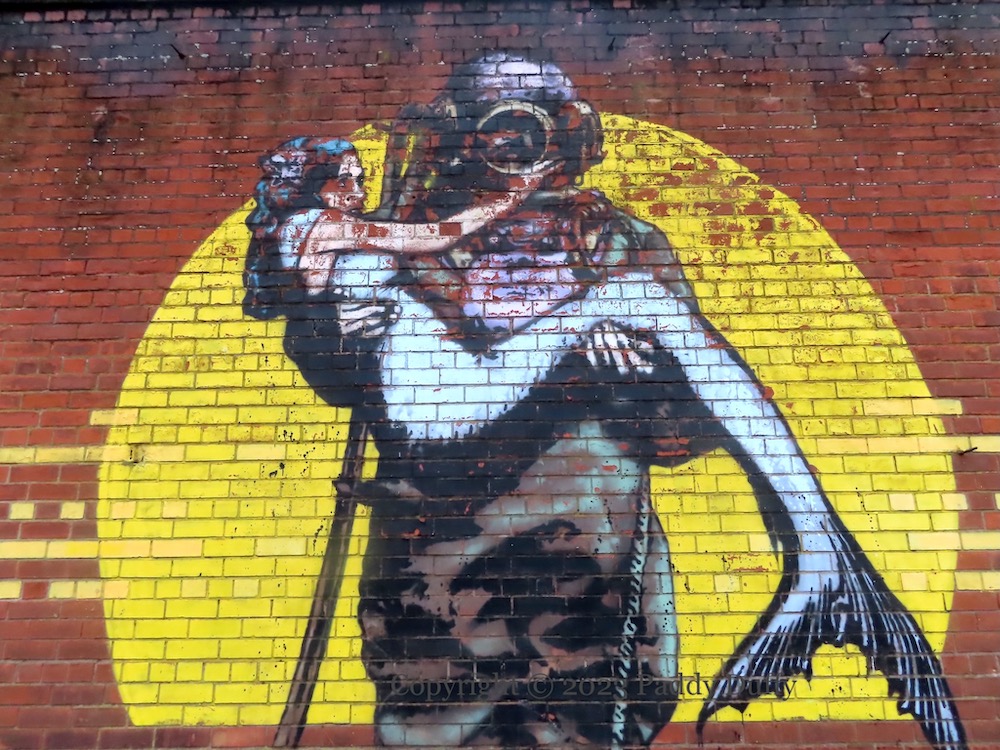
Dublin’s ADW (tw | web | Fb) came north for CNB/HTN17 and painted a mermaid rescued(?) by a deep-sea diver – with a mustache to match her tail. The meme goes back at least to this 1895 Punch cartoon.
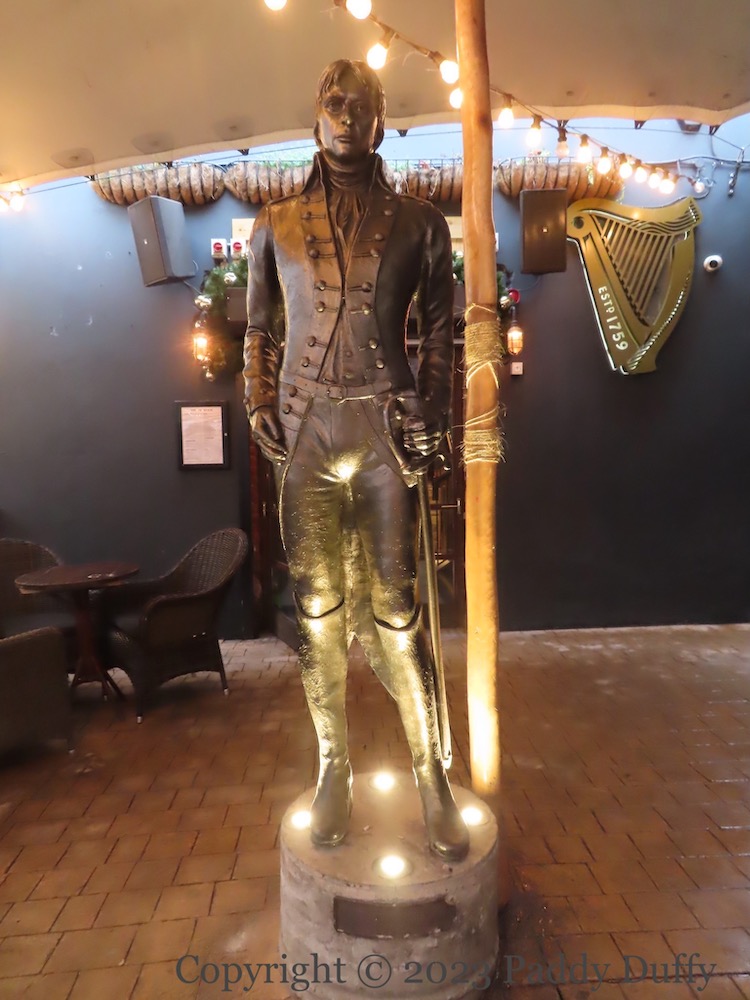
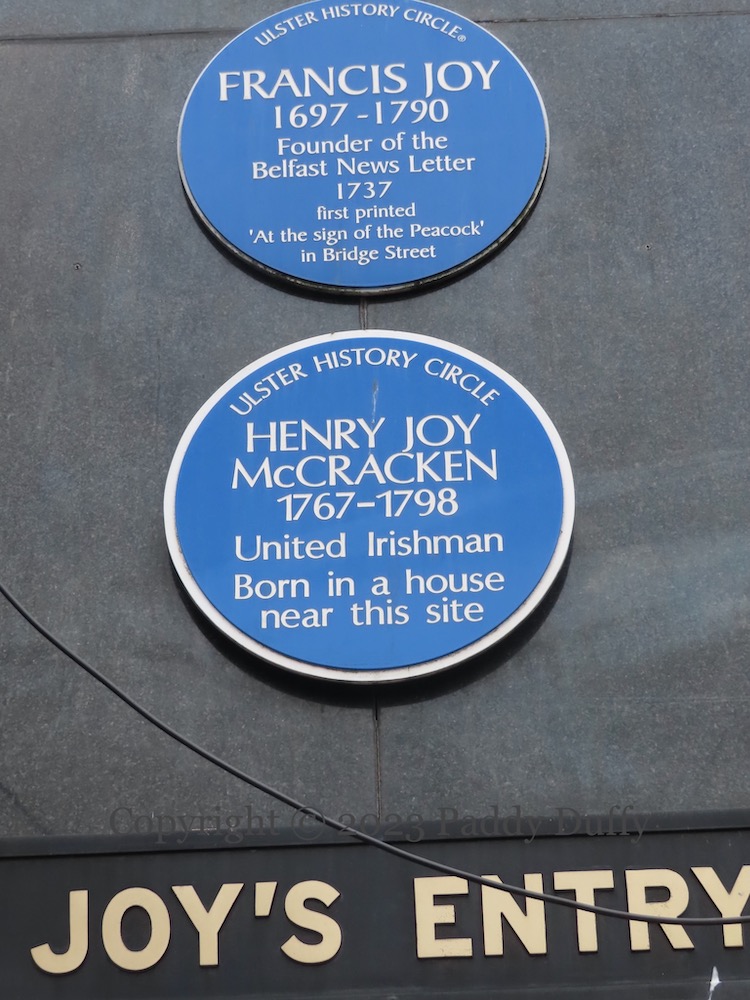
Henry Joy McCracken’s mother was Ann Joy, daughter of Francis Joy, linen manufacturer and founder of the Belfast Newsletter. They both have a “blue plaque” at the northern end of the entry – see the final image, below. Henry led the Antrim uprising of the United Irishmen in 1798 and was hanged for it in Corn Market at age 30. (WP)
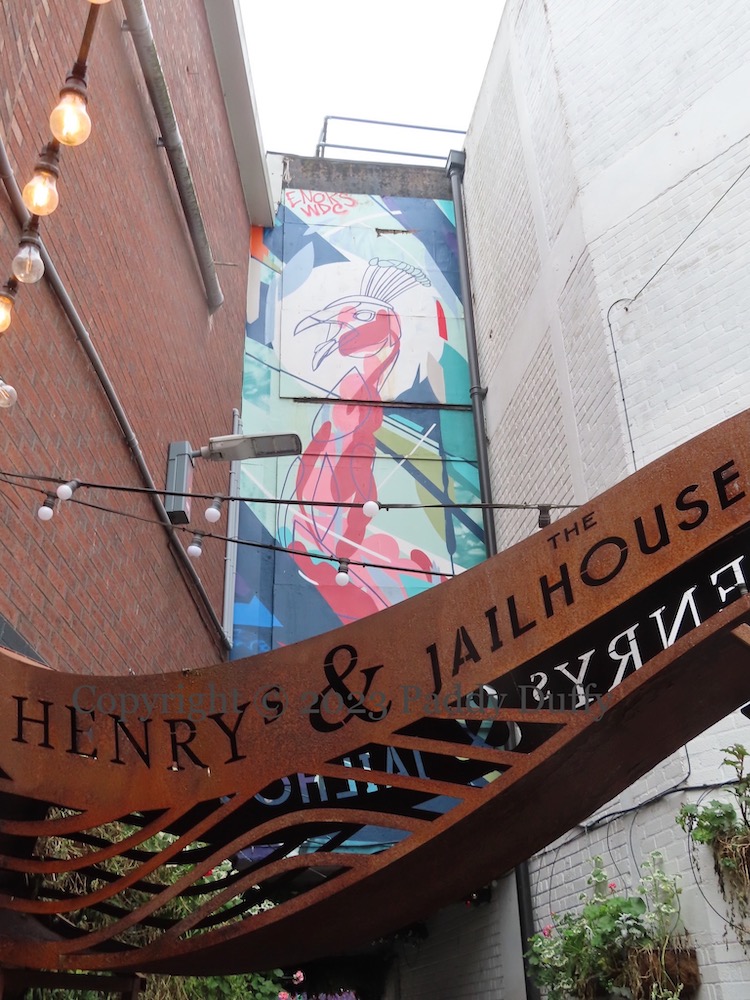
The peacock piece – official title ‘Peripheral Palisading’ – is by James Earley (web). It is perhaps inspired by the blue plaque’s note that the News Letter was “first printed ‘at the sign of the peacock’ in Bridge Street”. For a better shot of it, see the Visual History page on the Belfast Entries.
Also in the Entry is a large wall-painting of Olaudah Equiano.
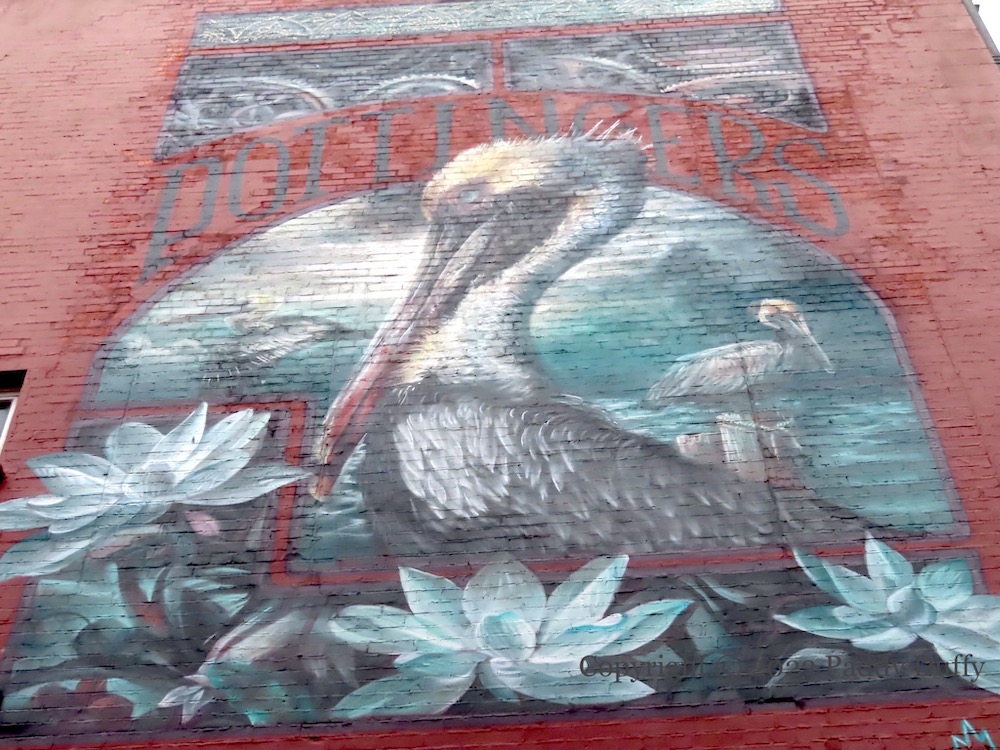
This giant pelican was painted by Nomad Clan (web) from Manchester, England, as part of the first year (2020) of the Belfast Entries Project (Visual History). According to ArtUK, the pelican is a reference to “the Pottinger’s family crest” (Lord Belmont) while the “east Asian flowers” along the bottom and the cogs at the top point “to Belfast’s rich industrial past.
In 1789, Olaudah Equiano published a memoir to 311 subscribers describing his early life in west Africa, his kidnapping, transport via Barbados to enslavement in Virginia, then in London, England, and then in Montserrat in the Caribbean. He bought his own freedom in 1766 and went back to England and joined the burgeoning abolitionist movement. His memoir detailing the treatment and conditions he had experienced made him famous. He toured Britain and Ireland in support of his book: “I found the people extremely hospitable, particularly in Belfast [in 1791-1792]” (BBC Sounds 17m 58s). He stayed with Samuel Neilson, a founding member of the United Irishmen (Clifton Belfast | WP | see also yesterday’s post on Belle Martin). Ten years after his death in 1797, the trans-Atlantic slave trade was abolished in both the UK and the States.
The mural in Joy’s Entry, by London artist Dreph, is based on a portrait painted by William Denton and engraved for the book by Daniel Orme (Dreph | National Portrait Gallery).
For an overview of the anti-slavery movement in Belfast, including Thomas Russell, Olaudah Equiano, and Frederick Douglass, see this William Orr speech (at Slugger).
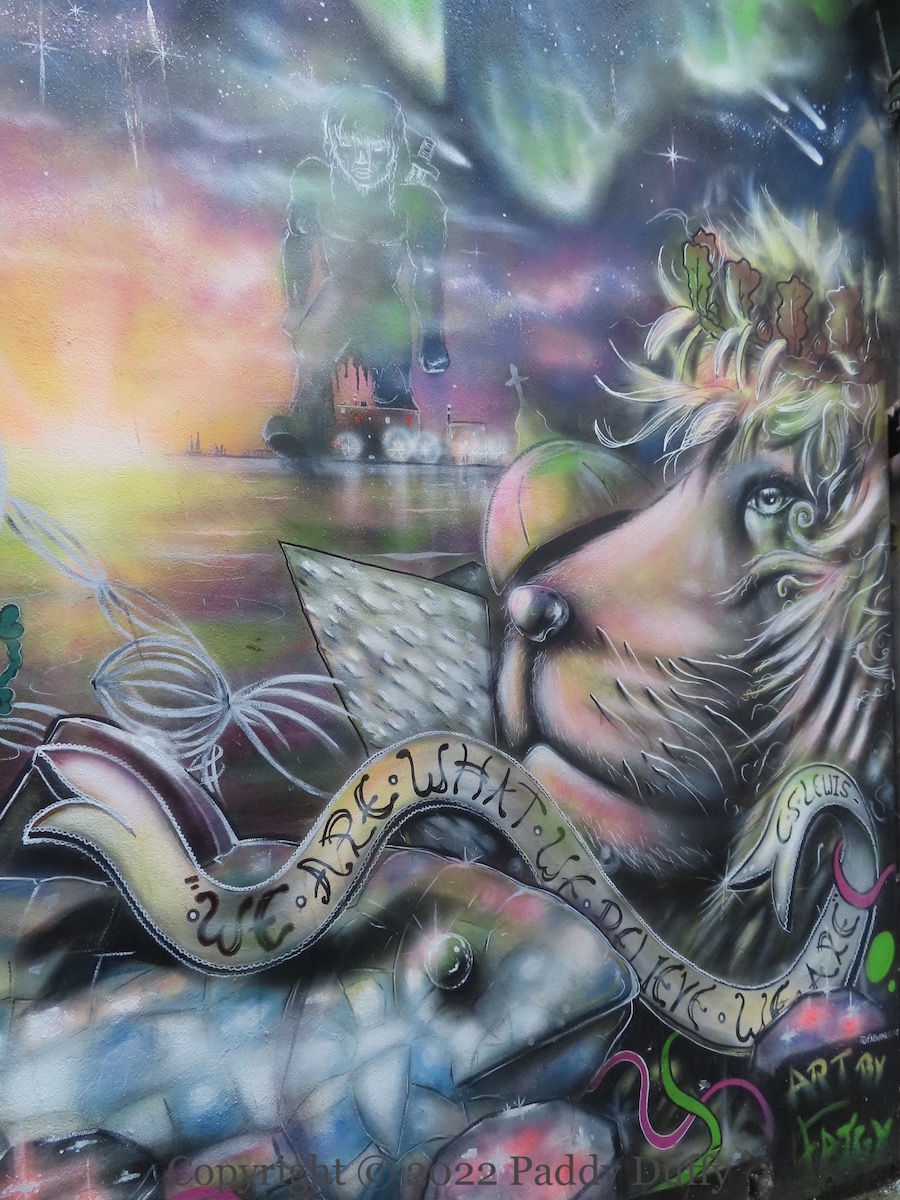
Like “You’re never too old to set another goal or dream another dream” in east Belfast, “We are what we believe we are” appears to be another of those inspirational quotes attributed to – but not actually by – CS Lewis. The quote appears alongside Belfast landmarks the Titanic centre, Aslan, the Big Fish/Salmon of Knowledge, an unidentified cupola. Part of a piece by Faigy (ig) in Wilson’s Entry, Belfast.
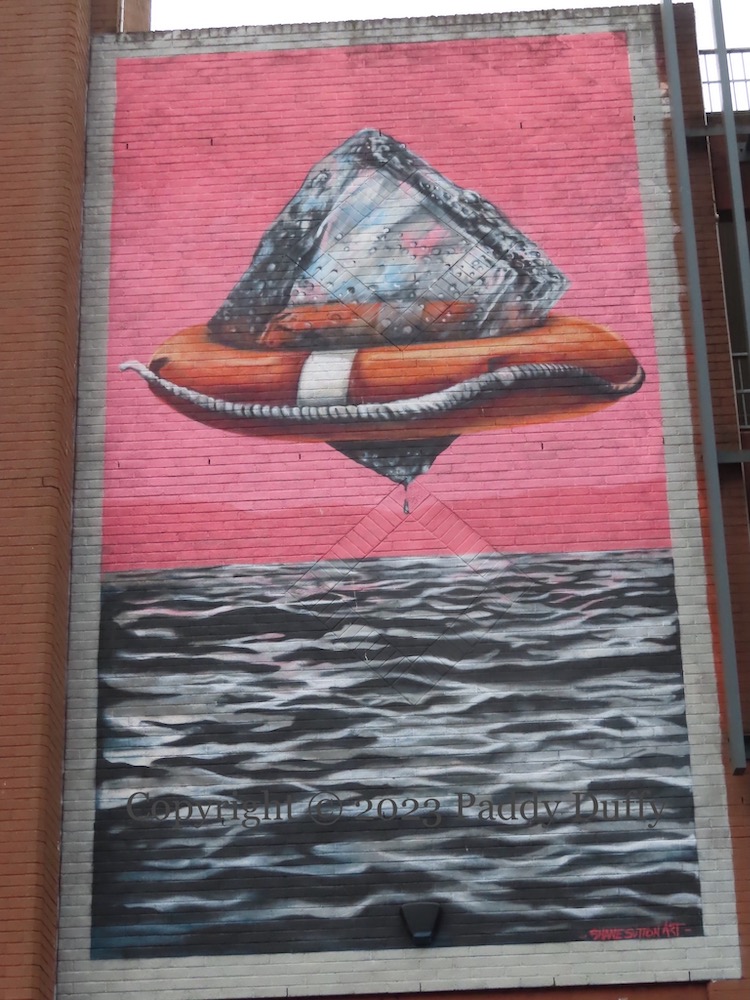
If the ice melts, we’re all in the drink – an environmental message from Spacer (Shane Sutton tw) for Friends Of The Earth (NI) (ig | tw) in High Street, Belfast.
“Civilisation has its roots in the soil & without soil there will be no future life – Tá an duıne fréamhaıthe san ıthır, gan í ní hann dó” by Ed Reynolds (web | tw) and Tancredi Caruso. Together they put on an exhibition and painted a mural for the Belowground Visions Of Life project (Soil Security Programme). The mural is outside Bunscoıl Mhıc Reachtaın (hence the Irish translation) in the old ‘Little Italy’ area of Belfast. Sand or soil has been added to the mural to give it texture.
Bunscoıl Mhıc Reachtaın (McCracken Primary) is an Irish-language school named after the famous Belfast family and in particular after Mary Anne McCracken, who was a campaigner in the 1800s for the education of children both male and female (among with many other causes – see previously the post on the bust of Mary Anne in Carrick Hill, opposite Clifton House: The World Affords No Enjoyment Equal To That Of Promoting The Happiness Of Others.
The bunscoil opened in 1999 in the New Lodge, before moving to its current location (and site of this mural) in Lancaster Street (Naíscoıl Mhıc Reachtaın). (Lancaster Street is itself named after the controversial Quaker educator, Joseph Lancaster (WP) – Joe Baker p. 72.) According to an Irish News report in 2020 on Irish-language schools, the bunscoıl at that time, at least, had more pupils than its approved maximum.
The school borrows from the teaching philosophy of Patrick Pearse (Belfast Media), discussed previously in connection with Coláıste Feırste in An Tusa An Chéad Laoch Eıle?



 Paddy Duffy Collection