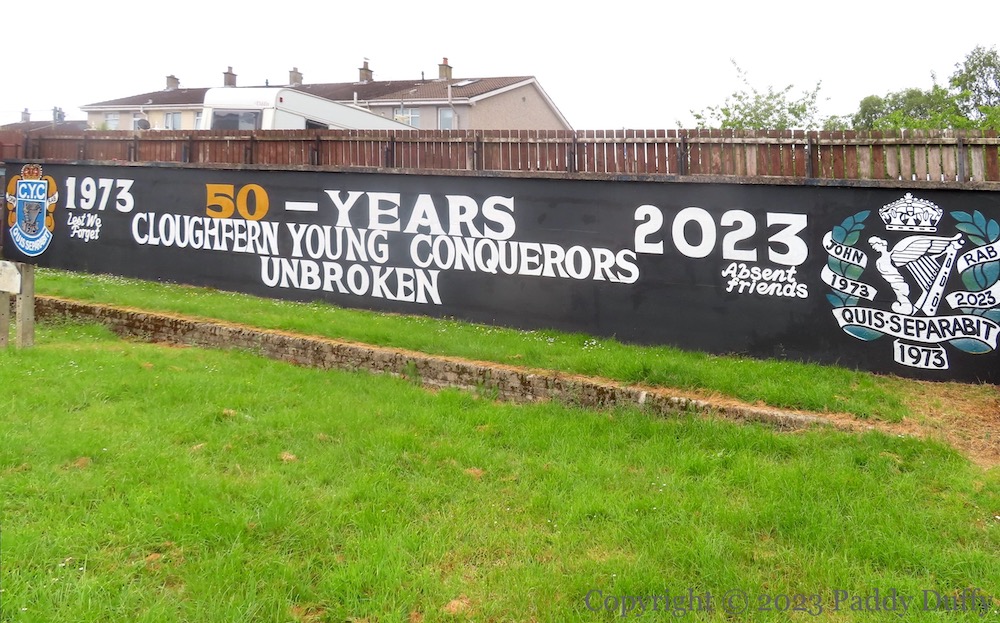
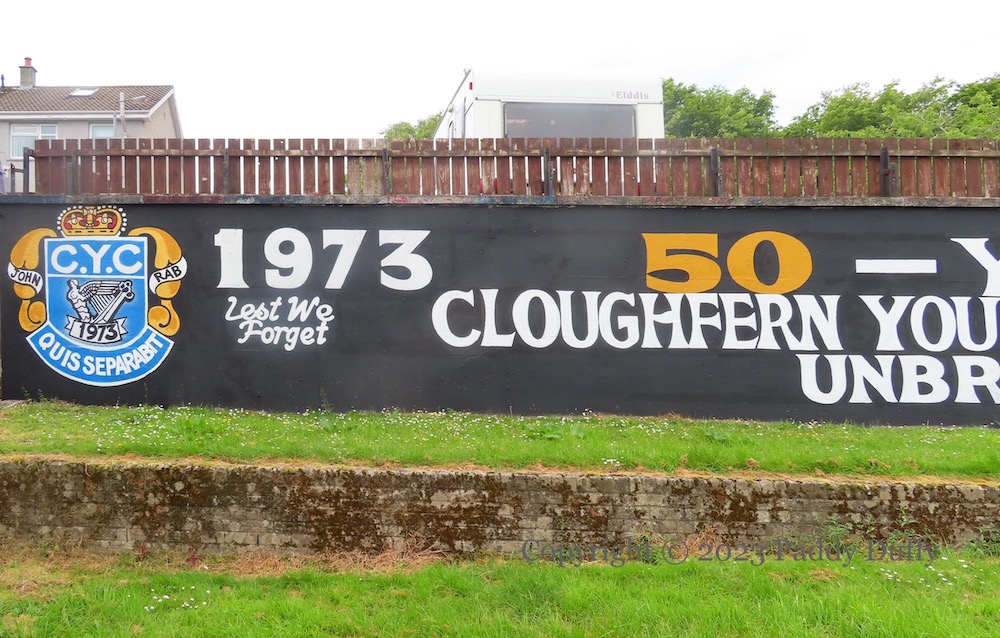
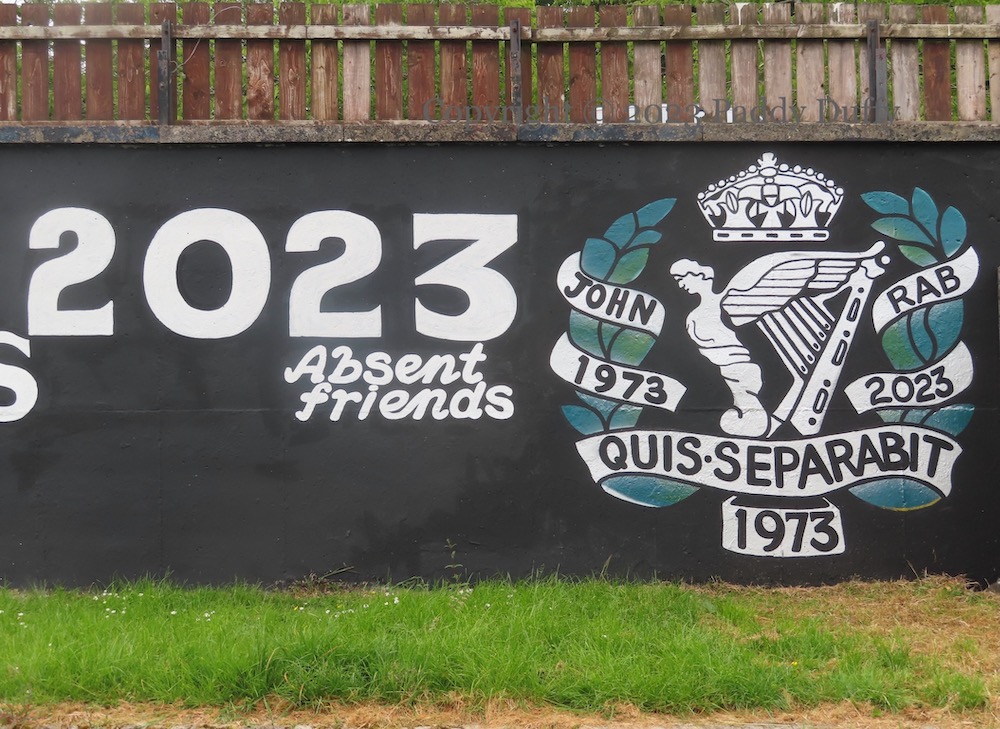
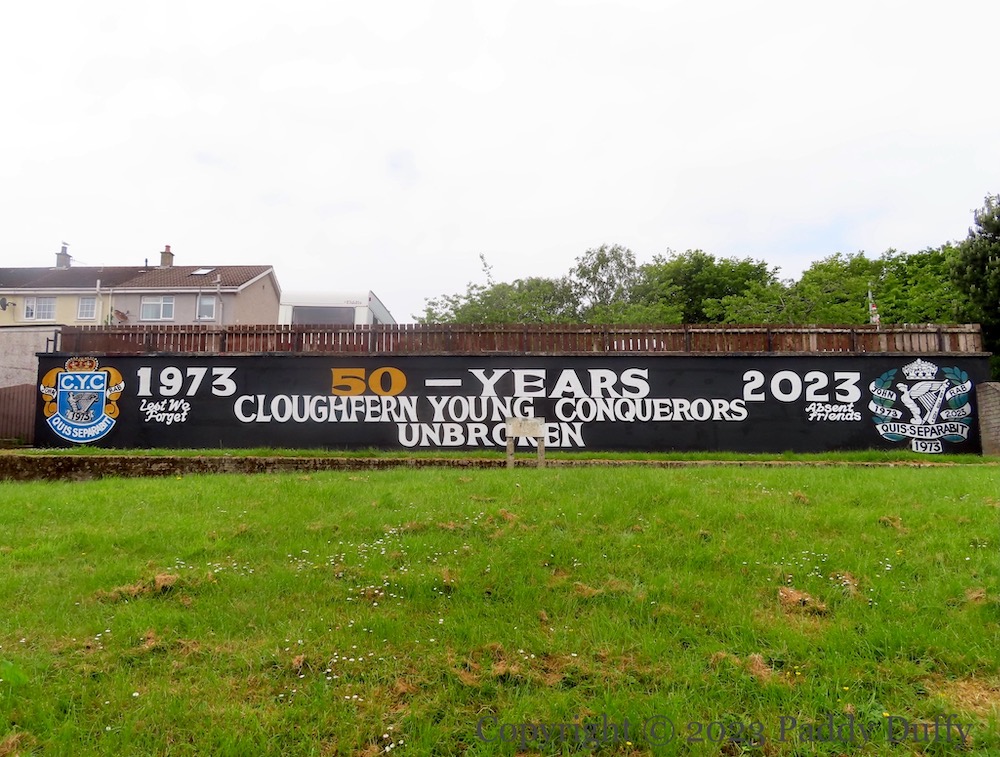
Cloughfern Young Conquerors flute band (Fb) was founded 50 years ago this year – 1973, the same year as the UDA began using the name “UFF.
The ‘wigned-maiden harp’ emblem is used on both sides. With “Quis separabit” is the Royal Irish/Ulster Regiment/Rifles, but perhaps the UDR is intended. On the left, the style and surround imitates the emblem of the UDA; the right-hand side reproduces a former mural to the UDA’s John “Grug” Gregg and Rab Carson on the nearby gable – see Gregg & Carson. Gregg was a bass drummer in the band; he and three other bandsmen were fined in 1997 for assaulting police officers at an Apprentice Boys march (Bel Tel). Gregg was shot, along with Carson, in 2003, in the feud with Adair’s west Belfast C Company (WP).
Long-time Palestinian activist and former spokesperson for Islamic Jihad Khader Adnan died on May 2nd, at the age of 45, after 87 days on hunger strike in Ramla prison, in central Israel (Al Jazeera).
This was Adnan’s fifth time on hunger strike. In 2017, he spent 58 days on hunger strike and in 2015, 56 days. The strike in 2011-2012 lasted 66 days, during which time a mural was painted just to left of the mural shown here, featuring Adnan and Hanna Shalabi; they, along with many other prisoners, were on hunger strike to protest the “administrative detention” (imprisonment without trial) of more than 300 Palestinians – see Administrative Detention. Earlier, shorter, strikes took place in 2002 and in 2000, when he was imprisoned by the Palestinian National Authority for directing a protest against Lionel Jospin, then French Prime Minister (Gulf News).
According to Amnesty International, there are currently more than 1,000 Palestinians being held on ‘administrative detention’ (Amnesty).
As can be seen from the in-progress shots below, Rısteard Ó Murchú painted Latuff’s cartoon, with Latuff looking on.
What is now Coláıste Feırste began life as Meánscoıl Feırste in 1991, teaching a group of nine students a curriculum inspired by Patrick Pearse (discussed previously in An Tusa An Chéad Laoch Eıle?) and based in Cultúrlann MacAdam-Ó Fıaıch (Cultúrlann). It moved to Beechmount in 1998 and in 2018 expanded into new buildings that were meant to accommodate 600 pupils (Doherty Architects), which it has now exceeded (BBC) as it enters its thirty-third year in existence.
The theme of preserving and promoting the Irish language occurs in several places in the mural: next to Pearse we see his saying, “Máırtín Ó Chadháın ” [a land without a language [is] a land without a soul], in the classroom scene we have “Labhaır í agus maırfıdh sí” [speak it and it will endure], and finally we see the Dream Dearg protesting for an Irish-Language Act (see previously #AchtAnoıs).
The in-progress images included below among completed detailed shots date from May 6th and 20th.
Giant’s Foot/Beechview Park. Replaces the short-lived mural of Olympians, seen in Sporting Giants.
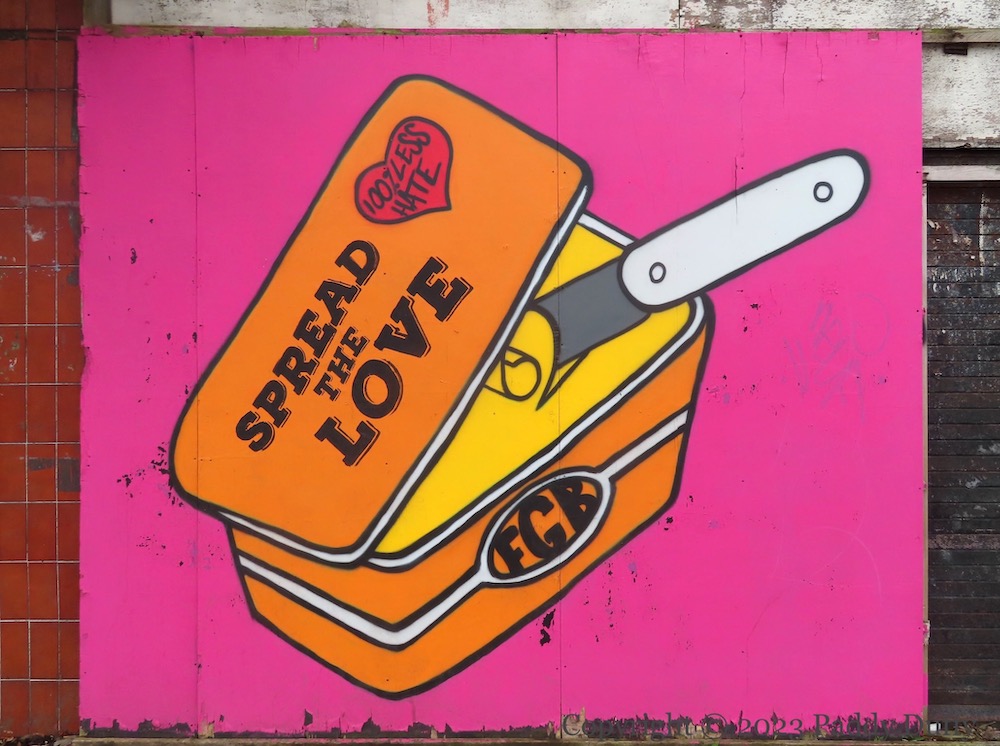
“100% less hate”, says street artist FGB (ig), ruthlessly taking over a site of Hallion’s Covid-era graffiti (see Inspiring Belfast | Between The Lines | It Hasn’t Gone Away You Know). Will an east-Belfast turf-war result? Or will both parties just move to the Vault’s new digs down-town (and in the Shankill)?
The mural’s design was previously a paste-up and a sticker (seen in a 2019 post) and a print (ig).
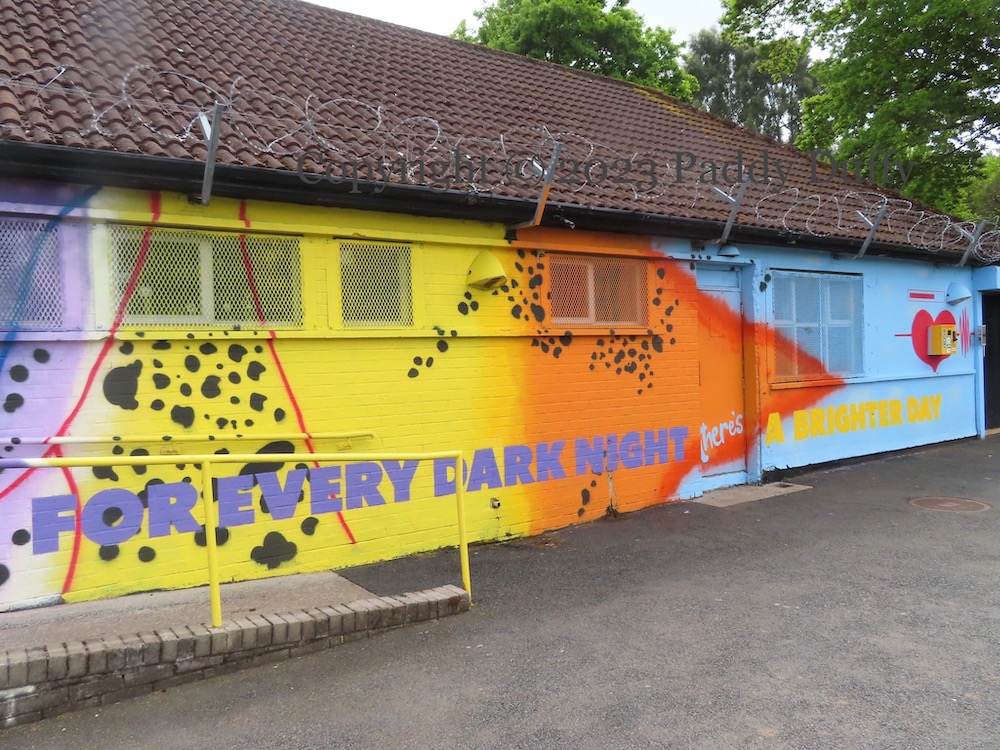
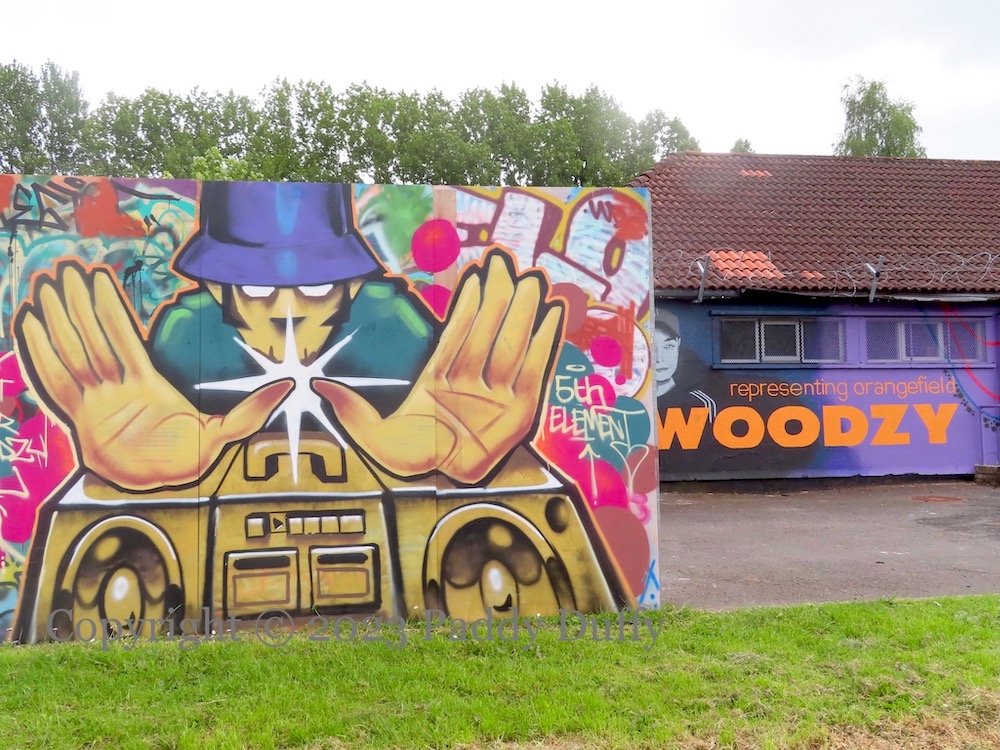
“For every dark night there’s a brighter day.” This mural on the pavilion in Orangefield Park encourages people –young men in particular – to take care of their mental health, and serves as a memorial to Adam “Woodzy” Woods, who died last (2022) May of an overdose (BBC). Skank FM has images of the launch (instagram). With assistance by 5th Element (ig).
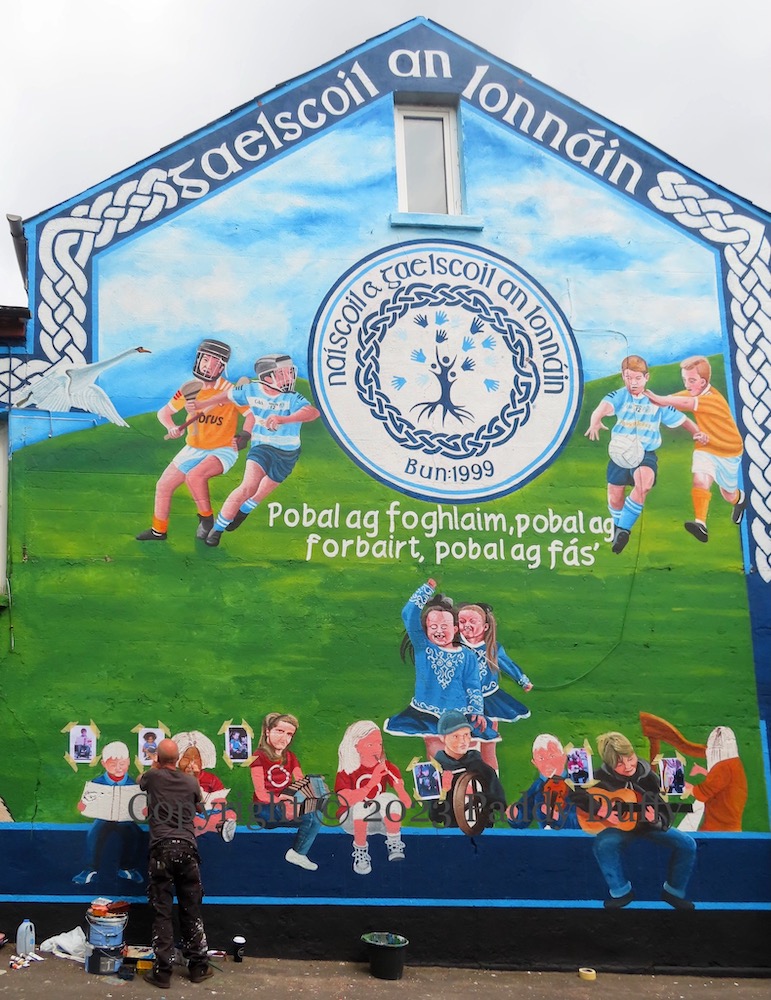
“Pobal ag foghlaım, pobal ag forbaırt, pobal ag fás” [a community learning, developing, growing]
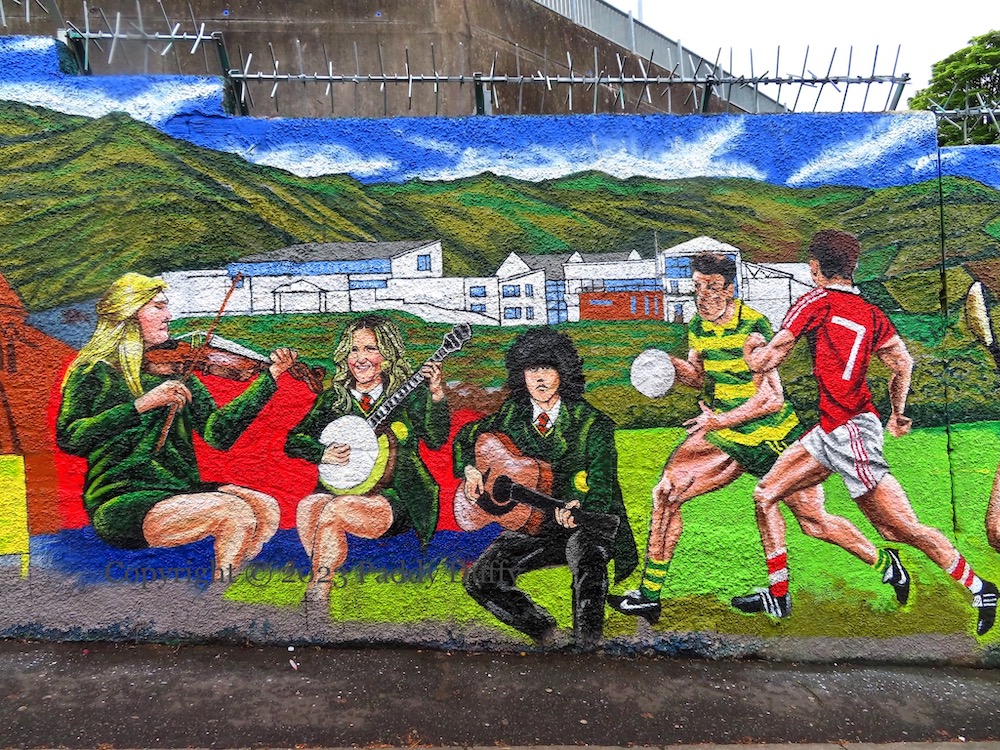
Students from “Naíscoıl & Gaelscoıl An Lonnáın (Fb) bun[aithe] 1999″ [Nursery-school and Irish-language [primary] school of the loney, founded 1999] are shown playing Gaelic games, Irish dancing, and playing traditional instruments (and the guitar). On the left are representations from Irish mythology: the Children Of Lear and Setanta killing Culann’s hound (and taking the name Cú Chulaınn in taking its place), along with hedge-row school (see Hedge Row School).
The origin of the name is unclear; the nearest loney [lane] was the “Pound” loney, so-called because of the animal pen just outside Barrack Street, used to store livestock before moving on to the markets the following day (Rushlight | Uachtar Na bhFál). (The Pound Loney is included in the mural in Durham Street – see Et In Arcadia Ego.)
The other well-known loney in Belfast is the “buttermilk loney” which was either/both what is now Ballysillan Park (that is, connecting Olpark with the horsehoe bend) or the top part of the loney that connected Wheatfield (the top of Ardoyne) to the Ligoniel junction and on towards the old Ligoneil House (there are a mixture of usages in this Belfast Forum thread); this image from the 1930s might show the lane in (what was still at the time) the hills above Oldpark; a new housing-development towards the top of the Ballysillan Park is euphemistically called “Buttermilk Loney”. (It is also said to have been a prior name of Skegoniell Avenue (Belfast History).)
(The Uachtar Na bhFál page also mentions “Turf” loney, “Mountain” loney, and “Killoney”.)
The history of the Irish word “lonnán” is unclear. Uachtar na bhFál says the word is of Scots origin (perhaps as “loanin”). (See this BelTel article on the opening of the Ulster-Scots centre in 2014.) Spelled “lonnen”, it is also a Geordie word (Heslop’s Northumberland Words | wiktionary). The Irish News and Belfast Live, working from the same (uncited) press-release about Páırc An Lonnáın (which is along the Westlink below Raıdıó Fáılte), state that “loney” comes from the English word “loaning”. The Irish word “lonnán” does not appear in Dinneen 1904; Dinneen 1953 defines it (hyper-specifically) as “a grassy recess running up into high basaltic cliffs”.
The image above and immediately below are from May 19th, as the mural was nearing completion; other ‘in-progress’ images are as dated below. See Extramural Activity for images of the completed work.
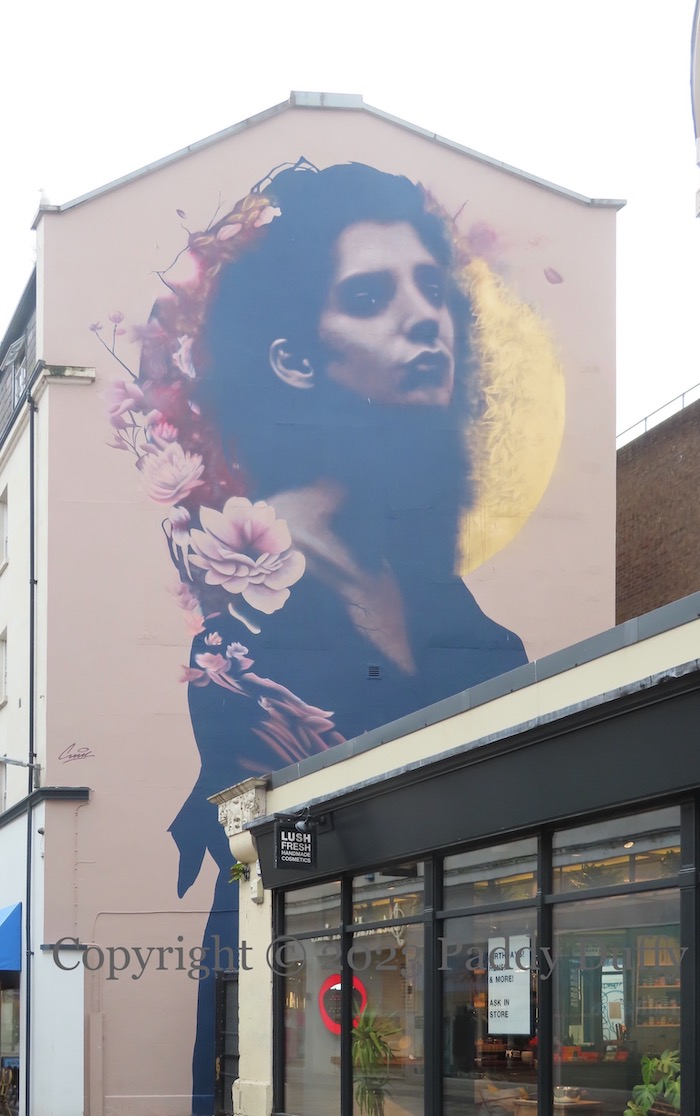
Work by emic (ig) in Castle Lane, Belfast, perhaps picking up a theme from Friz’s Under The Cherry Blossoms in Castle Arcade which focused on the castle and grounds in the era of Arthur Chichester. Chichester’s castle burned down in 1708 and by 1800 the castle and its grounds were vanishing under buildings akin to the nearby corn market and Belfast entries (WP).











 Paddy Duffy Collection