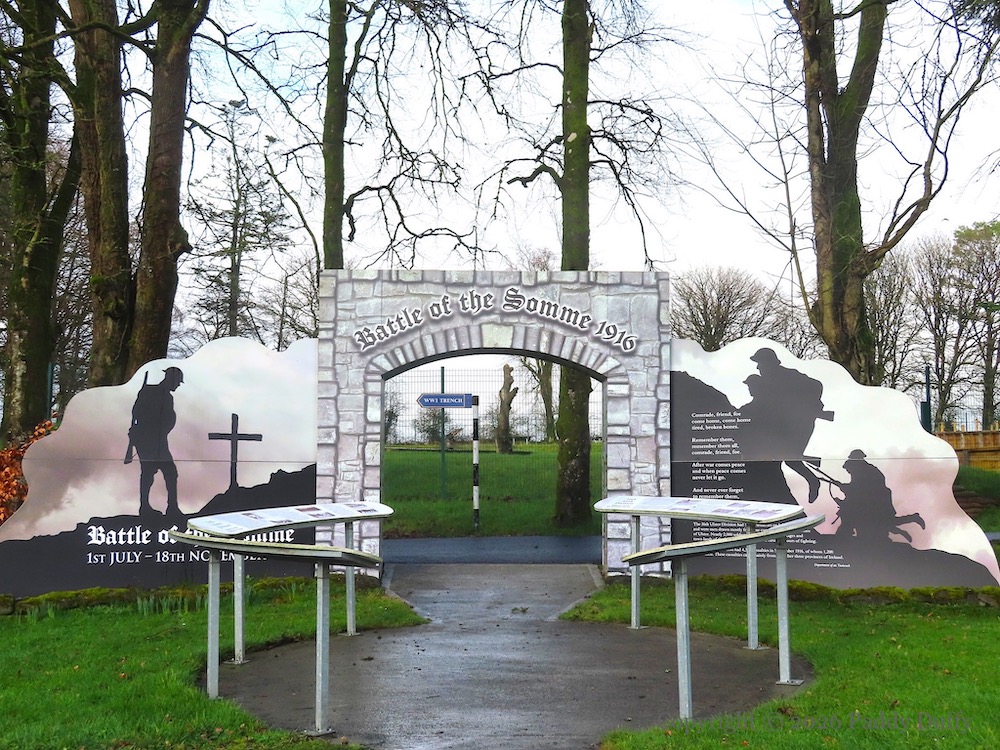
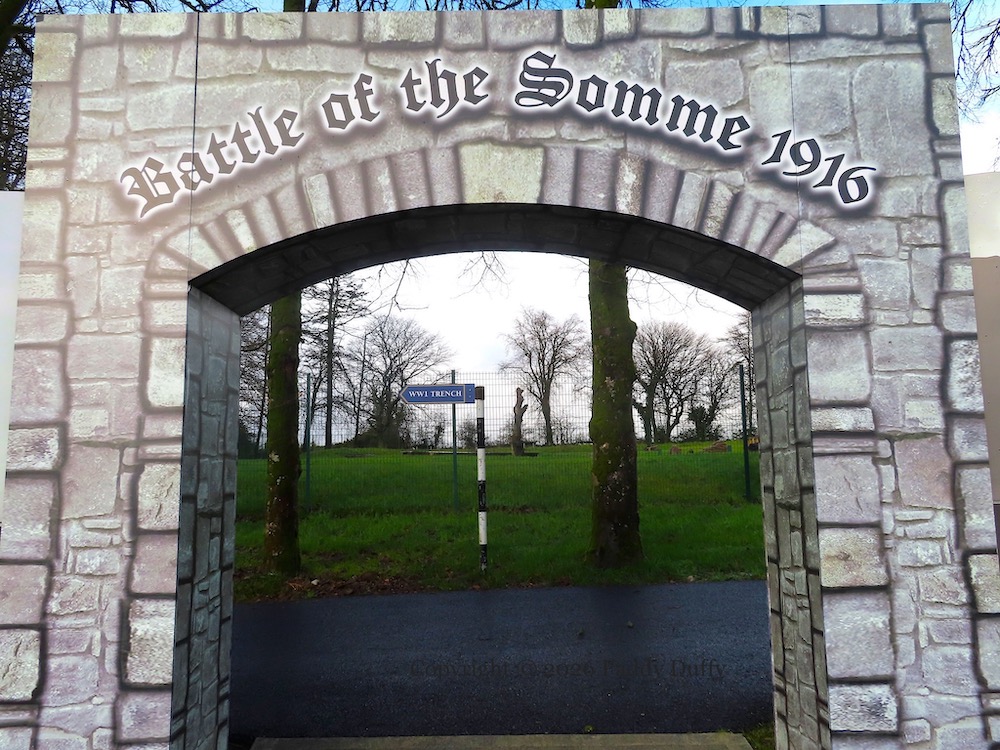
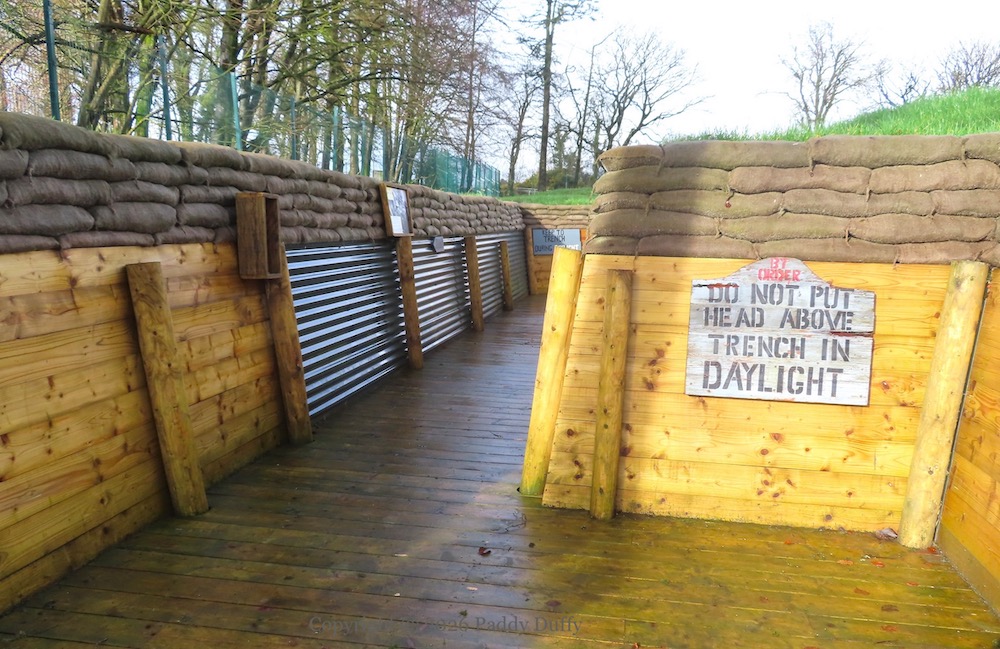
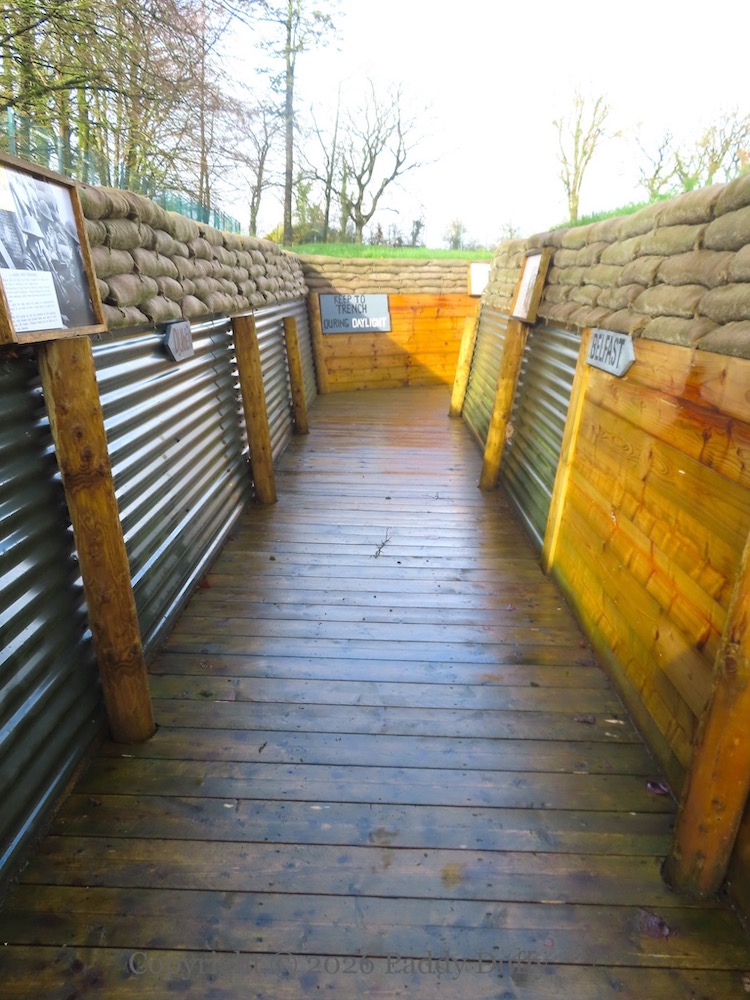
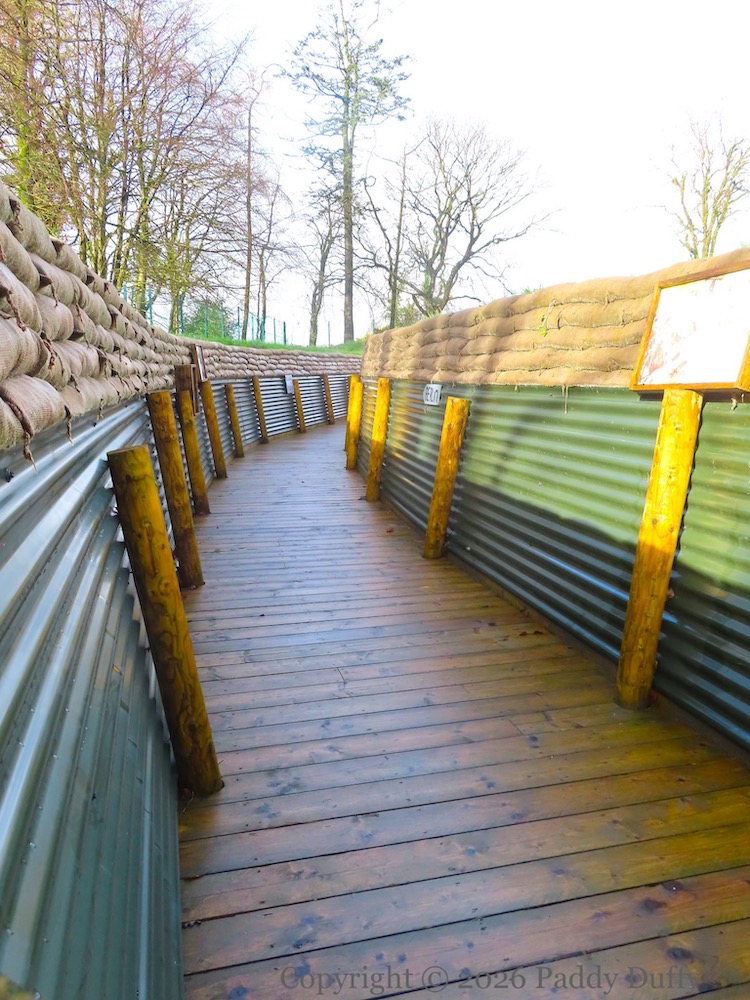
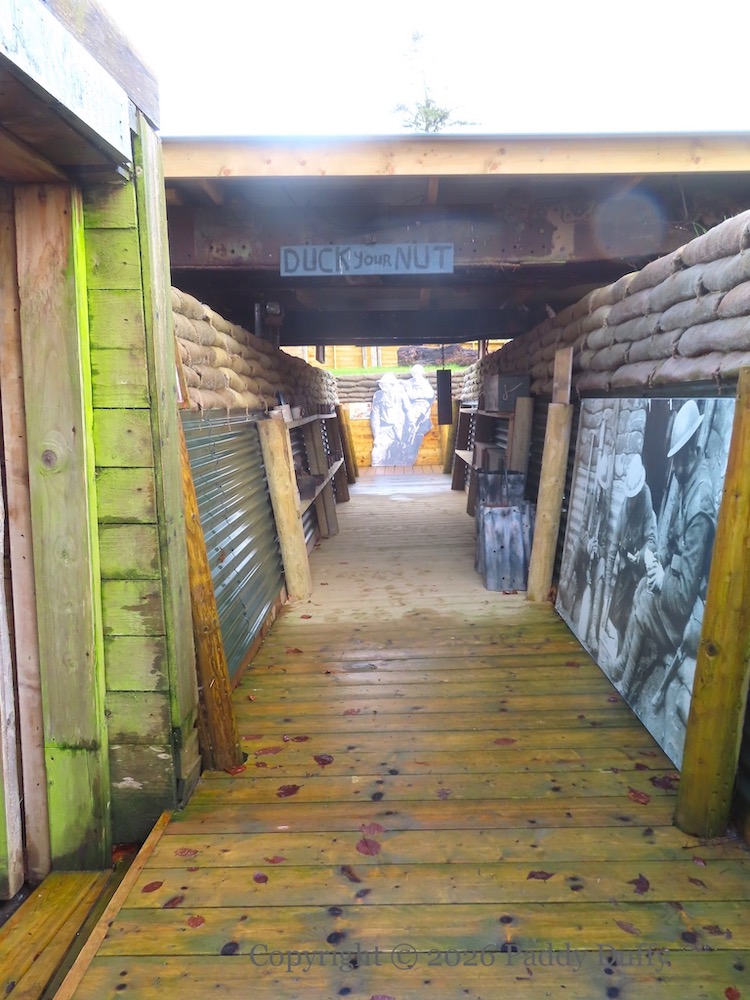
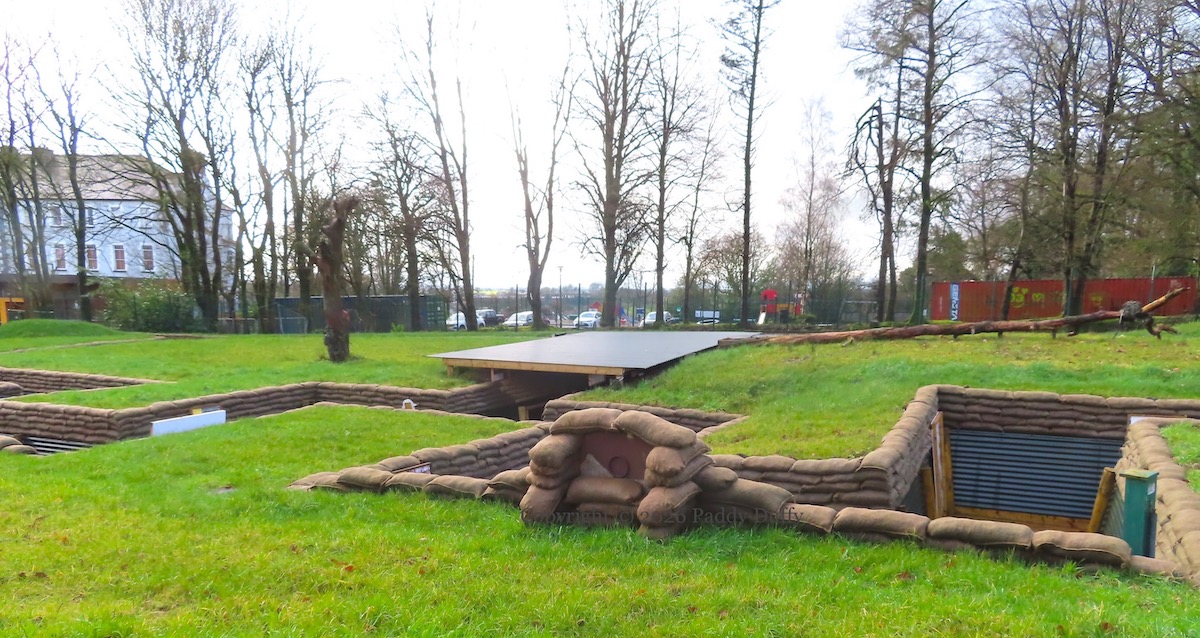
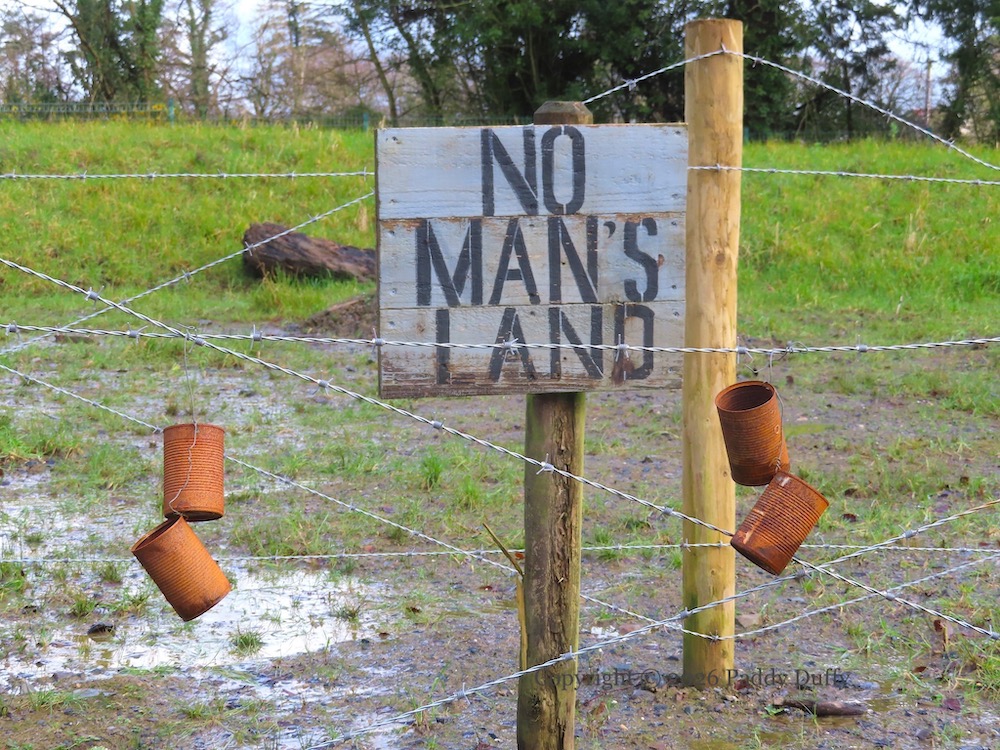
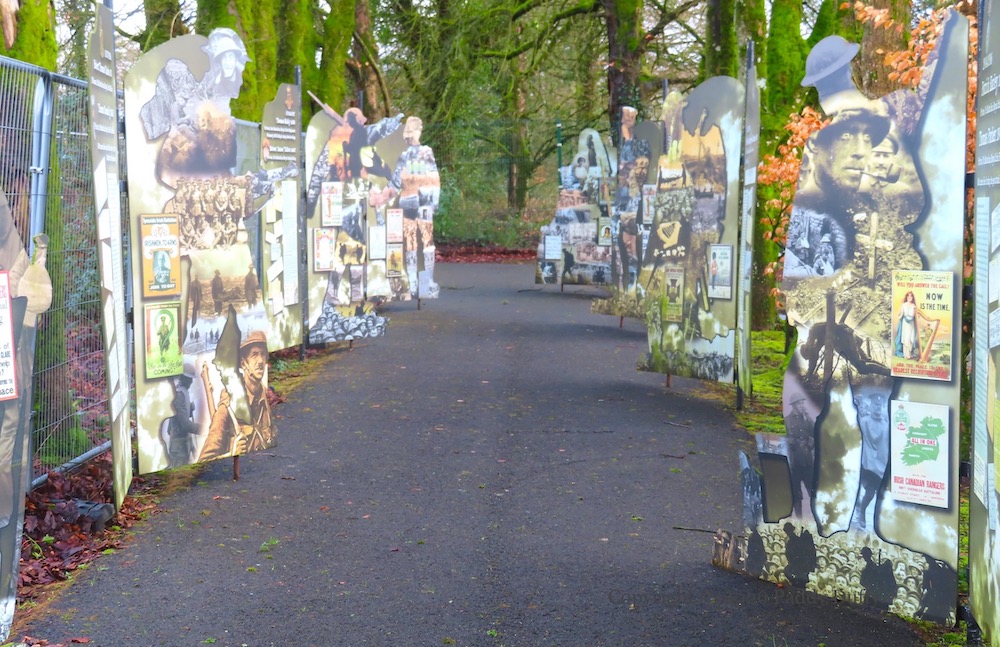
The Cavan County Museum (web) in Ballyjamesduff includes a “WWI trench experience”, with 350 metres of trench and more than 6,000 sand-bags. The Cavan volunteers joined the 9th battalion of the Royal Irish Fusiliers (108th brigade of the 36th). The officer commanding of the Division, Oliver Stewart Wood Nugent, was from Cavan (History Ireland).
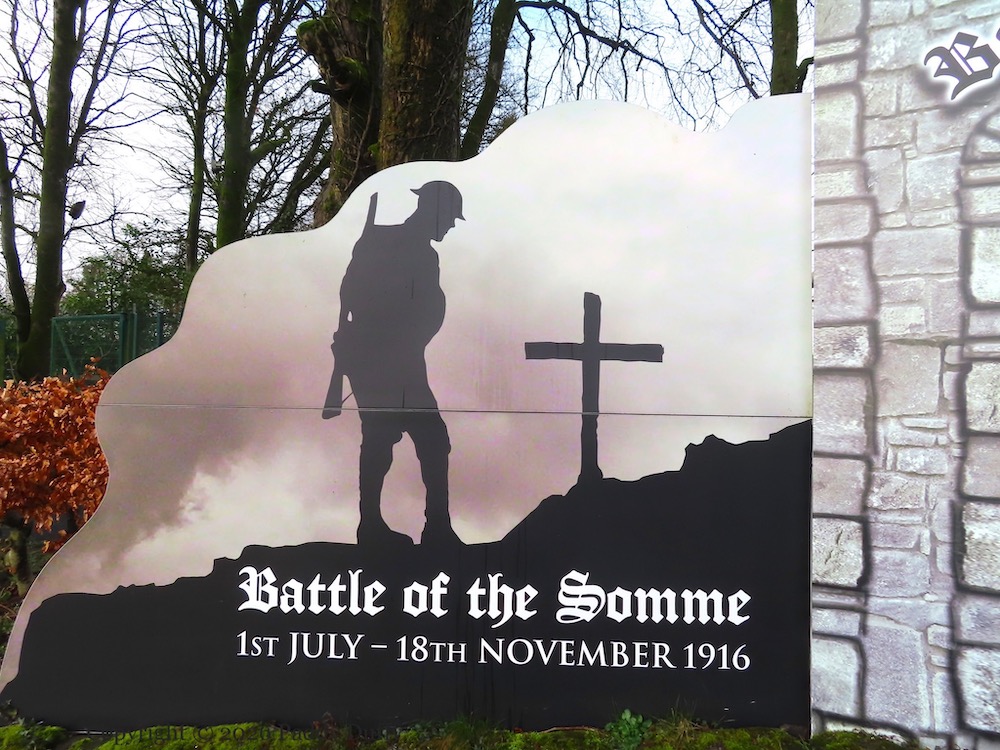
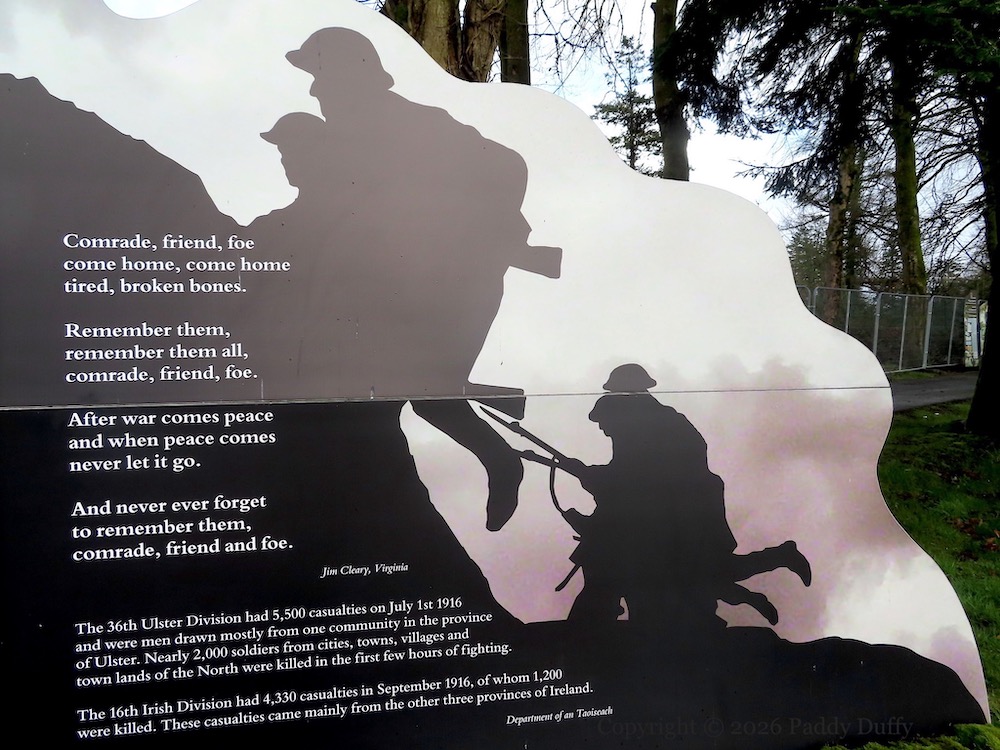
“Battle Of The Somme 1st July – 18th November 1916”, “”Comrade, friend, foe/come home, come home/tired, broken bones.//Remember them,/remember them all,/comrade, friend, foe.//After war comes peace/and when peace comes/never let it go.//And never ever forget/to remember them,/comrade, friend and foe.” – Jim Cleary, Virginia.”
“”The 36th (Ulster) Division had 5,500 casualties on July 1st 1916 and were men drawn mostly from one community in the province of Ulster. Nearly 2,000 soldiers from cities, towns, villages and town lands of the North were killed in the first few hours of fighting. The 16th (Irish) Division had 4,330 casualties in September 1916, of whom 1,200 were killed. These casualties came mainly from the other three provinces of Ireland.” – Department Of An Taoıseach”
Michael Gaughan and Frank Stagg are presented along with the ten deceased 1981 hunger strikers on the cross-beam of a large wooden “H” at the top of Turf Lodge.
IRA volunteer Michael Gaughan died in Parkhurst prison in 1974 after 64 days on hunger strike. Gaughan’s coffin was draped with the Tricolour used to bury Terence McSwiney in 1920. He was force-fed seventeen times during the strike and his family alleged that he died from food stuck in a punctured lung. The practice was ended after Gaughan’s death.
Frank Stagg was on the Parkhurst hunger strike with Gaughan, and another in Long Lartin prison, and a third in Wakefield in December 1975. He died after 62 days on February 12th, 1976.
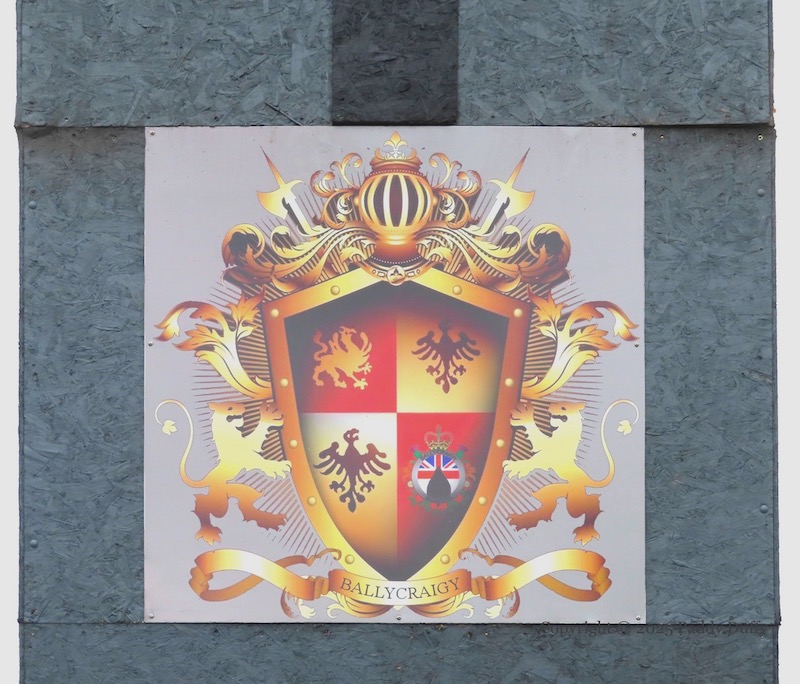
Preparations for Eleventh Night bonfires are underway in many estates, including Ballycraigy in Antrim which is getting help from an AI-generated Popeye. Ballycraigy used to boast the biggest Bonfire (see Lead The Way); you can keep track of this year’s build on the bonfire’s Facebook page.
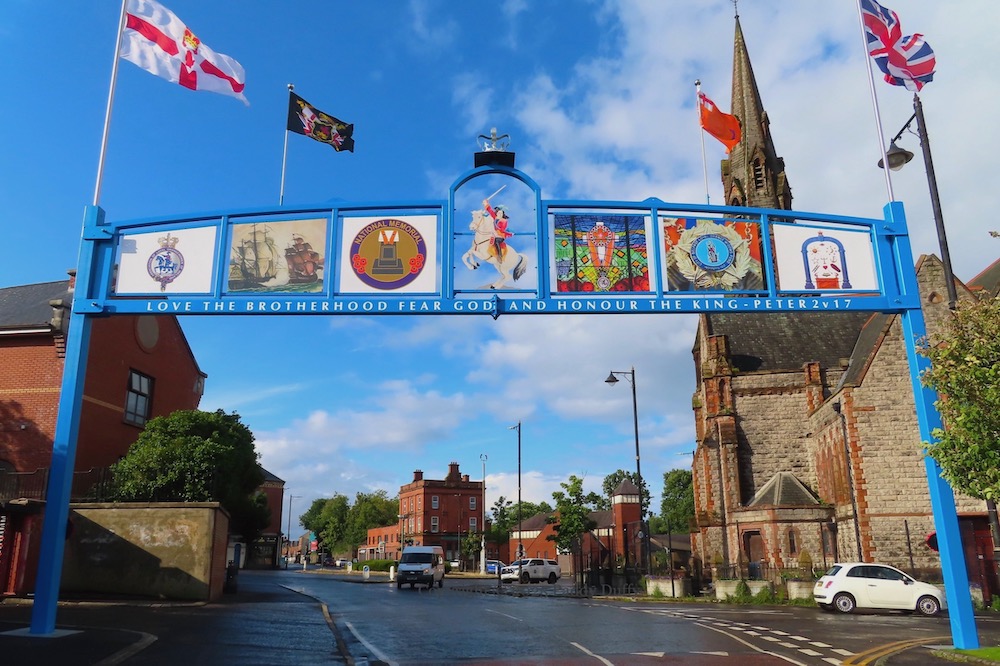
The Denmark Street arch (at the top of the lower Shankill estate and next to the Clifton Street Orange Hall) returns for the 2025 marching season.
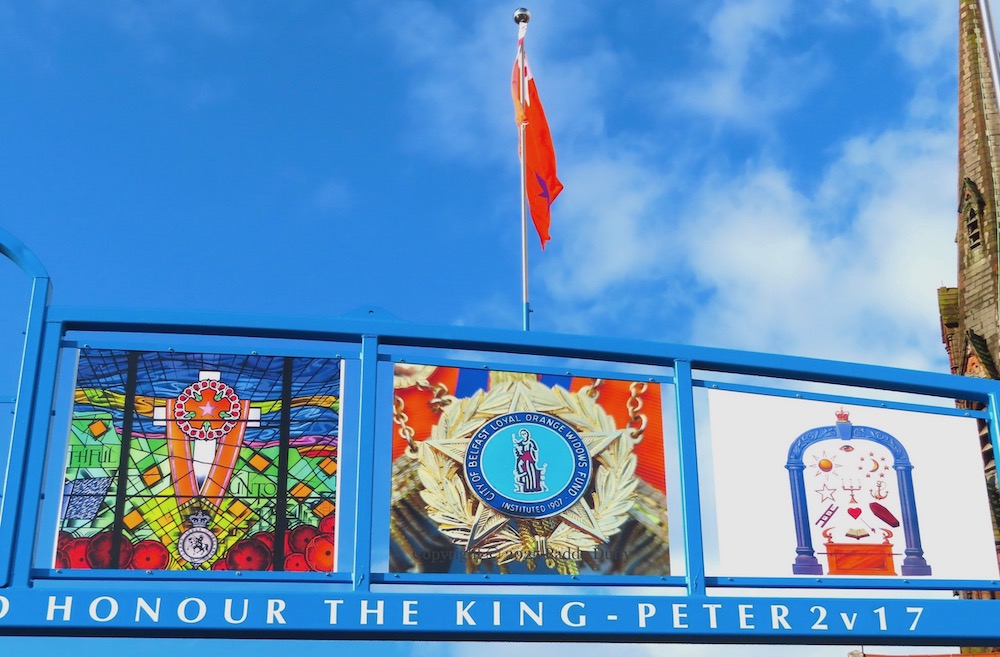
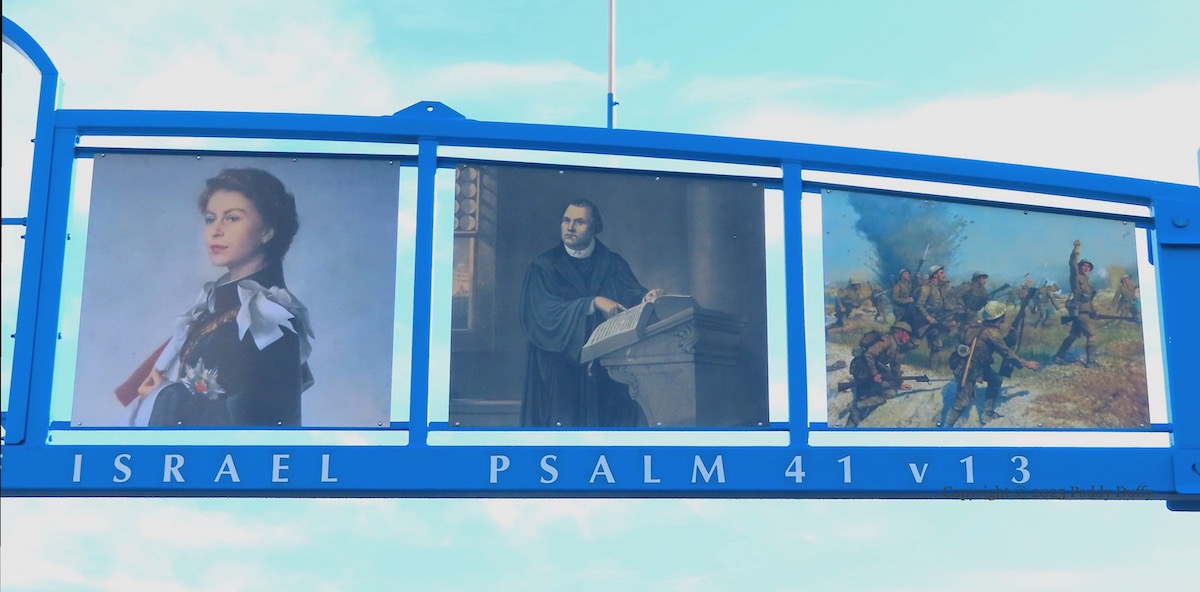
For each of the 12 panels, see Upward. Each side of the arch features a quote from scripture: on the outside, “Blessed be the Lord God of Israel – Psalm 41 v. 13”, and on the estate side “Love the brotherhood, fear God, and honour the King – [1st] Peter 2 v. 17”
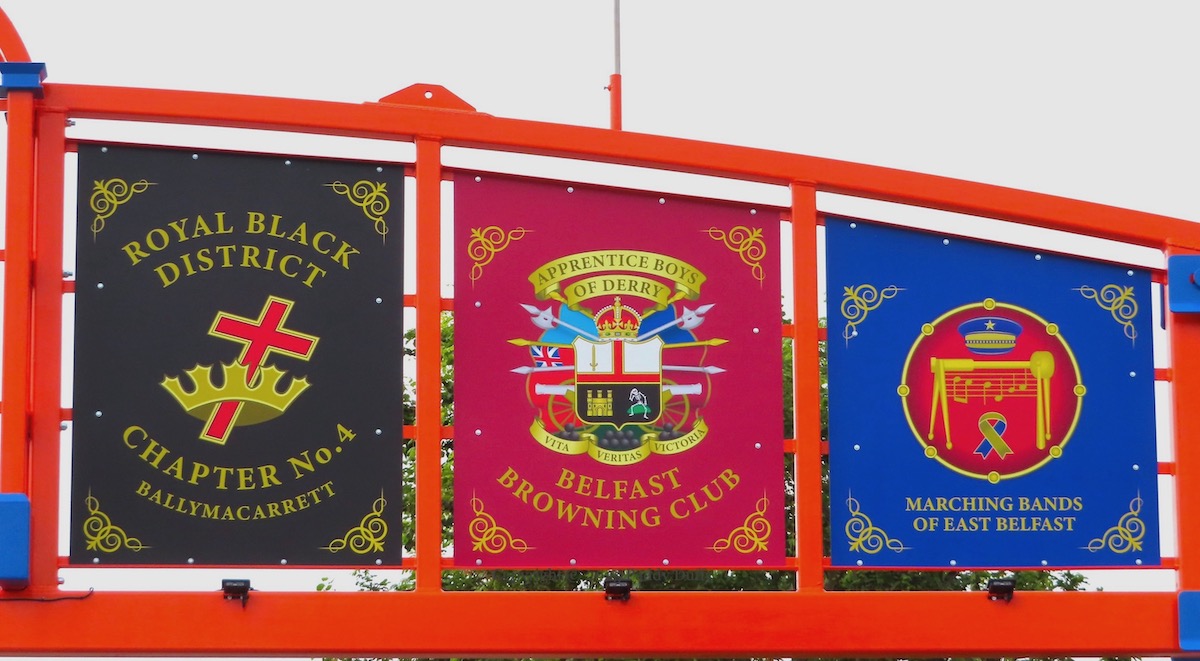
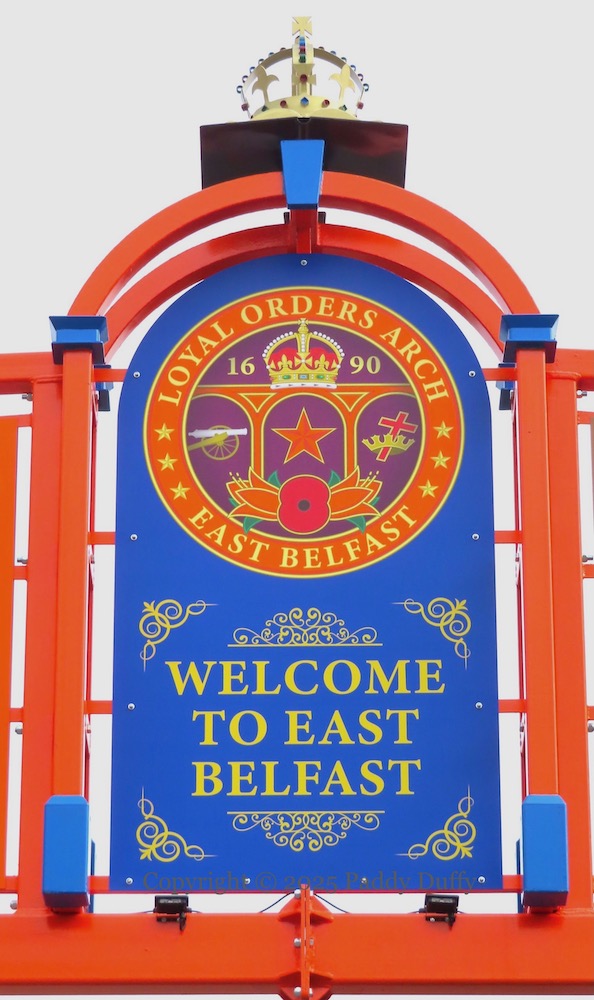
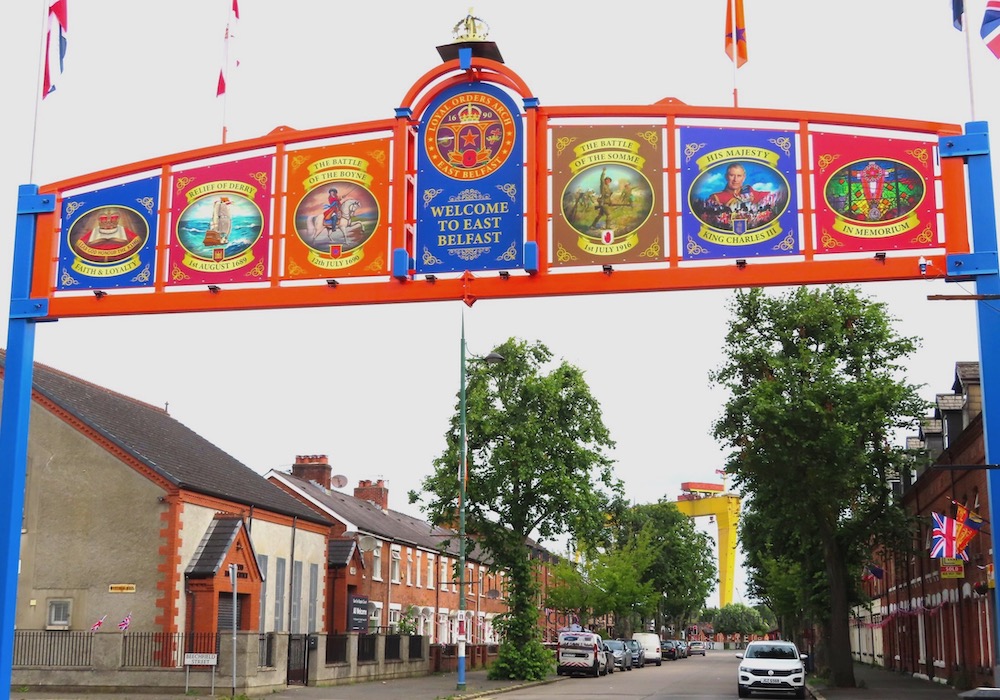
The News Letter reports that the new arch at the junction of Templemore Avenue and Beechfield Street is the first new arch in east Belfast for fifty years (News Letter). There was long ago an arch in Dee Street (Fb).
On the northern side are the emblems of local lodges – Ballymacarrett Junior District LOL No. 3, Royal Arch Purple District Chapter No. 6, Ballymacarrett District No. 2 Women’s LOL, Ballymacarrett District LOL No. 6, Royal Black District Chapter No. 4 Ballymacarrett, Apprentice Boys Of Derry Belfast Browning Club – as well as “Marching Bands of east Belfast”.
On the southern side, we see (l-r) “Faith & Loyalty”, the Relief Of Derry, the Battle Of The Boyne, JP Beadle’s painting of the 36th Division going over the top at the Battle Of The Somme, King Charles III, the stained-glass window in Schomberg House in memoriam (not: “in memorium”) murdered OO members.
The arch was officially dedicated on June 30th. Ballymacarrett Orange Hall is a bit further down Templemore Avenue, on Albertbridge Road.
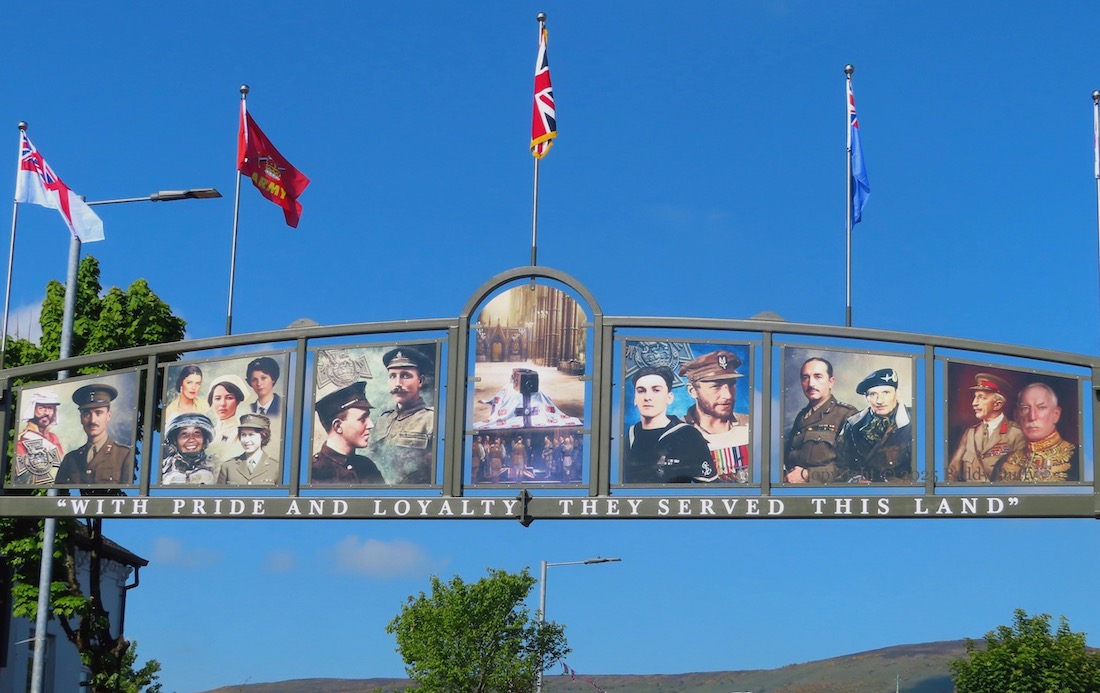
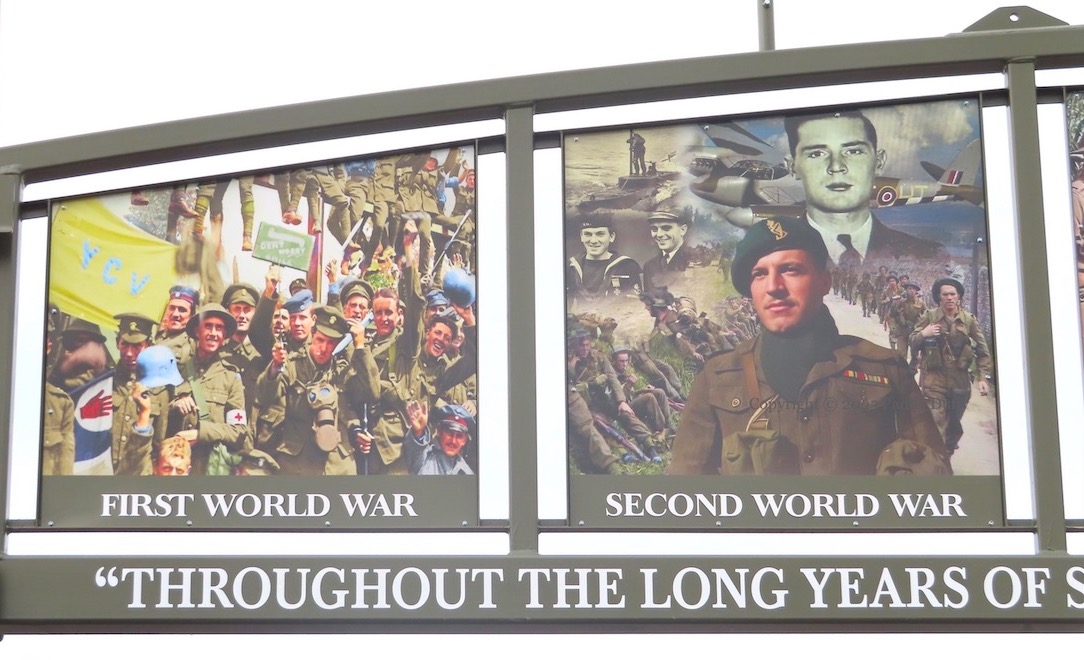
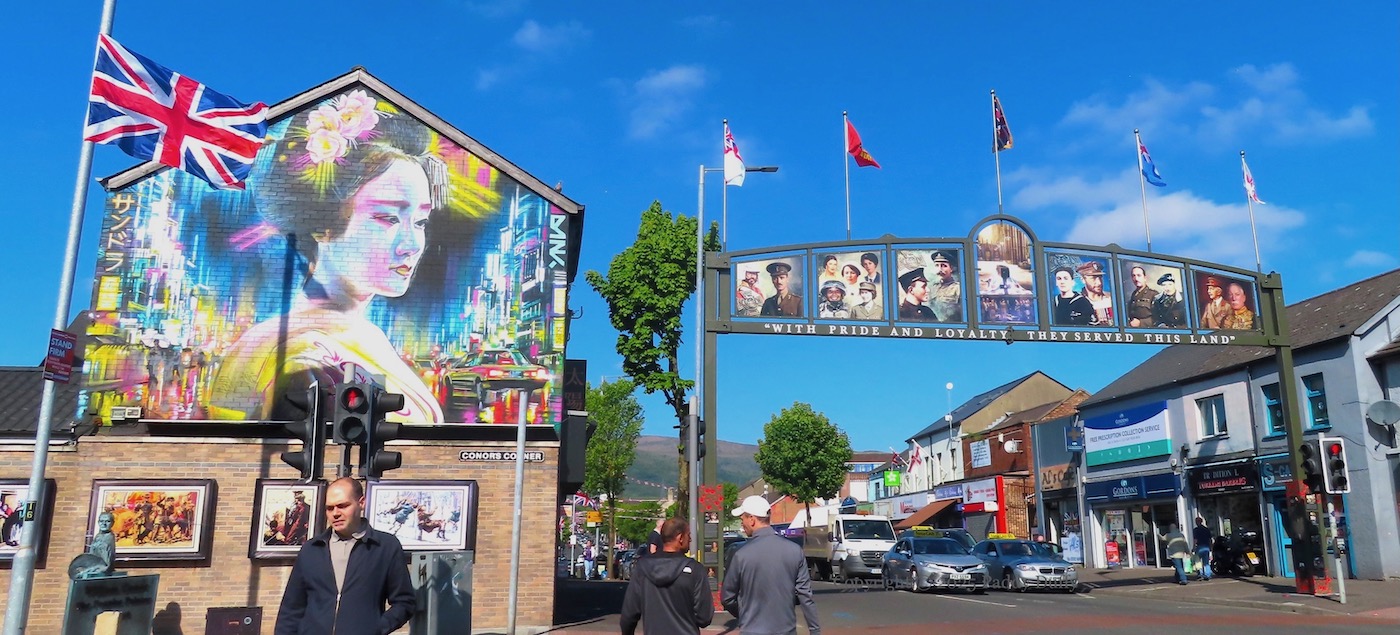
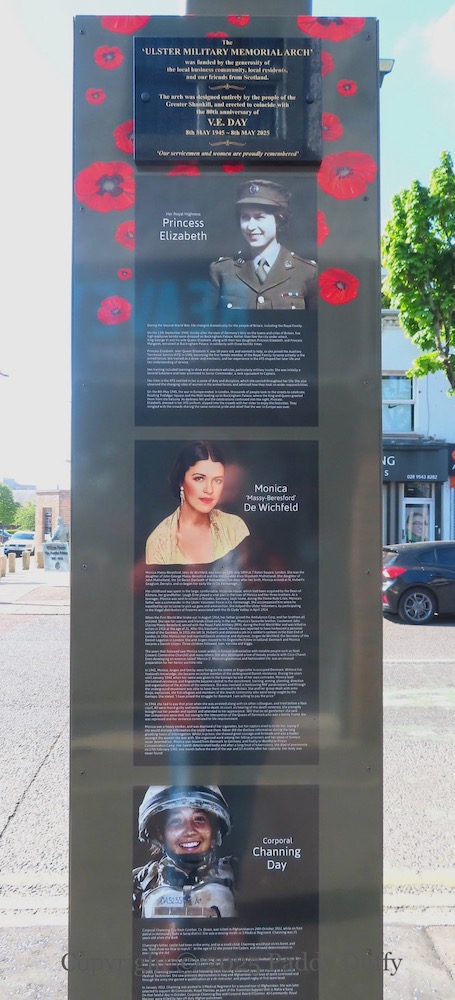
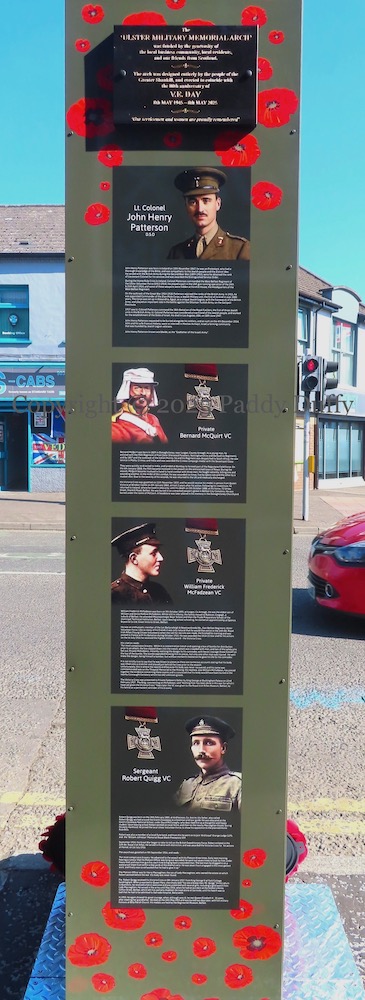
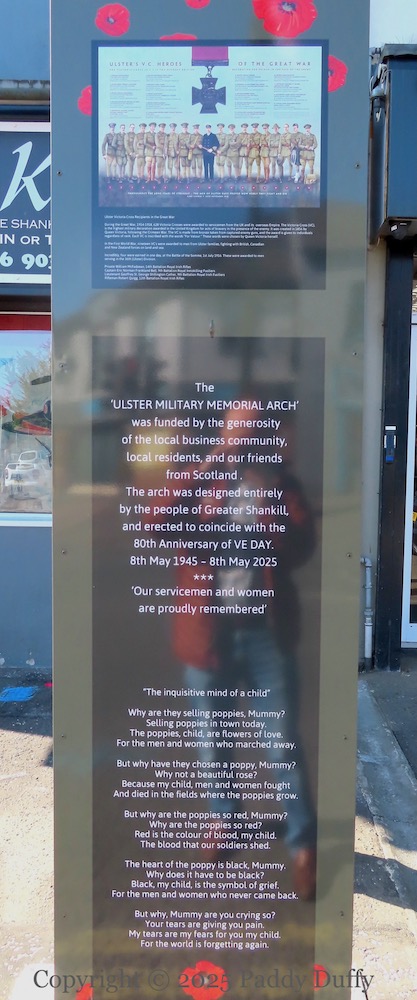
“The ‘Ulster Military Memorial Arch’ was funded by the generosity of the local business community, local residents, and our friends from Scotland. The arch was designed entirely by the people of the Greater Shankill, and erected to coincide with the 80th anniversary of VE Day 8th May 1945 – 8th May 2025. Our servicemen and women are proudly remembered.” For images of the VE Day launch, see the BelTel.
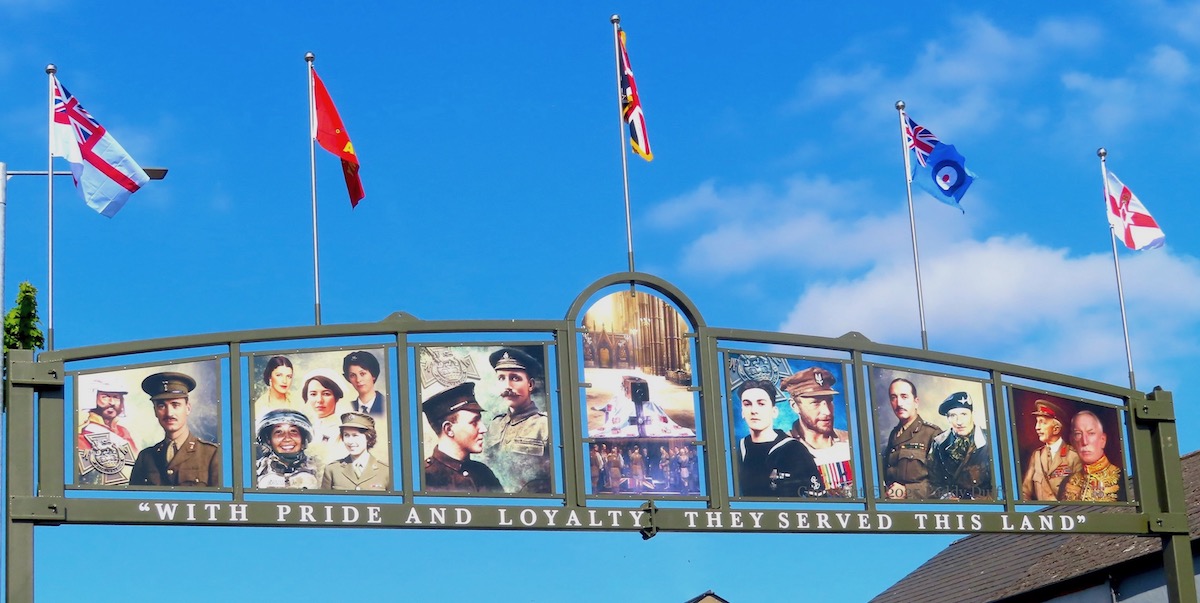
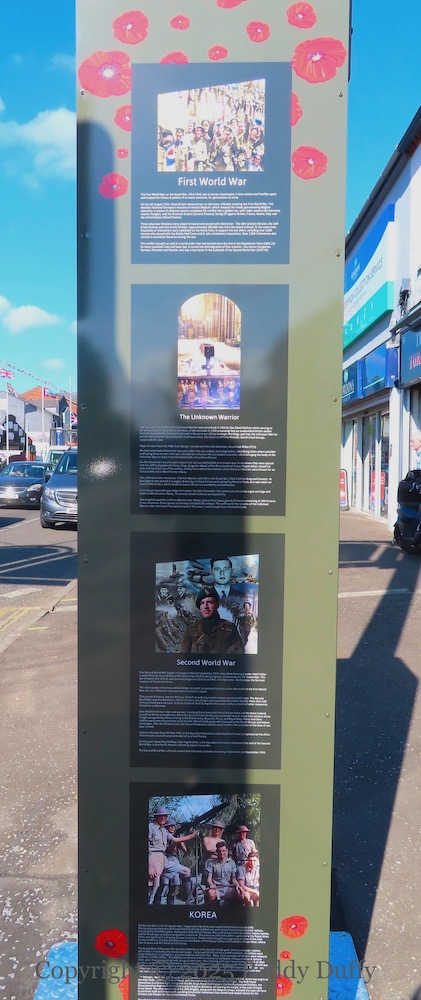
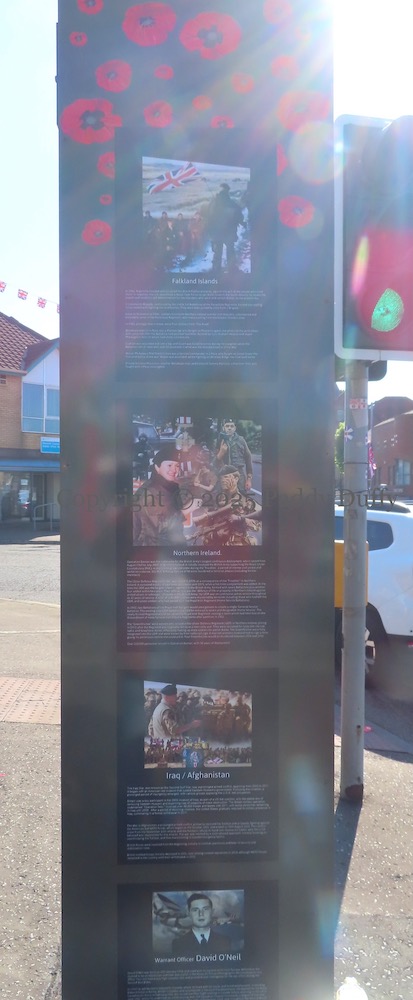
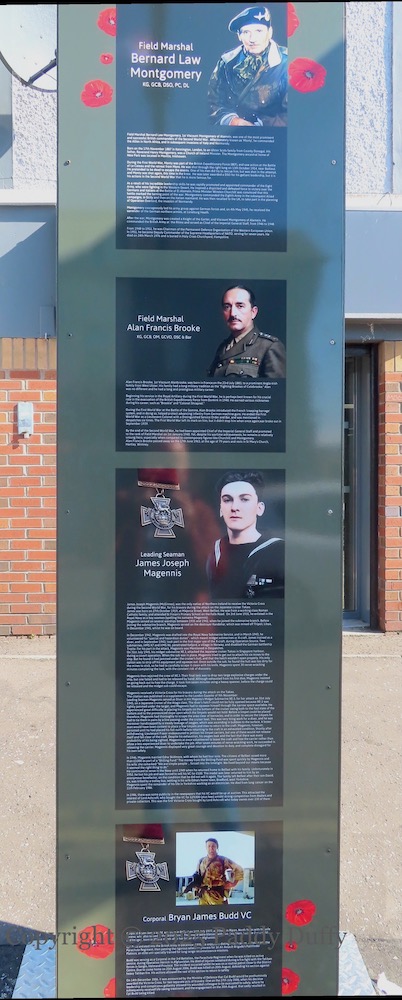
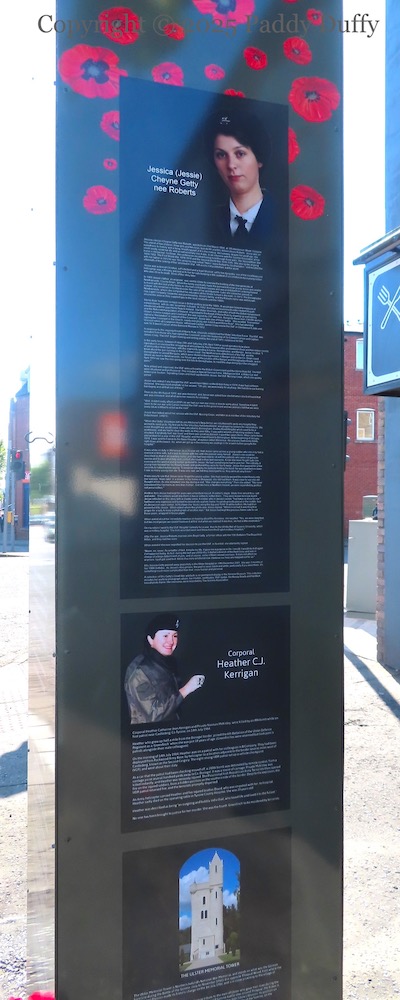
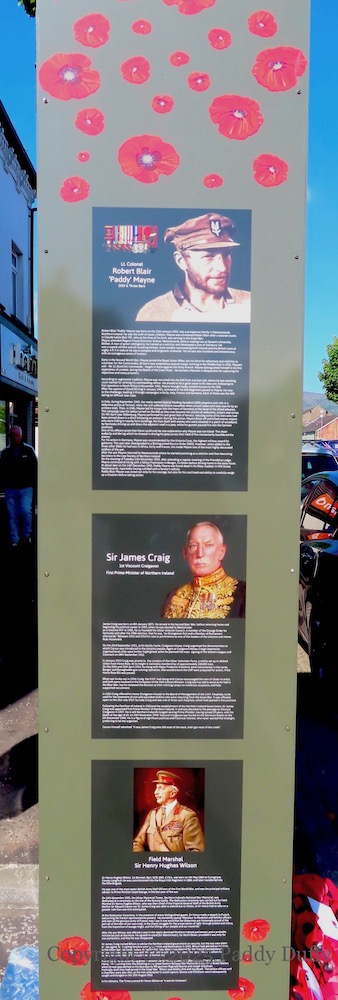
Pictured on Peter’s Hill side of the arch (bearing the quote “With pride and loyalty they served this land”) are (left to right) … Private Bernard McQuirt (a VC winner in 1858 during the Indian Rebellion) and Lt Colonel John Henry Patterson Monica De Wichfeld (raised in Fermanagh and Danish resistance member), Jessie Roberts (a nurse for the Ulster Volunteers and (in WWI) for the Volunteer Aid Detachment, serving in Birmingham and in Wimereux, France; she gets a very long entry on the info panels (see below), as her biography is not available on-line), a (unidentified) nurse, Corporal Channing Day (a medic killed in Afghanistan, 2012), Princess Elizabeth Private William Frederick McFadzean and Sergeant Robert Quigg the tomb of “the unknown warrior” (central panel) Leading Seaman James Joseph Magennis and Lt Colonel Robert Blair ‘Paddy’ Mayne Field Marshal Alan Francis Brooke and Field Marshal Bernard Law Montgomery Field Marshal Sir Henry Hughes Wilson and Sir James Craig
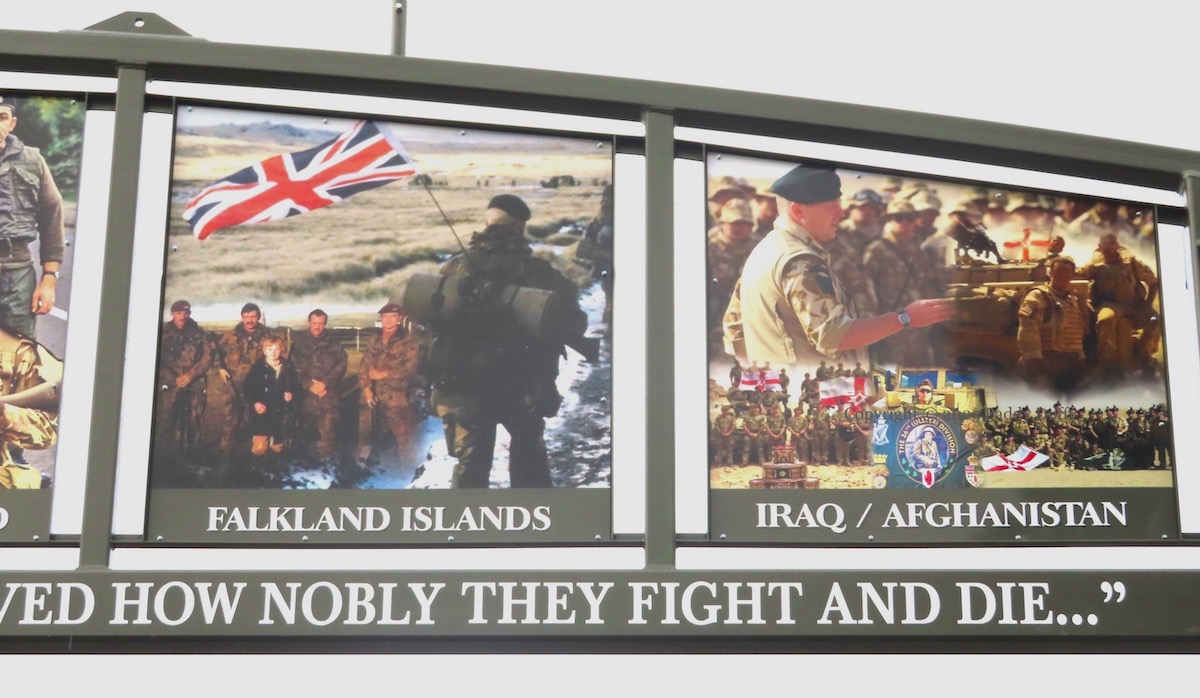
On the other/Shankill side of the arch, bearing the quote “Throughout the long years of struggle … the men and women of Ulster have proved how nobly they fight and die”, the ‘WWII’ panel includes (top right) Warrant Officer David O’Neill, a Canadian Air Force pilot hailing from Ballymena, lost in 1943, and the ‘Northern Ireland’ panel features (left) Corporal Heather CJ Kerrigan, a UDR Greenfinch killed by the IRA in 1984. These two are also profiled in the info panels around the legs of the arch, along with Corporal Bryan James Budd, a 3rd Para soldier killed by friendly fire in Afghanistan, 2006.
Also included is JF Willcocks’s poem Poppies (sometimes called The Inquisitive Mind Of A Child): Why are they selling poppies, Mummy? Selling poppies in town today./The poppies, child, are flowers of love. For the men who marched away./But why have they chosen a poppy, Mummy? Why not a beautiful rose?/Because my child, men fought and died in the fields where the poppies grow./But why are the poppies so red, Mummy? Why are the poppies so red?/Red is the colour of blood, my child. The blood that our soldiers shed./The heart of the poppy is black, Mummy. Why does it have to be black?/Black, my child, is the symbol of grief. For the men who never came back./But why, Mummy are you crying so? Your tears are giving you pain./My tears are my fears for you my child. For the world is forgetting again.”
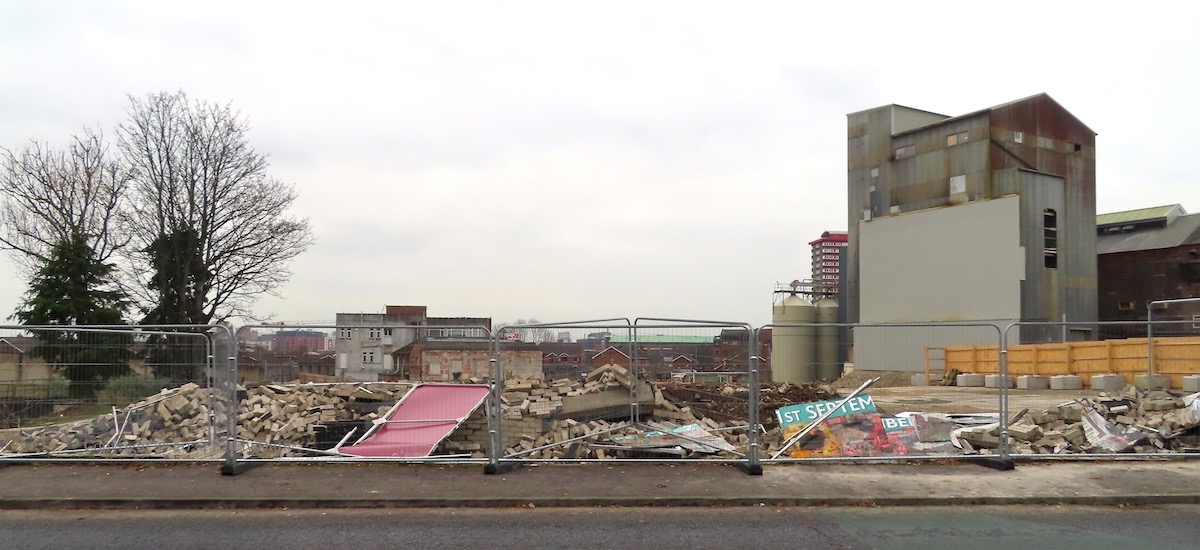
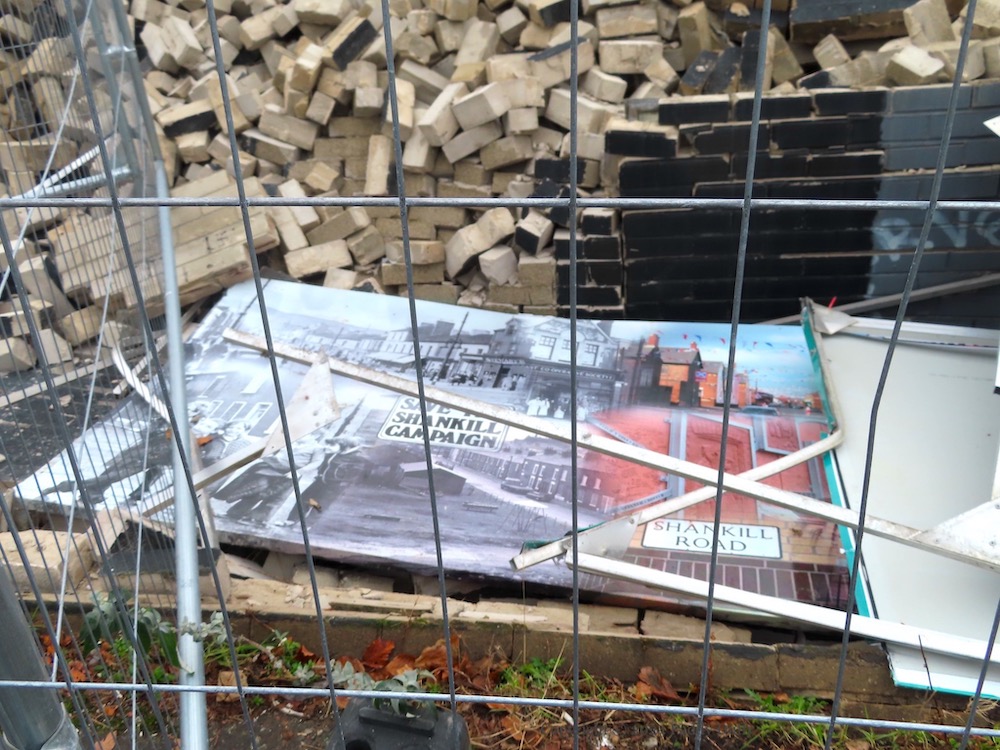
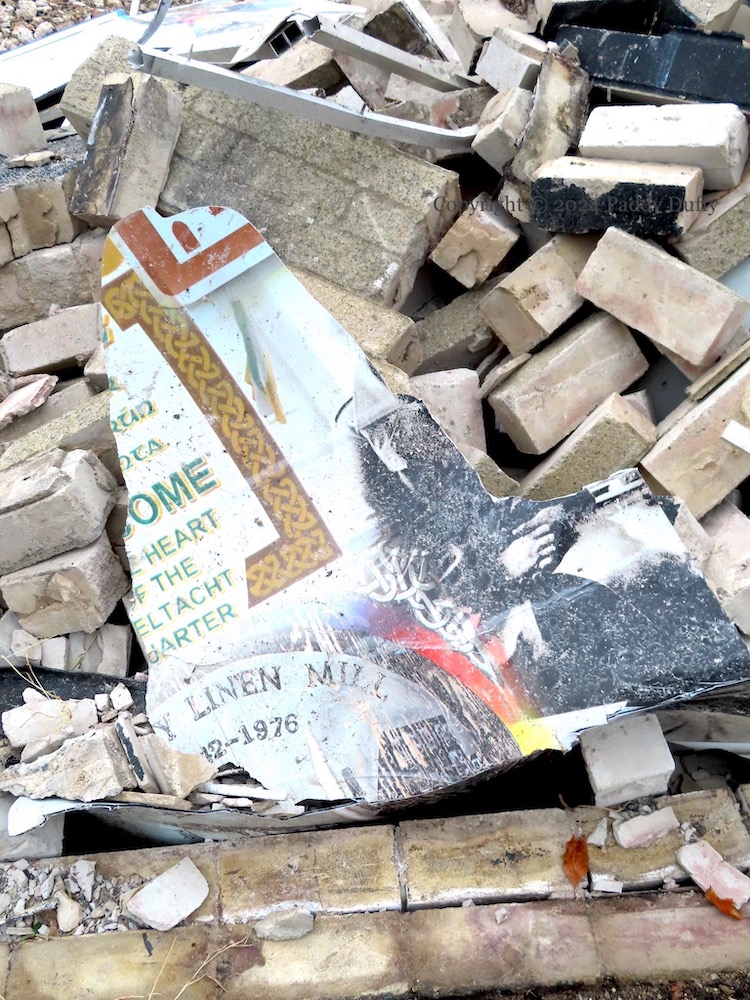
In addition to taking out the top of the UVF mural in Mount Vernon (see Taken By Storm), Storm Darragh (on the night of Friday 6th/Saturday 7th) also knocked down part of the long wall on Northumberland Street (Visual History) between the two sets of security gates, taking with it most of the extended “Imagine” board (see Hope And History; the original portion was mounted for International Peace Day (“[2]1st September” visible in the final image) in 2011 – see Imagine).
The piece on the right, with the Seamus Heaney quote, is partly gone, revealing (in the image above) the old mural supporting (Manchester)United’s Big Lily.
The railway line running between Belfast and Lisburn opened in 1839 (WP) and in 1863 a bridge was built to allow passage over it. This bridge was known as “the Boyne bridge” after the legend that King Billy had travelled across a nearby bridge (the Saltwater Bridge across the Blackstaff) on his way to meet James II in 1690. The (railway) bridge was expanded in 1936 (Read The Plaque) and the Saltwater bridge was used as the foundations for the approach road from Sandy Row to the expanded bridge (WP).
The new Grand Central Station “Transport Hub” means that trains no longer pass underneath the bridge and its demolition was included in the 2017 plans, scheduled to begin in October of this year (2024). However, protesters lodged a legal bid to stop the demolition, under the auspices of the Ulster Architectural Heritage Society (BBC) but lost the case, though it is now not being “demolished” but “sensitively dismantled” and parts saved for “an art project” (Third Sector). A rally is planned for November 5th to “Save Sandy Row” (Boyne Bridge Defenders facebook group).
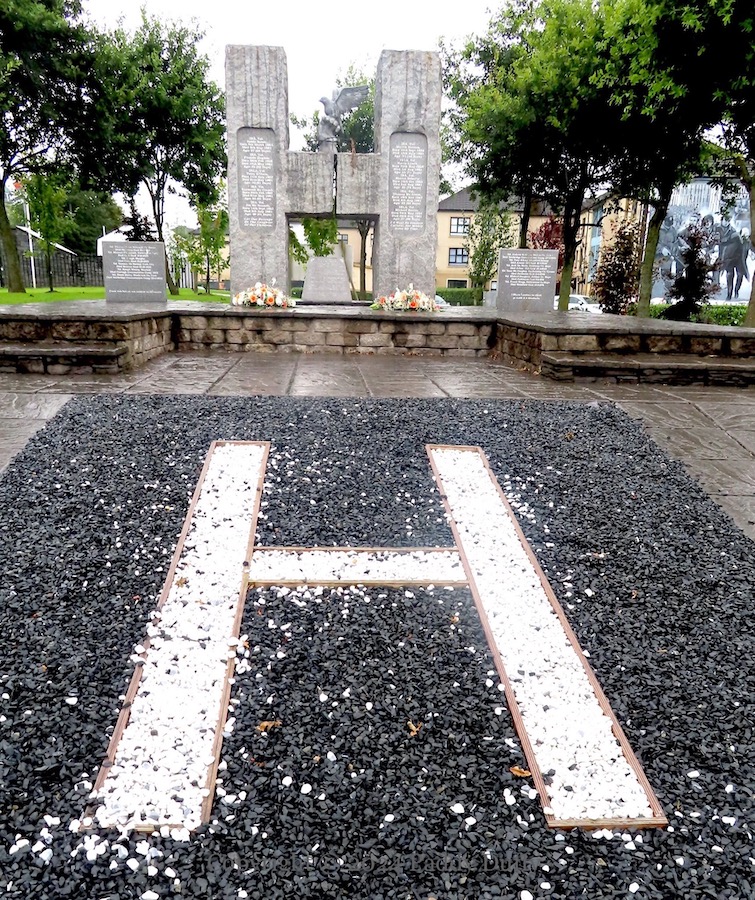
“H” for “H-blocks” and for “hunger” – the flower garden in front of the hunger strikers’ memorial in Rossville Street, Derry, has been replaced with this “H” in white pebbles among black.
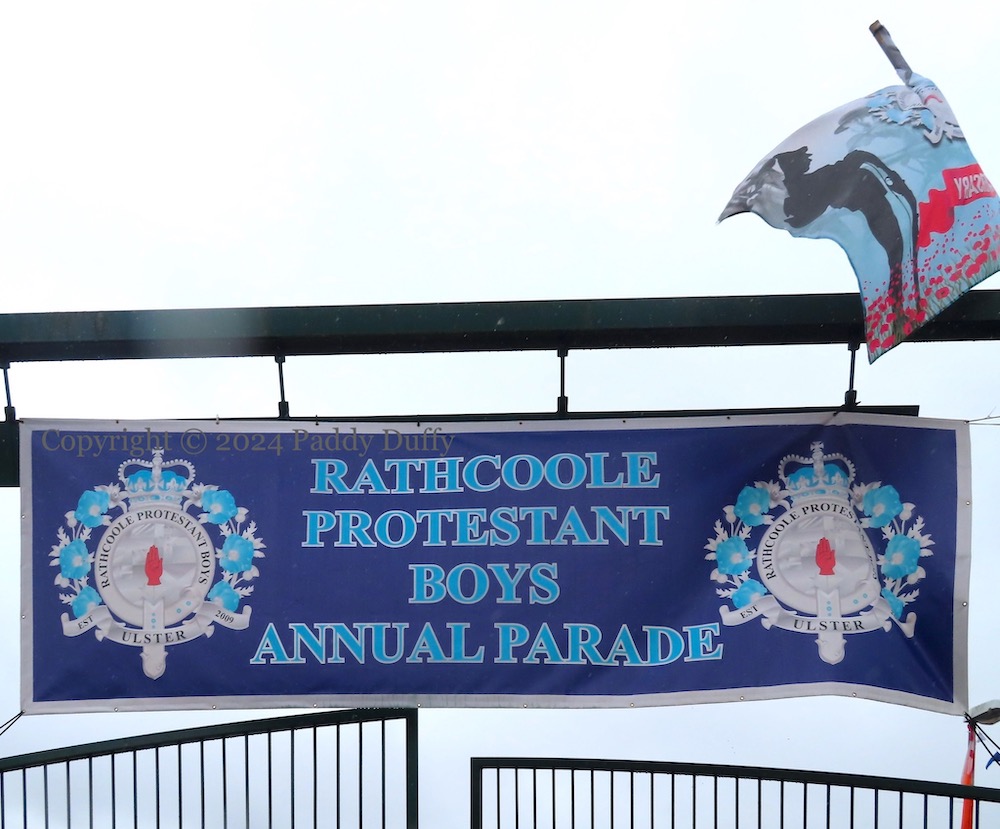
This images in this entry depict, above and below the information board about the park, the World Wars installation inside the park and the banners on the fence along Derrycoole Way.
There is an annual commemoration of the fallen in the World Wars in Rathcoole each year. The monument consisting of mourning soldiers and sandbags) was created in 2020 (Fb group | News Letter) and the bench was perhaps added in 2022. Images from the 2023 ‘row on row’ commemoration can be seen at NI World. The Row On Row group (web) hope to create a permanent memorial on the spot.
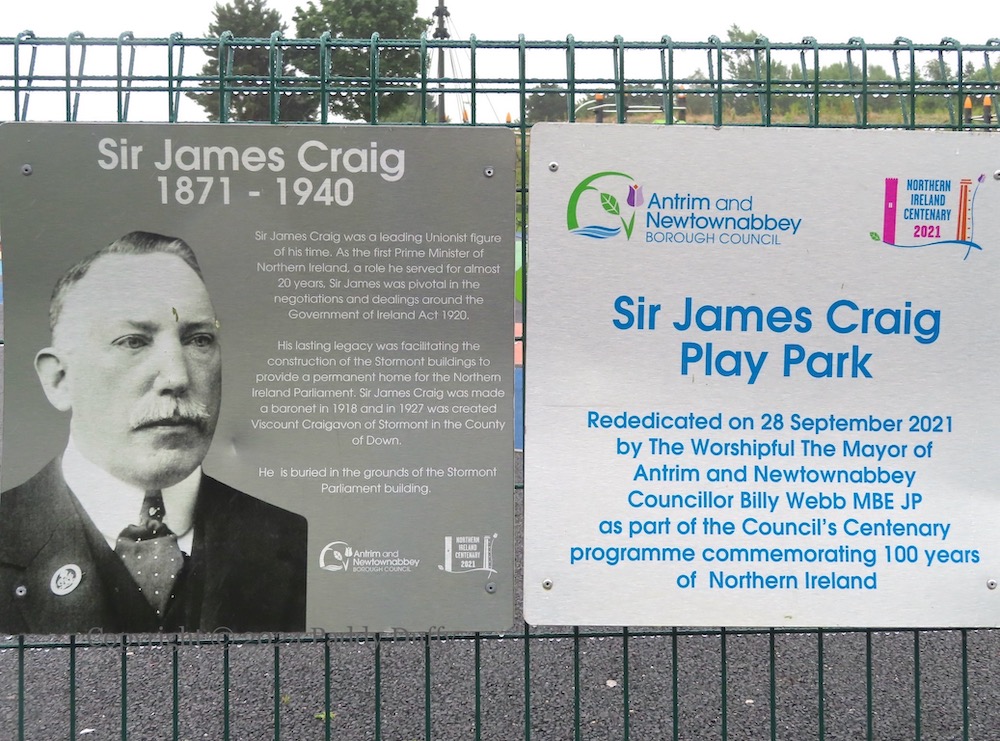
Rathcoole People’s Park was renamed the Sir James Craig Play Park by Antrim & Newtownabbey council in September, 2021, as part of the council’s celebrations of the centenary of Northern Ireland (NI World).
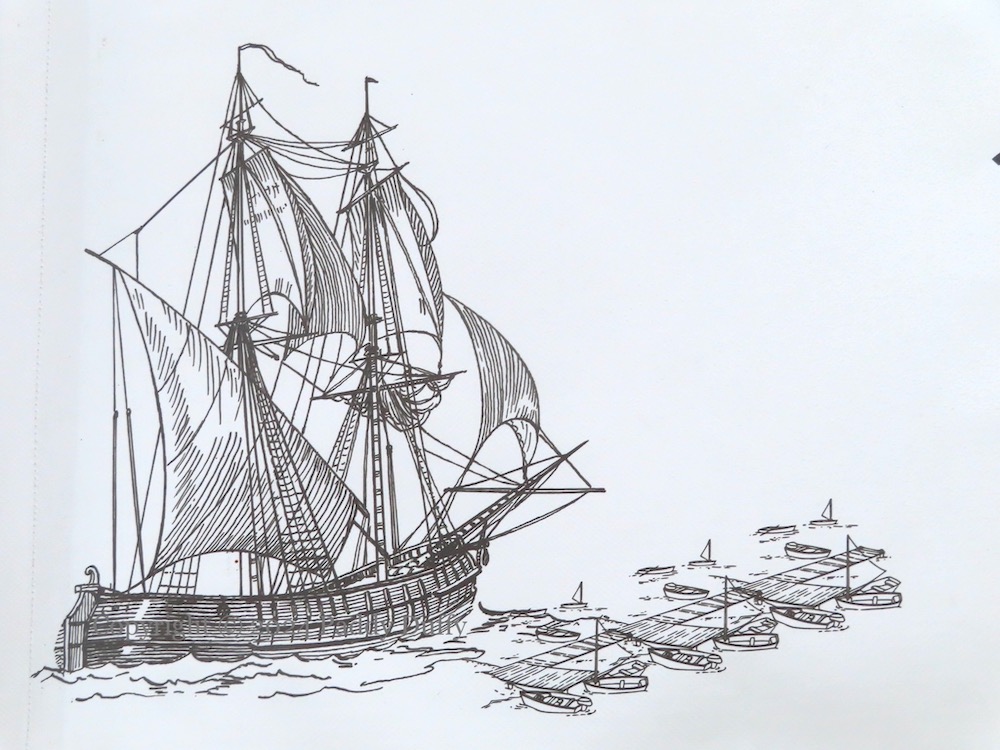
The banners on the side are from the Rathcoole Protestant Boys flute band (Fb) whose annual parade was at the end of June, and the Whitehouse Williamite Historical Society (Fb) whose fun-day on June 15th included a historical re-enactment of William’s army landing at Whitehouse. (For more on William’s connection to Whitehouse, see June 14th, 1690.)






















 Paddy Duffy Collection