Handsome, Easy-Going, And Utterly Untrustworthy

After Britain’s declaration of war against France in 1793, the United Irishmen – who hoped for French support for a rebellion in Ireland – could no longer meet openly. In Belfast, meetings were held at Dr [Benjamin] Franklin’s tavern, also called “Peggy Barclay’s” after its owner, under the guise of a social group called the Muddlers’ Club.

The true nature of the group was betrayed to the authorities in 1796 by Isabella “Belle” Martin, a serving girl in the tavern (Romanticsm Anthology | Belfast Entries | Belfast Media | Joe Baker). As the text in the Peter Strain mural above concludes, “Half a dozen of them saw the inside of a Scottish prison as a result” and the club dissolved. (The text surrounding Martin’s profile is from Glenn Patterson’s book, A Mill For Grinding Old People Young – this was the name of Peggy Barclay’s inn when she left the city centre for the Buttermilk Loney (now Skegoniell Avenue) on the Shore Road in north Belfast.

The tavern, in Sugarhouse Entry, later become a hotel before eventually being destroyed in the WWII blitz. Sugarhouse Entry still exists but has been impassable since 1972 when it was closed off as part of the “ring of steel” securing Belfast city centre (DC Tours).

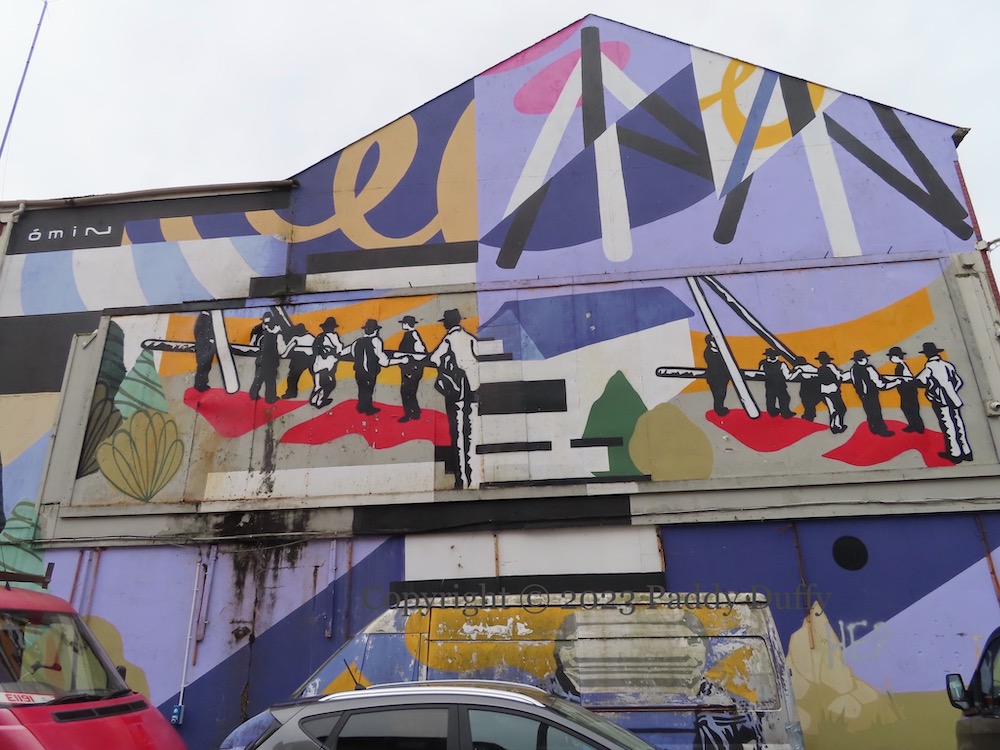
There is today a restaurant called The Muddlers’ Club, named after the society, in Warehouse Lane. Two of its murals are shown in The Eye Of Providence; for others see also God Approves Our Undertakings and The Wider Conspiracy in the Seosamh Mac Coılle Collection.

See also the Visual History page on the Belfast Entries.

Crown Entry, Belfast

Click image to enlarge
Copyright © 2023 Paddy Duffy
T01837 [T01847]

Alternative Ulster

“Where is our Alternative Ulster? – download paused.” Alternative Ulster was a fanzine (Fb | Musical Revolutions) and later a magazine (Issuu) and radio show covering the Belfast music and arts scene until March 2012; the name was then used for the Stiff Little Fingers’ song (youtube) in 1978.

By Verz (Fb) and Belfast One (web) in Fountain Street, Belfast.

Click image to enlarge
Copyright © 2023 Paddy Duffy
T01836

Trust Women

Belfast’s first maternity hospital – the Humane Female Society For The Relief Of Lying-In Women – was in Donegall Street, perhaps in the building that sat over the Exchange Place entry, from 1794 to 1830, when it moved to Clifton Street (Mcafee). It was run entirely by women (info board in I Was Sick And Ye Visited Me).

The illustration is by Peter Strain (web) in Exchange Place.

Click image to enlarge
Copyright © 2023 Paddy Duffy
T01850

Reality Show

“Make drugs history – cleaner communities now.” This is an anti-drugs board in the Tullycarnet estate. In both its title and various elements, the board references the television show Shameless, which was set on a Manchester housing estate and ended on May 28, 2013, after eleven seasons (WP). Black-and-white images from the estate, and other Belfast landmarks, are featured at the top.

The plaque below reads: “Shameful mural. This mural was officially unveiled on 15th June 2009 by First Minister Peter Robinson. This mural was created by young people from Tullycarnet to highlight that drug and alcohol use should not be normalized by communities.”

Click image to enlarge
Copyright © 2023 Paddy Duffy
T01789 [T01788]

The Blots On The Page Are So Black

In a letter in 1859 to Dr Richard Madden, a fellow abolitionist (and historian of the United Irishmen), Mary Ann McCracken wrote, “America, considered the land of the great, the brave, may more properly be styled the land of the tyrant and the Slave.” (McNeill)

Also given an abolitionist bent are some lines from section 16 of Louis MacNeice’s Autumn Journal, describing Belfast as “A city built on mud; / A culture built upon profit; / Free speech nipped in the bud, / The minority always guilty. [Why should I want to go back / To you, Ireland, my Ireland? / The blots on the page are so black / They cannot be covered with shamrock. / I hate your grandiose airs / Your sob-stuff, your laugh and your swagger, / Your assumption that everyone cares / Who is the king of your castle. / Castles are out of date, / The tide flows round the children’s sandy-fancy; / Put up what flag you like, it’s too late / To save your soul with bunting.]

The illustrations are by Peter Strain (web) in Joy’s Entry and Wilson’s Court. See also by Strain Handsome, Easy-Going, And Utterly Untrustworthy and Trust Women.

On McCracken, see The World Affords No Enjoyment Equal To That Of Promoting The Happiness Of Others.

On abolitionism in Belfast, see Olaudah Equiano and If There Is No Struggle, There Is No Progress.

See also the Visual History page on The Belfast Entries.

Click image to enlarge
Copyright © 2023 Paddy Duffy
T01711 T01710 T01838

#BreakTheBias

Crossed arms are the symbol of the #BreakTheBias campaign, which is the theme of this year’s International Women’s day (IWD) and people all around the world are striking the pose on social media to show their support (e.g. tw) including this large mural in Belfast, which has been painted off Corporation Street.

By Visual Waste (web | ig), with support from Children In Crossfire (web).

Tomb Street, Belfast

Click image to enlarge
Copyright © 2023 Paddy Duffy
T01748 [T01749]

Olaudah Equiano

In 1789, Olaudah Equiano published a memoir to 311 subscribers describing his early life in west Africa, his kidnapping, transport via Barbados to enslavement in Virginia, then in London, England, and then in Montserrat in the Caribbean. He bought his own freedom in 1766 and went back to England and joined the burgeoning abolitionist movement. His memoir detailing the treatment and conditions he had experienced made him famous. He toured Britain and Ireland in support of his book: “I found the people extremely hospitable, particularly in Belfast [in 1791-1792]” (BBC Sounds 17m 58s). He stayed with Samuel Neilson, a founding member of the United Irishmen (Clifton Belfast | WP | see also yesterday’s post on Belle Martin). Ten years after his death in 1797, the trans-Atlantic slave trade was abolished in both the UK and the States.

The mural in Joy’s Entry, by London artist Dreph, is based on a portrait painted by William Denton and engraved for the book by Daniel Orme (Dreph | National Portrait Gallery).

For an overview of the anti-slavery movement in Belfast, including Thomas Russell, Olaudah Equiano, and Frederick Douglass, see this William Orr speech (at Slugger).

See also the Visual History page on The Belfast Entries.

Click image to enlarge
Copyright © 2023 Paddy Duffy
T01709