“Our laughter will be the joy of our victory + [the] joy of the people; our revenge will be the liberation of all.” This is perhaps the only appearance of this quote from Bobby Sands’s hunger strike diary, from Thursday March 12th. In the background are the towers of Long Kesh; in the foreground is Sands’s funeral procession (RTÉ | youtube).
This is a complete version of Bobby Sands’s poem The Rhythm Of Time, along with the names and portraits of the ten deceased 1981 hunger strikers, and Michael Gaughan and Frank Stagg, who died on hunger strike in England.
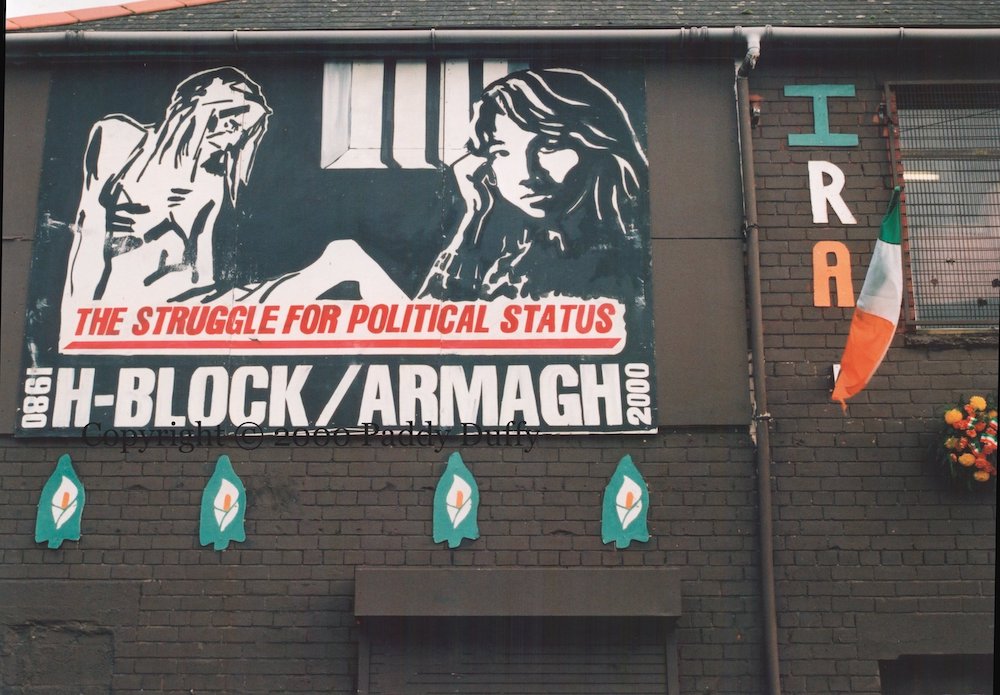
“The struggle for political status.” The twentieth anniversary of the hunger-strikes in Long Kesh and Armagh Women’s prison, 1980-2000, is commemorated. Seven men in Long Kesh and three women in Armagh went on strike, for fifty-three days and nineteen days, respectively.
The lilies are held over from the previous year – see The Final Salute.
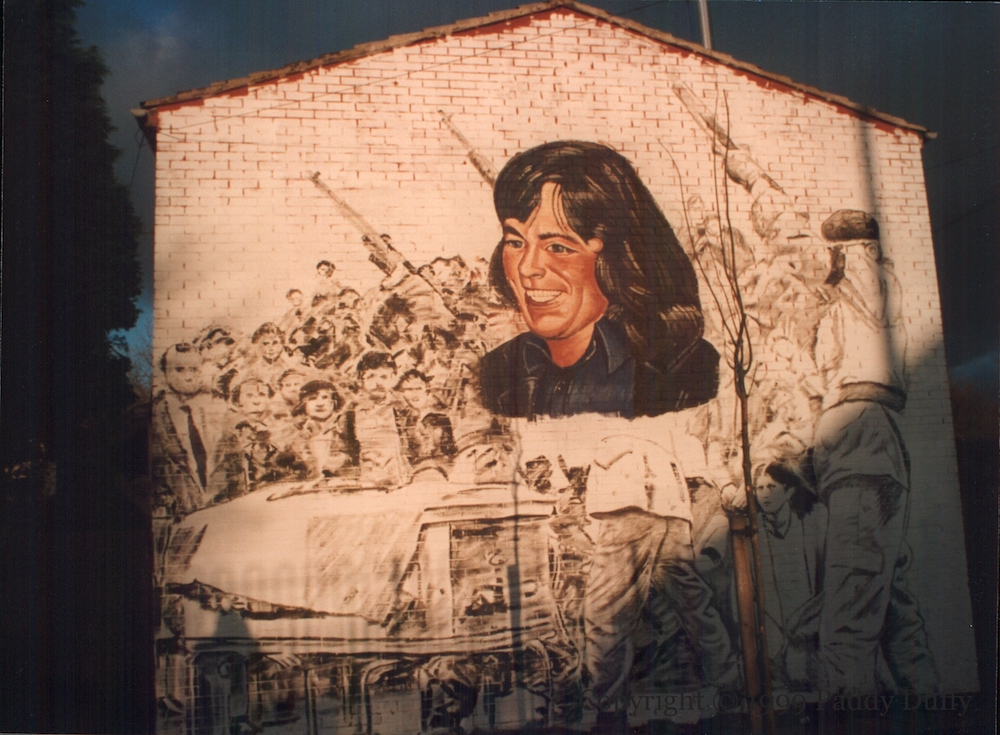
The IRA’s Joe McDonnell was the fifth of the 1981 hunger-strikers to die, on July 8th, after 61 days. McDonnell’s portrait is superimposed upon a sketch of a photograph of the funeral volley fired while his coffin was en route to Milltown cemetery (An Phoblacht).
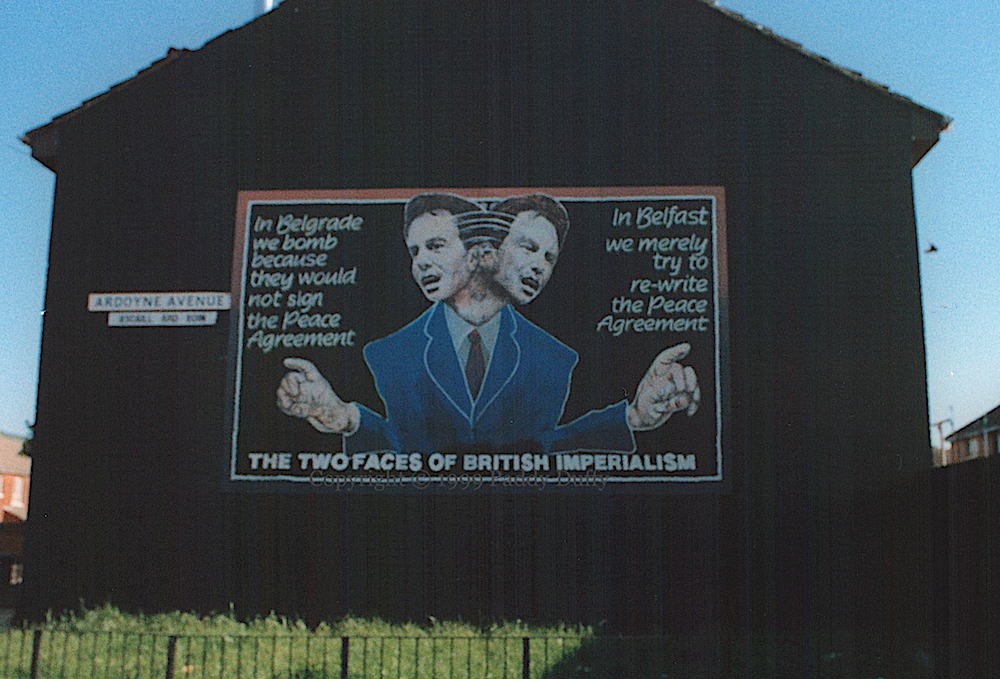
“The two face of British imperialism: In Belgrade we bomb because they would not sign the Peace Agreement … In Belfast we merely try to re-write the Peace Agreement”.
Labour Prime Minister Tony Blair gave a statement on Britain’s participation in the NATO bombing of Serb targets in Yugoslavia after Slobodan Milosevic rejected an agreement with the Kosovo Albanians – this, Blair said, was only the latest in a series of bad-faith actions on Milosevic’s part; the targets included Milosevic’s house, the Socialist party’s headquarters, and a TV station (BBC | Guardian).
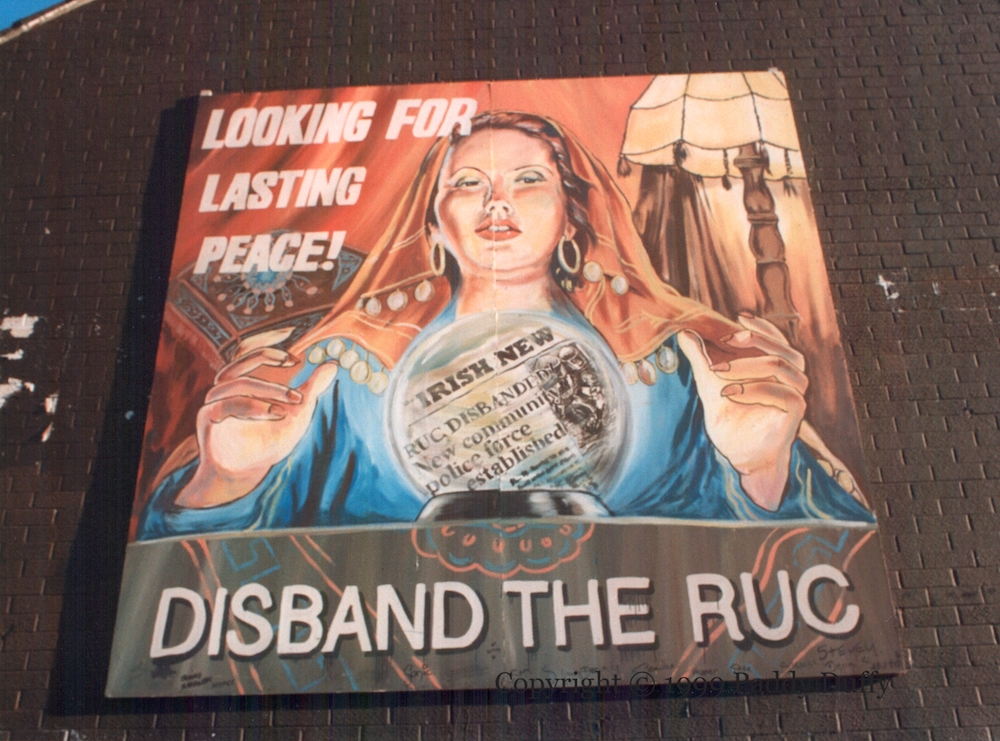
“Disband the RUC.” A fortune-teller sees the path to peace in an Irish News headline in her crystal ball: “RUC disbanded. New community peace force established”. Reform or replacement of the RUC is one of the top nationalist concerns in the peace process, after the release of POWs.
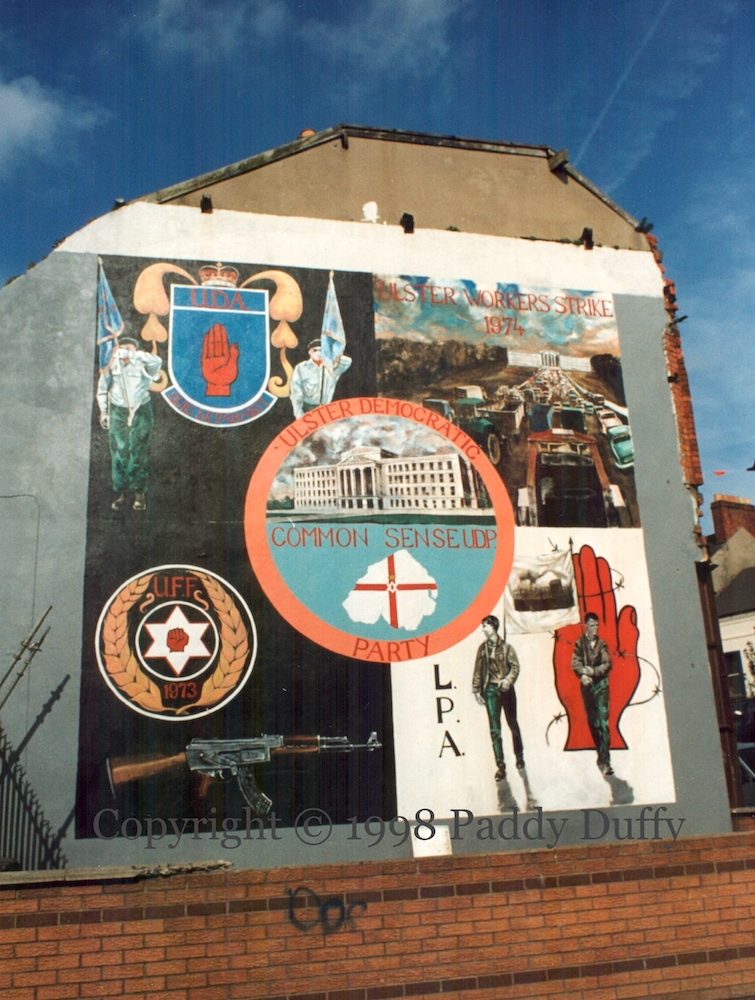
The Ulster Democratic Party (UDP) was the political wing of the UDA, and supported a policy of an independent Northern Ireland (as described in the policy document ‘Common Sense‘). It won a few council seats in the late 1980s and early 1990s (and dissolved in 2001) (BBC-NI).
The top-right panel is similar to this Victor Patterson photograph of the farmers’ protest at Stormont during the Ulster Workers’ Council strike that brought down the Sunningdale Agreement in 1974.
An Orange Order marcher (with skeletal face, glowing eyes, and a ‘Give way’ sign) is about to step on a protestor from the lower Ormeau who holds a sign reading “Peace – Justice” and has just released a dove that is sitting on top of the road-sign on the corner.
The scene is the Ormeau Road at Farnham Street, and the mural is in Farnham Street at the Ormeau Road; the mural thus includes a depiction of itself: the edge of the mural (with blue sky and grey pavement) appears on the wall to the left of the pizza shop with painted shutters reading “What part of NO don’t you understand?” (An image of the actual shutters, from the squire93 collection, is included below.)
In the top left is a smaller piece painted on a board: the words “Will there ever be peace? No.” are super-imposed on a grave.
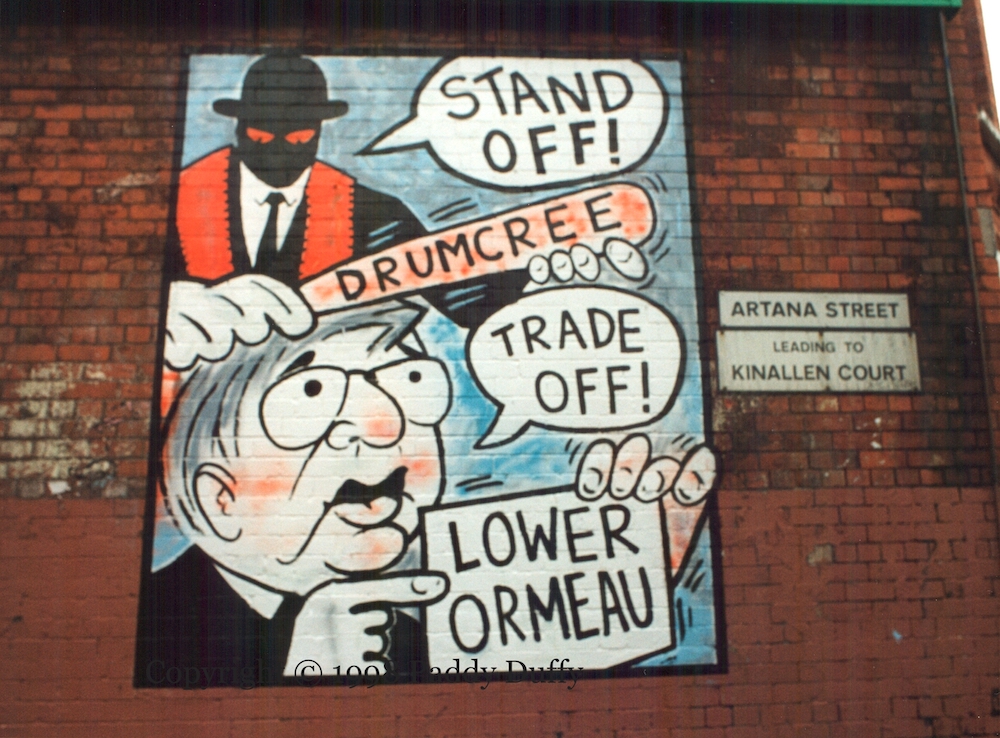
In the summer of 1998, an Orange Order march was allowed to parade along Ormeau Road. Parades Commission chairman Alistair Graham (pictured in the mural beneath the evil-eyed OO member) “insisted that the Ormeau Road decision “was not a simple trade-off for our earlier decision on Drumcree”” (Irish Times).
“A postcard from the edge – Having a wonderful time! How was your summer?” Postcards From The Edge was a 1990 film starring Meryl Streep and Shirley MacLaine based on the semi-autobiographical novel of the same name by Carrie Fisher (WP). In this mural, the nationalist community is locked in the dark while the Orange Order parades loudly on the Ormeau Road in south Belfast.





 Paddy Duffy Collection