Get Me Back To The Green Hill

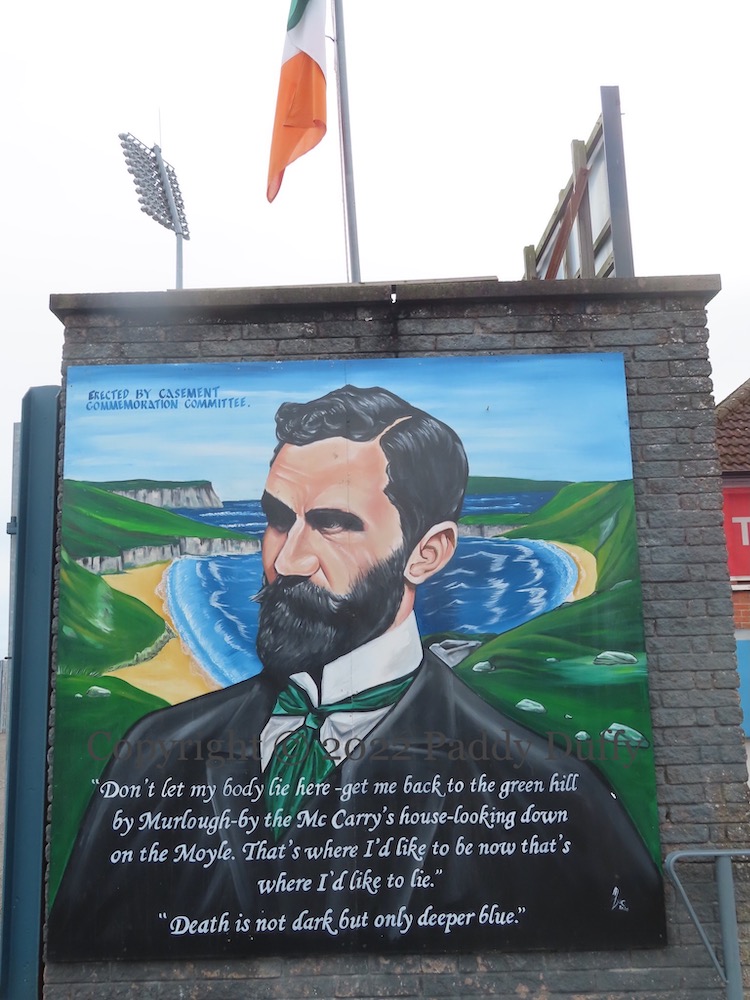
“Don’t let me body lie here – get me back to the green hill by Murlough, by the McCarry’s house, looking down on the Moyle. That’s where I’d like to be now, that’s where I’d like to lie. … Death is not dark but only deeper blue.” [Letter to Elizabeth “Eilis” Bannister, July 25th, 1916] Roger Casement was executed in Pentonville prison, in England, in 1916, for his role in gunrunning for the Rising, and his corpse was buried in the prison cemetery. Despite repeated requests for repatriation, it wasn’t until 1965 that the corpse was returned to Ireland – but to his home town of Dublin rather than to his beloved Murlough, where his cousins Eilis and Gertrude lived (in what was by then Northern Ireland): the corpse was released on condition that it not enter Northern Ireland, for fear of stoking political tensions between the sects (WP).

Casement Park, Andersonstown, west Belfast

Click image to enlarge
Copyright © 2022 Paddy Duffy
T01156
Kieran Doherty

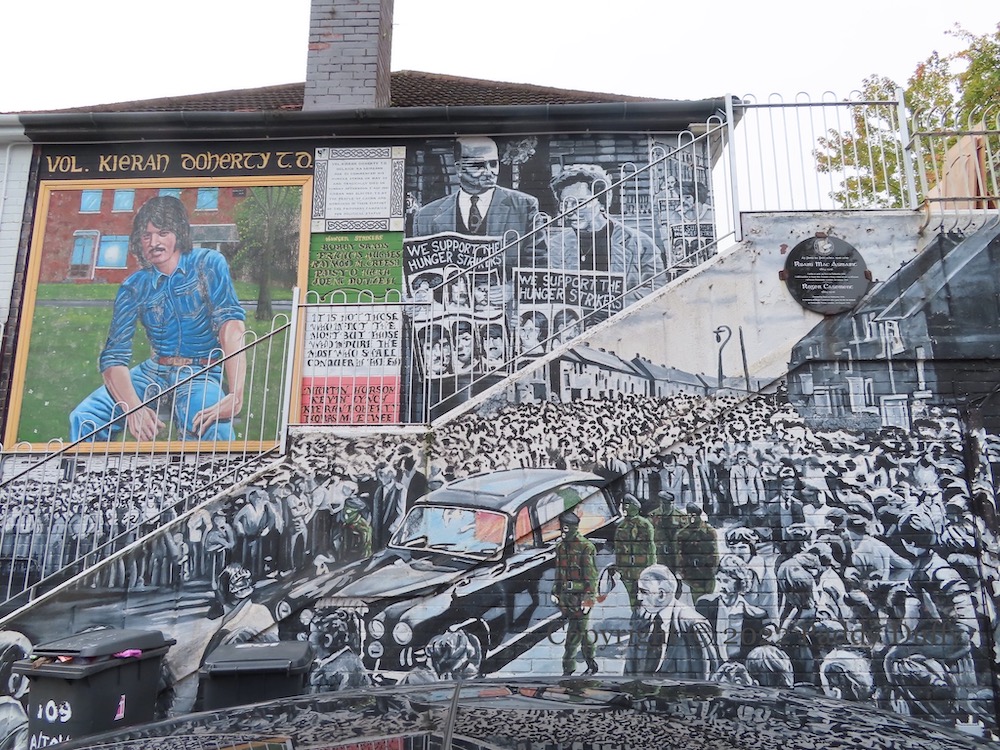
Kieran Doherty died on August 2nd, 1981, after 73 days on hunger-strike. The mural above depicts scenes from his funeral on 1981-08-04. The portrait of Doherty in the top left replaces a similar one in the same location; the plaque at the portrait’s top-right corner remains from before. The angled panel shows Doherty’s parents, Alfie and Margaret.

There is video of the launch on youtube.

The photograph on which the central panel is based is by Derek Spiers; see also this set at hungerstrikes.org. The volley took place outside the Doherty family home in nearby Commedagh Drive (Belfast Media).

Click image to enlarge
Copyright © 2022 Paddy Duffy
T01155 [T01154] T01153

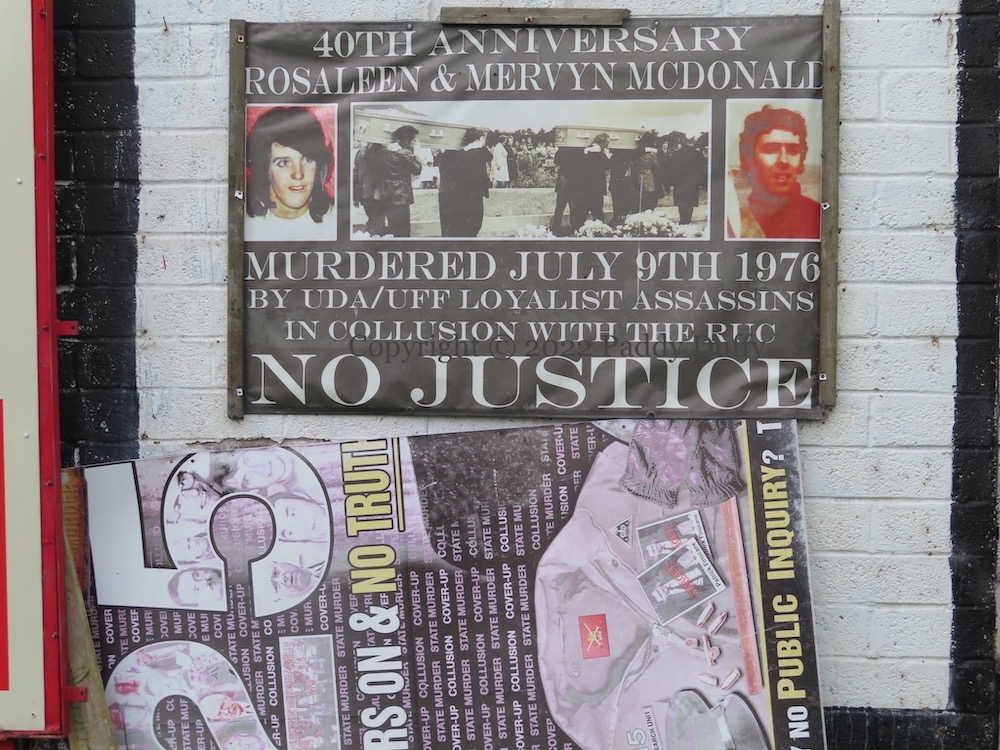
No Justice

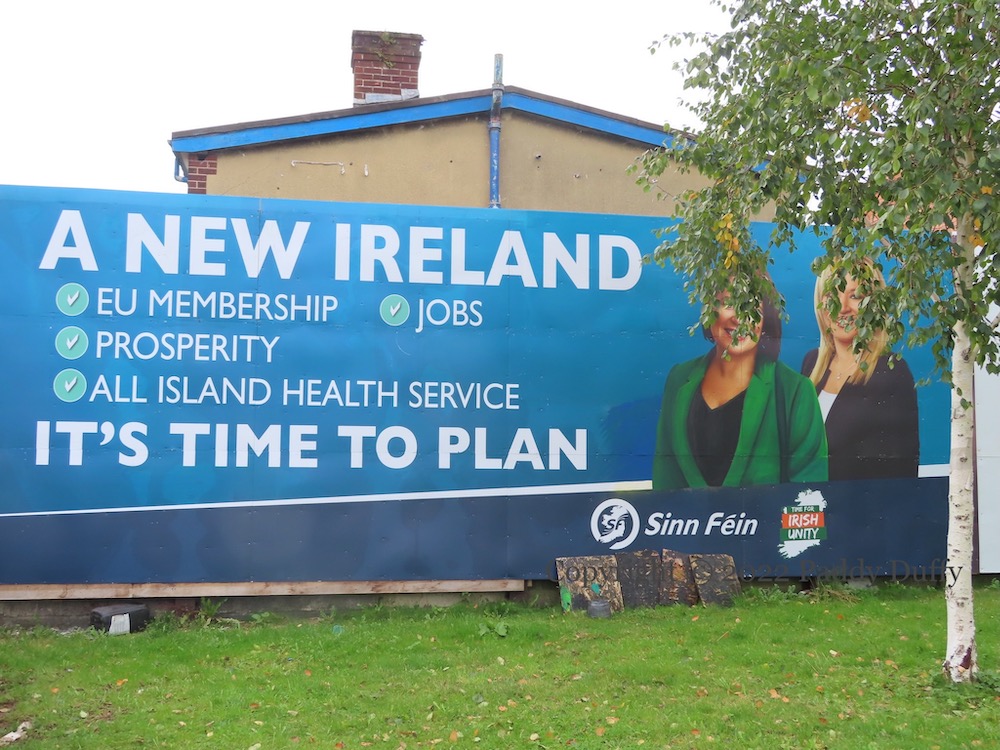
Here is a gallery of images from the Falls Road/Glen Road junction (site of the old Andersonstown RUC barracks). The images top to bottom follow the wall from right (Glen Road) to left (Falls Road).

Above: a call for the release of Basque prisoners.

Below: Mervyn and Rosaleen McDonald were Catholics living in the mixed Longlands area of Newtownabbey when they were visited by “UFF loyalist assassins” and shot dead in front of their two young children. The killings are described in most detail in Jack Holland’s Too Long A Sacrifice, which contains an interview with the gunman and the claim that the unit had access to RUC files (p. 94).

Seamus Costello fought for the IRA during the Border Campaign and was interned in the Curragh for two years. He stayed with the Officials during the split, but was driven out in 1974 and formed the Irish Republican Socialist Party (IRSP) and the INLA. He was shot in 1977. (WP)

A large Fıanna banner.

Metalwork commemorating the deceased 1981 hunger strikers.

A Sınn Féın electoral banner.

Click image to enlarge
Copyright © 2022 Paddy Duffy
T01146 T01147 T01148 [T01149] T01152 T01151 T01150

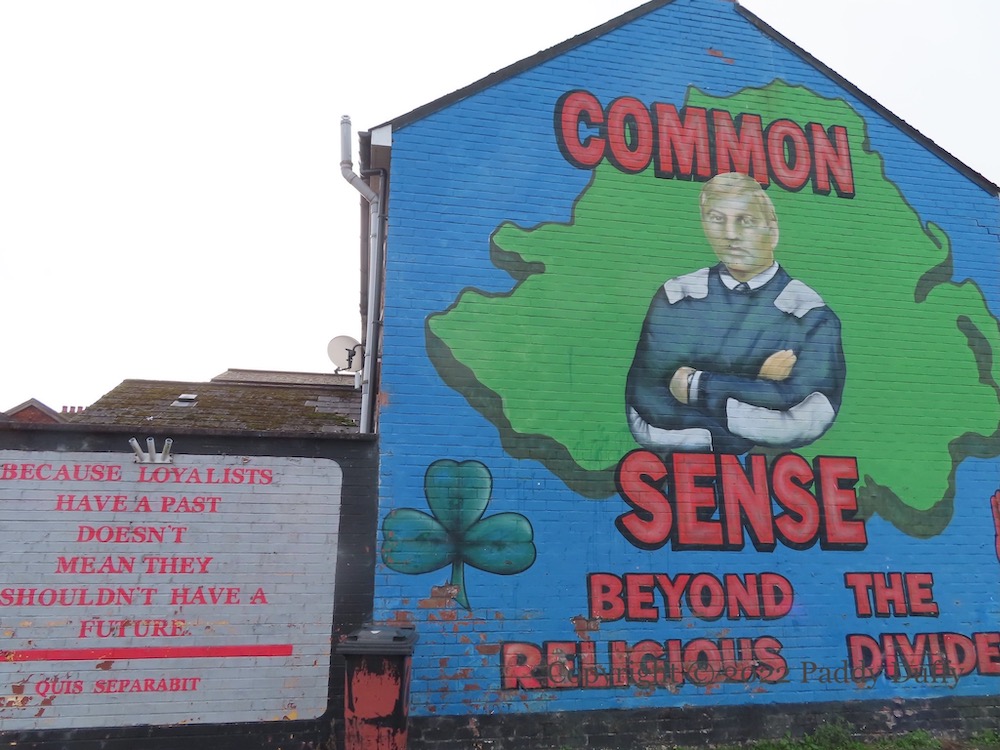
Common Sense

UDA commander John McMichael was also secretary of the New Ulster Political Research Group (NUPRG), a think tank of the UDA/UFF. The group argued for an independent Northern Ireland (based in part on beliefs about a separate Ulster ethnic identity – see the Visual History page on Cú Chulaınn) in two documents, 1979’s Beyond the Religious Divide and 1987’s Common Sense (available at CAIN), promoting the philosophy of ‘Ulster nationalism’, depicted here by the free-floating Northern Ireland. McMichael ran unsuccessfully for the Belfast South seat after the murder of Robert Bradford (see To Bathe The Sharp Sword Of My Word In Heaven).

The side wall reads “Because loyalists have a past doesn’t mean they shouldn’t have a future. Quis separabit.” It previously had a McMichael quote – see We Must Share The Responsibility.

Click image to enlarge
Copyright © 2022 Paddy Duffy
T01140

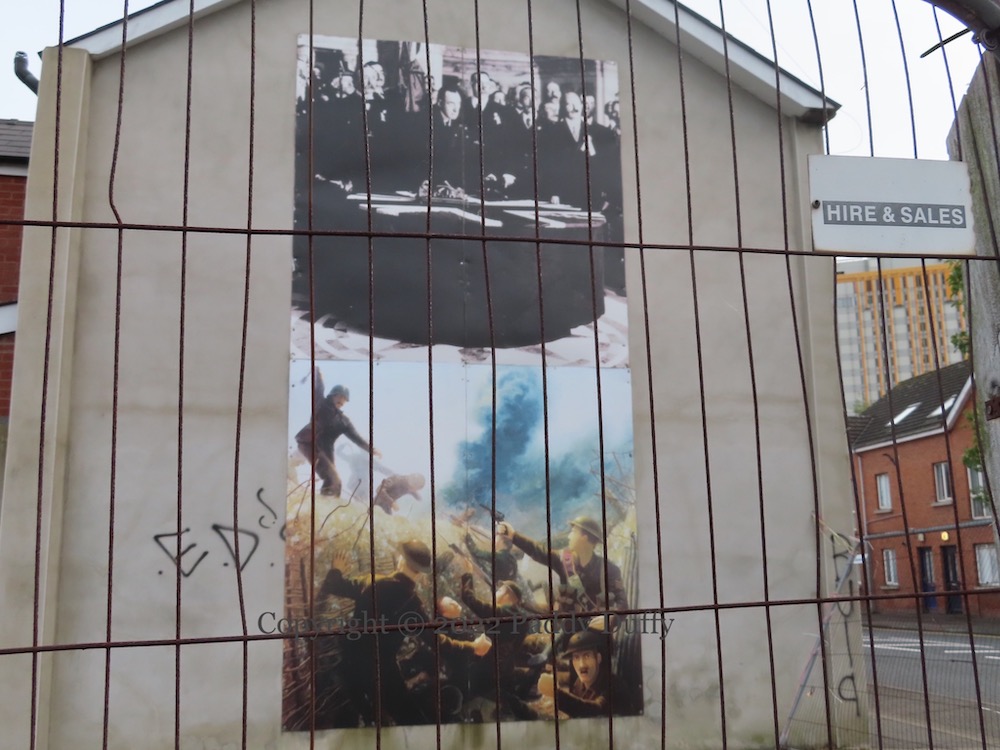
September 28th – July 1st

Here are a pair of boards in Barrington Gardens, Belfast: above, the signing of the Ulster Covenant, on September 28th, 1912; below, an attack on British trenches, perhaps intended to represent a scene from the first day of the Battle Of The Somme, July 1st, 1916.

Click image to enlarge
Copyright © 2022 Paddy Duffy
T01120 [T01119]

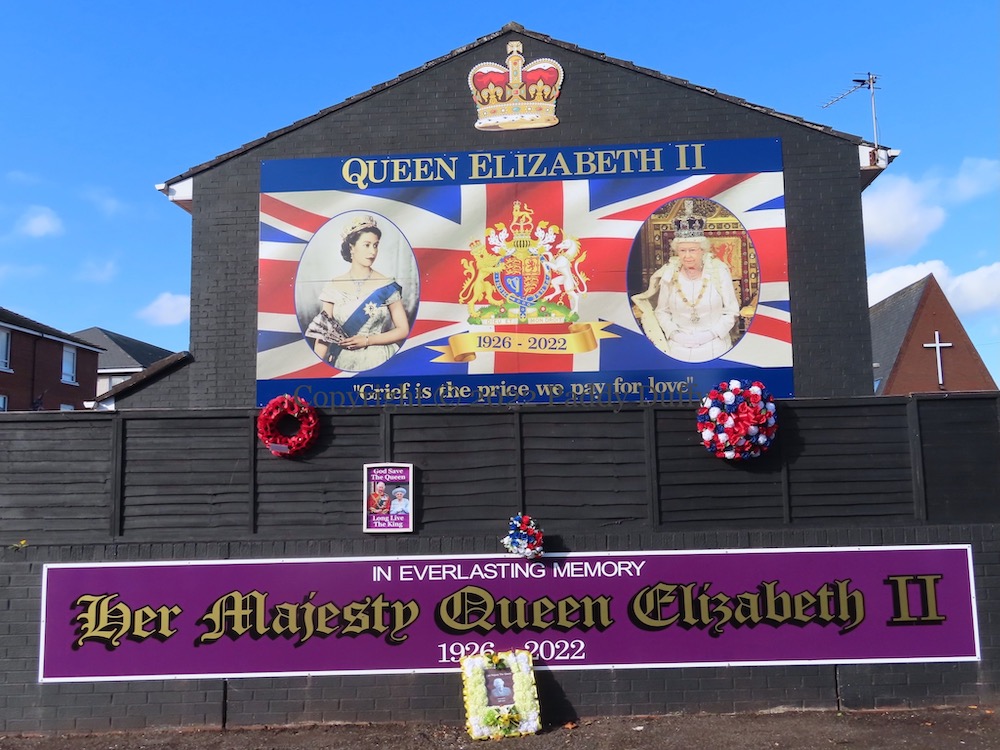
Grief Is The Price We Pay For Love

Elizabeth II, queen of the United Kingdom, passed away on September 8th, at the age of 96, in the same year of her platinum jubilee, the 70th anniversary of her accession. The phrase “grief is the price we pay for love” comes from a message from Elizabeth in consolation with the relatives of those killed in the “9-11” attacks in 2001 (text at The Guardian).

“In everlasting memory – her majesty Queen Elizabeth II – 1926-2022.” “Long live the King”

Rowland Street, south Belfast

Click image to enlarge
Copyright © 2022 Paddy Duffy
T01086 [T01087]

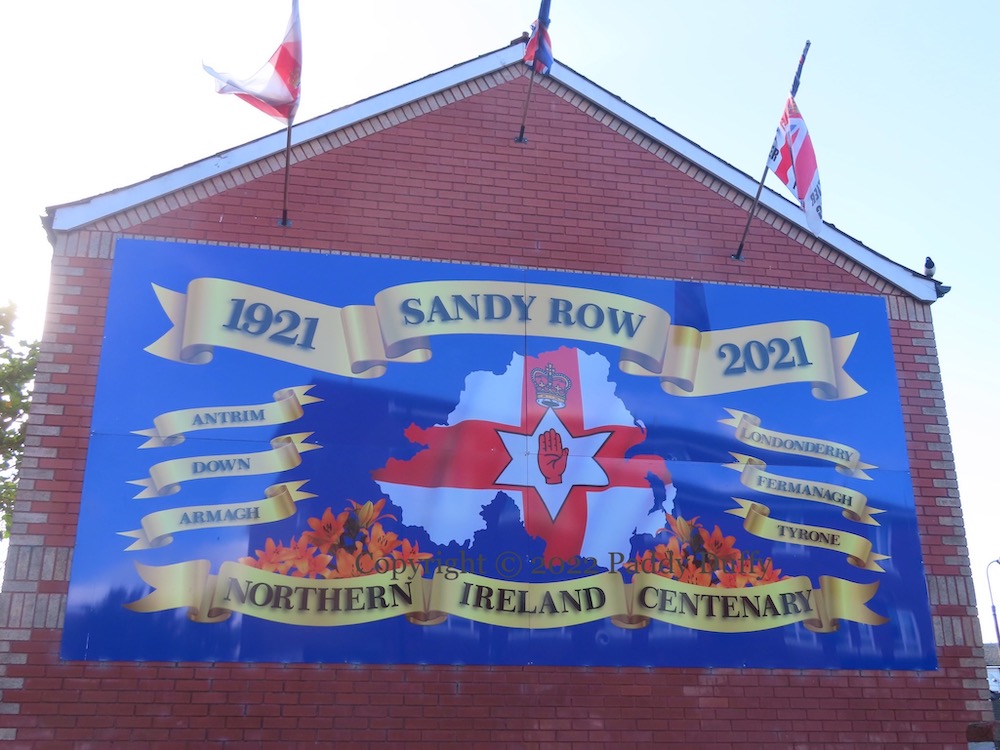
Our Wee Country

“From Sandy Row to the house of Windsor: happy diamond jubilee 1952-2012. God save the Queen.” Although the coronation was held in June 1953, Elizabeth acceded to the throne immediately upon the death of George VI, on February 6th, 1952. This board was previously on an adjacent wall but has been moved to this location (on top of the ‘Our Wee Country’ mural, replacing a damaged mosaic) to make way for the NI centenary board shown below.

The Irish Football Association (web | tw) is the governing body for Northern Irish soccer, overseeing both domestic and international events. The original Our Wee Country (fan organisation Web | tw) mural was in Carnforth Street, east Belfast.

Click image to enlarge
Copyright © 2022 Paddy Duffy
T01084 [T01083] T01085

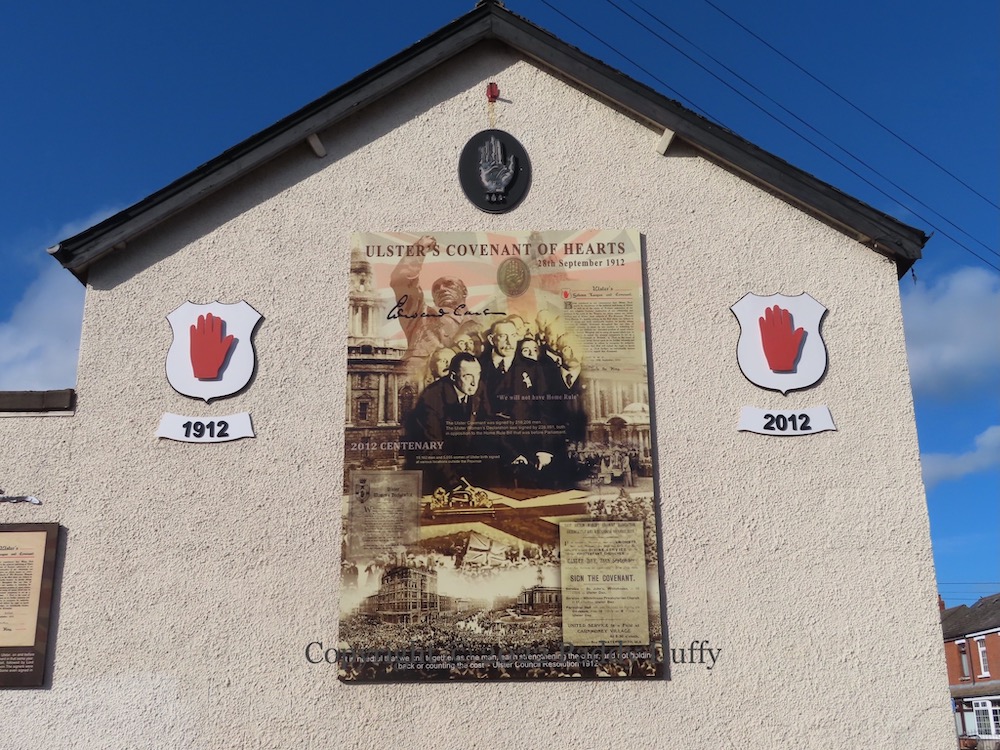
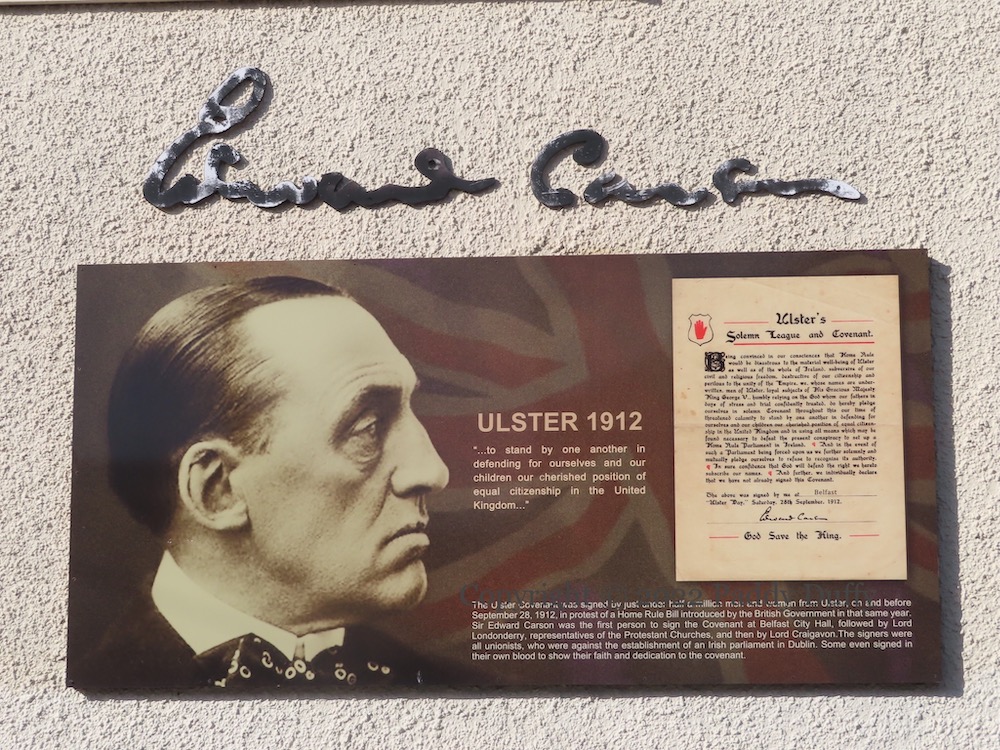
Covenant Of Hearts

“Ulster’s covenant of hearts” is the title given to the main board in this collection commemorating the 100th anniversary of the signing of the Covenant in 1912 and the figure of Edward Carson, leader of the Ulster Unionist Party, founder of the Ulster Volunteers, and first signatory of the covenant.

Tavanagh Street, Village, south Belfast

Click image to enlarge
Copyright © 2022 Paddy Duffy
T01088 [T01089] T01090

We Shall Defend Our Island

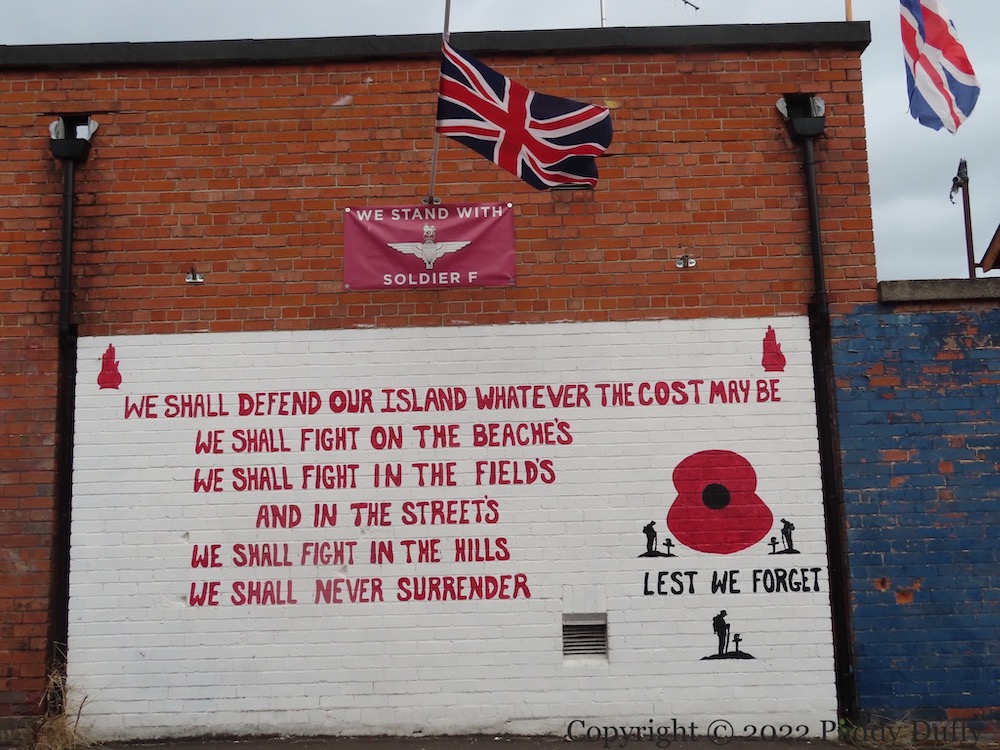
The mural in Castlereagh Parade was repainted for the centenary of the end of WWI, but with some notable differences from the previous version. Three flag-holders have been added above. On the right are now a poppy and mourning soldiers. The quote comes from a speech by Winston Churchill on 1940-06-04 – “We shall defend our island whatever the cost may be. We shall fight on the beaches. [We shall fight on the landing grounds.] We shall fight in the fields and in the streets. We shall fight in the hills. We shall never surrender.” – but the current first line was previously omitted in favour of another Churchill quote: “We have nothing to offer but blood, tears, and sweat.” See: Whatever The Cost May Be.

Click image to enlarge
Copyright © 2022 Paddy Duffy
T01054 [T01055] soldier f