August 1969

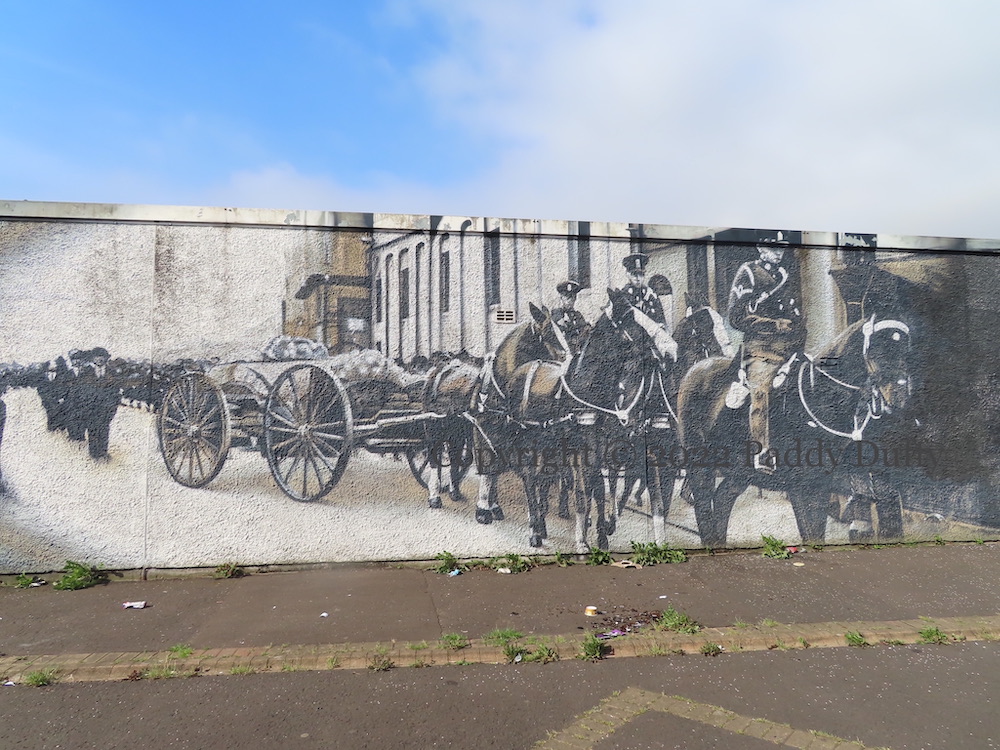
“Is cuımhın lınn.” To commemorate the beginning of the Troubles, a series of events was organised by the Belfast 1969 Pogroms Commemoration Committee, in Clonard, Falls, and Ardoyne, including a photographic exhibition, documentary screenings, panel discussions, a play, a mass, and murals (Irish News), including The Pogrom Of August 1969 and the one above, in Bombay Street, which used to run between the Shankill and Falls but after the riots and burnings of August 1969 was split in two by a so-called “peace” line.

“These are terrible days … but some good has already come from these attacks on our communities. You have young people and elderly people all closely knit together and that is a grand thing. We must not allow hatred to spring up in our hearts. For what we are aiming for now is justice. We demand justice. We are not begging for it – we are demanding it. It is our right and we will keep on demanding it until we get it. We don’t ask for anything more – just a fair deal … that we will soon have a community where everybody, irrespective of religious belief or irrespective of political ideology will be able to lead a normal life and will not be unjustly discriminated against.” – Fr Patrick Egan, sermon in Clonard Monastery, August 1969 (youtube).

Click image to enlarge
Copyright © 2022 Paddy Duffy
T00828 [T00829]

The Mainspring

Seán Mac Dıarmada was born in Leitrim, left for Glasgow at age 15, but after two years returned to Belfast in 1905 (working on the trams) and – according to the new mural above – spoke from the back of a coal lorry in Clonard Street, outside the Clonard branch of the Ancient Order Of Hibernians. Mac Dıarmada was for a short time an AOH member, before moving on to the Irish Republican Brotherhood and Irish Volunteers, which led to his participation in the 1916 Easter Rising and execution on May 12th of that year.

The title of this post is historian F.X. Martin’s assessment of Mac Dıarmada, quoted in a pamphlet on Mac Dıarmada from the National Library Of Ireland, which includes reproductions of letters from and about Mac Dıarmada. The NLI made more letters available today (2016-02-08). (See also this Irish Times write-up).

Previously: A 2013 Mac Dıarmada mural in Ardoyne.

Click image to enlarge
Copyright © 2022 Paddy Duffy
T00826 [T00825]

Norah McCabe

Norah McCabe was shot in the back of the head by a plastic bullet fired from an RUC land rover at around 7:45 a.m. on July 9th, 1981, the day after hunger striker Joe McDonnell died. (Danny Barrett would be killed by a British Army sniper in the evening.) The new boards were mounted to coincide with the fortieth anniversary of McCabe’s death. In 1981, a mural was painted at the same spot (in the old Linden Street) to protest the use of plastic bullets: see Plastic Death.

“Norah McCabe, 1947-1981, murdered by an RUC plastic bullet on 9th July 1981, aged 33 years.” With a poem “Peace” by daughter Áıne McCabe, who was three months old when her mother was killed (Irish News).

(old) Linden Street, west Belfast

Click image to enlarge
Copyright © 2022 Paddy Duffy
T00824

We Bleed That The Nation May Live

Arrayed against the forces of the British Army (which are shown in armoured cars and in sniping positions in the foreground of the mural, along the whole length of the wall) are various symbols of Irish nationalism: Oliver Sheppard‘s 1911 statue of Cú Chulaınn dying; the pikemen of the 1798 Rebellion (featured yesterday: Éırí Amach 1798); the four provinces of Ireland; Érıu the mythological queen of Ireland/Éıre as designed by Richard J King/Rísteard Ó Cíonga; Easter lilies; the emblems of Na Fıanna Éıreann and Cumann Na mBan on either side of a quote from (The Mainspring) Sean MacDiarmada “We bleed that the nation may live; I die that the nation may live. Damn your concessions, England: we want our country”; a phoenix rising from the flames of the burning Dublin GPO (inspired by Norman Teeling’s 1998 painting The GPO Burns In Dublin); the GPO flying an ‘Irish Republic’ flag; portraits of signatories and other rebels — (left) Padraig H. Pearse, Thomas J Clarke, Eamonn Ceannt, Thomas MacDonagh, (right) Countess Markievicz, James Connolly, Sean MacDiarmada, Thomas Plunkett; the declaration of independence, placed over the advertising box of AA Accountants – see the in-progress shot below. For more work-in-progess images, see yesterday’s post, Éırí Amach 1798. At the very bottom is a quote from the mother of Gerard ‘Mo Chara’ Kelly, Harriet Kelly: “We want the freedom of our country and your soldiers out.”

McQuillan Street, west Belfast

Click image to enlarge
Copyright © 2022 Paddy Duffy
T00821 [T00822] T00823

Don’t Play England’s Game

“No extradition! Don’t play England’s game” – after years of legal wrangling, Liam Campbell was extradited to Lithuania on charges of procuring weapons for the Real IRA (BBC | Saoradh). See previously: Silence Is Complicity. Cıarán Maguire was handed over to the PSNI by Gardaí in April 2021 (Donegal Daily).

Braemar Street, west Belfast, with a 40th anniversary hunger strike board below.

Click image to enlarge
Copyright © 2022 Paddy Duffy
T00818 [T00819] [T00820]

Ban Plastic Bullets Now!

The United Campaign Against Plastic Bullets organised a march on July 16th, from Divis to the middle Falls, ending in Islandbawn Street with the launch of a new mural commemorating 17 victims of rubber or plastic bullets (Irish News). (Belfast Media has a gallery from the march.) Amnesty International last year released a report on the continued use of Attenuating Energy Projectiles (AEPs).

“Seeking justice for victims of rubber and plastic bullets. Plastic bullets = murder, main & mayhem”

For the previous plastic bullets board in Islandbawn Street, see Plastic Death.

Francis Rowntree, Tobias Molloy, Thomas Friel, Stephen Geddis, Brian Stewart, Michael Donnelly, Stephen McConomy, Paul Whitters, Julie Livingstone, Henry Duffy, Carol Ann Kelly, Norah McCabe, Peter Doherty, Peter McGuinness, John Downes, Keith White, Seamus Duffy.

Click image to enlarge
Copyright © 2022 Paddy Duffy
[T00808] T00807

Executed

On October 18th, 1922, the third Dáıl/second Provisional Government Of Southern Ireland approved – in the absence of anti-Treaty members – a bill entitled the “Army Emergency Powers Resolution” which introduced martial law, including martial courts with the death penalty for anyone found in possession of an illegal firearm – “illegal” meaning not sanctioned by the nascent pro-Treaty Free State. Under these powers, seven IRA volunteers were executed on November 17th and 19th, followed on the 24th by Erskine Childers (a member of the team that negotiated the Treaty but subsequently against it). In response, the IRA declared that TDs who had voted for the bill were fair game, and on December 7th Seán Hales of Cork was shot and killed. In reprisal, the government ordered the execution of four more volunteers, one from each province: Liam Mellows, Joe McKelvey, Dick Barnett, Rory O’Connor. The four had been arrested five months earlier, on June 30th, 1922, at the start of the Civil War, after surrendering the Four Courts. By the end of the war, 81 executions had taken place. (An Phoblacht | Irish Times | The Irish Story | WP | WP)

For the left-hand side of the wall, on the shipyard clearings and the McMahon murders, see Belfast Butchery.

Click image to enlarge
Copyright © 2022 Paddy Duffy
T00803 [T00802]

Alternative Transport, Alternative Location

Pieces of the long Beechmount Avenue wall have moved to different locations due to the construction of new fencing and other improvements. The WBTA Alternative Transport board is now above the longest-surviving mural in Belfast, the Clowney Street phoenix.

Click image to enlarge
Copyright © 2022 Paddy Duffy
[T00800] T00801

Springhill-Westrock Massacre

This is a mural by Mo Chara Kelly (with DD Walker, Michael Kelly, and Ta Heath) commemorating the deaths of five people shot by British Army snipers in 1972: Paddy Butler (39), David McCafferty (15), Margaret Gargan (13), John Dougal (16), Fr Noel Fitzpatrick (40). The snipers fired from JP Corry’s timber yard (shown on the right) and at the time the Westrock bungalows were still standing (shown lower left).

“Belfast’s Bloody Sunday. On the 9th July 1972 the British Army murdered 5 Irish citizens and severely wounded 2 others. It’s time for the truth.”

Springfield Road, west Belfast

Click image to enlarge
Copyright © 2010 Paddy Duffy
T00495

We Demand The Truth

“Ballymurphy Massacre – August 1971 – We demand the truth” with portraits of the 11 dead – Quinn, Mullan, Connolly, Teggart, Philips, Murphy, McCarthy, Doherty, Laverty, Corr, McKerr.

The painting (by Rıstead Ó Murchú) on the board shows the killing (from the direction of Springmartin) of Father Hugh Mullan in waste ground near Springfield Park. It was previously on the Whiterock Road but has now been moved onto the Springfield Road to join the murals on the low wall calling for justice. Two of the panels are also included. More can be seen in in Peter Moloney’s collection.

Springfield Road, west Belfast

Click image to enlarge
Copyright © 2010 Paddy Duffy
T00496 T00493 T00494