This board in Donegall Pass mashes together not only Linfield and Rangers, but a Union Flag and Ulster Banner, and soccer with WWI soldiers making their way through barbed wire.
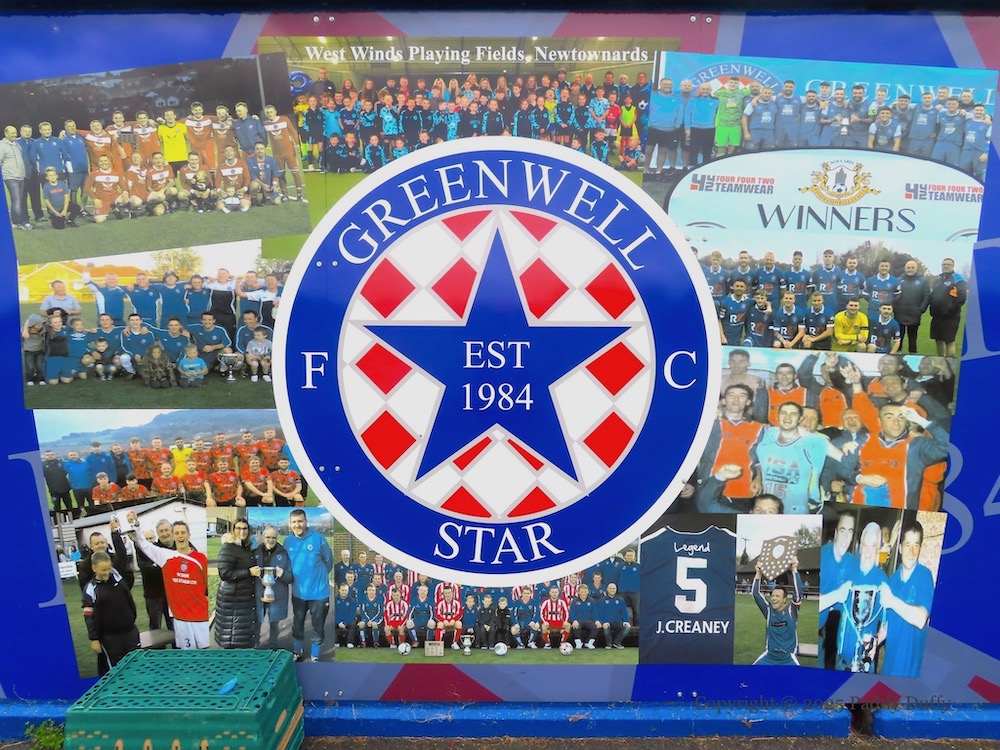
The streets of the West Winds estate in Newtownards are named after RAF aircraft: Lysander, Beaufort, Shackleton, Valetta, Sunderland, Catalina, Auster, Canberra, Lancaster, Dakota, Hampton, Stirling, Blenheim, Anson, and Halifax. (See 50 Years And Counting for a picture of the aircraft.)
The first units built in the estate, in 1970, were Canberra Gardens and Blenheim Drive, just off the Comber Road.
“English Electric Canberra – bomber, photo-reconnaissance, trainer, interdictor, radio countermeasures, drone & target tug … the world’s first jet bomber … first jet aircraft to make a nonstop transatlantic flight … world altitude record”
“Bristol Blenheim – light bomber, night bomber, aerial reconnaissance, heavy fighter, maritime patrol & trainer … the fastest light/medium bomber in the world”
Also celebrated is flautist James Galway, whose parents lived in the estate for a time, and Greenwell Star (Fb) – “Bridging communities through football”. Club members were involved in painting over the UVF mural on the side of the club’s changing-rooms in March (Fb), in preparation for the new board being mounted in April.
West Winds Development Association and Newtownards Cultural Society with support from the Housing Executive (Newtownards Chronicle)
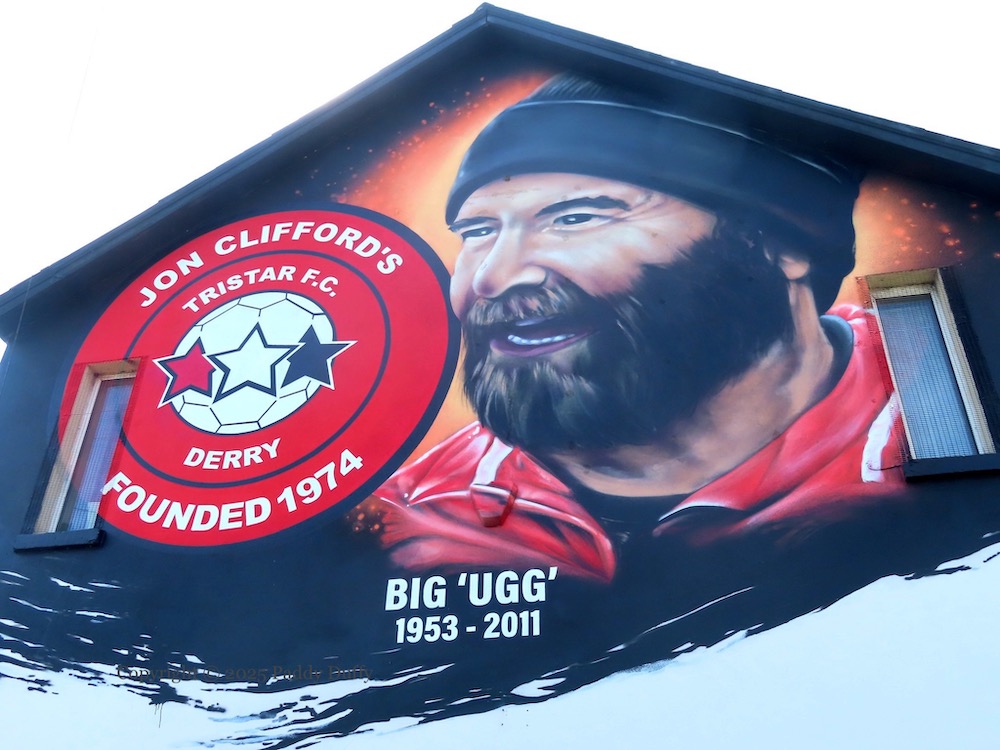
“Jon Clifford’s Tristar FC, Derry, founded 1974”. Jon “Ugg” Clifford died on September 3rd, 2011, while waiting for a lung transplant (BelTel). In 1974 he had founded a youth soccer club – initially for boys – called “Tristrar” (web) in Creggan. The park where they played – Bull Park – was renamed in his honour, a portrait on boards was mounted in 2013 (which has now been replaced by the larger painting shown here), and a memorial championship was begun in 2014 (Derry Daily).
Update: The mural was officially launched on October 9th, 2025 (BBC).
The emblem in the top left of this board is the original emblem of the Irish Football Association. The Association was formed in 1880 by seven Belfast clubs but after partition a rival Football Association Of Ireland was formed and the original body eventually represented only Northern Ireland. (WP)
All of the players named and pictured post-date 1950, when the IFA stopped selecting southern players for the IFA’s team. They are … Tommy Jackson, Billy Caskey, Phil Gray, Tom Finney, Norman Whiteside, Danny Griffin, George McCartney, Alf McMichael, Tommy Cassidy, Robbie Garrett, Brodie Spencer, Jordan Owens, Billy Ferguson, George O’Boyle.
“AONISC” (bottom left) is the Amalgamation Of Northern Ireland Supporters’ Clubs (web). There are about 60 clubs in the amalgamation, but seven local clubs are named here: Albert Foundry, Woodvale Loyal, Tavern GAWA, Bootle Street, Wheatfield, 1st Shankill, Ligoniel.
In Battenberg Street on the side of the Stadium Bar and off-sales.
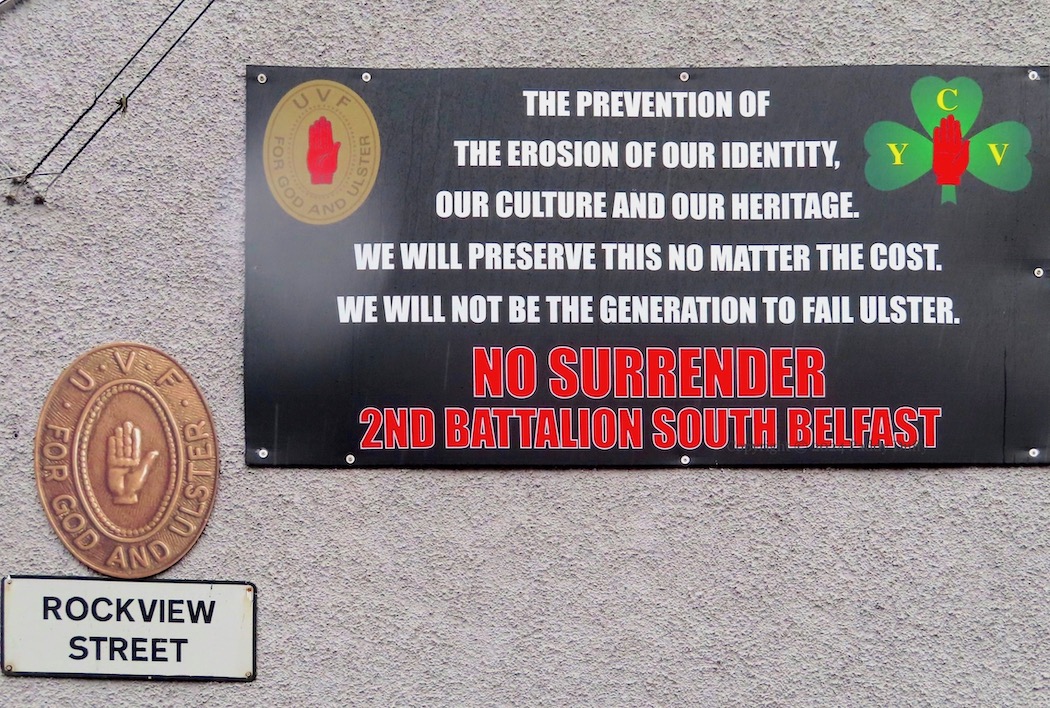
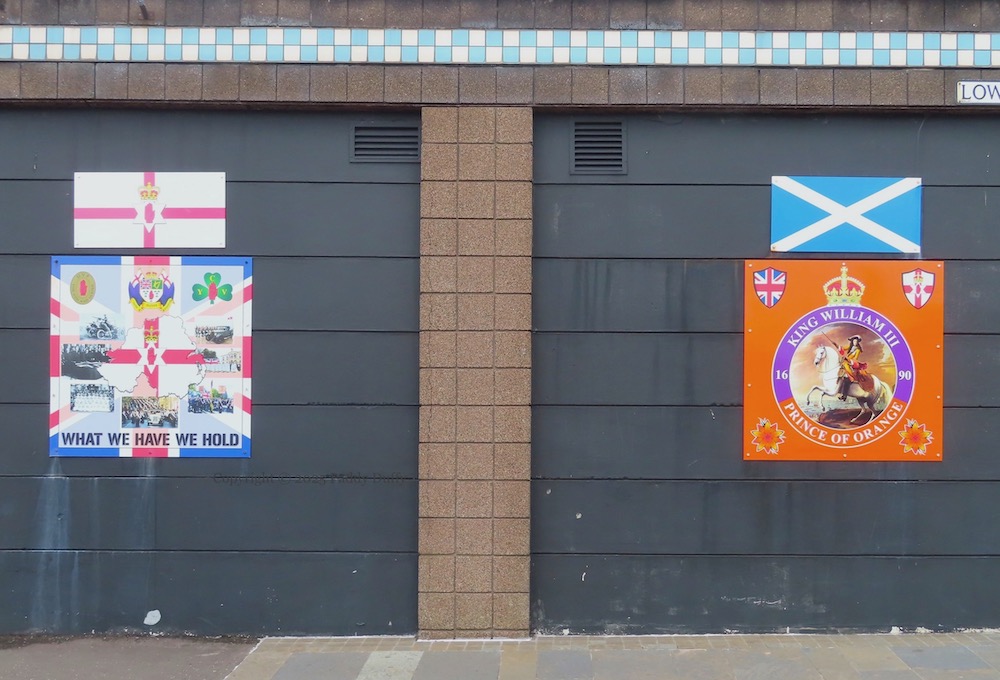
“Loyalist Village, south Belfast.” UVF markings in the Village continue to proliferate with the recently-added board shown above (from the top of Tavanagh Street) alongside a slew of other boards, some of which are included below.
The “Village team” is not Linfield FC but the UVF (the phrase was also used by the Village UDA); “VTOT” (standing for “Village team on tour”) has previously been used as graffiti – see Welcome To Hell!!!
The purple hoarding below gives “1913” as a creation-date for the battalion. The Ulster Unionist Council organised the signing of the Covenant in September, 1912, and in January 1913 voted to bring together the militias that had been formed in various places into an Ulster Volunteer Force. One of these was a South Belfast battalion that had formed in 1912 (History Ireland). Hence, both “1912” and “1913” are given as dates for the creation of the battalion. When the Volunteers were integrated into the Ulster Division for the Great War, the South Belfast Volunteers joined the 10th battalion of the Royal Irish Rifles.
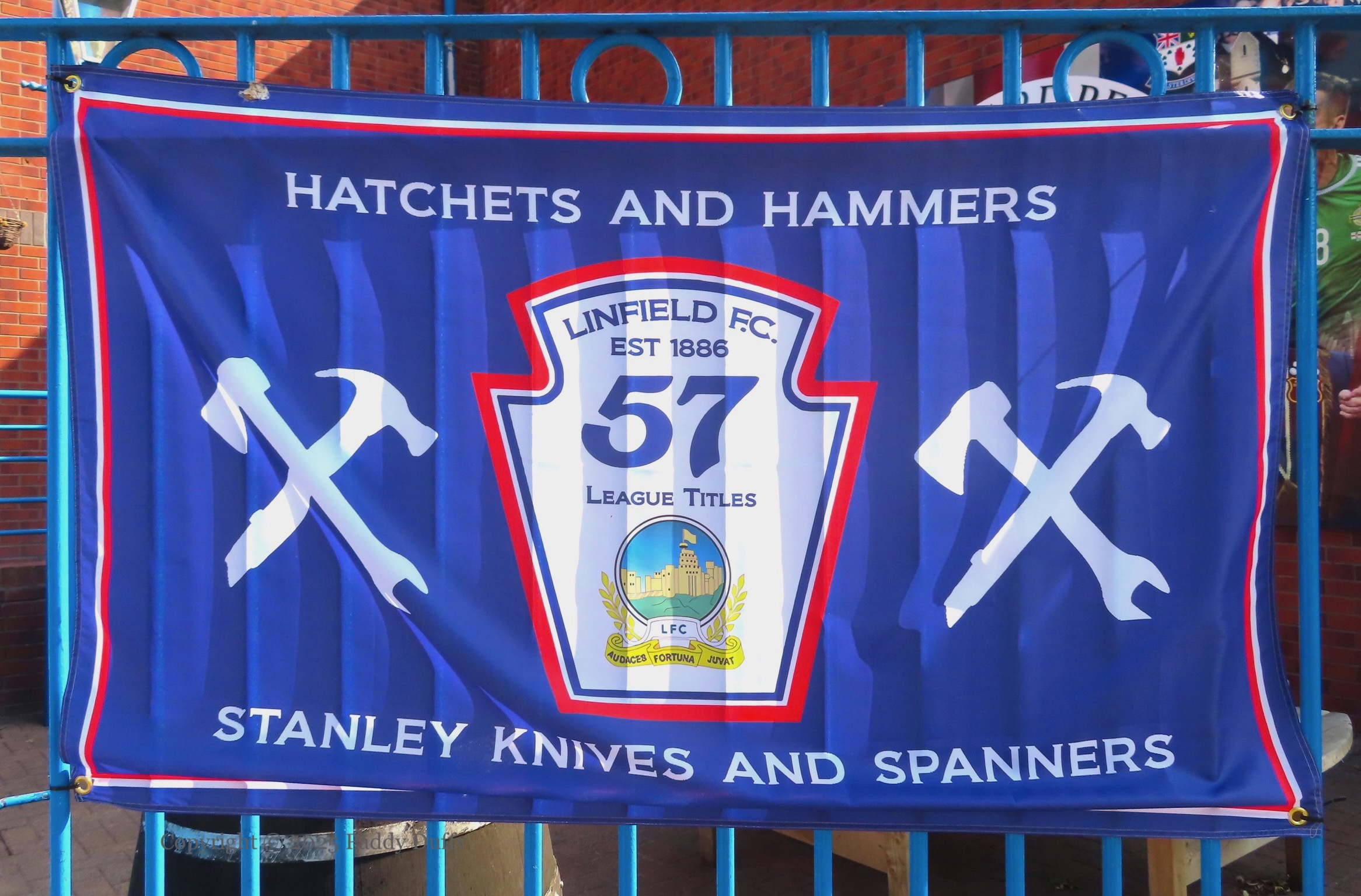
The lyric, “With hatchets and hammers, Stanley knives and spanners, [we’ll show the bastards how to fight]” comes from a Linfield FC song (youtube | lyrics only). The team won the 2024-2025 (Northern) Irish Premiership league title in April, coasting to an easy win before the split (the final five games against the other top six teams) and thus secured their 57th league title – hence the emblem in the shape of a Heinz (ketchup) label at the centre of the banner above.
Linfield have two matches remaining in the 2025-2026 campaign, against Coleraine and Cliftonville, but are currently in fourth place and out of the running to be champions.
On the railings outside the Rangers’ Supporters’ Club on the upper Shankill Road.
“The Main Man” is John (“Wee John”) McKillop, a life-long super-fan of the Ruaırí Óg teams who died at the end of July 2023 at the age of 60 (Saffron Gael | BelTel). This is a repainting of the mural on the side of the Lurig Inn (Fb) in Cushendall; for the previous version, including information about the scene depicted, see Bound Together from 2023.
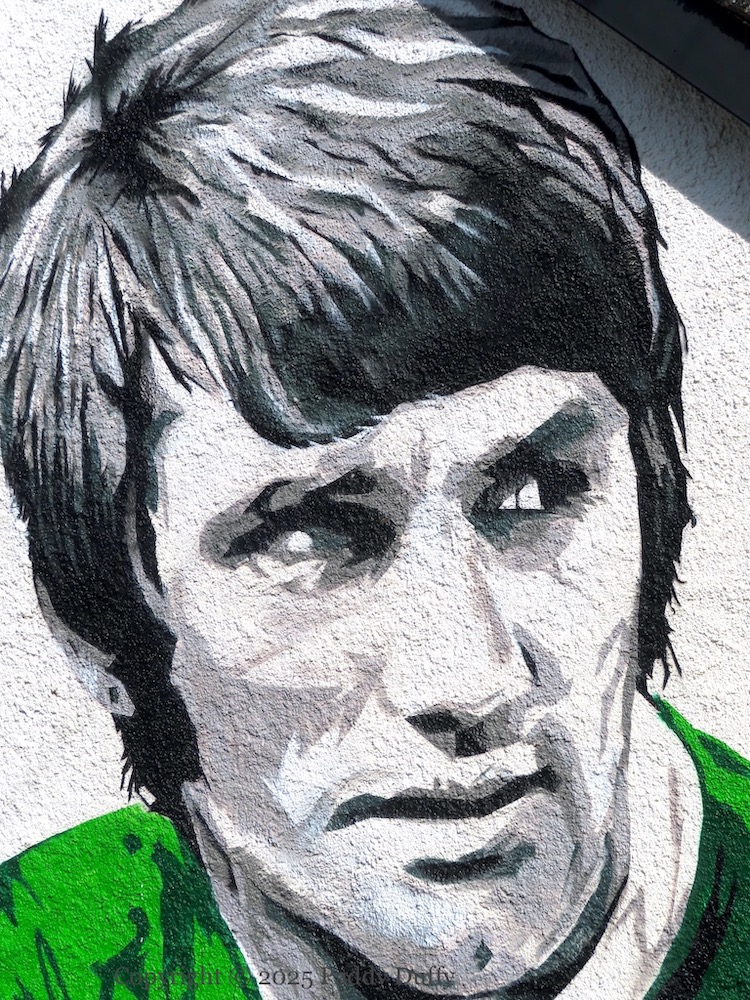
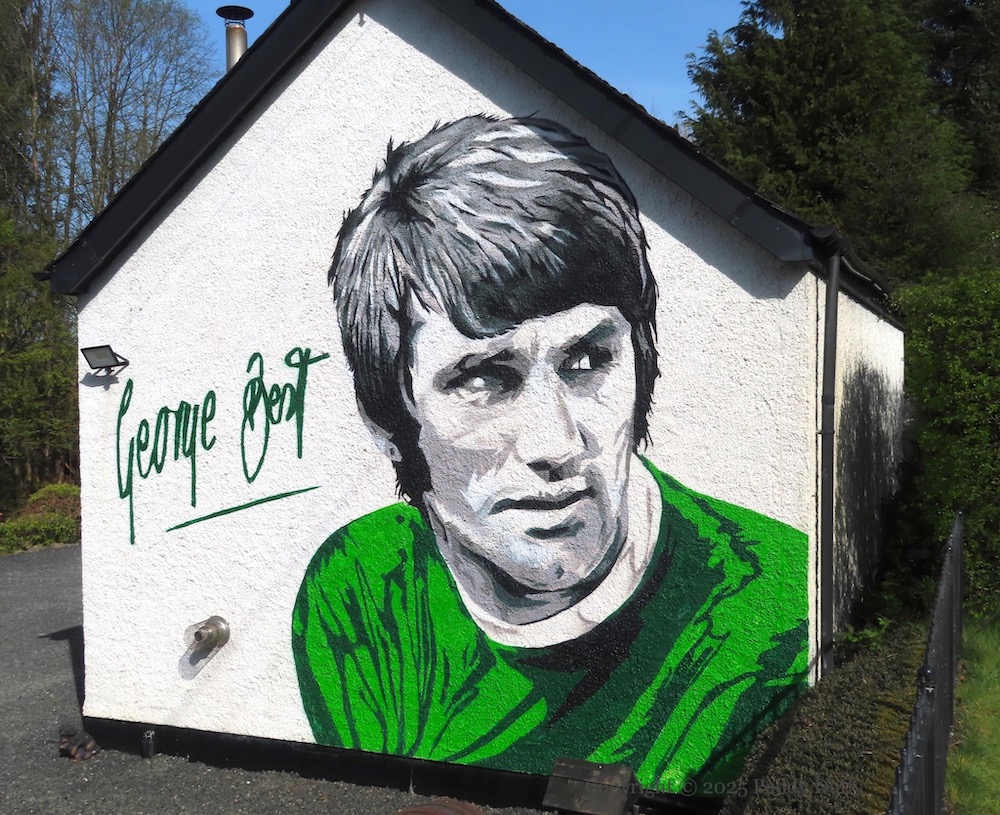
George Best began his international career at the age of 20, in 1964, playing six matches that year in the green shirt of Northern Ireland, and scoring goals against Switzerland and Scotland in November.
This mural depicts a very young Best, perhaps circa 1967; the source image is unknown – Best typically parted his hair from the left and exposed his teeth. The piece was painted by ACE Sprayworks (web), with support from Warren Anderson Tiling, at Anderson’s home near Cloughmills. (Sunday World)
Best was a familiar figure in the first wave of re-imaging (see Visual History 10).
Here are two boards in Riverside Park, Dervock, celebrating the town’s “heritage and culture”.
Above: “Kennedy Kane McArthur, Dervock born and bred. 1912 Stockholm Olympics marathon gold medal winner, new World Record.” Ken McArthur emigrated to South Africa at age 20 and ran his first marathon at 28. Four years later, he represented South Africa at the Olympics and was victorious in the marathon (WP). There is footage of the race at olympics.com. There is a display of boards honouring McArthur on an abandoned building in Dervock.
Below: “The journey of heritage and culture has shown us who we are, the memory of our past will let a new future begin.” Members of the (contemporary) Dervock flute band (Fb) stand on the Scottish St Andrew’s Saltire, above a black-and-white photograph (from NI Archive) of drumming – including Lambeg drumming (Discover Ulster Scots) – from about 1920.
Gort Na Móna CLG (Fb) has been “at the heart of the [Turf Lodge] community”, inculcating “muıntearas, mısneach, féınluach, bród [friendship, bravery, self-esteem, pride]” in its young people “ó/since 1974”.
The text and emblem appear here against a montage of photographs over-washed in the club colours of maroon, saffron, and blue.
[A small typographic note: different fonts are used for the Irish on the left and the Irish in the middle; the font in the middle (correctly) lacks tittles/dots on the letter “ı”.]
Springfield Road, at the upper entrance to the estate and across the road from the electrical boxes seen in Lóıste Na Móna.











 Paddy Duffy Collection