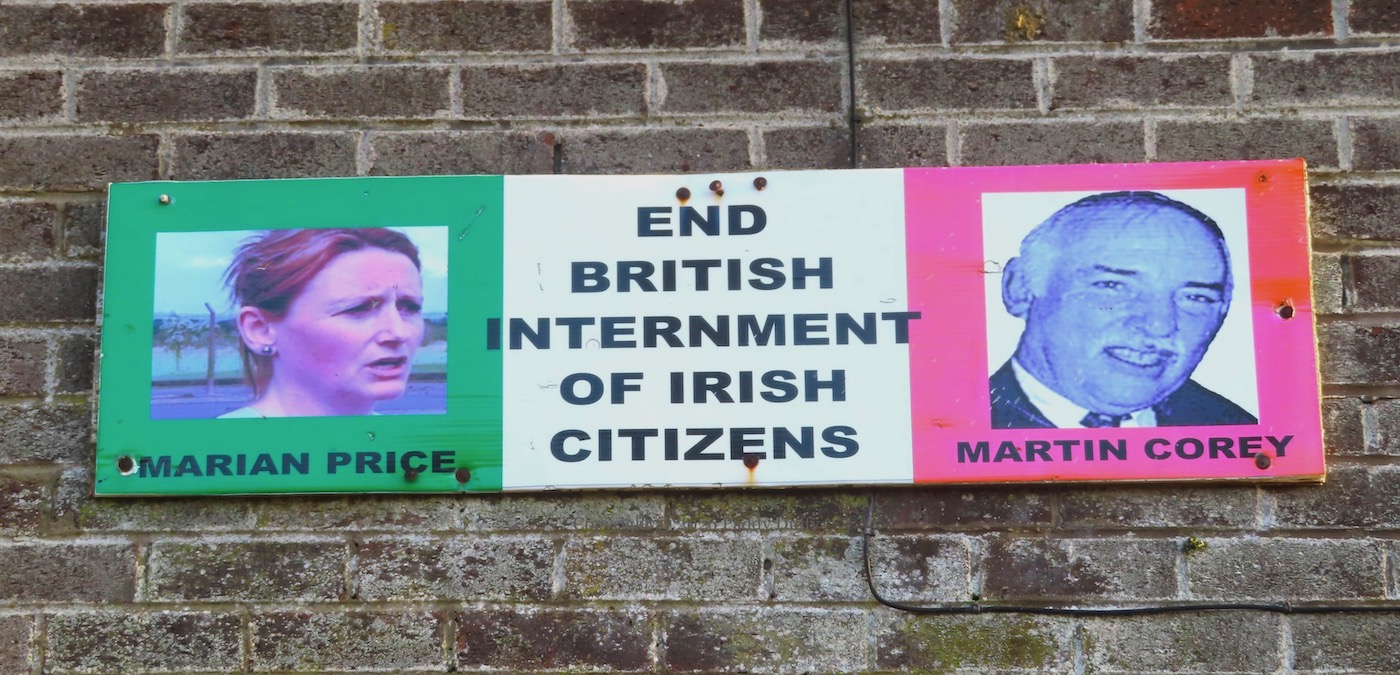
This board with portraits of Marian Price and Martin Corey goes back to 2013 (and perhaps earlier than that). It remains on display in the Obins Street area of Portadown, even though Price was released in 2013 and Corey in January 2014.
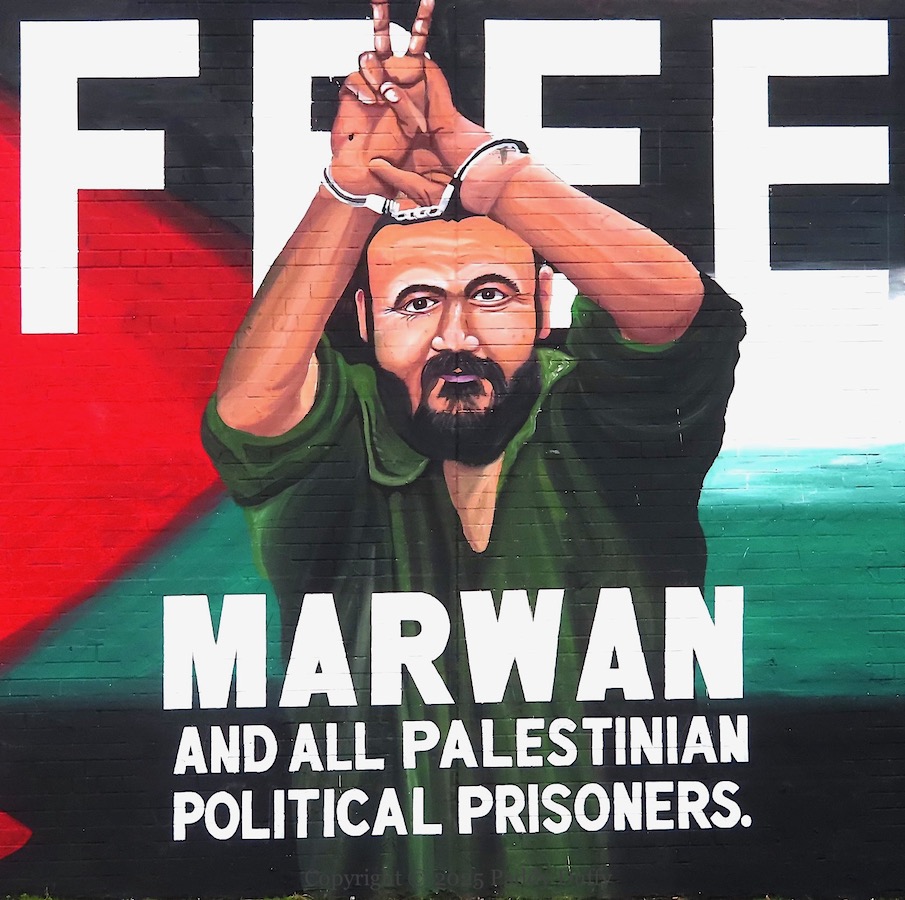
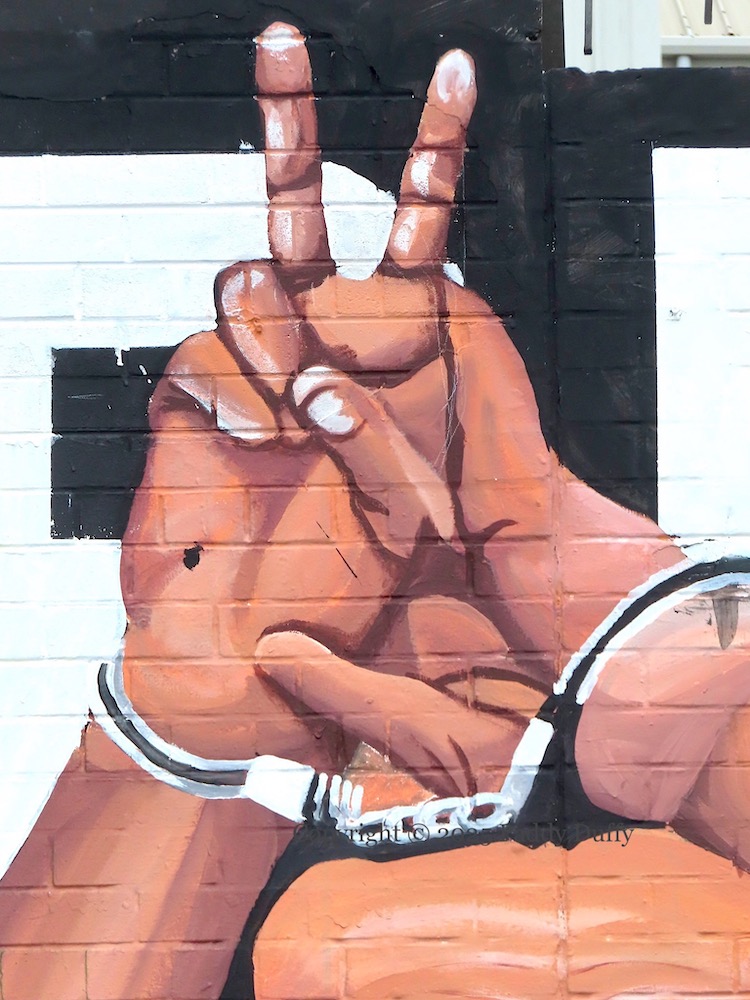
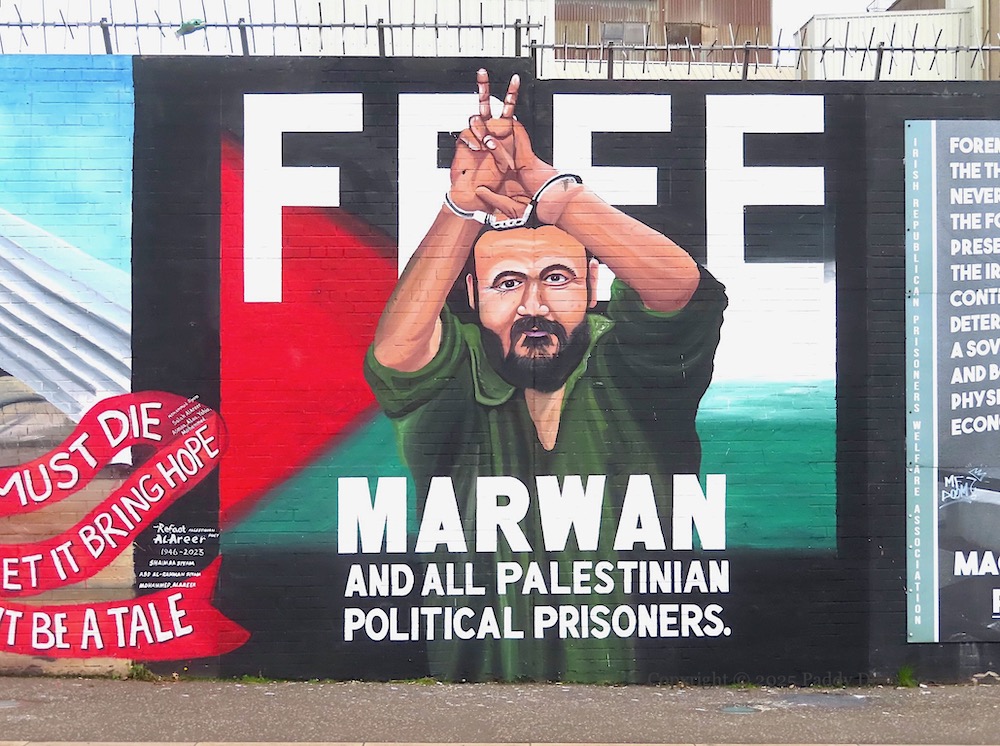
“Free Marwan and all Palestinian political prisoners”. Marwan Barghouti, a leader of the group Fatah, has been in Israeli prison since 2002. He was seen last month in a video showing Israeli’s national security minister taunting the 66-year-old Barghouti in his cell (BBC | Al Jazeera | NPR).
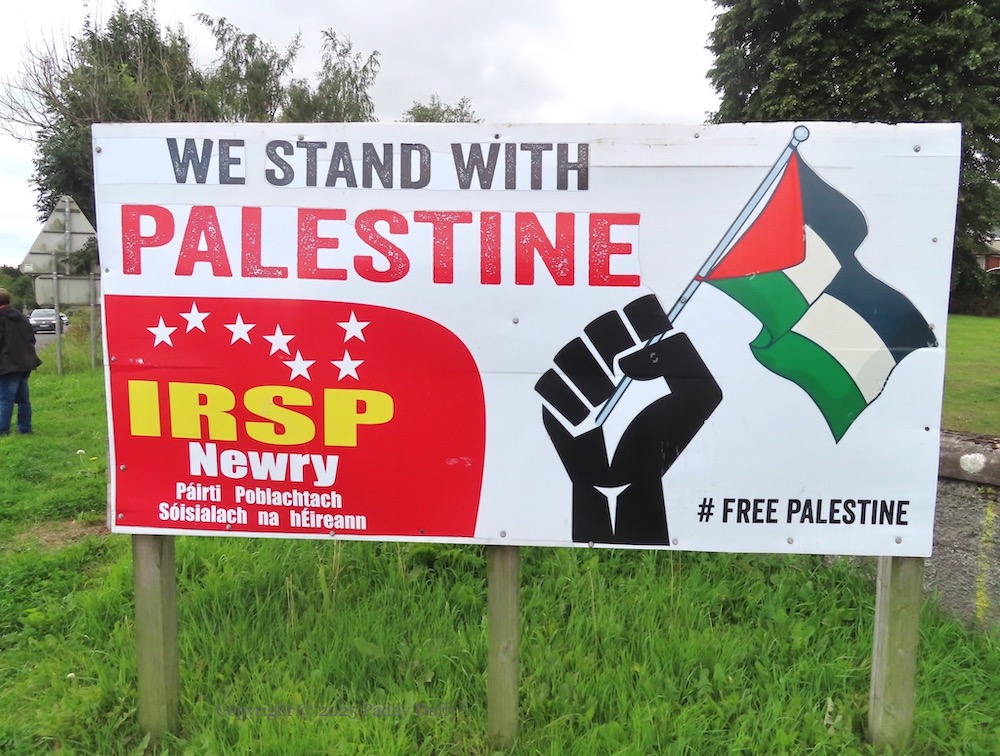
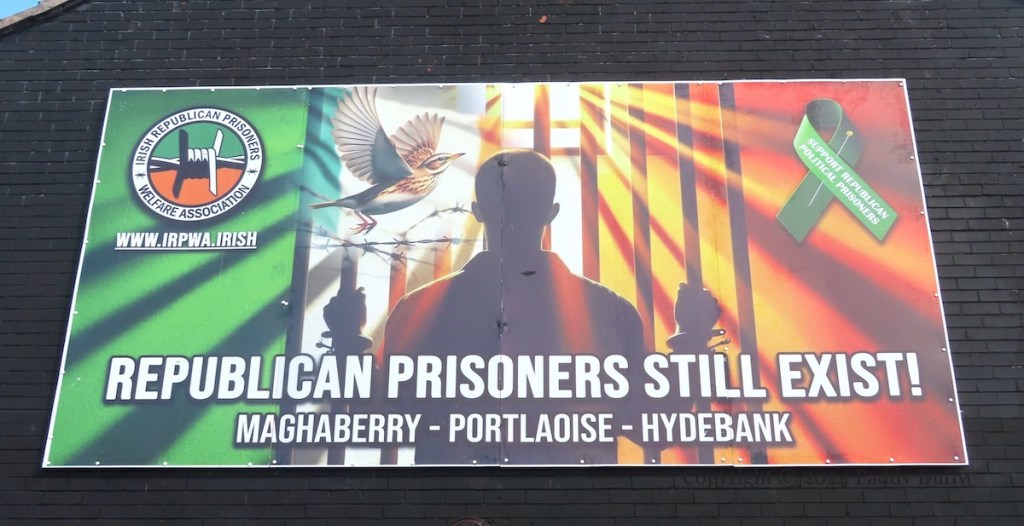
Here are two IRSP (web) boards and one IRPWA (web) board at Camlough Road on the edge of Derrybeg, Newry. Above, “Stop the genocide – Newry supports Palestine” (Teach Na Fáilte is the IRSP’s ex-prisoners division – Newry Fb); immediately below, “For a socialist republic – ‘He was the only one who truly understood what James Connolly meant when he spoke of his vision of the freedom of the Irish people’ – Nora O’Connolly O’Brien on Seamus Costello”; last below, “End internment – Portlaoise, Maghaberry, Hydebank”.
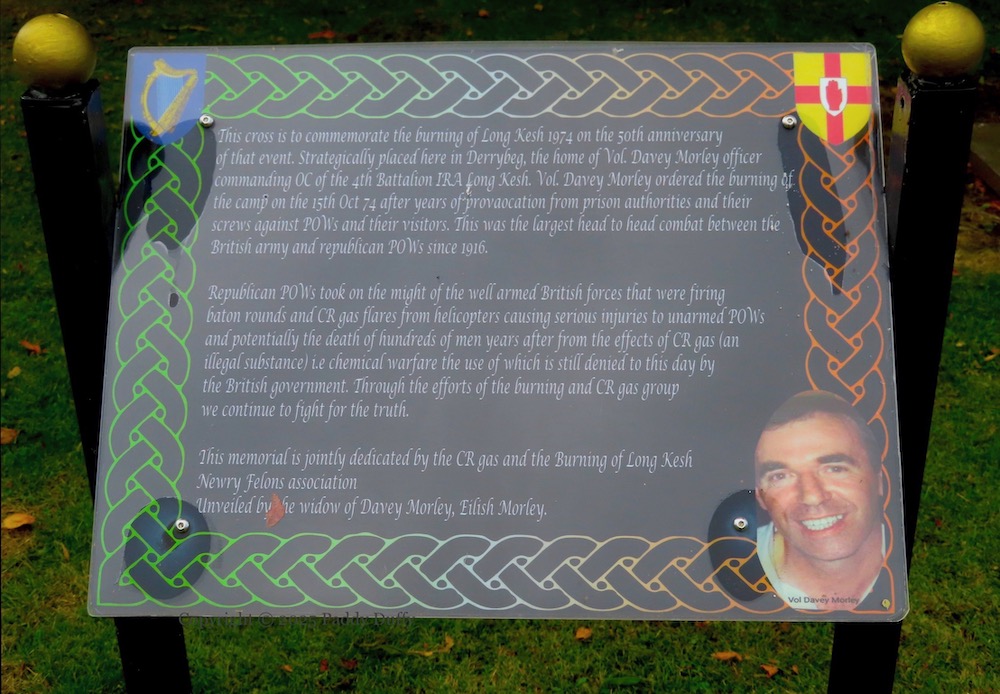
This is one of four Celtic crosses raised to commemorate the fiftieth anniversary of the Burning Of Long Kesh in 1974 and, in this specific instance, to pay tribute to local Derrybeg volunteer Davey Morley, camp OC of the Provisionals, who gave the order for the camp to be burned (Pensive Quill).
Morley died in 1987, at age 46, possibly suffering the aftereffects of CR gas (The Blanket | Only Our Rivers).
Images of the December 2024 launch can be seen on Newry.LN’s Fb page.
“There are special people in our lives who never leave us even after they are gone. In loving memory of all the men that have passed away since the burning of Long Kesh 15th & 16th October 1974. Rest in peace. Also remembering the blanket men and women, all republicans who have lost their lives in our fight for freedom. Rest in peace.”
“This cross is to commemorate the burning of Long Kesh 1974 on the 50th anniversary of that event. Strategically placed here in Derrybeg, the home of Vol. Davey Morley officer commanding (OC) of the 4th battalion IRA Long Kesh. Vol. Davey Morley ordered the burning of the camp on the 15th Oct 74 after years of provaocation [sic] from prison authorities and their screws against POWs and their visitors. This was the largest head-to-head combat between the British Army and republican POWs since 1916. Republican POWs took on the might of the well-armed British forces that were firing baton rounds and CR gas flares from helicopters causing serious injuries to unarmed POWs and potentially the death of hundreds of men years after from the effects of CR gas (an illegal substance) i.e. chemical warfare the use of which is still denied to this day by the British government. Through the efforts of the burning and CR gas group we continue to fight for the truth. This memorial is jointly dedicated by the CR gas and the Burning of Long Kesh Newry Felons association. Unveiled by the widow of Davey Morley, Eilish Morley.”
A poem on the back of the cross reads:
“Oh mother of mine, I committed no crime So please do not weep when they bury me deep Because here in this ground with my comrades I sleep The spirit of freedom they can never defeat.
No defeat in the battle, no defeat in the war No defeat as in death, just our hearts you have tore
Continuing tears our people do shed For this country of ours and its patriot dead But one day we will be free, my comrades and me
So dear mother don’t weep, I am only asleep Put a kiss on my head and a flower at my feet And remember together we can never be beat!”
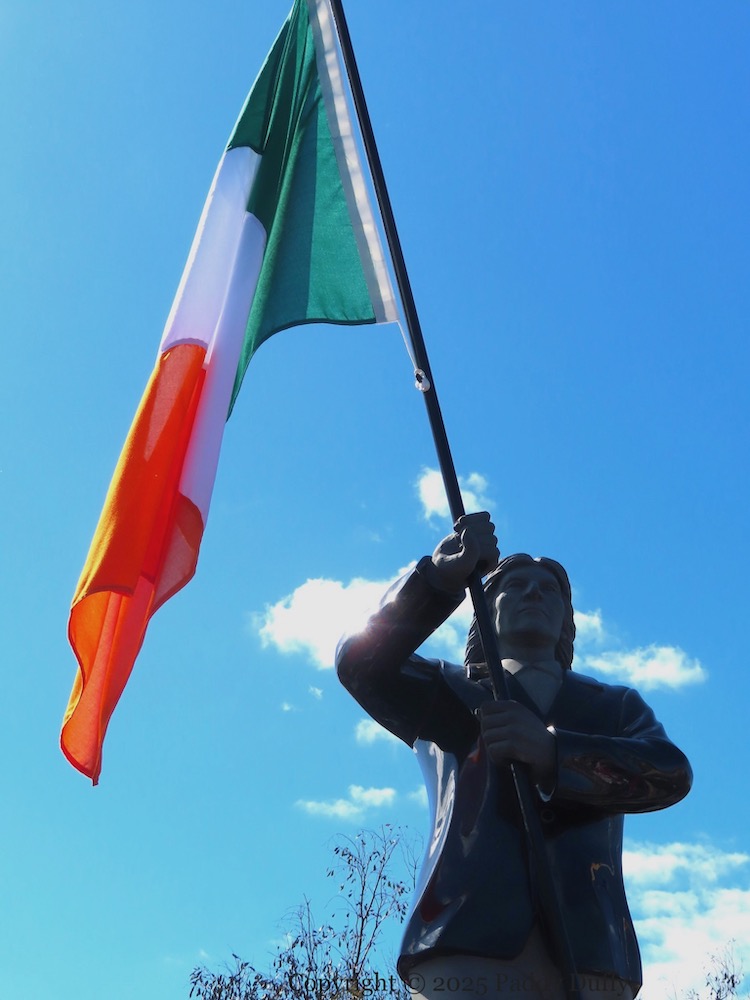
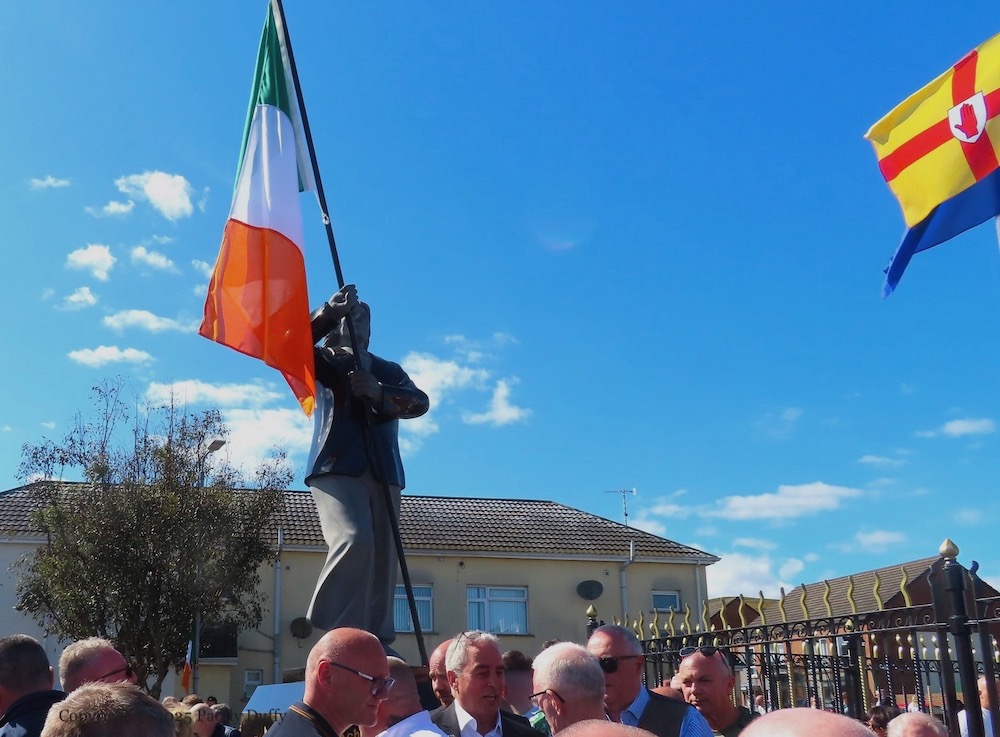
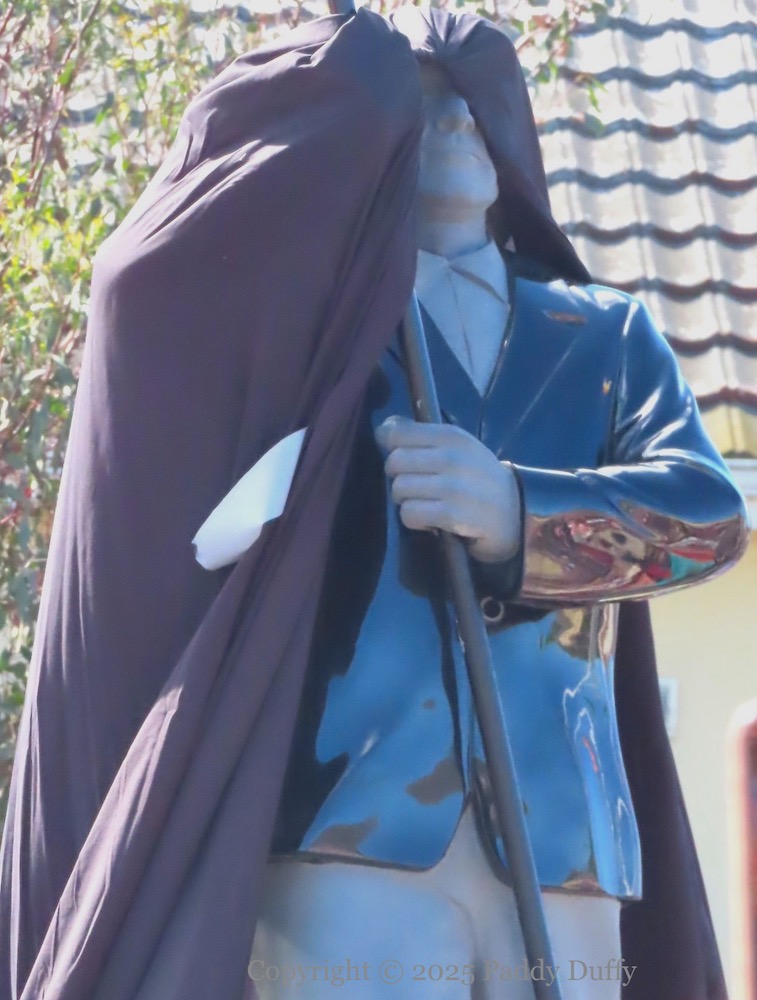
“Óglach Bobby Sands 9th March 1954 – 5th May 1981”. Sands was the first of the ten IRA and INLA prisoners to die in the second hunger strike. For the 44th anniversary of his death, a statue was unveiled in Twinbrook, near the Sands family home and next to the memorial garden in Gardenmore Road (Peter Moloney Collection).
The statue was created by Packy Adams (Belfast Media | Irish News) and appears to be based on the photographs by Gérard Harlay – discovered in 2019 – of Sands carrying a United Irishmen flag in a march that took place a few months before his (final) arrest in 1976 (Bobby Sands Trust). The new statue (which does not have planning permission) has a built-in flag-pole, to which an Irish Tricolour was added for the launch on May 4th.
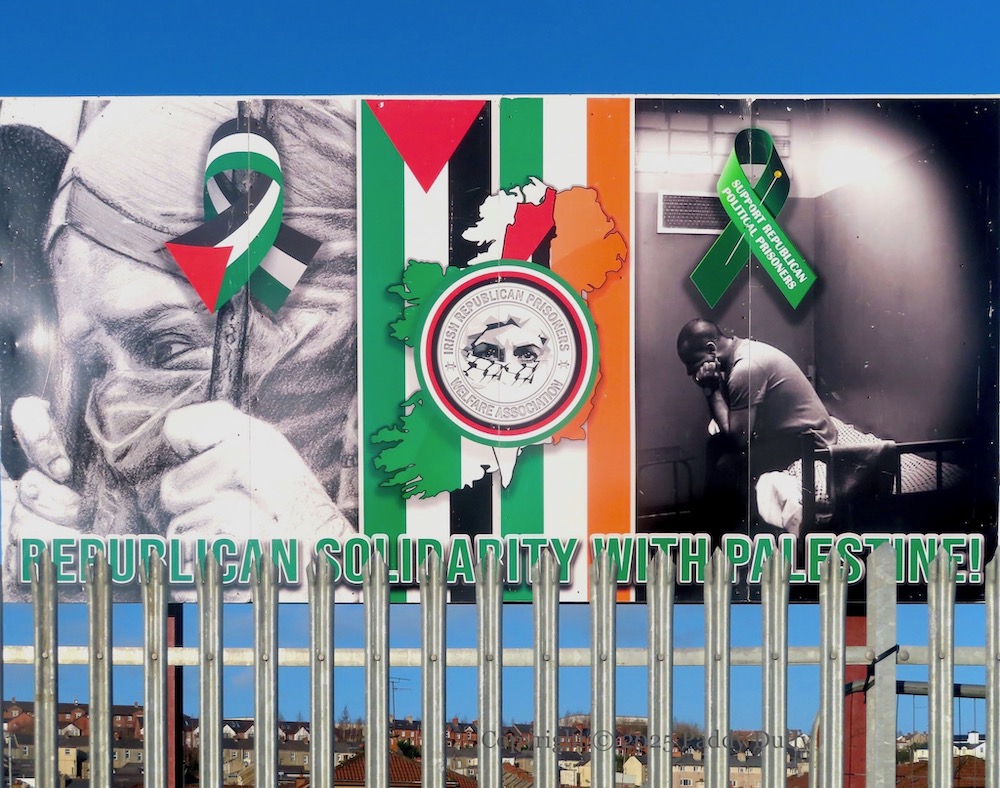
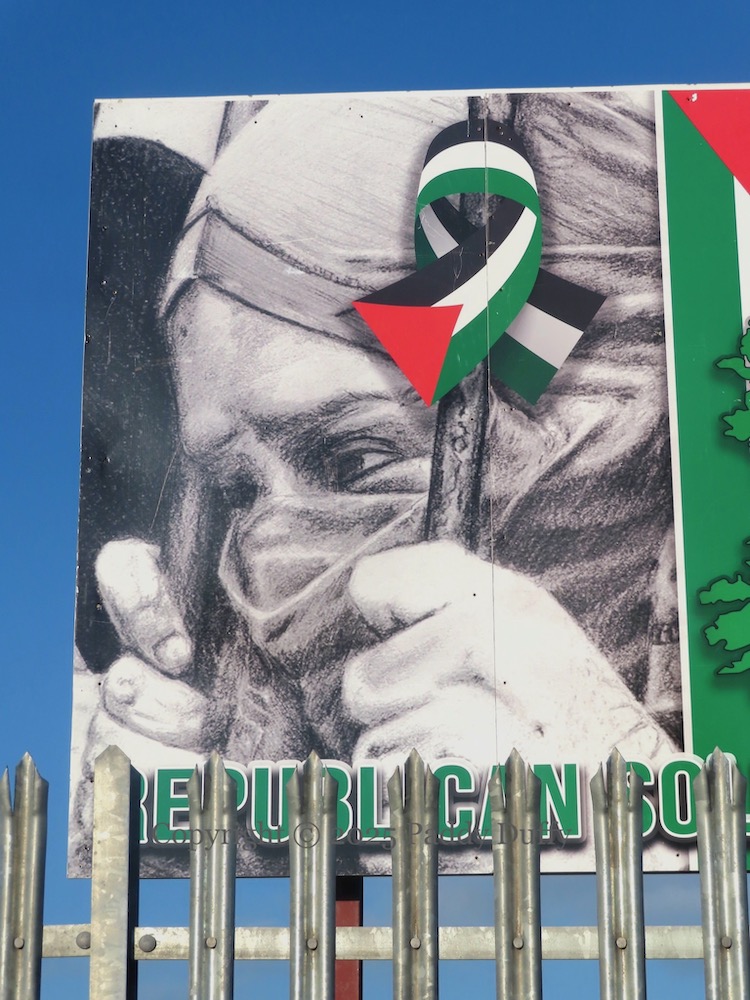
Since the October 7th attack by Hamas and the subsequent Israeli invasion of Gaza, the number of Palestinian prisoners held by Israel has gone up from about 5,000 to about 9,000, including about 3,500 prisoners held under what is called “administrative detention” or what would be known here as “internment without trial”. (Figures for the last fifteen years are available at HaMoked and at B’Tselem.) Prisoners recently released from Israeli detention have described the beatings and degrading treatment they received (Amnesty | Reuters | Haaretz).
During the peace process of the mid-1990s, a green ribbon was used as a symbol of republican political prisoners, whose release was one of the major goals in a peace settlement – see this large example from Shantallow, Derry, from 1998. It is still used post-Agreement by physical-force republicans, e.g. End Brit Brutality and Maghaberry Concentration Camp.
The board is on the Meenan Square construction site in the Bogside, Derry. For the INLA board in the background of the wide shot, see Serious Trouble.
“There are special people in our lives who never leave us even after they are gone. In loving memory of all the men that have passed away since the burning of Long Kesh 15th & 16th October 1974. Rest in peace. Also remembering the blanket men and women, all republicans who have lost their lives in our fight for freedom. Rest in peace. Ní fhéadfaıdís sınn a bhrıseadh [They cannot (lit. would not be able to) break us].”
This Celtic cross memorial was erected to commemorate the fiftieth anniversary of the burning of Long Kesh. According to Derry Now (which has photos of the launch) the cross is one of four to be be raised in various areas. For the one in Newry, see Davey Morley.
This is a new UDA board in Monkstown, Newtownabbey. At the top we see the emblems of “Loyalist Prisoners’ Aid” and “Ulster Defence Union” alongside the familiar UYM and UFF emblems. For the UDU, see the entry on one its earliest appearances, in a 2009 mural in the lower Shankill. Loyalist Prisoners’ Aid is a fundraising album of UDA songs (now freely available at SoNIC). (Also seen: an LPA flag flying in Newtownards in 2018.)
The photograph at the bottom (close-up below) shows the UDA marching in 1972 in North Street, Belfast city centre. (Of the buildings on the left, only the brick building housing “Castle jewellers” remains standing – Street View.) The original photograph can be seen at Alamy.
“This memorial is dedicated to the memory of the officers and members of our organisation who were murdered by the enemies of Ulster and to those who paid the supreme sacrifice whilst on active service during the present conflict. Quis separabit.” Four of the 1st battalion dead are named in the mural across Devenish Drive – see Monkstown UDA.
Ards Park, Monkstown, Newtownabbey. For the previous mural in this spot, see Murals Irlande Du Nord.
“Solidarity”, “تكافل” (in Arabic) between (Irish) republican prisoners and Palestinians in Israeli jails. Al Jazeera reports that roughly, 9,500 Palestinians from Gaza and the West Bank are currently being held, and about 3,600 without charge, under “administrative detention”. Springfield Park, west Belfast.
Below: “Support republican political prisoners” in “Maghaberry – Portlaoise – Hydebank”. IRPWA (web) board in Ardoyne Avenue, north Belfast. See also: the same message on Divis Street, west Belfast.










 Paddy Duffy Collection