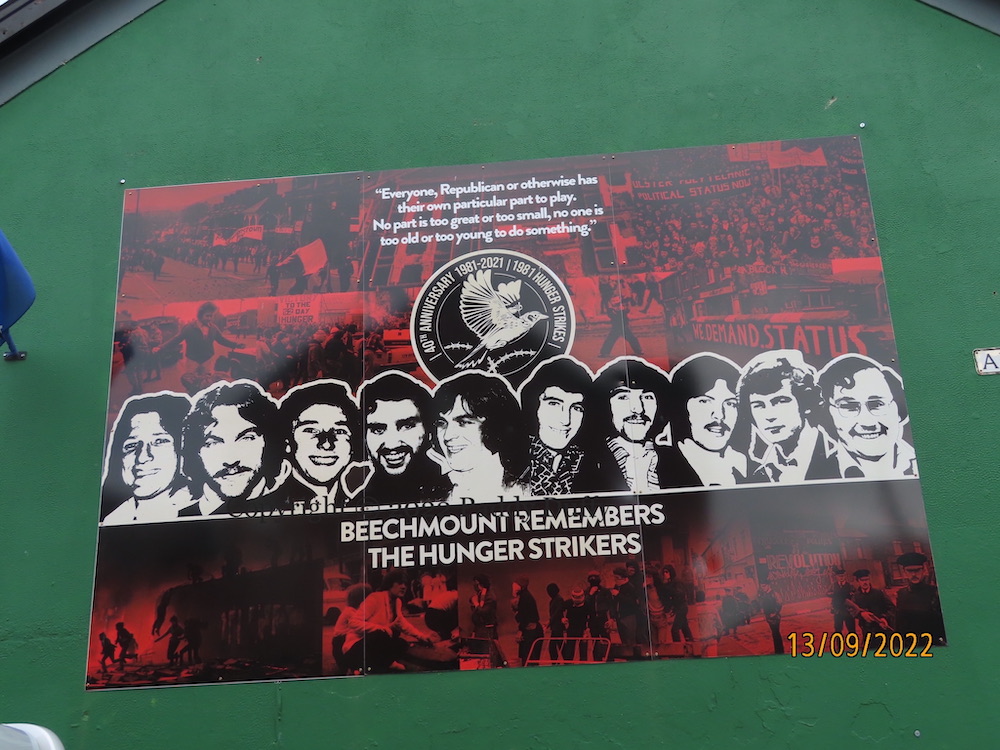
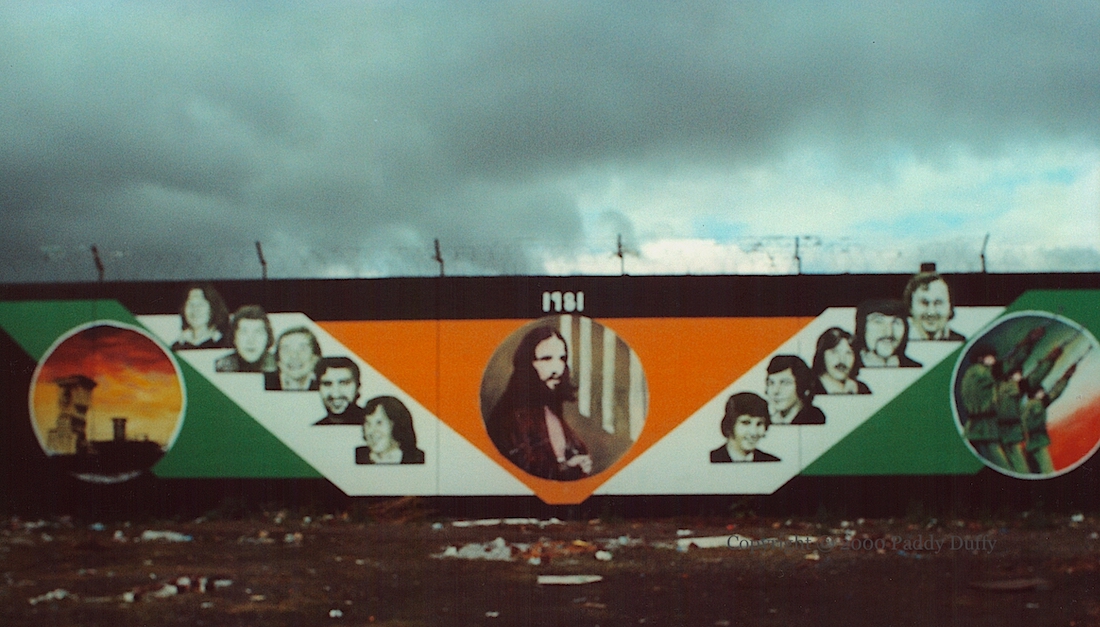
This board was mounted in AMCOMRI Street for the fortieth anniversary of the 1981 hunger strike, with photographs from the area in the background, including the Revolution mural at the bottom of Beechmount Avenue in 1996-1997.
“Everyone, Republican or otherwise, has their own particular part to play. No part is too great or too small, no one is too old or too young to do something.”
IRA prisoner Kieran Nugent is reputed to have said – upon being imprisoned after the removal of Special Category status in 1976 – “I’m not a criminal – the Brits will have to nail prison clothes to my back.”
The RUC barracks at the junction of the Falls Road and Glen Road was demolished in 2005. Since then, it has become a small park and since 2008 the back wall has been full of republican messages and imagery. The metal-work commemorating the hunger strikers pre-dates the painted and printed works, dating back to 2006.
(There is a complete Visual History at Extramural Activity.)
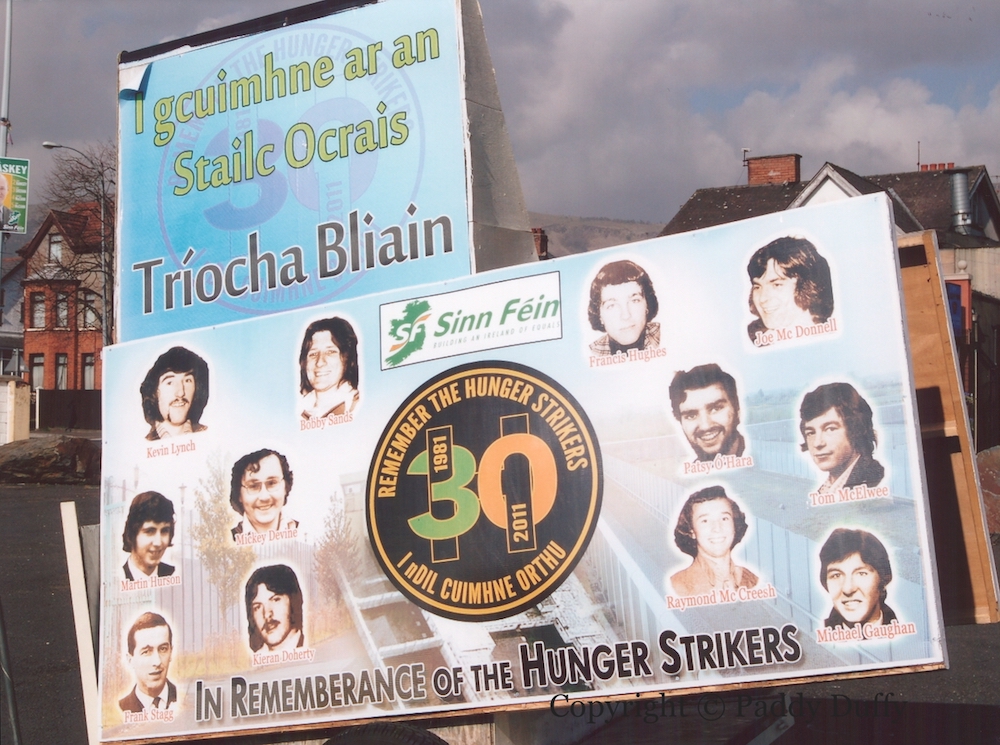
Also included (last) is a mobile board, parked on the Glen Road side, commemorating the thirtieth anniversary of the second hunger strike (“Stailc Ocrais Tríocha Bliain”), in which ten IRA and INLA prisoners died.
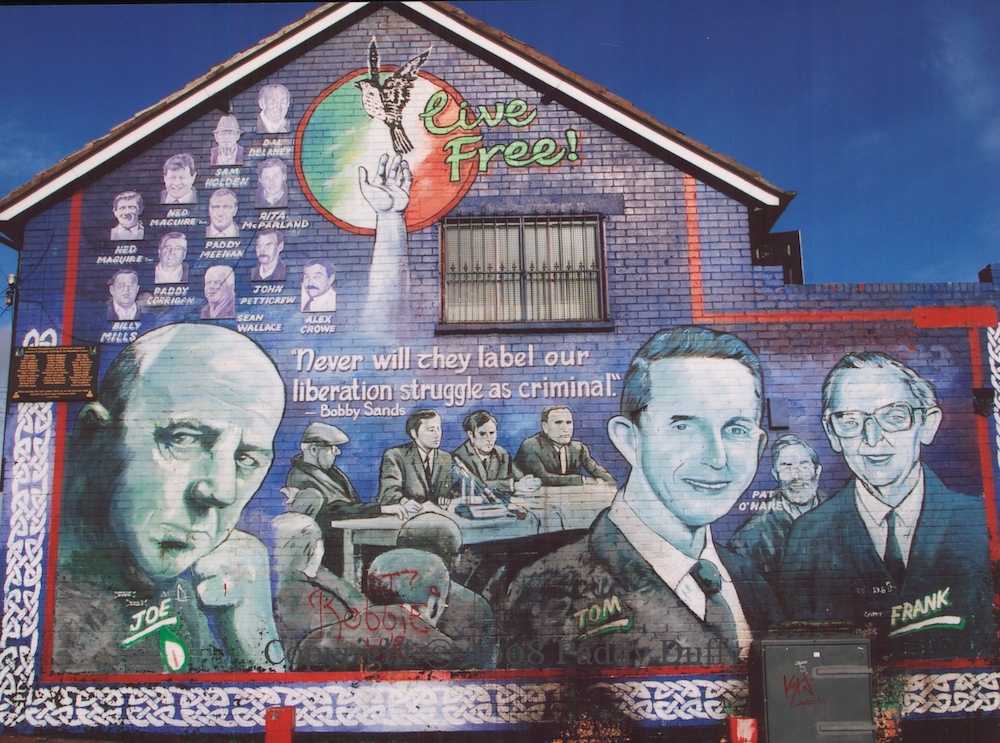
“Never will they label our struggle as criminal – Bobby Sands.” [March 6th Diary]
Joe Cahill joined Na Fıanna in 1937 and was involved in the republican movement from then until his death in 2004, including being in Tom Williams’s company in 1942 and later a founder member and Chief of Staff of the Provisional IRA. In the centre of the image he is at the end of the table at the August 13, 1971, press conference to comment on the introduction of internment (CAIN). He is honoured in the mural above alongside his brothers Tom and Frank Cahill. (Pat O’Hare is painted between Tom and Frank.)
In the top left are small boards with portraits of Ned Maguire Snr, Ned Maguire Jnr, Sam Holden, Dal Delaney, Rita McParland, Paddy Meenan, Paddy Corrigan, Sean Wallace, John Petticrew, Alex Crowe.
The hunger strikers memorial in Rossville Street, Derry, was launched in 2000. Compared to the entries from 2001 and 2004, this version has a new centre-piece – the metal lark has been replaced by a combination lark and hand cast in stone.
The central “H” carries the names of the ten deceased 1981 strikers, while the stones to either side carry the names of other republicans to have died on hunger strike: Thomas Ashe 1917, Michael Fitzgerald 1920, Joseph Murphy 1920, Terence McSwiney 1920, Joseph Whitty 1923, Denis Barry 1923, Andrew Sullivan 1923, Tony D’Aroy 1940, Jack McNeela 1940, Sean McCaughey 1946, Michael Gaughan 1974, Frank Stagg 1976.
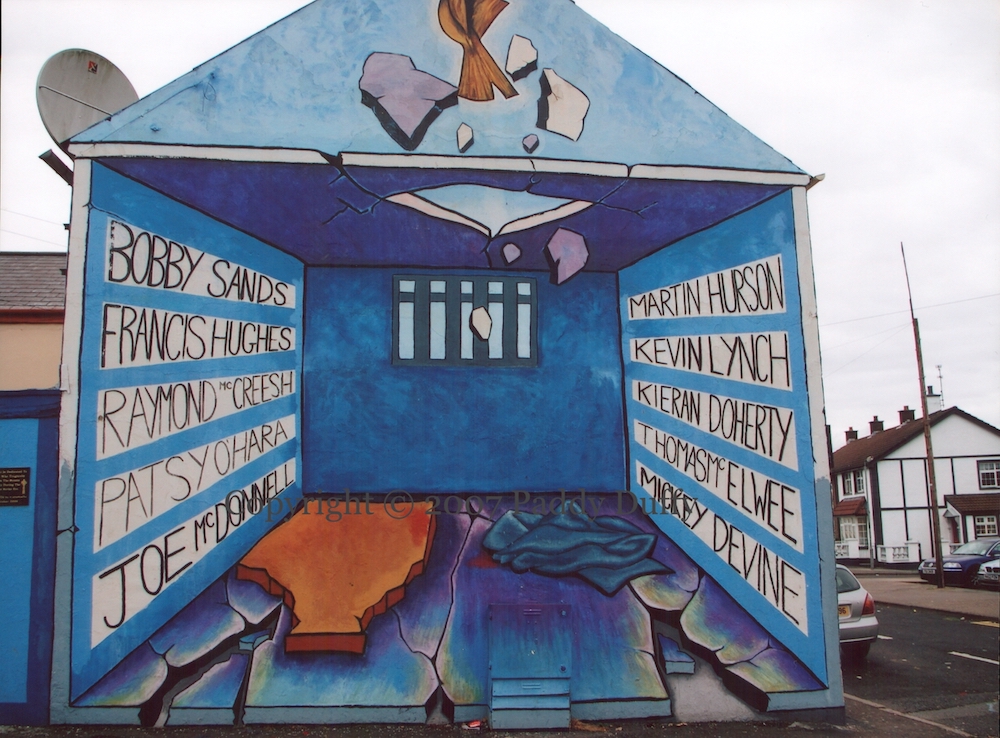
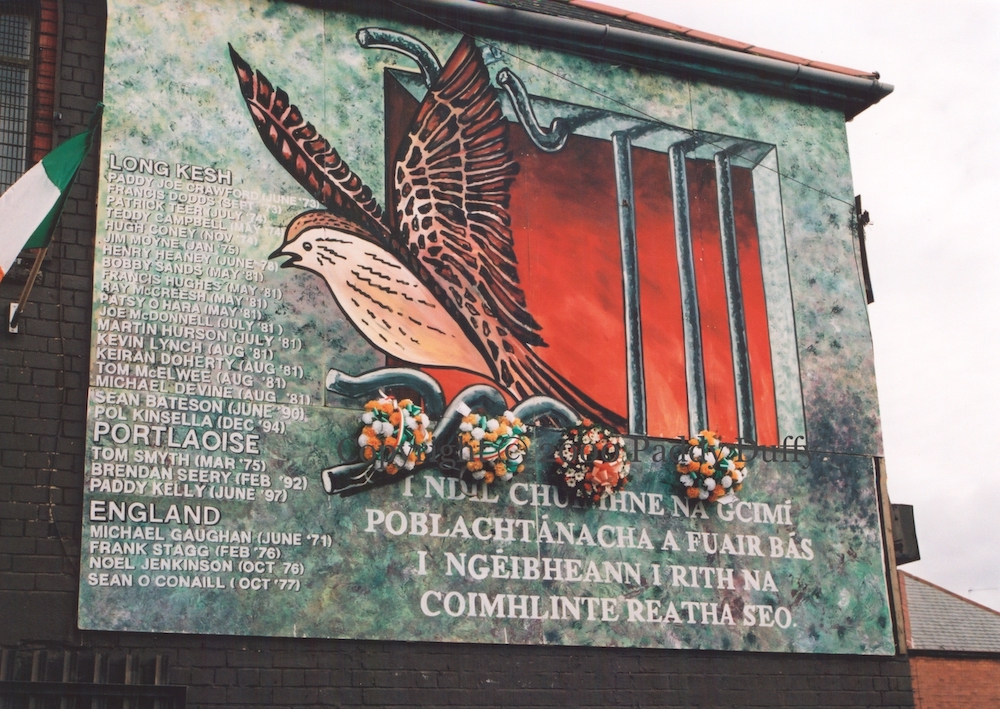
A lark (rather than a dove) bursts through the ceiling of a H-Block cell lined with the names of the ten deceased 1981 hunger strikers. “This mural is dedicated to all those who tragically died on the streets of Derry during the hunger strike era. Suımhneas Dé dá nanamacha. 3rd October 2006.”
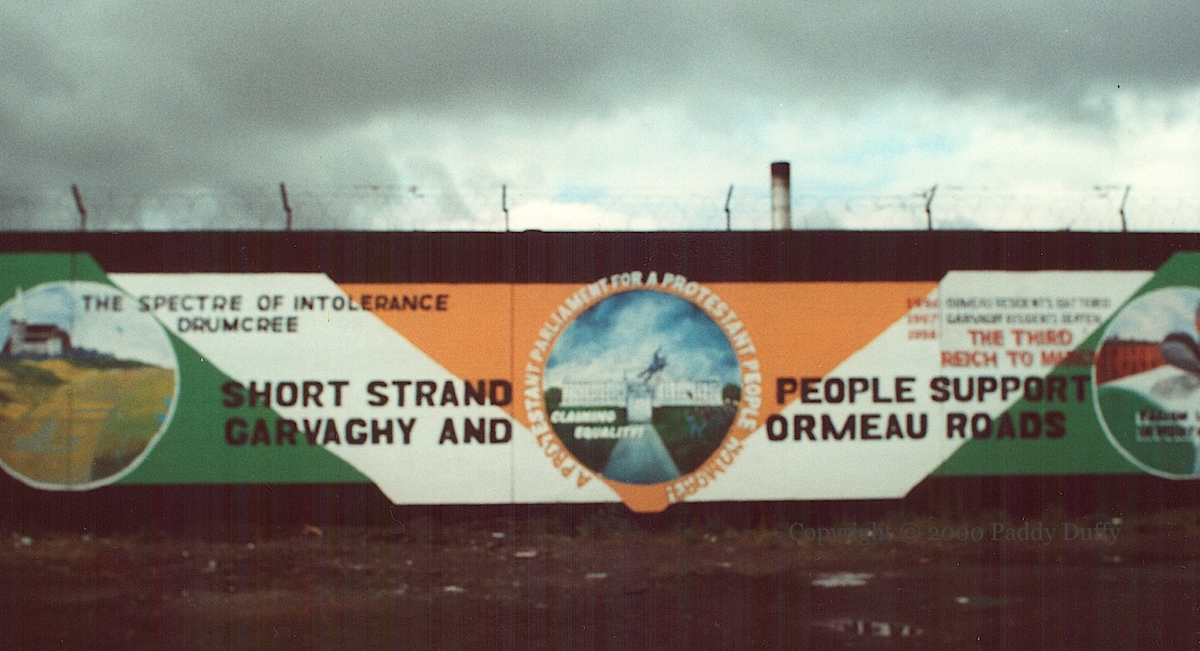
Northern Ireland’s first Prime Minister, James Craig, said in 1934, that Stormont was “carrying on a Protestant Government for a Protestant People” (NI Parliamentary Debates), though the phrase has now been transformed into the doubly alliterative “A Protestant parliament for a Protestant people”. In the centre of a long mural at the waste-ground at the top of Mountpottinger Road, people carrying Irish Tricolours tear down the statue to Northern Ireland’s most prominent leader, Sir Edward Carson, that stands outside Stormont, “claiming equality”.
The main issue that has tested the resolve of governments both local and national to the equality declared in the 1998 Belfast (Good Friday) Agreement is Orange Order parading through nationalist areas, such as the Garvaghy Road below Drumcree church in Portadown, and the Ormeau Road in south Belfast.
“Short Strand people support Garvaghy and Ormeau Roads.” On the left: The spectre of intolerance – Drumcree.” Centre: “A Protestant parliament for a Protestant people no more!” On the right “1996: Ormeau residents battered; 1997: Garvaghy residents beaten; 1998: The third reich to march.” and “Fascism lives! in Portadown”.
The piece is next to a hunger-strikers commemoration piece with ten portraits on shaped wooden boards against a painted background with blanket-man Hugh Rooney in the center. Between the two is a “spirit of freedom” lark and the names of the ten deceased 1981 strikers.
“I ndıl chuımhne na gcımí poblachtanacha a fuaır bas ı ngéıbheann ı rıth na coımhlınte reatha seo.” A lark bursts through prison bars of Long Kesh, Portlaoise, and prisons in England, in which republicans have died from the 70s to 90s.
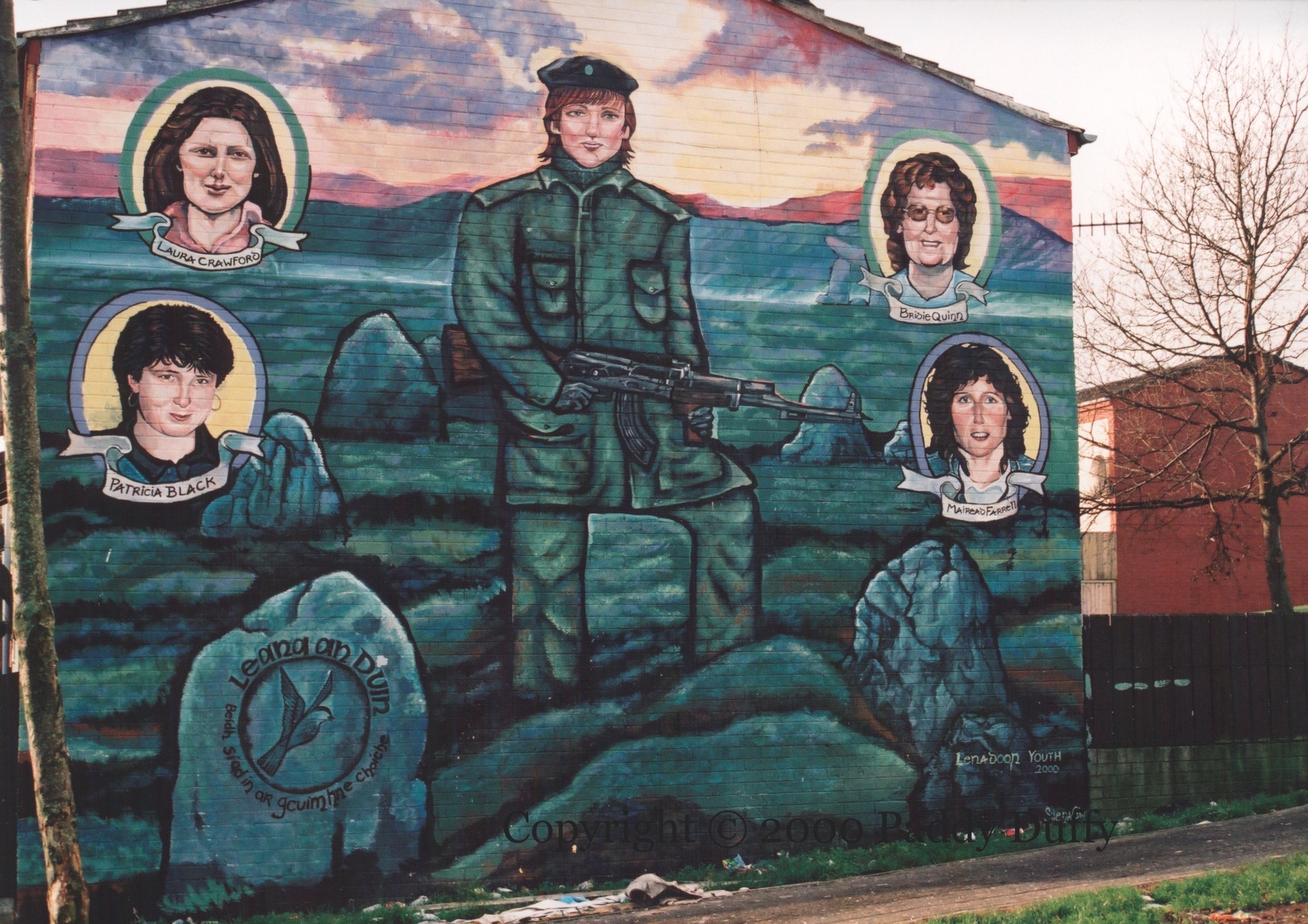
“Leanna An Dúın – Beıdh sıad ın ár gcuımhne choíche.” Local female IRA volunteers Laura Crawford, Patricia Black, Bridie Quinn, Maıréad Farrell and a generic female volunteer with assault rifle on manoeuvres in an Irish landscape strewn with standing stones.
Signed by “Lenadoon Youth 2000”. Glenveagh Drive, Lenadoon, Belfast
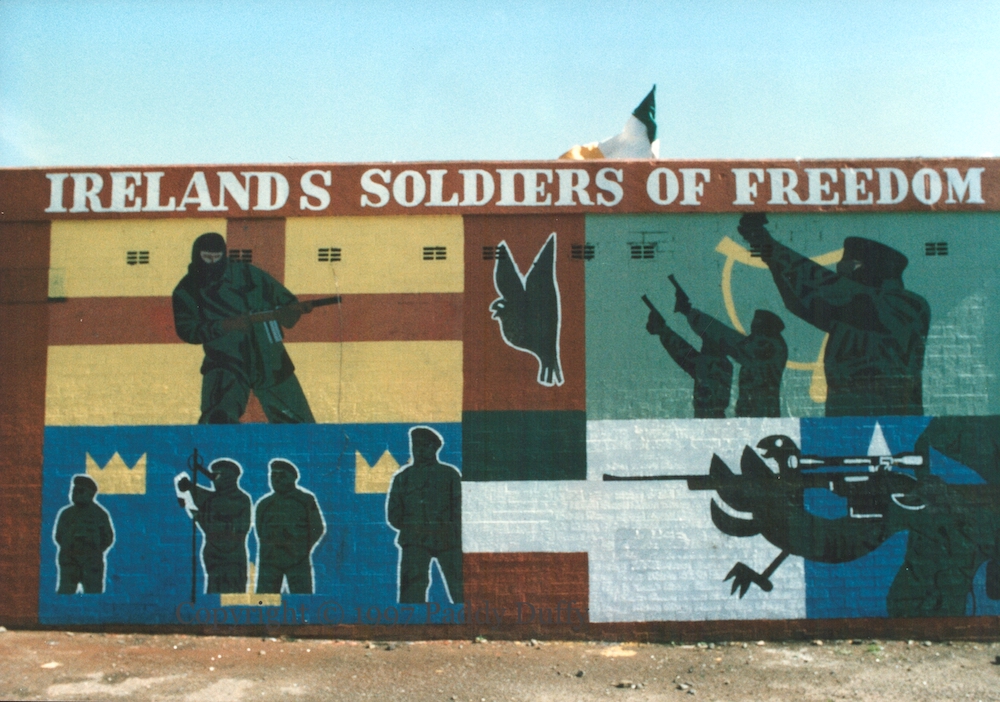
IRA volunteers are superimposed upon the flags of the four provinces. In the top left (Ulster) and bottom right (Connacht) they are aiming weapons (one with a sniper’s scope), while in the top right (Leinster) they are firing a funeral volley, and in the bottom left (Munster) are reading a statement at a microphone; in the middle are a lark and a Tricolour.
South Link, Andersonstown, west Belfast, replacing the even-more-heavily armed volunteers in Beıdh Ár Lá Lınn.










 Paddy Duffy Collection