These UVF posters urge residents of east Belfast who owe money to loan sharks not to sell drugs or find some other way to pay it back, but instead to get in touch with a political representative.
The Sunday World reported that repayments are being withheld after the Shankill UVF ordered the leadership in East Belfast UVF to stand down (in November 2023 – IRN | BBC) and took over the operation. The posters thus come from the old (East Belfast) guard, trying to thwart the new bosses and hoping to resume collection themselves.
SDLP councillor Séamus De Faoıte commented (in the Irish News), “Anyone who has knowledge of criminal activity or exploitation of vulnerable people should report it to the relevant authorities, but people do not need to take any lessons from the UVF when it comes to upholding the law.” (Also: BelTel)
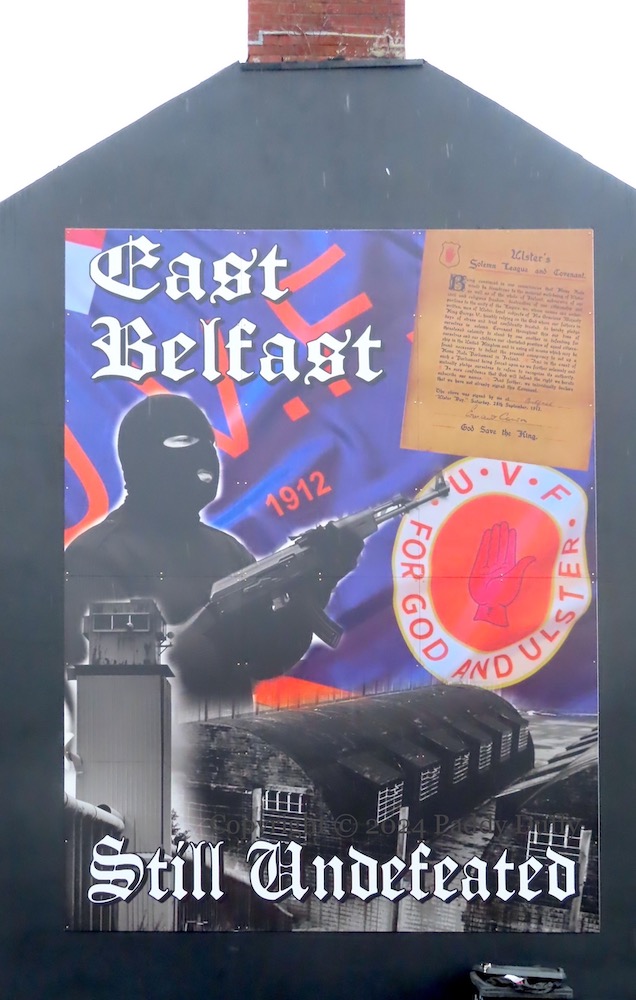
The UVF mural in Carlingford Street, east Belfast, that the one shown here replaces was controversial at the time (2013) because of its proposed inclusion of two hooded gunmen in fatigues firing into the air. In response to the concerns expressed, the final version put both figures in WWI uniforms and had only one firing into the air – the other gazed downward in prayer – and the modern UVF was referenced only in the forms of the towers and cages of Long Kesh and of a roll of honour. (See Years Of Sacrifice for both the draft and final murals.)
The cages are retained in this new board but the depiction of violence is more explicit here than in the proposed mural a decade ago: at the centre of this piece is a hooded gunman carrying an assault rifle.
For the wider context of re-imaging and re-re-imaging (that is, the disappearance and return of PUL hooded gunmen), see Visual History 11.)
Long Kesh’s cages are also included in a Shankill board to Stevie McCrea – A True Soldier Of Ulster.
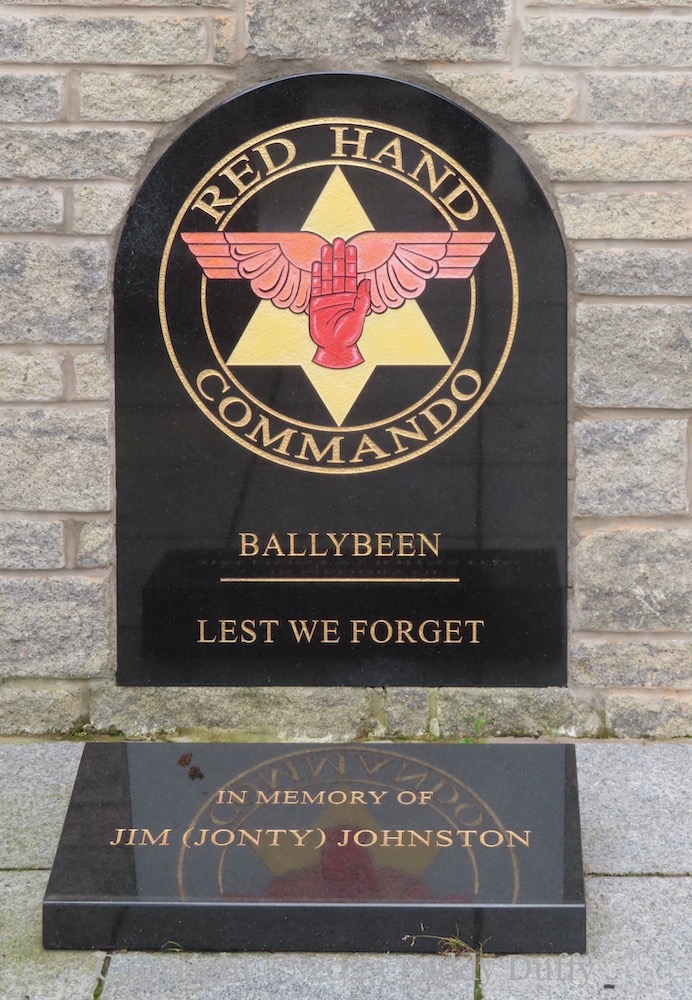
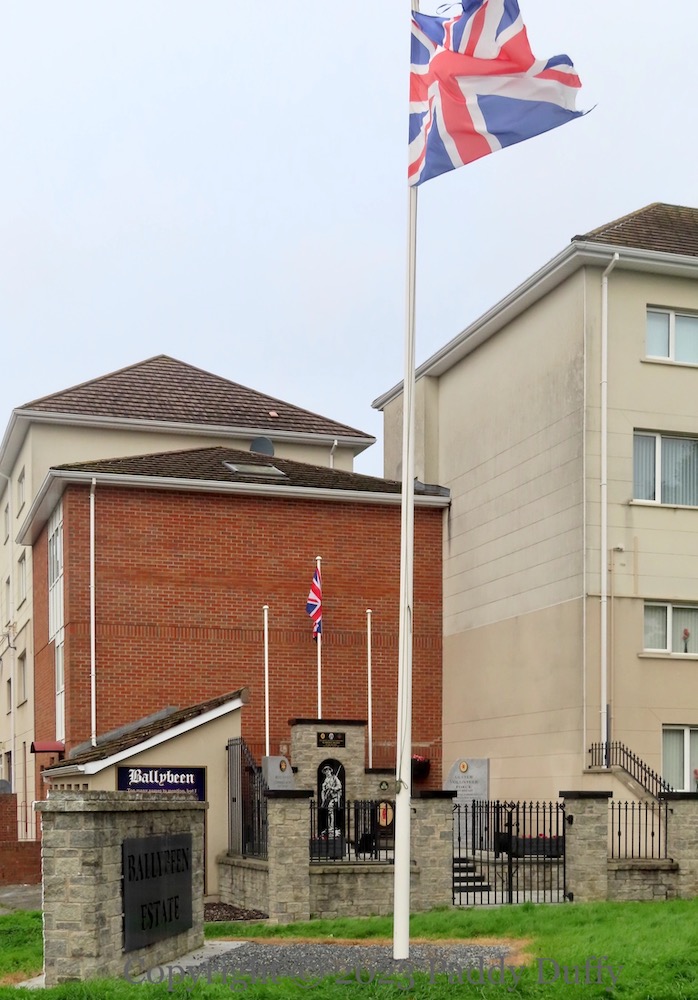
This is the UVF/RHC memorial garden in Ballybeen, with individual plaques to “East Belfast battalion commander” RJ ‘Mickey’ Wilson (died 2022), Jim ‘Jonty’ Johnston (killed in 2003 BelTel), M. Walker, G. McCartney, David Brown. While most of the plaques and stones are to the modern UVF, there are three pieces to the 36th (Ulster) Division.
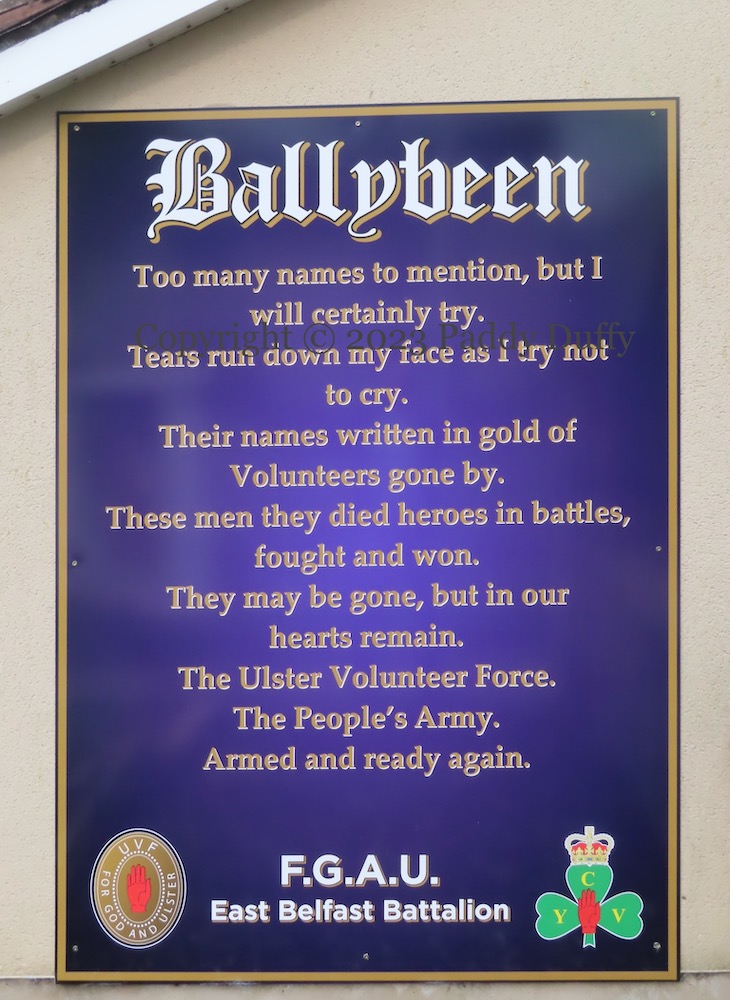
“Too many names to mention, but I will certainly try./Tears run down my face as I try not to cry./Their names written in gold of Volunteers gone by./These men they died heroes in battles, fought and won./They may be gone, but in our hearts remain./The Ulster Volunteer Force. The People’s Army./Armed and ready again.”
“Always remembered by the officers and volunteers of South Londonderry/Randalstown Ulster Volunteer Force.” This memorial mural and plaque in Magherafelt names Charlie Wright, Jonathan Wallace, Ken Wilkinson, and Ian McArthur.
Of these, Wilkinson seems the most well-known, as he served as a PUP representative for the area. He commented on sectarian tensions in Randalstown in 1999 (An Phoblacht) and in Coleraine in 2009 (Irish Examiner), and spoke against sueprgrass trials in 2011 as a member of FAST (Irish Times | see previously FAST and FASTing For Human Rights And Justice); he was accused of intimidation of Catholics in Antrim in 2003 (An Phoblacht). He stood for a number of elected positions (e.g. 2013) but was unsuccessful.
Ostensibly for his stand against drug-sellers, in 2010 a pipe-bomb (BBC), and in 2011 a make-shift car-bomb (BelTel), were placed against his home and he received death threats in 2013 (politics.ie). He died in 2021 (BelTel | News Letter | Irish News).
The plaque in the memorial garden (shown below) reads, “This plaque is dedicated in memory of all of the loyalist people of Ulster who have suffered at the hands of the enemies of our land. Lest we forget.”
This is the new Sam Rockett mural in the Woodvale, replacing the mural seen in Murdered By Cowards. The old mural just featured Rockett, who died in August, 2000, in the feud between the UVF and lower Shankill UDA. This new mural also features the “ethnic cleansing” of Torrens in 2004.
Torrens sits between Cliftonville, Ardoyne, and the lower Oldpark, and was one of the many historically mixed areas in north Belfast that, with the Troubles, became increasingly segregated and separated from neighbouring areas by “peace” lines. Jarman (1996) provides eye-witness testimony of the dispute in Torrens in 1996 which saw Catholic families leave the area. Its proximity to Ardoyne (and Cliftonville), however, meant that over the next few years the houses were gradually abandoned by Protestants, culminating in 2004 when ten of the remaining Protestant families moved out of the area, alleging persistent intimidation and employing the term term “ethnic cleansing” – a term the poem to the right of the mural uses three times.
The area was eventually redeveloped from 2008-2012, with the Wyndham Street “peace” line coming down and Elmgrove Street being opened to the Oldpark Road.
The line in the poem “the resistance formed a steady band” is unclear – it might refer to loyalists being bussed into Torrens in 1996 (see the testimonies in Jarman); if it refers to B Company it would make a connection to Rockett. As it is, the connection between the two elements of the mural (if any is intended) seems to be that Rockett was from the lower Oldpark, near Torrens.
“In the name of Ireland’s cruel game/Oh, land that once sang freedom’s song/Now marred by ethnic cleansing’s wrong.//Echoes of anguish haunt the Protestants of Torrens,/Ethnically cleansed, a sinister goal,/Their weapon honed, to exact a toll.//Families robbed of essence and space,/fuelled by hated, to erase their trace.//Against the darkness, spirits sincere,/Hand in hand across the land,/the resistance formed a steady band.//Ethnic cleansing’s horrors unveiled at last,/Hearts of courage, unbreakable souls,/Truths unfurled, their power untold,/A captured scene of the evil deeds done.”
The in-progress images are from August 17th and 18th. The mural was completed for the anniversary of Rockett’s death on August 23rd. The source for the central image (of furniture being loaded into a lorry) is unknown.
“O valiant hearts who to your glory came/Through dust of conflict and through battle flame//Tranquil you lie, your knightly virtue proved/Your memory hallowed [not “hollowed”] in the land you loved.” The hymn ‘O Valiant Hearts’ was a poem written during the first World War to commemorate the Allied dead, and was put to a variety of tunes during the 1920s, including arrangements by Vaughan Williams and Holst (WP); the most commonly sung tune, however, is that of Charles Harris (youtube, includes the full poem).
The memorial shown in the middle of the board is a Cross Of Sacrifice (see previously: One In Design And Intention) built on top of a German pill box at the centre of Tyne Cot cemetry, near Passchendaele, Belgium. The title of today’s post comes from remarks made by George V during a 1922 visit to the cemetery (History.org). The map in the background shows the area just south of Ypres (Canadian Soldiers).
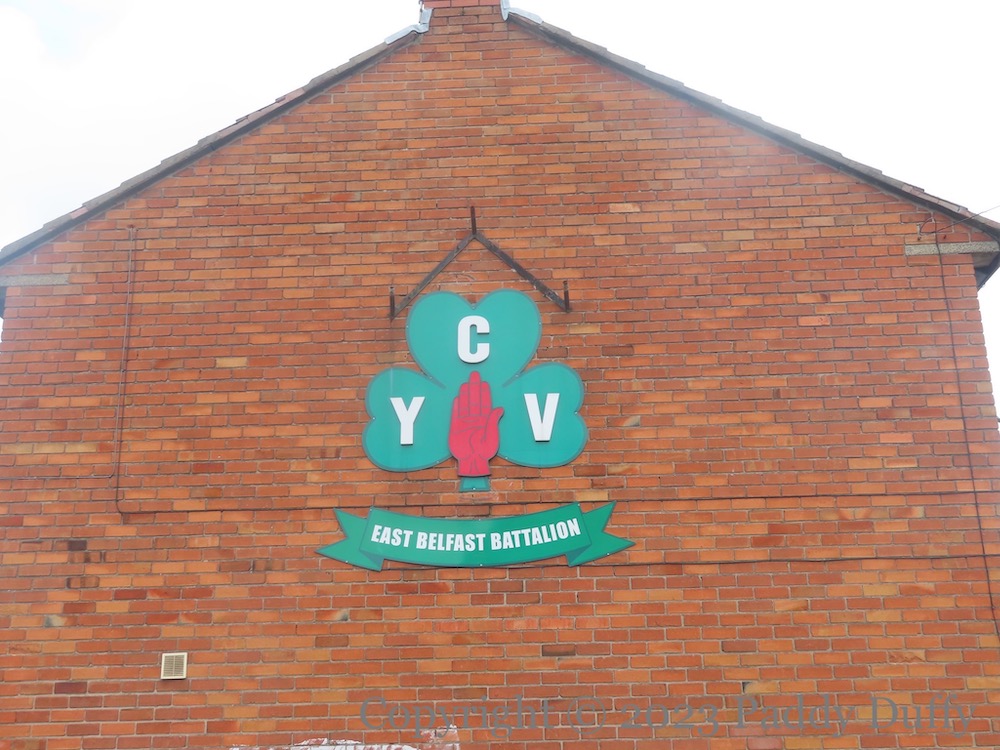
The board is in Pim’s Avenue, Belfast, opposite the older YCV emblem shown below.
The hand-painted UVF Scottish Brigade mural (see Boab Kerr) in Beechfield Street/Tower Street has been replaced by this new printed board. The plaque to Kerr has been retained, but four names have been added – David Totten, Brian Milligan, Billy Inglis, and Jim Holt, who is now the most prominent. Holt died in February 2021 (ACT Fb).
The “Shankill Boys” were the roughly 700 men of the West Belfast battalion of the Ulster Volunteers who were almost all killed at the Somme. (This board – or a previous copy of it – was previously in Carnan St.)
As with all of the Belfast battalions, West Belfast had a “USSF” [Ulster Special Service Force] – its emblem is in the top left of the second board, below. (See previously USSF and Carving Out A Place In History) The other emblem is that of the ‘Greengairs Thistle Flute Band’ (web). Although the background comes from WWI, the roll of honour lists modern-day volunteers from the UVF. Thomas Chapman, James McGregor, Robert McIntyre, William Hannah, and Robert Wadsworth are portrayed in Carnan Street – see C. Coy Street. The modern-day C Company, formed in 1974, is named after the Four Step Inn, which was bombed in September 1971 (see Four Step).
This hooded gunman from the UVF’s North Belfast/3rd battalion will keep an eye on your wains while they play in the playground across the street. This mural replaces a kids’ mural that read “New Mossley estate recognises the importance of its young people.” (Street View)
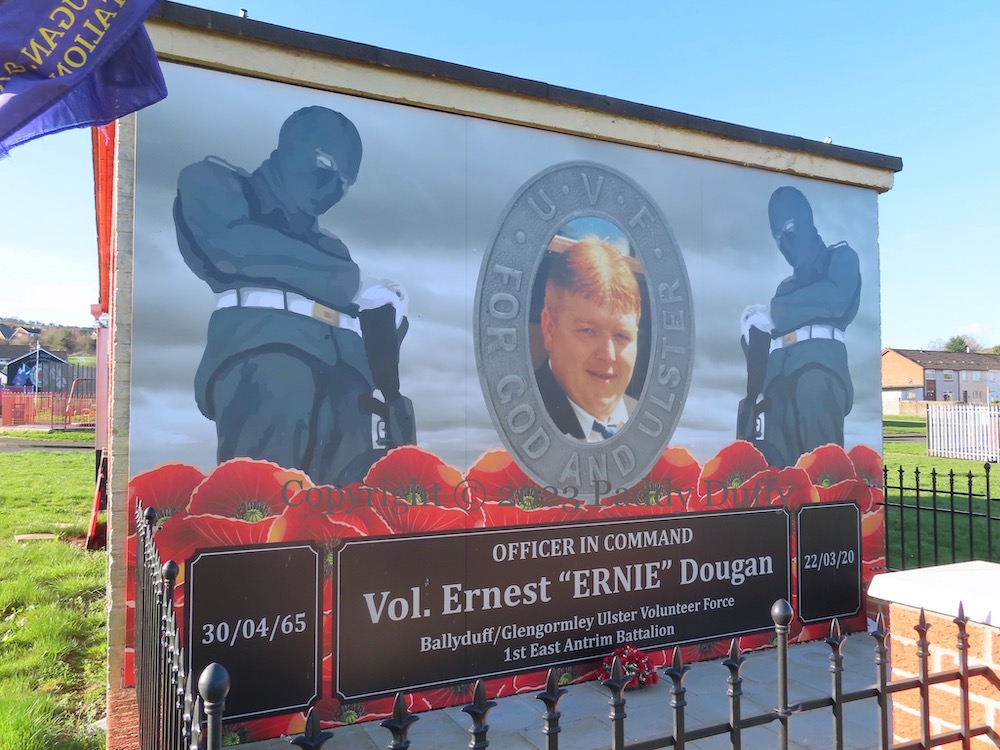
“Officer in command Vol. Ernest “Ernie” Dougan (30/04/65-22/03/20) Ballyduff/Glengormley Ulster Volunteer Force 1st East Antrim Battalion.” Dougan died at the beginning of lockdown and so the public commemoration of his passing did not take place until 2022. He was also involved in the Ballyduff Community Redevelopment Group (Fb). According to a Sunday World article, Dougan did not join the UVF until sometime after the Agreement, after he was given a punishment beating by the UDA in north Belfast (see Irish Times | Mirror) and moved out to Ballyduff.














 Paddy Duffy Collection