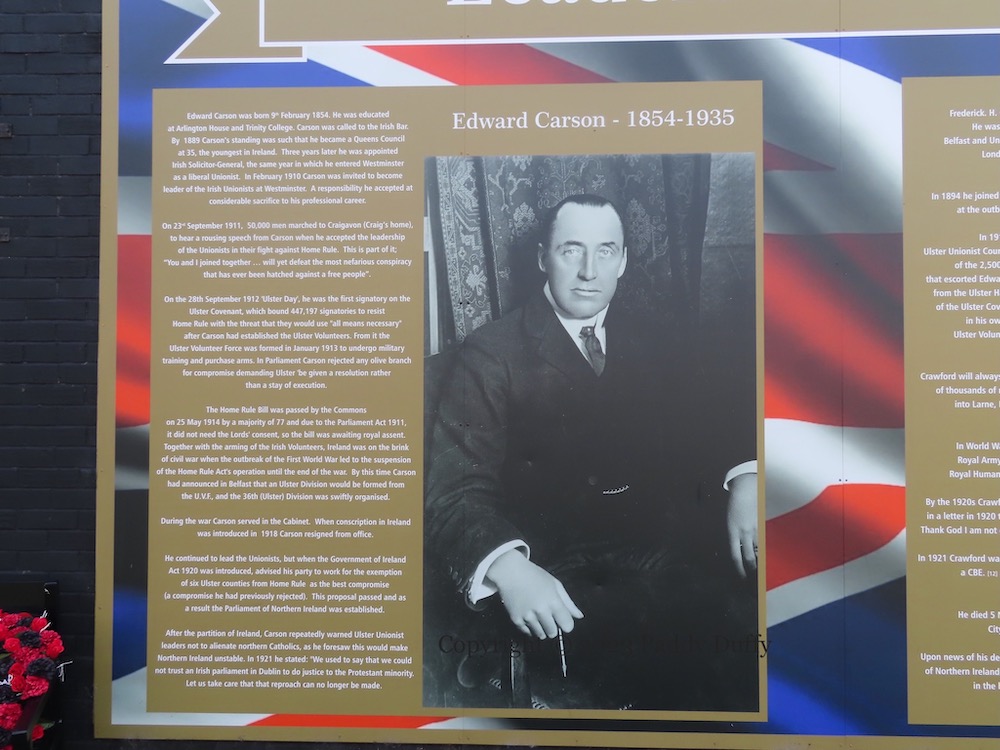
Carson, Crawford, and Craig are lionised as resisters of devolvement of Ireland to Dublin in the early twentieth century. Despite calling Home Rule “the most nefarious conspiracy that has ever been hatched against a free people” and vowing to fight it by “all means necessary”, including the Ulster Volunteers armed by Crawford’s “guns for Ulster”, Edward Carson “warned Ulster Unionist leaders not to alienate norther Catholics, as he foresaw this would make Northern Ireland unstable.”
Above is a mural in Carlingford St, east Belfast showing gravestones of two deceased locals: “6322 Private J. Condon, Royal Irish Regiment, 24th May, 1915, age 14” and “10/16015 Rifleman S. Thompson Royal Irish Rifles, 5th October, 1918”. Their gravestones are the end-point of a journey that began with the Covenant and the Ulster Volunteers (illustrated by images of Carson, the Covenant, gun-running, and Volunteers drilling).
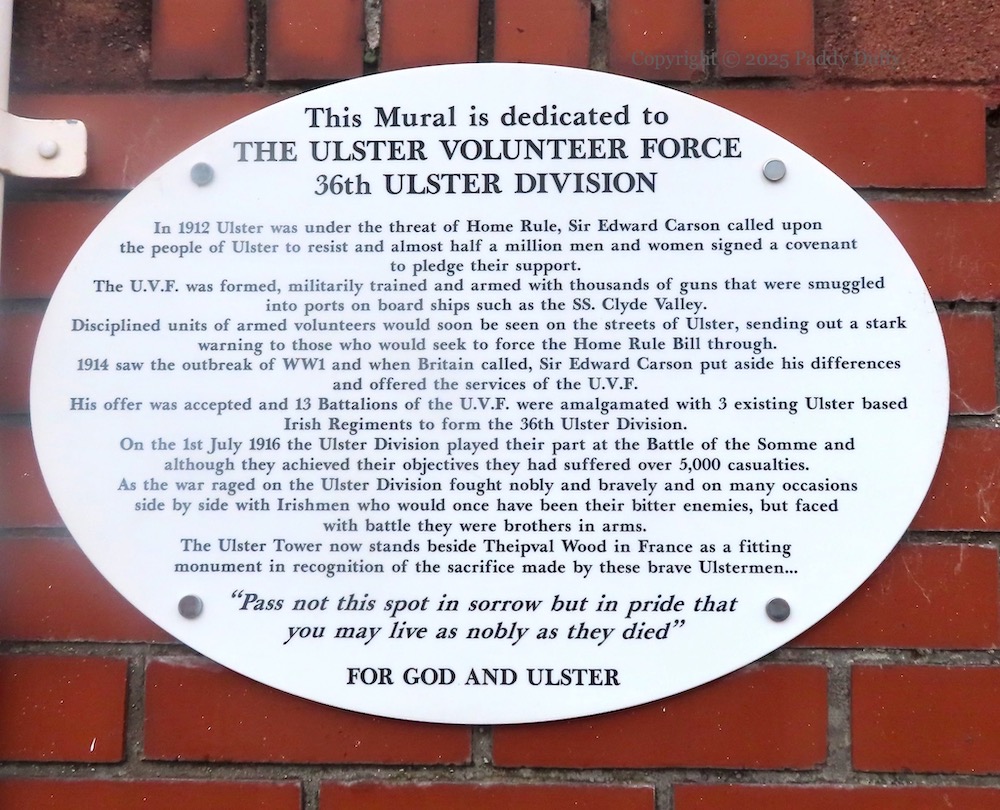
To the left is a plaque describing the journey from the Covenant to the Ulster Volunteers to the Somme: “In 1912 Ulster was under the threat of Home Rule, Sir Edward Carson called upon the people of Ulster to resist and almost half a million men and women signed a covenant to pledge their support. The U.V.F. was formed, militarily trained and armed with thousands of guns that were smuggled into ports on board ships such as the SS. Clyde Valley. Disciplined units of armed volunteers would soon be seen on the streets of Ulster, sending out a stark warning to those who would seek to force the Home Rule bill through. 1914 saw the outbreak of WW1 and when Britain called, Sir Edward Carson put aside his differences and offered the services of the U.V.F. His offer was accepted and 13 battalions of the U.V. F. were amalgamated with 3 existing Ulster based Irish regiments to form the on the 36th (Ulster) Division. On the 1st july the Ulster Division played their part at the Battle of the Somme and although they achieved their objectives they had suffered over 5,000 casualties. As the war raged on the Ulster Division fought nobly and bravely and on many occasions side by side with Irishmen who would once have been their bitter enemies, but faced with battle they were brothers in arms. The Ulster Tower now stands beside Theipval [sic] Wood in France as a fitting monument in recognition of the sacrifice made by these brave Ulstermen … “Pass not this spot in sorrow but in pride that you may live as nobly as they died” For God and Ulster”
There is also a side-wall (out of frame to the right) with the words of Captain Wilfrid Spender, describing the first day of the Battle Of The Somme, 1916, but it is in poor condition.
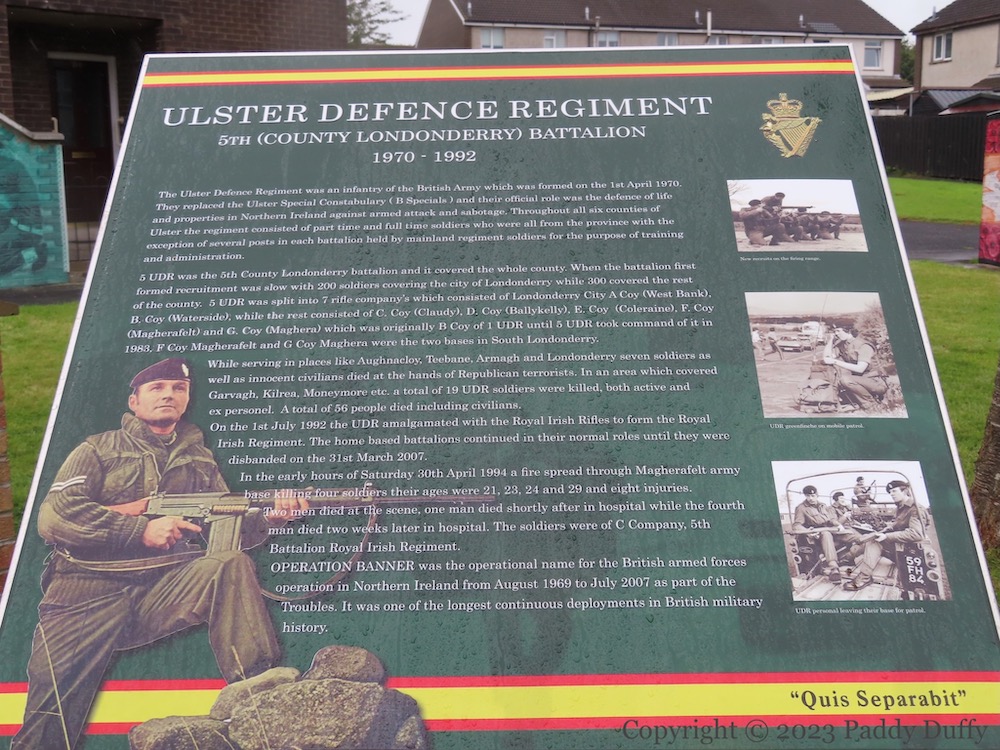
This selection of images from Leckagh Drive, Magherafelt, focuses on the memorials to the dead of WWI (and WWII in the mural above), with an additional board commemorating the UDR 5th (County Londonderry) battalion); there is also a mural and some plaques commemorating (modern-day) UVF volunteers, which will be in tomorrow’s post.
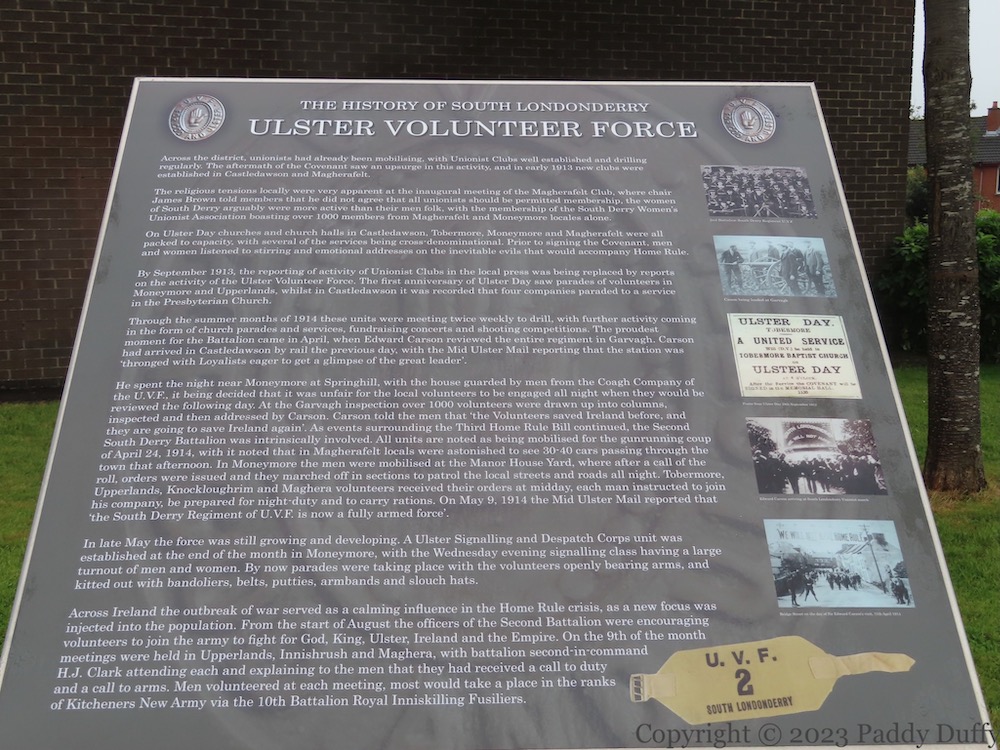
The board shown in the final image provides a history of the South Londonderry volunteers from towns such as Magherafelt, Castledawson, Moneymore, and Tobermore. Edward Carson reviewed the volunteers in April 1914. Later that same month, arms were received from the weapons landed in Larne. In the Great War, the men from the area served in the 10th battalion of the Royal Inniskilling Fusiliers in the 109th brigade of the 36th Division.
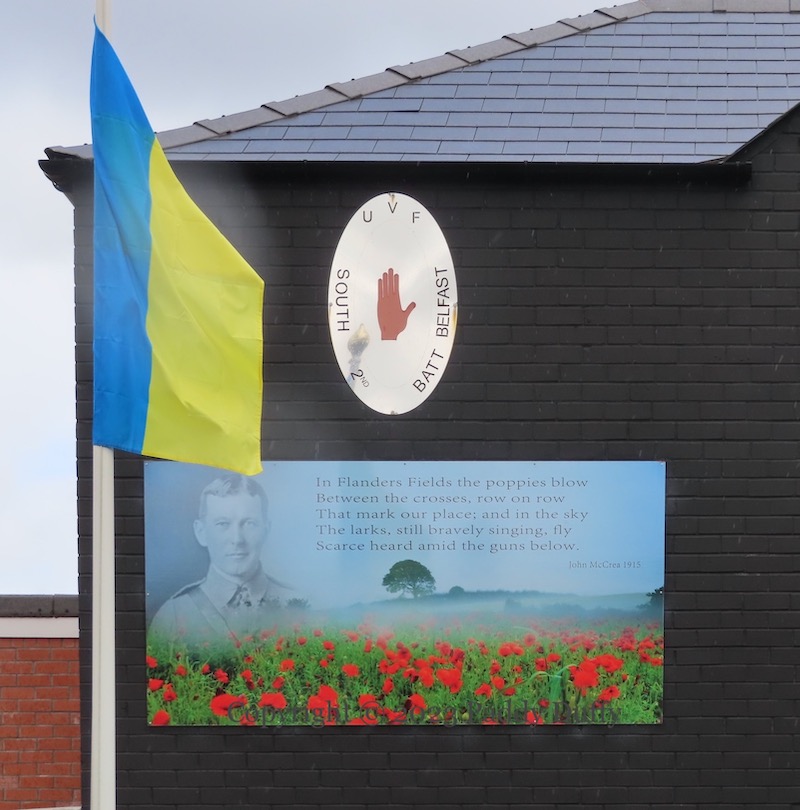
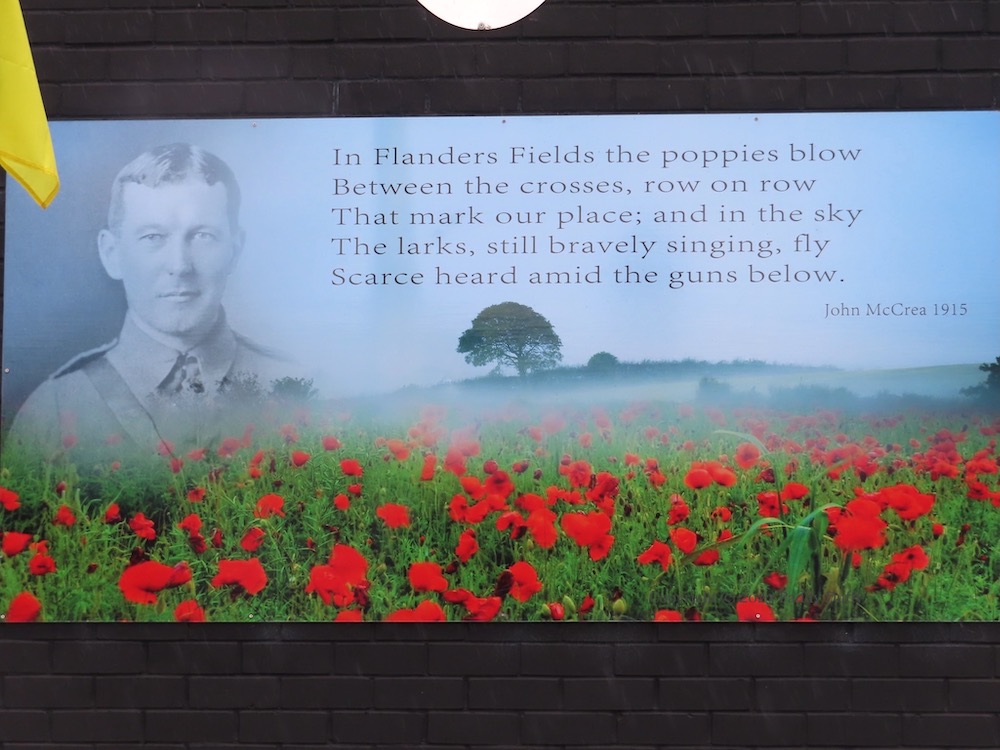
The house next to the Village memorial garden got an extension at the back in 2020 and with it the left-hand part of the house’s gable wall was extended upward (compare with the images from 2017 in Continuing Conflicts). The board with a verse from McCrea’s In Flanders Fields was present previously, but has been raised, and above it there now stands a red-hand emblem of the “UVF 2nd batt. south Belfast”.
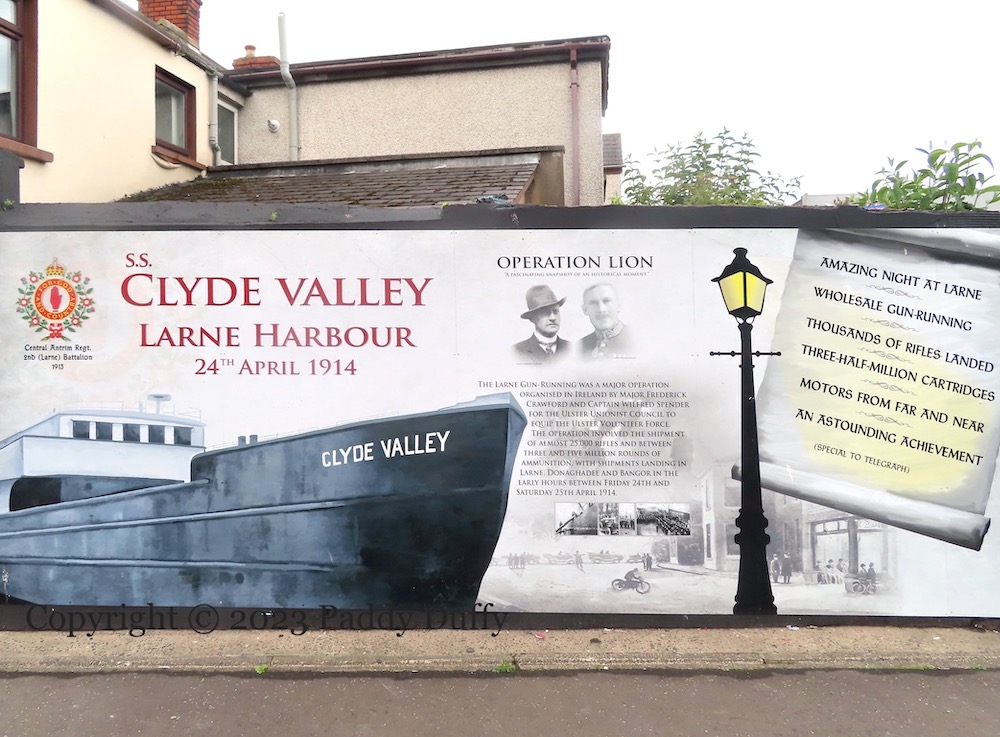
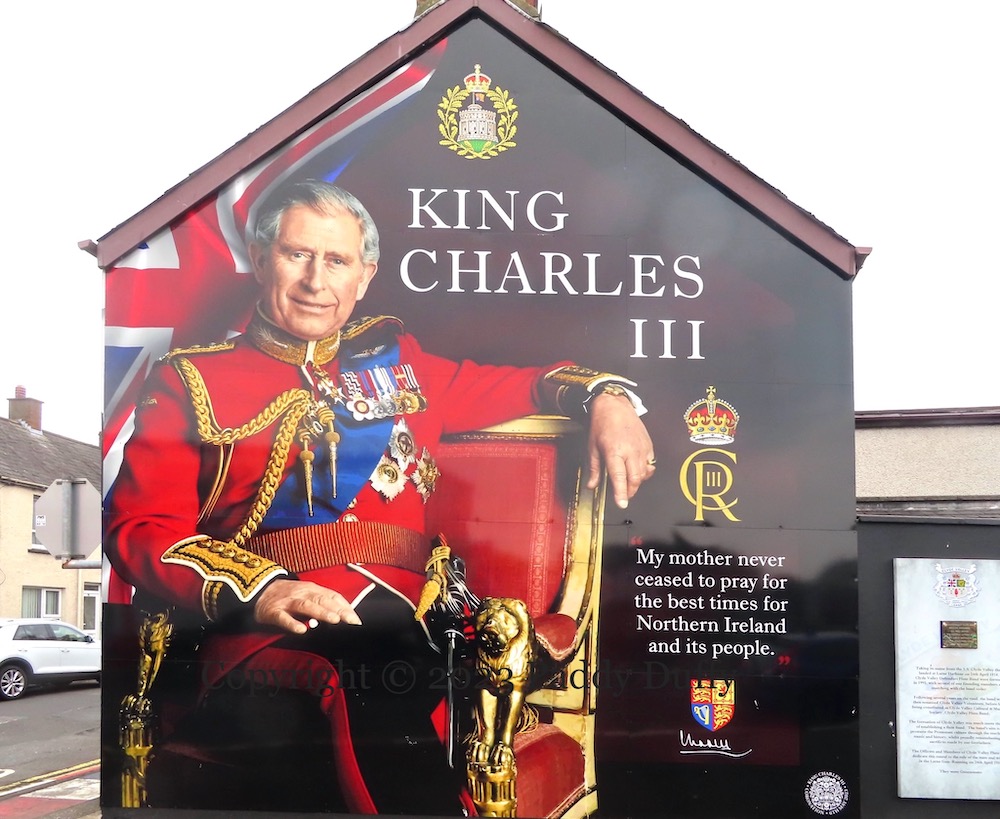
There’s a new King Charles III board in Boyne Square, Larne, of a similar sort to those we have seen in various other areas and using the same “lounging” image of Charles as in east Belfast, Carrickfergus, and the Caw (Londonderry) – though the quote is different: “My mother never ceased to pray for the best times for Northern Ireland and its people” (source unknown). The celebration of the 1914 gun-running that was on the wall previously (see Amazing Night In Larne) has been moved to the side wall, replacing King Billy.
“Operation Lion – a fascinating snapshot of an historical moment. The Larne gun-running was a major operation organised in Ireland by Major Frederick Crawford and Captain Wilfred [sic] Spender for the Ulster Unionist Council to equip the Ulster Volunteer Force. The operation involved the shipment of almost 25,000 rifles and between three and five million rounds of ammunition, with shipments landing in Larne, Donaghadee and Bangor in the early hours between Friday 24th and Saturday 25th April 1914.”
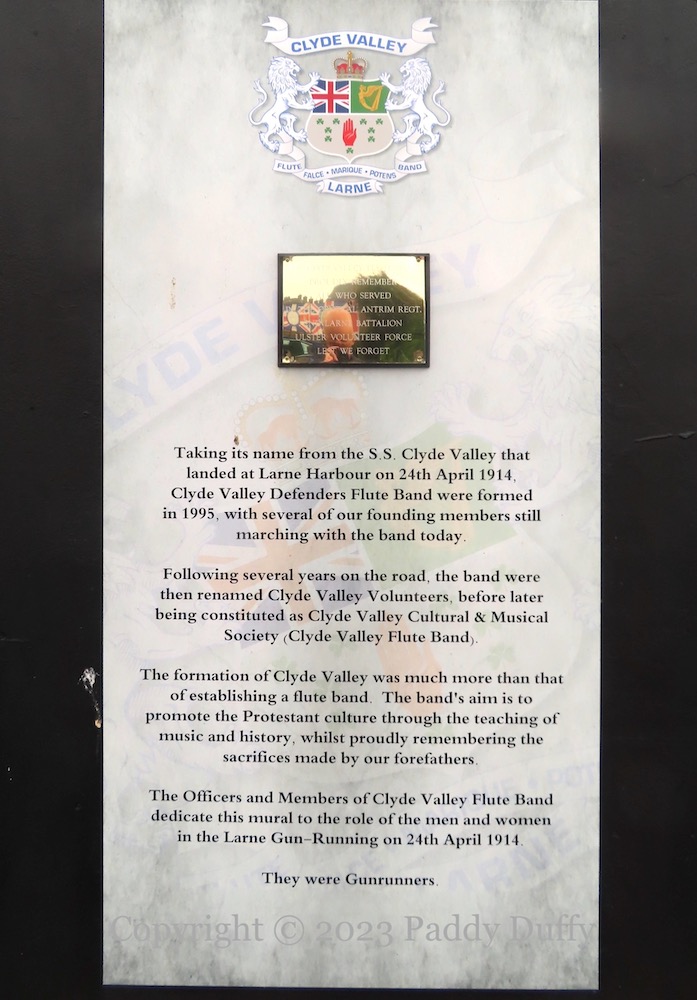
“Taking its name from the S.S. Clyde Valley that landed at Larne Harbour on 24th April 1914, Clyde Valley Defenders Flute Band were formed in 1995, with several of our founding members still marching with the band today. Following several years on the raod, the band were then renamed Clyde Valley Volunteers, before later being constituted as Clyde Valley Cultural & Musical Society (Clyde Valley Flute Band). The formation of Clyde Valley was much more than that of establishing a flute band. The band’s aim is to promote the Protestant culture through the teaching of music and history, whilst proudly remembering the sacrifices made by our forefathers. The Officers and Members of CLyde Valley Flute Band dedicate this mural to the role of the men and women in the Larne Gun-Running on 24th April 1914. They were Gunrunners.”
The “Shankill Boys” were the roughly 700 men of the West Belfast battalion of the Ulster Volunteers who were almost all killed at the Somme. (This board – or a previous copy of it – was previously in Carnan St.)
As with all of the Belfast battalions, West Belfast had a “USSF” [Ulster Special Service Force] – its emblem is in the top left of the second board, below. (See previously USSF and Carving Out A Place In History) The other emblem is that of the ‘Greengairs Thistle Flute Band’ (web). Although the background comes from WWI, the roll of honour lists modern-day volunteers from the UVF. Thomas Chapman, James McGregor, Robert McIntyre, William Hannah, and Robert Wadsworth are portrayed in Carnan Street – see C. Coy Street. The modern-day C Company, formed in 1974, is named after the Four Step Inn, which was bombed in September 1971 (see Four Step).
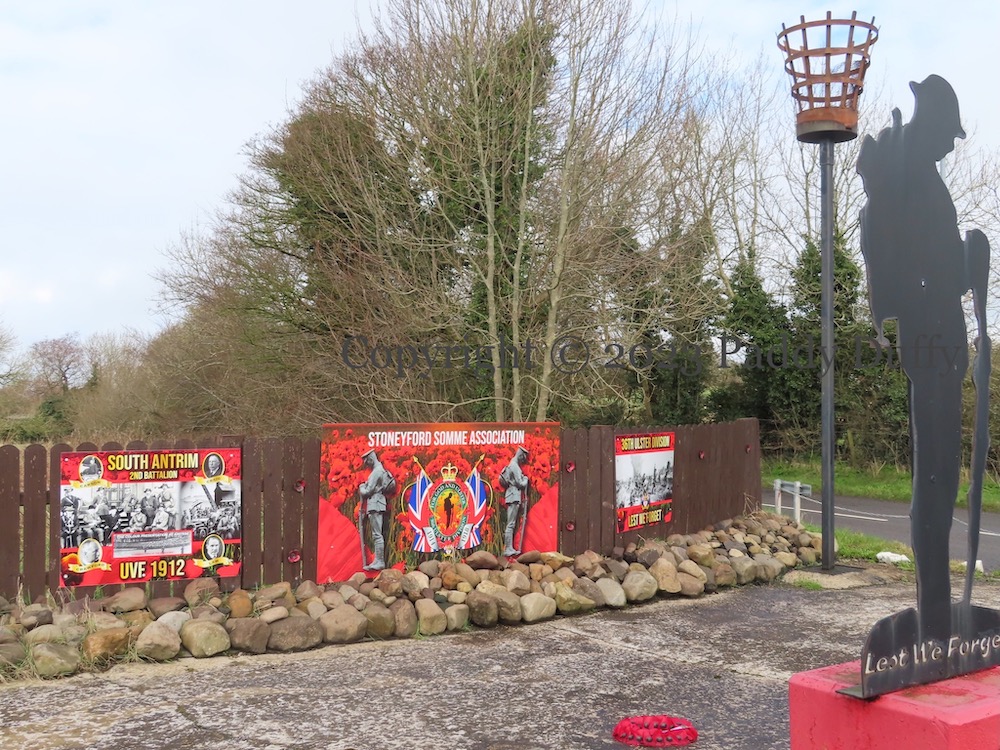
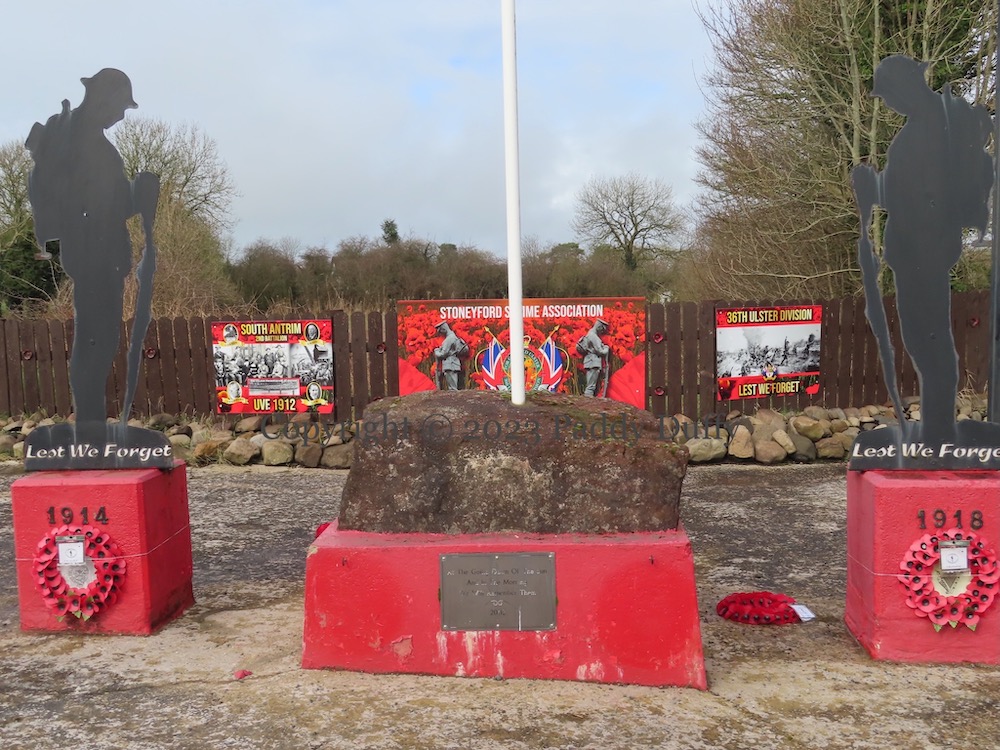
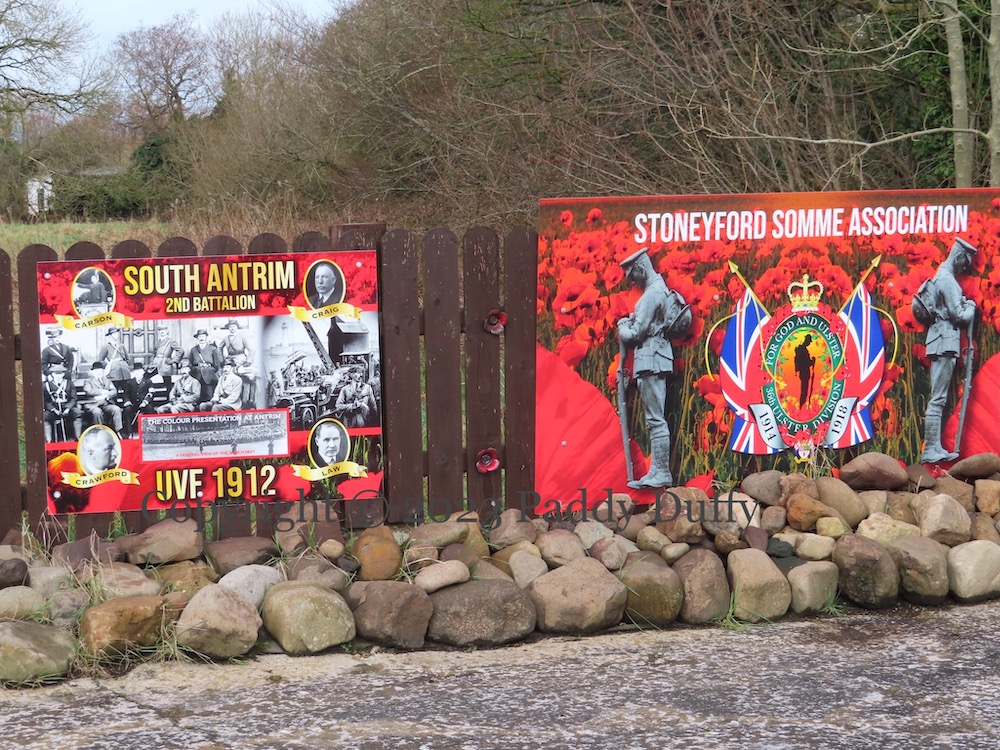
Boards have been added to the WWI memorial plaque in Stoneyford. On the right, the 36th Division go over the top in Beadle’s ‘Attack Of The Ulster Division’ (see Over The Top); the board on left more specifically commemorates the 2nd battalion of the South Antrim Ulster Volunteers, flanked by the leaders of the anti-Home Rule movement – Carson, Craig, Crawford, and Bonar Law.
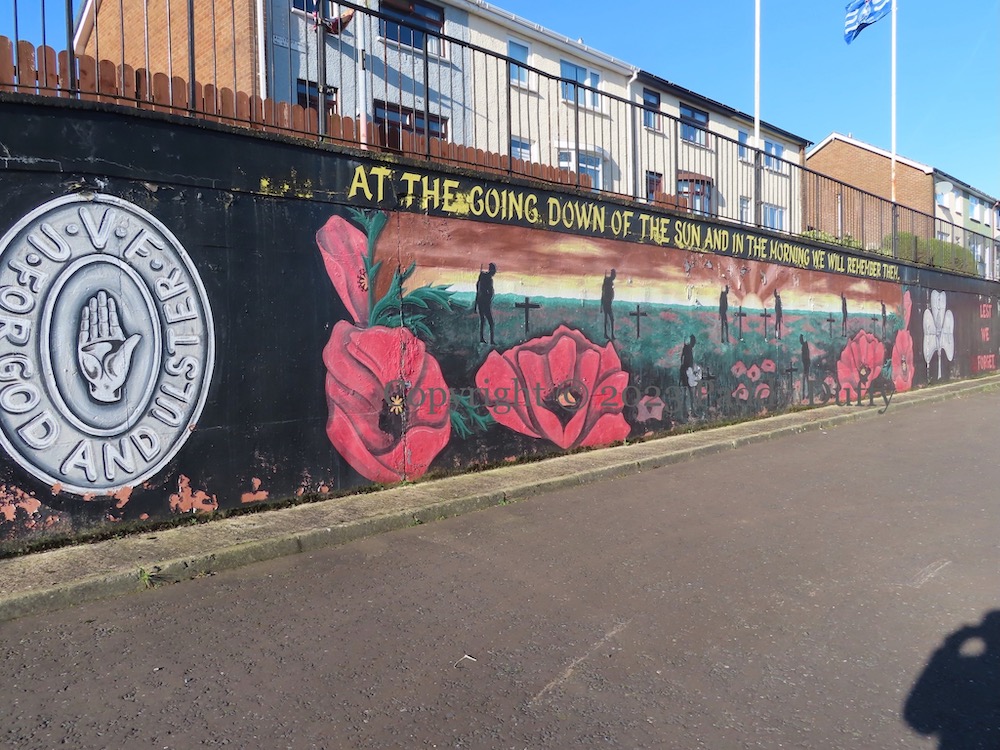
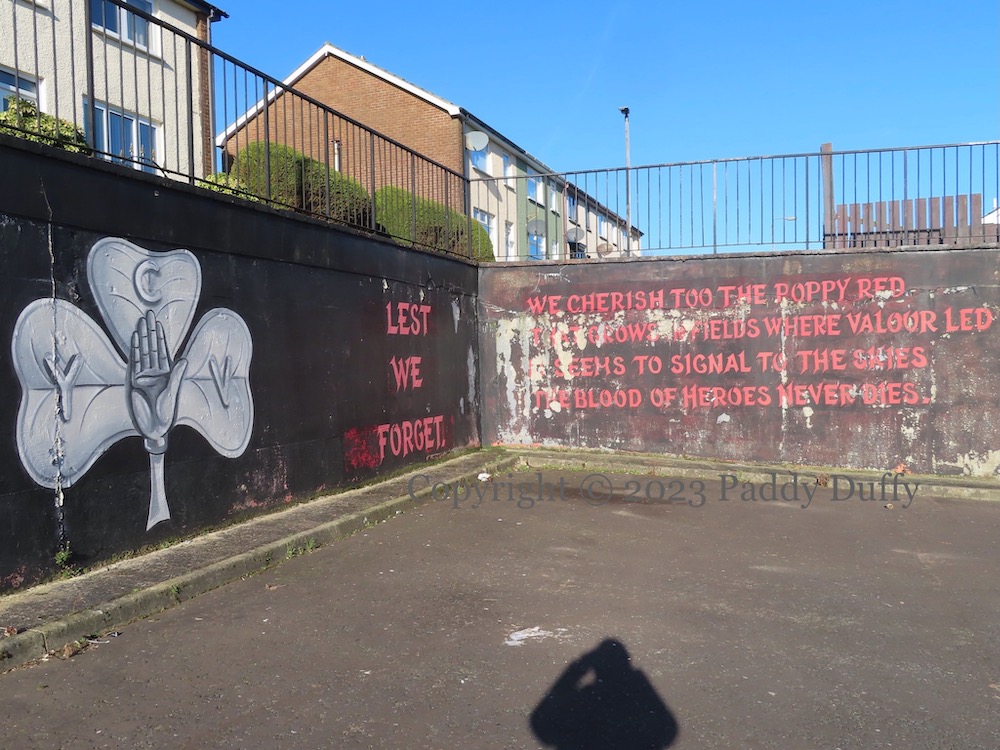
“We cherish too the poppy red/That grows in fields where valour led/It seems to signal to the skies/The blood of heroes never dies.” From Moina Michael’s poem We Shall Keep The Faith.
This is a UVF/YCV mural in Grange Drive, Ballyclare, celebrating and commemorating soldiers from the Ulster Volunteers who went on to serve in the 36th (Ulster) Division in WWI and in particular at the Somme. The central panel shows soldiers bearing the Division’s standard (painted in colour in an otherwise black-and-white mural and in the style of the (US) Marines ‘Iwo Jima’ Memorial (WP)) which comprises the Union flag, harp insignia of the Royal Irish Rifles, and the red hand of Ulster on a field of shamrocks.
The other panels show uniforms of the Ulster Volunteers, a Protestant woman defending the fields, soldiers going over the top, and soldiers bowed at a UVF memorial.
Also included, below, is an ‘over the top’ image from a substation at the very top of the estate.
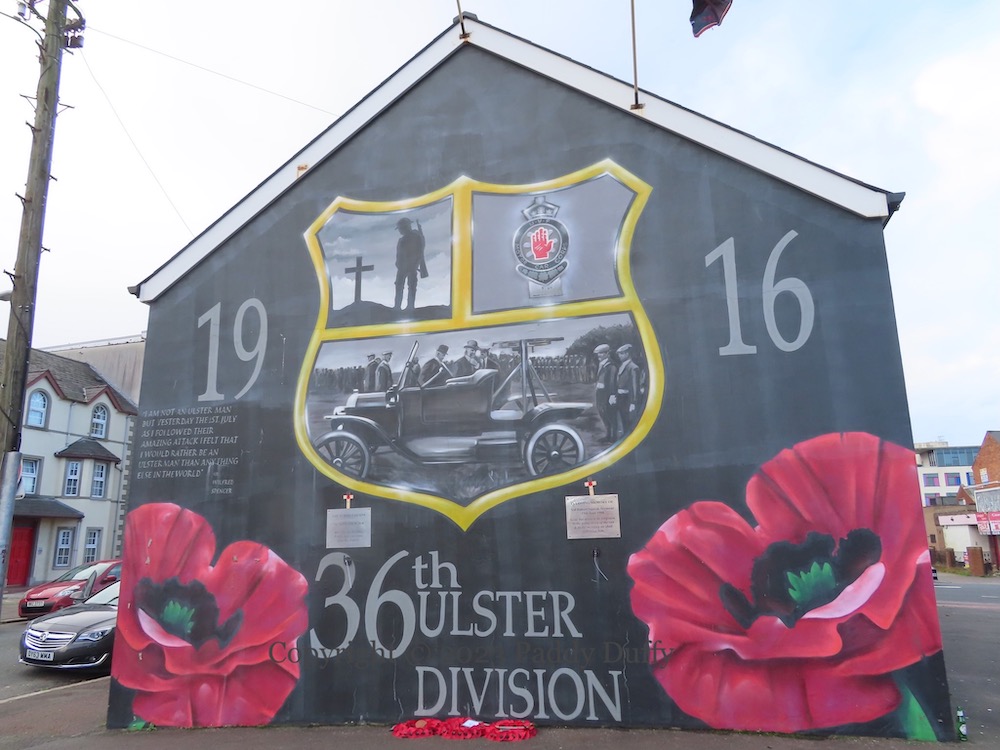
The first time that the horseless carriage was used in a military operation was the Ulster Volunteers’ “Larne Gunrunning” of April 1914. By this time, there are thought to have been 350 vehicles in the Corps (Angelsey). It’s not clear whether the cars were later used by the 36th (Ulster) Division – please comment/get in touch if you can shed light on this. (For Spencer’s quote on the left, see I am not an Ulsterman.) The plaque is to (modern) UVF volunteer ‘Squeak’ Seymour.











 Paddy Duffy Collection