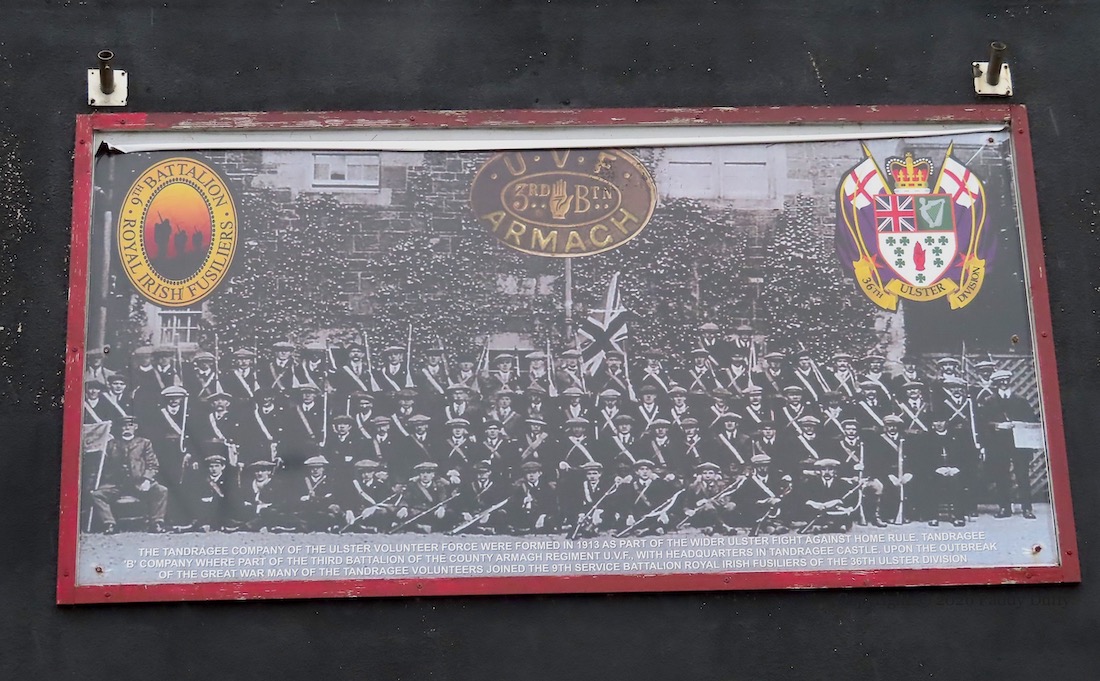
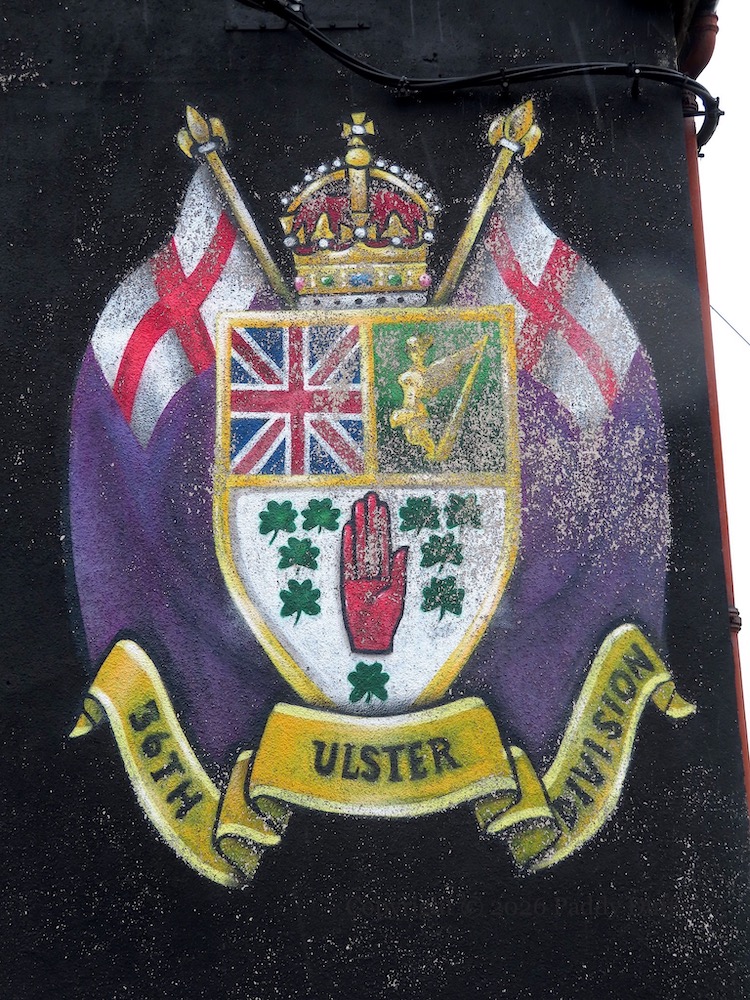
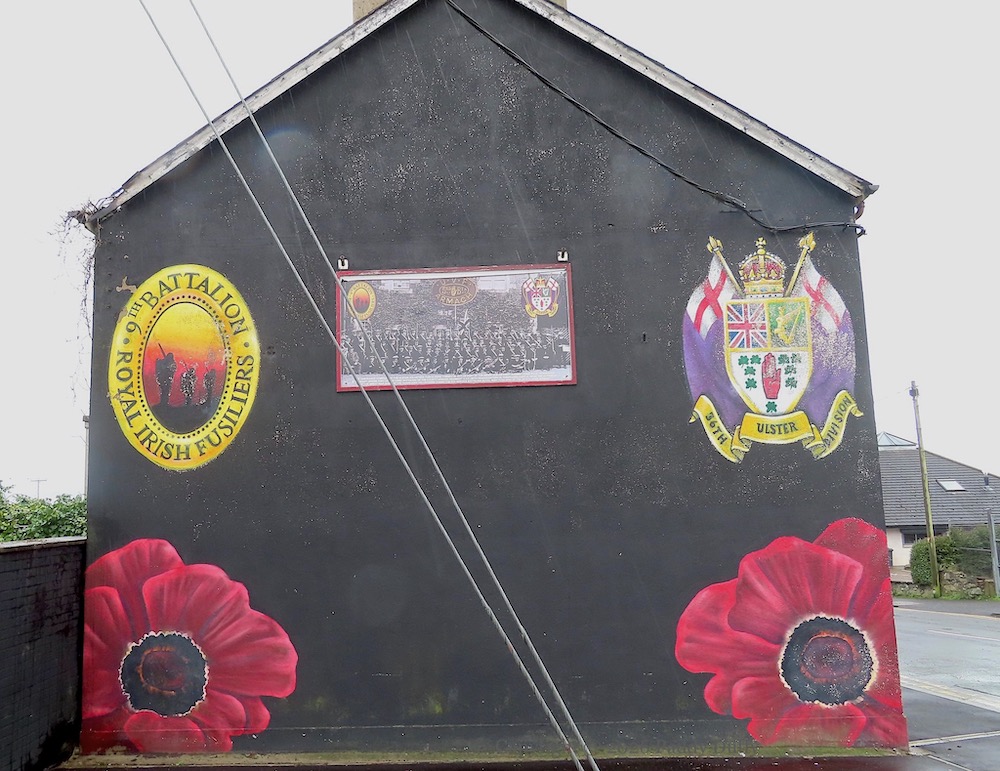
“The Tandragee company of the Ulster Volunteer Force were formed in 1913 as part of the wider Ulster fight against Home Rule. Tandragee ‘B’ Company where [were] part of the third battalion of the County Armagh Regiment UVF with headquarters in Tandragee Castle. Upon the outbreak of the Great War many of the Tandragee Volunteers joined the 9th Service Battalion Royal Irish Fusiliers of the 36th (Ulster) Division.”
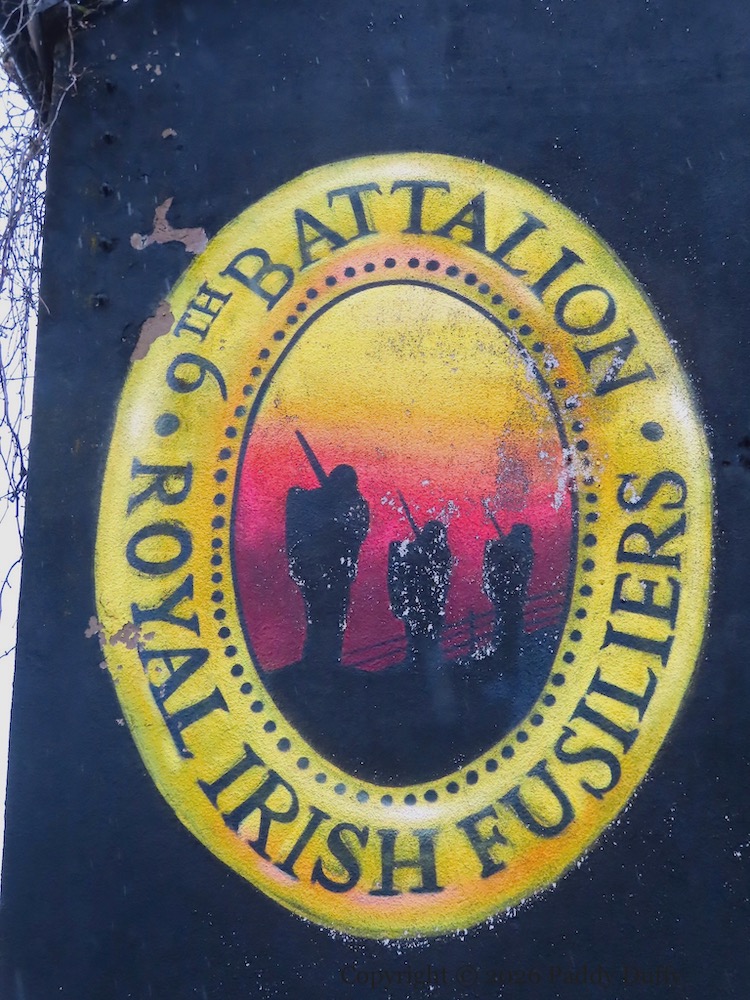
The 9th battalion comprised volunteers from Armagh, Monaghan, and Cavan.
For a fuller version of the photograph, see Cyberprod.
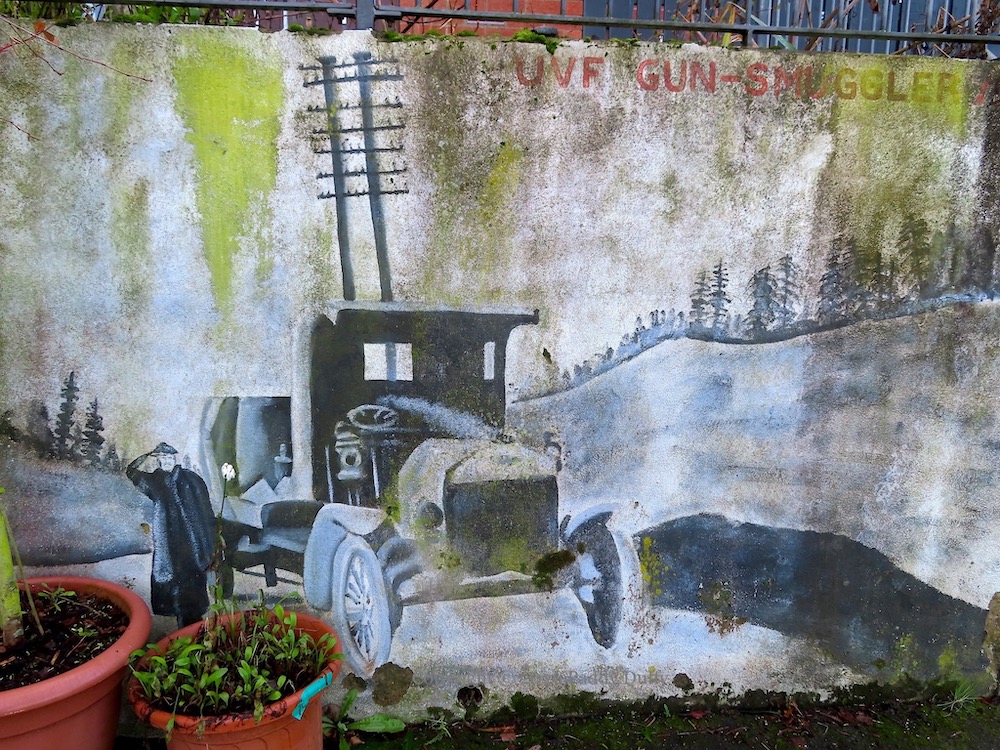
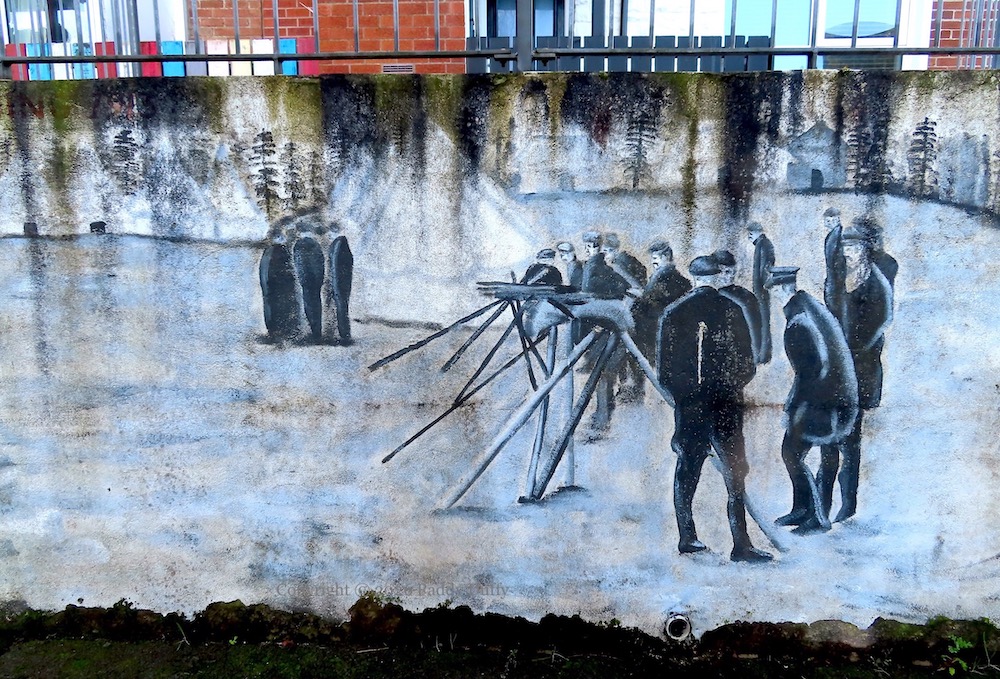
These faded Armagh murals have the titles “UVF Gun-Smuggler 1913” and “Arms Training 1913”.
The gun-smuggling mural features not the 1914 gun-running on Clyde Valley – the ship that brought in the weapons and ammunition into Larne – but a motor-car. There was earlier gun-running or bulk gun-purchasing – 175 rifles were bought from Harrods by the Earl Of Lanesborough and sent to Enniskillen (Balaclava Street) and 500 rifles were brought from Manchester in August 1913 (Irish Bayonets). (See also History Ireland.) These perhaps used automobiles for distribution, and the Larne gun-running is described as the first time that the horseless carriage was used in a military operation – there were about 350 vehicles in the “Motor Car Corps” (Angelsey p. 3).
The location of the car, and of the ‘arms training’ in the second mural, are unknown. Here is a 1914 image (Getty) showing tents and a single machine-gun at Ballywalter. The sources of both paintings are unknown.
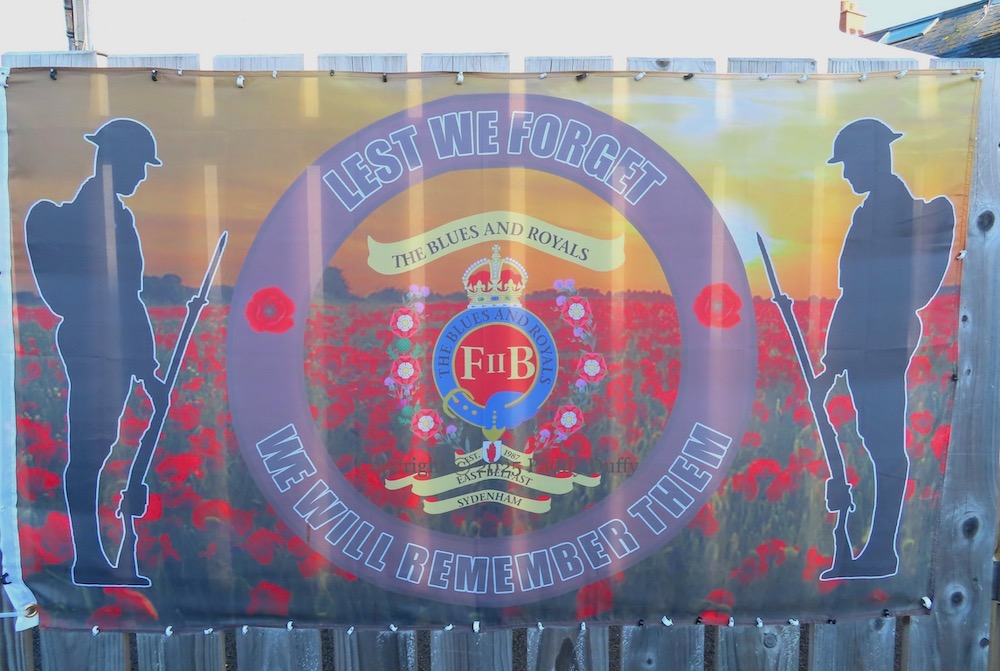
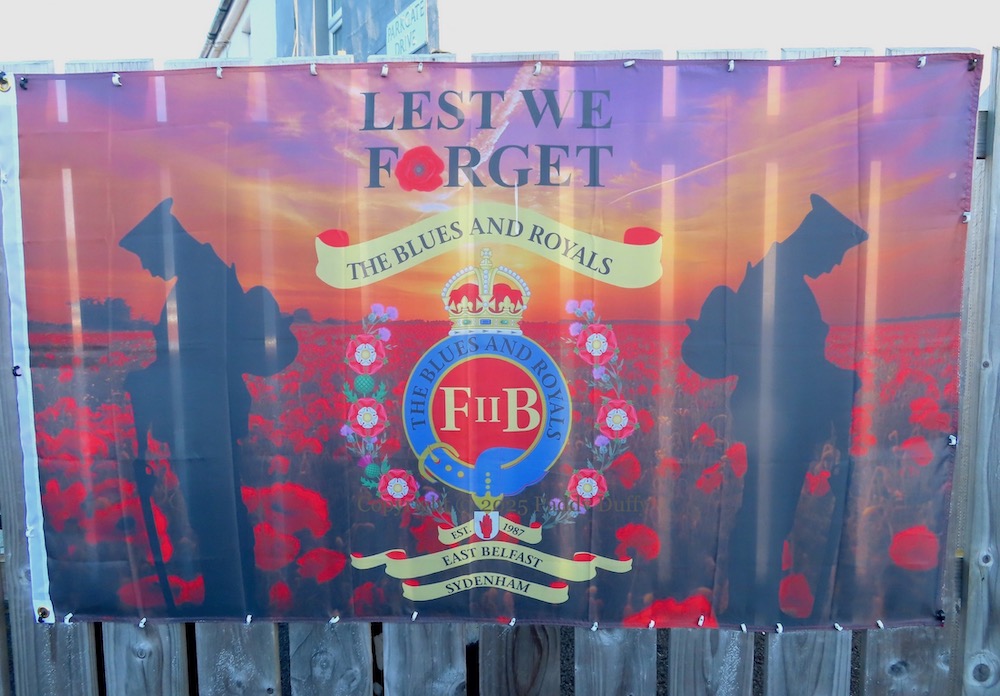
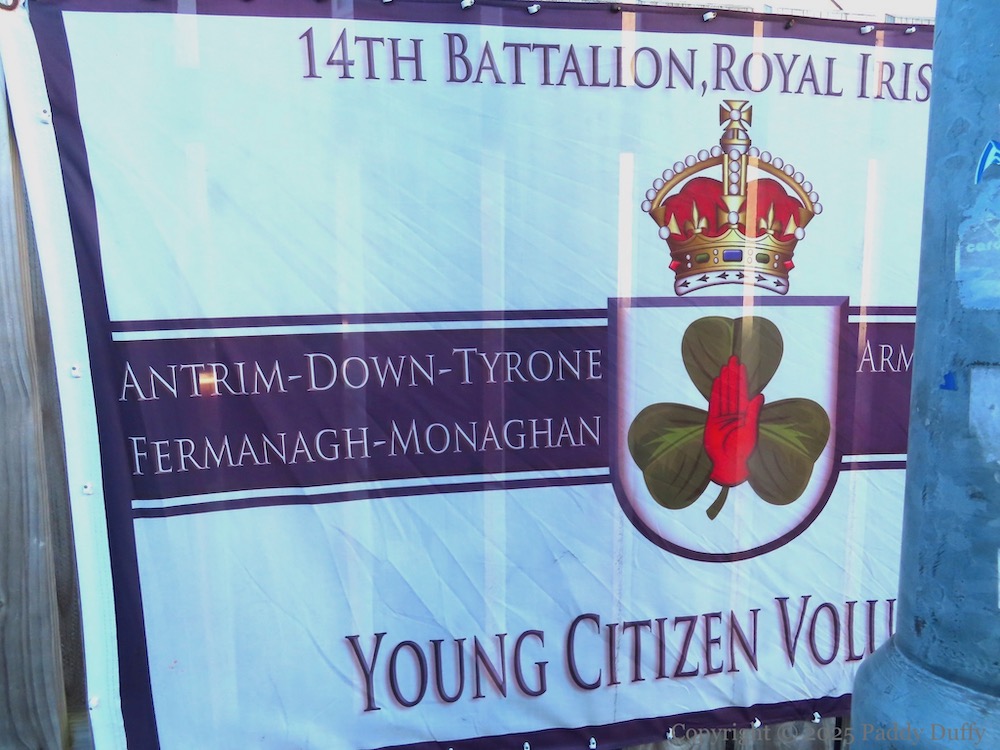
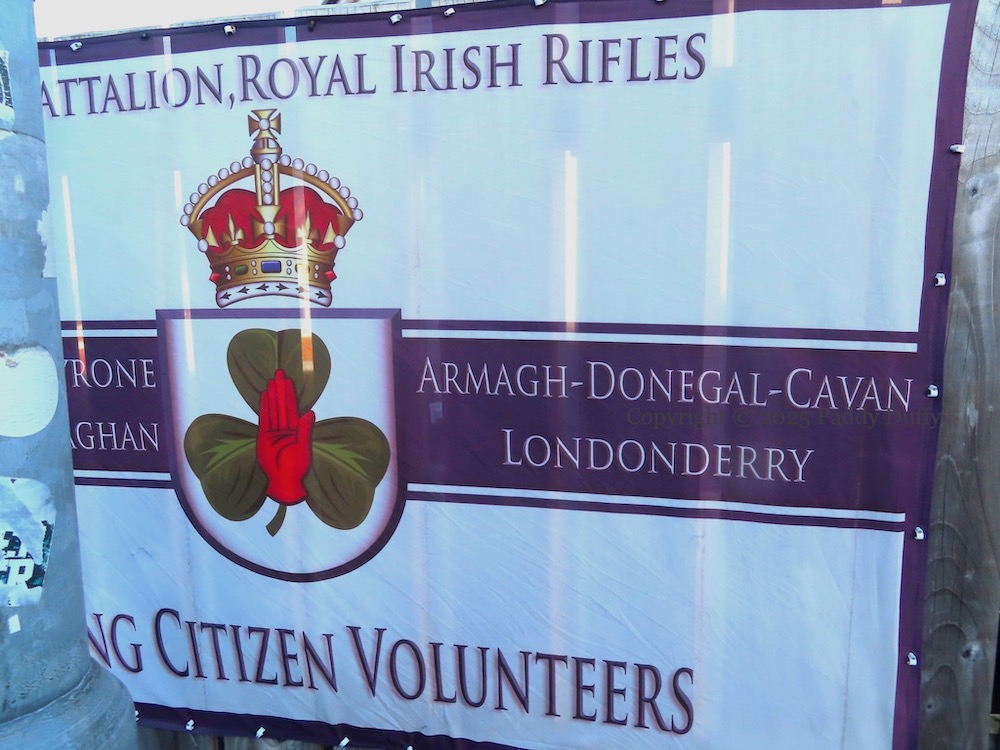
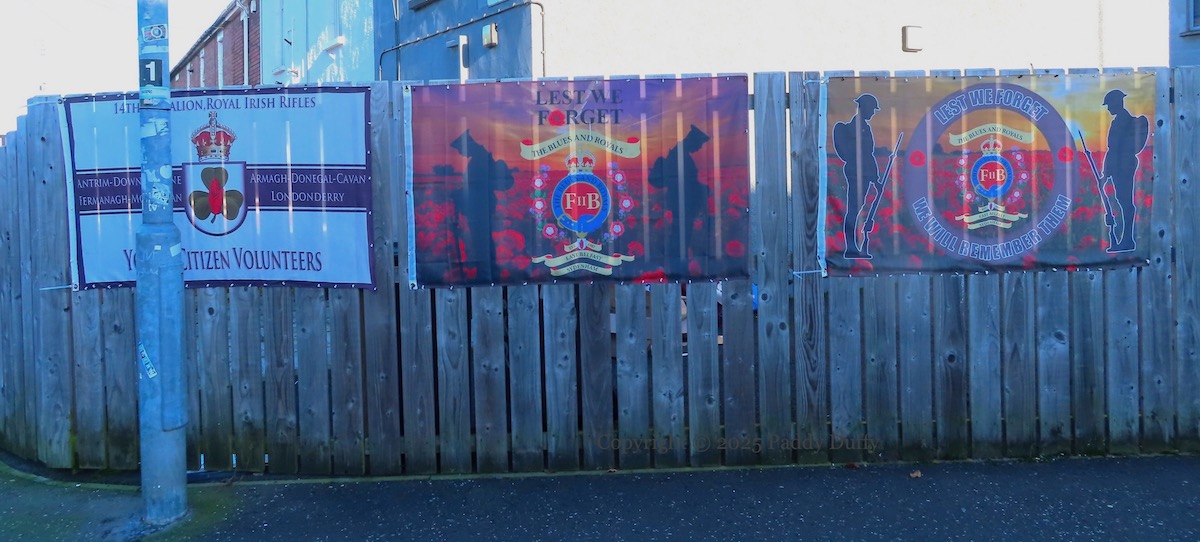
These flags – one to the Ulster YCV (14th RIR) and two to the Blues And Royals flute band, Sydenham (Fb) – are on the fence below the Northern Ireland Centenary board in Mersey Street, at the junction of Parkgate Drive in east Belfast.
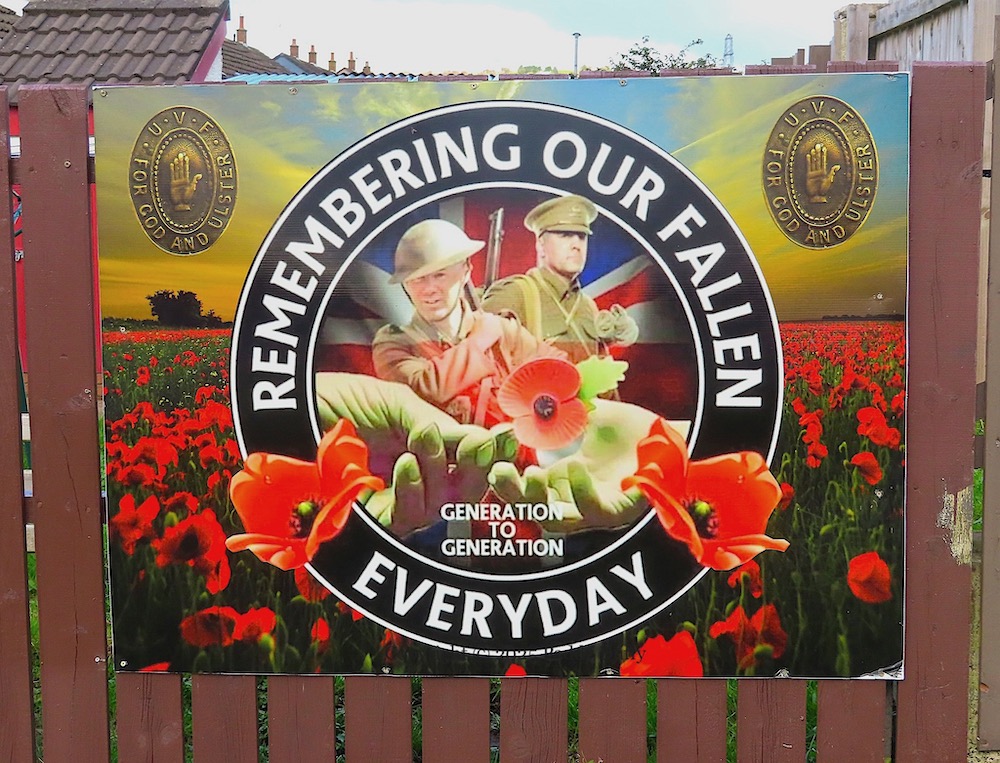
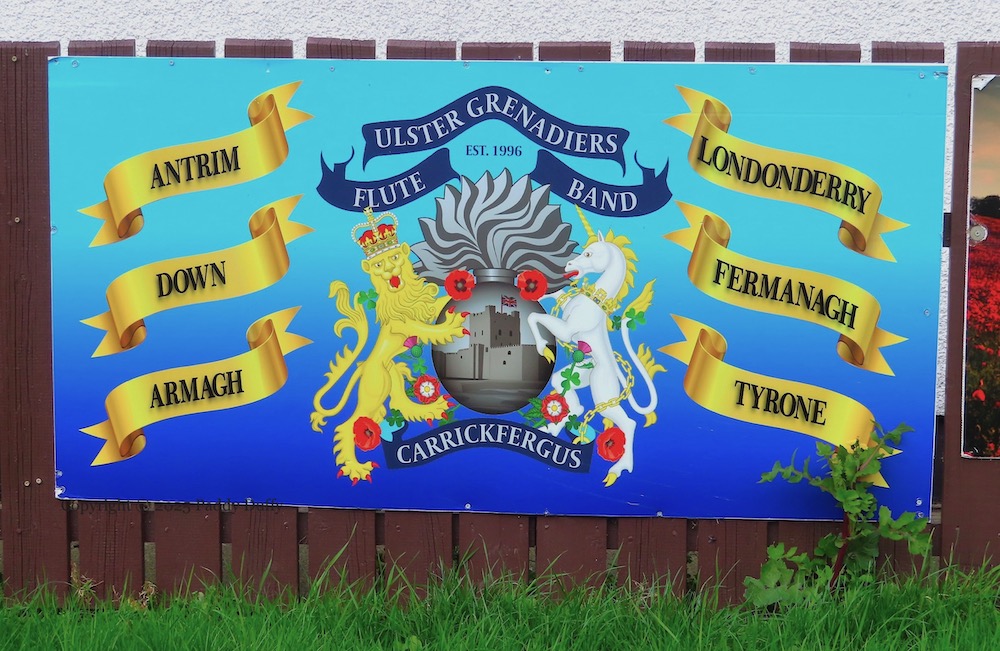
Here are two new small boards on the fence where Hawthorn Avenue and Sandes Court meet between Woodburn and Sunnylands. Above, “Remembering our fallen everyday [sic]” with images of soldiers from the World Wars and UVF emblems in the corners. Below, an Ulster Grenadiers flute band (Fb) board, similar to the large board mounted last year (2024) in St Bride’s Street – see Never Forget, Always Remember.
The main board, on the gable beyond – “Loyalist Woodburn celebrates 100th anniversary Northern Ireland” – and Captain Sir Tom Moore remain as in 2022’s entry – see Maintain The Union.
This entry updates 2023’s Harryville Says No with images of two additional boards/plaques erected by the 12th Battalion Royal Irish Rifles Memorial Association (Fb), “in honour of the men from Harryville [Ballymena] who made the ultimate sacrifice during the Battle Of The Somme from 1st July to 18th November 1916”.
“Remembering 57386 Sergeant John McNabney, formerly of No 9 Larne Street, 36th Divisional signal company, awarded the distinguished conduct medal, military medal with bar, and mentioned in despatches.” McNabney’s career and many decorations are described in Ballymena Guardian | Your Lurgan.
This is a printed version Wilfrid Spender’s report of the first day of the Battle Of The Somme, replacing a previously painted instance that was in the same style as the adjacent mural.
“‘I am not an Ulsterman but yesterday the First of July, as I followed their amazing attack, I felt that I would rather be an Ulsterman than anything else in the world. My pen cannot describe adequately the hundreds of heroic acts I witnessed, the Ulster Volunteer Force, from which the Division was made, has won a name that equals any in history. Their devotion deserves the gratitude of The British Empire’ – Captain Wilfrid [not “Wilfred”] Spender, The Somme 1916″
Spender’s words are superimposed upon JC Beadle’s Attack Of the 36th Division (see Over The Top).
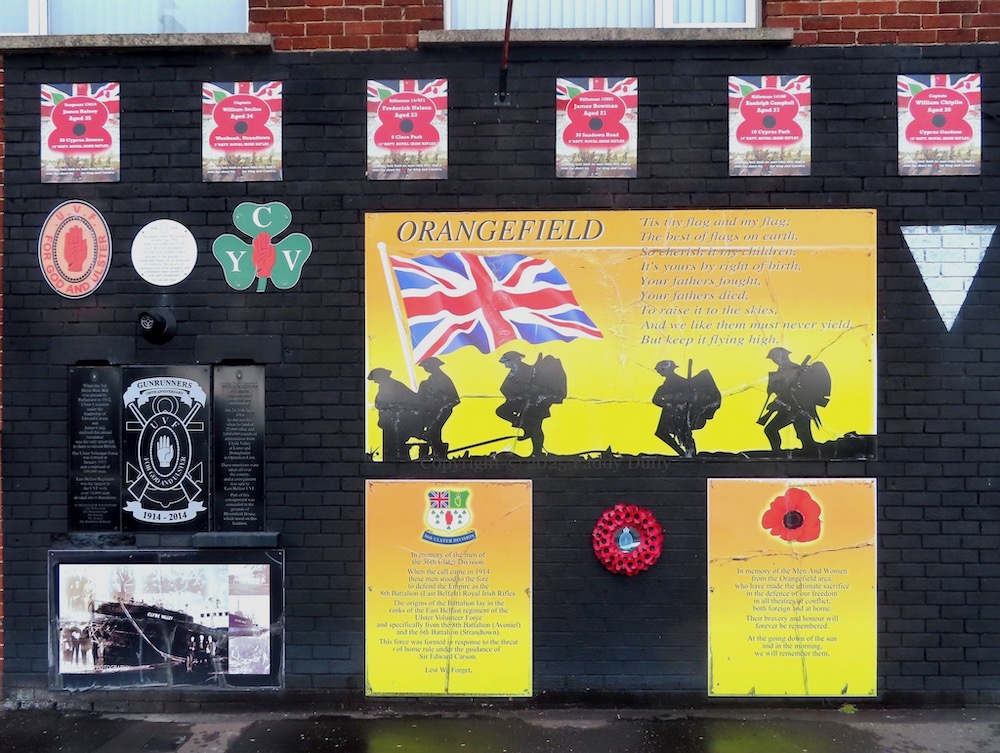
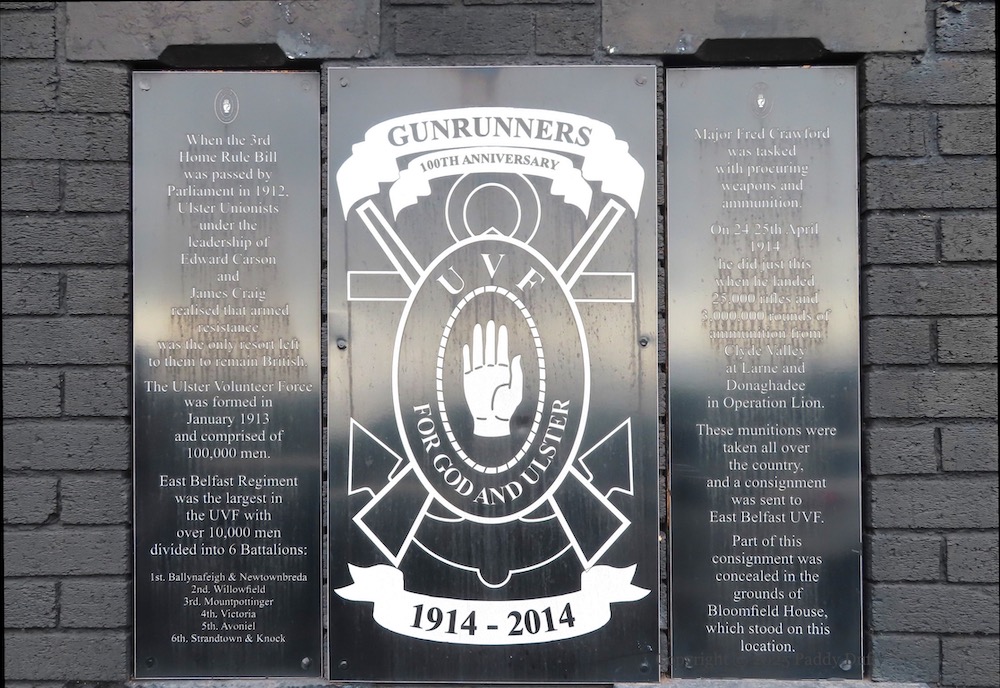
The image above shows a unified and wider view of the two pieces seen previously in Bloomfield House and In All Theatres Of Conflict: on the left, a board marking the centenary of the Ulster Volunteers’ ‘Larne Gun-Running’; on the right, a board commemorating the casualties from the 36th (Ulster) Division in WWI; above them both are small boards from the ‘Poppy Trail’ collection of deceased locals.
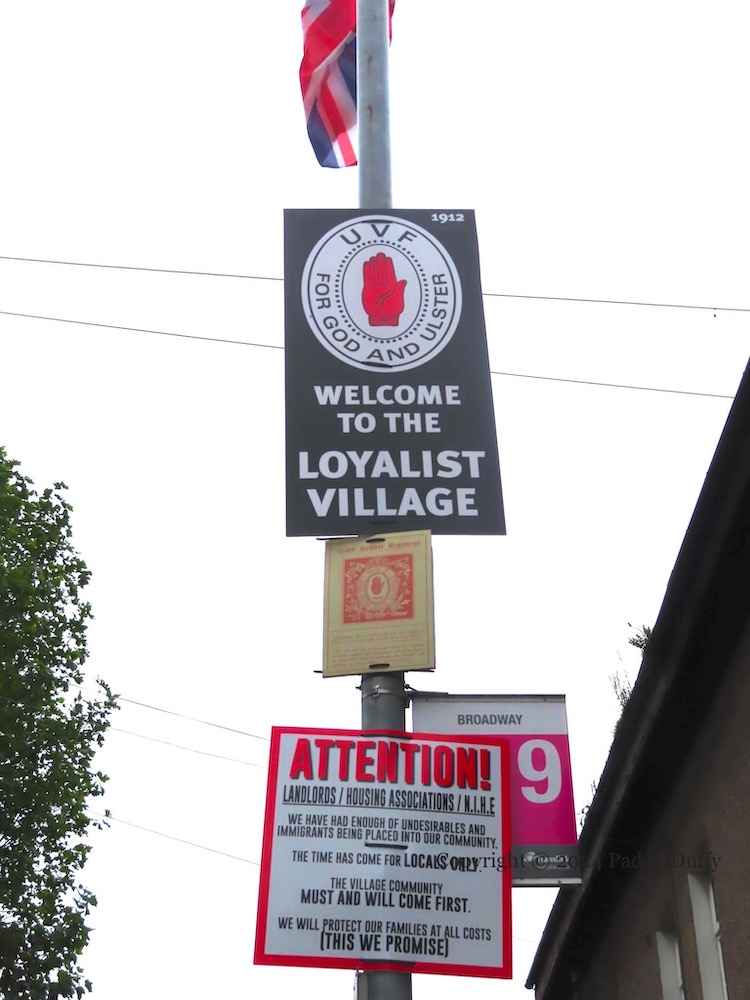
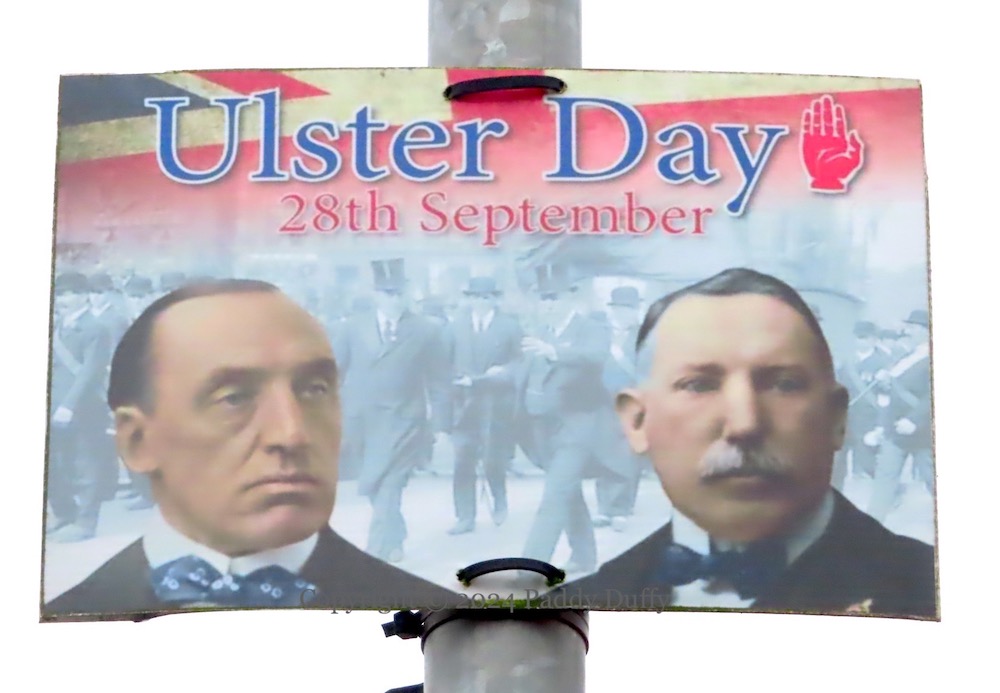
Here is a selection of placards from the Village in south Belfast, many on the theme of the fight against Home Rule in 1912 and the creation of Northern Ireland in 1921.
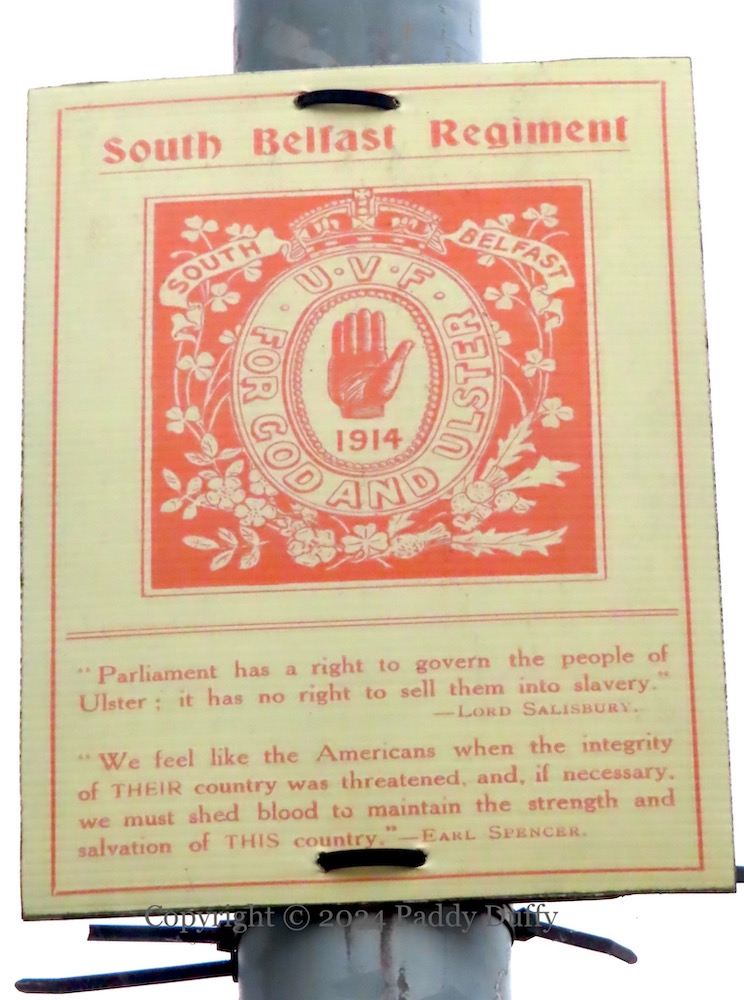
The most interesting is perhaps the small placard sandwiched (in the image below) between the UVF territorial marking (see e.g. Welcome To The Village) and the “warning” to landlords (see Not A Dumping Ground). The quote form Salisbury – “Parliament has a right to govern the people of Ulster; it has no right to sell them into slavery” – comes from a speech made in 1892 (Launceston Examiner) and Spencer was addressing the Lords in 1893 when he said, “We feel like the Americans when the integrity of THEIR country was threatened, and, if necessary, we must shed blood to maintain the strength and salvation of THIS country” (Hansard). Both statements, that is, were made in connection with the second Home Rule bill (of 1893) rather than the third as the “1914” crest of the “South Belfast regiment” of the Ulster Volunteers would suggest.
Below is a reproduction of a stamp featuring Edward Carson, described in the Notre Dame collection. These stamps were sold as a fundraiser; they were not used for postage.
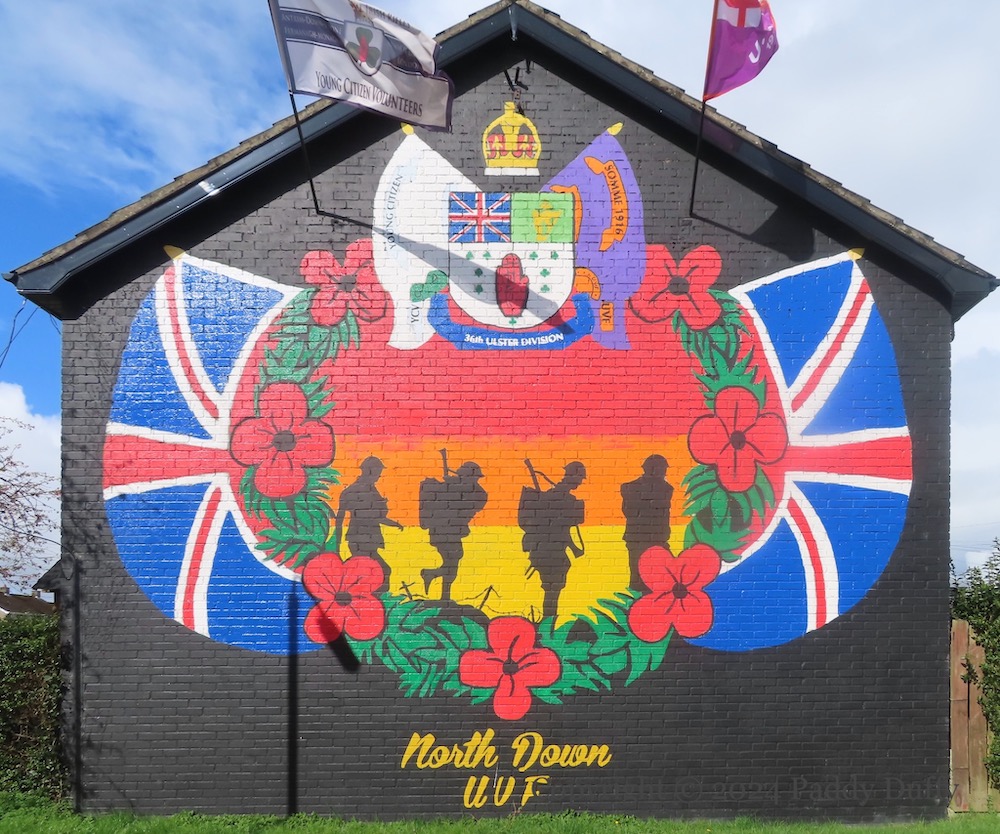
Each quadrant of Down (north, south, east, west) gave rise to a battalion of Ulster Volunteers, and North Down comprised 15 companies, almost doubling the typical British-Army size of eight companies (History Ireland; see also another History Ireland article on the initially sporadic development of the Volunteers out of Unionist Clubs).
Upon the outbreak of the Great War, the Down volunteers joined the 13th battalion of the Royal Irish Rifles, which were assigned to the 108th brigade of the 36th Division of the British Army.
The mural shown in this entry is a recent repainting; the previous version was painted in 2017 (and originally c. 2007 – see M03697).
See also: Only A Few Minutes – a memorial mural to Bangor native James Samuel Davidson, of the 108th and a North Down volunteer.
Clandeboye Road, at the bottom of the Kilcooley estate.
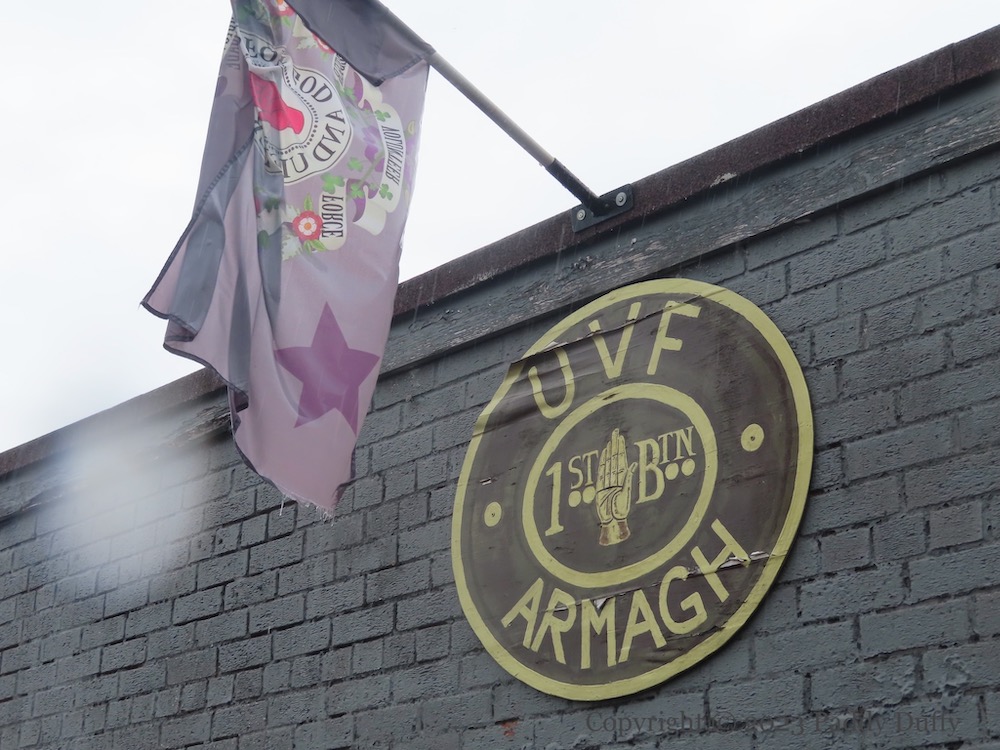
These two boards from the Armagh True Blues flute band (Fb) in Barrack Hill commemorate the Ulster Volunteers of 1912 who went on to join the 9th (County Armagh) battalion of the Royal Irish Fusiliers (Wartime Memories).
The “1st batt” emblem (in the third image) applies to both the Ulster Volunteers of the Home-Rule era and the Troubles-era Mid-Ulster UVF.








 Paddy Duffy Collection