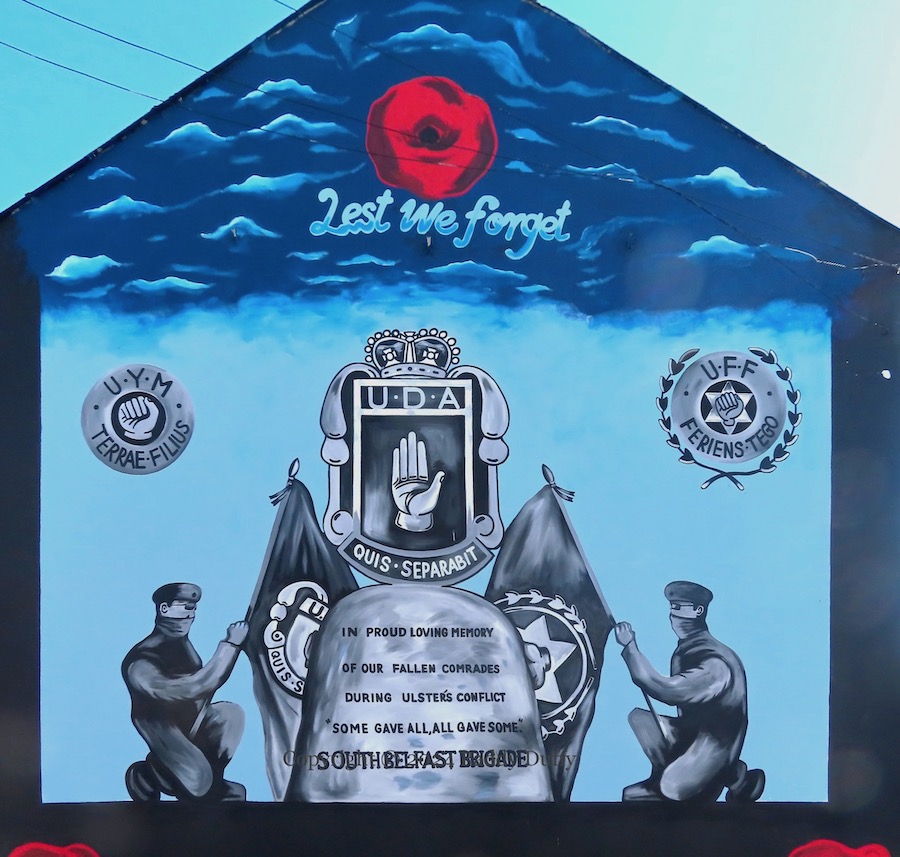
“In proud [and] loving memory of our fallen comrades during Ulster’s conflict. ‘Some gave all, all gave some.’ South Belfast Brigade.” According to Sutton, 91 UDA members died during the Troubles (CAIN).
The text on the side-wall reads, “Death is not an honour but a sacrifice and those who gave that sacrifice are remembered by those that followed. Quis separabit.”
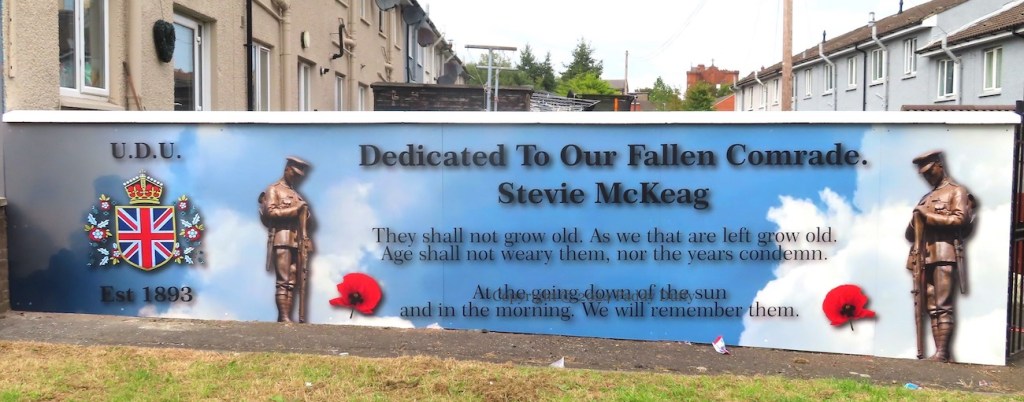
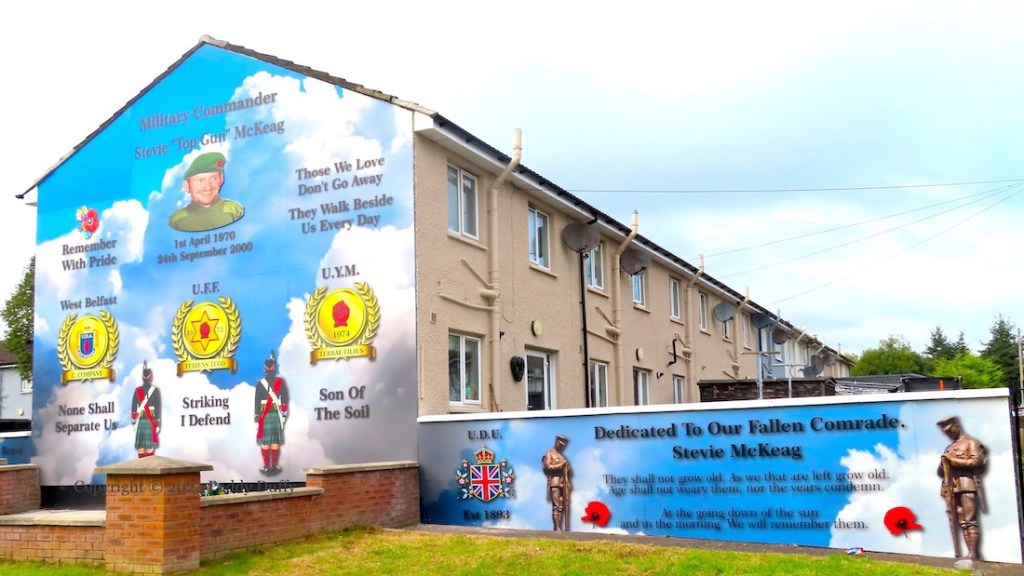
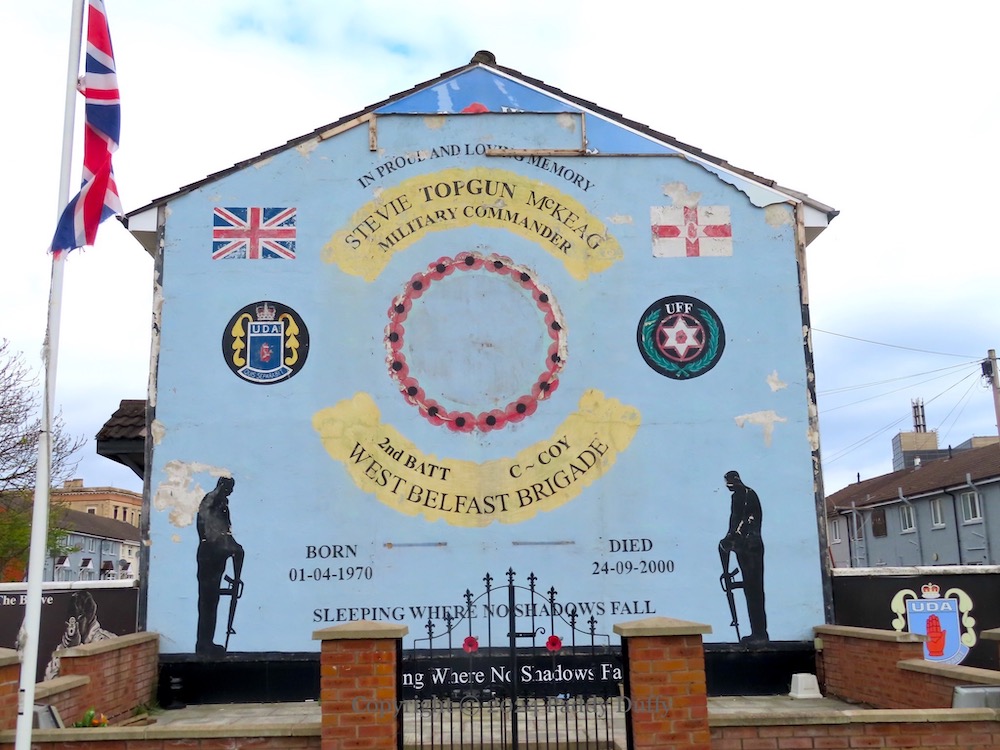
After a long spring and summer of inaction, a new tribute to UDA assassin Stevie “Top Gun” McKeag has been put in place in the lower Shankill, replacing the flat-capped version of 2016.
In Tolstoy’s War And Peace, the prince Andrei Bolkonsky at one early point remarks, “It is not given to people judge what’s right or wrong. People have eternally been mistaken and will be mistaken, and in nothing more so than in what they consider right and wrong.” But after he is wounded at the Battle Of Austerlitz in 1805 and again in 1812 at the Battle Of Borodino, he loses his admiration for the blood-thirsty Napoleon and for war in general, and comes to think that events are a function of many individual decisions.
Stevie McKeag, hit-man for the UDA’s second battalion (west Belfast) ‘C company’, killed at least a dozen Catholics between 1990 and 1998 (WP). The version presented on the left-hand side-wall (just below) begins, “It is not given to people to judge what’s right or wrong. People have internally been mistaken and will be mistaken …” which seems to be contradictory, and then continues “… and in nothing more than in what they consider right and wrong” which is difficult to parse so as to give the intended meaning.
The mirrored hooded gunmen on either side of the quote come from an old mural in the estate – see UDU-UFF-UDA.
The smiling McKeag is here shown in the main panel wearing a green beret (as is the anonymous volunteer in the side-wall) and commando jumper (with shoulder patches) as though he were a “military commander” in the Commandos or Royal Marines of the British Army. The UDU, the poppies, and the graveside mourners in the right-hand side-wall are used to put McKeag’s actions in the context of resistance to Home Rule and the British Army’s role in the Great War.
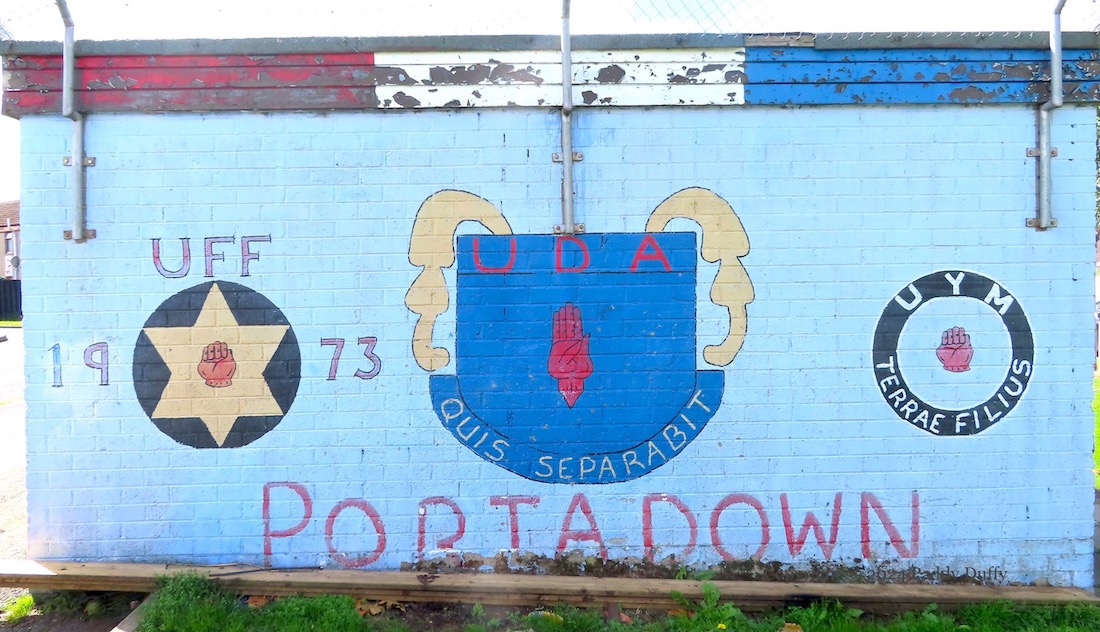
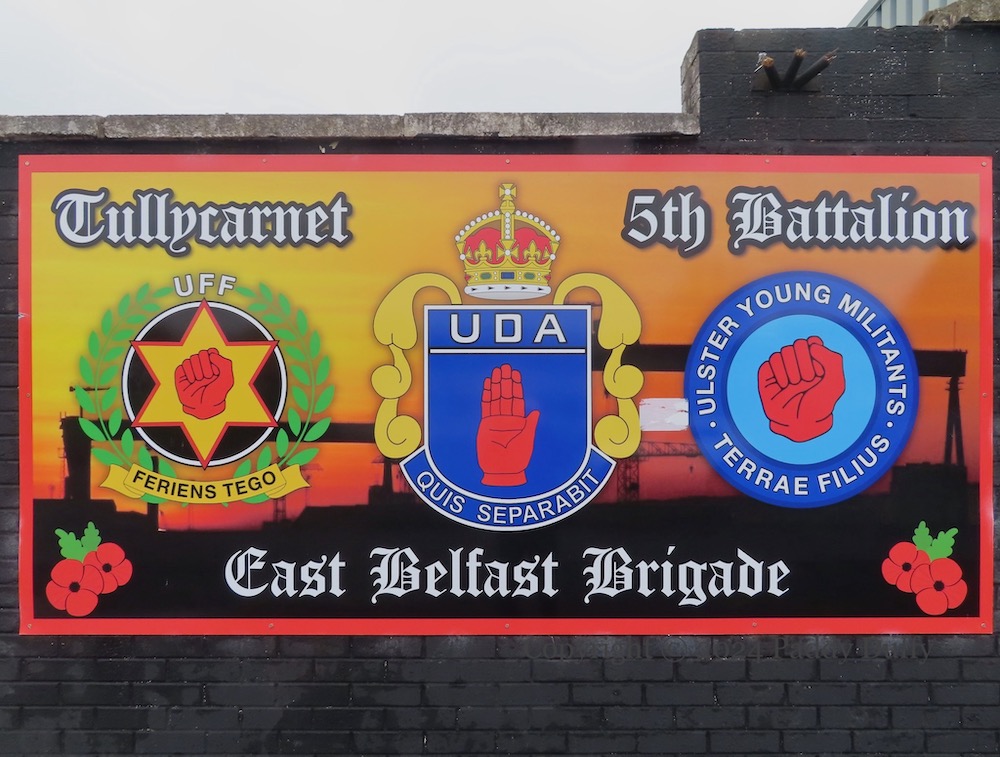
For the composition of the main panel, as well as its use of boards on top of the background, compare with the UDA piece in the Woodvale. The translation into English of the UDA’s, UFF’s, and UYM’s Latin mottos – [Quis separabit] / None shall separate us | Feriens tego / Striking I defend | Terrae Filius / Son Of The Soil – is unusual, as is the bouquet of flowers behind the poppy.
For more, including the mourning soldiers, see the entry at Extramural Activity.
“Land of the free because of the brave”. “Remember with pride”. “Those we love don’t go away/They walk beside us every day”. “Dedicated to our fallen comrade”.
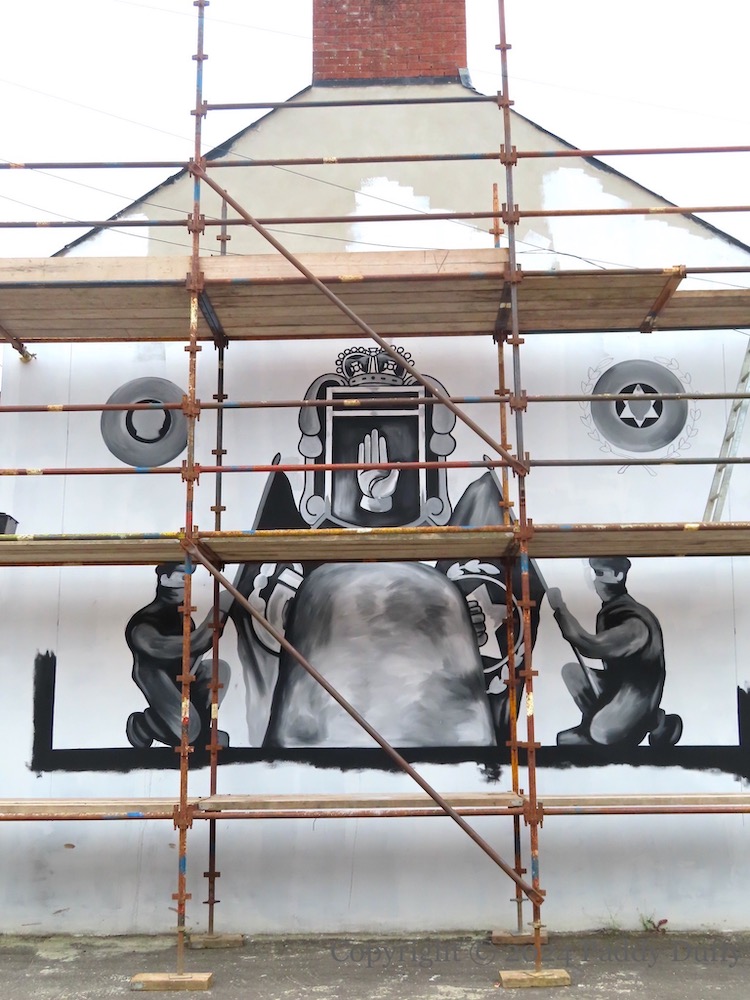
April 25th, 2024: The boards were taken off, revealing an older version that stood 2010-2015.
[In the middle circle there were, over the years, a series of printed portraits of McKeag (and one painted version). For the version from 2014, see M11119; see also the image 2011, which links back to other versions from 2010, 2009, 2008, and 2007).]
May 3rd, 2024: Scaffolding in front of the wall
This layer of paint (and plaster?) was also taken off, to reveal the remains of the original King Rat mural on the wall – see X15041 in the Seosamh Mac Coille collection.
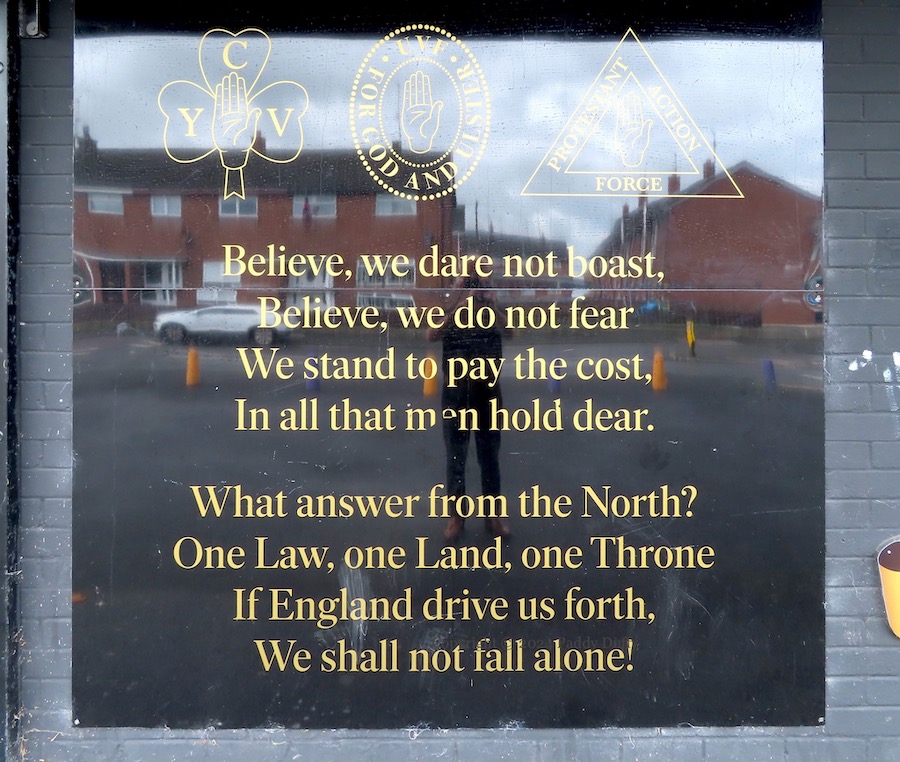
These are the boards at the chip shop (formerly a Spar and before that a Mace) in the centre of the Mourneview estate, Lurgan.
Above, and in detail below, are the pieces from the front of the shop, in Pollock Drive. Anti-clockwise from bottom-left:
First: “Believe, we dare not boast,/Believe, we do not fear/We stand to pay the cost,/In all that men hold dear.//What answer from the North?/One Law, one Land, one Throne/If England drive us forth,/We shall not fall alone!” Kipling’s poem Ulster.
Next (tall piece): A company, 1st battalion, Mid Ulster brigade UVF – Lurgan as well as Broxburn (outside Edinburgh) and Thornliebank (near Glasgow).
Next: PAF plus (out of frame in the wide shot) “When injustice becomes law resistance becomes duty.” The same panel was seen in Ballyclare, though for the 1st East Antrim battalion rather than the Mid Ulster brigade.
Above: A tribute to the Ulster Volunteers from the area: the 9th battalion Royal Irish Fusiliers joined the 108th brigade in the 36th (Ulster) Division; the 5th battalion joined the 31st brigade and the 10th (Irish) Division. This board goes back to (at least) 2011.
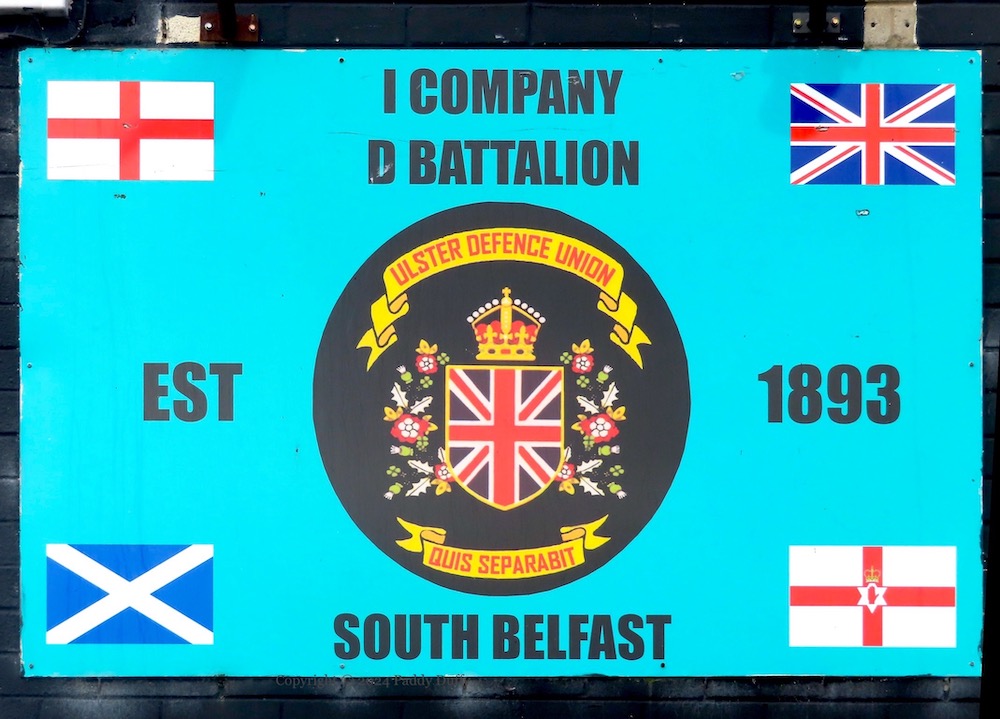
Finally (top left), a UDU/UDA board, to 1 company, D battalion, South Belfast. All of the remaining pieces are UVF/PAF.
Around the corner, in Mourne Road, a gallery of photographs of the Craigavon Protestant Boys (Fb) past and present, with a plaque in memory of Victor Stewart. “Our only crime is loyalty.”
In the adjacent Spelga Park: “Unbowed & unbroken – our only crime is loyalty – Mourneview/Gret estate bonfire” with an unusual combination of shamrock and Orange lily.
This is a vintage UDA mural in Moeran Park, in the Rectory area of Portadown, still in reasonable shape after more than a decade – compare this image with the 2011 image in the Peter Moloney collection.
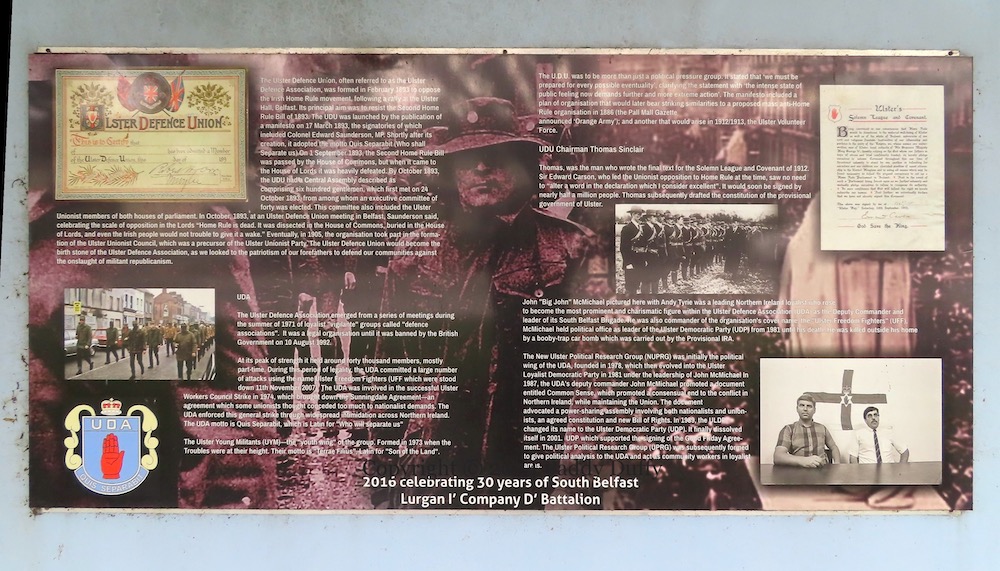
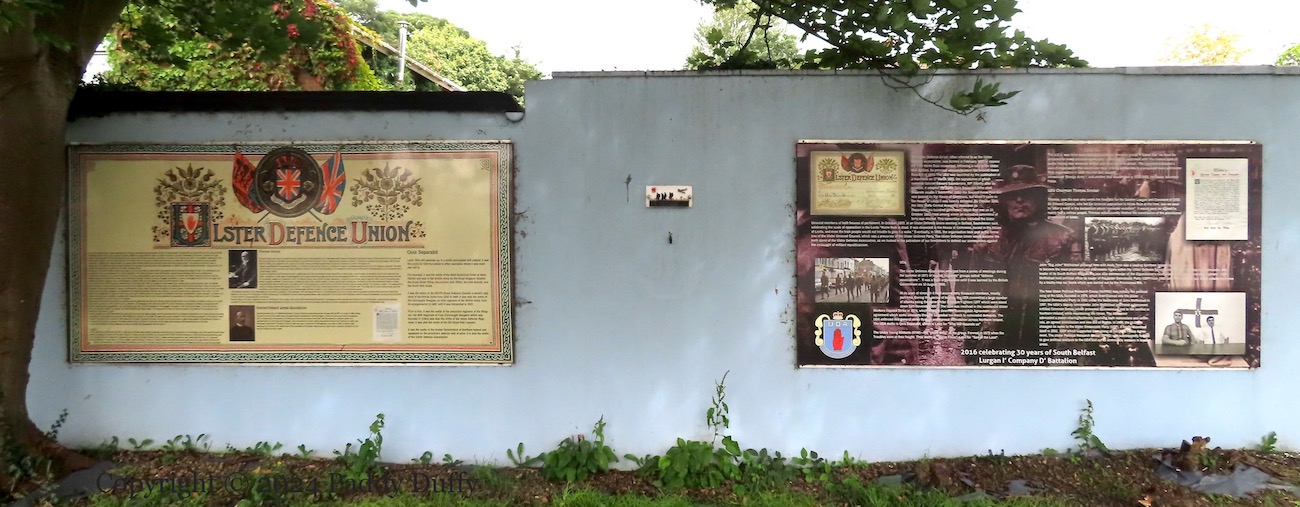
These are the UDA boards on Avenue Road, near Lurgan Park, which proved controversial when they were erected (in 2016), mainly because the second piece (below) “celebrat[es] 30 years of South Belfast/Lurgan 1 company D battalion” UDA and shows Troubles-era shows-of-strength (News Letter) and because it turned out the wall was owned by the Housing Executive (NIWorld).
The piece above describes the creation of the UDU in 1893, as a response to the second Home Rule bill, which was passed by the Commons but rejected in the Lords, and which Edward Saunderson celebrated by saying, “Home Rule is dead. It was dissected in the House of Commons, buried in the House of Lords, and even the Irish people would not trouble to give it a wake”. The UDU is as used an origin-story for the UDA, though often in vague terms, such as the verbiage here which reads “[the UDU] would become the birth stone of the Ulster Defence Association, as we looked to the patriotism of our forefathers to defend our communities”. (For more, see UDU-UFF-UDA. For Saunderson, see Union Is Strength.)
This year (2024), UVF lettering a stone’s throw away, on the other side of the entrance to the park, likewise drew criticism (BelTel | ArmaghI), but it has now been removed.
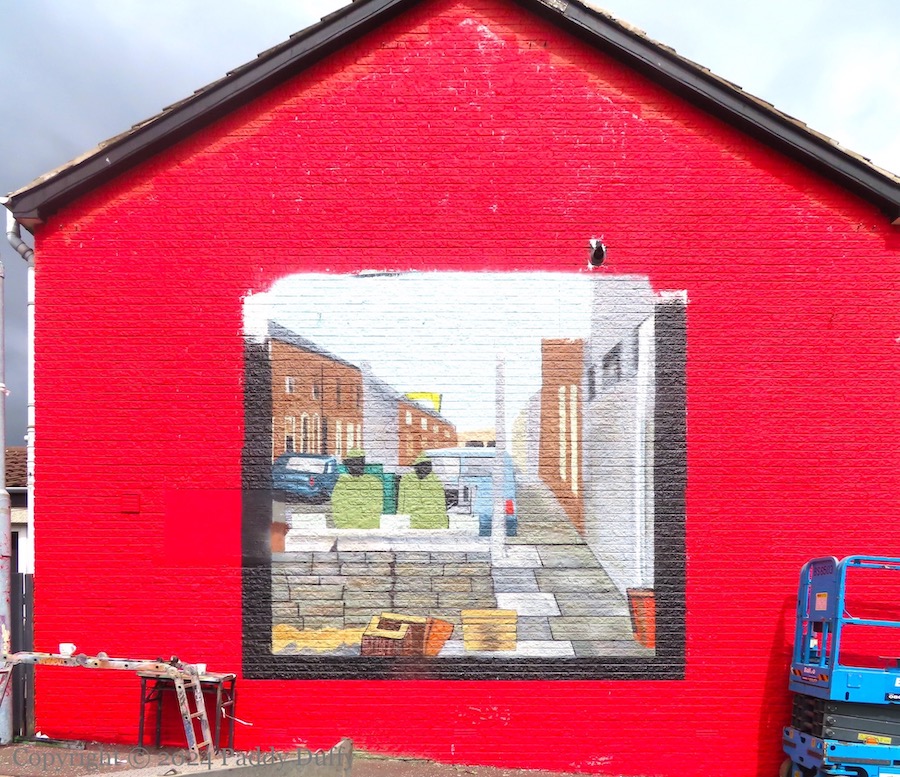
The scaffolding has been down from this obviously incomplete mural in Kilcooley, Bangor, and work on it seems to have ceased. The reasons for its abandonment are unclear.
A black street sign out of shot to the right (which can be seen in the third image, as well as a UDA emblem at the top) reads “Humber Street” – Humber Street was in east Belfast, at the top of Dee Street. We have not been able to locate this or other photographs of barricades in Humber Street. The period is presumably c. 1972, when the UDA set up no-go areas in Belfast (Pathé video; AP videos: one | two | three).
The other mural, on the left of the wide shots, is to East Belfast UDA brigadier Tommy Herron. As can be seen in the earliest in-progress image, below, the mural replaces the North Down Defenders mural.
The “completed” images, above, are from June 30th; work began at least two months previously.
This UDA board is at the bottom of Linn Road (Larne) at the entrance to the Antiville estate. “Antiville” is perhaps derived from the Irish “an tıgh bhıle, “the house of/by the sacred tree”.
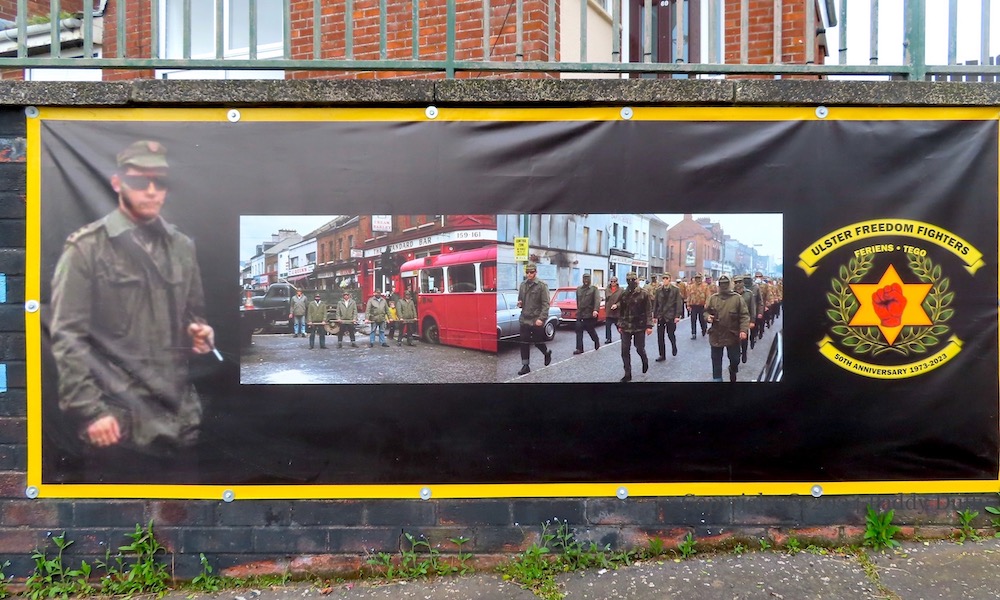
The UDA began using the “Ulster Freedom Fighters” name from February 1973 onwards in order to avoid the UDA becoming a proscribed organisation, though its members had already killed dozens of people in 1972 and January 1973 (WP timeline). (Fifty Years Of Service (in Ballymoney) marks the fiftieth anniversary – in 2021 – of the UDA.)
The tarp shown above likewise conflates the UDA and UFF, with two images from 1972, before the “UFF” name was used; on the left, the men marching behind a van marked “UDA Patrol” are on the Shankill Road (BelTel); on the right, four men stand at a barricade in the Woodvale (Victor Patterson).
The images in the second tarp show (left) a bus blocking Agnes Street and four men blocking the Shankill Road (Getty – no date given) and (right) a 1975 march in Belfast (Som Tribune).
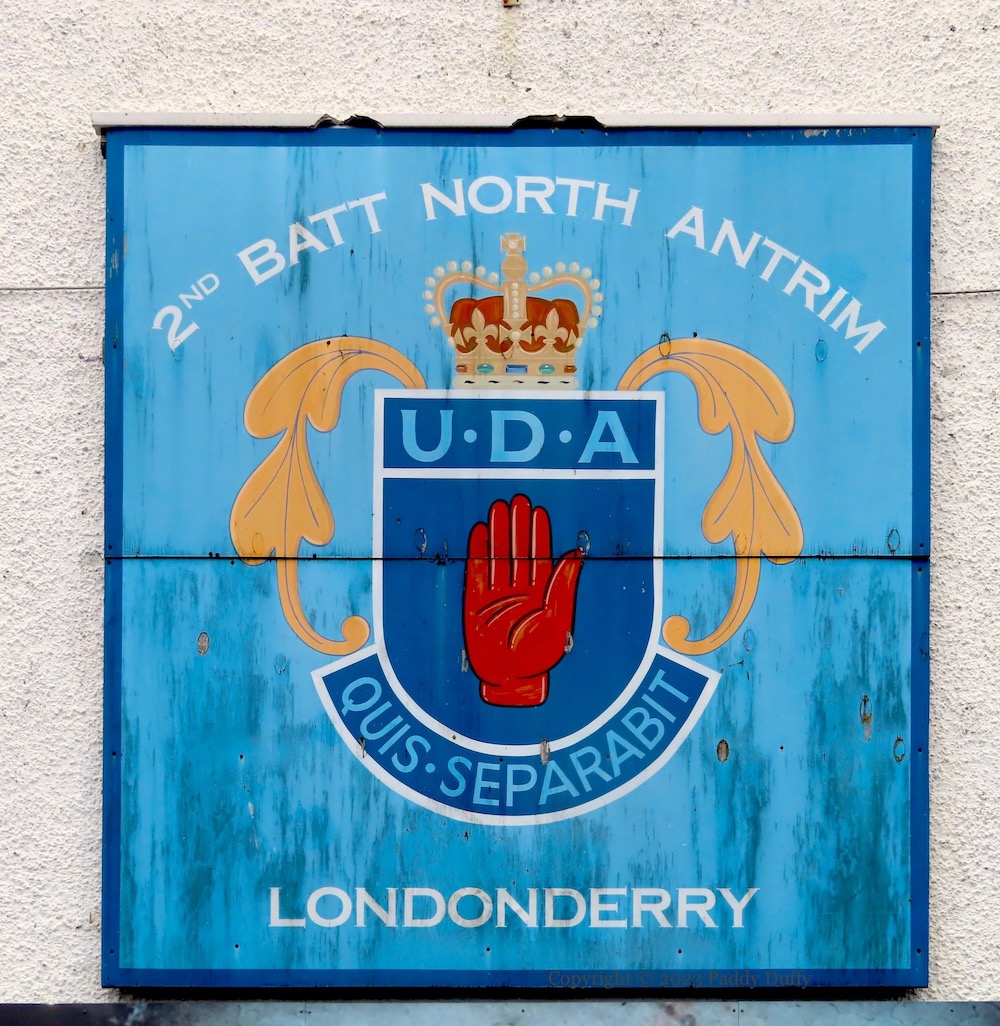
An anti-drug-dealing message (see Peace Impact Programme) has been added below the (2nd battalion North Antrim & Londonderry) UDA emblem (seen previously in 2012) in Linden Avenue, Coleraine.

















 Paddy Duffy Collection