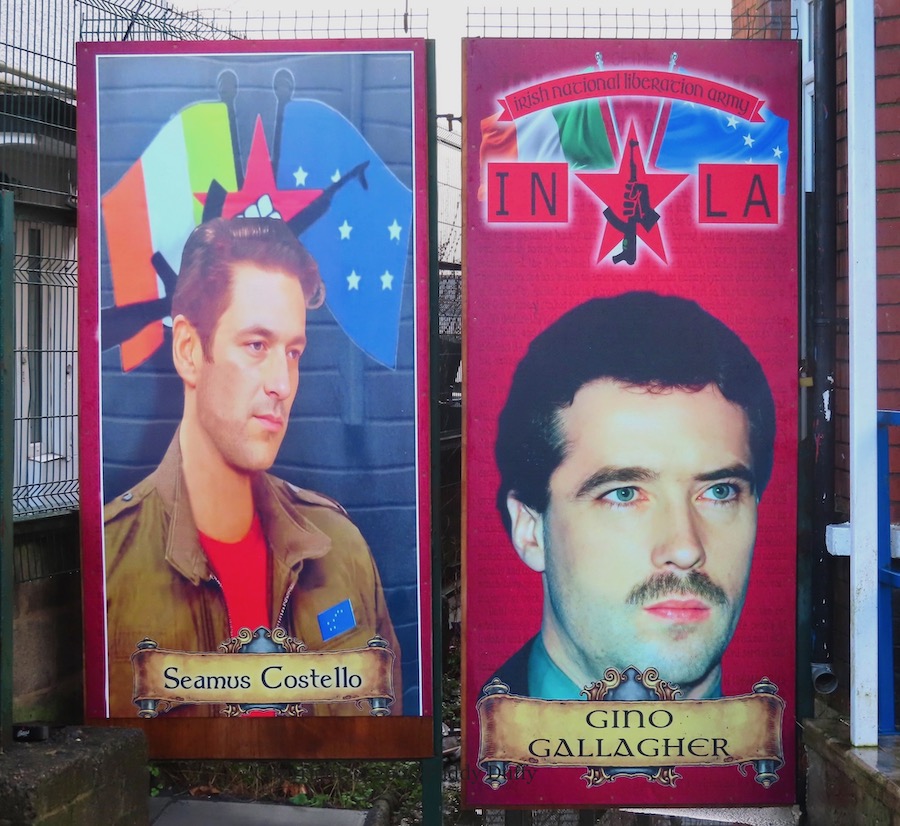
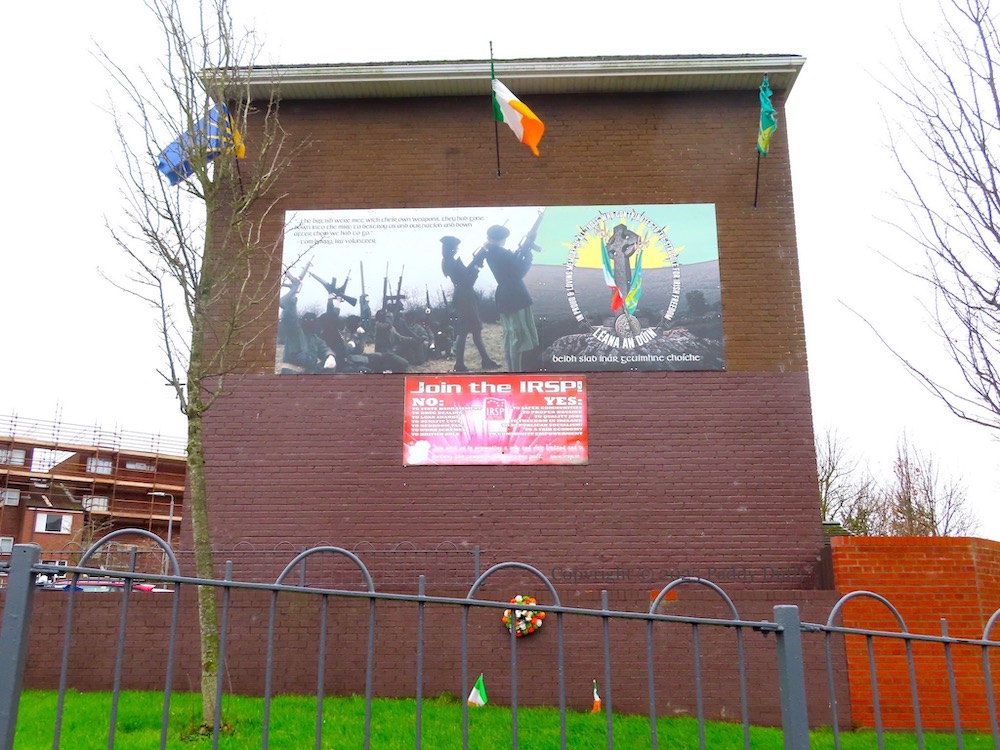
Costello House, home of the IRSP and site of these two new boards, is named after Seamus Costello (b. 1939), who fought for the IRA during the Border Campaign and was interned in the Curragh for two years. He stayed with the Officials during the split, but was driven out in 1974 and formed the Irish Republican Socialist Party (IRSP) and the INLA. He was shot and killed in 1977 (WP).
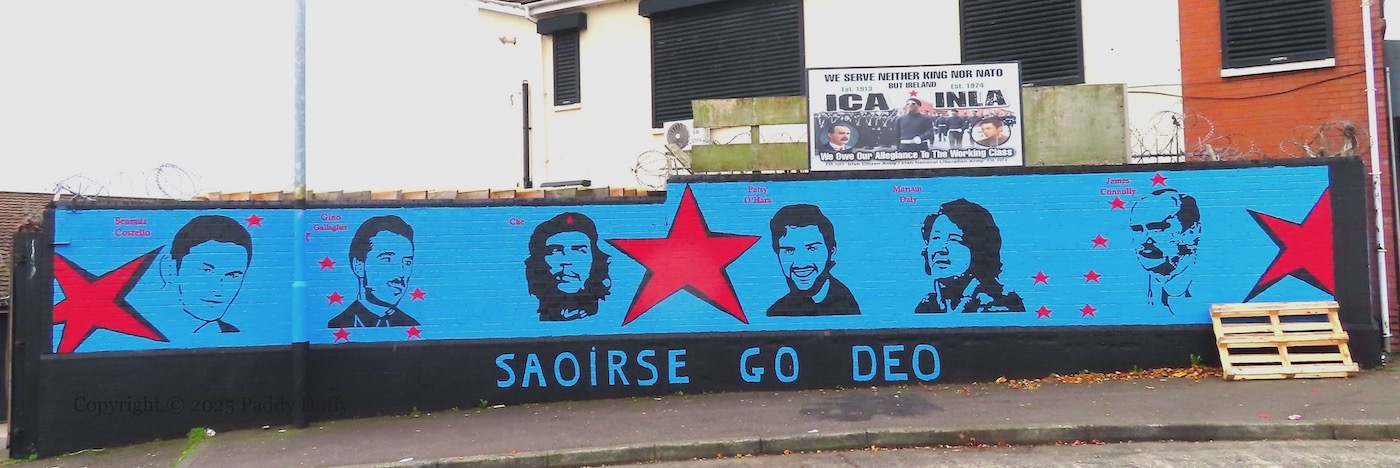
Costello appears alongside one of his successors as INLA leader, Gino Gallagher, for whom see the recent Gino Gallagher, Chief Of Staff.
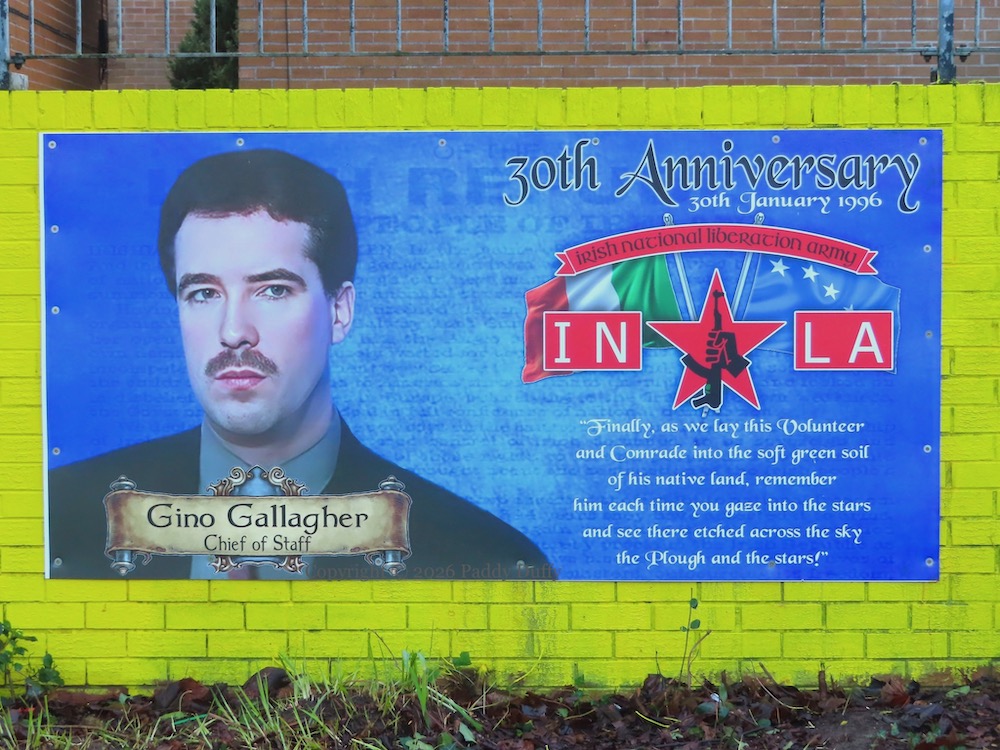
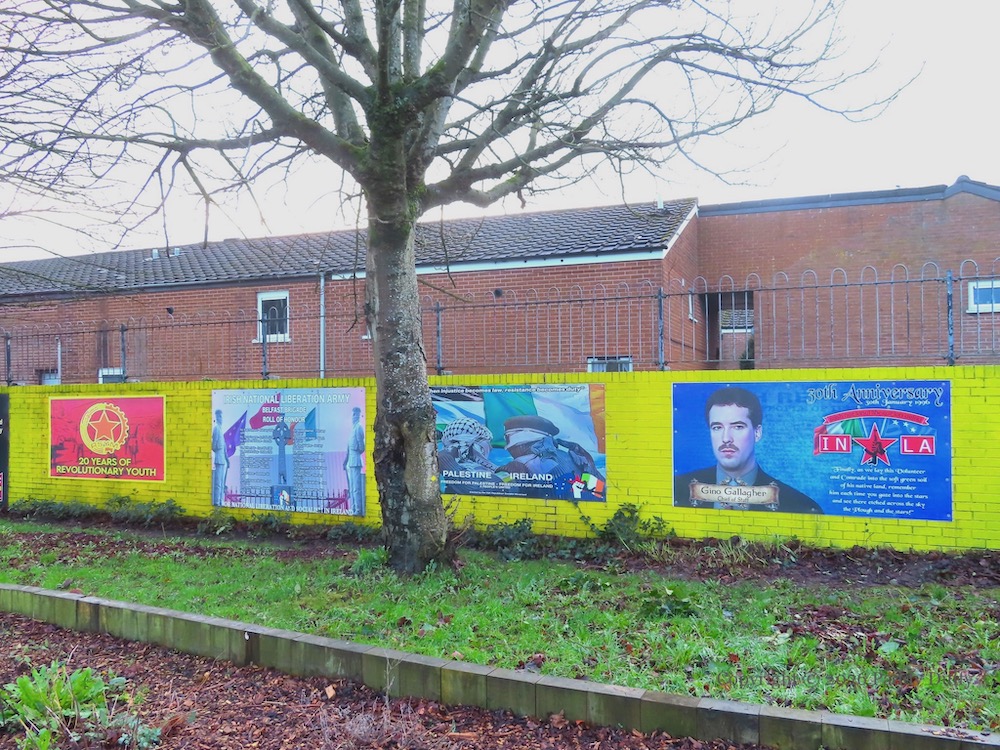
This memorial board to Gino Gallagher was mounted the day before the thirtieth anniversary of his death in 1996, possibly by former colleagues (Irish Times | Republican News). On the 31st, a colour party paraded to Gallagher’s grave in Milltown (youtube).
“Gino Gallagher, chief of staff, 30th anniversary, 30th January 1996. Irish National Liberation Army/INLA. “Finally, as we lay this volunteer and comrade into the soft green soil of his native land, remember him each time you gaze into the stars and see there etched across the sky the plough and the stars!””
“[They said I was ruthless, daring, savage, blood thirsty, even heartless. The clergy called me and my comrades murderers; but] The British were met with their own weapons. They had gone down into the mire to destroy us and our nation and down after them we had to go. – Tom Barry, IRA volunteer.”
Tom Barry served in the British Army as a teenager and saw action in Mesopotamia and Egypt. The military training served him well when he joined the IRA and soon became commander of the West Cork brigade’s flying column. The quotation above offer a justification for the guerrilla tactics which helped drive the British to the negotiating table. In the Civil War, Barry was on the anti-Treaty side. (WP)
“In proud and loving memory of all those who contributed to the struggle for Irish freedom. Léana An Dúın. Beıdh sıad ınár gcuımhne choíche.”
The red board below is an old (2019) IRSP board, reading, “Join the IRSP. No to state harassment, to drug dealing, to loan sharks, to benefit cuts, to bedroom tax, to work schemes, to British rule. Yes to safer communities, to proper housing, to quality jobs, to freedom in Ireland, to republican socialism!, to a fair economy, to community empowerment. Join with us in promoting a new and fair Ireland and in building the campaign for a border poll. www.irsp.ie“
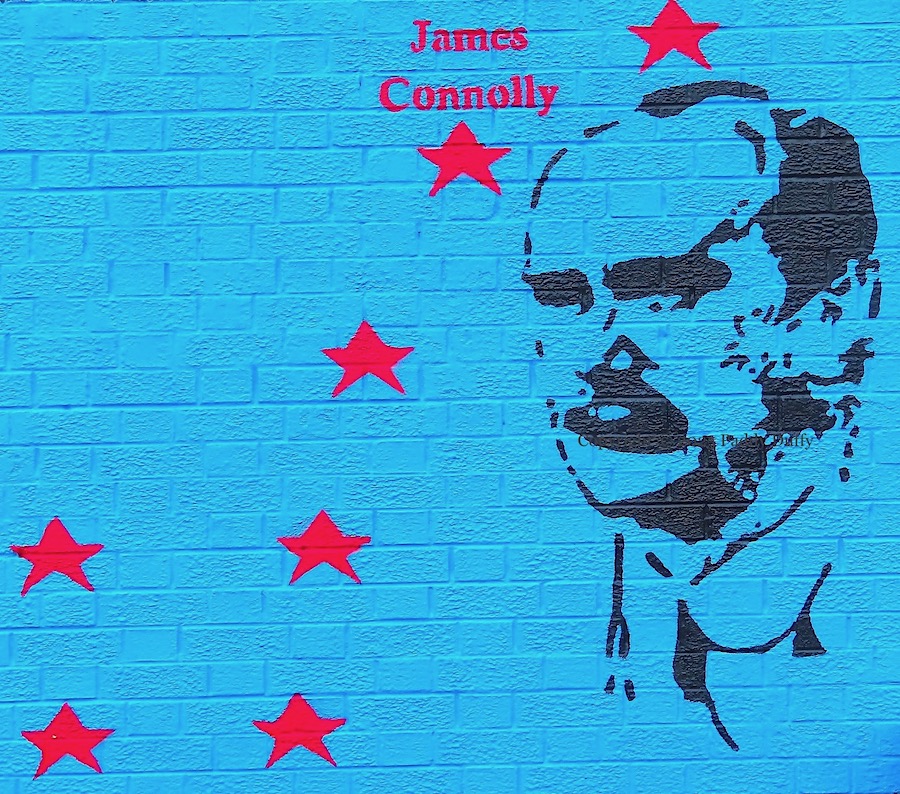
“I owe my allegiance [here “allegience”] to the working class” is a phrase associated with Seamus Costello (b. 1939), who fought for the IRA during the Border Campaign and was interned in the Curragh for two years. He stayed with the Officials during the split, but was driven out in 1974 and formed the Irish Republican Socialist Party (IRSP) and the INLA. He was shot in 1977 (WP). Nora Connolly, at Costello’s funeral, said, “He was the only one who truly understood what James Connolly meant when he spoke of his vision of the freedom of the Irish people.”
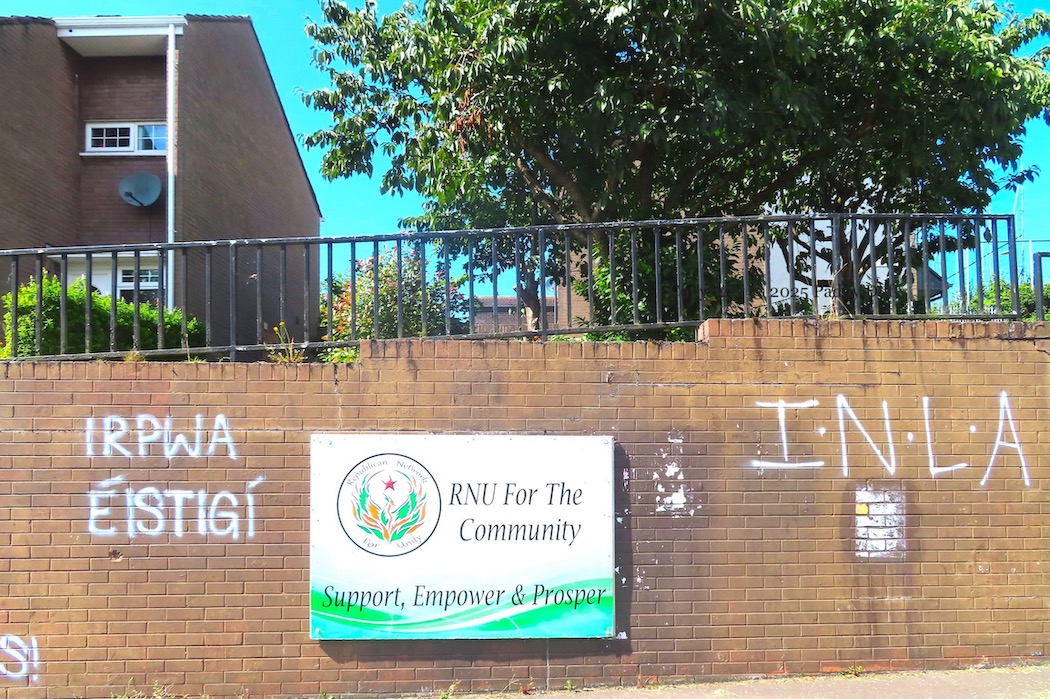
Here are IRSP (web) and RNU (Fb) signs side-by-side in Bishop Street, Derry, both employing the idea of ’empowerment’. Above: “Empower your community – Join the IRSP, the party of Connolly and Costello”; below: “RNU for the community – support, empower & prosper”.
In Irish, the seven bright stars of the celestial group Ursa Major are together known as “an céachta” or “an camchéachta” – the bent plough, though the reason for the modification “bent” is unclear (Vıcıpéıd). (In other cultures they are thought of as a wagon/wain, or dipper, or the hind-quarters and tail of a bear.)
The “starry plough” flag was originally proposed in 1914 for the Irish Citizen Army and flown over the Imperial Hotel during the 1916 Rising (WP); it is now the symbol of the INLA/IRSP (web) and many current anti-Agreement groups,
The starry plough shown here, in Cliftonpark Avenue, north Belfast, has the correct number of stars – seven – but has lost its typical shape.
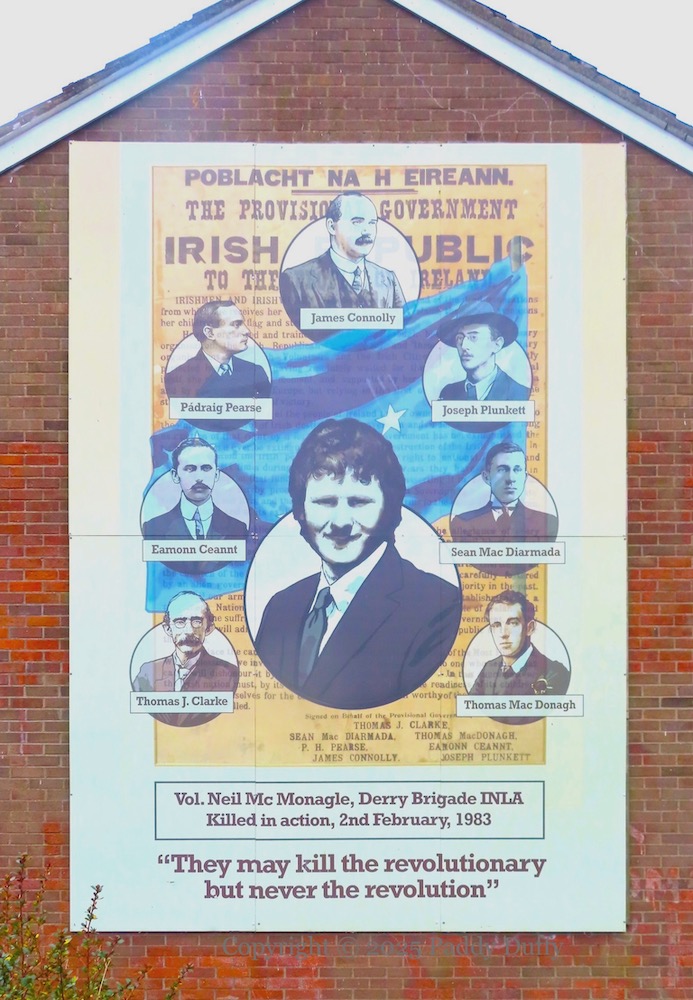
Derry IRA man Neil McMonagle is placed among the seven signatories of the proclamation of the provisional government of the Irish Republic.
The board is in Leafair Park, Derry, close to the spot where McMonagle, aged 23, along with friend Liam Duffy, were shot by undercover British soldiers (specifically Sergeant Paul Oram of 14 Intelligence Company (WP)) on February 2, 1983. McMonagle died instantly while Duffy was wounded but survived. The official account alleged that both McMonagle and Duffy were armed; locals deny this. For an account of the killing and a tribute, see these obituaries from republican publications in 1983.
“Vol Neil McMonagle, Derry Brigade INLA. Killed in action 2nd February 1983. “They may kill the revolutionary but never the revolution.””
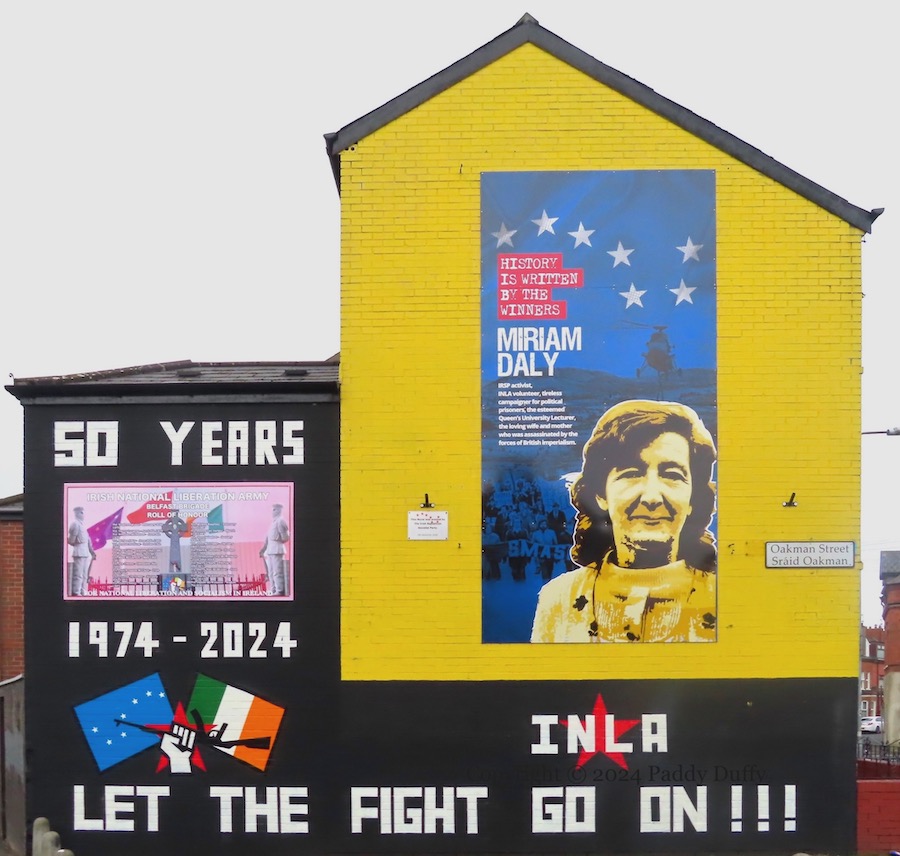
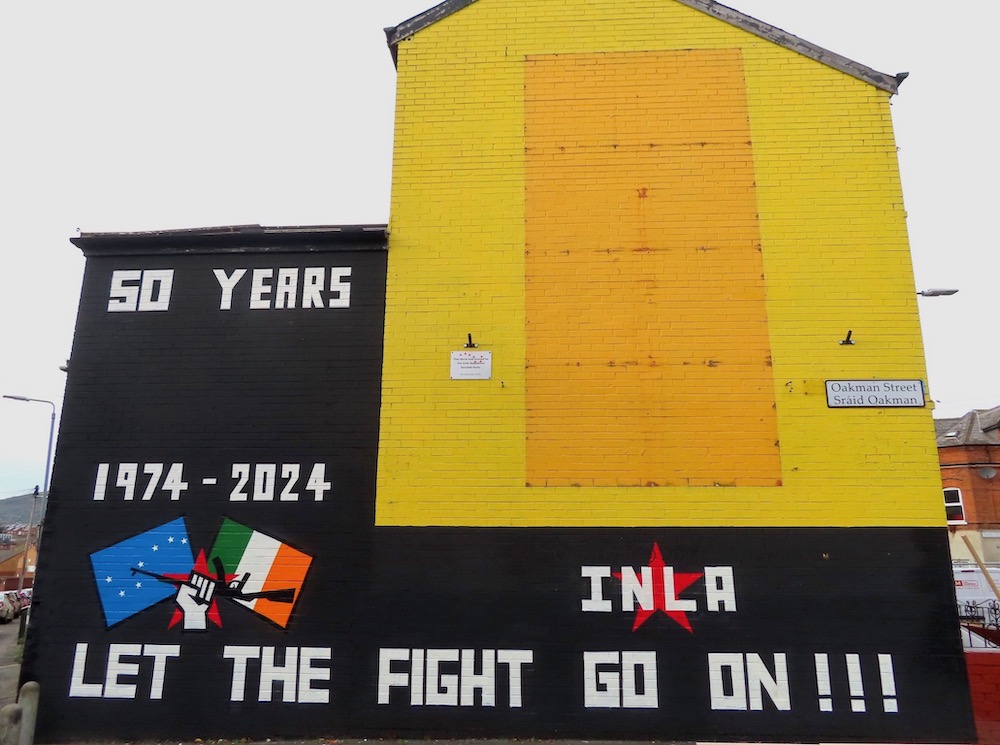
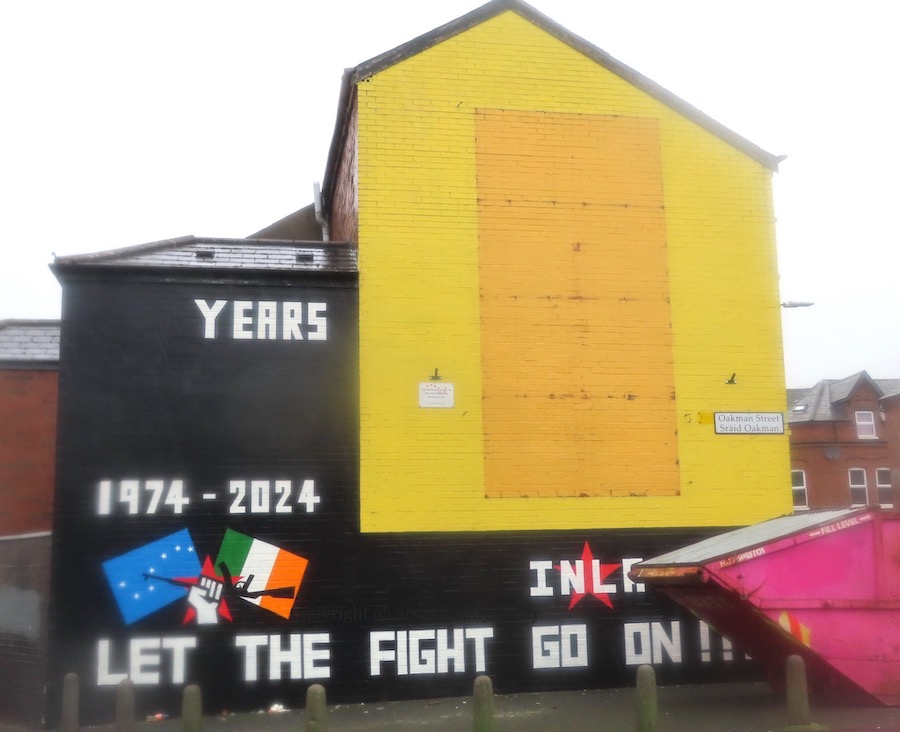
This entry updates Let The Fight Go On!!! from December 1st, which showed the new INLA 50th anniversary wall in Oakman Street but without the (pink) roll of honour on the left. Those listed in the roll of honour are: Hugh Ferguson, Danny Loughran, Brendan McNamee, Miriam Daly, Ronnie Bunting, Noel Little, Jim Power, Matt McLarnon, Joe Craven, Paul “Bonanza” McCann, Thomas “Ta” Power, John O’Reilly, Mickey Kearney, Emmanual Gargan, Gino Gallagher, John McColgan, Patrick Campbell, Christopher “Crip” McWilliams, Harry O’Hara, Barry “Bar” McMullan, Martin McElkerney, James McWilliams. The last five post-date the Agreement, starting with Patrick Campbell, who died in 1999 at the hands of drug-dealers in Dublin (Irish Times | Bel Tel).
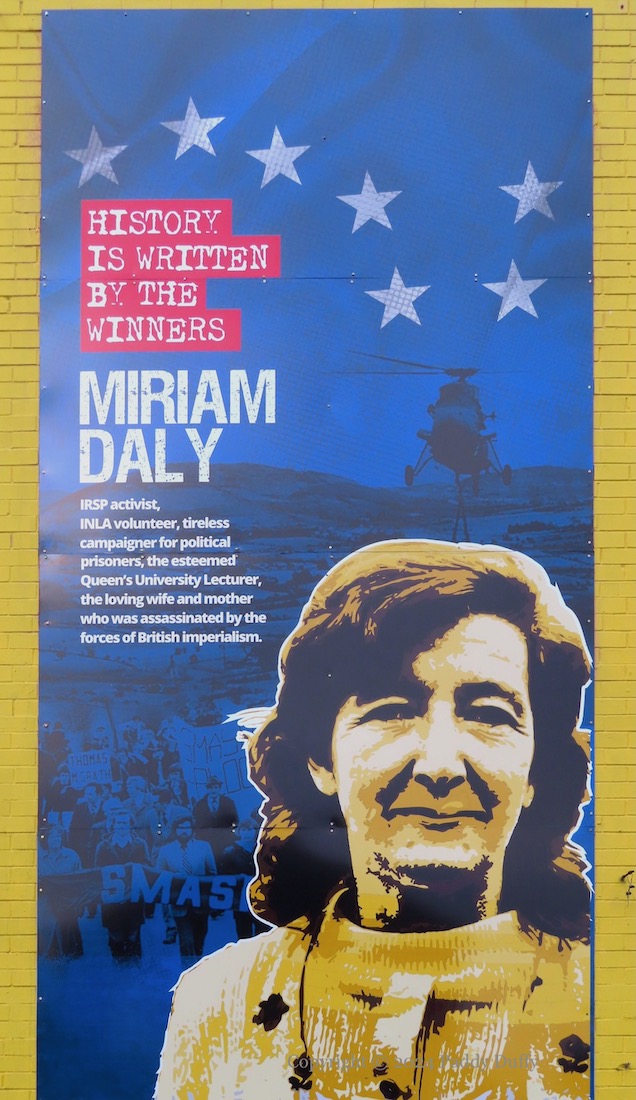
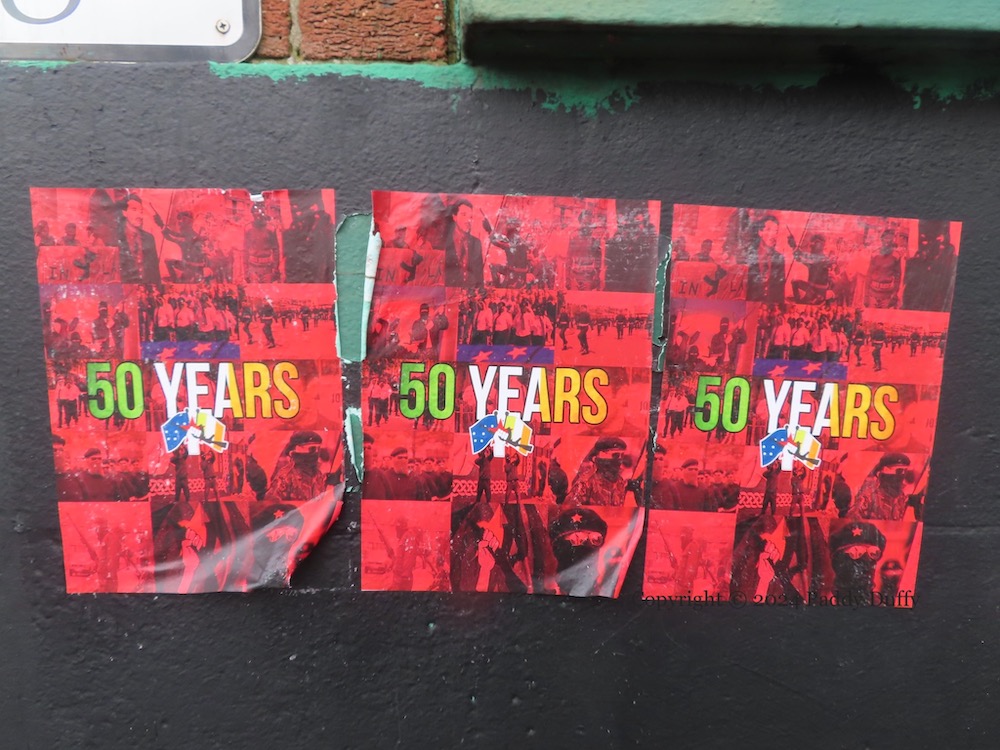
The Miriam Daly board (mounted in 2016) was temporarily taken down while the frame was painted to mark the fiftieth anniversary (“1974-2024”) of the creation of the INLA on December 8th, 1974 (WP). “Let the fight go on” are the final words of (INLA) hunger-striker Patsy O’Hara; the group officially ended its armed campaign in 2009 (BBC).
See also the fiftieth anniversary graffiti in Waterford St | mural and graffiti in the Bogside, Derry.











 Paddy Duffy Collection