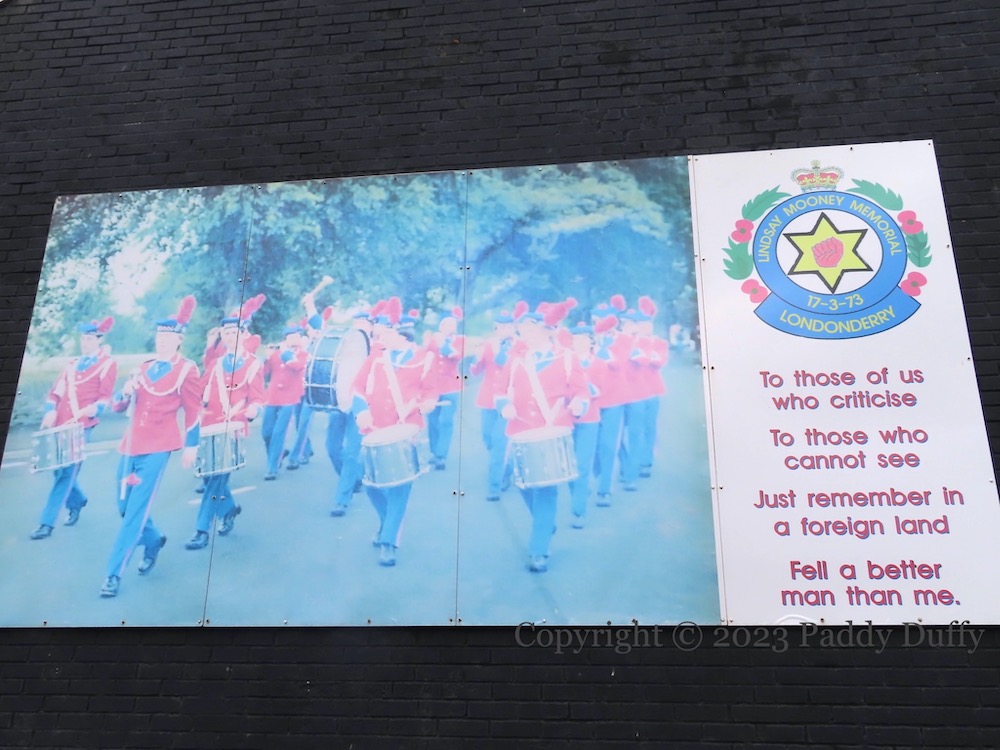
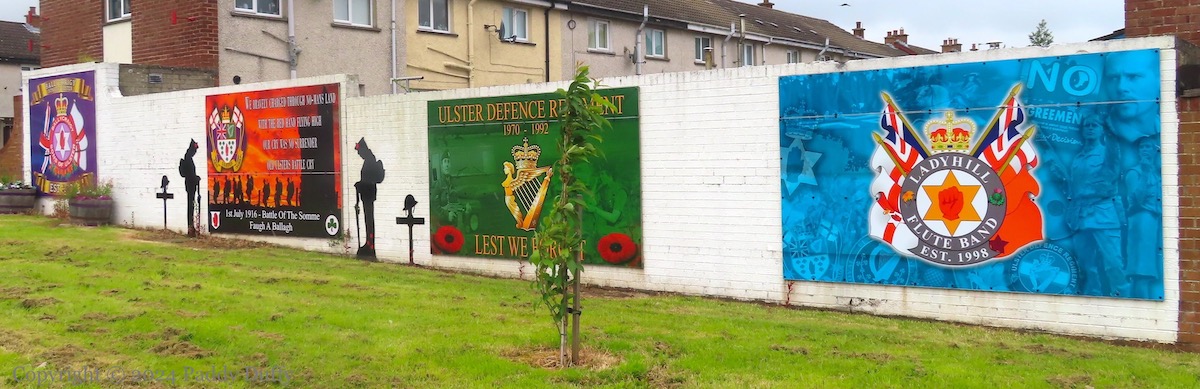
The [Sergeant] Lindsay Mooney Memorial Flute Band was formed in 1973 after the St. Patrick’s day death of Lindsay Mooney, a UDA member killed by the premature explosion of a bomb near Lifford, County Donegal (Sutton). The band dissolved in 1993 but commemorative nights are still held (NI World). It has presumably re-formed, as there are videos on youtube of the band parading in 2021 and in 2022 and they will march for the 50th anniversary of the band later this year (2023) (youtube).
The board above is in the Lincoln Court area of Londonderry, from where Mooney and the band both hailed. “To those of us who criticise, to those who cannot see, just remember in a foreign land fell a better man than me.”
“‘We bravely charged through no-man’s land/With the red hand flying high/Our cry was ‘No surrender’/Old Ulster’s battle cry.’ 1st July 1916 – Battle Of The Somme. Faugh a ballagh.”
“No surrender” was the cry against the forces of James II as they marched on Derry on December 7th, 1688, a moment celebrated by members of the Orange Order, Royal Black Institution, and Apprentice Boys, and from there, possibly shouted on July 1st as the 36th Division, formed from the Ulster Volunteers, attacked Schwaben Redoubt from Thiepval Wood (Irish Times | History Ireland).
The red hand is the emblem of the 36th (Ulster) Division and the shamrock stands for the 16th (Irish) Division, which was not in action on July 1st (the Battle Of Albert) but at the Battle Of Ginchy and Battle Of Guillemont in early September (Long Long Trail). (See also various Messines 1917 murals: Killed Wounded Missing | Comrades In Arms | We Are The dead | Brothers In Arms | Messines 1917
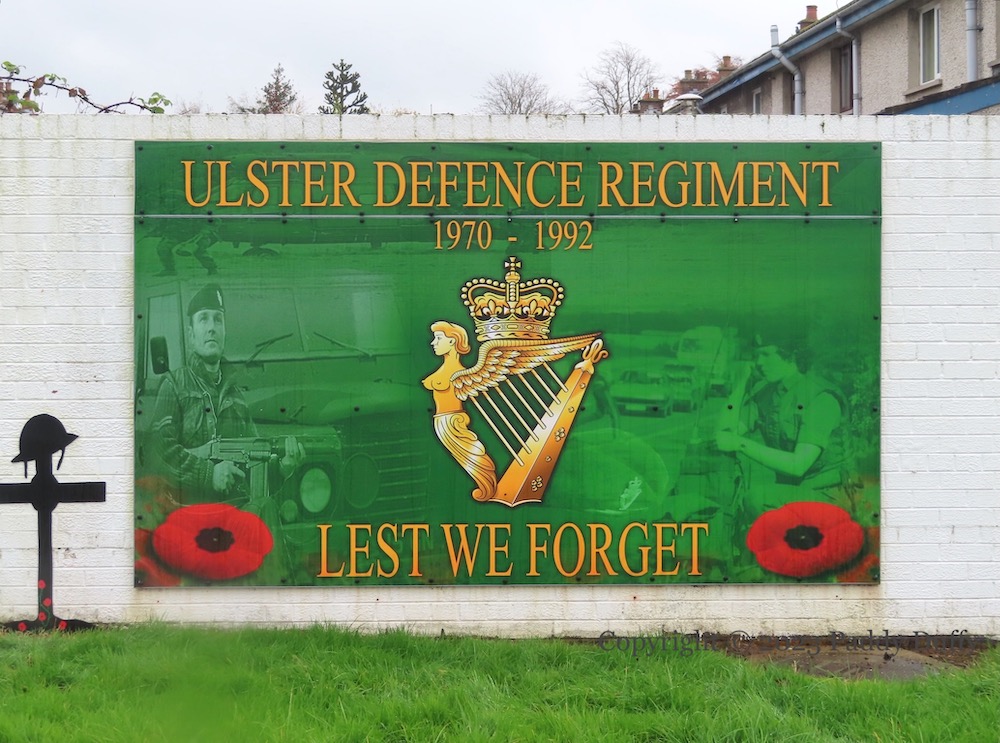
“Faugh a ballagh” is also included; of the regiments who supplied battalions for the 36th Division, only one – the Royal Irish Fusiliers – used that motto, the 9th battalion of the RIF was raised from the Armagh, Monaghan, and Cavan Volunteers. The motto of the Royal Irish Rifles (who supplied 8 of the 12 battalions of the 36th), and later of the UDR, was “Quis separabit”. “Faugh a ballagh” was the motto of the Royal Irish Rangers and is the motto of the current Royal Irish Regiment.
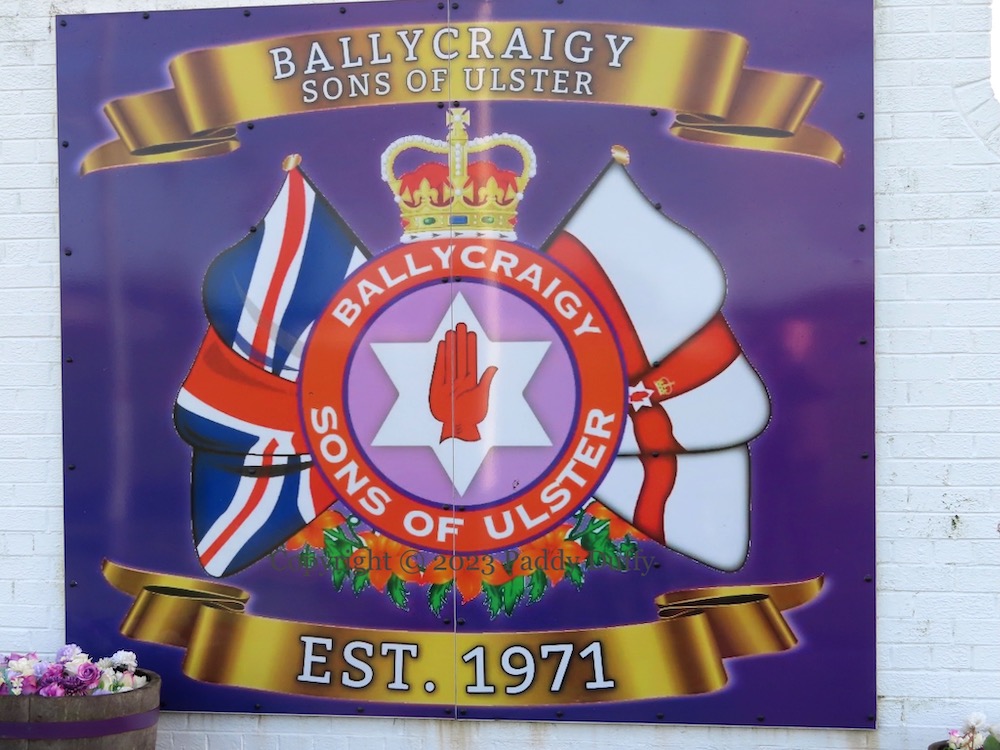
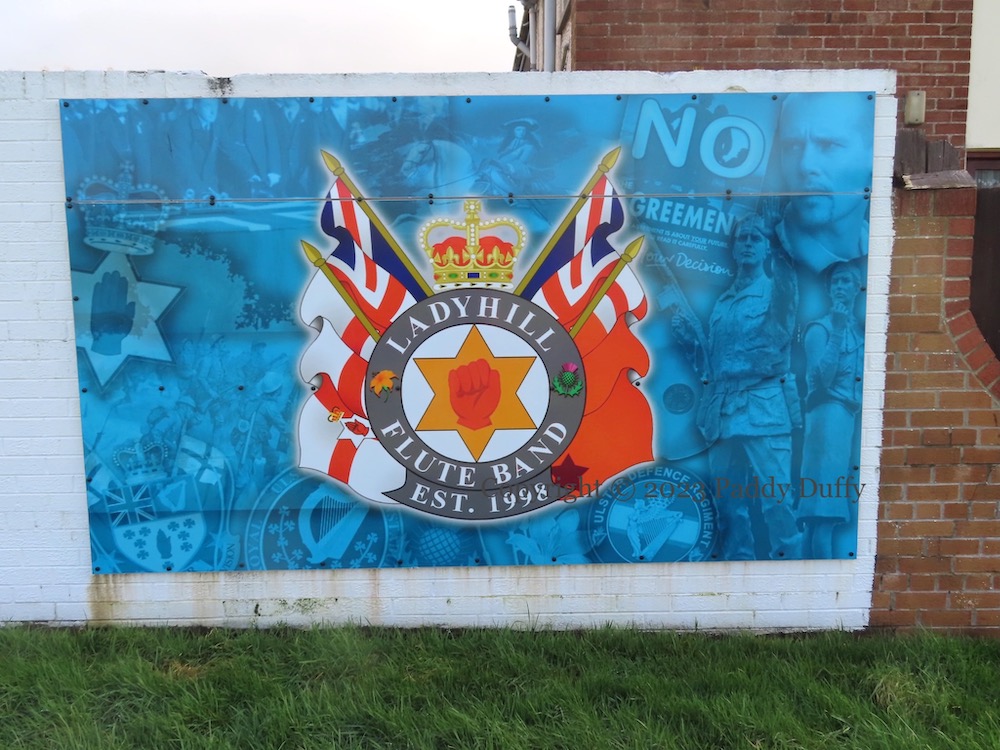
The military boards are flanked by boards for two local flute bands: “Ballycraigy Sons Of Ulster est. 1971” (tw) and “Ladyhill flute band est. 1998” (Fb).
Update 2024-06: Silhouetted graveside mourners have been added to either side of the Somme board – see the final two images.
2023-11: with silhouetted graveside mourners and helmet on cross
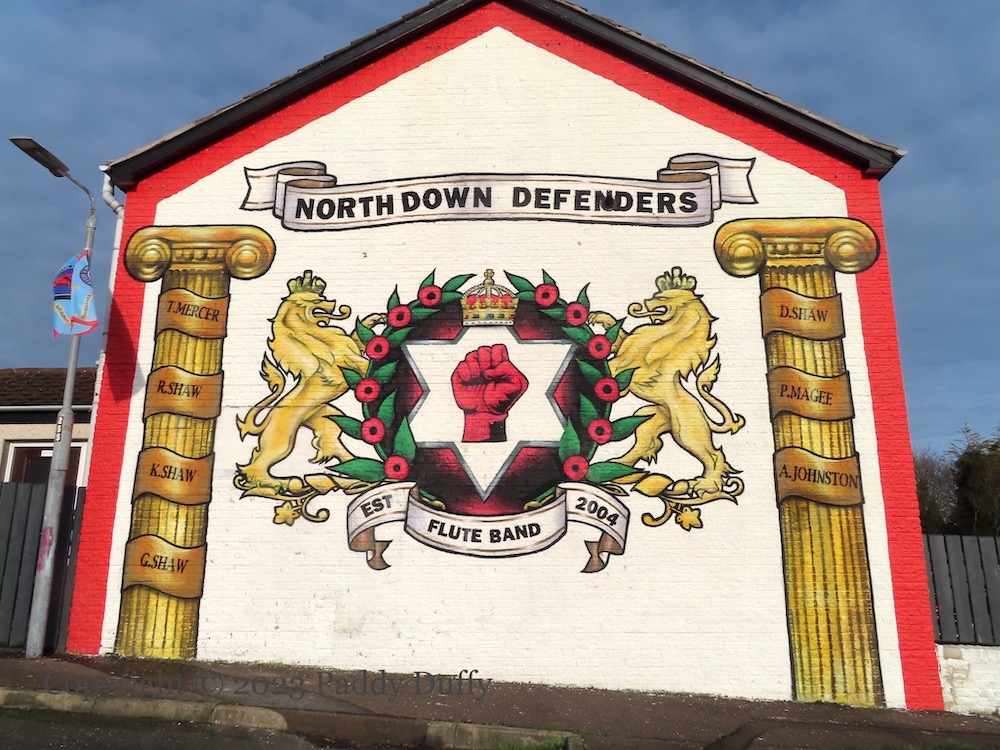
At the end of 2016, Dee Stitt of Charter NI and the UDA was criticised for remarks describing his North Down Defenders (Fb) as the “homeland security” of Bangor’s Kilcooley estate and describing working-class estates as “jungles” in which there is always a “big guy” (Guardian video 8 min mark ff.| BelTel | ITv) .
The mural above does not directly indicate ties to the UDA/UFF, except for the red fist. For a more explicit NDD board further down the estate, with UDA, UFF, UYM, and LPA flags, see North Down Defenders.
Ballyclare Comrades football club – whose motto is ‘Nihil nisi optimi’ [nothing but the best] – was founded in 1919 by members of the local Great War ‘comrades’ association. That heritage is used here for the Ballyclare Protestant Boys flute band. In the centre, between images from WWI, the flowers of the four ‘home nations’ are joined by orange lilies, and in the shield are the lion and the unicorn from the coat of arms of the UK.
“To Flanders fields some men in our town were sent and along their way many would repent their priority goal to keep Ulster free that we may have freedom both you and me as part of Great Britain they fought and died and their names we will remember and remember with pride. Lest we forget. Comrades from Ballyclare. Nihil nisi optimi. The Comrades.” “Ballyclare Protestant Boys Est. 2004”
The Pride Of Ballybeen is a flute band formed in 2014. Their band mural features the Union Flag and Ulster Banner flanking the red hand of Ulster on a six-pointed star against an orange field, surrounded by a crown and a garland pinned by a rose; the titular banner, below, is supported by shamrock and thistle.
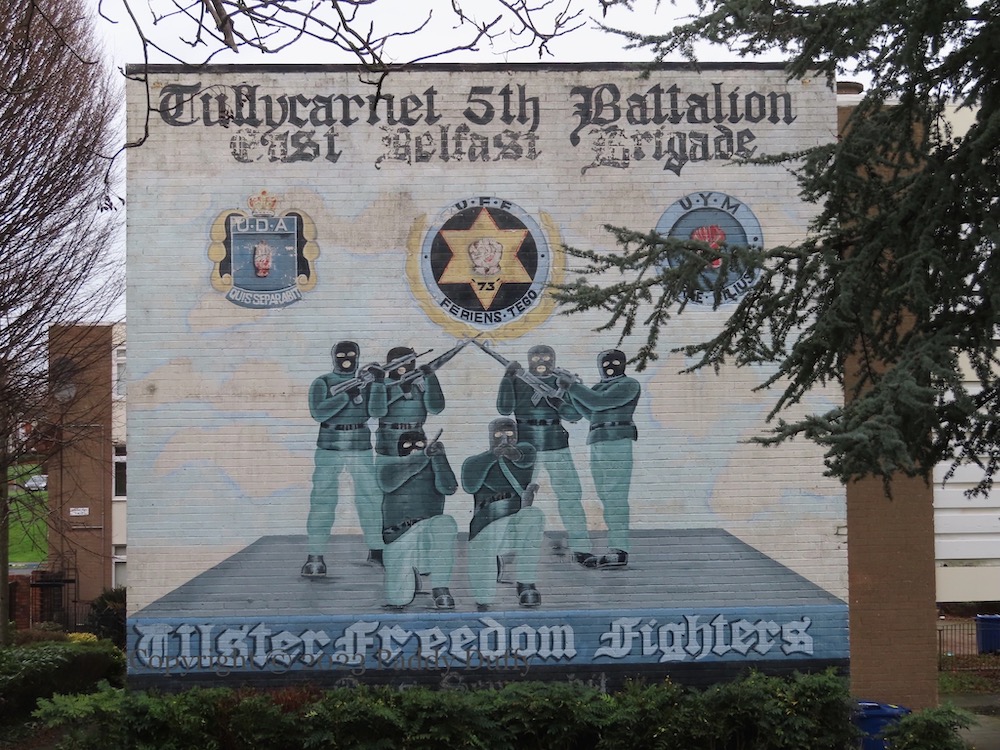
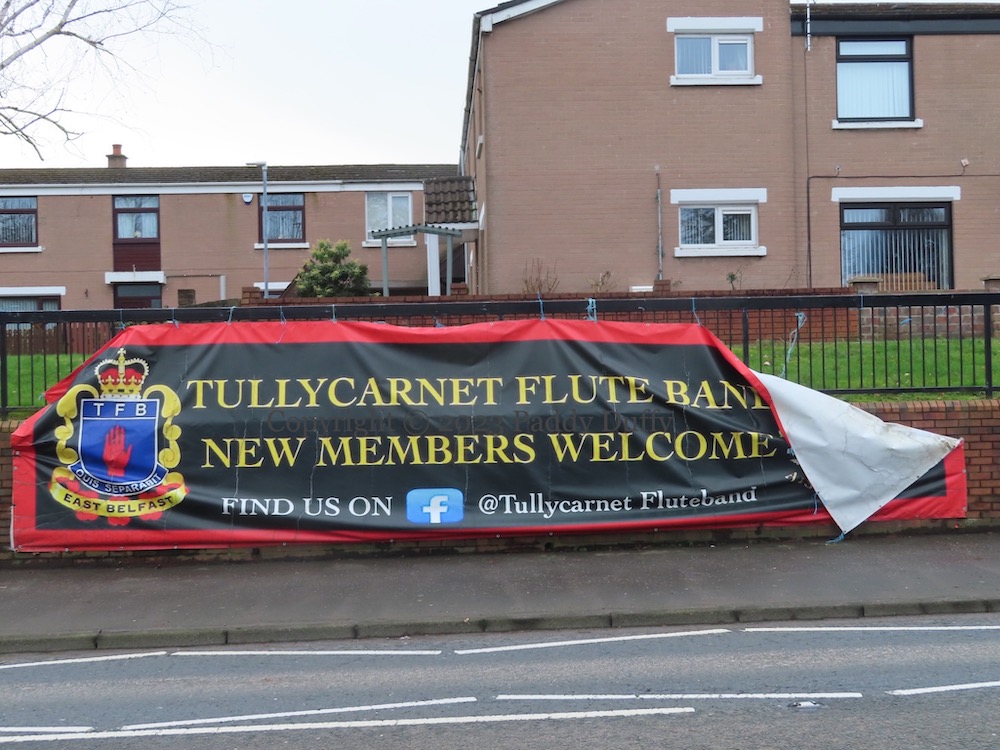
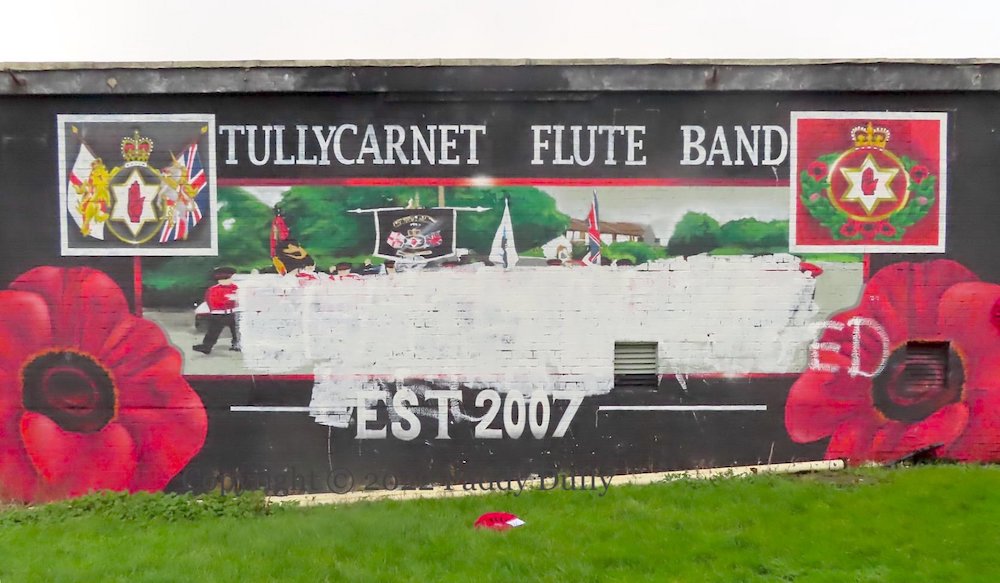
UFF, UDA, and UYM mural in Tullycarnet: Tullycarnet 5th Battalion, East Belfast Brigade. The mural dates back to 2006 at least. Also included (below) is a large Tullycarnet flute band tarp on the railings.
The Tullycarnet flute band (Fb) murals on the hill were repainted for Remembrance Sunday in November 2021 but vandalised shortly thereafter (Belfast Live) with graffiti naming an alleged paedophile which was then whited out. One year on and the mural has not been repaired.
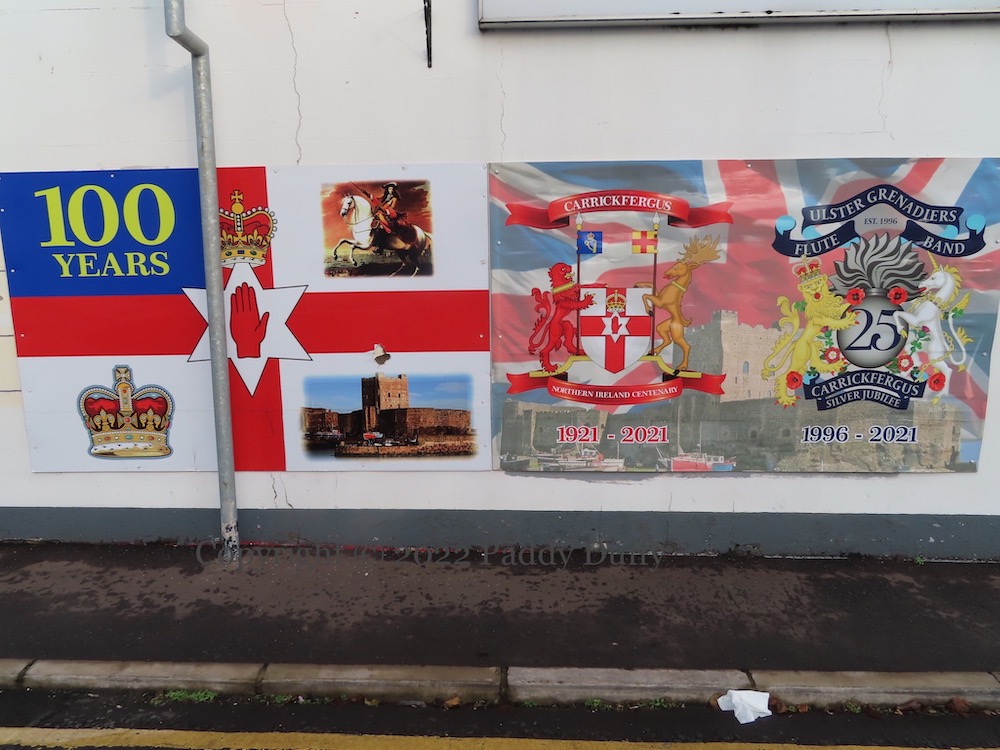
On the left of this memorial board in Carrickfergus are five portraits from the later life of the child who began life in Greece as Prince Philip of Greece and Denmark. The family was exiled during the Greco-Turkish War. He ended up in Britain where he later joined the navy and stopped using his titles when he became the British subject, Philip Mountbatten. When he married Elizabeth he became Prince Philip, Duke of Edinburgh. His life-time matches that of the Northern Irish state (see in the second image): he was born a month after its creation and died in 2021 at the age of 99, a month shy of its centenary.
These boards and banners are in Albert Road and Thomas Street, Carrickfergus, near the Orange lodge, (for which see On Foreign Fields). They are perhaps all sponsored by the Ulster Grenadiers flute band. “Carrickfergus says “No” to Irish Sea border”
“Loyalist Woodburn celebrates 100th anniversary Northern Ireland”. Maintain the union of (left to right) England (St George’s Cross), Wales (The Red Dragon), Northern Ireland (Ulster Banner), Scotland (St Andrew’s Saltire). Along the fence we have the NI coat of arms and Captain Sir Tom Moore.
In this board the Rising Sons Flute Band (“RSFB”) portrays itself as following in the footsteps of the Ulster Volunteers who joined the British Army and specifically the 8th battalion of the Royal Irish Rifles in the 36th (Ulster) Division, which was drawn from east Belfast’s Ulster Volunteers in 1914.









 Paddy Duffy Collection