Slán Abhaıle

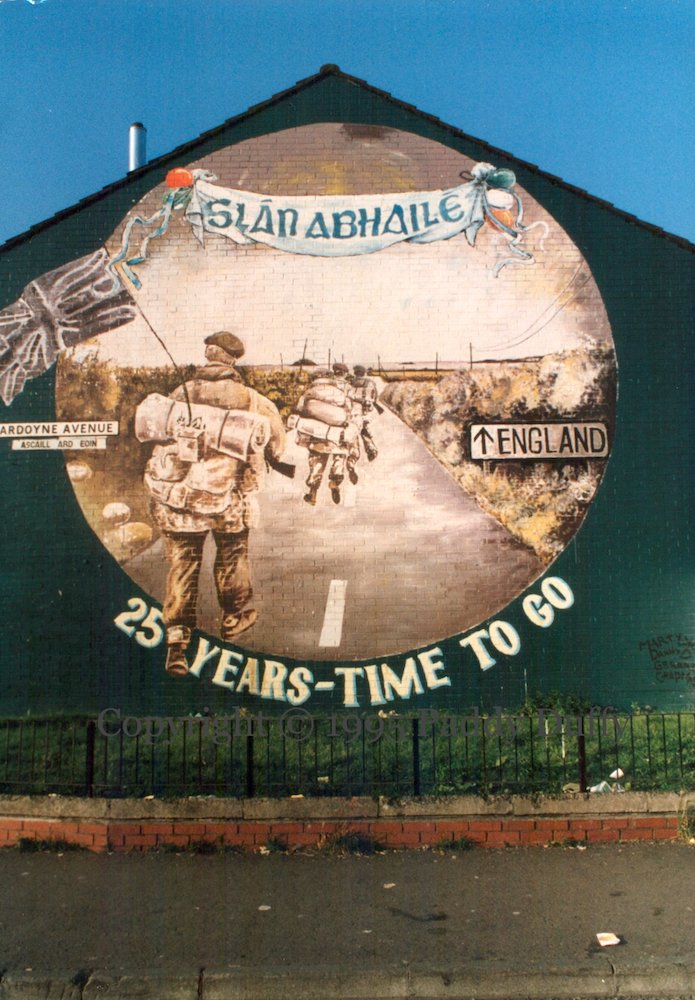
British soldiers trooping back towards London, being painted on the back of Free Derry Corner, on Lecky Road, Derry. The piece is by Robert Ballagh, taking a famous photograph of British forces in the Falklands marching (“yomping”) towards Port Stanley and placing it in a circle (to suggest a closing eye, perhaps) below tricoloured party balloons.

The image was also produced as a mural in the Short Strand (east Belfast) and on a board above the Sınn Féın offices/Sıopa Na hEalaíne in west Belfast and as a mural on Free Derry Corner and on a board in Shantallow, Derry and on a board in Letterkenny.

Ardoyne Avenue, north Belfast

Click image to enlarge
Copyright © 1994 Paddy Duffy (undated image)
T00107 [T00205]

Liberty

Both of these murals by Mo Chara Kelly in the old Linden Street remained unfinished. “I was doing one about the Falls Curfew [for the 20th anniversary march – shown above]. … It never got finished because we had to start Women Against Oppression. When you’re available, people just came up to you, “Mo Chara, we need a mural on this. Could you stop that one? We need to do this one. There’s a Nelson Mandela one needs doing, could you do that?” Everything was chopped and changed all the time, and I never got back to it.” (Painting My Community/An Pobal A Phéınteáıl – English-language version available for free)

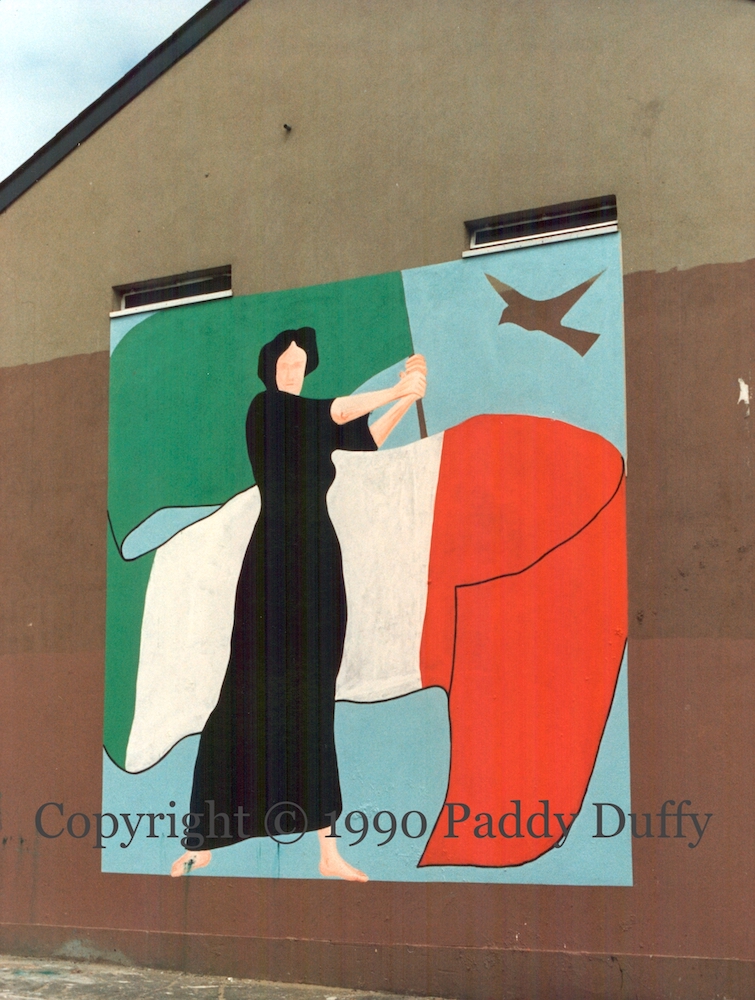
The second shows a barefoot woman carrying a large Tricolour and a lark overhead. It is based on the Women’s Day (“Frauen Tag”) poster from 1914. “Heraus mit dem Frauenwahlrecht” – “Forward with women’s suffrage”. German women were given the right to vote in 1918. This mural was replaced by Women Against Oppression.

Click image to enlarge
Copyright © 1990 Paddy Duffy
T00090 T00096

So I Always Looked The Other Way

A cartoon by ‘Cormac‘ (Brian Moore) is turned into a mural on Belfast’s Whiterock Road by Mo Chara Kelly. The mural satirizes the ad included below, which urges people to call the confidential telephone to report terrorist activity. Instead, the protagonist can no longer ignore the violence of the British Army (and RUC) and calls the Sınn Féın office.

1 When the Brits were having a go … “Who cares?” I thought.
2 And when something really rough happened I just trained harder to forget it … [Speech-bubble:] Anything for a quiet life, see.
3 But where’s it got me? What have these brave lads in khaki done for me? [British Army soldier:] We’re not here to do things for you; we’re here to do things to you.
4 [RUC commander:] Hey, don’t forget us. We’ve done our share of wrecking homes, harassing people. We’ve murdered and tortured and …
5 And when I saw their kind of justice I thought “There’s got to be something better than this.” [Judge:] You may think I’m a corrupt Orange bigot. But I know that I’m a very well-paid corrupt Orange bigot! And the only justice you’re going to get is British justice.
6 So I made up my mind. I wanted these thugs off our backs. [Thought-bubble:] Is it any wonder that the British tourist is the most despised person on earth?
7 You see I want a decent future, and it’s not going to happen while these “hero[e]s” are doing the dirty work of British imperialism. And it’s not going to happen if you’re waiting for someone else to do something.
8 622112. Hallo? Is that the Sınn Féın office?

Click image to enlarge
Copyright © 1990 Paddy Duffy
T00091

Behind The Mask

Here is an instance of the ‘masked skull’ design produced by prisoners in Long Kesh (according to Mo Chara Kelly), seen also in Britains Death Squads. This version is simpler: it does not have any writing and there is no UDR emblem on the UDA-style hat.

The small boards above the mural declaring west Belfast an “apartheid-free zone”/”ceantar saor ó apartheıd” were mounted in 1986 along with the ANC mural.

Beechmount Avenue, west Belfast – this wall has its own Visual History page as it is the most-often painted wall in Belfast.

Click image to enlarge
Copyright © 1990 Paddy Duffy
T00040

The Shape Of Things To Come

This is the second version of this mural, both from 1981. In the original – which can be seen in the Homer Sykes collection – the main panel was a large white rectangle with three volunteers with assault rifles and an RPG (and the signature in the bottom left, reading “Done by Beechmount youth against H Block”).

This version removes the gunmen and uses more of the main panel, describing “the shape of things to come” in a series of images showing of people rallying to the Irish tricolour, attacking a British soldier who falls among rubble. In the gable, the sunburst and Tricolour, with automatic rifle, remain. The words to the left read “I lie at night and try to think why / our lads in jail are prepared to die. // The British government sit back and laugh / but the people know that they are daft. // Four of our comrades have passed away / is there call for more to die[?] // O, British government use your sights / and give our lads their 5 just rights.”

Oakman St, Beechmount, west Belfast

Click image to enlarge
Copyright © 1981 Paddy Duffy
T00024 [T00038] T00054

The Training Ground

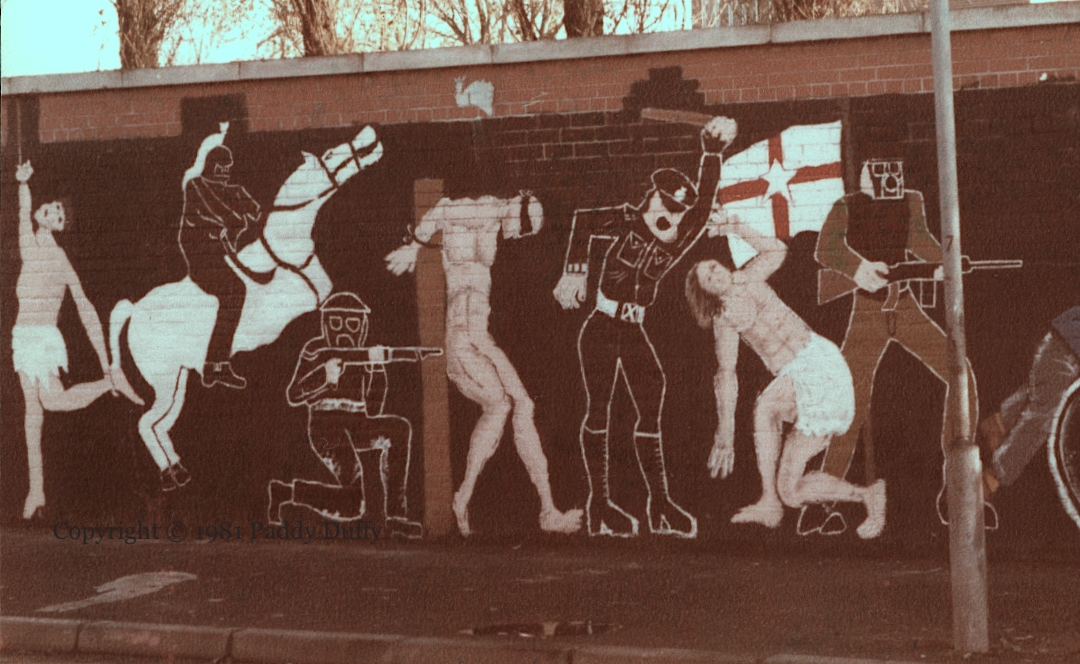
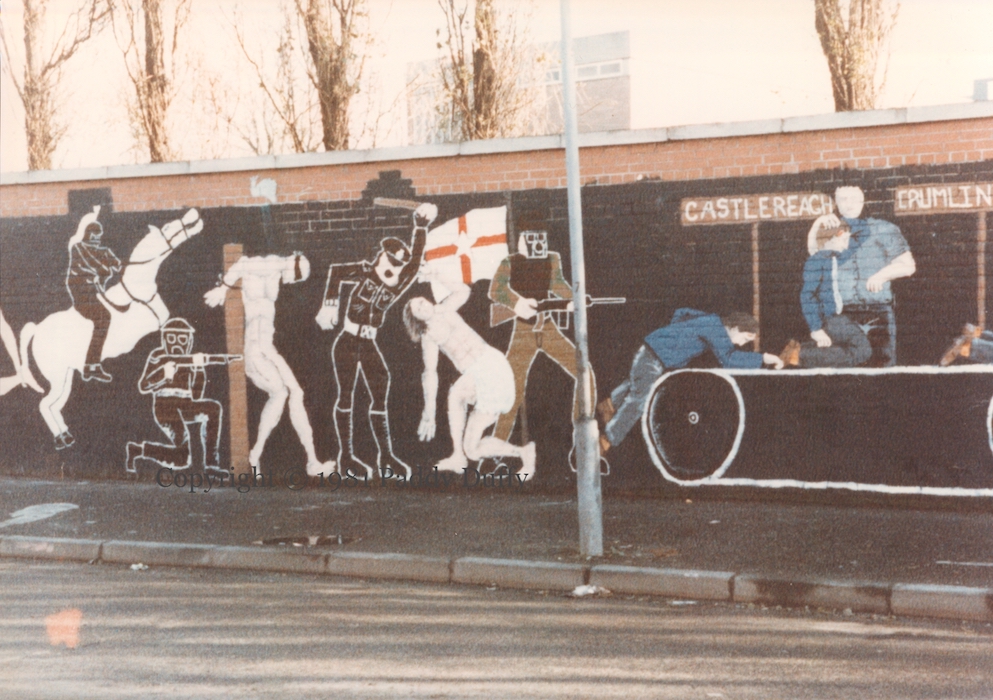
Jeff Perks’s 1979 linotype “The Training Ground” was reproduced on Beechmount Avenue in 1981. It depicts the history of the British Army in Ireland. Rolston (“Politics, Painting and Popular Culture: the Political Wall Murals of Northern Ireland”, Media, Culture and Society 9.1, 1987) claims (p. 19) that the image would have been familiar to nationalists from the cover of “Ireland: Voices For Withdrawal” (shown below). The baton-wielding policeman on the right was also reproduced in a famous 1996 Derry mural (“68-96 Nothing Has Changed” M01279).

Missing on the far left are four Cromwellian soldiers (see M00123); on the right, the arrested are loaded onto The Conveyor Belt.

Click image to enlarge
Copyright © 1981 Paddy Duffy
T00020 T00035