Ulster And Scotland Did Answer The Call

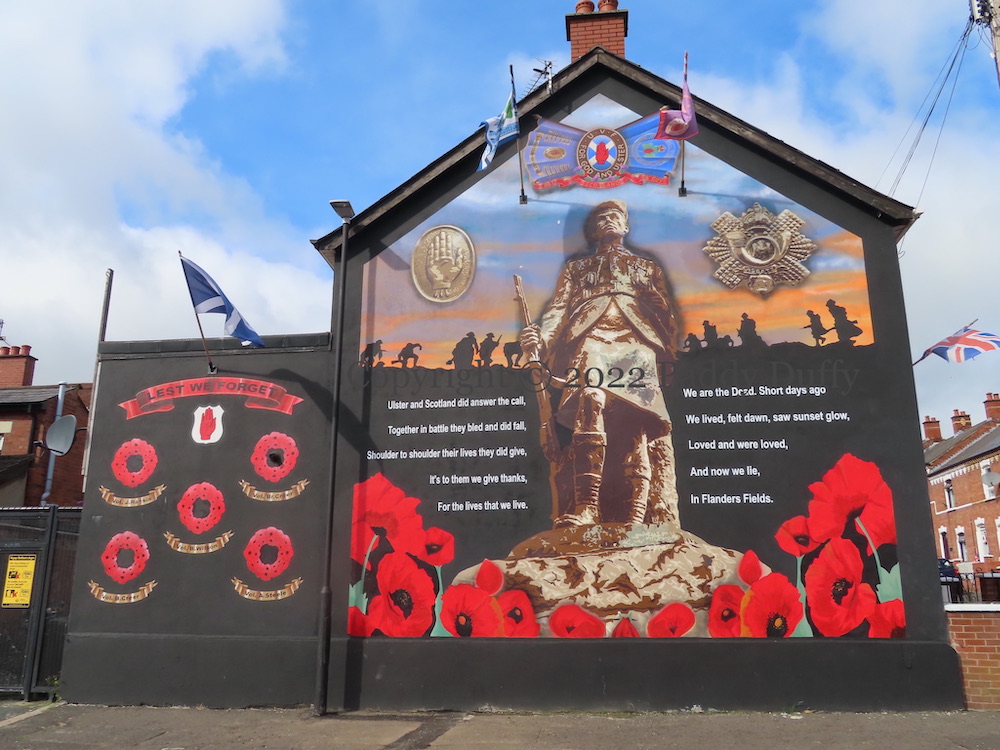
The Battle Of Assaye (India) took place on September 23rd, 1803, and the 74th regiment of the Royal Highland Fusiliers became known as the Assaye regiment in recognition of their performance (WP). By the time of WWI, the regiment had been merged into the Highland Light Infantry, whose 2nd battalion fought at the Somme in 1916 alongside the 36th (Ulster) Division (WP). The Highlanders’ emblem (which still includes the word “Assaye”) is on the right, the Ulster Volunteers’ on the left. In the apex are the flags of the UVF and YCV (14th battalion Royal Irish Rifles). This new mural commemorates the UVF volunteers of both WWI and the Scottish brigade: J. Rankin, Br. Creer, B. Wilson, B. Creer, A. Steele.

“Ulster and Scotland did answer the call/Together in battle they bled and fall/Shoulder to shoulder their lives they did give/It’s to them we give thanks/For the lives that we live.”

“We are the dead. Short days ago/We lived, felt dawn, saw sunset glow/Loved and were loved/And now we lie/In Flanders Fields.”

Disraeli St

Click image to enlarge
Copyright © 2022 Paddy Duffy
T00941 [T00942]
Shankill Star

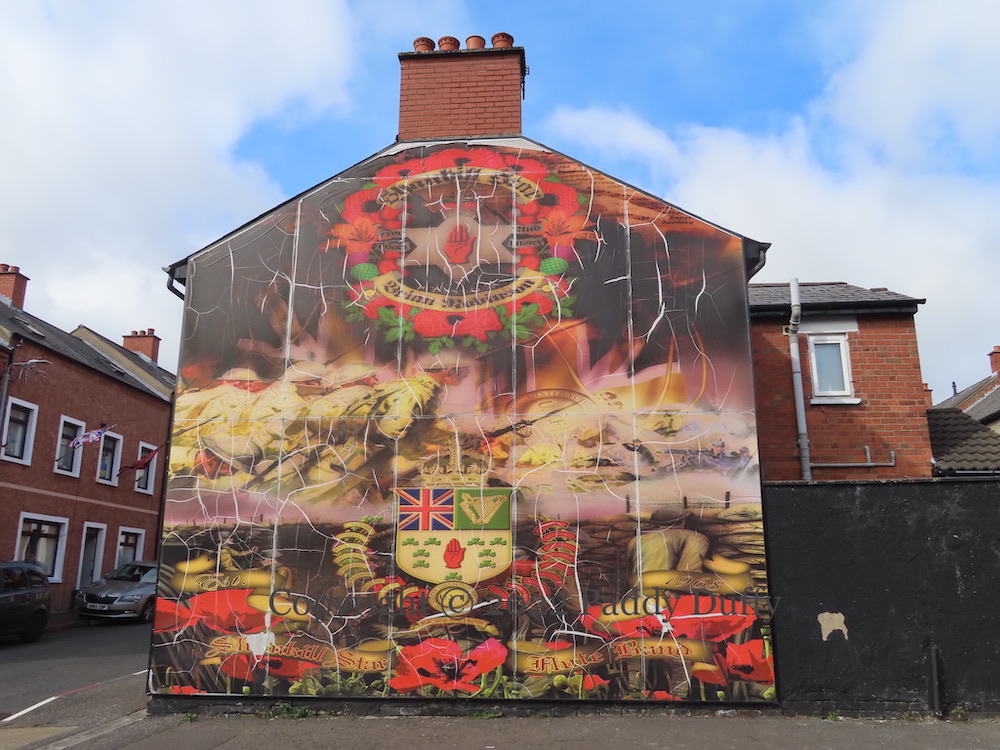
This memorial to Brian Robinson (unveiled March 2, 2013) was sponsored by the Shankill Star Flute Band, in Disraeli Street – where Robinson grew up – and is replete with images from the first World War such as soldiers (both British and German), trenches and poppies.

Robinson was killed on 2 Sept., 1989 by an army undercover unit moments after he had shot and killed a Catholic named Patrick McKenna (WP). This is the second mural on the street to Robinson. The piece is not paint, but printed laminate, which is now cracking and peeling.

Click image to enlarge
Copyright © 2022 Paddy Duffy
T00939 [T00940]

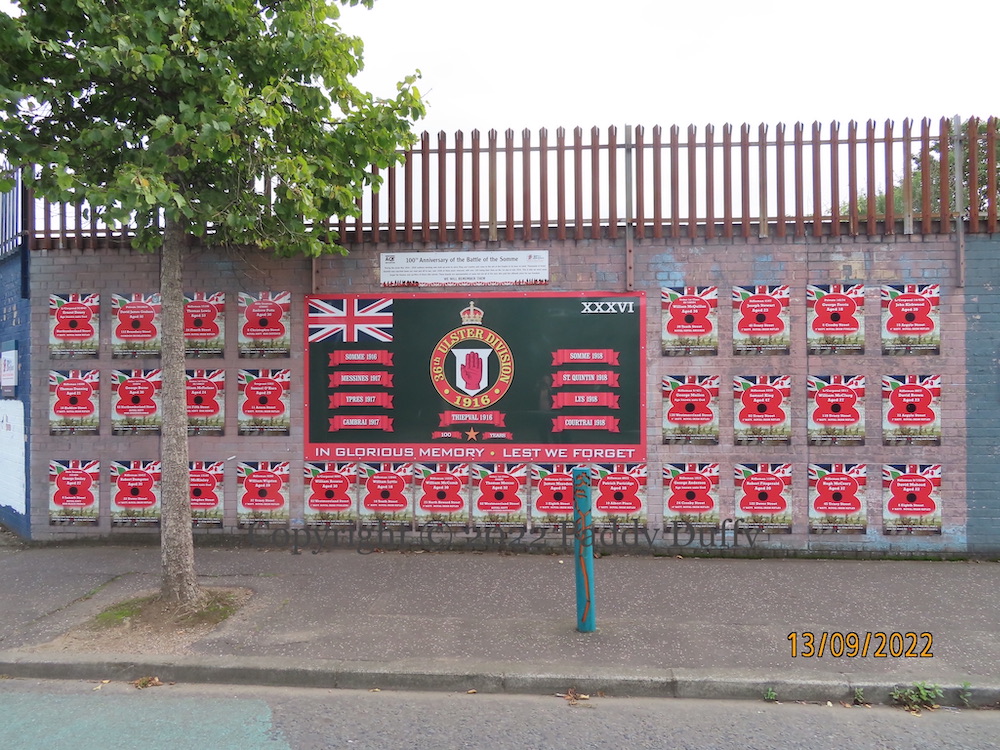
XXXVI

The main battles of the 36th (Ulster) Division (“XXXVI”) are listed – Somme, Thiepval, Messines, Ypres, Cambrai, Somme (1918), St. Quintin [St. Quentin], Lys, Courtrai – and those who died are commemorated on this new board. The main board is surrounded by smaller boards, part of the Poppy Trail, bearing the names, ages, addresses, ranks, and units of deceased soldiers. For example: William Lyttle, aged 18, 16 Tenth Street, 9th batt. Royal Irish Rifles, Rifleman 13044.

The same (main) board has also been mounted on the Shankill: see Improving Your Environment.

Replaces: They Haven’t Gone Away and Welcome To The Shankill.

The info board above reads: “Thousands of brave Shankill men marched down our road and off to war, over 1500 of them never returned, with over 150 losing their lives on the 1st day of July 1916.”

Click image to enlarge
Copyright © 2022 Paddy Duffy
T00883

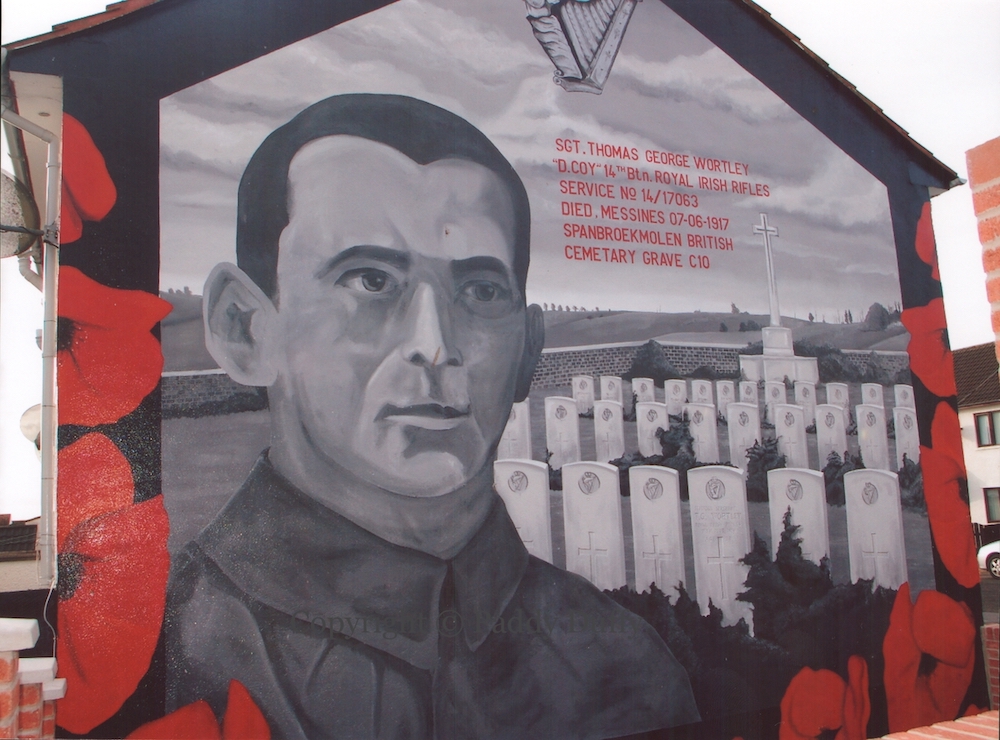
Thomas George Wortley

“Sgt. Thomas George Wortley , “D Coy” 14th Btn. Royal Irish Rifles, Service No. 14/17063, Died Messines 07-06-1917, Spanbroekmolen British Cemetary Grave C10″. Wortley was born in Carrickfergus, lived in Belfast, died on the first day of the battle at Messines (findagrave), buried in a small cemetery of British soldiers, many from the 36th (Ulster) Division, in Spanbroekmolen on the Ypres Salient in Flanders (WP) – shown in the mural – and is remembered in Carrickfergus with a parade each year on the date of his death (carrickfergusrollofhonour).

Maple Gardens, Carrickfergus

Click image to enlarge
Copyright © 2012 Paddy Duffy
T00651

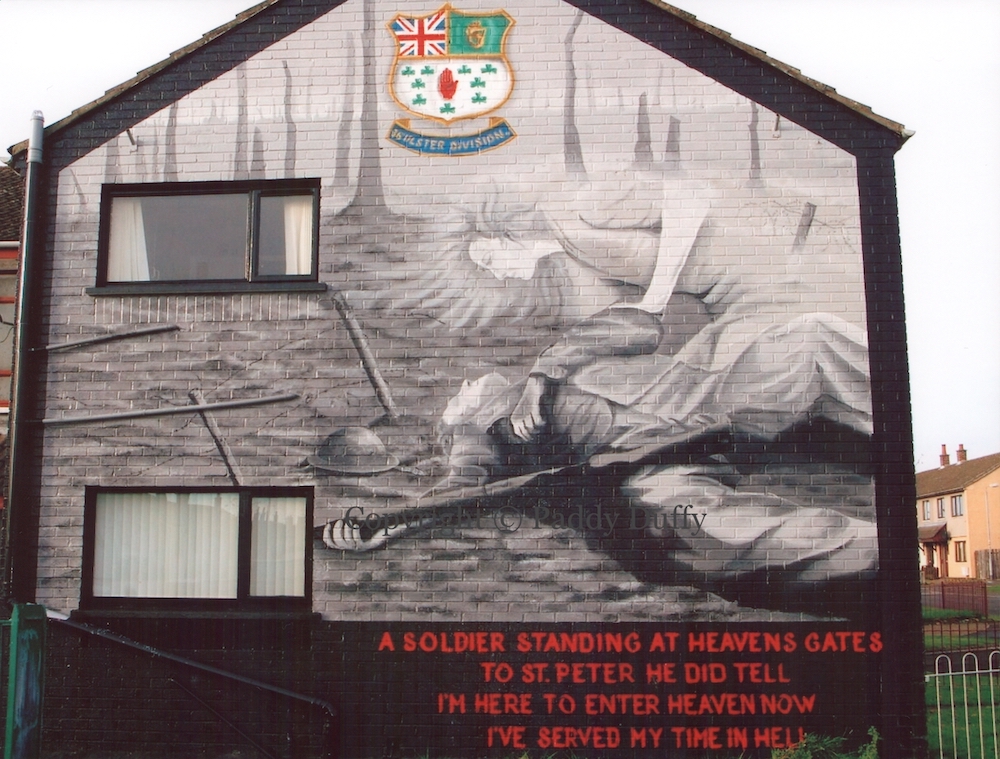
Time In Hell

A dead WWI soldier in the scorched Belgian countryside is comforted by an ethereal figure who will convey him to heaven: A soldier standing at heaven’s gate/To St. Peter he did tell/I’m here to enter heaven now/I’ve served my time in hell – a variation on James Donahue’s WWII Soldier’s Poem (WP). The poem was previously used of Republicans in a 1981 mural in Derry (see I Refuse To Change/M00151).

The Larches, Carrickfergus

Click image to enlarge
Copyright © 2012 Paddy Duffy
T00635

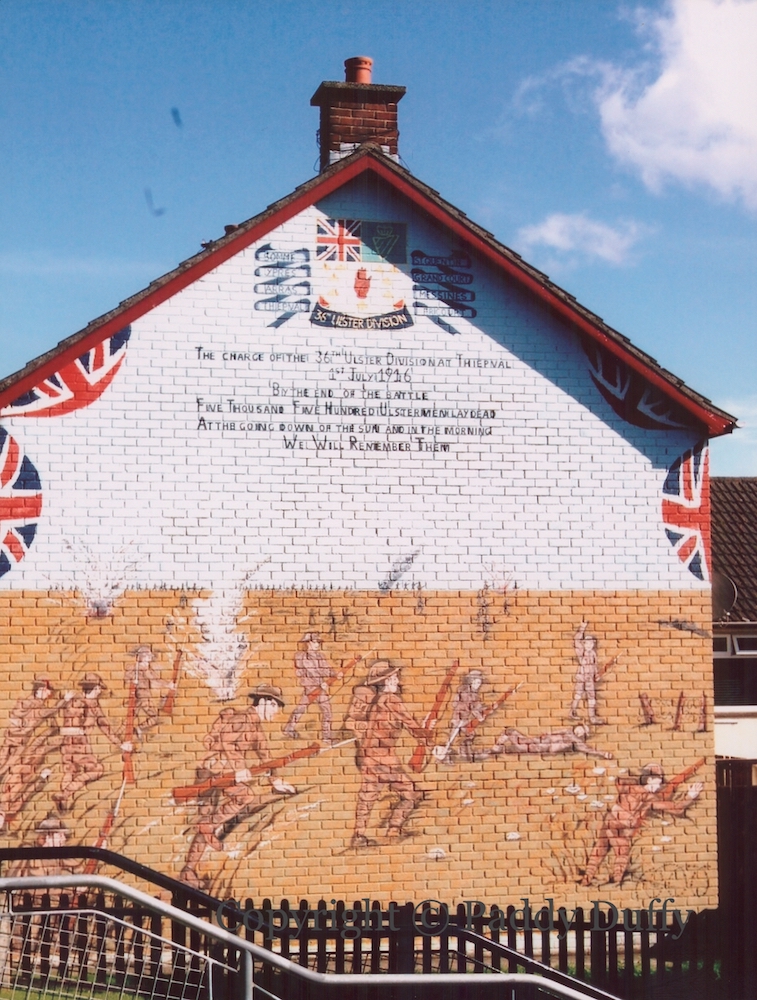
Charge Of The 36th At Thiepval

“The charge of the 36th (Ulster) Division at Thiepval, 1st July 1916. By the end of the battle, five thousand five hundred Ulstermen lay dead. ‘At the going down of the sun and in the morning we will remember them.’”

Inniscarn Drive, Rathcoole, Newtownabbey

Click image to enlarge
Copyright © 2011/2012 Paddy Duffy
T00646 [T00656]

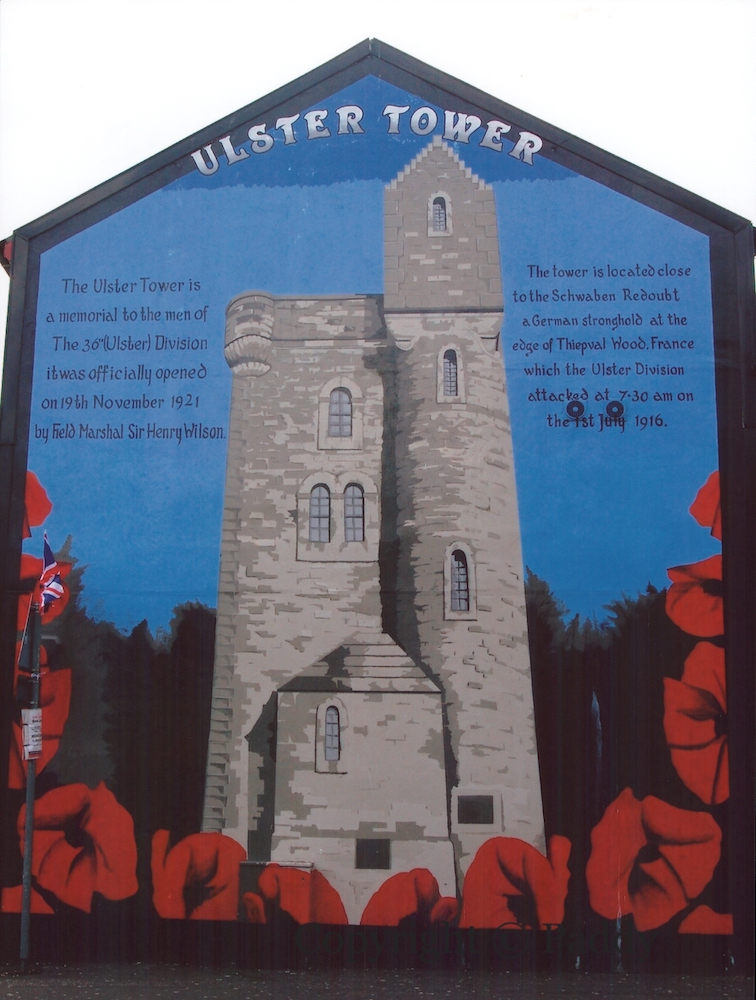
Ulster Tower

“The Ulster Tower is a memorial to the men of the 36th (Ulster) Division. It was officially opened on 19th November 1921 by Field Marshal Sir Henry Wilson. The tower is located close to the Schwaben Redoubt, a German stronghold at the edge of Thiepval Wood, France, which the Ulster Division attacked at 7.30 am on the 1st July 1916.”

“This mural was dedicated to the men of the 36th (Ulster) Division on 31st July 2010 by the West Belfast Athletic And Cultural Society. ‘Greater love hath no man than this, that a man lay down his life for his friends’ – John 15:13”.

Conway Street (“Somme Street”), Shankill, west Belfast

Click image to enlarge
Copyright © 2012 Paddy Duffy
T00691 [T00692]

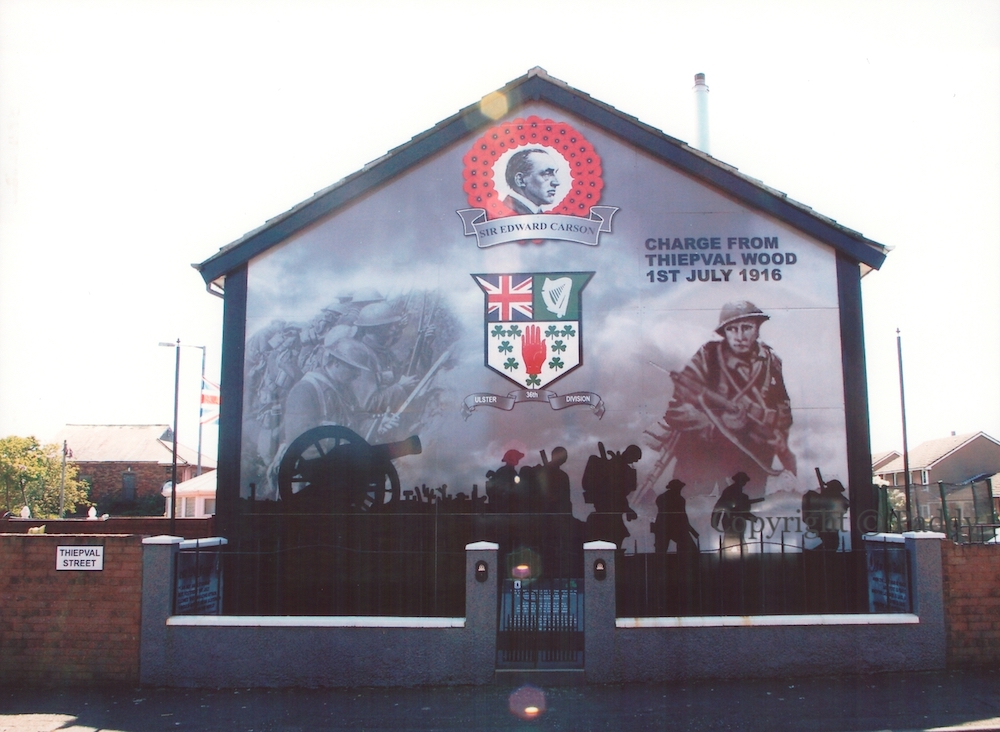
Charge From Thiepval Wood

The nameplate on the lower corner of Northland Street now reads “Thiepval Street” and the Thiepval board above adorns the end wall (replacing an earlier mural to UVF A Company 5th platoon). On the other side of Conway Street is/was North Howard Walk where a plate now reads “Passchendaele Court“. The names are unofficial (as of November 15th, 2012). (See also “Somme Street”.)

The memorial stone is dedicated to the UVF company (and not to the WWI soldiers from the 36th (Ulster) Division who died in the charge from Thiepval Wood, July 1st, 1916): “This stone is dedicated to the memory of the fallen volunteers of No. 5 platoon A company 1st Belfast battalion Ulster Volunteer Force. ‘As poppy petals gently fall/Remember us who gave our all/Not in the mud of foreign lands/Nor buried in the desert sands//In Ulster field and farm and town/Fermanagh’s lanes and Drumlin’d Down/We died that violent death should cease/And Ulstermen might live in peace’ Lest we forget.”

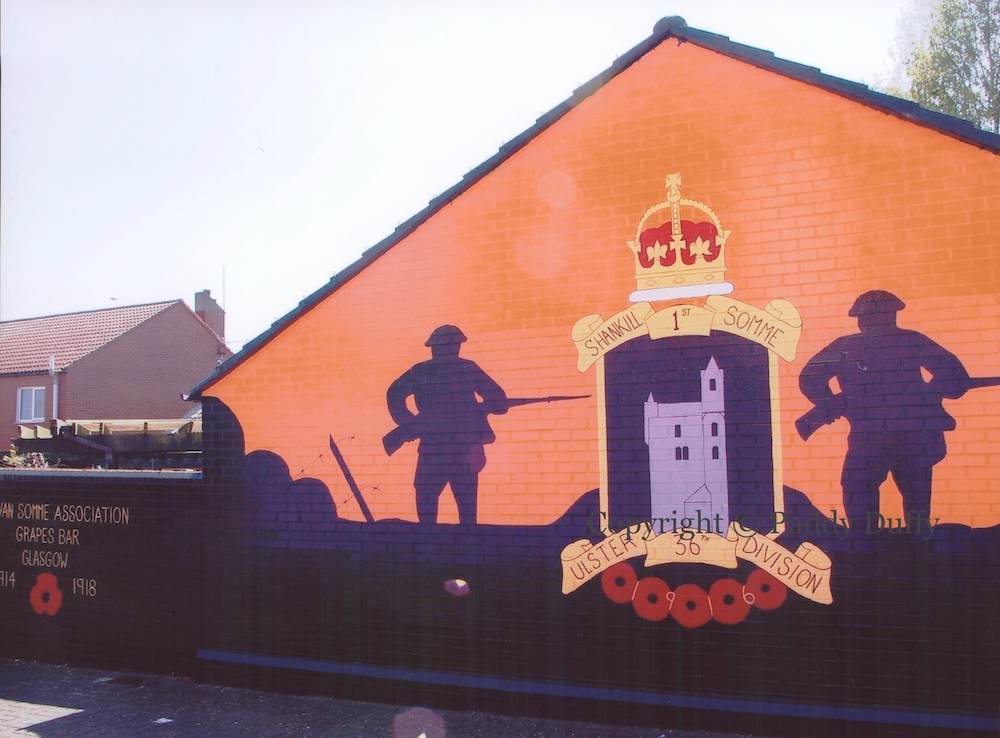
The Conway Walk mural was produced by the “Shankill 1st Somme [Association]” with support from the “Govan Somme Association, Grapes Bar, Glasgow”.

Northland Street and Conway Walk, west Belfast

Click image to enlarge
Copyright © 2012 Paddy Duffy
T00702 T00700 [T00701]

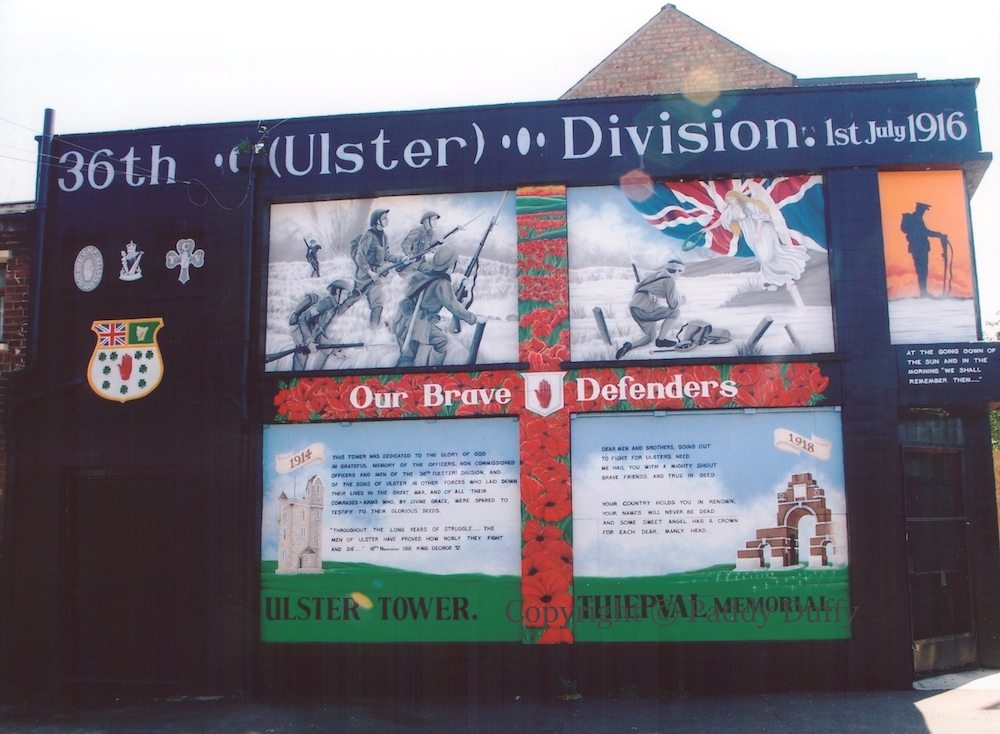
Our Brave Defenders

The four main panels of the mural (above) show
the men of the 36th going over the top on the first day of the Somme (1st July 1916),
the “angel of Mons” (WP),
Ulster Tower (“This tower was dedicated to the glory of God. In grateful memory of the officers, non commissioned officers and men of the 36th (Ulster) Division, and of the sons of Ulster in other forces who laid down their lives in the great war, and of all their comrades in arms who, by divine grace, were spared to testify to their glorious deeds. ‘Throughout the long years of struggle …. the men of Ulster have proved how nobly they fight and die’ – 16th November 1918 King George V”),
and
Thiepval Memorial (“Dear men and brothers, going out/to fight for Ulster’s need/we hail you with a mighty shout/brave friends, and true in deed.//Your country holds you in renown/your names will never be dead/and some sweet angel has a crown/for each dear, manly head.”)

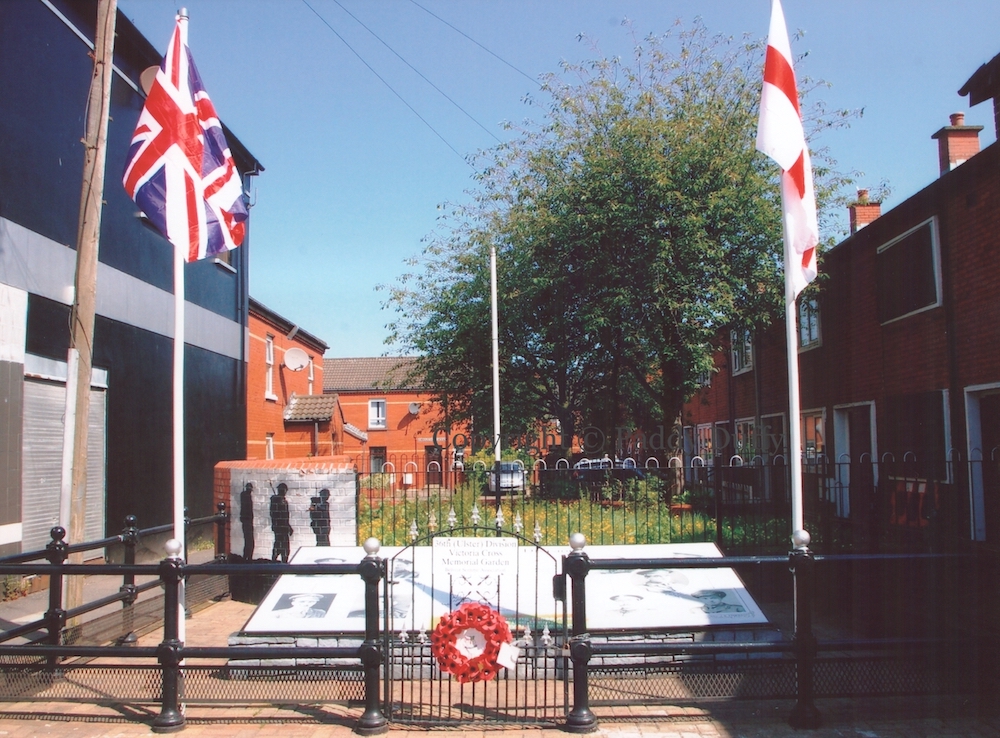
The memorial garden features the Victoria Cross winners from the 36th (Ulster) Division. For close-ups, see the Peter Moloney Collection.

St Leonard’s Crescent (the old Newcastle Street) in east Belfast

Click image to enlarge
Copyright © 2011/2012 Paddy Duffy
T00679 T00680

The United Kingdom

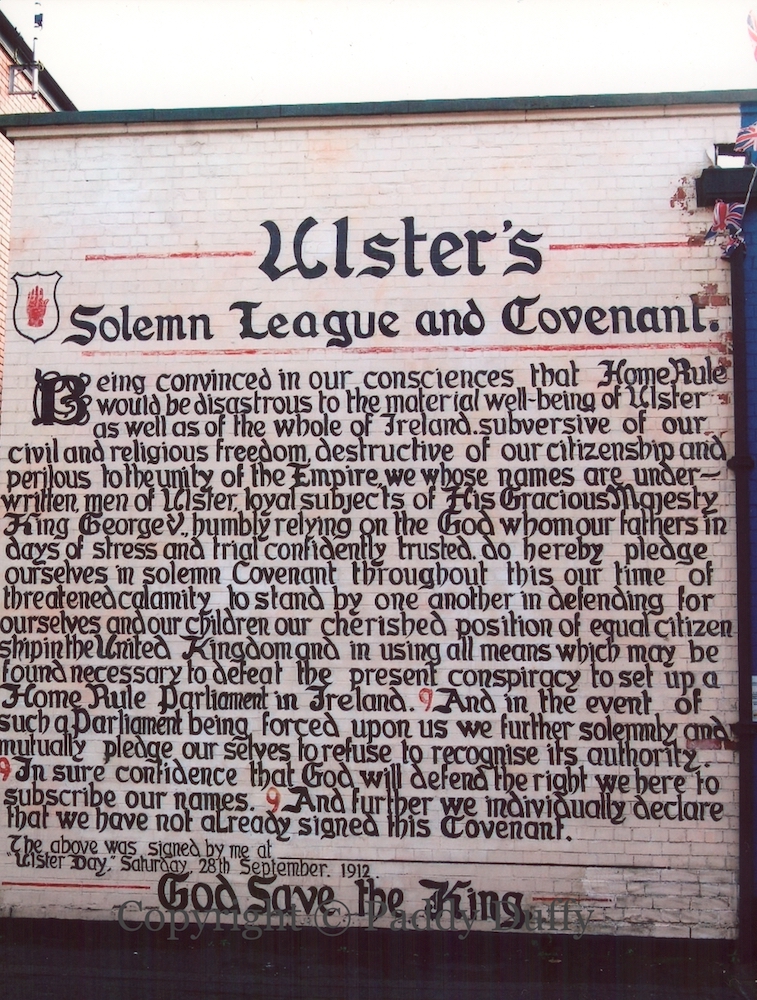
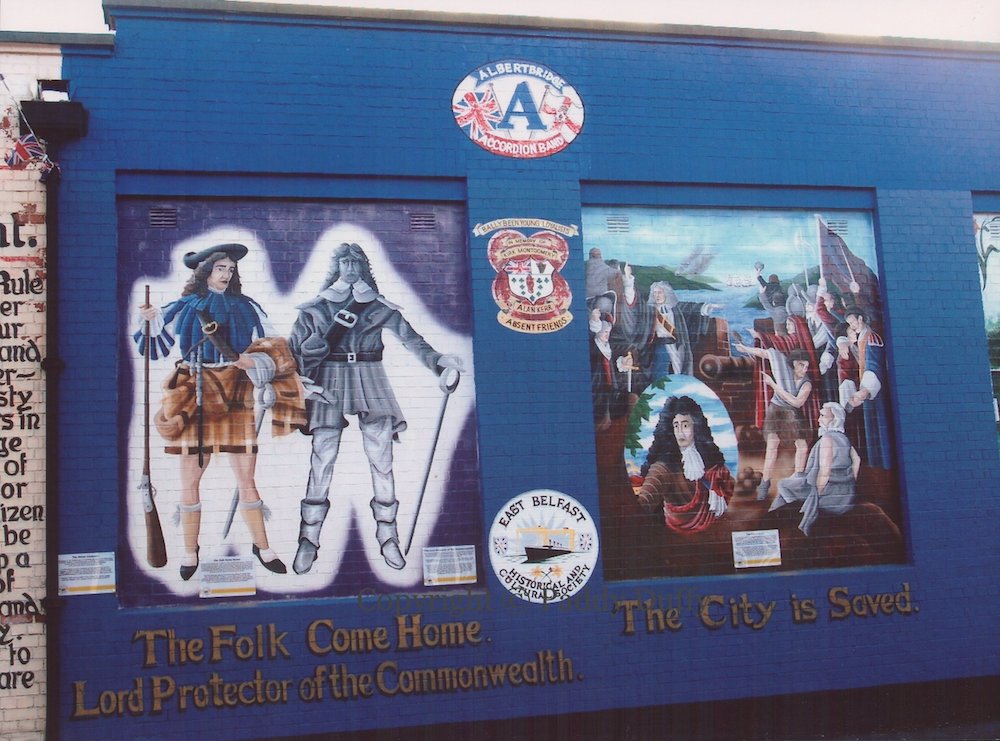
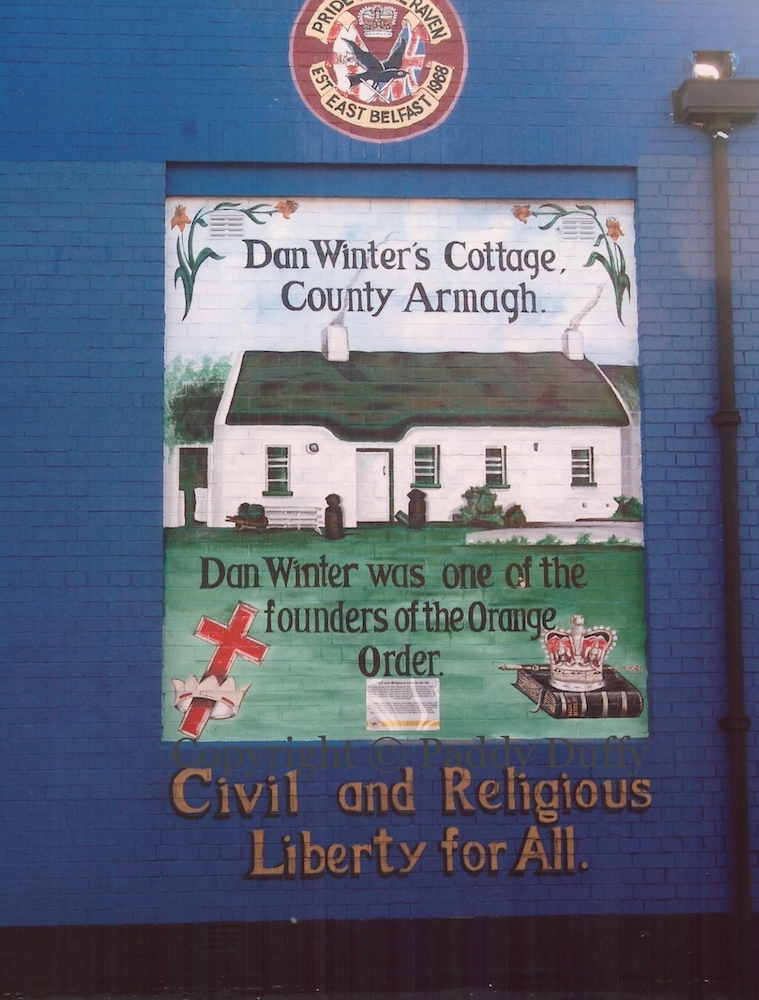
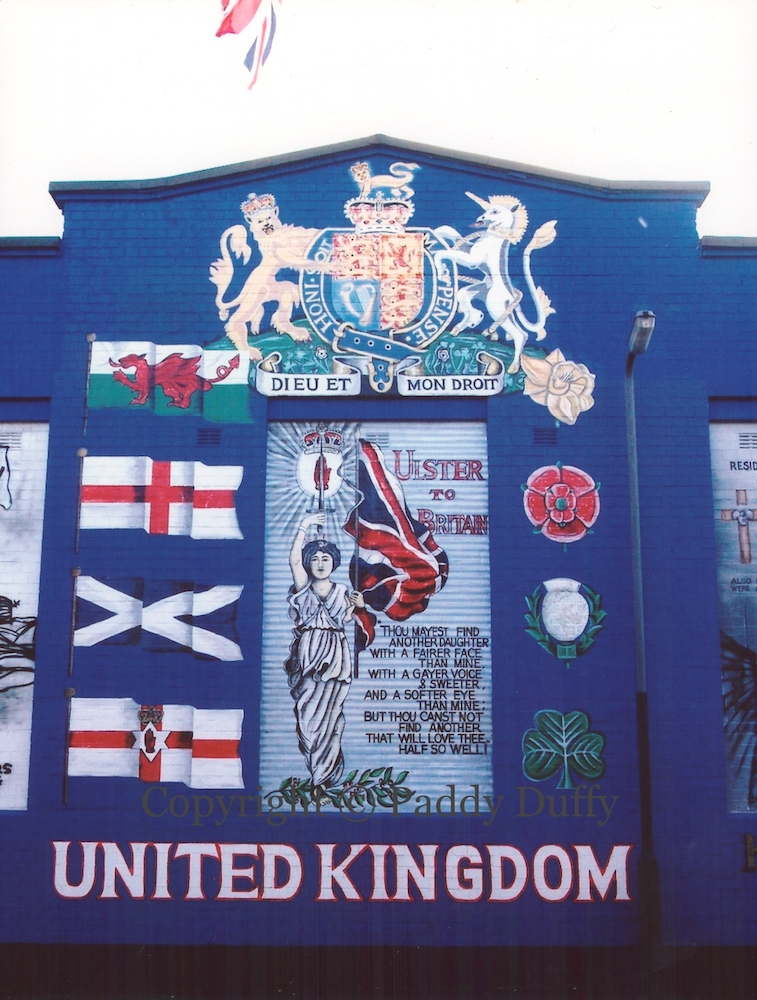
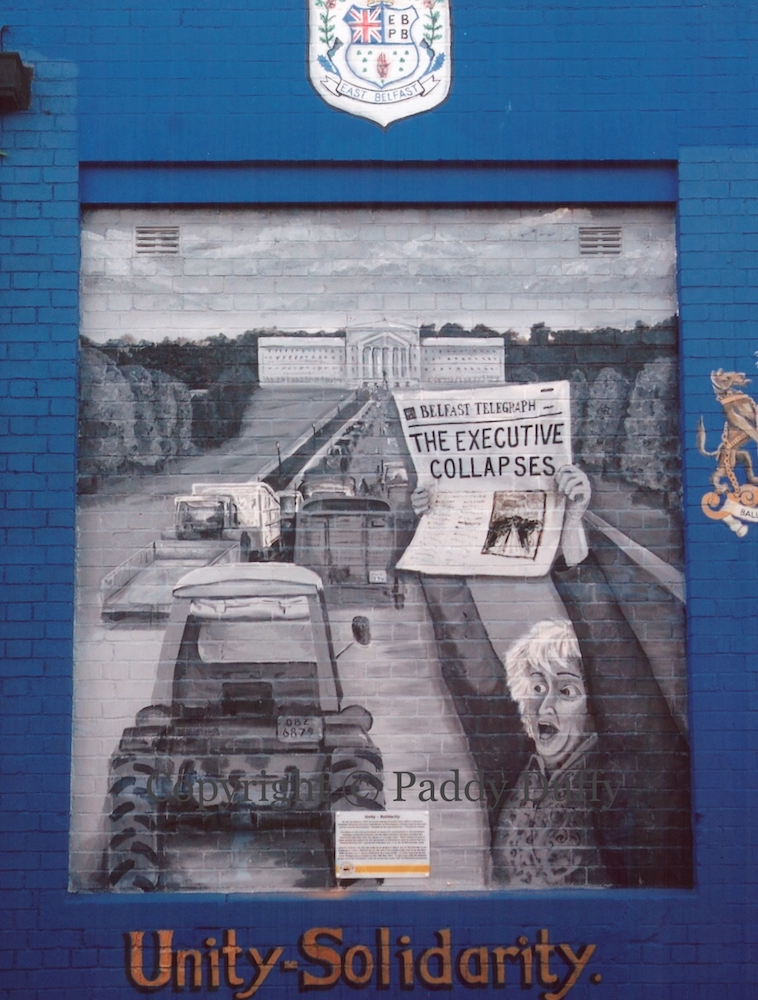
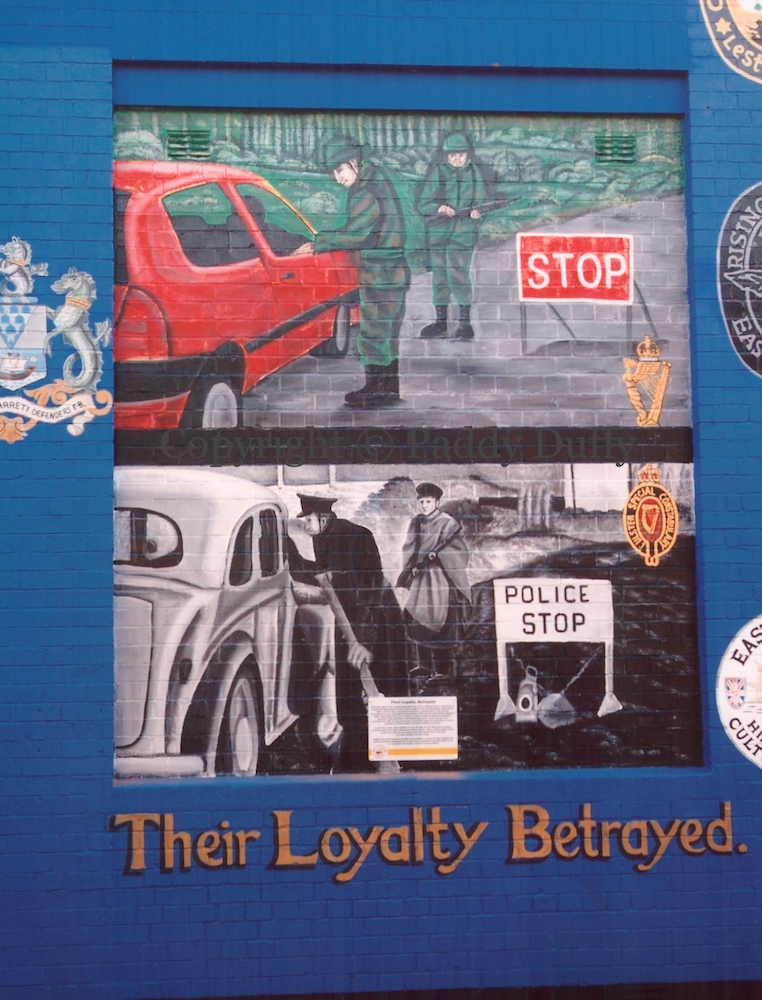
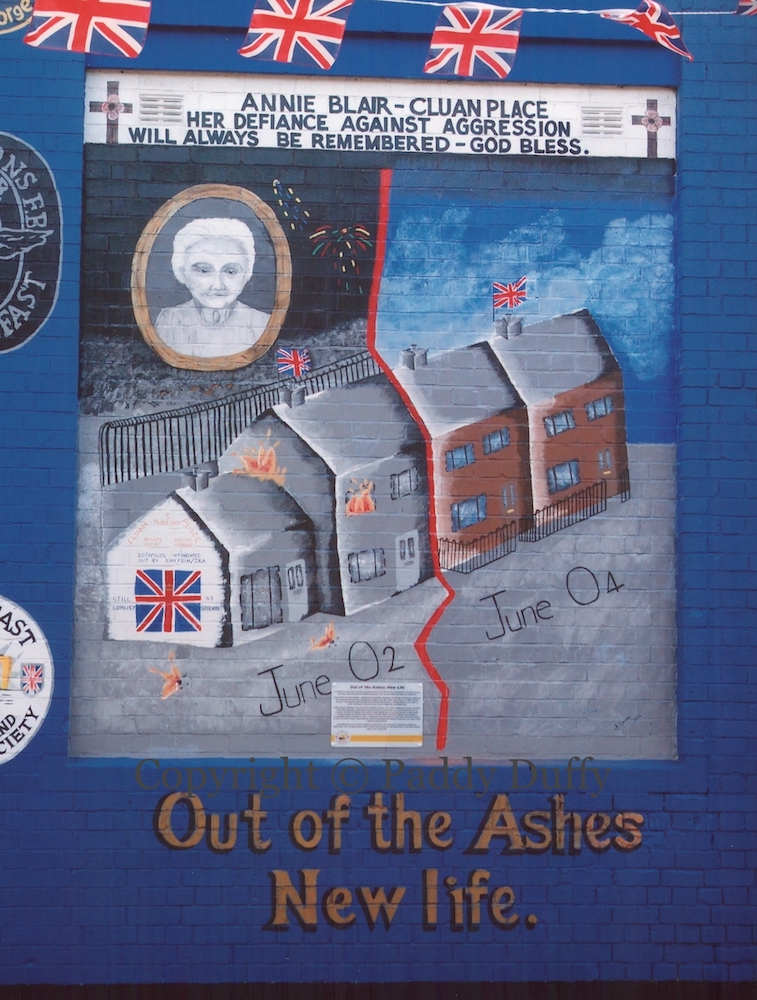
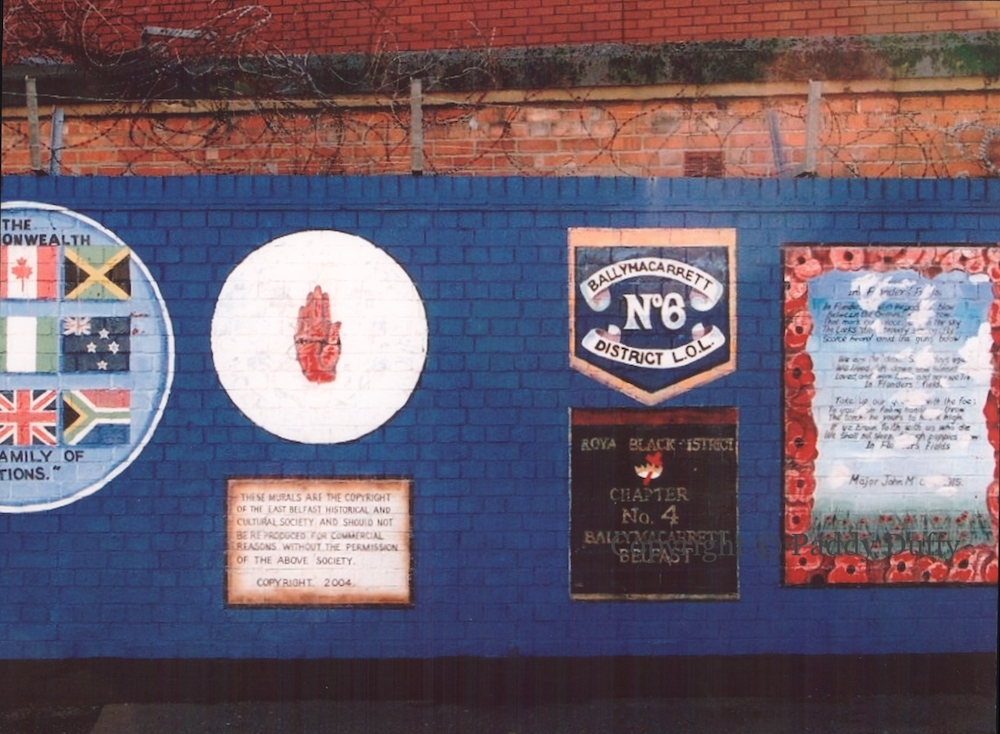
In 2004 the East Belfast Historical And Cultural Society sponsored a series of 14 murals in Thorndyke Street charting Protestant history from Cromwell to Cluan Place. From left to right, these are:

  • The Covenant
  • “The Folk Come Home. Lord Protector of the Commonwealth” (Cromwell)
  • “The City Is Saved” (Siege Of Derry)
  • “Civil And Religious Liberty For All.” “Dan Winter’s cottage, County Armagh. Dan Winter was one of the founders of the Orange Order”
  • “Better The Grave Than Slavery.” “How is freedom measured? By the effort which it costs to retain. Freedom!” (WW1)
  • “Their Sacrifice, Our Freedom.” “As we scrambled over the trench ladders, the YCV flag appeared. Jim Maultsaid” (WWI)
  • “United Kingdom”
  • “Hitler Attacks Belfast”
  • “Defending The Community” (Paramilitaries)
  • “Unity – Solidarity” (Sunningdale Agreement)
  • “Their Loyalty Betrayed” (UDR/B Specials)
  • “Out Of The Ashes, New Life.” “Annie Blair – Cluan Place. Her defiance against aggression will always be remembered – God bless”
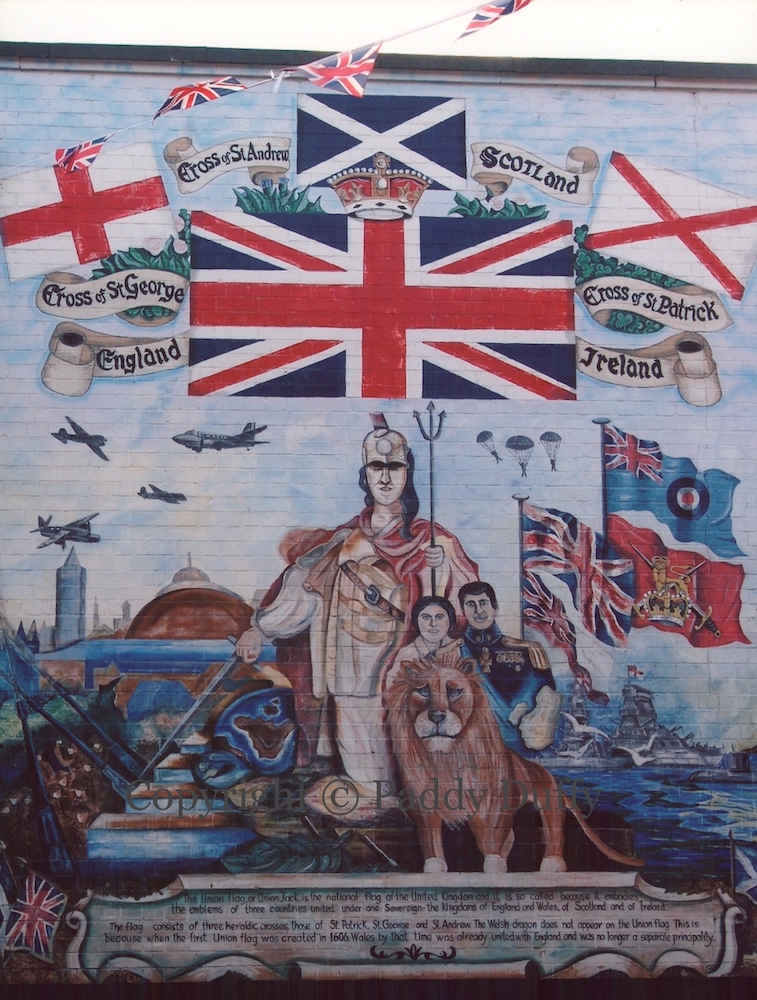
  • Britannia. “The Union flag, or Union Jack, is the national flag of the United Kingdom and it is so called because it embodies the emblems of three countries united under one sovereign – the Kingdoms of England and Wales, of Scotland and of Ireland. The flag consists of three heraldic crosses, those of St Patrick, St George and St Andrew. The Welsh dragon does not appear on the Union flag. This is because when the first Union flag was created in 1606, Wales by that time was already united with England and was no longer a separate principality.”
  • Commonwealth/Sponsors

The murals were launched in 2004 and information panels were added in 2005.

Click image to enlarge
Copyright © 2012 Paddy Duffy
T00587 T00600 T00593 [T00604] T00594 T00589 [T00607]
T00588 [T00608]
T00596 [T00595] T00597 [T00606] T00598 T00599 [T00605] T00590 [T00603] T00591 [T00592] [T00602]
T00601