The end wall of Columbia Street in the Woodvale was knocked down, taking with it a former Duke Elliott/UDA mural, which was then replaced with boards (rather than murals) commemorating the history of the UDA and Elliott. Elliott lived one street over, in Leopold Street (WP). He was killed in 1972, at age 28, in a dispute with other UDA members.
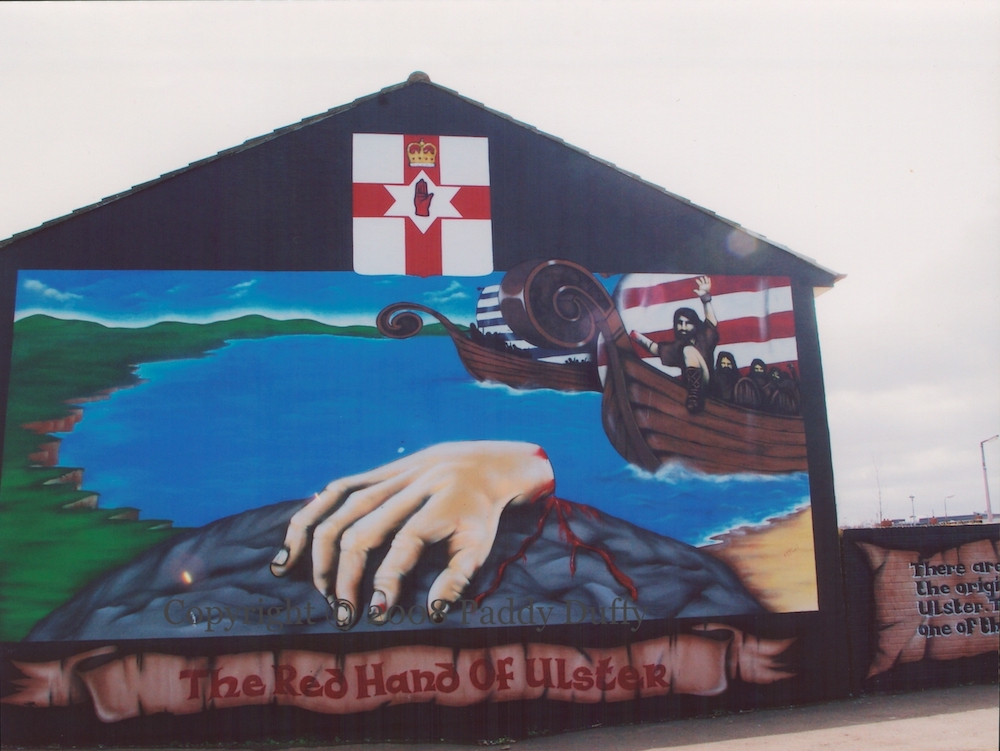
“There are many legends telling the origins of the Red Hand Of Ulster. This mural depicts only one of those.” In this case, the myth is that Ulster was offered as a prize to whoever could reach it first and was won by throwing a severed hand onto the shore. The flag of Northern Ireland (the Ulster Banner) is in the apex.
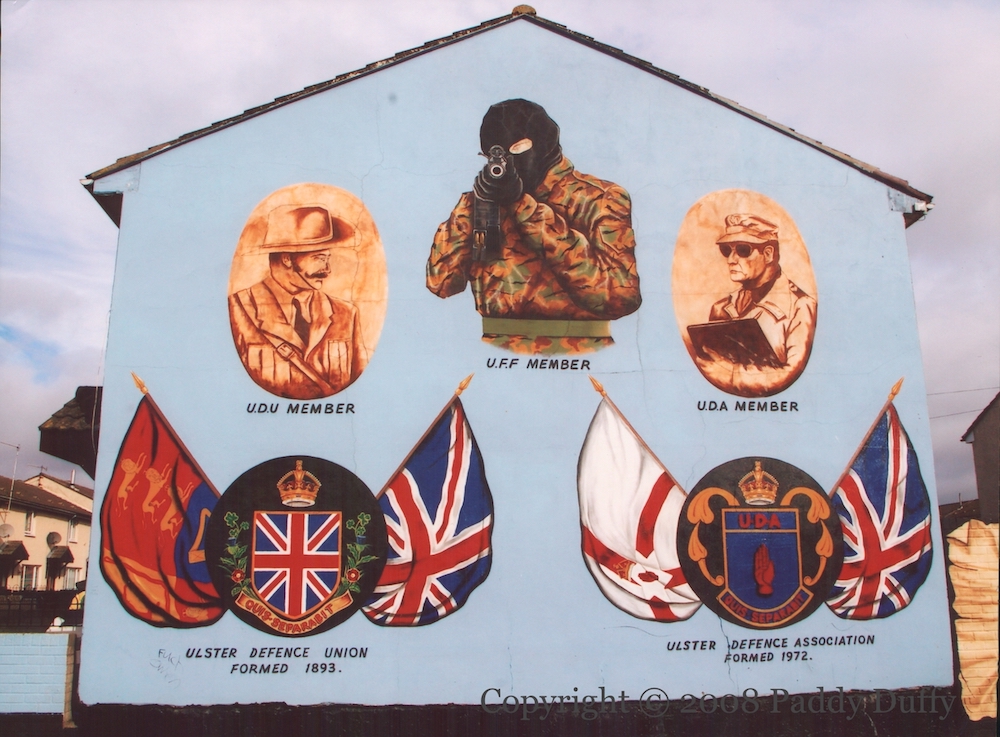
This is a 2007? repainting of a lower Shankill mural placing Ulster Freedom Fighters/Ulster Defence Association (UFF/UDA) within the historical context of “a new organization entitled the Ulster Defence Association, the objects of which are to elect an assembly of 600 delegates, having authority to declare the policy and direct the action of the Ulster Unionists and to raise funds for the purposes of the organization from loyalists of all classes.” The motto of the organisation was “Quis separabit” (which is the same as the UDA’s).
The Union faded away in the 1910s, but the name was revived by the UDA in 2007.
The manifesto was launched on St Patrick’s day 1893, in response to the 2nd Home Rule bill. Membership was closed on June 1st, by which time 170,000 people had signed up. The newspaper source of the text is unknown; a similar newspaper article from the Tasmanian Daily Telegraph can be found here. The words “Ulster Defence Association” do not occur in the manifesto.
The Ulster Banner – the flag of the Northern Ireland government from 1924 to 1973 – is taken from the arms, shown here. The supporters are a lion – for the Ulster-Scots – and an elk – for the Irish (WP).
“In August 1971 many Protestants fled their homes as the IRA launched a bitter sectarian attack on Protestant communities throughout Belfast. The loyal people of Liverpool held out the hand of friendship in our hour of need up to 2000 terrified women and children escaped from burning homes to live in the safety of Liverpool. That act of friendship by the people of Liverpool will never be forgotten. Liverpool – Belfast a bond never broken. No surrender ” With newspaper reports by the Belfast Telegraph and Liverpool Echo. Sponsored by the East Belfast Historical And Cultural Society.
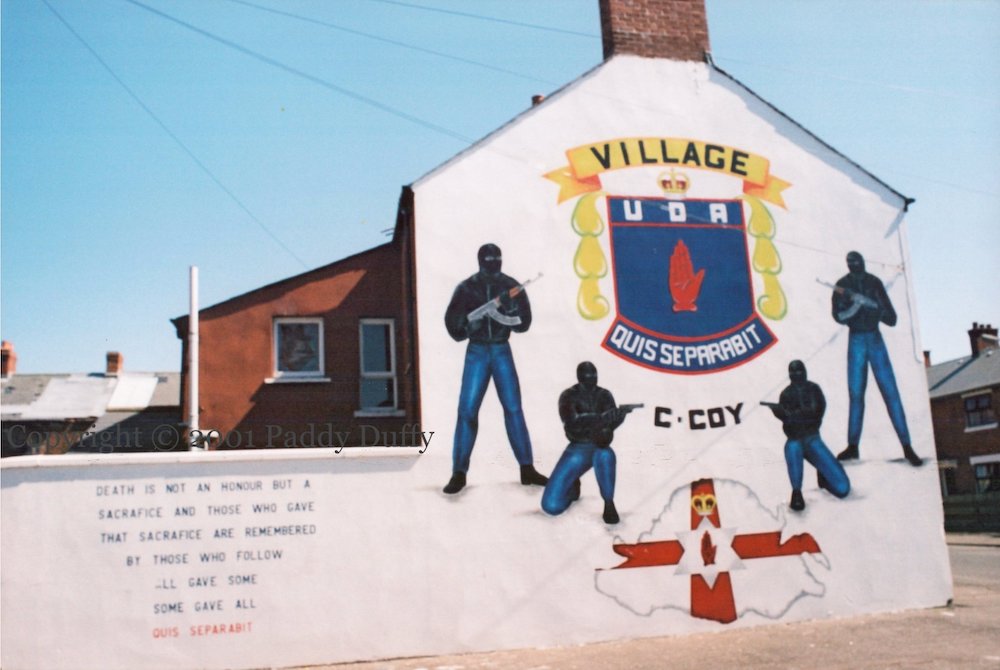
“Death is not an honour but a sacrafice [sic] and those who gave that sacrafice [sic] are remembered by those who follow. All gave some, some gave all. Quis separabit.” Village UDA C company volunteers in balaclava pose with assault rifles around an Ulster Banner in the shape of Northern Ireland.
Chained-together padlocks represent Long Kesh and UDA/UFF prisoners of war (LPOW). The Ulster nationalist flag is on the left. For the four-quadrant shield, see Sans Peur.
UDA mural in Avoniel Road showing two hooded gunmen kneel on a free-floating Northern Ireland. Avoniel Road and Dee Street would fall within the territory of 2nd battalion, east Belfast.
A Visual History page details the various appearances of Eddie The Head in his guise as a Red Coat soldier-cum-UDA volunteers. In this Shankill Eddie, he carries an assault rifle and an Ulster Banner as he marches over the graves of “E[ddie] Copeland”, “S[ean] Kelly”, and “S[tephen] Larkin”. The three are IRA volunteers: Kelly, along with Thomas Begley, bombed Frizzell’s fish shop on the Shankill Road in 1993 – Kelly survived; Copeland was injured during an attack on Begley’s wake; Larkin made an attempt on the life of Johnny Adair in 1993.






 Paddy Duffy Collection