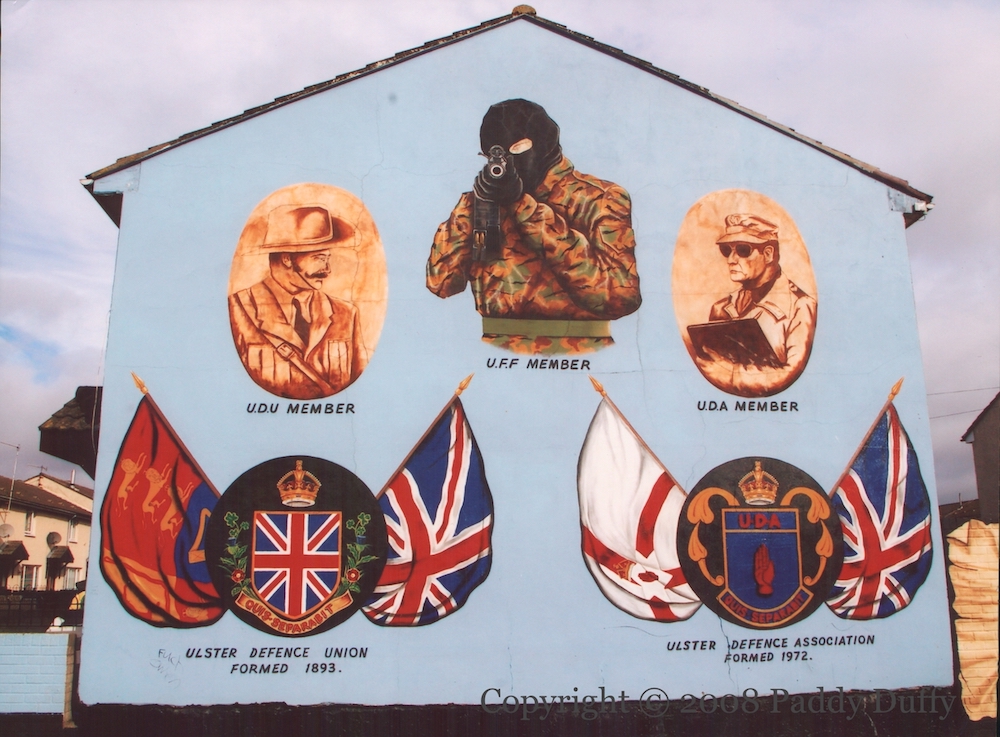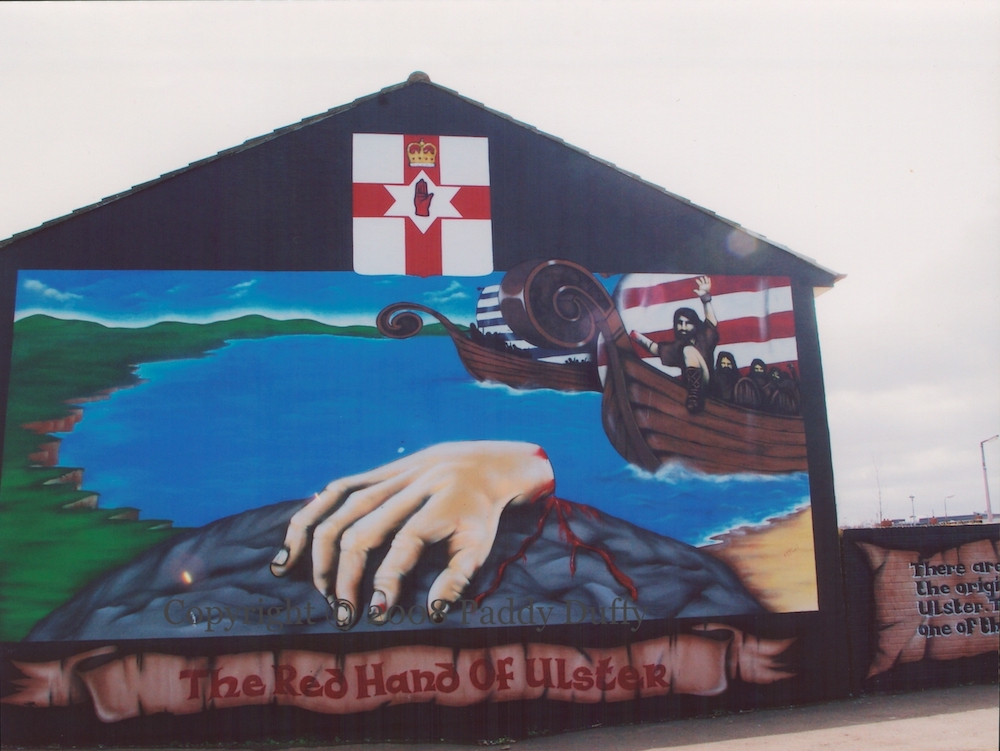
The Ulster Banner – the flag of the Northern Ireland government from 1924 to 1973 – is taken from the arms, shown here. The supporters are a lion – for the Ulster-Scots – and an elk – for the Irish (WP).
“In August 1971 many Protestants fled their homes as the IRA launched a bitter sectarian attack on Protestant communities throughout Belfast. The loyal people of Liverpool held out the hand of friendship in our hour of need up to 2000 terrified women and children escaped from burning homes to live in the safety of Liverpool. That act of friendship by the people of Liverpool will never be forgotten. Liverpool – Belfast a bond never broken. No surrender ” With newspaper reports by the Belfast Telegraph and Liverpool Echo. Sponsored by the East Belfast Historical And Cultural Society.
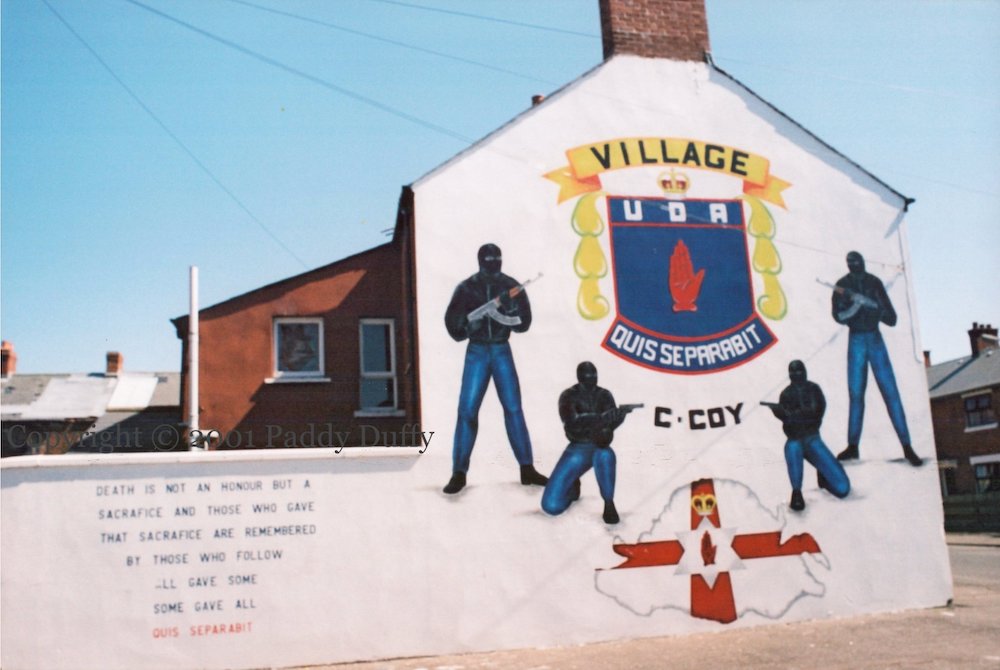
“Death is not an honour but a sacrafice [sic] and those who gave that sacrafice [sic] are remembered by those who follow. All gave some, some gave all. Quis separabit.” Village UDA C company volunteers in balaclava pose with assault rifles around an Ulster Banner in the shape of Northern Ireland.
Chained-together padlocks represent Long Kesh and UDA/UFF prisoners of war (LPOW). The Ulster nationalist flag is on the left. For the four-quadrant shield, see Sans Peur.
UDA mural in Avoniel Road showing two hooded gunmen kneel on a free-floating Northern Ireland. Avoniel Road and Dee Street would fall within the territory of 2nd battalion, east Belfast.
A Visual History page details the various appearances of Eddie The Head in his guise as a Red Coat soldier-cum-UDA volunteers. In this Shankill Eddie, he carries an assault rifle and an Ulster Banner as he marches over the graves of “E[ddie] Copeland”, “S[ean] Kelly”, and “S[tephen] Larkin”. The three are IRA volunteers: Kelly, along with Thomas Begley, bombed Frizzell’s fish shop on the Shankill Road in 1993 – Kelly survived; Copeland was injured during an attack on Begley’s wake; Larkin made an attempt on the life of Johnny Adair in 1993.
“Free our prisoners o[f] w[ar]”, specifically prisoners from the South Belfast UFF/UDA. This pair of smaller murals is in the garden next to St Alban’s, and the gable mural is across the road.
“4,000 years of Ulster-Scots history and heritage. Ulster & Scotland – shared language, shared literature, shared culture.” 400 years takes us back to the plantation; 4,000 years suggests an even deeper connection.
Ulster-Scots was included in the 1998 Good Friday Agreement (pdf) under the principle of support for “linguistic diversity”. This mural celebrating Ulster-Scots and ties between Northern Ireland and Scotland dates to 1999, with the crests of St Andrew and St Patrick on the left, and an Ulster Banner and Scottish lion rampant on the right.
“Dinnae houl yer wheest, houl yer ain!” [Don’t hold your tongue, hold your own!]
“Red Hand Commando A Company Shankill”. The plaque unfortunately cannot be read.
There was previously a board above the flag-pole holder, showing the same emblem but with “Scottish Brigade” instead of “Red Hand Commando”, against a St Andrew’s Saltire (D00029).
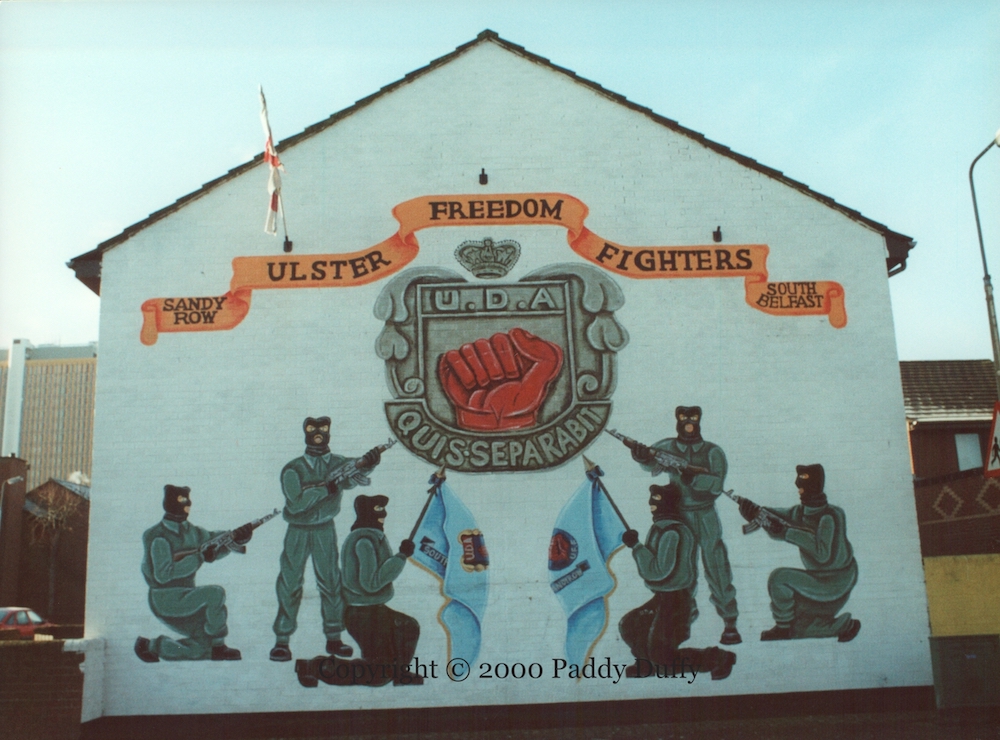
The scroll on the left between the emblems of the UDA, UYM, UFF and the Ulster banner reads, “In memory of our freedom fighters who fought and died for Ulster. It was not for glory they fought nor honour or riches but freedom alone which no good man should lose but with his life.” There is a pair of manacled red fists above the central UFF emblem, which itself rests on a free-floating outline of Northern Ireland superimposed with the Ulster banner. On the right is a crouching volunteer from A battalion, from south Belfast’s Sandy Row.