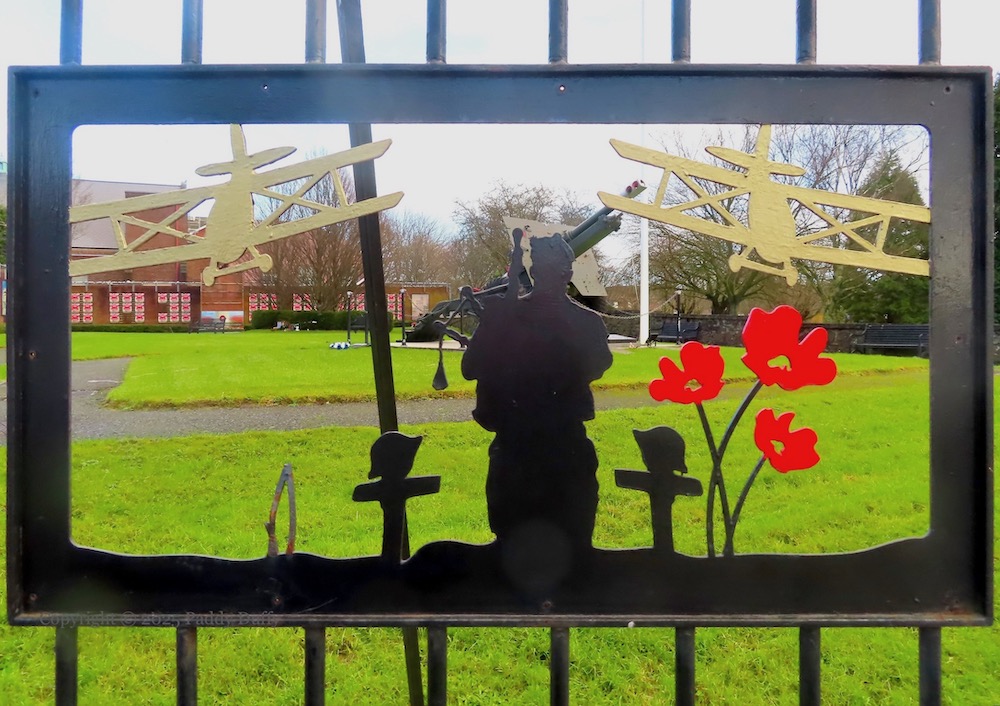
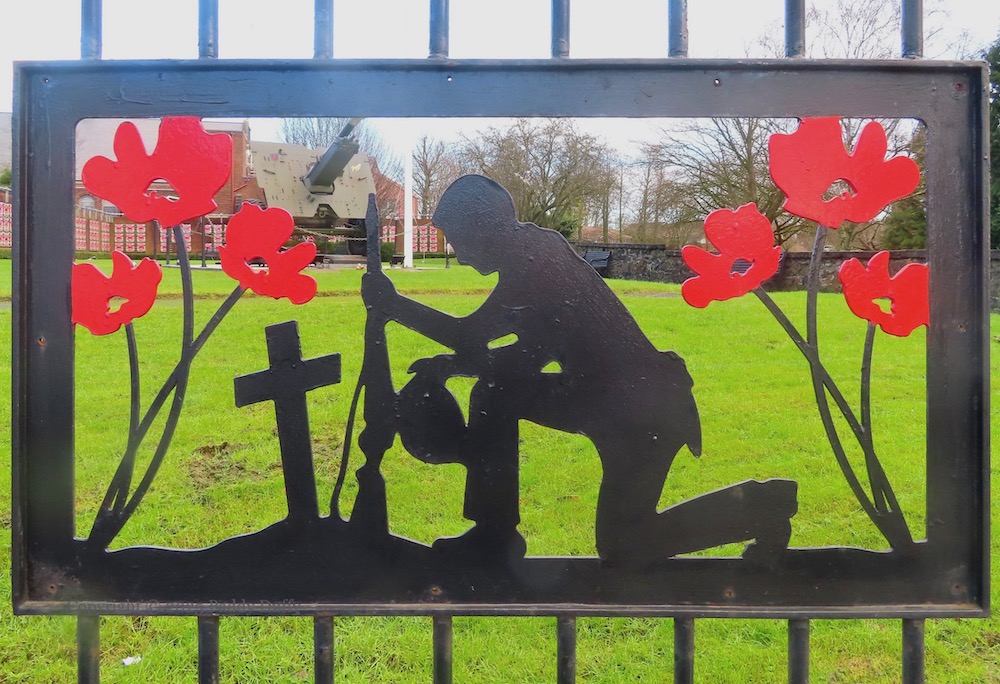
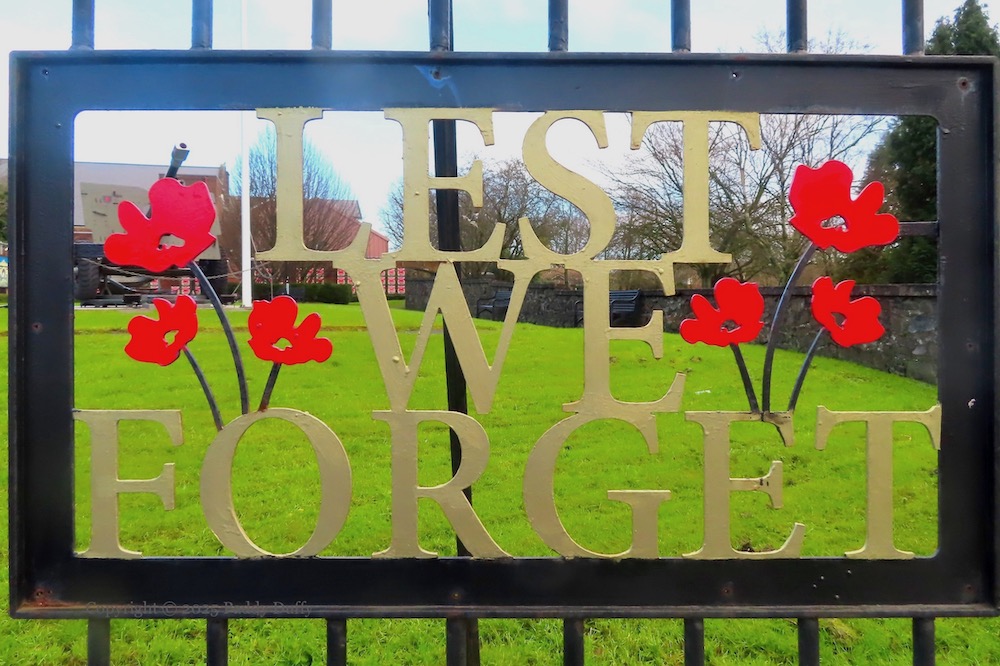
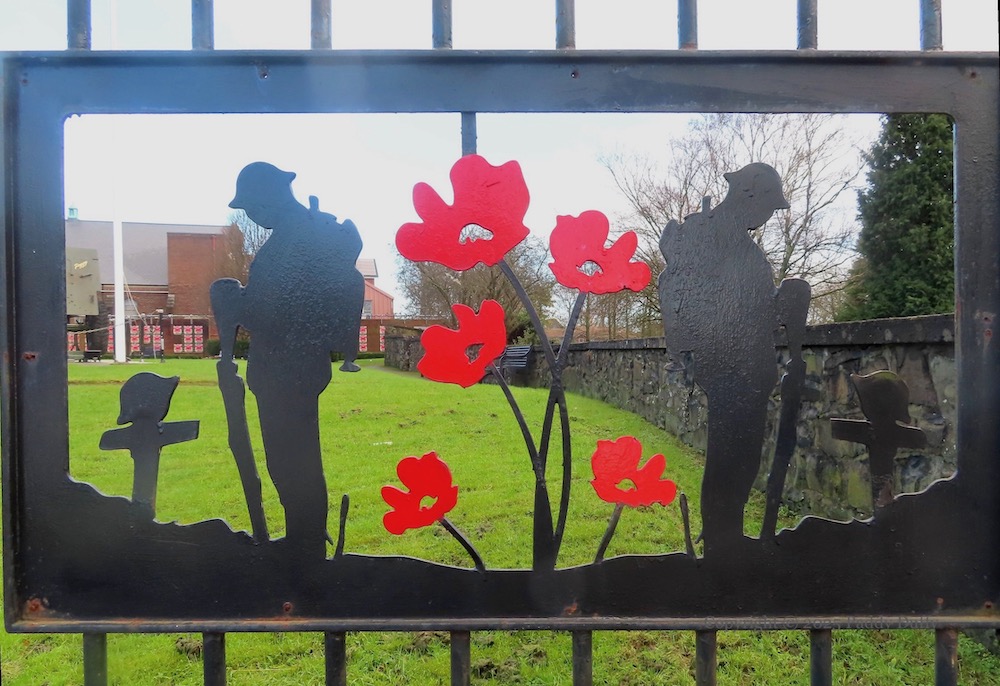
These wreaths are mounted next to the Battle Of Britain board on Beverley Street (Band Of Brothers) which celebrates and commemorates the Polish pilots in the RAF’s 303 Squadron during WWII.
The first and third of these three wreaths – which were new at the end of 2024 – combine WWI and WWII. In the first, we see poppies and the familiar image of a WWI soldier standing by a graveside, along with an image of a WWII fighter-plane (probably a Spitfire or Hurricane) flying over a crowd of soldiers. The third combines the red-and-white of Poland with a poppy. (See also the wreath from 2018, which placed Polish writing and imagery within a wreath of poppies.)
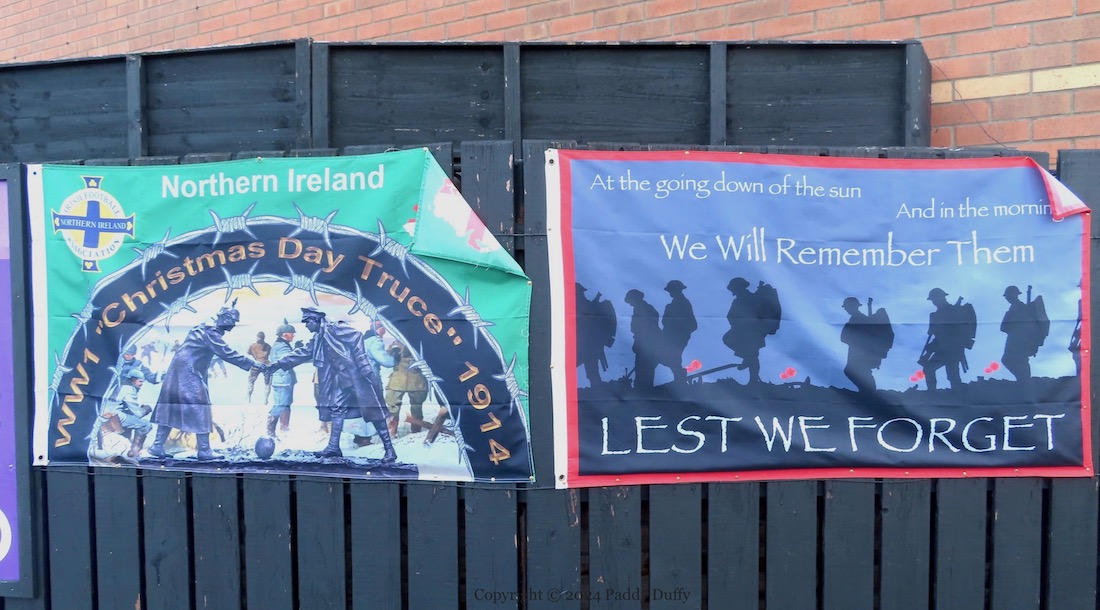
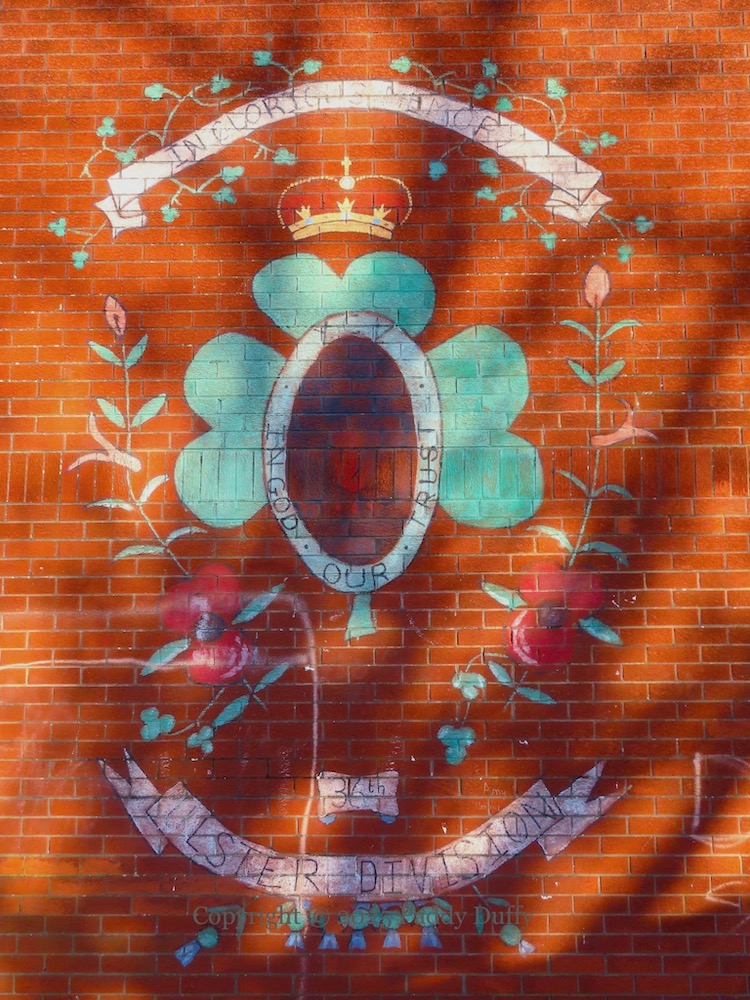
Here is a gallery of images of the boards and flags on the fencing around “Buck’s Shed” in Rathfern, Newtownabbey. The usual themes are represented: the 36th Division and WWI (Mountainview Battlefields Association Fb), the British military, Rangers FC, and George Best.
The rosette at the centre of the poppy wreath shows the UK armed services badge (with the crown overlaid by the Ulster Banner) surrounded by a verse from Binyon’s ‘For The Fallen’ and “Tiger’s Bay – York Street – Sailortown loyal”. That group’s Facebook page is private and no home-page seems to be available for ‘North Belfast Friends Of The Somme’.
North Queen Street, Tiger’s Bay, Belfast, at the old Lewis Street.
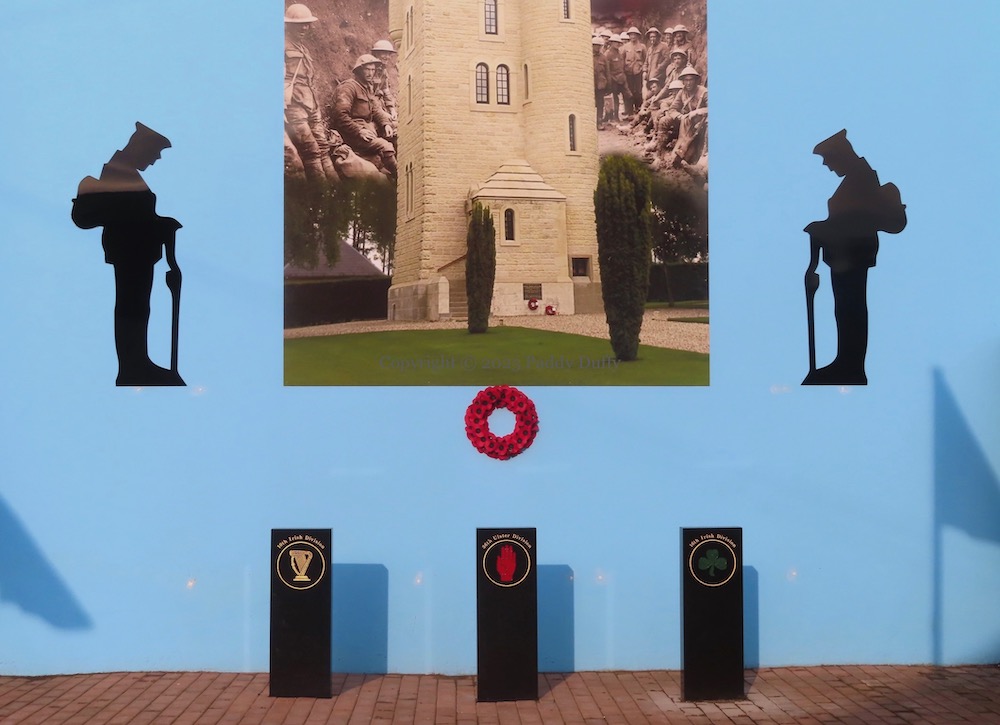
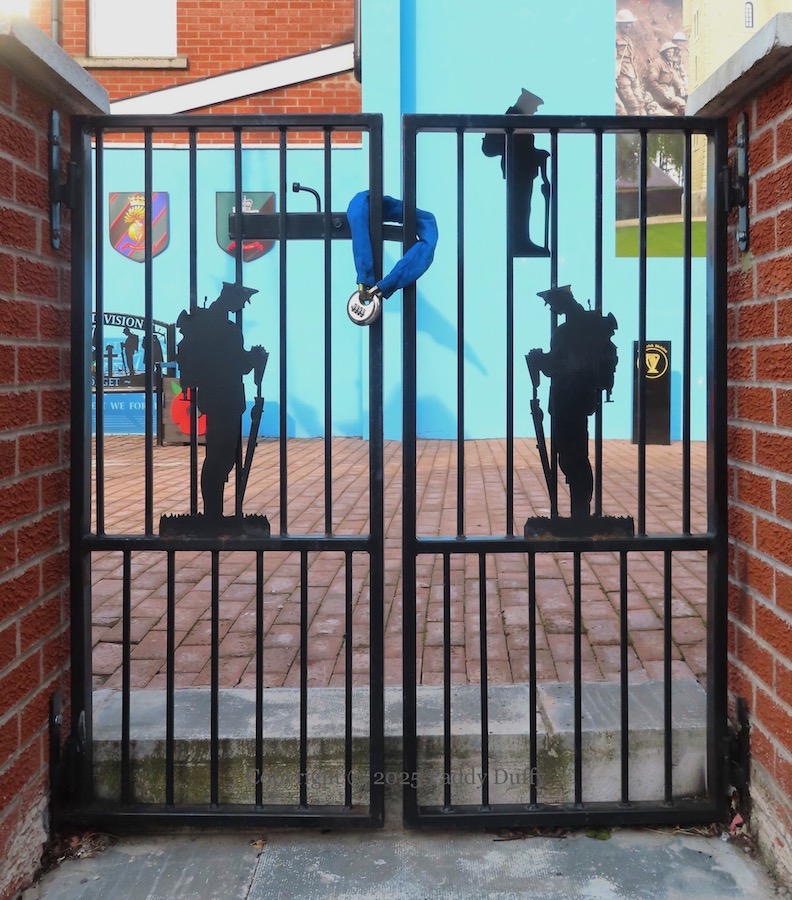
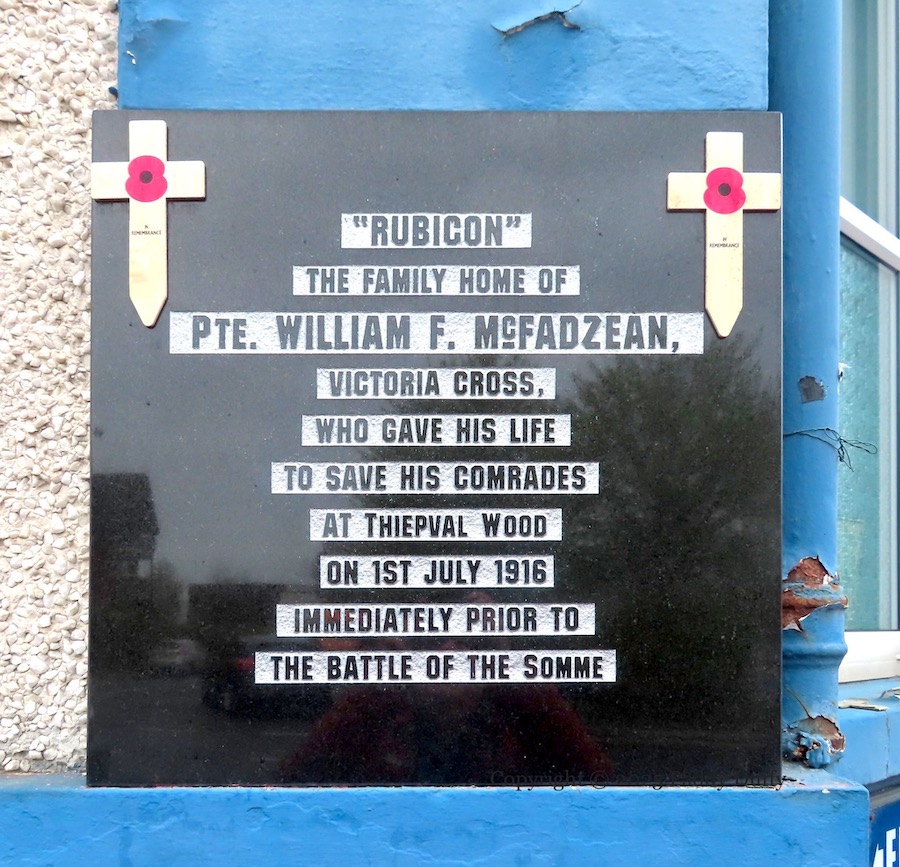
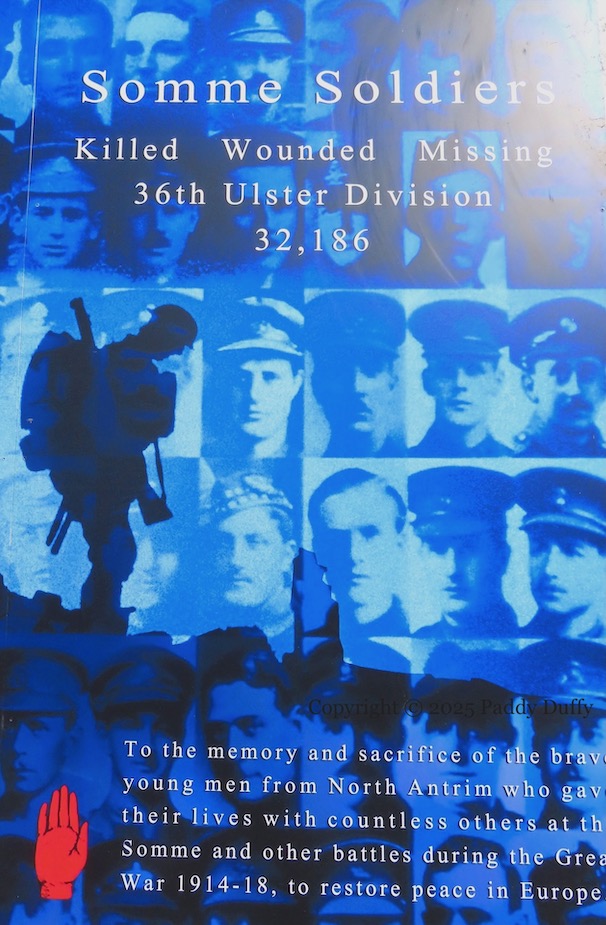
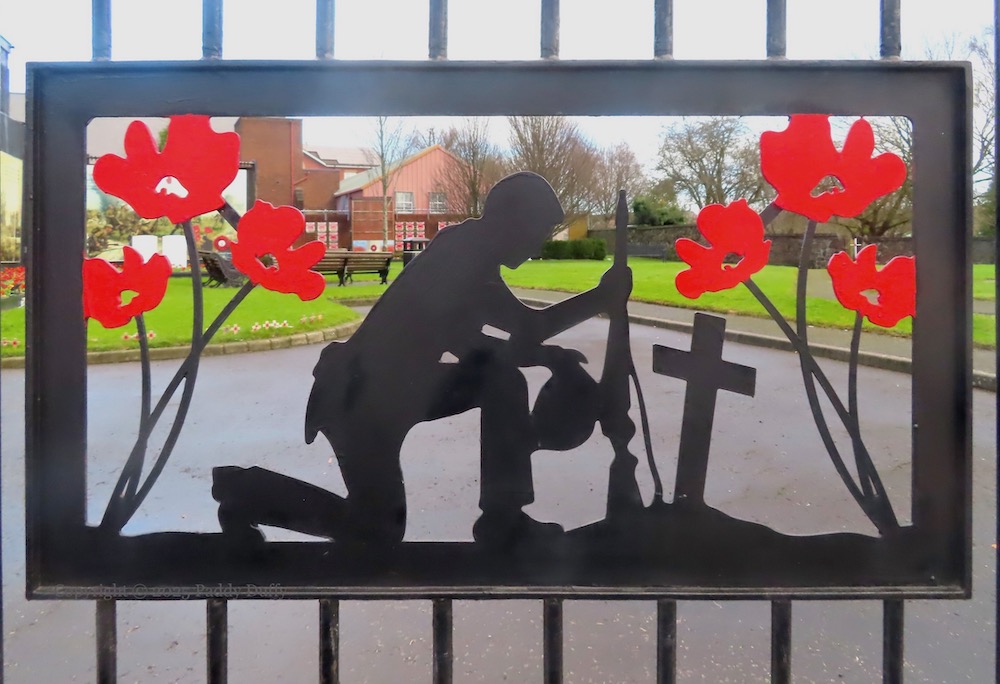
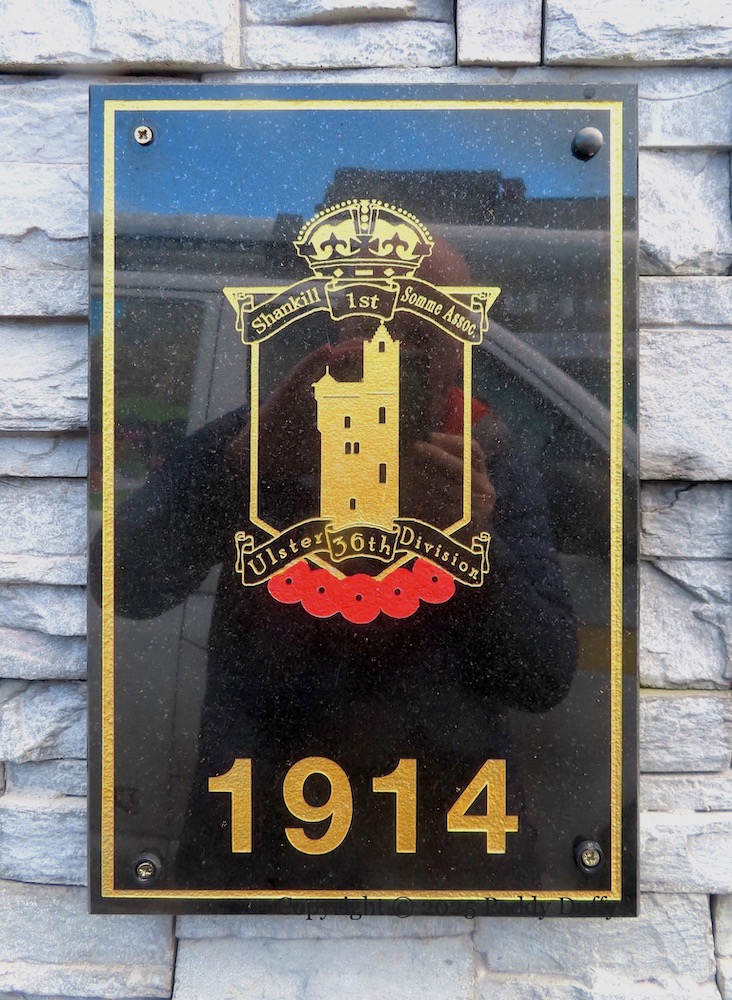
This entry covers two steps in the development of the WWI memorial garden on Donegall Road at Barrington Gardens.
Previously, there were two boards on the gable wall (see The Road To The Somme), of the Covenant signing and soldiers in the trenches of WWI (a copy of a Carol Graham painting).
The images below (from November, 2023) show the latter board absent as the brick walls are being built and a roll of honour to locals who lost their lives being installed.
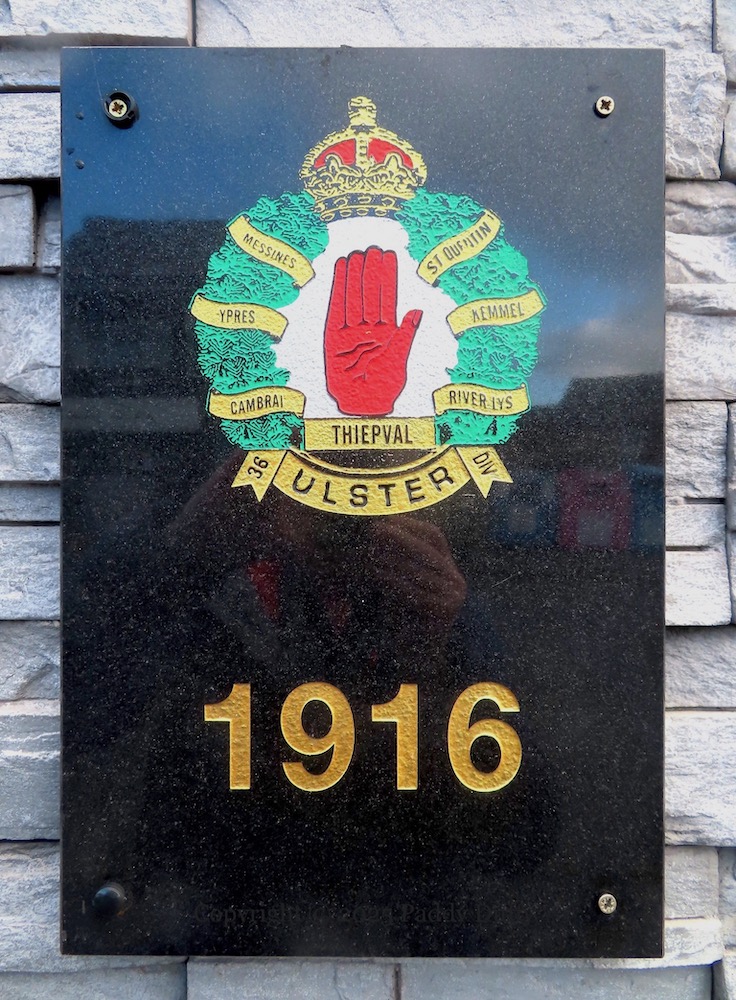
The images in the top half of the entry (from October 2024) show the gable and side-wall painted blue, with a large board showing the Ulster Memorial Tower in Thiepval, below a red hand, and (on the side-wall) the crests of the YCV, Inniskilling Fusiliers, Royal Irish Fusiliers, and the Royal Irish Rifles.
This is a smallish board in New Mossley, Newtownabbey:
On the left: “11th/12th Battalion Royal Irish Rifles (South and Central Antrim Volunteers) – The Ulster Memorial Tower, Thiepval, France. The Ulster Memorial Tower was unveiled by Field Marshall Sir Henry Wilson in Thiepval, France, on 19 November 1921, in dedication to the contributions of the 36th (Ulster) Division during The Great War 1914-1918. The tower marks the site of the Schwaben redoubt, against which the (Ulster) Division advanced on the first day of the Battle of the Somme.”
Specifically, the Central Antrim regiment (of the Ulster Volunteers) became the 12th battalion RIR, while the South Antrim regiment (of the Ulster Volunteers) became the 11th battalion RIR; both joined the 108th brigade in the 36th division.
The redoubt is also the site of the Thiepval Memorial.
JP Beadle’s painting “Battle of the Somme: Attack of the Ulster Division” hangs in Belfast City Hall (Royal Irish has a history of its purchase).
On the right: “The Great War 1914-1918. 32,186 killed, wounded, missing, 36th (Ulster) Division. They fought together as brothers in arms, they died together and now they sleep side by side. To them we owe a solemn obligation. They died that we might live.”
The sword-in-cross is a common war memorial but the one pictured is probably the Tyne Cot memorial to the Commonwealth dead of WWI (see Great War 100 Reads).
See also: The same boards (at larger size) next to the memorial garden – South And Central Antrim Volunteers. And from the historical record, True Heroes – which includes two small, painted, 36th Division boards from the street in 2009.
Benjamin West painted The Battle Of The Boyne in 1778 and his composition – with William moving from left to right on a white horse and Marshal Schomberg dying in the bottom-right corner – has become the standard representation in loyalist culture, perhaps due to versions of it appearing on the covers of songbooks for the Orange Order and the Apprentice Boys soon after (Belinda Loftus 1982 Images In Conflict). It appears here on the wall of Whitehead Orange Hall, along with a board connecting service by Irish soldiers in British forces in WWI and Afghanistan (see previously: The Sacrifice Remains the Same in east Belfast).
“15th battalion Royal Irish Rifles (North Belfast Volunteers). To the memory and sacrifice of the North Belfast Volunteers who formed in this area, brave young men who gave their lives at the Somme and other battles to restore peace in Europe. ‘To them, bravery was without limit. To us, memory is without end.'” Five of the six portraits were included in the previous mural (see Many Did Not Return): (1) Rifleman Forrester, (2) Rifleman Baird, (4) Sergeant Major Magookin, (5) Rifleman Templeton, (6) 2nd Lt De La Harpur.
“Second Lieutenant Edmund De Lind. Awarded the VC for actions near Grugies, France 21st March 1918.”
De Wind was born in Comber but went to Canada in 1911. When the Great War began he joined the Canadian Army in Edmonton and fought at the Somme and Vimy Ridge. He joined the British Army and joined the RIR, the 15th battalion of which was originally drawn from the North Belfast Volunteers (War Time Memories). He died on March 18th, 1918, at St Quentin, near Grugies, in the Aisne. For his actions he was awarded the Victoria Cross; it is held in the Canadian War Museum, Ottawa. (CEF | Royal Irish | Legion | Ulster History | WP)
As is seen in the final two images, De Wind is remembered on one of the pillars outside St Anne’s in Belfast city centre.
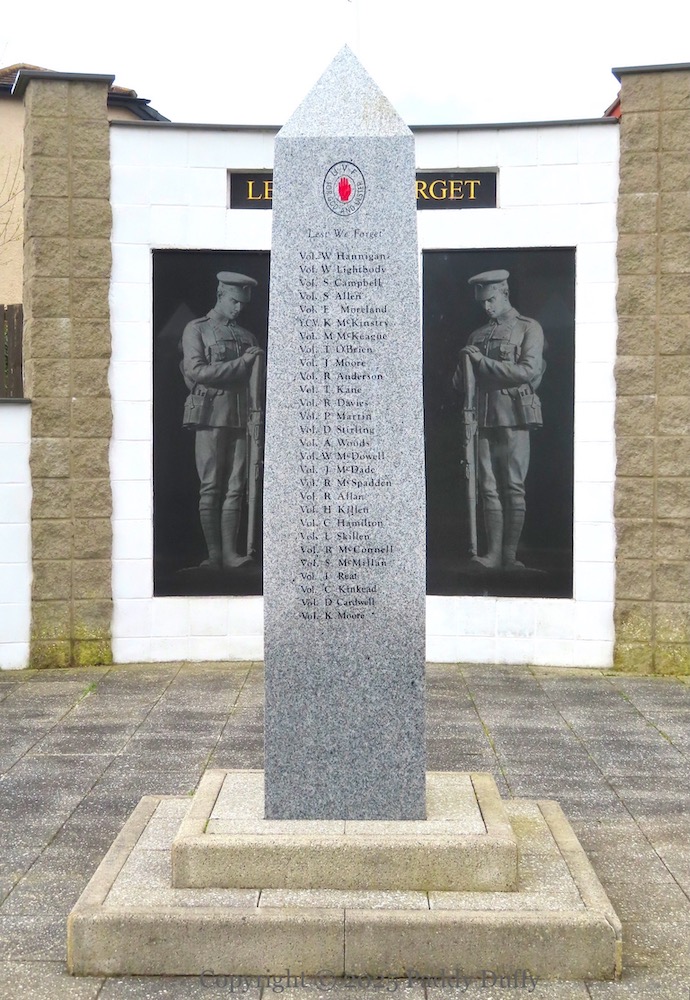
The stone in front pre-dates this mural, though more names have been added since it was seen in Ghosts Of The Somme. “Rathcoole Friends Of The Somme roll of honour. Past member – lest we forget.”
Inniscarn Drive, Newtownabbey. Launched July 22nd, 2024.
These are the boards at the chip shop (formerly a Spar and before that a Mace) in the centre of the Mourneview estate, Lurgan.
Above, and in detail below, are the pieces from the front of the shop, in Pollock Drive. Anti-clockwise from bottom-left:
First: “Believe, we dare not boast,/Believe, we do not fear/We stand to pay the cost,/In all that men hold dear.//What answer from the North?/One Law, one Land, one Throne/If England drive us forth,/We shall not fall alone!” Kipling’s poem Ulster.
Next (tall piece): A company, 1st battalion, Mid Ulster brigade UVF – Lurgan as well as Broxburn (outside Edinburgh) and Thornliebank (near Glasgow).
Next: PAF plus (out of frame in the wide shot) “When injustice becomes law resistance becomes duty.” The same panel was seen in Ballyclare, though for the 1st East Antrim battalion rather than the Mid Ulster brigade.
Above: A tribute to the Ulster Volunteers from the area: the 9th battalion Royal Irish Fusiliers joined the 108th brigade in the 36th (Ulster) Division; the 5th battalion joined the 31st brigade and the 10th (Irish) Division. This board goes back to (at least) 2011.
Finally (top left), a UDU/UDA board, to 1 company, D battalion, South Belfast. All of the remaining pieces are UVF/PAF.
Around the corner, in Mourne Road, a gallery of photographs of the Craigavon Protestant Boys (Fb) past and present, with a plaque in memory of Victor Stewart. “Our only crime is loyalty.”
In the adjacent Spelga Park: “Unbowed & unbroken – our only crime is loyalty – Mourneview/Gret estate bonfire” with an unusual combination of shamrock and Orange lily.
“In Deo speramus”. “Edgarstown Remembers” “our forty-two fallen sons who made the ultimate sacrifice by giving their tomorrow for our today in the Great War 1914-1918.” “Dear Lord, I am just a soldier, a protector of our land/A servant called to battle when my country takes a stand./I pray for strength and courage and a heart that will forgive/For peace and understanding in a world for all to live./My family’s prayers are with me, no matter where I roam./Please listen when I’m lonely and return me safely home – Unknown”
On July 1st, 1916, the Battle of Albert began, the first of many battles in what is known collectively as the Battle of the Somme. Soldiers from the 36th (Ulster) Brigade went “over the top” at 7:28 a.m. By the end of the day, more than nineteen thousand British soldiers were dead, five thousand from the 36th.
Below the main panel, which shows combat at close quarters, are the words of Wilfrid Spender: “I am not an Ulsterman but yesterday, the 1st. July, as I followed their amazing attack, I felt that I would rather be an Ulsterman than anything else in the world … the Ulster Volunteer Force, from which the Division was made, has won a name that equals any in history.”