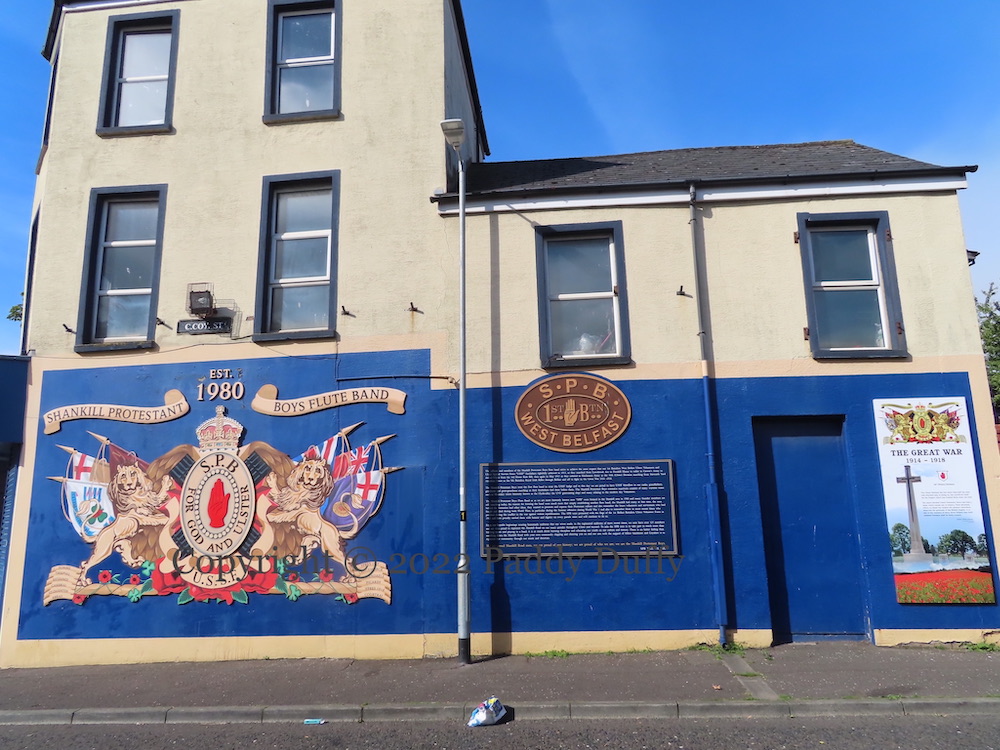
At first glance the piece above looks like a colourful mural but it is in fact a large painted carving of lions rampant on either side of the emblem of the Shankill Protestant Boys flute band, named for the Shankill Boys of the original Ulster Volunteers and the Ulster Special Service Force unit within it which was designed to be a unit of “first responders”, ready to react at short notice to action by republicans or British forces anywhere in northern Ireland (historyireland).
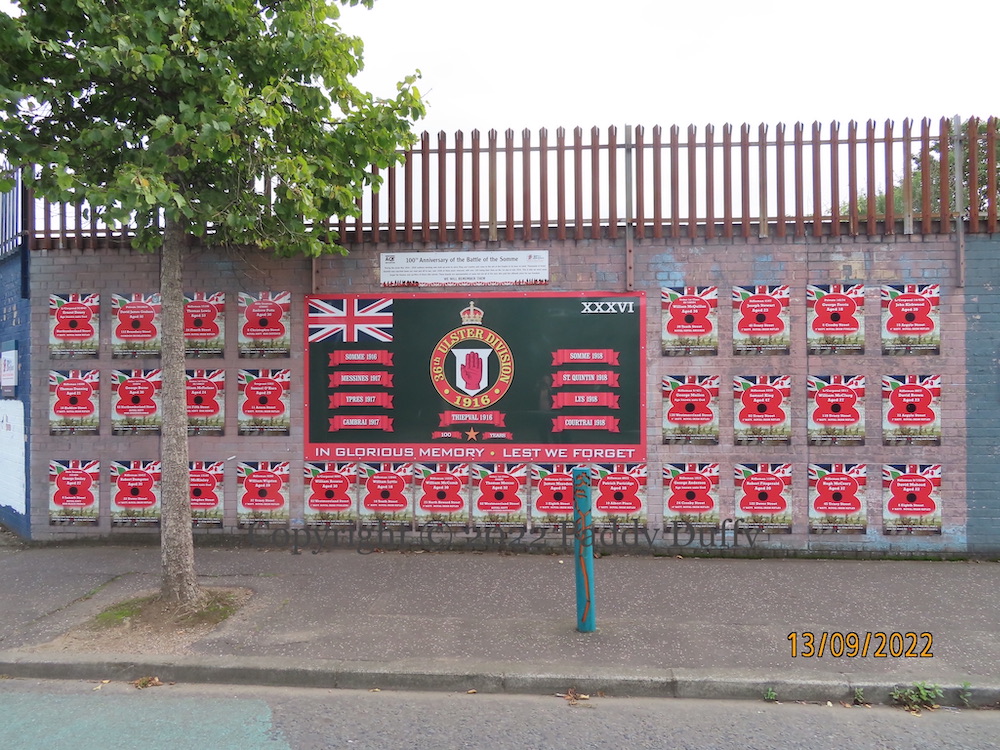
The main battles of the 36th (Ulster) Division (“XXXVI”) are listed – Somme, Thiepval, Messines, Ypres, Cambrai, Somme (1918), St. Quintin [St. Quentin], Lys, Courtrai – and those who died are commemorated on this new board. The main board is surrounded by smaller boards, part of the Poppy Trail, bearing the names, ages, addresses, ranks, and units of deceased soldiers. For example: William Lyttle, aged 18, 16 Tenth Street, 9th batt. Royal Irish Rifles, Rifleman 13044.
The info board above reads: “Thousands of brave Shankill men marched down our road and off to war, over 1500 of them never returned, with over 150 losing their lives on the 1st day of July 1916.”
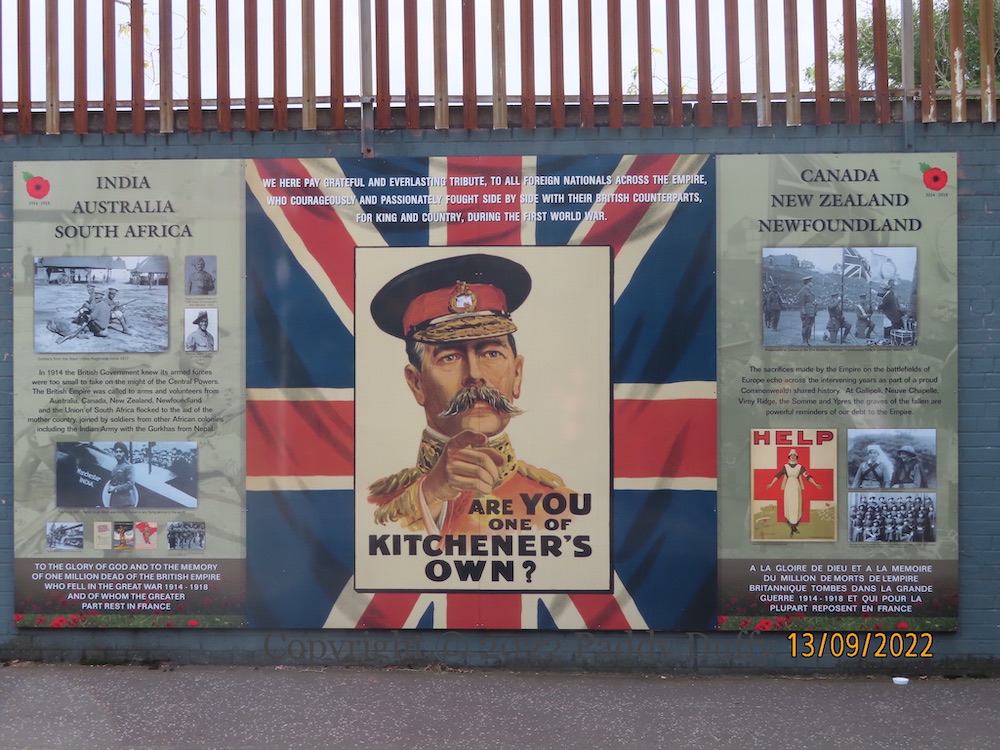
“Are you one of Kitchener’s own?” asks this mural in Northumberland Street: “We here pay grateful and everlasting tribute, to all foreign nationals across the empire, who courageously and passionately fought side by side with their British counterparts, for King and country, during the First World War.” The left-hand side (second image) features images of soldiers from the West Indies and India, including “The Flying Sikh”, Hardit Singh Malik and a French lady as she “pins flowers on a regiment containing Muslims, Sikhs, and Hindus.” On the right, images of the “presentation of Colours to the 51st Battalion Canadian expeditionary force” and of Canadian “bluebird” nurses in the Canadian Army Medical Corps.
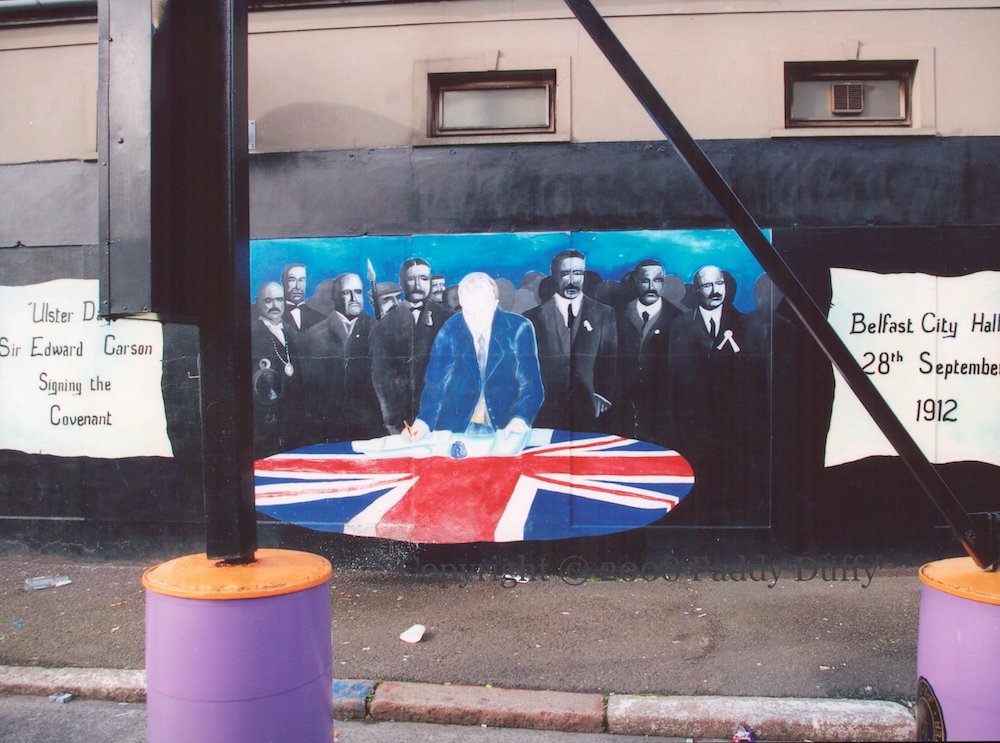
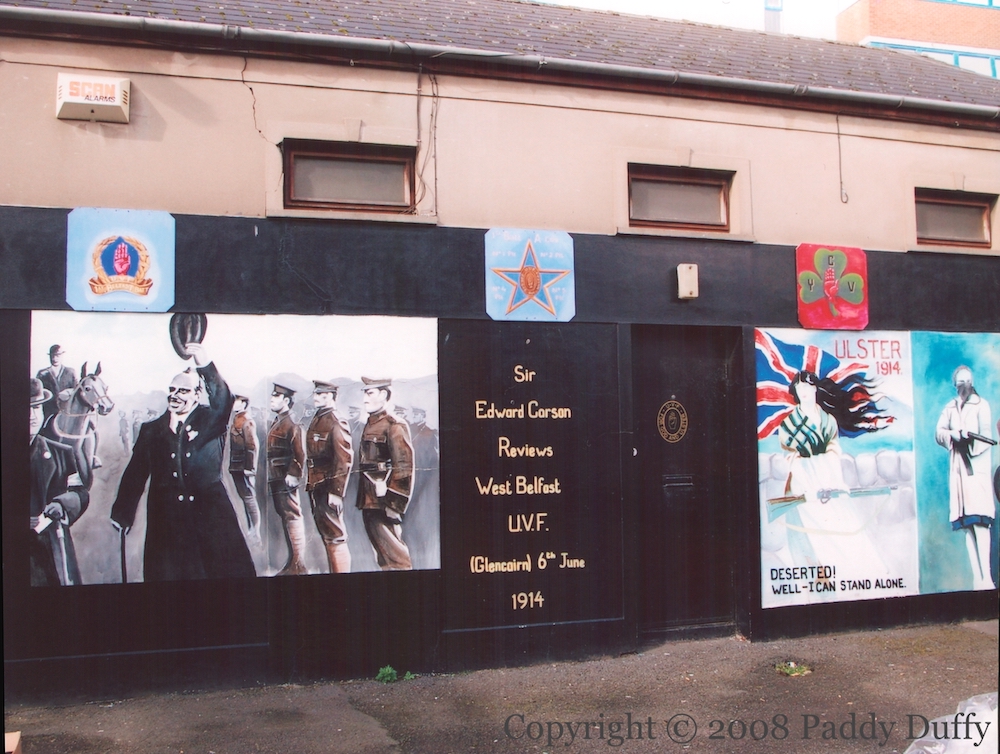
These three panels are in the courtyard of the Rex Bar in what used to be Moscow Street, celebrating resistance to Home Rule – Covenant Day September 28th 1912; the formation of the Ulster Volunteers, being reviewed at Fernhill House in Glencairn Park by Edward Carson; “Deserted! Well I can stand alone“; and (in post-partition Northern Ireland) “a Protestant farmer’s wife guards her husband against sectarian attack from across the border”.
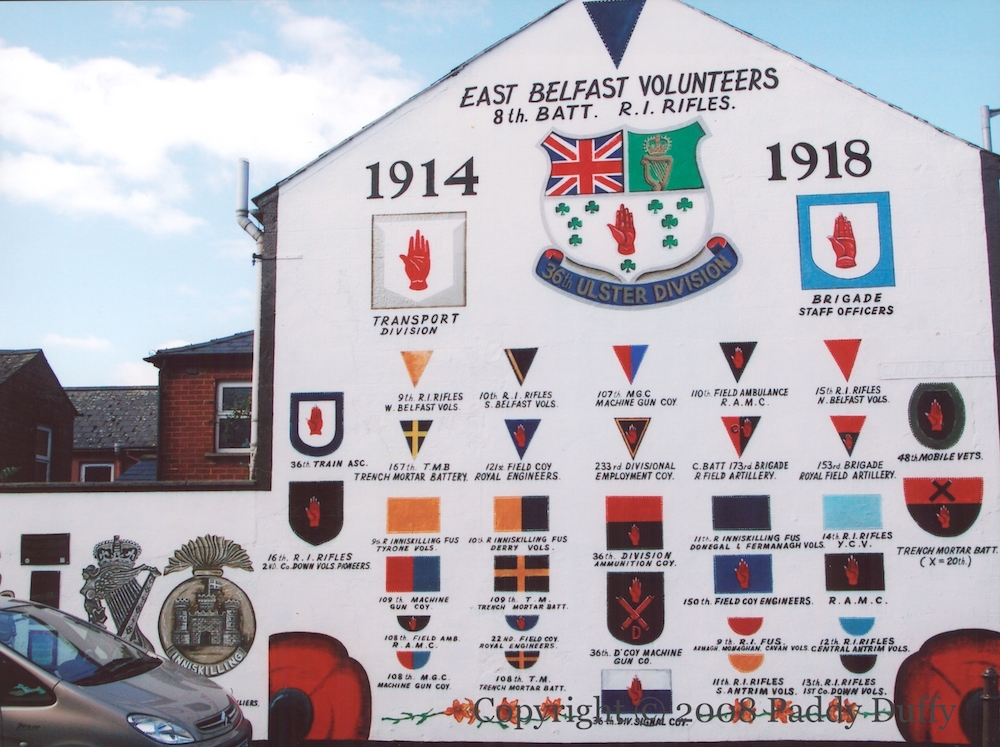
This mural at the mouth of Canada Street commemorates The main mural features insignia of more than thirty units of types from the 8th Batt. RIR, ranging from machine gunners to vets.
The plaques on the wall to the left celebrate the nine Victoria Crosses won by members of the 36th (Ulster) Division “For valour”: Cather, McFadzean, Bell, Quigg, Emerson, De Wind, Seaman, Knox, and Harvey; the final plaque is McCrae’s In Flanders’ Fields.
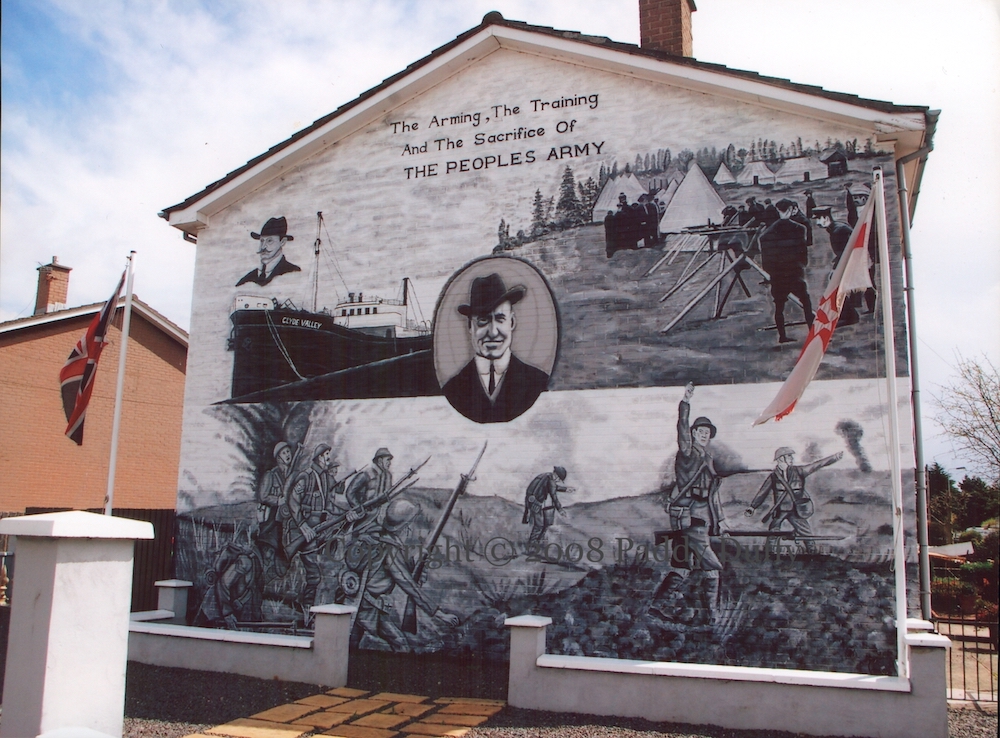
“The arming, the training, and the sacrifice of The People’s Army.” The arming of the Ulster Volunteers (top left) comes from the guns smuggled into Larne on the Clyde Valley. The training of the Ulster Volunteers shown (top right) is probably at Ballywalter. The sacrifice (bottom) is the 36th (Ulster) Division going over the top in James Beadle’s painting ‘Charge of the 36th (Ulster) Division, Somme, 1st July 1916’.
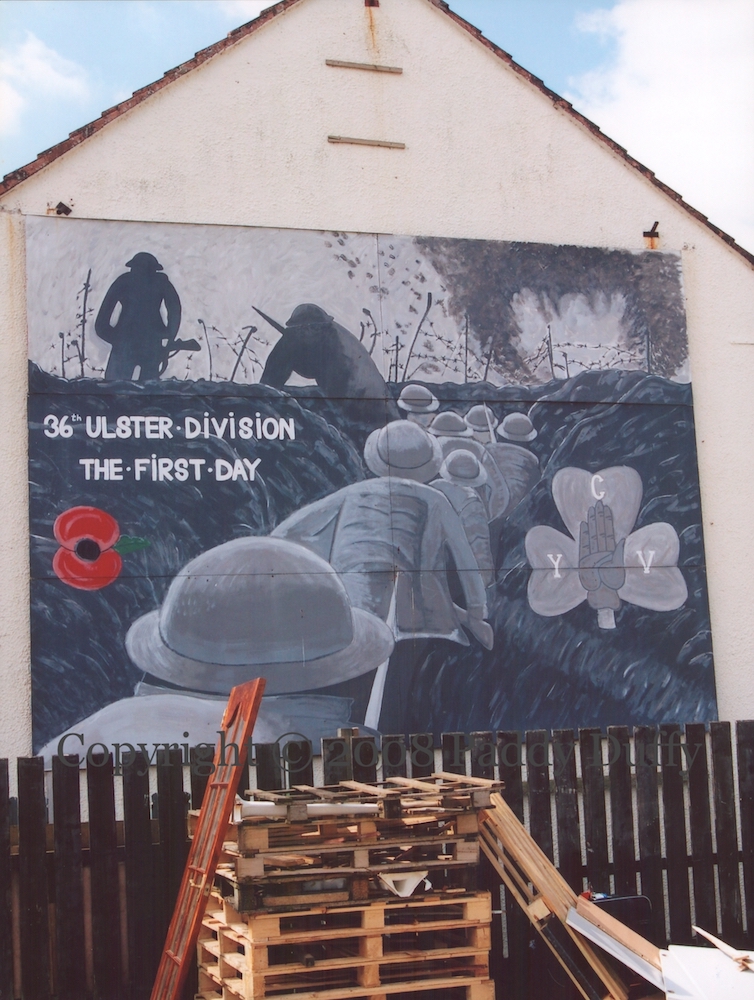
British soldiers from the 36th (Ulster) Division go over the top on the first day of the Battle Of The Somme, July 1st, 1916. The mural is a reproduction of a famous photo by Paul Popper.
These paintings are on boards on the wall around the Cathedral Youth Club in the Fountain.
Above are two boards (on the side) showing the Apprentice Boys crying “No surrender!” and the breaking of the boom that ended the siege. A 2007 entry in the Peter Moloney Collection shows three additional panels to the right, also relating to Londonderry.
Along the top are the emblems of the Royal Inniskilling (27th) Fusiliers (featuring Crom castle), Royal Irish Rifles (featuring the Maid Of Erin harp), Royal Irish Fusiliers (featuring the barossa eagle).
Wrapped around the left column are “Ballykinler, Finner, Clandeboye” – three of the training camps of the 36th. Wrapped around the right column is “Lest we forget”.
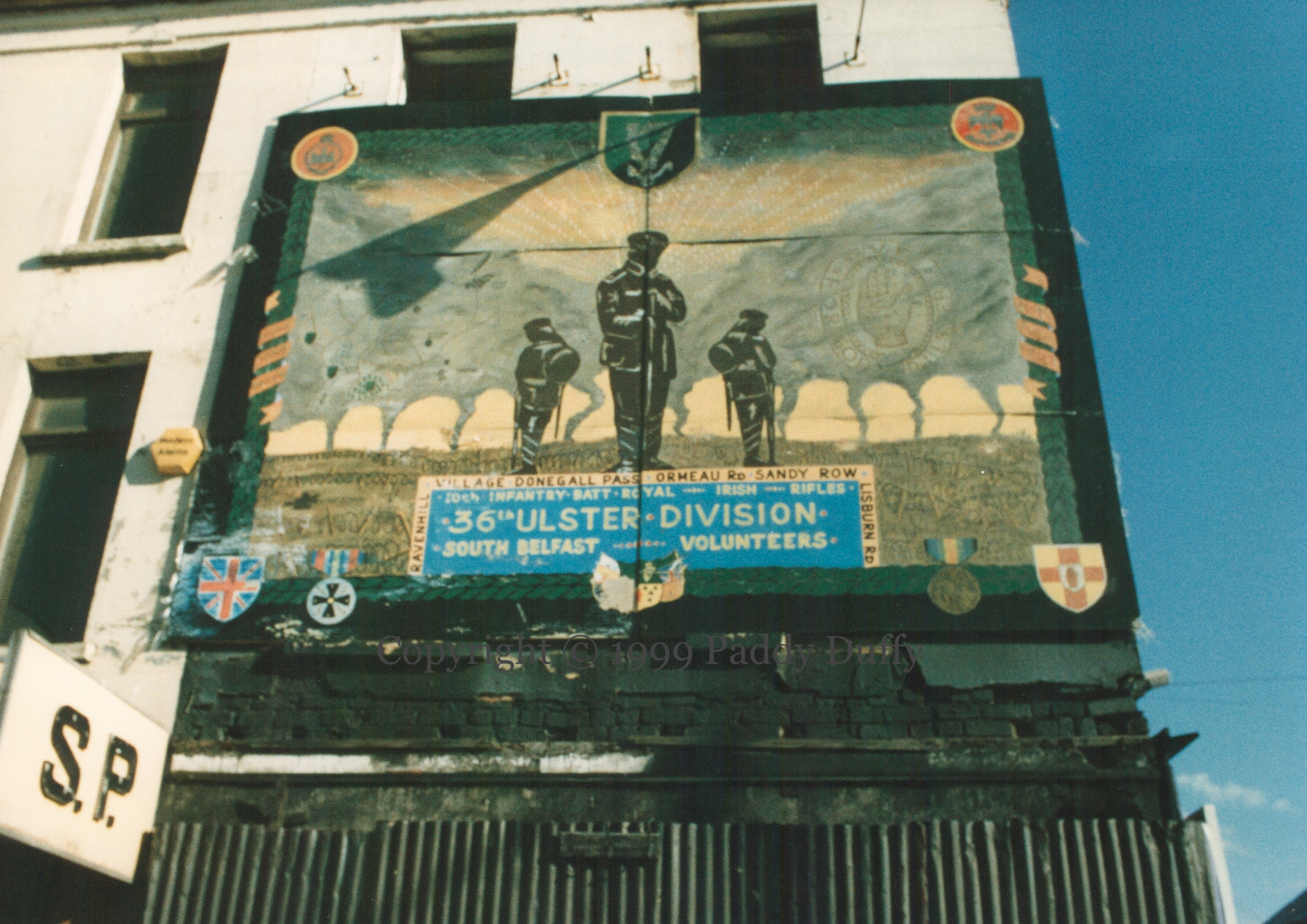
The central text reads: “Ravenhill – Village – Donegall Pass – Ormeau Rd – Sandy Row – Lisburn Rd. 10th infantry battalion Royal Irish Rifles, 36th (Ulster) Division, South Belfast Volunteers”
The Union Flag appears in the lower left, next to an unidentified medal, while the flag of Ulster (rather than Northern Ireland, which did not yet exist) appears in the lower right, next to a Victory medal. (In a previous version of this painting, the Union Flag was a VC and the medal was a Distinguished Conduct Medal.) Between them is the emblem of the 36th Division.
The main image shows three graveside mourners standing in a field of barbed wire and in front of ?mis-shapen tombstones?, all against a background of sunrise over a mountain on which have been superimposed (left) a map of the Somme and (right) a large UVF emblem.
Painted by Ron McMurry on boards. Donegall Pass, south Belfast
These two murals are side-by-side in Blythe Street.
On the left, a particularly violent rejection of the peace-process: “they arose in the dark days to defend our native land for God and Ulster”, “And when the Lord thy God shall deliver them before thee, though shalt smite them and utterly destroy them, thou shalt make no covenant with them nor show mercy unto them – Deuteronomy 7 verse 2”.
On the right, a UVF roll of honour: “In memory of fallen comrades. Lest we forget. John Hanna, Billy Millar, Noel Little, Bunter Davidson, Billy Stewart, Davy McNaught, Sammy Mehaffy, Dicky Richardson [later removed], Geordie Norris [later added]. Their duty demanding, their courage outstanding. Here lies a soldier, murdered by the enemies of Ulster.”




 Paddy Duffy Collection