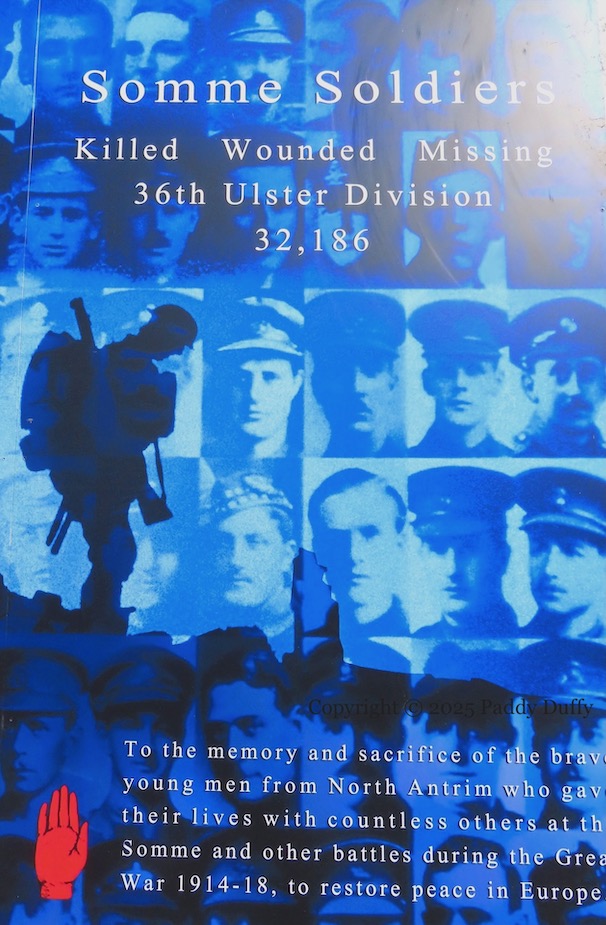
This is a 36th Division memorial board, with special attention to the men from the North Antrim regiment of the Ulster Volunteers (IWM), who in WWI were part of the 12th (Central Antrim) battalion of the Royal Irish Rifles and fought at the Somme (War Time Memories). The 36th Division in total suffered approximately 2,000 deaths and 3,000 casualties on the first day of the Somme offensive, July 1st, the Battle Of Albert (Royal Irish).
“1st July 1916. Somme soldiers killed, wounded, missing, 36th (Ulster) Division: 32,186.” “1-7-1916 7:30 a.m. remember”, “For these things do I weep; my eyes flow with tears – Lamentations 1 Vs. 16“, “Their name liveth for evermore”, “To the memory and sacrifice of the brave young men from North Antrim who gave their lives with countless others at the Somme and other battles during the Great War 1914-18, to restore peace in Europe. To them bravery was without limit, to us memory is without end.”
Here are two boards in Riverside Park, Dervock, celebrating the town’s “heritage and culture”.
Above: “Kennedy Kane McArthur, Dervock born and bred. 1912 Stockholm Olympics marathon gold medal winner, new World Record.” Ken McArthur emigrated to South Africa at age 20 and ran his first marathon at 28. Four years later, he represented South Africa at the Olympics and was victorious in the marathon (WP). There is footage of the race at olympics.com. There is a display of boards honouring McArthur on an abandoned building in Dervock.
Below: “The journey of heritage and culture has shown us who we are, the memory of our past will let a new future begin.” Members of the (contemporary) Dervock flute band (Fb) stand on the Scottish St Andrew’s Saltire, above a black-and-white photograph (from NI Archive) of drumming – including Lambeg drumming (Discover Ulster Scots) – from about 1920.
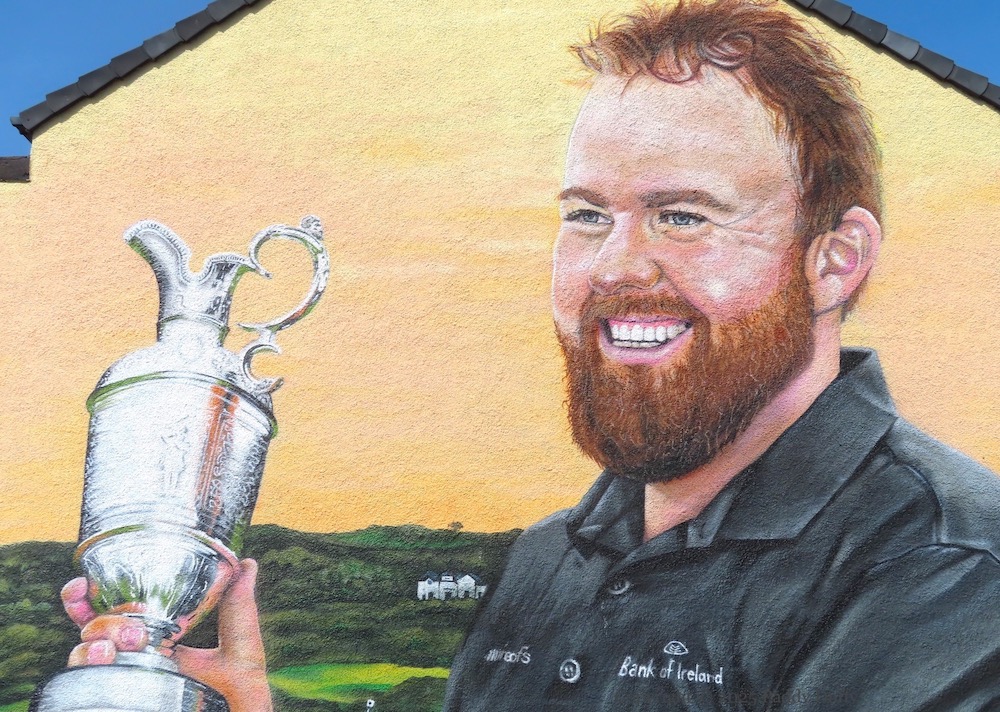
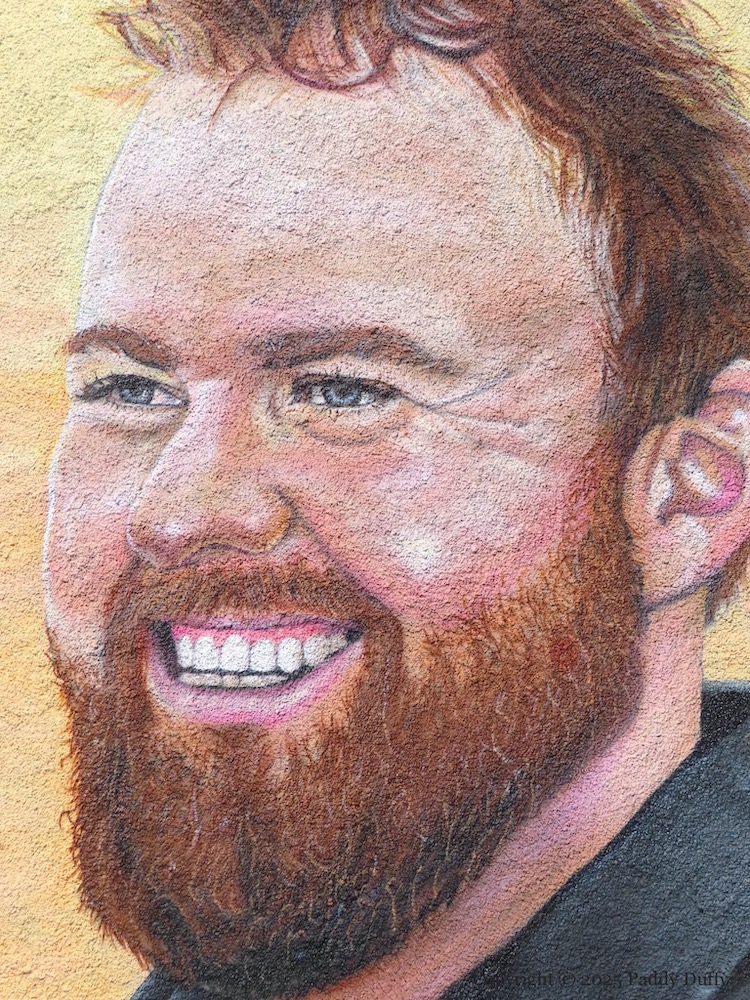
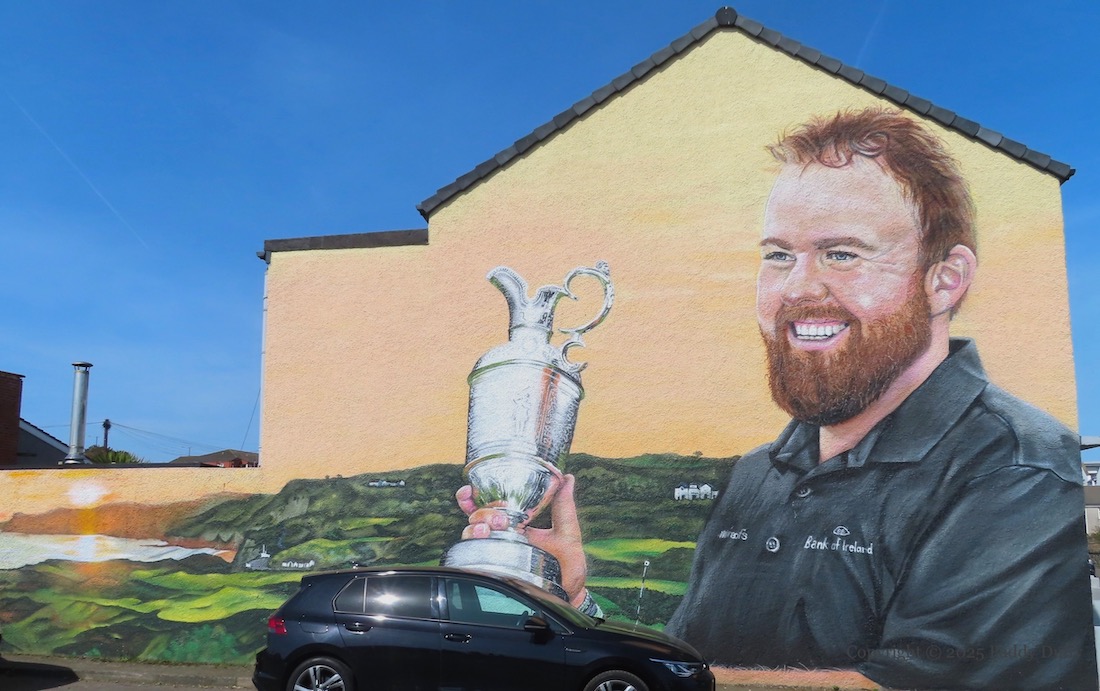
Shane Lowry won the Open golf championship in 2019, his only “major” win so far. He is still in with a chance at the Masters, which concludes today, though he is seven strokes behind leader Rory McIlroy; Lowry tees off at 7 and McIlroy at 7:30 p.m.
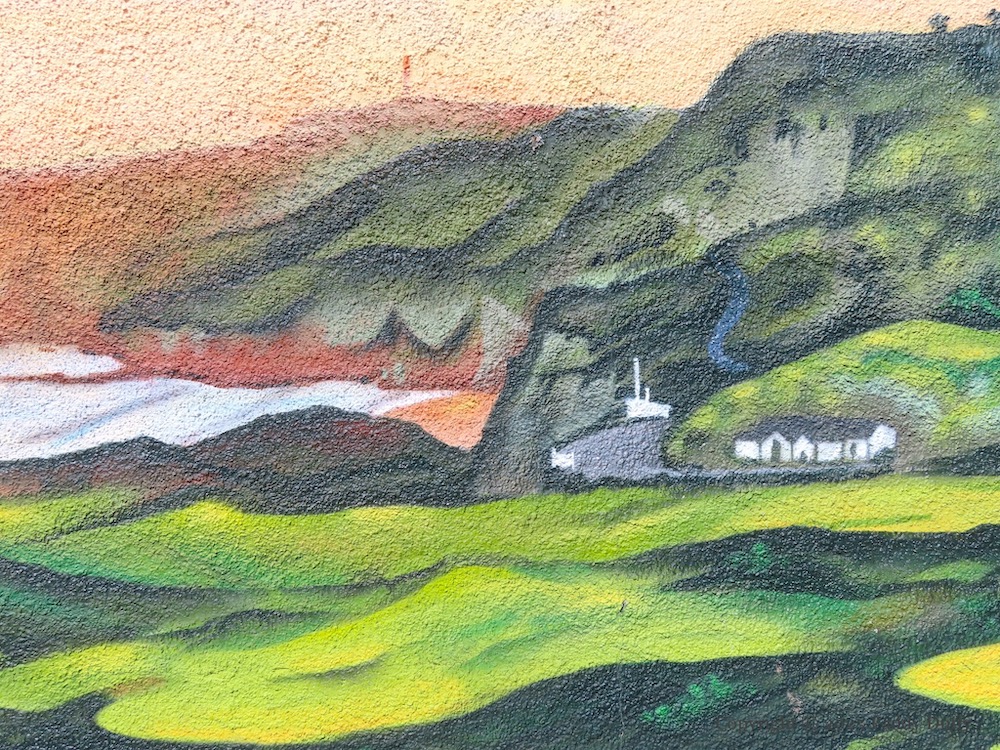
2019 was the last time the Open was played at Royal Portrush. This mural was painted by Peaball (web) on Causeway Street, near the club, last July (2024), a year before the Open will return to the course (July 17th-20th).
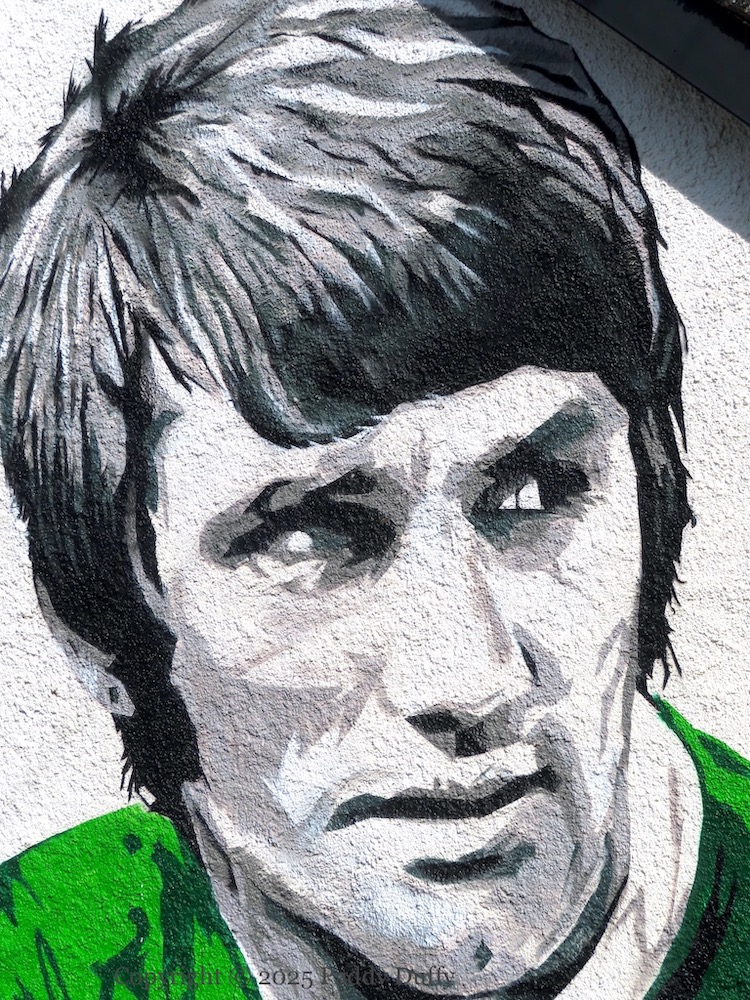
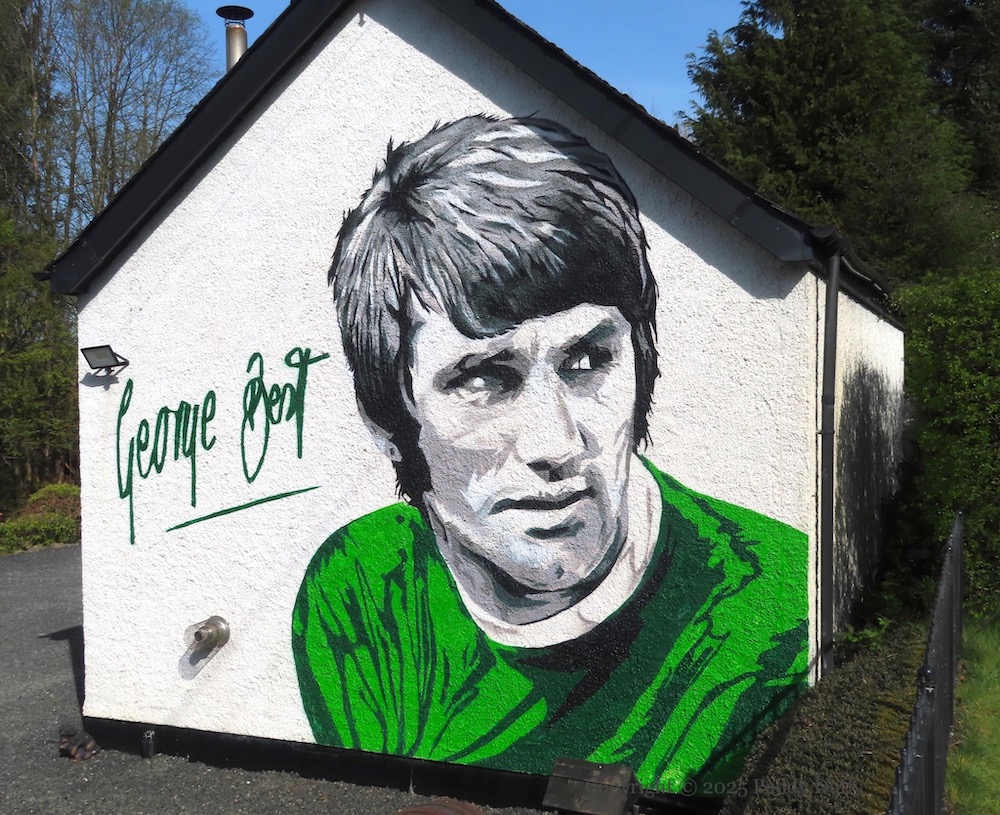
George Best began his international career at the age of 20, in 1964, playing six matches that year in the green shirt of Northern Ireland, and scoring goals against Switzerland and Scotland in November.
This mural depicts a very young Best, perhaps circa 1967; the source image is unknown – Best typically parted his hair from the left and exposed his teeth. The piece was painted by ACE Sprayworks (web), with support from Warren Anderson Tiling, at Anderson’s home near Cloughmills. (Sunday World)
Best was a familiar figure in the first wave of re-imaging (see Visual History 10).
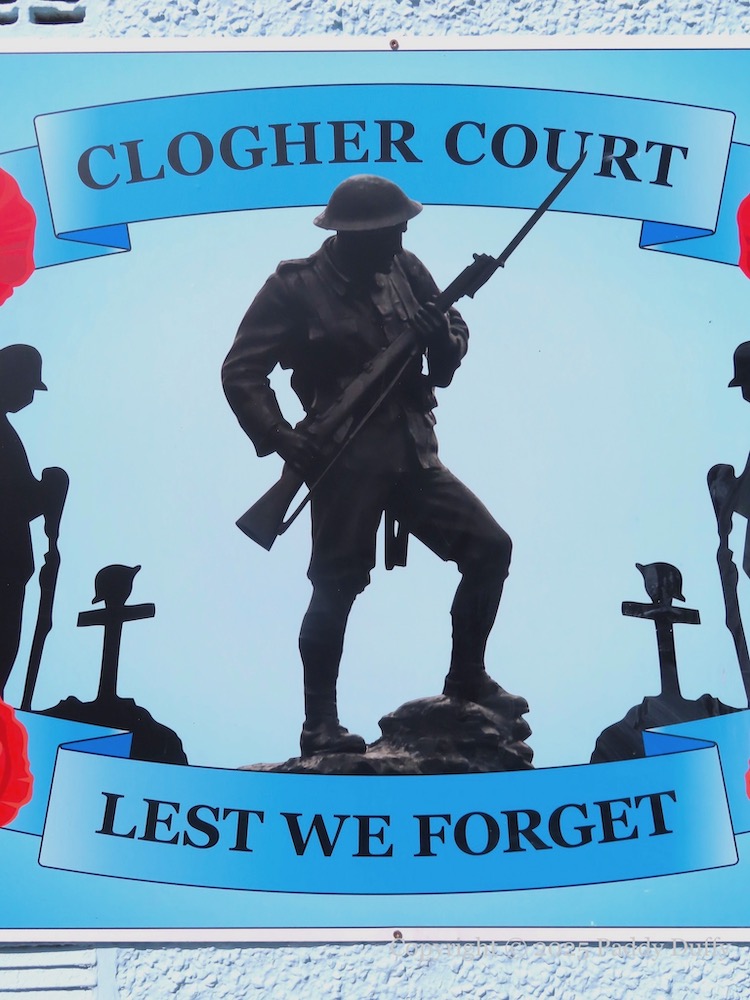
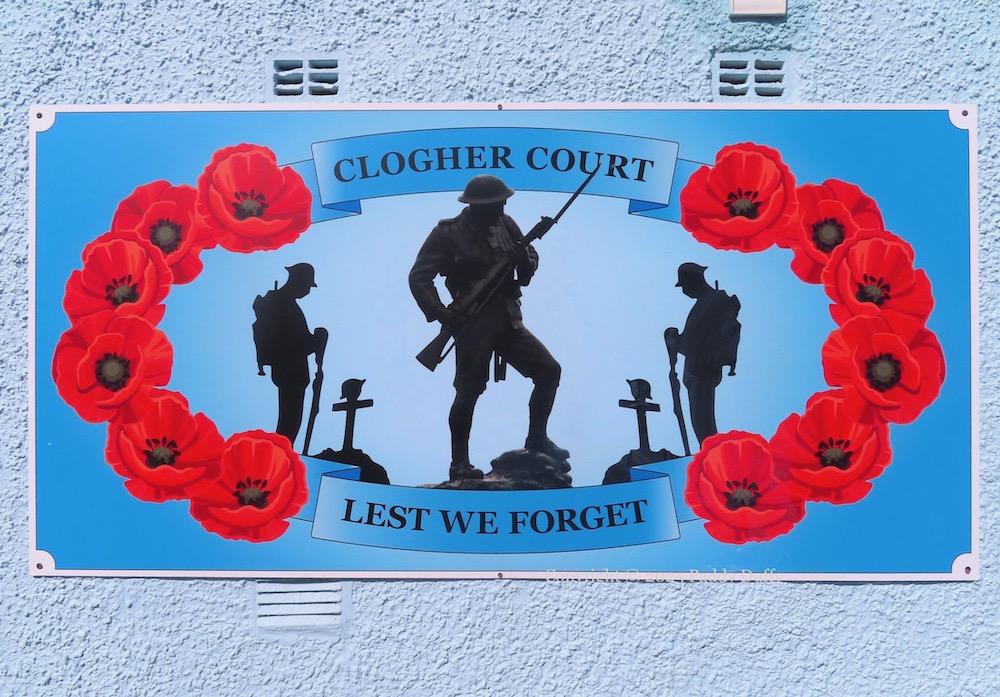
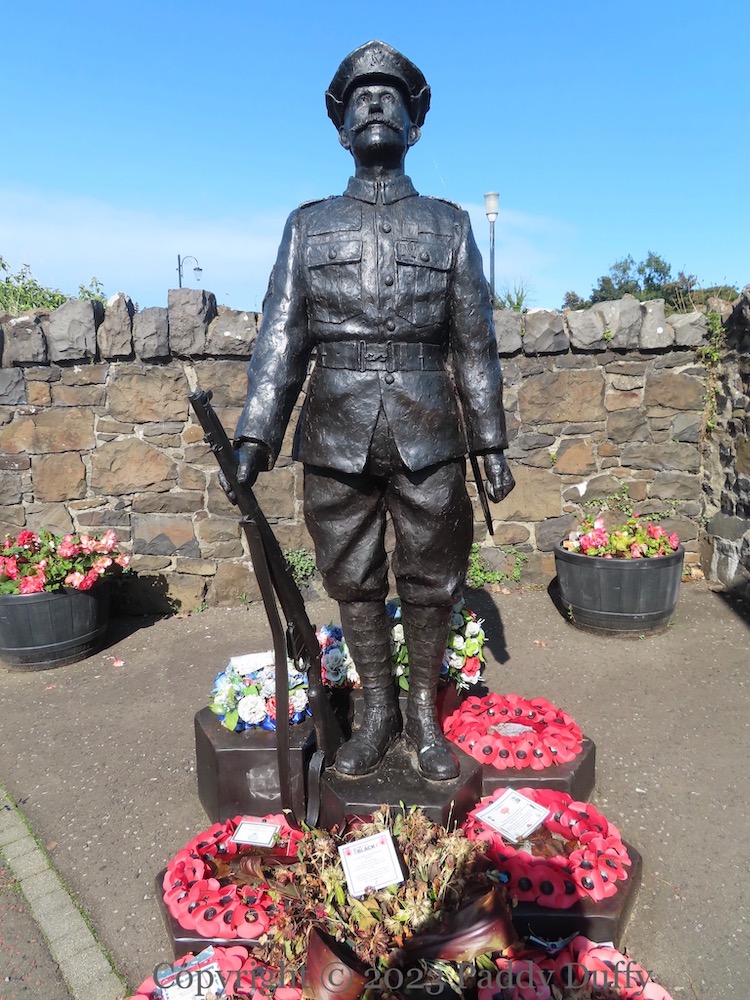
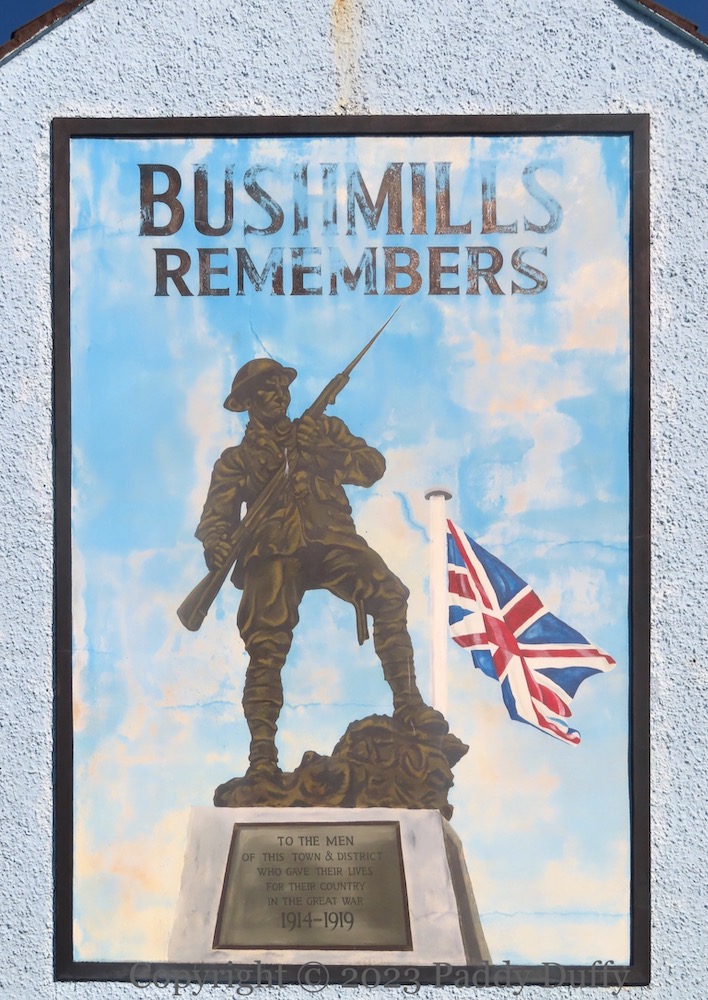
153 men of the 12th Battalion Royal Irish Rifles (which included men from Ballymena and other Central Antrim Volunteers) died on the first day of the Battle Of The Somme, July 1st, 1916. The 12th’s Robert Quigg received the VC for his actions in the evening, rescuing wounded men from no-man’s-land. He is remembered by the statue and plaque (shown below) in Bushmills; he was from Ardihannon townland near the Giant’s Causeway and before the war commanded the Bushmills unit of the Ulster Volunteers (WP).
The boards are in the Dundareve estate, Bushmills, and the Quigg statue is on Main Street, just west of the estate. The boards both depict the War Memorial statue in the middle of the roundabout at Main Street and Dunluce Road.
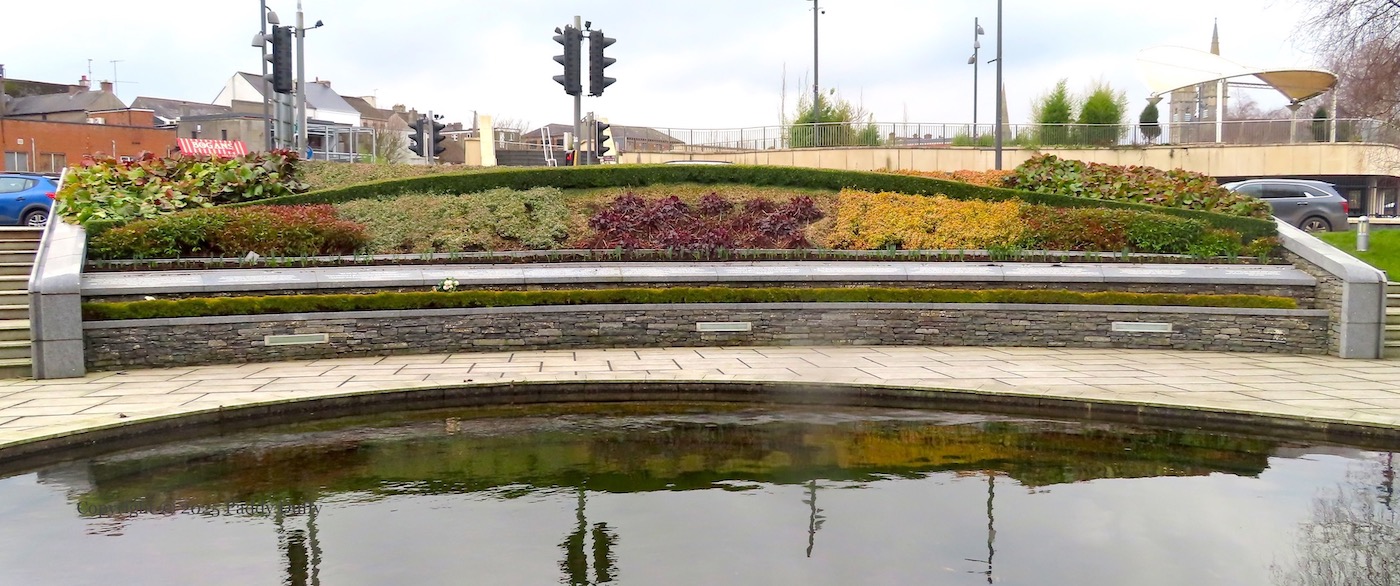
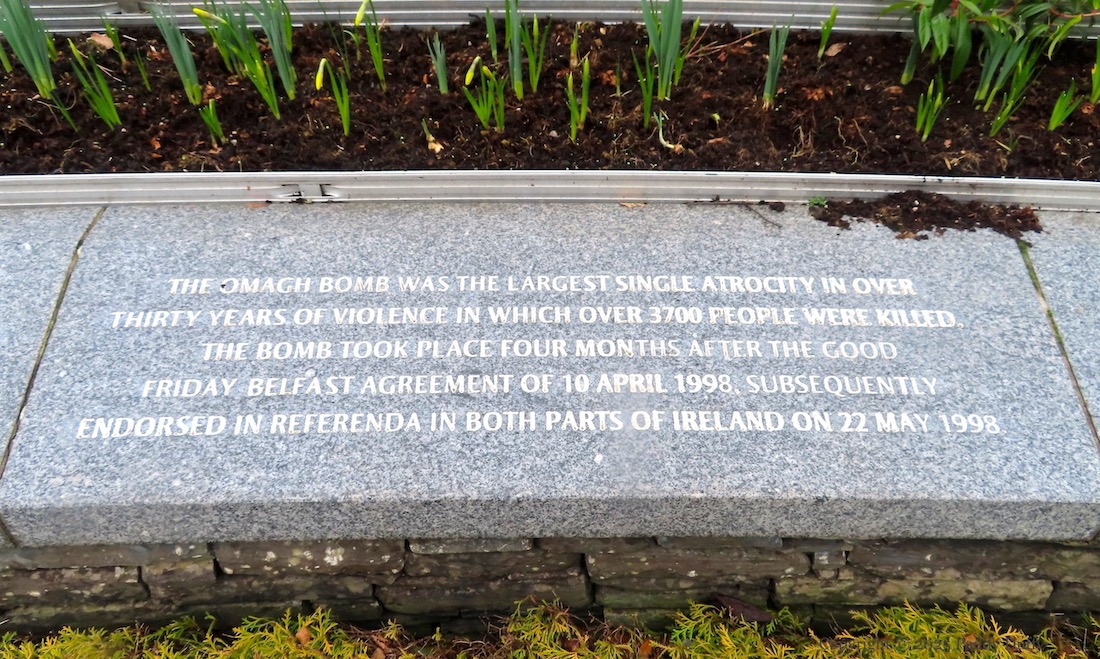
This memorial to the victims of the Omagh bombing is in a green-space along the Strule river about 300 metres (WP) from the spot where an RIRA car-bomb exploded on the afternoon of 15th of August 1998, killing twenty-nine people and injuring more than 200 others.
The garden was opened on the tenth anniversary, in 2008 (replacing a smaller obelisk). It includes 31 mirrors on poles (including a set of unborn twins in the number of deceased) which are part of a reflective system that sends sunlight towards a crystal pillar in Market Street that marks that spot of the bomb (Troubles Archive).
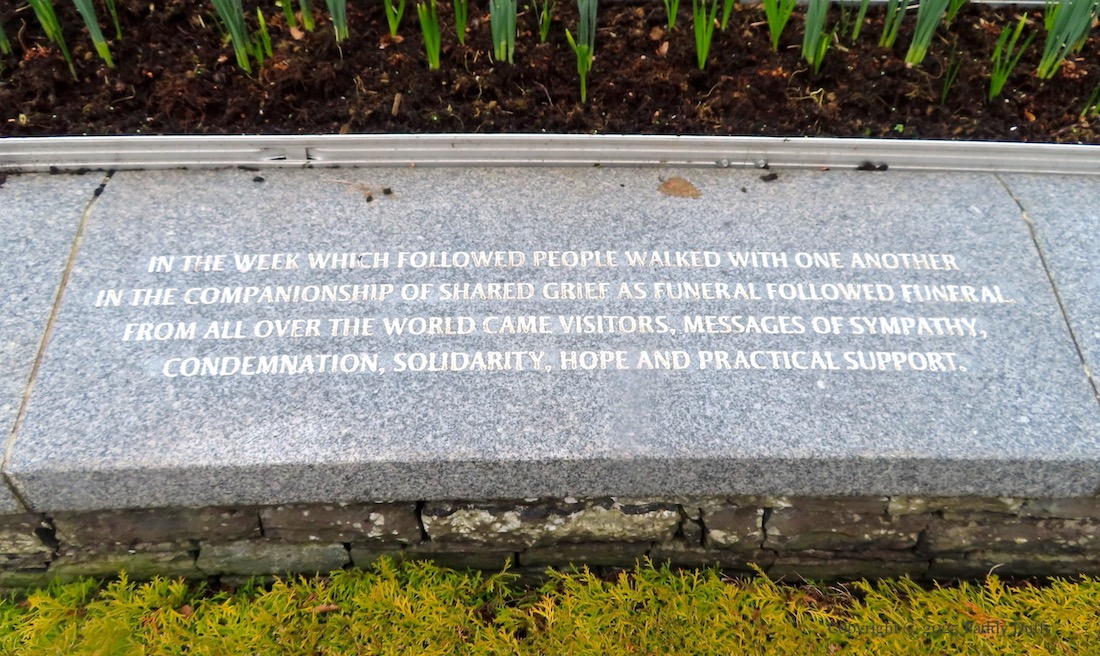
There are also a series of engraved stones on an arc around the pool that tell the story of the day and its aftermath, as well as naming the dead:
“Weather wise it was one of the best days that summer had seen. Ordinary people were doing ordinary things on an ordinary day. In one fateful moment all this was changed forever. Time stood still, futures were obliterated, loves were shattered, hearts were broken. In the carnage, emergency personnel and many ordinary people reached out, helped the injured, gave hope to the dying and held the dead. That evening a great silence descended on the town. In the week which followed the people walked with one another in the companionship or shared grief as funeral followed funeral. From all over the world came visitors, messages of sympathy, condemnation, solidarity, hope and practical support. The Omagh bomb was the largest single atrocity in over thirty years of violence in which over 3700 people were killed. The bomb took place four months after the Good Friday/Belfast Agreement of 10 April 1998, subsequently endorsed in referenda in both parts of Ireland on 22 May 1998. In the years that followed people Omagh and elsewhere sought to rebuild their lives, their families, their community, and to create a new future. Regardless of the past, every new days dawns as a gift laden with its own possibilities, as the morning sun banishes the darkness of night.”
One of the stones reads “Bear in mind these dead/Coınnıgh ı gcuımhne na maırıbh seo/Tened en cuenta a estos muertos – (John Hewitt)”; two of the victims were Spanish.
Drumragh Avenue, Omagh
“Saturday 15 August 1998 at 3.10 PM. To honour and remember the 31 men, women and children who were killed, the hundreds injured and those whose lives were changed forever in the Omagh bomb. ‘The light shines in the darkness and the darkness has not overcome it’ (John 1.5)”
“To honour and remember 31 people murdered and hundreds injured from three nations by a dissident republican terrorist car bomb. (Omagh Support And Self Help Group)”
Donaghadee harbour celebrated the bicentennial of its construction (which took from 1821-1834) with a mural towards the bottom of Manor Street. From left to right, we can see the “motte” or “moat”, an Anglo-Norman motte-and-bailey castle from the 1100s; the lifeboat (behind the crew) is the Sir Samuel Kelly, named for a hero of the Princess Victoria sinking in 1953 (Historic UK) – the station was established in 1910; the Copeland Islands and holiday-makers; Tom Blower, who left from Donaghadee to swim the North Channel in 1947; Bobby Simpson hiring out row-boats below the lighthouse, which was built in 1836.
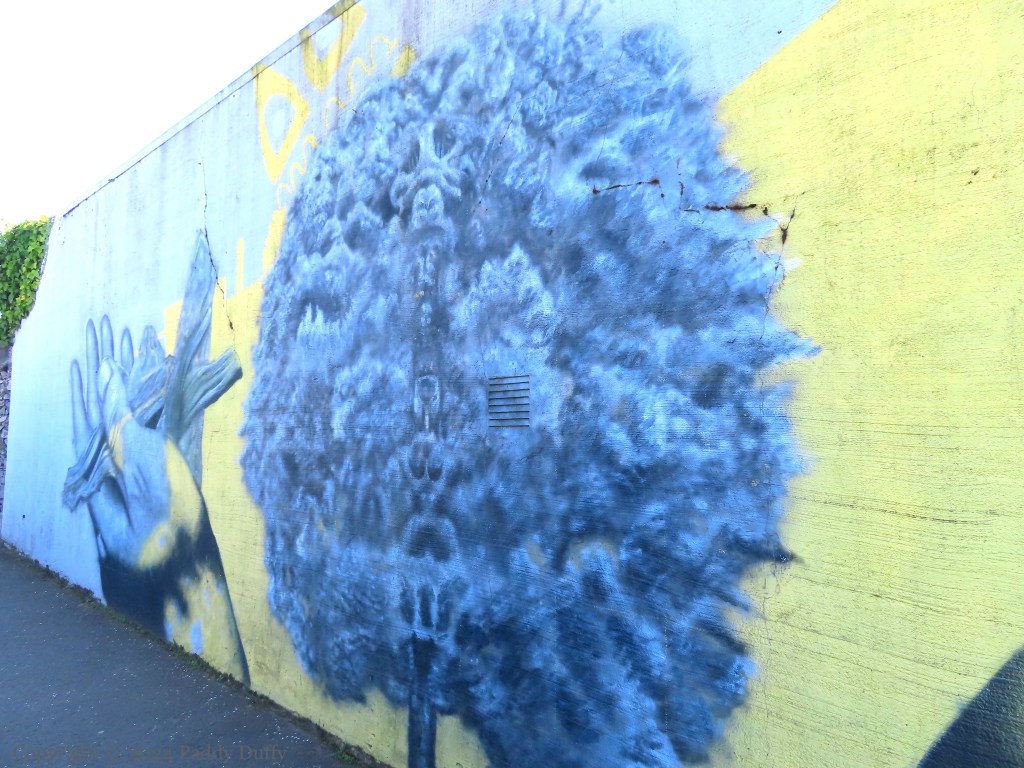
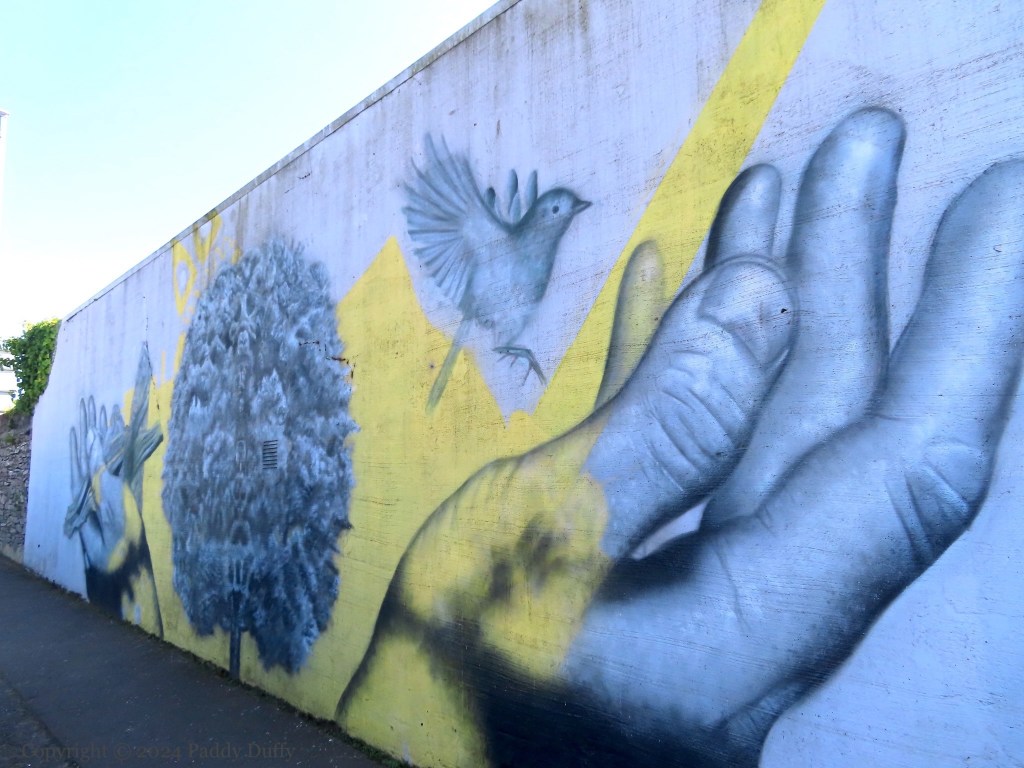
This piece of street art is by emic (web) (with the “Friday Folk”, a social group for retired women (Volunteer Now)) in Killyleagh Street, Crossgar, County Down. It appears to show the transmogrification of driftwood and rock (in the left hand) into a bird (in the right hand). Get in touch if you can supply a reference or better interpretation.
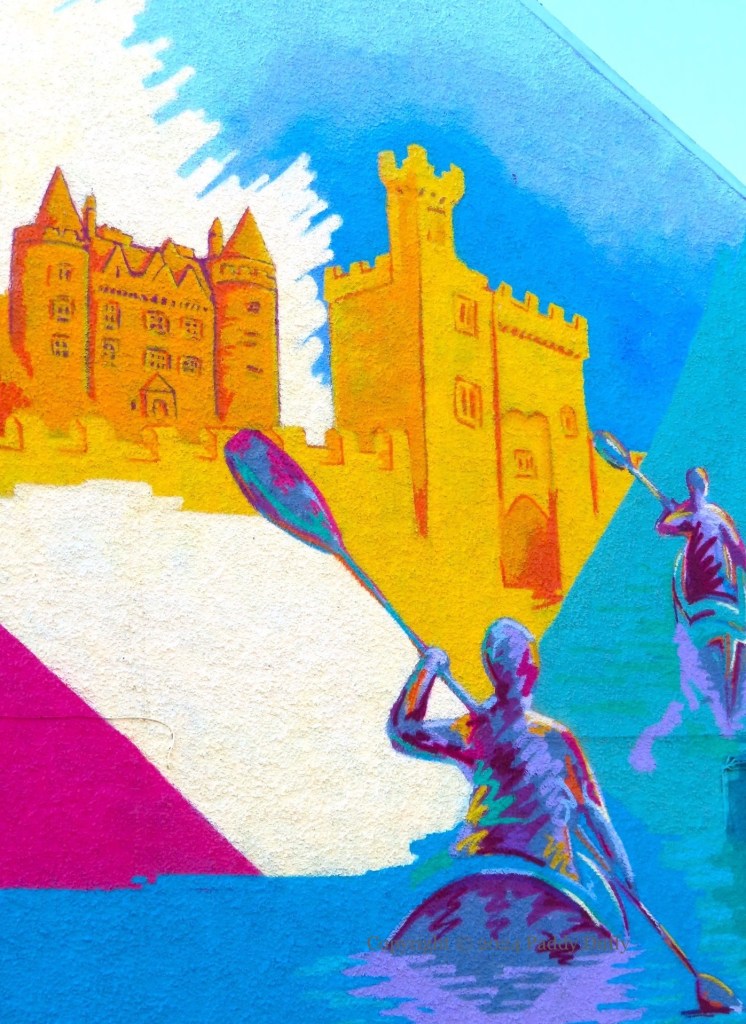
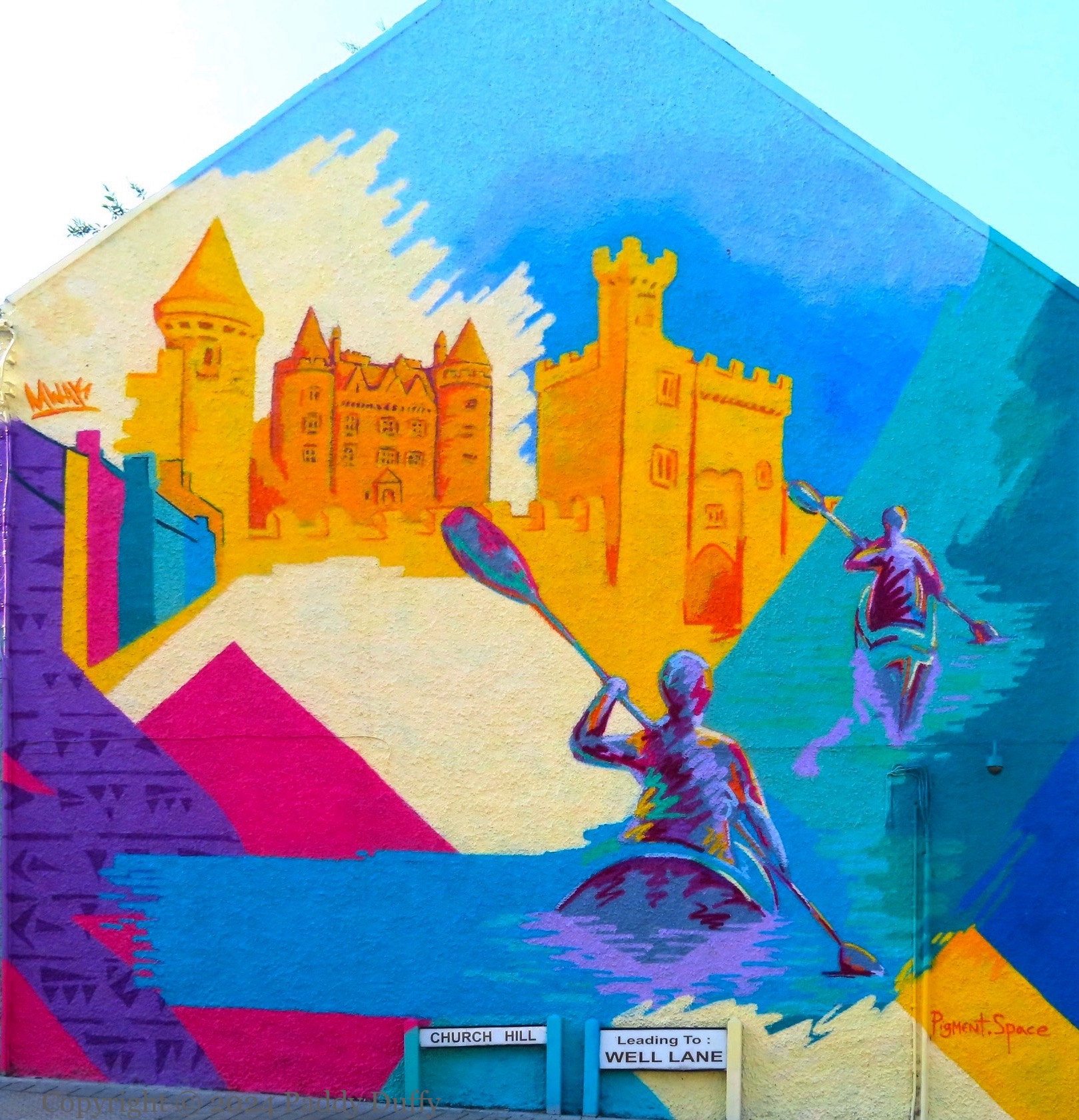
The distinctive turrets of Killyleagh Castle were added by Charles Lanyon in the mid 1800s, when the house – parts of which go back to the 1100s – was renovated (Castles World). There is no water around the grounds but Canoe NI has maps of trails in the Strangford Lough area that go past Killyleagh.
The art is by Pigment Space/MWAK (ig) in Church Hill, Killyleagh, on the side of the ‘Great Wall’ Chinese take-away.
















 Paddy Duffy Collection